


6,99 €
Mehr erfahren.
- Herausgeber: Books on Demand
- Kategorie: Geisteswissenschaft
- Sprache: Englisch
Written with speakers of Swedish and English in mind, the author catches a glimpse of English at play with Swedish in mainstream news and international media between 2015 and 2020. What do we know about Volvo, immigrants or travel? Is Brexit part of a social practice? Why is French included as well as Norwegian wolves and wood? How do British and Swedish political party leaders, US presidents and climate activists perform, and why so many elephants? When English is taken hostage to help occupy Swedish space it can affect the political direction and impact everyday lives. With curiosity and the help of other language(s) readers should get the gist of English on the run in Swedish Social Space.
Das E-Book können Sie in Legimi-Apps oder einer beliebigen App lesen, die das folgende Format unterstützen:
Seitenzahl: 321
Veröffentlichungsjahr: 2020
Ähnliche




















Cover photo & photo of text
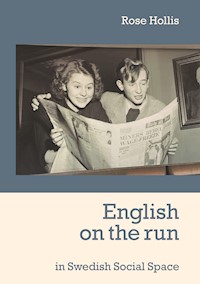
The photo on the front cover and the one on page 325, taken in October 2019, are from Drottninggatan in Stockholm, the street where the government offices called Rosenbad are undergoing renovation. The two photos appear as part of a historical display in public space on the board fence erected around the building site. The National Property Board Sweden is responsible for information about renovation.
The cover photo depicts Gun Hägglund, the first female news reader on Swedish TV, and Gunnar Hörstadius, reading the Daily Mail on 12 January 1950 at the Swedish Publicists’ Association at Rosenbad. The photo is available from Stadsmuseet in Stockholm (Stockholmskällan).
Table of Contents
Preface
Travel in Mind
In flight
Places and spaces
Adults in the room
Crossing the line
“Betweenness”
Running down the clock
Gatekeeping
In defence of
How does it feel?
Monster or mate?
Genius
Gone cuckoo –ish
Out and about in society
A liking for –ish
Follow my leader
Creating a Buzz
The new black
The new normal
Meteorites
In vogue
Purity, Vigour & Majesty
Ordmärkeri
Welcome to the capital of Scandinavia
Mind the gap
Humanity is social practice
SAS
We are travelers
SAS – We dream in foreign languages
Down-classing
Made by Sweden – Make in India
Volvo
The Winter’s Tale
The golden stork
Silly season
It’s not about
Understanding the Mood
Napoleon
A sudden passion for French
Wild Street
Zest
My, my Waterloo!
The Beach
Burkas and bathing machines
“I know words. I have the best words”
Watch your words!
In English: This happened in Sweden Friday night, Mr President
… and the hare jumped into Cornelis grave
Extinction
Strawberry fields
The Brexit arena
Make the world Greta again
The End of May
Defining moments
Language is social practice
The just do it – do or die Brexit!
Politics vs Personality
Radiation
Charisma
Hus, house, ting, thing
Deal or No Deal … probably
Mr No Deal
Round trips
Trump: I have had ‘a very good call with Stefan Löfven’
Greenland
Giving language a look
The Merry-Go-Round
Taking back control
Influencers
Stop, I want to get off!
Let’s Get Brexit Done!
Islanders
Preface
The idea for this book has grown out of an interest in politics, education and the way situations and languages meet via Swedish and international mainstream news media. It prompted a desire to learn how English expressions affect Swedish news and other texts and vice versa and what happens to English on the run as it becomes part of the production of Swedish Social Space. Is it possible to catch a glimpse of English and Swedish at work together as the news flashes past us day after day and texts meet at random? After following some of the action between 2015 and 2020, the answer is, Yes, but of course it is just a glimpse.
When combined with Swedish, English plays the clown, the villain, or acts as the sweetener to package a message in Swedish. It is both elitist and elusive when it is squeezed into Swedish space in much the same way as French is nudged into English. In its quest for originality, English gets online in different guises – dressed up in French as Je suis Charlie, or glued together as metoo. It shows a liking for “F” as in FridaysForFuture and fixes the posters for organisations like Extinction Rebellion. It stands for political uproar in the UK and the US introducing new words and phrases for people in other countries to accept or try to avoid.
Past studies at The Department of Media Studies (JMK), The Department of English, The Department of Education at Stockholm University, as well as my work as a teacher within Higher Vocational Education, have influenced my writing to some extent, but this is not intended to be an academic text. The discussion around language and topics is often light-hearted but also serious since words we encounter in the media and elsewhere can influence political decisions that greatly affect society and even the direction our own lives take.
Who or what produces what we all “know” about refugees or immigrants, about SAS, Volvo or New Karolinska Hospital etc. with the help of English? How is a space such as Brexit sustained over time through a particular discourse; a way of speaking or writing about it that becomes part of social practice?
Henri Lefebvre (1901-1991) is a French philosopher whose work on understanding the production of space has provided me with many hours of thought. Here, I have just borrowed and tested a few of his ideas. Lefebvre sees society itself as a mode of production and language as part of this. With some allowances made for the huge impact digitalisation of mainstream media has had which he barely encountered in his lifetime, many of his thoughts on social space and practices are relevant today.
Lefebvre treads his own pathway through the production of space in his quest for unity, to bring together the mental space of philosophers; representations of space – the knowledge, signs, and symbols we meet up-front as conceived, for example, by urban planners and experts; and representational space – the more covert side of life directly lived and experienced through work or leisure.
Swedish social space as it occurs in this book refers mainly to how language is used in news media in Sweden, and how Swedish connects with English in international news media as older texts overlap with new ones. “Swedish” used here does not necessarily concern nationality.
I have written with speakers of English and Swedish in mind, but also for people with an interest in learning the Swedish language, which is not so widely spoken outside of the country. Depending on levels of curiosity and which other language(s) readers may already understand, I hope it will be possible to get the gist. Dealing with the power of language in the news media on society is no easy task; my aim is to help strengthen a growing awareness.
Brexit still takes up more space than it should as we move into 2020, but new terms are already waiting in the wings to suit political ends and are keen to enter production.
A person with a different background from my own would no doubt follow English on the run in Swedish Social Space via other topics in the mainstream news.
I have done my very best to ensure that citations and words used are as they appeared, although news is quickly updated in digital versions and the original use of language can therefore change. Words and phrases disappear and reappear like magic. It is my responsibility if I have misquoted anyone. Readers should note that when a word(s) occurs in English within a phrase or sentence in Swedish, it now appears in italics to make reading easier.
Thanks is due to all those hard-working journalists, reporters, editors, politicians and many others for “contributing” to the array of expressions in English and Swedish that meet in mainly mainstream media over the past five years. A special thanks to those who also speak out against the use of language that harms society.
Many thanks also to my husband, Torbjörn Cederholm, for not protesting too much whenever I needed to discuss the never-ending stream of examples, and also for reading through the manuscript and checking as far as possible the huge number of footnotes this collection of ever-changing texts has produced.
1. Travel in Mind
English tolerates most conditions and participates willingly in real life meetings, crossing semantic fields and language boundaries to suit those who use it.
In flight
How does it feel to be in Sweden? The reporter thrust a microphone into the crowd of travellers arriving at the Stockholm Central station in the middle of the night. We are still in the mood for walking, replied a young man from Syria – not meaning exactly that – but managing to roll tragedy, hope and humour into one.
English keeps the mind busy locating fragments of language as we strive to make sense of the news in Sweden in 2015 and locate the part of the brain that can help us understand how it might feel to arrive at your final destination after crossing so many national borders on foot with a three-year old child slung over your shoulders and your sole belongings packed into a plastic bag. A catalogue of “walkin” lyrics is running amok in your head. Don’t worry, sings Ace Wilder as Swedish Mello starts up again on TV. A holiday brochure from Alpresor lying on the sofa catches your eye and offers you a Nordic Walking tour abroad –– Nordic walking is mainly on the flat, it explains, while you note the research results that show the way you walk can actually affect your mood: bouncing along the street makes you happy; slumping makes you sad.
English expressions still arrive in Sweden on foot but most of us encounter the language digitally via Swedish or global media. Some words enjoy a long round of applause as they make a perfect landing, acknowledged for their humour or contribution to society; others touch down unceremoniously, unnoticed at first in everyday life, waiting for a chance to perform. Loved or loathed, English tolerates most conditions and participates willingly in real life meetings, crossing semantic fields and language boundaries to suit those who use it.
Places and spaces
French philosopher, Henri Lefebvre, devoted much of his thinking around the human production of space and is critical of the structuralist views of language, which ignores the spaces people produce by living them. We do not live by words alone, he reminds us. Place is always there, the landscape doesn’t move, however many changes we inflict upon it, but the meaning of space has changed from the idea of an empty area to that of a fascinating space between the theoretical and the practical, the mental and the social.
Moving away from products, labour, and economics that preoccupied Marx thinking, Lefebvre sees production as a broad, philosophical space, but also society’s base of which language forms a part. He sees a huge gap between linguistic mental space that includes the structural language theories of Saussure, Chomsky and others and the social space of people where language becomes part of social practice.l Lefebvre seeks more concrete replies to questions about production. Who produces? What? How? Why and for Whom?
Politicians often talk about us using terms like, “the real people” or “the ordinary people” which we learn through reports in various media. This is a space of representation. Lefebvre emphasises the importance of another space, representational space, the space produced by those who actually “live”, experience and perceive their own production of space directly and talk about it – their discourse – a word he seems to dislike. These spaces are all involved in Lefebvre’s thinking around production and should be understood as forming a unity in the production of social space.
During his later years, Lefebvre recognised that communication technology has a profound effect on people’s lives, it is no longer just for use at work, but used at home and increasingly for leisure. Media is so much more today than reading a few news reports in Swedish.
We cannot produce the kind of replies that Henri Lefebvre was seeking from the lived spaces of the 1970’s, but we can enter the knowledge “trap” and dive into “media space”. It will at least produce some concrete examples of an ever more familiar everyday practice that constantly refers representations of space to representational space through signs and images.2 A small “elite” can sidestep this, but many consumers fail to reject the familiarity. We need to consider which space we are in as we consume the words and images in mainstream news media. What is happening around us? Who are we with? Is there an echo that affects what we believe and think and keeps us lazy? That is a major challenge for us today. Christian Fuchs in his writing points out another danger that is currently under discussion.
In the age of digital media, Lefebvre’s work reminds us that digital capitalism creates spaces of alienation and that a humane digital society requires a self-managed and socialized Internet and digital media landscape.3
This book deals mainly with use of language. At the same time language doesn’t exist alone – it dwells in places and helps to produce social spaces, the main question being: how do English and Swedish meet on local, national or international TV news, radio, in newspapers and other media we encounter?
Which words and phrases are used and repeated and how does it affect us? There have been some squabbles along the way here as older and more recent texts in Swedish or English collide and collude; when I turned to books for reference and heard voices from abroad; when Emails and newsletters landed, or unavoidable tweets, and the odd blog or two. But I leave it to others to follow the trail of English in social media – if you can.
English travels around in its Swedish context contributing to creativity and understanding, as well as to some of the nonsense we meet. Encounters with language are never chronological and texts get tangled up in knowledge, which you could bear in mind as you read this book.
Lefebvre has some more advice: In language as in space, there is a before and an after while the present dominates both past and future.4 Language is produced out of the lives people lead and the words, collocations, catchphrases, clichés, and sentences we meet and reproduce in our need for communication. We have already heard many combinations before. English has long since become part of a circular society appearing, disappearing and reappearing as ideas are shared and new meanings are created and recycled in Swedish social space.
l Henri Lefebvre, Plan of the Present Work, The Production of Space, Translated by Donald Nicholson-Smith, Blackwell: Ch. 1. 3-6 (1991, 2003)
2 Henri Lefebvre, From Absolute Space to Abstract Space, The Production of Space, Translated by Donald Nicholson-Smith, Blackwell: Chapter 4, 233 (1991, 2003)
3 Christian Fuchs, Henri Lefebvre’s Theory of the Production of Space and the Critical Theory of Communication, Communication Theory, Volume 29, Issue 2, May 2019, Pages 129–150 (Oct 2018)
4 Henri Lefebvre, Social Space, The Production of Space, Translated by Donald Nicholson-Smith, Blackwell: Chapter 2, 131 (1991, 2003)
Adults in the room
In the run up to the Swedish election in 2018, and in the gap that followed after the election with no outright winning political alternative, party leaders and media strategists hunted around for the perfect phrases to plug in interviews and debates to convince voters that their party is best. The phrase “Vuxna i rummet” is one such “medlöpare”, a supporting phrase that was dragged in and out of TV studios by the leader of the conservative party in Sweden – the Moderates. Exactly where the Moderate party stands in relation to this particular kind of support is confusing, although English is clearly the source.
Adults in the Room is also the title of a Number l Sunday Times bestseller in 2017, written by economist Yanis Varoufakis, an embattled former finance minister of Greece who attempts to take on both the IMF, and the EU alike in negotiations before resigning. The title of Varoufakis book stems from the well-known expression Elephant in the room – a quote used by Dostoevsky in the 1800s in his book called Demons, which referred to an inquisitive person who failed to notice the elephant in a museum. Nowadays, the idiom tends to refer to an obvious problem or difficult issue that everyone knows about but no one wants to mention – hence the need for adults who think they can handle the situation.
In this case “the problem” concerns “vågmästaren”, a party representing the far right that can tip the balance between the more social liberal left and conservative right in the Swedish Riksdag. Since Google Translate still has trouble handling Swedish, as well as its politics, the best translation it can come up with for “vågmästare” in English is wizard! Presumably Google means the white wizard, Saruman.
Welcome to Middle Earth!
Playing around with languages carries a huge risk – you can never be sure that repeating certain words and phrases with all their hidden threads will take you where you want to go, especially in the media.
With a ticket originating from Russian, English and Greek, the current leader of the Swedish Moderates, Ulf Kristersson, may well be on a one-way ticket to the moon (the dark side) for Christmas, accompanied by a number of other adults in the room. During 2018, we also learn from the US treasury, that Mark Zuckerberg, Facebook’s very own adult in the room, is in trouble too.
I wonder what happened to that earlier wisdom, Women are from Venus, men are from Mars, and its follower Adults are from Earth; Children are from the Moon?
White Hutchinson, Producers of Experience Destinations, provide an amusing example to show how children interact with their world. Apparently, a small child somehow managed to crawl through a large slot in an amusement arcade machine and then got stuck. When the fire fighters arrived he was sitting happily inside the machine amongst all the stuffed animals!
Adults view the environment in terms of form, shapes, and structures and as background… Children, on the other hand, interpret the environment holistically and evaluate it for all the ways they can interact with it.5
“Elefanten i rummet” is the name of a Swedish stand up comedy show performed in 2017 by David Batra, the husband of the former party leader of the Moderates, Anna Kinberg Batra, who resigned after getting a little too close to the far right party in Sweden regarding support for her own party programme.
Elephants come and go, according to what you wish to see or not to see, as Jimmie Durante demonstrated.6
In 1935, comedian Jimmie Durante starred in the Billy Rose Broadway musical Jumbo, in which a police officer stops him as he leads a live elephant and asks, ‘What are you doing with that elephant?’ followed by Durante's reply, ’what elephant!?’ was a regular show-stopper.
In 2018, David Batra appears in a TV 4 programme called Mumbo Jumbo. It is easy to live in a small world full of elephants. But new laws passed during 2018 will change life for people as well as elephants in Sweden. Public service TV will be funded through taxation and elephants will in future be banned from performing in circuses. “Nu blir det slut med elefanter på svenska cirkusar. Även sjölejonen lämnar showbusiness”.7 Perhaps to compensate for this sudden loss of circus stars, the show, “Elefanten i rummet” will be performed again in 2019 at the well-known venue in Stockholm called “Cirkus”.
As 2019 gets underway in Sweden and people return to work, communication experts begin to close in on us, their heads brimming with new ideas based on the latest fads in psychology and philosophy. The race is on to win contracts for new company courses, which some CEOs and other leaders will no doubt inflict on their employees – at least until the idea is finally thrown out by researchers as quasi science. By then it is too late since government departments and companies will have already learnt how to manage their year – with the help of elephants.
Negotiating expert Viveca Sten is doing her best to give advice to Stefan Löfven, the leader of the Social Democrats, who is hoping to regain his job as Prime Minister in the latest round of voting in the Riksdag. According to her choice of method, Sten recommends a package solution that has a number of different components. One of these components is to offer your presumptive partners (in this case the Centre Party and the Liberals) a treat they are really passionate about! You can’t swallow an elephant whole, she says, but you can start to nibble on its tail first and then on its ear – if I understand her correctly.
Crossing the line
Refugees and immigrants travelling the highways and byways of Europe during 2015 are turned into a mega series through use of English. What does it feel like to be in Finland? a reporter asks in a Swedish TV programme. People are always laughing at your face, replied this young man, which an empathetic audience will understand in the right way, while others jeer. Despite the images that pop up, the expression on his face confirms that people in Finland smile at him and are friendly.
Insignificance is turned into main story that night because a young man has reached the end of the line for this reporter. But, as each passport is lost or abandoned a new story unfolds. Whenever you cross the line it starts all over again, says another refugee – it’s not the end like you thought.
In 2015, there is a sudden rush to publish articles that match the late summer mood, and one Swedish tabloid, Aftonbladet, begins to include on line reports written entirely in English, which is fairly unusual to see in the Swedish mainstream press. One report tells of a love letter written in Arabic, but presented in English: Help us find the author of this love letter found on Samos. Another report is entitled: All that’s left is a life jacket made of paper. The same author writes: Muhammed Hassan compares the journey across the Mediterranean Sea with a bomb attack. If you are in the right place, you survive. If you’re in the wrong place …8
Newly clichéd texts are sprung out of lives lived and recently lost which continually revises the way we see person and place wherever we happen to be at the time. A doctor from Syria speaks at length in Arabic on Swedish TV about her work in a town under siege and the transcript shows us what she had seen and experienced during her work at the hospital.
How did it feel at the end of the day? That was the reporter’s question. There is barely time for a pause before she replies in English – I’m alive.9
While some parts of Europe are kept busy dealing with large numbers of people escaping from Syria, Afghanistan and other war-torn countries, the international media has begun to follow the Brexit negotiations more closely. Like ice dancers performing before a panel of judges on TV, British politicians provide readers with a truly fantastic display of cherry flips and loop jumps, as they approach each new red line. Clearly, if you possess the knowledge and the skills to handle your situation, officially or unofficially, you can cross any number of boundaries, borders or red lines, and start up your story again – as Prime Minister Theresa May has proved. Boundaries of this kind are far more flexible than we think and borders are increasingly made invisible by many organisations like Médecins Sans Frontières, Doctors without borders, Journalists without borders, and Elephants without borders, to name just a few.
Crossing (or stepping over) the line usually refers to a type of unacceptable behaviour, but lines are continually crossed in the flurry of contexts people meet that need some kind of orientation. Red lines are definitely trending in the media during 2018 although some British and American dictionaries are lagging behind with up to date explanations. Collins Cobuild gives two examples, …a point beyond which a person or group is not prepared to negotiate, and the red line … that divides an ice hockey rink in half.10
When Napoleon referred to a thin red line it meant the colour of the military opposition he faced, and even today the red lines, one on each side of the floor in the House of Commons, are supposed to be two sword-lengths apart for safety’s sake. It signifies a no-man’s land where Members of Parliament may not speak when they are standing between the lines.
“Röda linjen” in Swedish is different. People often use colours, the Red Line, for example, to direct you in the Stockholm underground. The London underground uses names like Central Line, which is a shade of red, or Waterloo & City Line, which is a shade of aquamarine.
Obama dodged the “rhetorically troublesome” red line question put to him at a news conference in Stockholm. I didn’t set a red line. The world set a red line, he answered. He had previously referred to the Assad regime as follows …a red line for us is we start seeing a whole bunch of chemical weapons moving around or being utilized. That would change my calculus.11 Actually, it didn’t change anything.
Red lines are all the rage and hard to avoid so the leader of the Left Party in Sweden also joins the red lines trend. The colour obviously suits him, “Löfven måste respektera våra röda linjer”, he says, keeping to Swedish.
Unicorns and magical thinking have taken up their fair share of Brexit media space for more than two years, but unless someone produces a helpline to keep us all going until the 11pm deadline on Friday March 29, and most likely way beyond that date, red lines will continue to be every journalist’s nightmare during 2019 whether in Britain, the US or Sweden. What else can they possibly say about them? Plenty it seems. There are many alternative ways to deal with red lines in the context of Brexit at the start of 2019 in British and international media.
The end of March is fast approaching and desperation sets in. It is intriguing to follow the news headlines as well as discussions to see how the discourse is changing. Even though fewer new red lines are actually being created, more are under attack. As red line fever reaches epidemic proportions via reports on Brexit debates and reactions to Trump tweets, no one is immune. There is no vaccine available for the red line virus invading mainstream media. Here is a selection taken from various sources:
… ditch red lines on Brexit, drop Brexit red lines, abandon red lines, change red lines, dissolve the red lines, Brexit red lines could shift, red lines ripping Britain apart, trapped in cage of red lines, alter red lines to build a consensus, break her Brexit red lines, UK red lines “shut doors”, etc. etc.
Deals are on and off the table as fast as the ping-pong sound of a small white ball. Mikael Gove, the UK environment secretary at this time, fails to convince enough members of parliament to accept the Prime Minister’s deal despite his dire warnings and links to the Game of Thrones, Winter is coming by Jon Snow and his direwolf friend Ghost, which was reported on earlier in the New York Times.
As the latest deadline for leaving the EU creeps ever closer, the phrase Brextra time appears in The Sun newspaper.12 It’s easy for most foreign language speakers of English to understand. The word “extra” comes from Latin extraordinarius "out of the common order," from extra ordinem "out of order," especially the usual order.
BREXTINCT May’s Brexit deal dead as a dodo fills the front page of The Sun which is followed by further gloom and doom expressions in the media. It’s a done deal, it’s dead in the water, dead as a doormat or it’s a dead parrot. This encourages the Dutch Prime Minister to say that Theresa May is like the knight in Monty Python and the Holy Grail who loses his arms and legs in a duel and calls it a draw, according to The Guardian.13 Monty Python is always given the last word, isn’t he?
The word Brexit works so well because people around the world already know the word exit (a Latin word in English from the 1530’s). The word “exit” was originally a stage direction meaning ‘he or she goes out’, according to the Online Etymology Dictionary.14 The Guardian offers up a few more words, Brexidus and Brexiles, in an article about people leaving Britain to live somewhere else in Europe or other parts of the world.15 The Independent adds Brextremists to the never-ending list.16
What exactly happens in a person’s brain when they hear the word Brexit? Your guess is as good as mine, but you don’t need to be an expert to understand some of the fun journalists and politicians are having or to acknowledge the fantastic linguistic opportunities that a referendum result can sometimes create – even outside of the UK.
Everyone needs some animal magic to deal with Brexit – not least the EU minister in France. The original interview appears to have taken place in Le Journal du Dimanche before the story reached The Independent newspaper and spread across other media throughout the EU region and on to the US. Nathalie Loiseau named her cat Brexit because it mewed crazily to be let out but when it reached the exit couldn’t decide whether to go out or stay in, so the story goes, until an update in Aftonposten from Norwayends the game. “OPPDATERING 19.03 klokken 18.54: Loiseau sier til Radio J. at uttalelsen var en fleip, og at hun ikke har katt”.17
So, the minister doesn’t own a cat. It is just a joke, and a real poke at the British government and parliament. Fake mews according to French radio, which was confirmed by a member in her cabinet. A sense of humour is often the way to handle Brexit, but did she also cross a line?
As EU leaders take over the Brexit schedule on 21 March 2019 and begin to dictate the terms, Donald Tusk, President of the European Council answers one journalist’s question about which MPs should end up in hell. His answer causes a chuckle.
According to our pope (he is referring to Jean Claude Juncker) the hell is still empty – it means there’s a lot of spaces, is his reply that, “as we say in Sweden”, then goes viral.18
Brexit now appears to be functioning as a kind of “meta-word moment”. Born out of Grexit, from a much earlier blend, Brexit produces any number of offshoots, which obligingly follow convention by adopting a capital letter or not depending on whether these are seen as a name. Some language creations work easily and survive as long as they are needed, like Brexiteer, but other so-called neologisms just feel awkward like bregret and brexhausted.
The constant need to produce new signs and placards on marches and demonstrations urges people to tax their brains. The result is brexshit, The Brexorcist, and even the nickname Brex. But at some point, whether an exit from the European Union ever takes place or not, the word Brexit will suffer burn out and eventually extinguish itself. On the other hand, it leaves a legacy of new meanings behind it that strongly influence what we see in certain words, like the backstop, previously embedded in the field of sport, but currently a way of stopping a “hard” border between the Republic of Ireland and Northern Ireland.
We have reached the cliff edge. I heard it again this morning. We are still wary, but having spent so much time waiting to jump, even the lemmings have fallen asleep! Well, except in Norway where lemmings are said to have pretty wild reputations. According to myth, Norwegian lemmings have a habit of exploding. They appear out of nowhere generated in the sky and fall to earth like rain.
Time to drop again, lemmings! We’re now on a no-deal knife-edge, according to the front-page headline in the Daily Mail before CNN informs us, the cliff date is delayed! The collocation cliff edge is now so well known in connection with Brexit, it has started to thaw and its edge has melted away – linguistically speaking! The cliff date is good enough for people to understand, in the context of Brexit.
Thawing of idioms and collocations is nothing new. Charles Dickens, for example, introduced new word combinations in many of his books, repeating his phrases until they had become stable enough to be easily recognisable and ready to tolerate development first and then deviation. Dickens changes “turn” into the verb phrase “turn about, develops it into a noun phrase “a turn about” and finally allows it to deviate into a new collocation “change about”.19
“Betweenness”
When more than one language is understood well, it creates a kind of “betweenness” for different texts; an interface if you like, where meaning is either shared or shattered, or where meaning changes only slightly according to the various contexts a word or a phrase finds itself in. Many people in Sweden already speak two languages but experience of combining more than three languages is limited. For people who can speak three or four languages, which is the case for some refugees and immigrants, it must be a challenge to keep track of certain words.
Following use of language as well as the current political situations in the US, the UK and Sweden is like leapfrogging back and forth through an unfinished trilogy. Words and expressions in English, like the many Trump tweets that sprout from an older nationalistic rootstock or Brexit jargon that continually spikes new meanings, belong to the so called mash-up of English and Swedish that listeners, viewers and readers in Sweden either endure or seem to enjoy. It is very difficult to avoid expressions that all of a sudden take on a life of their own in mainstream news media. New usage often spreads via the powerful double act performed by BBC and CNN television, and it’s a real challenge for journalists and reporters in Sweden to catch hold of so many new expressions that criss-cross an imagined Atlantic Ocean, and then decide which bits to pass on to their readers and subscribers. Many are quick to react as soon as English is reproduced in domestic media, but at the same time enjoy repeating certain words that catch on quickly.
The notion of intertextuality has its supporters as well as its critics, but is included as an entry in the English Oxford Dictionary along with many examples of usage. Here is one example: Every text is a product of intertextuality, a tissue of allusions to and citations of other texts20.
That is what makes use of language so intriguing and meanings so elusive, especially when different languages participate in the same act. When we peer through the window of language to view other people’s brains, we are also involved in production, because whoever is doing the peering then decides if languages and meanings can meet in friendliness or if they will start to quarrel.
It is hard to avoid reporting on the constant Twitter storms and government shutdowns in the US, or some of the parliamentary fury over the Brexit backstops, deadlocks and gridlocks – not to mention the earlier political impasse in Sweden. The term impasse, which wriggled into English via French, has created a kind of “betweenness” regarding the US, the UK and Sweden, often brought together in current news reports. All three countries are experiencing difficult situations.
The US impasse continues to be over the funding and building of Trump’s wall and most of the English-speaking world has now learnt how to respond to Trumpian outbursts according to choice of perspective. Regardless of which language is being used, journalists end one or two sentences with a US Trump comment in English, like nice, sad, terrific, bad etc. Even articles in Swedish are beginning to feel incomplete if they don’t end with one or other banal comment/expletive. On the other hand, it forces writers to dig into their synonym banks – just to be different. Smart.
On the UK side, reporting on Brexit gains momentum again during January and February 2019 and explodes as the March deadline approaches. There is no escaping the Speaker of the house in the UK parliament, John Bercow, who has attained cult status outside of Britain. The Sun newspaper refers to him as speaker of the devil. “ ‘Kråmande sprätt’ spelar avgörande brexitroll” is the headline seen in Svenska Dagbladet.21 Trolls, or Monty Python, often get the last word in Scandinavia!
Half the population of Sweden has by now learnt how to pronounce the word Orr––der, Orrrrrder, and to recognise the stress patterns used to say, The Prime Minister must -– and WILL – be heard. Division. Clear the lobbies, Bercow bellows as over six hundred members of parliament file in and out of locked or unlocked rooms to vote in just eight minutes. The Ayes and/or the Noes have it, the speaker announces. Lock and unlock leaves a good few people wondering what it is all about.
In the aftermath of, “Sverige har nu fått en regering”, also in early spring 2019, there are a few uncertain weeks to get through before the first party political debate takes place in the Swedish Riksdag. But politics is in full swing elsewhere and the news is still full Brexit terminology, but also a liking for letters: chaos, crashing out, crunch, clumsiness, countdown, Cumberbatch, or whatever other words journalists can find so long as they all begin with a “C” for some reason It’s quite a relief when the first Swedish Riksdag debate begins in Stockholm.
The Swedish Prime Minister maintains his usual calm, plodding along regardless style, leaving others to turn up the heat and start the debate. The leader of the Moderates gives the leader of the Left Party, Jonas Sjöstedt, a promise in English – to bring down the government – albeit for a completely different reason, Vill du avsätta regeringen? I’m on! replies Kristersson, turning to English for support.
The leader of the Christian Democrats, Ebba Busch Thor, has learnt the word mash-up and throws it into the ring. The Centre party leader, Annie Lööf, likens the whole Brexit process to a Shakespearean tragedy. Let’s hope not. Cambridge University recently slapped a trigger warning on Shakespeare’s plays. They are so full of sex and violence, murder and rape that students are nowadays warned before attending lectures in case of distress.
Brexit chaos takes over the media again. The ongoing Amendment debates




