


21,99 €
Mehr erfahren.
- Herausgeber: John Wiley & Sons
- Kategorie: Fachliteratur
- Sprache: Englisch
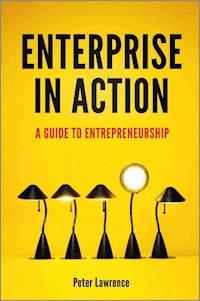
An authoritative guide to understanding and mastering the core issues and competencies involved in entrepreneurial success
Where do entrepreneurial opportunities arise? How do successful entrepreneurs exploit trends? What is the role of innovation in entrepreneurship? How do companies get started and become self-sustaining? Based on studies of 80 companies, including 30 Sunday Times Fast Track Companies, and 20 highly successful US entrepreneurial firms, this book answers these and many other key questions about entrepreneurship. This authoritative guide to the world of entrepreneurship offers valuable lessons for MBA students and established entrepreneurs alike.
- Shows practitioners how success is influenced by factors such as industry dynamics, entry barriers, reconfiguration, and core competencies
- Delivers practical coverage of an array of key issues, including how to exploit trends, how to foster innovation, how to get additional funding for expansion, and much more
- Provides expert guidance on how to successfully address each of the factors or core competencies covered
- An excellent supplement to standard graduate texts on the subject, it breathes new life into standard curriculum topics by presenting them within the context of real-world success stories
Sie lesen das E-Book in den Legimi-Apps auf:
Seitenzahl: 415
Veröffentlichungsjahr: 2013
Ähnliche


















Contents
Acknowledgements
Chapter 1: Change and Opportunity
School days
One Alfred Place
CRIME
Trucking across the prairie
Bottoms up
The flick of a switch
Summary
Chapter 2: Destination: Core Competence
Les trentes glorieuses
Démarche or legitimation
The chrysanthemum effect
Manufacturing: the world we have lost?
Taking up the slack
You shall not own them
Going Dutch
The whole truth
Summary
Chapter 3: A Natural History of Innovation
Relativising the product
Wrapping the product
Developments in services
Configuration and beyond
The next game
Summary
Postscript
Chapter 4: Shades of Originality
Originality in action
Configuration
Reconfiguration
Review
Chapter 5: Biography and Capability
To have and have not
The voyage of the turnip
School and work
A feast for life
Fashioning and developing
Lift-off
The whole truth
Summary
Chapter 6: Niche Markets and Entry Barriers
A royal ride
The geography of the niche
Geography and competition
Taking stock
Niche companies never die . . . !
The gunslinger as dude
The industrial niche
Le Marron Sculpté
Entry barriers
The whole truth
Oh what a wonderful niche
Summary
Chapter 7: Cruising Altitude
Organic growth or acquisition
Revenue growth
React Fast
British and American ways of doing
Execution and development
Execution and reputation
Caravan to boardroom
Summary
The whole truth
Chapter 8: The Challenge of Inheritance
Figgjo
The big putsch
The long game
Summary
A very short story
Chapter 9: Opening the Box
Everything in the garden
The garden centre as a competitive business
Taxi, taxi!
Summary
Chapter 10: Beyond the Box
CEO: a new twist
A vintner’s tale
More than a name
CEO in action
Postscript
The end of the runway
References
Index
“Enterprise in Action is a rarity among business and management texts, being genuinely interesting and practically useful. Written in Peter Lawrence’s unique, clear and concise style (and enlivened by examples of his sly humour) the book provides the academic, the student – and the practising manager – with superb examples of how small and medium enterprises really cope with change. The international case study based approach used in the book demonstrates that managers have a difficult job, but that they can ensure their businesses survive and prosper if they are willing to make key decisions at the right times. I thoroughly recommend Enterprise in Action to anybody currently running a business or interested in how businesses really work.”
Professor Simon Denny, University of Northampton, Holder of the Queen’s Award for Enterprise Promotion
“A perceptive, thought provoking and lively book, which follows a ‘hands on’ approach, drawing valuable lessons from face to face interviews carried out with the founders or current owners of almost 100 owner-managed companies and SMEs. It offers valuable insights on the changing nature of enterprise and the consequent challenges and opportunities for contemporary entrepreneurs and business organisations.”
Dr Grahame Fallon, Senior Lecturer in International Business, Brunel Business School, Brunel University
“I must admit it, I like to read management books, and a new book by Professor Lawrence feeds this guilty pleasure. He presents a literate and highly original tour of strategic changes within representative organizations. Whether he takes us into the inner workings of an English school, a Dutch consulting firm, or a Midwest American waste management company, he always makes insightful comments on the changes the organization made to make itself relevant and successful.”
Dr Dwight Tanner, Vancouver, BC, Canada
© 2013 John Wiley & Sons, Ltd
Registered office
John Wiley & Sons Ltd, The Atrium, Southern Gate, Chichester, West Sussex, PO19 8SQ, United Kingdom
For details of our global editorial offices, for customer services and for information about how to apply for permission to reuse the copyright material in this book please see our website at www.wiley.com.
All rights reserved. No part of this publication may be reproduced, stored in a retrieval system, or transmitted, in any form or by any means, electronic, mechanical, photocopying, recording or otherwise, except as permitted by the UK Copyright, Designs and Patents Act 1988, without the prior permission of the publisher.
Wiley publishes in a variety of print and electronic formats and by print-on-demand. Some material included with standard print versions of this book may not be included in e-books or in print-on-demand. If this book refers to media such as a CD or DVD that is not included in the version you purchased, you may download this material at http://booksupport.wiley.com. For more information about Wiley products, visit www.wiley.com.
Designations used by companies to distinguish their products are often claimed as trademarks. All brand names and product names used in this book are trade names, service marks, trademarks or registered trademarks of their respective owners. The publisher is not associated with any product or vendor mentioned in this book.
Limit of Liability/Disclaimer of Warranty: While the publisher and author have used their best efforts in preparing this book, they make no representations or warranties with the respect to the accuracy or completeness of the contents of this book and specifically disclaim any implied warranties of merchantability or fitness for a particular purpose. It is sold on the understanding that the publisher is not engaged in rendering professional services and neither the publisher nor the author shall be liable for damages arising herefrom. If professional advice or other expert assistance is required, the services of a competent professional should be sought.
A catalogue record for this book is available from the Library of Congress.
A catalogue record for this book is available from the British Library.
ISBN 978–1–119–94528–4 (paperback) ISBN 978–1–118–64425–6 (ebk)
ISBN 978–1–118–66171–0 (ebk) ISBN 978–1–118–66172–7 (ebk)
Cover design: Dan Patching Creative Design
To the Magnificent Seven
Acknowledgements
Most of all I would like to thank the owners and managers of the many companies which I researched and visited – to thank them for receiving me and indulging me, and for sharing insight and experience with me. This gave me the resolve to write this book, and nothing else could have done so.
Like most floundering writers I have been helped by my friends – helped in various ways, by encouragement, discussion, testimonies, contacts, introductions and more. In this connection I would like to thank Hans Heerkens, Rehan ul Haq, John Mansfield, Michael Lear, Libby Robotham, Andrew Phillips, Andrew Lear, David Buchanan and Vincent Edwards.
Chapter 1
Change and Opportunity
Most entrepreneurial opportunity is triggered by change. External change unfreezes existing industries and the context in which they operate, making new things possible. Changes in society in the broadest sense, embracing technical change, new legislation and regulation, changed political priorities, changes in the needs of business and personal customers, new forces impacting on these processes, even changes in social integration – all this may have an effect on existing industries and create opportunities for new or adapted ones.
The joke that change is the worst of all six letter words has some relevance in business, notwithstanding its creative potential that is the theme of this chapter. Everyone in business recognises disruptive change, that is to say, change which undermines a company’s operations, dislocates its business model, raises its costs or thins its profit margins.
There is also a tactical advantage to starting with disruptive change, which is that one can trace its effect on existing companies, as a prelude to more creative consequences.
Before introducing an example of disruptive change and showing its repercussions for one particular organisation, it may be helpful to say something about the provenance of the business cases cited in this book.
I mean to develop the ideas in this book with reference to real life examples. I have built up a research sample of getting on for 100 owner-managed companies or SMEs (small and medium sized enterprises) that I know something about, have visited, and have talked with their founders or present owners. That is to say, what I know of these companies comes from face-to-face contact not from the remote interrogation of databases.
Most of these companies are British, located in the UK, but I also make use of some company examples taken from other European countries – Holland, Scandinavia, and so on. And I am also drawing on a group of American companies, variously drawn from Chicago, Nashville, Dallas and west Texas, and North and South Dakota, particularly this last, again all of which I have visited.
Among the companies in the UK there is a subset of 30 SMEs that have appeared on the annual lists published by the Sunday Times of the fastest growing one hundred companies in any given year. A particular interest attaches to these companies since they have been externally validated by a credible criterion of success. These companies are of course still in the hands of their founders, who are generally keen to talk about the early days as well as present successes.
This group of Sunday Times companies are referred to throughout as Fast Track companies, and I almost always name them. It might be helpful to add that it is common for these Fast Track companies to be bought, or to merge, with a resulting loss of the original name (I have not so far found any that have disappeared for negative reasons). Unless there is a footnote to the contrary, companies mentioned will be given the name by which I first encountered them.
Lesen Sie weiter in der vollständigen Ausgabe!
Lesen Sie weiter in der vollständigen Ausgabe!
Lesen Sie weiter in der vollständigen Ausgabe!
Lesen Sie weiter in der vollständigen Ausgabe!
Lesen Sie weiter in der vollständigen Ausgabe!
Lesen Sie weiter in der vollständigen Ausgabe!
Lesen Sie weiter in der vollständigen Ausgabe!
Lesen Sie weiter in der vollständigen Ausgabe!
Lesen Sie weiter in der vollständigen Ausgabe!
Lesen Sie weiter in der vollständigen Ausgabe!
Lesen Sie weiter in der vollständigen Ausgabe!




