


Erhalten Sie Zugang zu diesem und mehr als 300000 Büchern ab EUR 5,99 monatlich.
- Herausgeber: The Lilliput Press
- Kategorie: Geisteswissenschaft
- Sprache: Englisch
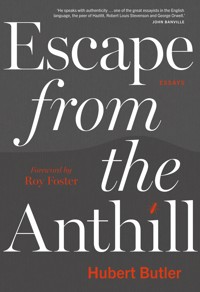
In this 40th anniversary edition, discover the epoch-defining collection of essays from one of Ireland's great essayists, Hubert Butler. Escape from the Anthill is known for its erudition, elegant prose, and the depth with which Hubert Butler engages with complex issues, offering sharp insights on resisting totalitarianism and defending personal freedom. Drawing on his experiences in Europe before and after World War II, Butler offers eloquent critiques of ideological conformity and celebrates the resilience of the human spirit in the face of oppressive systems. Challenging conformity and celebrating the importance of independent thought, Escape from the Anthill remains as pertinent today as ever before.
Sie lesen das E-Book in den Legimi-Apps auf:
Seitenzahl: 679
Veröffentlichungsjahr: 2015
Das E-Book (TTS) können Sie hören im Abo „Legimi Premium” in Legimi-Apps auf:
Ähnliche















ESCAPE FROM THE ANTHILL
FOR PEGGY
ESCAPE FROM THE ANTHILL
ESSAYS
HUBERT BUTLER
Foreword byRoy Foster
THE LILLIPUT PRESS DUBLIN
First published 1985 by
THE LILLIPUT PRESS
62–63 Sitric Road,
Arbour Hill,
Dublin 7,
Ireland
www.lilliputpress.ie
40th anniversary edition, 2025
Copyright © Estate of Hubert Butler, 1985, 2025
Foreword copyright © Roy Foster, 2025
10 9 8 7 6 5 4 3 2 1
All rights reserved. No part of this publication may be reproduced in any form or by any means without the prior permission of the publisher.
A CIP record for this title is available from The British Library.
ISBN 978 1 84351 954 6
ISBN eBook 978 1 84351 379 7
Cover design by Sarah McCoy
Set in 10 pt on 12 pt Palatino by Compuscript
Printed and bound in Czechia by Finidr
CONTENTS
Foreword by Roy Foster
Introduction
part one anglo-ireland and after, 1745–1984
1Henry and Frances
2New Geneva in Waterford
3The Bishop
4The Country House After the Union
5An Irish Ecumenical Movement
6The Eggman and the Fairies
7Anglo-Irish Twilight
8Beside the Nore
9Divided Loyalties
10The Invader Wore Slippers
11Portrait of a Minority
12A House of God
13Boycott Village
part two studies literary and speculative
14The Bell: An Anglo-Irish View
15Envoy and Mr Kavanagh
16Graham Greene and Stephen Spender: The Sense of Evil and the Sense of Guilt
17Two Critics: E. M. Forster and Edmund Wilson
18Three Friends: Eoin O’Mahony, Owen Sheehy-Skeffington and Elizabeth Bowen
19A Visit to Hesse and Some Thoughts About Princes
20Without the Bible in Spain
21Return to Hellas
22Lament for Archaeology
part three eastern excursions
23Mr Pfeffer of Sarajevo
24The Last Izmirenje
25The Sub-Prefect Should Have Held His Tongue
26The Artukovitch File
27Peter’s Window
Appendix: Statement to the Committee and Members of the Kilkenny Archaeological Society
Acknowledgments
FOREWORD
The following review of Escape from the Anthill was written for the Times Literary Supplement in 1985, but not printed in this form. I had been commissioned to produce a much shorter notice, but my first exposure to Hubert Butler’s high-octane essays brought a rush to the head. I pleaded with the then editor of the TLS, Jeremy Treglown, to allow me more space, but he was obdurate, and the review appeared in a much shorter version. Nonetheless I had been so passionate about it that Jeremy was driven to read the book himself; that was the kind of editor he was. He was instantly converted, handsomely apologized, and immediately tried to recruit Hubert to write for him. This indicates the impact made by Lilliput’s and Hubert’s first book, enterprisingly published by Antony Farrell from his bedroom at Gigginstown, County Westmeath.
Much else would follow. It turned out that this collection was the tip of an iceberg, as Antony devotedly unearthed dozens more essays stuffed into drawers and bookshelves in Maidenhall. Further volumes appeared, garnering admirers such as Neal Ascherson, Joseph Brodsky, Isaiah Berlin and John Banville, Dervla Murphy and David Reiff, as well as an ever-increasing and appreciative public in Ireland. The centenary of Hubert’s birth in 2000 was marked by a major symposium in Kilkenny and the Mayor of Kilkenny’s moving public apology for the way Hubert was ostracised over the ‘Papal insult’. There is a high-profile annual lecture in his name at the Kilkenny Arts Festival, and a Hubert Butler Essay Prize, which goes from strength to strength.
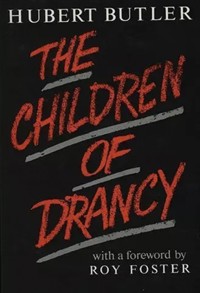
All this was in the future when I was arguing for more space in the TLS forty years ago. In some ways my review shows its age; it was written before the transformation of Ireland by economic boom, the reversal of emigration, the influx of newcomers, and the collapse of religious authority in public life; while in the wider world the implosion of the USSR and the upheavals of Eastern Europe were yet to come. Hubert would see the beginnings of them, not to his surprise, before his death in 1991. My review now strikes me as unduly Hiberno-centric; further collections from Lilliput, such as The Children of Drancy, showed how widely he cast his net, geographically and thematically. I also perhaps underplayed the mordant and sardonic note that keeps the reader nervously on their toes, and I should have said more about the inimitable Butler literary style. Nor had I met the man himself, though I would soon – like many others – find my way up the hairpin drive to Maidenhall and sit with Hubert and Peggy in the book-lined room with its view over the Nore valley. Had I known him when I wrote the review, I would have been more careful about using words such as ‘Anglo-Irish’ and ‘Ascendancy’, with which he had little patience. But reading that first collection in 1985 I knew I was hearing a voice saying things that needed to be said, and articulating them in a unique and quietly devastating way. That voice has grown ever louder and more resonant over the last four decades, and we need to listen to it more attentively than ever.
Hubert Butler: Escape from the Anthill
From Berkeley to Yeats, efforts have been made to define and categorise the Anglo-Irish mind – a curious compound of brutal Protestant logic and deliberate deviousness. In such a process of clarification, this surprising and engrossing book should take its place as an important text. It is a collection of the essays of Hubert Butler, written from his house on the River Nore near Kilkenny, and published in small journals over the last forty years. Born with the century, a member of a great Anglo-Irish (or more accurately Norman/’Old English’) family, he began his political and literary apprenticeship as a disciple of Horace Plunkett and AE in the 1920s. After working with the Irish County Libraries movement, he lived and travelled in Eastern Europe before returning to Kilkenny to farm, write, become associated with Sean O’Faolain’s legendary magazine The Bell, and involve himself in enterprises like reviving the Kilkenny Archaeological Society – while accepting that ‘it is not easy to be independent of tinned pineapples and the Dublin dailies’. If all this arouses expectations of whimsical nostalgia for the light of other days, they will remain unfulfilled. What comes across is a more flinty tradition, a visceral sharpness and an utter commitment to the individual conscience; as well as a personality all the stronger for being kept in its literary place. Opening the contents page, the impression is of disparateness; closing the book, one has the sense of having discovered an oeuvre.
In part this is because, as Butler himself remarks, ‘even when these essays appear to be about Russia or Greece or Spain or Yugoslavia, they are really about Ireland’. One might almost say, really about Kilkenny, whose public figures and private attitudes (historical and contemporary) turn up again and again. Butler has the Anglo-Irish antennae for a sense of place; his unadorned style shapes and expresses atmosphere with extraordinary clarity. A piece called ‘The Eggman and the Fairies’ explores a horrific tale of exorcism in a rural community below the fabled mountain Slievenamon in 1895; an essay on ’New Geneva in Waterford’ looks at a bizarre eighteenth-century experiment in importing Swiss Calvinist watchmakers to build a new city in the Irish countryside. In both cases, the subjects are adapted to his purpose and convey historical reality with distinction and economy.
The same is true of the most moving essay in the book, a long reminiscence of Butler’s life in Leningrad as an English teacher in 1931. This shows a novelist’s power of total recall, and a Chekhovian ability to encapsulate narrative. A few sentences delineate the life of a once-rich doctor, who after the revolution makes his house a commune for all his friends and relations. ‘When they had all in the old days lived in different parts of Petrograd, they travelled long distances to quarrel with each other. “Now it’s so easy, there’s no sport in it.”’ But the distinction of this essay lies in far more than an eye for psychological and social detail. Butler conflates the small events of his Russian winter with the larger themes of the time, in a manner both unpretentious and affecting. One instance comes at the very end, when he returns as a tourist twenty-five years and a world war later. He scans the city through a tourist telescope mounted above the Neva and thinks guiltily, ‘not of the tremendous disaster that has befallen Leningrad and all Russia, but of the small stupidities, the acts of laziness and greed I had committed myself’. Earlier, he describes his reaction to watching his friends marching on a demonstration to celebrate ‘the Fifteenth Anniversary of Socialist Construction’:
I have thought that just as half our physical lives passes in sleep, it is perhaps intended that our mental life should be equally distributed between the assertion of our uniqueness and its renunciation. If that trance-like state of submersion in a public or collective mood bears an analogy to sleep, it would reflect our individual and self-centred lives by very simple images and phrases in dream-like sequences. In such a way, the caricatures and slogans that floated above them would complement, like dreams, the intricate, logical natures of Kolya and the baroness. The slogans were the shadows of human thinking in which their thoughts merged restfully, just as their footsteps concurred in the broad beaten track upon the snow, and we do not expect faithfulness in tone or form or colour from shadows.
This is a characteristic reflection, because Butler’s recurring preoccupation is with the conflict between historical realities and the mythical forms in which they are expressed and remembered: ‘caricatures and slogans’. Thus Irish history is a constant theme, memorably described as ‘a scenic railway in a funfair: we pass through towering cardboard mountains and over raging torrents and come to rest in the same well-trodden field from which we got on board’. His own historical-political view is described in Maurice Craig’s Introduction as ‘protestant republican’, but this seems not quite right; ‘Anglo-Irish nationalist’ would be nearer the mark, if ‘Anglo-Irishness’ is understood as a tradition rather than a tribal identification. Butler’s stance nonetheless involves historical elision; he idealizes Irish politics in the late eighteenth century and optimistically believes that those who consider ‘real’ Irishness as congruent with Catholicism and Gaelicism are a small minority. Though he is sharply aware of the condescending second-rateness which characterizes much of the remnant Irish Protestant culture, he is preoccupied by the Ascendancy’s part in Irish history. One essay, describing the idiosyncratic writer Standish O’Grady’s attempt to radicalize the Kilkenny Moderator in 1898, and the gentry wars thus precipitated, reads like a George Birmingham novel. This piece, significantly, is sparked off by Butler’s annoyance at the horsey misrepresentation of O’Grady’s champion, Lady Desart, in a local exhibition dealing with ‘The Landed Gentry’.
She was not in the least like that. She was a plump and plain little Jewess with high intelligence and spirit, a guttural voice, and very strong pince-nez. She would have looked ridiculous on a horse, though she may have pretended to like them because her husband, whom she loved, was MFH and had even written a novel called The Honourable Ella of Foxshire. He died in 1898 and was succeeded by his brother, a distinguished barrister, and there was no longer any need for his widow to model herself on the Honourable Ella.
As throughout, reality remains stranger, more confused and funnier than fiction (or accepted history).
Beneath it all there is the authentic Ascendancy assertion of a privileged separateness. Two local Republicans arrive at the Butler home during the Civil War, seeking money for the cause. After Butler’s mother upbraids one of them for speaking to her with a cigarette in his mouth, she and her son embark upon an angry argument about whether to give their visitors a hearing. ‘The two men looked at each other in embarrassment, and slunk politely away.’ Marginalisation and tacit complicity remain the leitmotifs of the Anglo-Irish situation. Elsewhere Butler quotes a vivid and sympathetic letter written by his aunt’s housekeeper when the family house was burned down by Republicans; it ranks with the celebrated despatch from Lady Susan Dawnay’s gardener when the tennis-court of her Waterford house was the scene of a battle in the Civil War (‘Both sides greatly admired your ladyship’s antirrhinums.’) Such pragmatic and latitudinarian attitudes characterize the civilised pluralism of Butler’s world; he sees both the Ascendancy and the Ulster Protestants as a central part of the Irish tradition as well as a loss to the contemporary Republic.
In considering how far that loss was self-willed, Butler treads very carefully indeed. He prints here a 1954 essay on Patrick Kavanagh which icily indicts the confusions and bigotries inherent in that excellent poet’s bad-temped journalism. Kavanagh’s dislike of Yeats, Synge, Protestantism and much else led him to the odd position of identifying nationalism as a sort of Protestant heresy, perpetuated by the Anglo-Irish in their efforts to avoid Rome; Butler construes this, correctly, as neurotic obfuscation and believes that the attitudes it betokens are no longer relevant. Elsewhere he writes that ‘Religion, which once rampaged like a shark, devouring everything which could not escape, now feeds itself like some non-poisonous jelly-fish groping for plankton with sensitive tentacles’; but he speaks (as Maurice Craig gently points out) too soon. The confessional identities which are imprinted on Ireland may be the reductionist reality and perhaps they, rather than the relationship to Britain, form the key to modern Irish history.
Indeed, two haunting pieces in this collection arise from Butler’s preoccupation with religion in the Balkans, but come back in the end to Ireland. He has long been a fascinated and appalled student of the Croatian Nazi collaborators’ attempts at ‘mass conversion’ of Orthodox Serbs to Catholicism in 1941, which ended in mass murder. In ‘The Artukovich File’ he traces the means by which one of the ministers responsible was sheltered in Ireland for a year before his escape to California in 1948. The pursuit leads from Dublin lodging-houses to a Franciscan monastery in Ireland, and the story shows yet again Butler’s flair for reconstructing history with the artistry of a novelist. But the trail of the Croatian atrocities also led him even nearer to home, triggering a cause célèbre which brings us close to the essence of his life and work. For another essay, ‘The Sub-Prefect Should Have Held His Tongue’, describes the scandal which ensued when Butler unintentionally provoked public controversy by raising the matter of the Croatian persecutions at a Dublin meeting attended by the Papal Nuncio, who walked out in protest. (The Nuncio, according to an emollient Jesuit afterwards, in fact simply thought he had come to the wrong meeeting.) The ensuing scandal can only be understood if it is borne in mind that in 1952 Irish (and most Western) opinion saw little beyond Catholic martyrs and Communist tyranny; it is also instructive to remember that Butler’s first-hand knowledge of Yugoslavia is compounded by a preoccupation with what happens to historical truth under collaborationist regimes.
For the purposes of this book, the sad and salient point is that the scandal of ‘the Papal insult’ erupted into local life, splitting the Kilkenny Archaeological Society which Butler had helped re-found, and forcing him out of the sort of localist, intellectually acute, historical-minded, non-sectarian meeting of hearts to which all these essays are implicitly dedicated. Unlike Plunkett and AE, Hubert Buter did not withdraw to England; his belief remains rooted in the pluralist dispensation which was apparently offered for a brief moment towards the end of the Irish eighteenth century. But the folk-memory of the missed chance may in itself be a necessary condition of the Anglo-Irish mind: the rationalization of a dilemma where simple answers are so unpalatable as to be impossible.
Roy Foster, 2025
INTRODUCTION
These essays are not so heterogeneous as they look. They are all skewered together by a single idea. Or perhaps I should call it an obsession, a mental necessity that turned into a physical one. When I was a boy of fourteen I decided I was going to live in the place where I was born and where my father, grandfather and great grandfather had lived before me. It seemed then an easy and obvious thing to do, since I was my father’s eldest son and he had a house and farm in Kilkenny. There was also another reason, which influenced me, even when I knew how insubstantial it was. Though we have long been unimportant people, the Butlers, of whom my family is a junior branch, had ruled the neighbourhood since the fourteenth century, and there is scarcely a parish in Tipperary or Kilkenny that does not bear some trace of our sometimes arrogant, sometimes kindly interference. Could I not interfere too?
It was some time before I grasped how difficult this was going to be and noticed that not only was all my education slanted away from Ireland but that the whole island was tilted eastwards. It was very hard to stand upright unsupported on this precipitous slope, for as many people were pushing me from the west as were pulling me to the east. And ambition was tugging me vigorously the whole time towards the land of opportunity. And in fact, in a strongly centripetal world, staying at home is scarcely even respectable; certainly no one thinks it public-spirited. The man who does it can surely have no feeling for ‘broad horizons’ and mighty enterprises, for the unity of mankind and the exploration of the universe? Even in a manual worker it can be a discreditable thing to do, for our economists often moralize now about the need to make labour more ‘mobile’ so that it can be drafted to those spots where it is most needed. It is perverse and selfish to resist.
And if living in one’s own neighbourhood is difficult, to write about it is harder still. Who, anyway, are our neighbours? Our real neighbours, both of the spirit and the flesh, both those we know and those we don’t, seldom live near us nowadays. We keep contact with them by telephone and plane and car, or else we have one-sided commerce with them through books and television screens. In spite of that, though the familiar hills and rivers seldom now enclose a stable or self-sufficient community, I think they are only waiting to recover their plundered significance. The canals that once diverted the rivers are all choked and after five generations the railway cuttings that ravaged the hills are collapsing. Why should the great dams at Ardnacrusha and Poulaphouca, or the television mast on Mount Leinster, or the huge roads that level out villages and raths and esker ridges, prove more enduring? They are all linked with certain ways of life and thought, and ideas have never been as ephemeral as in the twentieth century.
But to look ahead like this is not very comforting to the beleaguered country-dweller. At eighty-four I am, like everybody else, very disillusioned but only averagely discontented. Fundamentally I think as I always did. The post to which I am willingly tethered still holds firm and I have grazed around it in a sufficiently wide circle. Close-cropped grass comes up again fresh and sweet, and whoever comes along next may find my patch slightly improved.
So even when these essays appear to be about Russia or Greece or Spain or Yugoslavia, they are really about Ireland. We choose some of our experiences and others are forced on us, but they have little meaning till they are related to some central focus of ideas and this focus for me has never varied. Many of the irrelevant things that have happened to me have been boring or nasty, but not all of them. For example, like many Europeans, I have exchanged a couple of dull sentences with Chou Enlai and seen the Great Wall of China, but I have no idea how to profit by this fascinating adventure, for I think we Westerners can mostly only sense the sweetness of China, we can bring nothing home with us. We are like honey bees which can get nectar from white clover but not from red, because their sucking apparatus is too short. And I do not believe that we should be spiritually impoverished if for a century or more we were excluded from all Asia and all Africa beyond the shores of the Mediterranean.
But nowadays can we exclude ourselves from anything? Can the ant ever escape from his anthill? Even the most sedentary and homebound person is obliged to roam the world in spirit ten or twenty times a day. The newspapers and the radio and television release a million images of remote places and people. They settle like butterflies on the brain till every cell is clogged with the larvae from their unwanted eggs. How can one protect oneself from the ravages of secondhand experience? Here and there perhaps one can replace this pre-digested stuff with experiences of one’s own. But to most people this seems an affectation, like the quest for free-range eggs or vegetables from ‘organic’ farms.
While we are more or less committed to mass travel and to information that is canalized for press-conferences, the experiences that nourish us are individual, not collective. Few of us have been of use to any Indian, Negro or Chinaman, and the regard we have for them is unmixed with personal gratitude; yet many generations of vicarious involvement have caused us to think we are necessary to each other, and it will take as many more to unlearn this.
When this happens we shall recognize again that within a few square miles we should have everything which we can possibly need. Here in Kilkenny the earth is fruitful and the neighbours are intelligent, imaginative and kind; their minds are well-adapted to poetry and jokes and the propounding and solving of problems. Though it is not easy to be independent of tinned pineapples and the Dublin dailies, we could be, at a price. But even the tinkers and the retired colonial administrators are more restless and discontented than they used to be. The colonials, travelling round the earth, have lost the countryman’s acquiescence in seemingly immutable things like temperature and rainfall and local prejudices. It is now easy to avoid what one cannot change, so they move about. And though our tinkers come back every summer to the same lanes and clearings, the last ones who came here had spent the winter washing dishes in the Cumberland Hotel at Marble Arch. They play the familiar tricks with a touch of urban sophistication, and it is hard to see them as neighbours whom it is one’s duty to love.
All this sounds misleadingly nostalgic. In fact nothing has happened that cannot be reversed if it is accurately recorded. That is the purpose of these essays, in which I try to show that the countryside, where mean and silly things happen because energy and intelligence have been drained away, is an essential part of the world pattern which too few have studied. In ‘Boycott Village’, for example, I complain that no one has investigated why ordinary people with nice intentions and neighbourly instincts proved to be such incompetent guardians of freedom. I do not know what the answer is but, if we relate the facts as we see them, posterity will perhaps handle them less clumsily than we have done.
I grew up before the great emigration of the Anglo-Irish in the twenties had begun, when some of the pioneers of the Irish Literary Revival were still alive and active, and through the Irish Statesman AE was still confidently elaborating his plans for a co-operative Ireland. These were dreams with reality and achievement behind them but they could not stand up to the Gaelic dream of Patrick Pearse, for it had been sanctified in blood. Now that dream too has faded, though the blood sacrifice still goes on, like the fire that smoulders slowly towards the forest when the picnic is over.
Now there are no dreams left to sustain us and all we have is a rag-bag of tangled notions and prejudices, of which I have exhibited a sampling in ‘Envoy and Mr Kavanagh’. I do not doubt that a new generation, with fresh ideas and the vigour to carry them through, will solve some of our problems, and yet in times of troubled peace like ours, when the old idealisms have lost their magic, the future, I believe, lies with the solitary individual of whom Chekhov used to write. I quote from one of his letters:
I see that our salvation will come from solitary personalities, scattered here and there over Russia, sometimes educated, sometimes peasant. Power is in their hands even though there are few of them. No man is a prophet in his own country and these solitary individuals, of which I speak, play an imperceptible role in society; they do not dominate it but their work is visible.
It was in the same way that Vershinin reassured the three sisters that knowledge and intelligence were never wasted. He said there was no town so boring and dead that three people of intellect and education could not make a faint impression; they would get swallowed up, of course, by the dark masses, but not without leaving some slight influence, and after them there would be six, then twelve, till at last they would be in a majority. ‘In two or three hundred years life would be unspeakably, amazingly lovely.’
Yet now something has happened to thrust this future loveliness even farther away. Vershinin had not forseen that as culture, under official patronage, became increasingly centripetal, Feeny, Meany and Sweeney, the three people of intellect and education, would fall under the irresistible, techno-cultural influence of the capital. Long before the three had propagated six and the six twelve, each nourishing his successors with the rich decay of his talents, the tempter would address himself seductively to them. Feeny and Meany would persuade themselves that they could serve their little town best from outside. Feeny would get a plum of a job as adviser to Channel 3 on South-Eastern Regional Culture, and Meany, no longer his ally but his rival, would draw a smaller income from his Friday afternoon talks on rural problems; Sweeney would stay behind, a new element, jealousy, penetrating his loneliness and distorting his judgment.
And what of the dark masses? They would be just as dark as before but with no trouble to themselves they would be given extension lectures and loan exhibitions, so that even Sweeney in his unpopular enthusiasms would seem superfluous and the task of swallowing him up would be greatly eased.
It is in fact a problem of men, not methods, and we can hope for little from the clever educational gadgets with which we try to irrigate the intellectual deserts. The soil that has been robbed of its natural creativity cannot be restored to health by fertilizing chemicals. Make it possible for Feeny, Meany and Sweeney, the ‘solitary individuals’, to live in their own homes, for nature has planted them there like antibodies in a diseased constitution. Only they have power to regenerate it.
This, of course, is contrary to all current notions. Everything that is seminal or germinative in the way of ideas is thought to develop in the great centres of culture, where intellectuals congregate. It is in the press, the theatres, the clubs of the metropolis that revolutionary ideas are expressed and challenged. Things are openly said that could scarcely be thought in a provincial town. Yet there is something self-destructive about these great congestions of originality. A sense of doom hangs over them as over the exuberant freedom of the Weimar Republic.
Here is one of the reasons. In a vast society like ours, ‘the man of intellect and education’, as Chekhov saw him, is one among several thousands, a natural solitary, in fact. His function is to be the pinch of bread-soda in the dough, and not to foregather with other ex-solitaries and form a bread-soda pudding. Yet an Irishman sees this happening every year. Feeny and Meany, drawn away from their solitude, bring with them to the city their instinct to defy. They gather together with other ex-solitaries; then they are no longer solitary and what is more they find they are no longer original. Their insights and perceptions, which surprised and often vexed their fellow-citizens, are banal and irrelevant among the exuberant heterodoxies of their new community. In place of the known neighbours whom it was their duty to challenge, there are faceless strangers who can only be met with abstractions. To get attention in such circles, the exsolitary may have to turn in his tracks, to sacrifice the particular to the general, and to accept as valid some mass-produced consensus whose insufficiency he would quickly have detected among the familiar diversities of his native town. In this way the cities acquire fanatics at the same rate as the provinces lose their solitary individuals.
Am I exaggerating? Probably, but there is evidence from Russia and Italy and Germany that totalitarian beliefs spread from the cities to the provinces where sharp antagonisms had been held in check by a long history of neighbourly interdependence.
So I go on believing that the strength to live comes from an understanding of ourselves and our neighbours or the diaspora that has replaced them. If we could focus on them all the curiosity and wisdom that we disperse round the world, as we focus all the rays of the sun through a burning glass on a pile of dead leaves, there is no limit to the warmth and life we could generate. It is easier of course to collect the dead leaves than to make the sparks to kindle them. Yet I believe the life which Chekhov prophesied, ‘unspeakably, amazingly lovely’, is not out of our reach, though it may now be a century or two farther away than he calculated.
Some of this material is unpublished (the latter portion of ‘The Artukovitch File’), some has been recast (‘Beside the Nore’, ‘Divided Loyalties’), updated (‘Boycott Village’) or extended from the original (‘Peter’s Window’) – sources will be found under Acknowledgments – but for the most part these essays are unaltered, though a few of them deal with problems that appear to have been solved or episodes that have long been forgotten. We have lived though two world wars and, in Ireland, rebellion and civil war. Yet the basic things remain the same. When I was a boy of ten the Ulster Unionists were saying Home Rule is Rome Rule and civil war was threatened. Now I am eighty-four and the Ulster Unionists are saying Home Rule is Rome Rule and civil war does not seem immeasurably far away. It is as though we were on a scenic railway in a fun-fair. We pass through towering cardboard mountains and over raging torrents and come to rest in the same well-trodden field from which we got on board.
I have lived for long periods at home and my garden, with its vegetables and raspberry canes, its orchard and neglected flowerbeds, has had to take the place of people and events. Thirty-three years ago my life of active involvement in enthusiasms which I shared with my neighbours ended abruptly. I have described how this came about in ‘The Sub-Prefect Should Have Held His Tongue’. I shall not refer to this again as my affection for my neighbours has not changed. We were all of us victims of events beyond our control. Ireland was caught in the backwash of a tremendous religious struggle in Central and Eastern Europe, which we did not understand and for which we were unprepared. It was inevitable that there should be casualties.
Are we here in Ireland any nearer to that eighteenth-century dream ‘to unite the whole people of Ireland, to abolish the memory of past dissensions, and to substitute the common name of Irishman in place of the denomination of Protestant, Catholic and Dissenter’?
The idea of a religious war is so abhorrent and disgraceful that many prefer to think that it is for loyalty to the British Crown that Ulstermen will fight. They are wrong, because Ulster loyalty is to a Protestant monarch and would not survive if the monarch became a Roman Catholic. In fact it is the old insoluble conflict between authority and private judgment. Though all of us sometimes defer to authority, sometimes judge for ourselves, the moment we cease to act as individuals and think collectively, what was a matter of choice becomes a matter of principle and a clash between Catholic and Protestant is likely.
Can ecumenism help? In Ireland 160 years ago there was a vigorous ecumenical movement. The circumstances were more favourable then than now but it ended in a deadlock. I have told the story in the following pages.
In ‘The Bishop’ I write of an eighteenth-century young man, agreeable and popular, who could not resist the fleshpots of an ascendancy he knew to be doomed.
In ‘The Eggman and the Fairies’ the Captains and the Kings have all but gone and taken with them their sophistication and learning, their love of their home and their self-knowledge by means of which what looked irremediable might have been remedied. The Clearys in their cruel innocence and isolation could only escape from poverty and ignorance into fairyland.
Most of the other Irish pieces are self-explanatory.
When I was thirty-one and Soviet Russia was fifteen years old I taught English for a term in Leningrad. I was very happy there and would like to have stayed longer but the pull of my home and those I loved was too strong for me. I came back with as little understanding of Marxism and Communism as I went but I made many friends whom I still remember with affection. There was a multitude of small misunderstandings and difficulties but they all counted for nothing compared with the imaginative kindness with which I was welcomed. In ‘Peter’s Window’ I tell the story of that time.
Men and women are surely more important than the systems in which they imprison themselves. Yet it is not easy to disentangle ourselves and to commit ourselves unreservedly to personal relations. Organized religion cannot liberate us for it is a system too, and there is nothing more bitter than the conflict of two religious systems, as I have found both in my own country and the foreign country I know best, Yugoslavia.
Three years after I returned from Russia I went to teach in Zagreb in the Anglo-American-Yugoslav Society. It had been founded by my friend, Dr Milan Churchin, the editor of NovaEuropa, the leading liberal journal of Central Europe, and by Dr Georgievitch, the Orthodox Bishop of Dalmatia. I also had a small scholarship from the School of Slavonic Studies in London.
Yugoslavia had been born in 1918 after the defeat of Austria-Hungary and the rise of the Succession States. For the southern Slavs it was the fulfilment of an ancient dream of harmony between four neighbouring and kindred peoples. I was at Oxford then and there was springtime in the air. There were Serbs, Croats and Czechs, there were Irish too, all rejoicing in their new-found freedom. We all had minority problems and I was surprised that Ireland, least scarred by war, did not identify herself with the other small new states more warmly, share experiences and take the lead for which she was qualified. The Croats knew about Ulster and some of them talked of Croatia, ruefully, as ‘the Ulster of Yugoslavia’. This needed a readjustment of roles, but one knew what they meant. They were Catholics and to them Zagreb, the Croatian capital, was ‘a little Vienna’. They wondered how they would fare in union with the more primitive Serbian Orthodox, who had fought for freedom while they had mostly fought for Austria-Hungary.
The day we arrived in Zagreb, 9 October 1934, news had just come that King Alexander, a Serb, had, with Barthou the French Foreign Minister, been assassinated in Marseilles by agents of the separatist Croat leader, Pavelitch. Zagreb was plunged in well-organized mourning with portraits of the king surrounded by black crape in the shop-windows and black bows on the funnels of the railway engines. Two days later the king’s body arrived from Split, where it had been shipped from Marseilles on its way to Belgrade. It lay for a couple of hours, surrounded by pot-plants, in the first class waiting-room at the station, where it was visited by mile-long processions. One of those who prayed beside the royal coffin was Archbishop Bauer, the Catholic Primate, accompanied by his Auxiliary Monsignor Stepinac.
During our time in Yugoslavia the shadow of the assassination hung over the whole country. Hitler had come to power in Germany and Jewish refugees were flocking to the Dalmatian coast. In Italy and Hungary, Pavelitch and his helper, Artukovitch, were training the army of the Croat rebels, who were, in 1941, to sweep into Yugoslavia with the Nazis and proclaim the Independent State of Croatia.
And yet my recollections are of peace and beauty. There was almost no traffic in Yelachitch Trg, the central square. Fat amethyst pigeons strutted through the market stalls looking for pickings and panicking when the church bells rang. The scent of mimosa and wood-smoke, holy candles and freshly tanned leather drowned the faint whiff of petrol. On Sunday, we walked up Slijeme Mountain, where wild cyclamen and hellebore grew through the beech woods. In our room I rooted oleander cuttings in bottles between the double windows. And when my pupils were on holiday I wrote down the story of Mr Pfeffer.
Zagreb, in the thirties, was a very cultivated little town; it had an opera house and theatres, and there were still remnants of an Austrianized aristocracy in the leafy suburbs. Dalmatia was Italianate and Belgrade was still largely Turkish in character. When one went south and penetrated to Montenegro, one seemed to pass from our cruel, complicated century to an earlier one, just as cruel, where each man was responsible to his neighbours for his crimes and where organized twentieth-century barbarity had not yet emerged. Possibly in ‘The Last Izmirenje’ I have idealized what I saw. To know what Montenegro was really like you must read Djilas’s superb autobiography, Land Without Justice’ (1958).
The war came and Yugoslavia was carved up by Germany and her allies. Croatia, which had not resisted the Nazis, was rewarded with her Independent State under the rule of Pavelitch, King Alexander’s convicted murderer.
Then in Zagreb an Aeschylean tragedy was enacted. The same young priest who had stood beside the coffin of his murdered king, reappeared before his countrymen as Archbishop at the right hand of his king’s assassin, helpless in the face of Pavelitch’s resolve to exterminate the Orthodox by expulsion, massacre or forced conversion. Unhappy but icily correct, Stepinac considered himself to be the servant of a power that is higher than the king or his murderer, and one that has rules for every occasion. His conscience was clear.
Violence came a second time to the city. Caring neither for king nor priest nor pope nor assassin, the Communists swept in, resolved to make all things new. I have written about this period in my two pieces, ‘The Sub-Prefect Should Have Held His Tongue’ and ‘The Artukovitch File’, yet I would like here to recall the historical background to the events I have described. There are three great sources of power and influence in Eastern and Central Europe: Roman Catholicism, Byzantine Orthodoxy and Communism. Orthodoxy, which broke away from Rome five centuries before the Protestant Reformation, was once, with its Patriarch magnificently enthroned at Constantinople, the rival of Rome in power and splendour. Now the Orthodox Church is a shadow of its former self. With Saint Sophia a secular museum, the Patriarch lives on sufferance from the Turks in a small quarter of Istanbul. Since the Russian Revolution the other Patriarchs over whom he reigns as primus inter pares are weak and scattered. Communist Moscow threatens them from the East and the Catholic powers from the West. Those Russian Orthodox who survived beyond the borders of Tsarist Russia and later the Soviet State, have had to fight for their faith and culture against the politico-religious scheming of Austria-Hungary and her successors, Czechoslovakia and Poland.
A powerful instrument in this little-known stuggle is the Uniat Church, devised by King Sigismund III of Poland and the Pope in the sixteenth century to attract the peasants of the eastern border-lands away from Orthodoxy. The Orthodox received into this Church retained their ritual and their married clergy but Rome, not Moscow, became the focus of their obedience.
This Uniat Church has been used many times in our century by the Western Powers for political purposes. At the beginning of the war in 1914, when the Austrians were advancing against the Russian Ukraine, a detailed memorandum about its occupation was formulated by the Uniat Archbishop, Count Szepticky of Lemberg in Austrian Galicia. Apart from the military and juridical arrangements, the Orthodox Church in the new Protectorate was to be detached from the Moscow Patriarchate and subjected to Szepticky himself, as Uniat Metropolitan. Prayers for the Tsar were to be forbidden and prayers for the Emperor substituted. The Muscovite saints were to be eliminated from the calendar. The new Prince of the Ukraine was to be Archduke Wilhelm, who had changed his name to Vasily, learnt Ukrainian and wore an embroidered Ukrainian tunic. But the Russians struck back, occupied Lemberg, arrested the Archbishop and published the Memorandum in the Petrograd papers. Soon after this the Revolution occurred.
In the Second World War the Uniat Church was active in Croatia; in 1941-2 Dr Shimrak, the Uniat Bishop, played a notable part in the campaign for the conversion of the Orthodox.
For many years the Czechs and Slovaks used the Uniats to secure and, if possible, extend their eastern frontier, where Carpatho-Russian Orthodox were settled along the Ukrainian border. They revived for themselves the old Austro-Hungarian dream of a vast Ukrainian protectorate and for this purpose rechristened Carpatho-Russian ‘Carpatho-Ukraine’ and supported the Uniats against the Orthodox. The story of this often violent struggle has been told month by month in SvobodnoyeSlovo (Free Word), the organ of the many émigré Carpatho-Russian Orthodox in the USA.
In Europe it is now only in Greece that a free Orthodox Church survives. When in 1964 there was a friendly meeting in the Holy Land between the Pope and the titular head of the Orthodox Church (the Patriarch in Constantinople), Chrysostom, the Primate of Greece, and his bishops refused to participate and even asked for the dissolution of the Uniat Church. The world was shocked that when all Christendom is craving for unity the Primate of Greece could be so intransigent, yet it is intelligible enough. The Greeks are the countrymen of Aesop, who wrote so many fables about small animals to whom large ones made friendly overtures. It is natural for them to dread the Uniat embrace.
Should we involve ourselves with complex happenings in far countries? Sometimes we have to, but we misinterpret them at our peril.
On May Day 1949 a crowd of 150,000, said to be the largest ever seen in Dublin, assembled in O’Connell Street to protest against the imprisonment of Archbishop Stepinac of Yugoslavia and a Hungarian Cardinal Mindszenty. There were bands, speeches, telegrams, women fainted and a young man, wrongly suspected of distributing Communist leaflsts, was struck on the head and taken to hospital.
In America there were even greater demonstrations and many thought that with so righteous a cause, and Russia still weak after the Nazi invasion, the moment for a third world war had arrived.
I know nothing about Cardinal Mindszenty but I knew that the struggle in which Stepinac was involved was totally misconceived. It was a pre-Communist and inter-Christian one. As in Ireland, race and religion go together, Catholic Croat confronted Orthodox Serb and Hitler’s war had triggered off a massacre of the Orthodox by the Catholics. Hugh Seton-Watson, the well-known historian of Central Europe, wrote in 1945: ‘The Communists saved Yugoslavia from a bloody civil war on racial lines, which would have been inevitable, if Mihailovitch [the Serbian Orthodox general] had come to power’.* This is something which in Ireland we would be reluctant to believe. Who could wish a Communist solution to our own racial and religious problems?
We live and think under a nuclear cloud and stretch our brains, built for solving human problems, into thinking cosmically. If sooner or later they fail us, friend and enemy will be destroyed together. How soon can we return to being men, not human adjuncts to machines, and handle again man-sized problems? How soon can we escape from the anthill which we have built round ourselves?
Hubert Butler
* Hugh Seton-Watson, Nationalism and Communism (London 1945), p. 90.
PART ONE
ANGLO-IRELAND AND AFTER, 1745–1984
Like circles raised in the water by the impulse
of a heavy body, our social duties, as they expand,
grow fainter… The love and service of our
country is perhaps the widest circle in which we
can hope to display an active benevolence…
If every man were to devote his powers to the service
of his country, mankind would be universally served.
CHARLEMONT
1
HENRY AND FRANCES
One afternoon fourteen or fifteen years ago we were cataloguing the library of our neighbour, Miss Power of Kilfane. It is a long beautiful room with tall windows between the bookcases looking on to a sweep of green lawn and beyond it a classically planted park. The library with its great fire was a delightful place in which to work or shirk work and we found ourselves too often sinking into luxurious arm-chairs and reading the books we were supposed to be cataloguing. Most of them were collected in the eighteenth and early nineteenth century and the family had two ruling passions, Art and Sport. The Kilkenny Theatre and the Kilkenny Hunt were their creations but the first of their two enthusiasms evaporated when the Theatre closed its doors in 1819 and when soon afterwards its founder, Richard Power, died. John Power’s hunt still flourishes but the literature of hunting is not large and only a few books appear to have been added to the shelves in Victorian times. In his day, Richard Power filled his bookshelves not only with a unique collection of plays; he had also a fine store of essays, biographies and political pamphlets. I was cataloguing these books when, on one occasion, I took down four small volumes dated 1770. They were called A Seriesof Genuine Letters between Henry and Frances, but they had no author’s name and I searched the pages for a clue. Some of the letters were dated from Kilfane and some from Farmley, where Henry Flood, the orator, lived; I exclaimed aloud when I discovered that many of the letters were dated from my own home, six miles away. Maidenhall is a small unpretentious Georgian house and I knew nothing of its history in the eighteenth century for my great grandfather did not come to the district till 1800 or later, but to the best of my knowledge it was built about 1745. Then I remembered having seen the name Griffith on an old Title Deed. I borrowed the books to compare dates and make what inferences I could from the letters themselves. I was fascinated by the supple and often witty prose and successfully placed the authors, for there were two of them, Richard Griffith (Henry), and his wife, Elizabeth (Frances), who lived here and built this house over two hundred years ago.
The letters are disappointingly meagre about the ordinary social life of Bennettsbridge and Kilkenny; they mainly deal with the complicated, uneasy love affair of Henry and Frances. The Griffiths were a learned and cultivated couple, who for some reason to which they only allude mysteriously, had first to delay then to conceal their marriage for several years. Possibly delays and dissimulations were caused by money difficulties or a disapproving relative but I think it more likely that Frances’ pride was the hindrance. Henry did not consider it necessary to be faithful to her and wrote to her about his infidelities in an aloof, philosophical way. For example, he had told her how his maid Nancy had had to be dismissed because she made such a scene about being supplanted in his affections by Sally. Frances tried to reply with equal philosophy but probably her heart was not in it:
As for the affair of Nancy and Sally, it is of no farther consequence to me than if James and the Coachman had been the Disputants. Nor did I mention my Opinion of Sally with any Design; for you may easily conceive that it is a matter of Indifference to me whether your present favourite was called Sarah or Anne; for while I am in possession of the Jewel that is lodged within I care not who holds the Casket.
O free for ever be his eye,
Whose heart to me is always true.
Her biographer, Miss Tomkins, has discovered an ingenious sentence in Frances’s novel, The History of Lady Barton, which suggests a different outlook and may throw light on the postponement of the marriage. ‘There is something extremely indelicate in professing a Passion for a virtuous Woman before we have undergone a sufficient Quarantine after the Contagion of an abandoned one, and Man in such a Situation resembles a Centaur, half-human and half-brute.’
Perhaps she was waiting till Henry had been purged by time of all those earlier contagions before she would acknowledge him as her husband.
Henry lived at Maidenhall, farming and building a flaxmill, Frances stayed with her old aunt at Abbey Street, Dublin, and later in lodgings in Chapelizod. Now and again, heavily chaperoned, she paid visits to her husband at Maidenhall. Before they published their letters they must have pruned them drastically, because though they are certainly genuine letters they contain very few of those trivial accounts of everyday life which the originals must certainly have had and which we would today find so enthralling. In the first edition the Irish place-names had been changed to English, so that the polite eye should not be offended by our barbarous nomenclature. Though frank about his morals he is fastidiously evasive about his occupation and finances, and it is only by inference and reference to other works that we find why he paid visits to country houses round Kilkenny and what happened to his flax mills.
He was doing some electioneering work, though for whom he was canvassing I do not know; as for the flax mills, he had got a grant from parliament for starting linen-manufacture on the Nore and in the expectation of a larger one he had built his factory and the house of Maidenhall. Then to set it going he had mortgaged it all. But very soon times changed for the worse, the second grant was withheld and Henry was ruined. It was soon after this that he and his wife decided to publish their letters to see if they could earn by literature what they had lost on linen. They succeeded and she became an immensely popular novelist and the first English translator of Voltaire; he too earned a living by his novels and his philosophical reflections. Most of their original work except the Letters is today unreadable but it charmed their contemporaries. Fanny Burney, after she had been reading The Letters of Henry and Frances, took up The Vicar of Wakefield by a new writer, Oliver Goldsmith, but she tells us she nearly threw it aside after reading a few pages, so disgusted was she with its coarse, indelicate outlook on life and in particular on matrimony; it was a cruel contrast to the ‘so elegantly natural, so unassumingly rational’ tone of the Griffith Letters. In London the Griffiths became well known in the circle of Garrick and Johnson; their little boy, Harry, who in the days of their poverty had to be brought up by his grandmother at Portarlington, became a nabob in India. He returned to Ireland, bought the estate of Millicent in Co. Kildare and played an influential part in Grattan’s Parliament. He was the father of Sir Richard John Griffith, the distinguished geologist and civil engineer.
Last year I got a letter from a lady in an American university, enquiring about the Griffiths on whom she was writing a thesis. Americans are well known for their choice of recondite subjects for theses, but I was ashamed that this learned couple should be the object of careful researches in Alabama, while I, who lived in their house, knew so little about them. I found that an excellent biographical sketch of them had been published in 1938 by the Cambridge University Press by Miss J. M. S. Tompkins, who had collected much new material from English sources. Naturally it was their late London career that interested her most; for me these few troubled years they spent in Bennettsbridge have by far the greatest appeal.
In those days it was possible for country gentlemen to see their lives in terms of classical analogy and imagery. It was easy enough for Irish landlords who left their latifundia to be administered by agents to picture their estates as ‘rural retreats’ to which they retired like Horace or Cicero from the cares of state to plant trees and study philosophy. They reflected on the vicissitudes of life, its inequalities and injustices, with a freedom that would have seemed to a later generation subversive and disloyal to their class. Henry Flood regarded his substantial estate nearby at Farmley, as ‘Tusculum’, where he relaxed from toil. He had amateur theatricals and lent his support to the revival of interest in the Celtic past. Griffith, though only an unsuccessful mill-owner with a bare 600 acres, modelled himself naturally on these philosophical grandees, calling his tours around his Bennettsbridge farm his ‘Ambarvalia’.
Henry used to attend the Kilkenny assizes and watch with philosophical melancholy the procession of the condemned to the gallows. His contempt for worldly values was of a rather static and literary kind but there are many letters which show him to have been a kindly and original character. He had a peculiar variety of colic, which he treated with opium and horse radish emetic and once or twice with the ‘Hygean waves of Scarborough’. When on a journey his agonies used to arouse so much exasperation and compassion in his fellow passengers that he forced himself to fast. Once at an inn he had three ginger-bread nuts and a pint of white wine and the landlord presented him with a bill for the full dinner. Griffith retaliated by going into the street and calling in an old beggar woman, to whom he insisted that the dinner which he had paid for but not eaten, should be served. ‘She is my stomach,’ he told the furious landlord.
Henry scarcely mentioned his employees or his factory. Before he purchased his machinery he paid a visit of inspection to Smyth’s Linen Factory at Waterford and, for Frances’ benefit, he tried to assimilate this revolutionary spectacle into his rational philosophy. In the mid-eighteenth century Chartism was still far off and machinery seemed capable of liberating Rational Man, a noble and exalted being, from his dependence on other living creatures. The animal nature, unlike machinery, ‘through Caprice is capable of disappointing the Ends of its Creation’. Rational Man, Henry thought, would be made free to contemplate Truth and Beauty and to practise Morality and Religion. ‘The Vulgar Herd, who are insensible to these advantages, I take to be more imperfect instruments than a Windmill or a Loom.’
There is no evidence that Henry and Frances were snobbish or insensitive employers. Henry at least was by no means fastidious in his intimacies. But it seemed to them that the higher pleasures were the fruits of the cultivated understanding and those to whom fortune had denied cultivation were of necessity barren and therefore uninteresting. We hear almost nothing about them.
Last autumn, watching a reaper and binder going round one of his fields with a couple of men accompanying it, I remembered how Henry used to sit among the stooks in a barley-field, writing to Frances and reading Pliny’s Letters. Watching the binders and stackers, he counted forty-seven women and fourteen men. Yet their lives were more remote from him than the lives of the ancient Romans. When his son was born, he wrote to Frances that if it had to be called Pliny he would prefer it to be named after the Younger Pliny than Pliny the Elder, since he would wish it endowed with liveliness rather than learning. Frances too liked to clothe her jokes and reflections in classical dress.
They had great skill in descriptive writing. How could the following account by Henry of a painted ceiling be bettered? ‘A Fricassy of Cherubims with here a Head and there a Leg or an Arm, peeping through the Clouds, which look like a good, rich, thick Sauce poured about them.’
They were wholly unpolitical people. I doubt whether it ever occurred to them that happiness could be brought about by social legislation. Happiness depended on the right ordering of life, on the enjoyment of rational delights, and the consolations afforded by wisdom and learning. In this system religion had an important function since it gave warmth to life, and Henry and Frances tinker with it experimentally like a pair of amateurs trying to coax heat out of an old-fashioned boiler. The principle on which it worked, they were aware, was Belief in God. This, Henry thought, was accessible to Protestants only. ‘The popes of Rome,’ he declared, ‘by assuming to themselves the powers of Binding and Releasing, have long since superseded their God.’ And at the request of a friend of his Henry wrote a strong letter denouncing the Errors of Rome and the Foulness of its Superstitions, its idle Forms and useless Ceremonies.
The occasion for this letter is remarkable. A Roman Catholic neighbour of Henry’s had changed his religion in order to receive an estate valued at £700 per annum. He had been crushed by a letter ‘all fire and brimstone’ from a brother, who was a priest at Bordeaux, and he had asked Henry to compose a reply for him. Henry reproduces his reply of which he was evidently proud. It could only have been written in the Age of Reason, when a Rational Argument was a weapon which could be adapted to every circumstance. It can justify apostacy for £700 per annum and is equally formidable whether it comes from the brain of the apostate or the friend who impersonates him. Henry was too volatile to be called a humbug; he could not deceive himself for long. He was an experimentalist and would quickly have revolted against his own arguments if anyone had imposed them on him as dogma.
‘Our Religion,’ Henry wrote, ‘is deduced from the plain Text of the Scriptures, yours from the sophistical Comments of the Priests. When a Priest once asked a Protestant, where his Religion was before Luther, he answered humorously but not less justly by asking him where was his Face before it was washed?’




