


48,99 €
Mehr erfahren.
- Herausgeber: John Wiley & Sons
- Kategorie: Fachliteratur
- Serie: Essentials (Dentistry)
- Sprache: Englisch
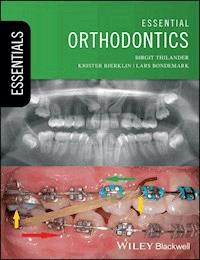
Essential Orthodontics is a comprehensive introduction to the biological principles of orthodontics. This book covers the why, when and how of orthodontics, enabling readers to identify which individuals need to be treated, to diagnose based on individual dentofacial development, and to understand the mechanical principles and tissue responses involved.
Divided into three parts, this authoritative resource covers pretreatment considerations, treatment principles of skeletal and dentoalveolar anomalies, and tissue response to orthodontic and orthopaedic forces. Classification of malocclusions and craniofacial growth and development are discussed, and the text explores how to distinguish between normal occlusion and malocclusions. Essential Orthodontics outlines how to perform a comprehensive orthodontic examination leading to an orthodontic diagnosis, and the formation of a treatment plan.
Following a student-friendly layout with key objectives and chapter summaries, Essential Orthodontics is an accessible yet comprehensive resource for both undergraduate and postgraduate dental students.
Sie lesen das E-Book in den Legimi-Apps auf:
Seitenzahl: 330
Veröffentlichungsjahr: 2017
Ähnliche


















Table of Contents
Cover
Title Page
Copyright
List of Abbreviations
Preface
Acknowledgement
Part 1: Pretreatment Considerations
Chapter 1: Orthodontic panorama
Key topics
Learning objectives
Orthodontic panorama
Conclusions
Chapter 2: Classification of malocclusions
Key topics
Learning objectives
Normal occlusion and malocclusion
Discrepancies between the jaws
Functional disturbances
Anomalies within the jaws
Frequency of malocclusions
Orthodontic treatment needs
Conclusions
References
Chapter 3: Craniofacial growth and development
Key topics
Learning objectives
Introduction
Definitions of general growth
Developmental periods and growth in height (stature)
Standards of growth and development
Prenatal development of the face and jaws
Postnatal growth and development of the craniofacial complex
Development of the dentoalveolar complex
Growth of soft tissues
Prediction of growth
Conclusions
References
Chapter 4: Diagnostic examinations
Key topics
Learning objectives
Introduction
Interview and anamnesis
Extra oral examination
Functional examination
Intra oral examination
Model analysis
Radiographic analysis
Important examinations at different dental developmental stages
Conclusions
References
Part 2: Treatment Principles of Skeletal and Dentoalveolar Anomalies
Chapter 5: Sagittal, vertical and transversal discrepancies between the jaws
Key topics
Learning objectives
Introduction
Cephalometric analysis
Treatment of Angle Class II malocclusion
Treatment of Angle Class III malocclusion
Treatment of deep bite
Treatment of open bite
Treatment of posterior crossbite
Treatment of scissors bite
Conclusions
References
Chapter 6: Crowding of teeth
Key topics
Learning objectives
Introduction
Model analysis
Orthodontic appliances
Treatment strategies
Conclusions
References
Chapter 7: Spacing of teeth
Key topics
Learning objectives
Introduction
Median diastema
Missing maxillary incisors
Pathological migration of teeth due to periodontitis
Spacing in the posterior areas of the dentition
Partial edentulous dentitions
General spacing of teeth
References
Chapter 8: Malposition of single teeth
Key topics
Learning objectives
Introduction
Infraocclusion of primary molars
Ectopic eruption of maxillary first permanent molar
Impacted maxillary canines
Supernumerary teeth
Conclusions
References
Part 3: Tissue Response to Orthodontic and Orthopaedic Forces
Chapter 9: Tissue response to orthodontic forces
Key topics
Learning objectives
Introduction
Tooth-supporting tissues
Physiologic tooth migration
Orthodontic tooth movements
Hyalinisation phase
Transmission of orthodontic forces into cellular reactions
Biomechanical principles
Conclusions
References
Chapter 10: Tissue response to orthopaedic forces
Key topics
Learning objectives
Introduction
Response in condyles
Response in sutures
Conclusions
References
Chapter 11: Possible adverse tissue reactions
Key topics
Learning objectives
Introduction
Damage to teeth
Damage to tooth-supporting tissues
Allergic reactions
Pain during orthodontic treatment
Risk of temporomandibular disorders (TMD)
Conclusions
References
Chapter 12: Retention and post-retention outcome
Key topics
Learning objectives
Introduction
Retention
The concept relapse
Post-retention period
Conclusions
References
Index
End User License Agreement
Pages
vii
viii
ix
xi
1
3
4
5
7
8
9
10
11
12
13
14
15
16
17
18
19
21
22
23
24
25
26
27
28
29
30
31
32
33
34
35
36
37
38
39
40
41
42
43
44
45
46
47
48
49
50
51
52
53
54
55
56
57
59
60
61
62
63
64
65
66
67
68
69
70
71
72
73
74
75
76
77
78
79
81
82
83
84
85
86
87
88
89
90
91
92
93
94
95
96
97
99
100
101
102
103
104
105
106
107
108
109
110
111
113
114
115
116
117
118
119
120
121
122
123
124
125
126
127
128
129
130
131
132
133
135
136
137
138
139
140
141
142
143
144
145
147
148
149
150
151
152
153
155
156
157
158
Guide
Cover
Table of Contents
Preface
Part 1: Pretreatment Considerations
Begin Reading
List of Illustrations
Chapter 2: Classification of malocclusions
Figure 2.1 Angle Class I occlusion (normal occlusion).
Figure 2.2 Normal sagittal molar relation because of mesial movement of the mandibular molar (arrow). However, the intermaxillary canine relationship indicates a Class II malocclusion, and thus this case shows a Class II malocclusion.
Figure 2.3 Angle Class II malocclusion (postnormal occlusion).
Figure 2.4 Angle Class II division 1 malocclusion (a) with proclined maxillary incisors (red line in a), and Angle Class II division 2 malocclusion (b) with retroclined maxillary central incisors (purple line in b).
Figure 2.5 Angle Class III malocclusion (prenormal occlusion).
Figure 2.6 Open bite in the front between the jaws.
Figure 2.7 Deep bite.
Figure 2.8 A deep bite with contact between the edges of the mandibular incisors and the palatal mucosa behind the maxillary incisors.
Figure 2.9 Unilateral crossbite on the right side of the individual, and there has been a forced guidance of the mandible, deviating the midline to the crossbite side (arrow).
Figure 2.11 Bilateral crossbite.
Figure 2.10 A scissors bite of maxillary left first and second premolar.
Figure 2.12 Establishment of an anterior crossbite with functional shift. In a centric relationship, there is an edge-to-edge contact between maxillary and mandibular incisors (a). When the bite is closing, the mandible is guided in a forward/anterior direction and an anterior crossbite is created (b).
Figure 2.13 Undersized alveolar process, resulting in a small apical base with proclined incisors. The shaded area visualizes the small apical base.
Figure 2.14 Large apical base resulting in vertical position of the maxillary incisors. The shaded area visualizes the large apical base.
Figure 2.15 Crowding of teeth in the maxillary and mandibular anterior regions.
Figure 2.16 Spacing between the maxillary central incisors, i.e. a median diastema.
Figure 2.17 A pronounced frenula (arrow) that keeps the central incisors away from each other, resulting in a large median diastema.
Figure 2.18 Congenital absence, agenesis, of a maxillary left lateral incisor. The left canine is now in the position of the lateral incisor (arrow).
Figure 2.19 A supernumerary tooth in the maxillary incisor region, i.e. a mesiodens (arrow).
Figure 2.20 An ectopic erupted maxillary first permanent molar, and the molar has resorbed the distal part of the second primary molar.
Figure 2.21 Bilaterally, the arrows point at the bumps buccally above the primary canines, indicating bilateral normal erupting canines.
Figure 2.22 An ectopic positioned maxillary left canine. The position of the canine crown is far mesial than normal, and the primary canine is persisting (arrow).
Figure 2.23 Infra occlusion of the primary maxillary and mandibular second molars (arrows).
Figure 2.24 Transposition of the first maxillary premolar and canine. The premolar is mesially to the canine (arrows).
Figure 2.25 An individual showing multiple malocclusions, in this case Angle Class II division 1 malocclusion (a), together with deep bite and spacing (b).
Chapter 3: Craniofacial growth and development
Figure 3.1 Mean growth in body height and velocity for Swedish boys and girls from 5 years of age to 31 years. Girls – dotted lines.
Figure 3.2 At the top, the mesoderm on each side of the neural tube splits into segments (somites) in an embryo at 4 weeks. At the bottom is seen a mid-sagittal section with the primitive oral cavity.
Figure 3.3 Drawing of the roof of the stomatodeum.
Figure 3.4 A child with a cleft lip.
Figure 3.5 Drawings of different stages in development of the secondary palate, anterior section.
Figure 3.6 A palatal cleft (a), a unilateral CLP (b), a bilateral CLP (c).
Figure 3.7 Diagram illustrating the proportions in body height at different ages. Note the relation between the head and the body at the different ages.
Figure 3.8 Superimposed tracings from individuals of 5 to 31 years of age and with normal occlusion.
Figure 3.9 Illustration of relocation (drift) of the maxillary palate. Photomicrograph showing cuboidal cells at the resorption area (a), periosteal resorption on the nasal side and deposition on the oral side (b), and photomicrograph showing flat bone lining cells at the deposition area (c).
Figure 3.10 Drawing illustrating timing of the termination of growth in different parts of the cranial base.
Figure 3.11 Illustration of relocation (drift) of the maxillary palate from 7 to 30 years of age. Resorption of the nasal floor and deposition on the roof of the palate.
Figure 3.12 Schematic illustration of the combined effect of drift and displacement.
Figure 3.13 In 9 boys, the mean growth changes from the age of 4 years until adulthood (Björk and Skieller, 1977). Apposition at the floor of the orbit (O), sutural lowering of the maxilla (Su), apposition at the infrazygonatic crest (C), resorptive lowering of the nasal floor (Re), and increase in height of the alveolar process (A).
Figure 3.14 Variability in condylar growth from 3 years before to 3 years after puberty and measured by the implant method (Björk and Skieller, 1972). The values indicate case numbers of boys and girls. Note the curved paths of growth and variability in direction of growth relative to ramus line (RL
A
).
Figure 3.15 Tracings of cephalograms superimposed on the skull base. To the left, anterior (upward) rotation from 11 years and 7 months to 17 years and 7 months of age. To the right, posterior (downward rotation) from 10 years and 6 months to 15 years and 6 months of age.
Figure 3.16 Development of the mandible with its complex sequence of remodelling changes.
Figure 3.17 The palatal height increases during tooth eruption.
Figure 3.18 Diagram showing mean increase in palatal height (mm) from 5 to 31 years of age; males (blue line) and females (red line).
Figure 3.19 The mesiodistal tooth widths of deciduous molars are larger than the permanent teeth (premolars). Usually the sum of the primary tooth widths is greater than that of their permanent successors. Therefore, when these primary teeth fall out, there is usually a slight amount of space of about 2 to 3 mm per side in the mandible and 1 to 2 mm in the maxilla.
Chapter 4: Diagnostic examinations
Figure 4.1 Check-list for registrations at the examination.
Figure 4.2 A straight profile (a), a convex (b), and a concave profile (c).
Figure 4.3 A 9-year-old girl with incomplete lip closure because of a large overjet (a,b).
Figure 4.4 Normal (a), small (b), and large nasio-labial angle (c).
Figure 4.5 A marked mentolabial fold (arrow) indicating high muscular strain on the mandibular incisors. Frontal view (a) and lateral view (b).
Figure 4.6 A normal vertically proportioned face, that is, one-third from the hairline to the nose (yellow line), one-third is the length of the nose (red line), and one-third is the lips and chin (black line).
Figure 4.7 A long vertical face: note the increased vertical height of the lower third of the face (white line).
Figure 4.8 Extra oral photos with the usual views, i.e. frontal, facial three-quarters and profile at rest (a–c) and smiling (d–f).
Figure 4.9 Intra oral photos: right, frontal, left occlusion (a–c), and occlusal view of the maxillary (d) and mandibular jaw (e).
Figure 4.10 Study models covering all teeth, the palate and the alveolar processes (a–e).
Chapter 5: Sagittal, vertical and transversal discrepancies between the jaws
Figure 5.1 Examples of reference points used in the cephalometric analysis according to Björk (1955).
Figure 5.2 Important reference lines and angles according to Björk (1955). Lines: NSL = cranial base line; NL = nasal line; ML = mandibular line. Angles: SNA = sagittal relation of the maxilla; SNB = sagittal relation of the mandible; ANB = sagittal inter jaw relation; ILs/NL maxillary incisor inclination; Ili/ML = mandibular incisor inclination; NSL/NL = vertical inclination of the maxilla; NSL/ML = vertical inclination of the mandible; NL/ML = vertical inter jaw relation.
Figure 5.3 Class III skeletal relation, i.e. a negative ANB angle implying the SNA angle (the angle between the black and blue line) is smaller than the SNB angle (the angle between the black and red line).
Figure 5.4 Class II skeletal relation, i.e. a positive ANB angle implying the SNA angle (black and blue line) is larger (>5 degrees) than the SNB angle (black and red line).
Figure 5.5 Low-angle or hypodivergent case, the angle between NSL and ML is small implying a skeletal deep overbite.
Figure 5.6 High-angle or hyperdivergent case, the angle between NSL and ML is large implying a skeletal open bite.
Figure 5.7 In this case the intention is with a functional appliance to move the mandible forward (a) for correction of the Class II malocclusion and simultaneously opens the bite as well as retroclination of the maxillary incisors (blue arrow) and proclination of mandibular incisors (white arrow in b). In (c), the occlusal acrylic over the mandibular molars and premolars has been removed to allow those teeth to vertically over-erupt (blue arrows), and thereby create bite opening. The functional appliances can also be combined with a headgear (d) to restrain the forward growth of the maxilla (red arrow).
Figure 5.8 Class II elastics for correction of a Class II malocclusion. The objective is to create a Class I occlusion by distal movement of the maxillary teeth (green arrow) and mesial movement of the corresponding mandibular teeth (red arrow). The force distribution of Class II elastics also results in a bite opening effect (yellow arrows).
Figure 5.9 A casted Herbst appliance (a). The Herbst appliance in place with a forward movement of the mandible to an almost incisal edge-to-edge relation (b,c). A firm Class I occlusion result after treatment (d,e).
Figure 5.10 In this Class II malocclusion case with normal skeletal relationship between the jaws (a), bilateral extraction of the maxillary first premolars has been performed and then a fixed appliance in both jaws was inserted (b). The final treatment result (c) with a Class I relation between the canines and Class II relation between the molars.
Figure 5.11 In (a), a removable appliance for correction of a Class III malocclusion (pseudo Class III) with a protrusion spring for proclination of the maxillary incisors (blue arrow). In (b), bilateral occlusal coverage (red arrow) of the maxillary posterior teeth to avoid vertical interlock between the incisors in crossbite. To retrocline the mandibular incisors, a labial bow has been inserted (blue arrow).
Figure 5.12 Fixed multibracket appliance for proclination of the maxillary incisors (red arrows) in a pseudo Class III malocclusion case.
Figure 5.13 Class III elastics for correction of a Class III malocclusion. The objective is to create a Class I occlusion by mesial movement of the maxillary teeth (red arrow) and distal movement of the corresponding mandibular teeth (blue arrow). The force distribution of Class III elastics also results in a bite opening effect (yellow arrows).
Figure 5.14 The reverse headgear (a) will be applied with elastics to a removable appliance in the maxilla (b) and move the jaw and teeth in a mesial direction (red arrow).
Figure 5.15 A fixed bite plane cemented with bands on the first maxillary molars (a). In occlusion, the mandibular incisors are in contact with the bite plane and between the maxillary and mandibular premolars and molars, a separation space of 3 to 4 mm is created (b), for vertical development of the lateral segments (yellow arrows) and thereby bite opening.
Figure 5.16 In (a,b), a removable appliance with a vertical crib.
Figure 5.17 A transpalatal bar soldered to the maxillary first molar bands (a). Since the bar is 6 to 8 mm away from the palatal mucosa, there will be pressure by the tongue on the bar and this pressure causes intrusion forces on the maxillary first molars. A clear imprint by the bar can be seen on the tongue (b), indicating pressure by the bar on the tongue.
Figure 5.18 A Quad Helix. When the Quad Helix is inserted, the lingual arch with the 4 loops are transversally compressed, resulting in expansion forces on the teeth (blue arrows).
Figure 5.19 A removable acrylic expansion plate is retained with clasps on the maxillary first permanent molars and the deciduous first molars. The screw in the middle of the plate is activated once or twice a week (0.2–0.4 mm), producing transversal expansion forces on the teeth (red arrows).
Figure 5.20 In (a), a cross-elastic between a palatal placed bracket on the right maxillary first molar and a buccal bracket on the right mandibular first molar. In (b), the maxillary molar is moved buccally and the mandibular molar lingually (yellow arrows). Both molars are also extruded (red arrows).
Figure 5.21 A RME appliance cemented on the maxillary first premolars and molars (a). The central screw is activated once or twice a day corresponding to an expansion of between 0.2 and 0.4 mm. Intra oral radiographs of maxillary incisors before and after RME (b,c). The X-ray image (c) shows a clear widening of the median palatal suture (yellow arrow). After expansion, a multibracket fixed appliance has created good alignment of the teeth (d), and the result after 1.5 years of treatment (e).
Figure 5.22 A modified Haas-type RME appliance for expansion in the early mixed dentition. Note that the appliance is only anchored on the maxillary deciduous canines and second molars. Photos with permission of Dr Marco Rosa, Italy.
Figure 5.23 A bilateral completely scissors bite (a). A fixed lingual arch with bands on mandibular first molars for transversal expansion of the mandibular arch (b). Transversal expansion of the mandibular arch achieved after 5 months' treatment (c).
Chapter 6: Crowding of teeth
Figure 6.1 Arch length, from the mesial surface of the first permanent molar to the distal surface of the lateral incisor (the line at the blue arrow). The anterior length represents the distance between the mesial surface of the canine and the midline of the dental arch (the line at the red arrow). The intercanine width is the distance between the crown tips of the canines (the red line).
Figure 6.2 Models with a small apical base, shaded area in the drawing (a,c), the skeletal base is not sufficiently large for the teeth and therefore the incisors are proclined. A large apical base (b,d) resulting in vertical positions of the teeth.
Figure 6.3 Slight anterior mandibular incisor crowding in the mixed dentition (a) and the crowding will most often self-correct during the development to the permanent dentition as observed in this case (b).
Figure 6.4 A moderate anterior crowding, and in this case it is recommended to slice off the mesial surfaces of the deciduous left canine (blue arrow) to create extra space for the lateral incisor to self-align.
Figure 6.5 The maxillary arch of a 10-year-old girl showing crowded incisors (a). Some years later (b), after extraction of the primary canines and extraction of the first premolars. The incisors are spontaneously corrected and only a short period with fixed appliance remains to correct the left premolar and to close the small spacings.
Figure 6.6 The maxillary premolars and molars on the left side have moved mesially, resulting in a Class II malocclusion and a crowded maxillary left canine (a). After distal molar movement of 4 mm during 6 months (b) and a subsequent multibracket fixed appliance (c). The result one year after treatment (d).
Figure 6.7 In this crowded case (a), transversal expansion with a multibracket fixed appliance has been achieved (b), and a final good alignment of the teeth has been created (c).
Figure 6.8 In the Invisalign technique, a series of aligners are used, and in (a) one of the aligners. Before treatment and a slight crowding of maxillary central incisors (b). The aligners inserted in both jaws (c), and after 4 months of treatment, the central incisors are almost fully aligned (d). Photos with permission of Dr Thor Henrikson.
Figure 6.9 In (a), a miniscrew (TAD) has been inserted between the roots of the maxillary second premolar and first molar to create reinforced anchorage during space closure. In (b), two TADs (miniscrews) have been inserted in the palate for anchorage support during distal molar movement.
Figure 6.10 In (a, b), shows a severe crowded case solved by bilateral first premolar extractions in each jaw followed by bimaxillary fixed multibracket appliance (c, d). The final result (e, f).
Figure 6.11 In slight crowding cases, enamel reduction can be assessed to create space. In (a), the reduction is performed by a diamond strip and in (b), by an air-rotor drill.
Chapter 7: Spacing of teeth
Figure 7.1 Median diastema with a hypertrophic frenulum.
Figure 7.2 A median diastema before treatment (a) and the result after closure with a fixed orthodontic appliance (b).
Figure 7.3 A maxillary left central incisor was replaced by a transplanted premolar 13 years ago because of trauma. The white arrow points at the restored premolar.
Figure 7.4 Agenesis of the lateral incisors. The maxillary canines have erupted close to and in contact with the central incisors.
Figure 7.6 The maxillary left canine has replaced the missed lateral incisor and adjacent to the canine is an implant-supported crown (canine) with a discoloured mucosa along the implant (white arrow) two years after treatment.
Figure 7.7 A transplanted maxillary third molar (white arrow) that has replaced the missed mandibular second premolar.
Chapter 8: Malposition of single teeth
Figure 8.1 At the age of 11.6 years, the mandibular second primary molars are in occlusion, and there is agenesis of the mandibular second premolars (a). Two years later, infraocclusion is evident on both primary molars (b). At the age of 16, a more pronounced infraocclusion on the second primary molars and the first premolars have started to tip distally (c).
Figure 8.2 Severe infraocclusion of the mandibular right first permanent molar, age 12 (a). Further tipping of the adjacent teeth (b). Space gaining and surgical exposure of the infraoccluded permanent molar (c). After orthodontic traction, the molar has erupted into occlusion (d).
Figure 8.3 Girl, 6 years of age, maxillary first permanent molars in ectopic eruption and atypical resorption on the second primary molars (a,b). Right second primary molar is lost and severe space deficiency for the second premolar due to mesial movement of the first permanent molar (c). In (d), the left permanent molar has freed itself and shows reversible ectopic eruption.
Figure 8.4 Left radiograph, girl, 7 years of age, with maxillary left permanent molar in ectopic eruption; the molar is still locked in the resorption distally on the second primary molar. Middle radiograph, 1 year later. The molar has freed itself, and the resorption is increased. Radiograph to the right shows the situation at the age of 9.5 years, with a hard tissue repair. In a follow-up study of 92 cases with resorbed second primary molar, 15 teeth showed hard tissue repair of the structure of the primary tooth, and this could be seen both on the radiographs and histologically (Kurol and Bjerklin, 1982a, 1982b).
Figure 8.5 To avoid influencing growth of the jaw, a local space maintainer can be recommended in cases where space should be maintained until eruption of the second premolar.
Figure 8.6 Both maxillary canines are impacted, and 3 of the maxillary incisors are resorbed.
Figure 8.7 After extraction of primary canines (arrows point to the extracted primary canines). A favourable change in eruptive pathway was seen, leading to uneventful eruption.
Figure 8.8 Severe space deficiency in the maxilla and ectopic position of the two maxillary canines (a). It is not possible to diagnose any root resorption on the right lateral incisor (white arrow). In (b), the CT slice shows severe root resorption on both the lateral incisors.
Figure 8.9 Maxillary right canine in a normal eruption and position. The left canine in ectopic position palatally displaced with a widened follicle (white arrow).
Figure 8.10 In (a), a case with a slight resorption of the maxillary left central incisor root. Orthodontic traction (white arrow) of the left canine away from the incisor root after surgical open exposure. In (b), with aid of a sectional arch, the canine is moved away from the incisor root after surgical closed exposure.
Figure 8.11 A peg-shaped mesiodens (black arrow) and an impacted canine (blue arrow).
Figure 8.12 In cases with two mesiodentes (black arrows), the crowns are most often positioned in different directions. About 25% of the patients with mesiodens have two mesiodentes.
Chapter 9: Tissue response to orthodontic forces
Figure 9.1 The PDL fibres: alveolar-crest fibres (ACF), apical fibres (AF), gingival fibres (GF), horizontal fibres (HF), oblique fibres (OF) and interradicular fibres (RF).
Figure 9.2 Area from a 22-year-old patient. Chain of cementoblasts (C) along a thick layer of cementum. Widened capillary in a cleft, where bone resorption may start during the initial stage of tooth movement (W). Darkly stained surface line containing connective tissue polysaccharides (D) and note the absence of osteoblasts along the bone surface. Embedded principal fibres in the cementum of the tooth (E).
Figure 9.3 Physiologic migration in the rat in the interdental area in direction of the black arrow. Resorptive alveolar bone surface (rB, and at open arrows). Depository alveolar bone surface (dB). Older fibres (oF) included in the new bone formation by osteoclasts. New fibrils (nF) near the bone surface and in the middle of the PDL. Osteoblasts (C) and dentin (D).
Figure 9.4 In the drawing to the left (a), location of bone resorption adjacent to the apical third of a maxillary canine. The tooth was moved continuously for 3 weeks. Compensatory formation of osteoid in open marrow spaces (o) and remnants of hyalinised tissue adhering to the root surface (h). Direct bone resorption adjacent to the apical third of the root (D). In (b) to the right, direct resorption with osteoclasts along the bone surface (D) and absence of epithelial remnants in adjacent periodontal tissue, i.e. centre of the formerly cell-free zone (C). The tooth root (R), and the blue arrows show the force and tooth movement direction.
Figure 9.5 To the left, in most cases, tooth movement is initiated by formation of a cell-free area (A) and new osteoid at (C). The pressure site (A1) and tension site (B1). To the right, a maxillary first premolar in a 12-year-old patient represents the area A in the Figure to the left. Root surface (R) and remaining pyknotic cell nuclei in hyalinised tissue (P). Direct bone resorption with osteoclasts (D).
Figure 9.6 Photomicrograph of the hyalinised zone (H) between alveolar bone (B) and root surface of the tooth (T). Alveolar bone resorption occurs from marrow spaces (blue arrow) and small arrows indicate thin line of bone between the resorbed bone and hyaline tissue. Small amount of root resorption (green arrow) at the border of the hyaline zone (adapted from Brudvik and Rygh, 1993).
Figure 9.7 Photomicrographs of the root resorption and repair sequence of the compressed PDL 21 days after tooth movement in the direction of the black arrows. Cementum (C), dentin (D) and hyalinised zone (H). To the left (a), neighbouring section with repair of peripheral parts of resorption lacunae by deposition cementum (thin arrows). In the middle (b), the length of the hyalinised zone (between the two open arrows) after 3 days of compression. To the right (c), the length of root resorption (between the two open arrows) after 21 days of tooth movement. Note the regular arrangement of the PDL cells and fibres in the peripheral part of the resorption lacunae (medium arrows). In the central part of resorption area (small open arrow), no trace of fibres is connected with the root surface. The small black arrows show the demarcation line between old bone (B) and new bond (b) in crest area (adapted from Brudvik and Rygh, 1995).
Figure 9.8 To the left (a), superficial root resorption (blue arrows). In (b), magnification of the root resorption area in the Figure to the left. Dentin (D) and dentinoclasts (DC). In (c), repaired lacuna with demarcation (De), secondary cementum (SC), dentin (D) and periodontal ligament (PDL).
Figure 9.9 Effect on pressure side of a maxillary premolar of a 12-year-old. The tooth is moved as indicated by the blue arrow. An osteoid layer that persists (OL) bordered the alveolar bone. Extensive bone resorption (R) has occurred in the area subjacent to this osteoid tissue. The bone surface is lined with osteoclasts (OC).
Figure 9.10 Effect of a force of 45 cN during 36 hours on the tension side of a second incisor. The tooth is moved as indicated by the blue arrow. Note the increase and spreading of new cells in areas close to the bone surface and to the stretched fibre bundles. Tooth root (T), interstitial space (IS) proliferating osteoblasts (OB) between fibre bundles and increase osteoid tissue (O).
Figure 9.11 A tipping force of the tooth (the arrow show the force direction). Two hyalinised zones will be the result, one on the pressure side (H) and another in the apical region (HA). Centre of resistance (x).
Figure 9.12 To the left (a), torqueing of a maxillary premolar. The arrows show the force directions and movements. The photomicrograph to the right (b), showing the pressure side in a 12-year-old patient after torqueing movement performed in the apical region with a force of 120cN during 2 weeks. As indicated by the presence of epithelial remnants, no hyalinization of the PDL has occurred. Tooth root surface (T), osteoclasts (OC) along the bone surface and epithelial remnants (E).
Figure 9.13 Torque movements resulting in bone fenestrations of the root tips of the left central and lateral incisors (arrows).
Figure 9.14 Two stages of bodily tooth movement; the arrows denote tooth movement directions. The drawing to the left (a), shows the effect observed during the initial stage of a continuous bodily movement. Hyalinised tissue/area (A) and slight compression (B), because of the initial tipping of the tooth. In the Figure in the middle (b), after the initial phase, a gradual upright positioning of the tooth caused increased bone resorption on the pressure side (A) and bone deposition along the stretched fibre bundles (B). The photomicrograph to the right (c), shows a bodily movement, with the blue arrow showing the tooth movement direction of a premolar in a dog during a period of 6 months. New bone layers on the tension side with osteoblasts (O) and small root resorption on the pressure side (R).
Figure 9.15 Experimental rotation of a maxillary second incisor in a dog. Formation of two pressure and tension sides. Demarcation line between old and new bone layers (B) and pressure side with root resorption (R).
Figure 9.16 To the left (a), arrangement of fibre bundles during and after extrusion of a maxillary central incisor. New bone layers at the alveolar fundus (B). To the right (b), relaxation of the free gingival fibres during intrusion. Bone spicules laid down according to the direction of the fibre tension (A) and relaxed supra-alveolar tissue (B).
Chapter 10: Tissue response to orthopaedic forces
Figure 10.1 To the left, normal occlusion with bilateral normal position of the mandible condyle in the fossae. To the right, a unilateral left posterior crossbite has resulted in changed condylar position in the glenoid fossae.
Figure 10.2 In (a), deviation of the chin to the posterior crossbite side (red arrow), resulting in a facial asymmetry of the young girl. In (b), the unilateral crossbite (red arrow indicates deviation to the right side). In (c), a young adult with an untreated unilateral right-sided posterior crossbite. Deviation of the chin to the right (red arrow).
Figure 10.3 Photomicrographs from the human intermaxillary suture. To the left (a), in young ages the collagen fibres perpendicular to the bony surface. In the middle (b), the thickness and density of fibres have increased with age. To the right (c), after 14 years of age, a stage to bony obliteration.
Figure 10.4 To the left (a), a rapid maxillary appliance has been inserted to expand the intermaxillary suture, no expansion yet started. In the middle (b), after 21 days of expansion and a clearly widened suture. To the right (c), deposition of bone in the widened suture to allow the suture to recover.
Chapter 11: Possible adverse tissue reactions
Figure 11.1 In (a), general WSLs after 1.5 years of treatment with fixed appliance, and in (b), another patient showing normal enamel conditions after fixed appliance therapy.
Figure 11.2 The green arrow pointing to a superficial resorption defect of the root and the defect rather close to the hyalinised zone (H). The alveolar bone (B) and root surface of the tooth (T).
Figure 11.3 In (a), maxillary right central and lateral incisor before orthodontic treatment, and in (b), the same teeth after treatment and with minor (2–3 mm) apical root resorptions (white arrows).
Figure 11.4 In (a), a patient with fixed appliance showing general gingival inflammation and bad oral hygiene. In (b), another patient showing how the oral hygiene should appear when treatment with fixed appliance is performed.
Figure 11.5 In (a), before treatment of crowding, and in (b), the same patient after treatment (proclination of mandibular incisors) and a small gingival recession has occurred (blue arrow).
Figure 11.6 The apex of the maxillary left central incisor has been displaced through the cortical bone (arrows), because of too much torqueing movement.
Figure 11.7 In (a), bitewing radiograph showing the marginal bone level before orthodontic treatment. In (b), after 2 years of treatment with a fixed appliance using bands on first molars. The white arrows indicate a loss of marginal bone of approximately 0.1 to 0.3 mm on the mesial and distal surface of the maxillary right molar.
Figure 11.8 Pronounced oedema and erythema of the lips in a nickel-sensitive patient treated with fixed appliance of stainless steel.
Figure 11.9 In (a), a nickel-sensitive patient using a plastic encased outer bow of a headgear. In (b), another nickel-sensitive patient bonded with brackets made of ceramics and in whom bands of titanium and a titanium molybdenum arch wire have been inserted.
Chapter 12: Retention and post-retention outcome
Figure 12.1 A retainer bonded to all maxillary canines and incisors (a). In (b), the maxillary retainer is bonded to the four incisors. In (c), a canine-to-canine is inserted and bonded to the mandibular canines only, while in (d), the retainer is bonded to both mandibular canines and all incisors.
Figure 12.2 The Jensen retainer with its typical labial arch wire for stabilization of the maxillary incisors (a), and in (b), the occlusal view of the retainer.
Figure 12.3 The Essix retainer is a vacuum-formed stent that is entirely made of transparent plastic that fits over all or mostly all teeth in the jaw (a), and the occlusal view of the retainer (b).
Figure 12.4 In (a), before treatment, and in (b), after treatment. In (c), relapse of one of the mandibular incisors.
Figure 12.5 In (a), a male 16 years of age with Class I occlusion, acceptable and small crowding of mandibular incisors, congenitally missing 3rd molars and no treatment needed. In (b), the same subject at 31 years of age and still Class I occlusion but now high demand for orthodontic treatment because of severe crowded mandibular incisors. Note also the diminished intercanine width of approximately 2 mm that have arisen between 16 and 31 years of age (black line versus blue line).
List of Tables
Chapter 2: Classification of malocclusions
Table 2.1 A compilation of average frequency figures of the most common malocclusions occurring between mixed and permanent dentition
Chapter 3: Craniofacial growth and development
Table 3.1 Time and order of emergence of permanent teeth (based on data of Helm and Seidler, 1974)
Table 3.2 Classification of age groups into developmental periods, based on dental stages (DS)
Essential Orthodontics
Birgit Thilander
Former Professor Emerita, Odont Dr (PhD), DDS Institute of Odontology Sahlgrenska Academy University of Gothenburg Gothenburg Sweden
Krister Bjerklin
Associate Professor, Odont Dr (PhD), DDS Department of Orthodontics The Institute for Postgraduate Dental Education in Jönköping Jönköping Sweden
Lars Bondemark
Professor, Odont Dr (PhD), DDS Department of Orthodontics Faculty of Odontology Malmö University Malmö Sweden
This edition first published 2018
© 2018 John Wiley & Sons, Ltd
First Edition
All rights reserved. No part of this publication may be reproduced, stored in a retrieval system, or transmitted, in any form or by any means, electronic, mechanical, photocopying, recording or otherwise, except as permitted by law. Advice on how to obtain permission to reuse material from this title is available at http://www.wiley.com/go/permissions.
The right of Birgit Thilander, Krister Bjerklin and Lars Bondemark to be identified as the authors of this work has been asserted in accordance with law.
Registered Offices}: John Wiley & Sons, Inc., 111 River Street, Hoboken, NJ 07030, USA
John Wiley & Sons Ltd, The Atrium, Southern Gate, Chichester, West Sussex, PO19 8SQ, UK
Editorial Office: 9600 Garsington Road, Oxford, OX4 2DQ, UK
For details of our global editorial offices, customer services, and more information about Wiley products visit us at www.wiley.com.
Wiley also publishes its books in a variety of electronic formats and by print-on-demand. Some content that appears in standard print versions of this book may not be available in other formats.
Limit of Liability/Disclaimer of Warranty




