


51,99 €
Mehr erfahren.
- Herausgeber: John Wiley & Sons
- Kategorie: Fachliteratur
- Serie: Essentials of Psychological Assessment
- Sprache: Englisch
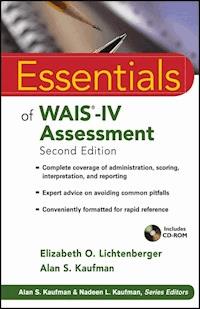
Quickly acquire the knowledge and skills you need to confidently administer, score, and interpret the WAIS¯®-IV Coauthored by Alan S. Kaufman, who was mentored by David Wechsler--the creator of the Wechsler scales--Essentials of WAIS¯®-IV Assessment, Second Edition is thoroughly revised and updated to provide beginning and seasoned clinicians with comprehensive step-by-step guidelines for effective use of the WAIS¯®-IV. This invaluable guide provides clinicians with a brand new interpretive process, overhauling its system of profile interpretation to be equally powerful across the entire WAIS¯®-IV age range. Like all the volumes in the Essentials of Psychological Assessment series, this book is designed to help busy mental health professionals quickly acquire the basic knowledge and skills they need to make optimal use of a major psychological assessment instrument. Each concise chapter features numerous callout boxes highlighting key concepts, bulleted points, and extensive illustrative material, as well as test questions that help you gauge and reinforce your grasp of the information covered. The new edition explores timely topics including gender and ethnic differences, as well as the role of the Flynn Effect in capital punishment court cases. Along with an accompanying Website containing scoring tables and case report material, the Second Edition includes information and advice on how to administer Q-interactive¯(TM)--the new digital version of the test--for administration of the WAIS¯®-IV via iPad¯® Essentials of Assessment Report Writing Essentials of WISC¯®-IV Assessment, Second Edition Essentials of WMS¯®-IV Assessment Essentials of Cross-Battery Assessment, Third Edition Essentials of WJ III¯(TM) Tests of Achievement Assessment Essentials of WJ III¯(TM) Cognitive Abilities Assessment, Second Edition Essentials of Neuropsychological Assessment, Second Edition Visit us on the Web at: wiley.com/psychology
Sie lesen das E-Book in den Legimi-Apps auf:
Seitenzahl: 794
Veröffentlichungsjahr: 2012
Ähnliche


















Contents
Cover
Series Page
Essentials of Psychological Assessment Series
Title Page
Copyright
Dedication
Series Preface
Preface to the Second Edition
Acknowledgements
Chapter 1: One Introduction and Overview
Introduction
History and Development
Binet-Simon Scales
Terman's Stanford-Binet
World War I Tests
Wechsler's Creativity
WAIS-IV and Its Predecessors
Wechsler-Bellevue Subtests That Survive on the WAIS-IV
Wechsler's Legacy
Purposes of Assessing Adults and Adolescents
Foundations of the WAIS-IV: Theory and Research
Standardization and Psychometric Properties of the WAIS-IV
Ethnic Differences in IQ
Overview of Ethnic Differences on the WAIS-IV
Comprehensive References on Test
Chapter 2: Two How to Administer the WAIS-IV
Appropriate Testing Conditions
Rapport with Examinee
Testing Individuals With Special Needs
Administration Considerations
Subtest-by-Subtest Rules of Administration
Chapter 3: Three How to Score the WAIS-IV
Types of Scores
Step-by-Step: How the WAIS-IV Is Scored
Chapter 4: Four How to Interpret the WAIS-IV: Conceptual and Clinical Foundations
Intelligent Testing Philosophy
Tying Together the Tenets of Intelligent Testing
Qualitative and Clinical Analyses of the WAIS-IV
Subtest-by-Subtest Qualitative and Clinical Analyses
Chapter 5: Five How to Interpret the WAIS-IV: Step-by-Step
Introduction to Interpretation
Steps 1–3: Analyze the FSIQ and the Index Profile
Introduction to Steps 4–10: Two Paths of Interpretation
Introduction to Steps 11–12: Analyzing Planned Clinical Comparisons
Chapter 6: Six Clinical Applications I: A Neuropsychological Approach to Interpretation of the WAIS-IV and the Use of the WAIS-IV in Learning Disability Assessments
Introduction
Levels of Interpretation
Neuropsychological Interpretation of WAIS-IV Performance
What Do the Verbal Comprehension Subtests Measure?
What Do the Perceptual Reasoning Subtests Measure?
What Do the Working Memory Subtests Measure?
What Do the Processing Speed Subtests Measure?
Learning Disability Assessment and the WAIS-IV
Constraints on Learning and Production
Conceptions of Learning Disability
Ability and Achievement Deficit Model of Learning Disability
Reporting WAIS-IV Results in an Integrated Report Format
Chapter 7: Seven Clinical Applications II: Age and Intelligence Across the Adult Life Span
Do Cognitive Abilities Decline With Advancing Age? A Cross-Sectional Approach
Does IQ Decline With Advancing Age? A Longitudinal Approach
Two Groundbreaking Longitudinal Investigations of IQ and Aging
Longitudinal Investigations of Wechsler's Scales Using Independent Samples
Longitudinal Study of WAIS-III and WAIS-IV Factor Indexes
Overview of the Wechsler Longitudinal Investigations With Independent Samples
Interpretation of Cognitive Decline: Speed or Problem Solving
Can Cognitive Decline Be Slowed or Predicted in Advance?
Chapter 8: Eight Clinical Applications III: WAIS-IV Use With Special Groups, Practice Effects, and Gender Differences
Individuals With Autistic Disorder and Asperger's Disorder
Individuals Who Are Intellectually Gifted
Individuals With Intellectual Disability or Borderline Intellectual Functioning
Individuals With Attention-Deficit/ Hyperactivity Disorder
Individuals With Learning Disabilities in Reading or Mathematics
Individuals With Traumatic Brain Injury
Individuals With Major Depression
Individuals With Probable Alzheimer's-Type Dementia and Mild Cognitive Impairment
Comparison of the Verbal Comprehension Index and the Perceptual Reasoning Index for the Clinical Samples
Comparisons Involving the FSIQ, GAI, and CPI for the Clinical Samples
Comparison of the Working Memory Index and the Processing Speed Index for the Clinical Samples
Clinical Samples With Relatively Low Scores on the Processing Speed Index
Utility of the Process Approach
Clinical Samples With Notable Differences Between Scaled Scores on Digits Forward and Digits Backward
Interpretation of Gain Scores for Normal Samples
Interpretation of Gender Differences for Normal Samples
Gender Differences on Processing Speed
Gender Differences in Spatial Visualization
Clinical Implications of Gender Differences on Mental Tasks
Chapter 9: Nine Strengths and Weaknesses of the WAIS-IV
Strengths of the WAIS-IV
Weaknesses of the WAIS-IV
Chapter 10: Ten Illustrative Case Reports
Case Report: Laura O., Age 17, Impaired Social Skills, Poor Motivation, and Weak Attention Abilities
Case Report: Jim W., Age 64, Possible Dementia
Chapter 11: Eleven The Initial Digital Adaptation of the WAIS-IV
Overview
Administering WAIS-IV in Q-interactive Assess
Overview of WAIS-IV Subtest Designs
Evaluating the Quality of the Q-interactive WAIS-IV
Getting Started With Q-interactive
Conclusion
References
Annotated Bibliography
About the Authors
Author Index
Subject Index
About the CD-ROM
Introduction
What's on the CD
Troubleshooting
Customer Care
Customer Note: If This Book Is Accompanied by Software, Please Read the Following Before Opening the Package
Essentials of Psychological Assessment Series
Series Editors, Alan S. Kaufman and Nadeen L. Kaufman
Essentials of 16 PF ® Assessmentby Heather E.-P. Cattell and James M. Schuerger
Essentials of Assessment Report Writingby Elizabeth O. Lichtenberger, Nancy Mather, Nadeen L. Kaufman, and Alan S. Kaufman
Essentials of Assessment with Brief Intelligence Testsby Susan R. Homack and Cecil R. Reynolds
Essentials of Autism Spectrum Disorders Evaluation and Assessmentby Celine A. Saulnier and Pamela E. Ventola
Essentials of Bayley Scales of Infant Development–II Assessmentby Maureen M. Black and Kathleen Matula
Essentials of Behavioral Assessmentby Michael C. Ramsay, Cecil R. Reynolds, and R. W. Kamphaus
Essentials of Career Interest Assessmentby Jeffrey P. Prince and Lisa J. Heiser
Essentials of CAS Assessmentby Jack A. Naglieri
Essentials of Cognitive Assessment with KAIT and Other Kaufman Measuresby Elizabeth O. Lichtenberger, Debra Broadbooks, and Alan S. Kaufman
Essentials of Conners Behavior Assessments™by Elizabeth P. Sparrow
Essentials of Creativity Assessmentby James C. Kaufman, Jonathan A. Plucker, and John Baer
Essentials of Cross-Battery Assessment, Third Editionby Dawn P. Flanagan, Samuel O. Ortiz, and Vincent C. Alfonso
Essentials of DAS-II ® Assessmentby Ron Dumont, John O. Willis, and Colin D. Elliot
Essentials of Dyslexia Assessment and Interventionby Nancy Mather and Barbara J. Wendling
Essentials of Evidence-Based Academic Interventionsby Barbara J. Wendling and Nancy Mather
Essentials of Executive Functions Assessmentby George McCloskey and Lisa A. Perkins
Essentials of Forensic Psychological Assessment, Second Editionby Marc J. Ackerman
Essentials of IDEA for Assessment Professionalsby Guy McBride, Ron Dumont, and John O. Willis
Essentials of Individual Achievement Assessmentby Douglas K. Smith
Essentials of KABC-II Assessmentby Alan S. Kaufman, Elizabeth O. Lichtenberger, Elaine Fletcher-Janzen, and Nadeen L. Kaufman
Essentials of Millon™ Inventories Assessment, Third Editionby Stephen Strack
Essentials of MMPI-A™ Assessmentby Robert P. Archer and Radhika Krishnamurthy
Essentials of MMPI-2® Assessment, Second Editionby David S. Nichols
Essentials of Myers-Briggs Type Indicator ® Assessment, Second Editionby Naomi Quenk
Essentials of NEPSY®-II Assessmentby Sally L. Kemp and Marit Korkman
Essentials of Neuropsychological Assessment, Second Editionby Nancy Hebben and William Milberg
Essentials of Nonverbal Assessmentby Steve McCallum, Bruce Bracken, and John Wasserman
Essentials of PAI ® Assessmentby Leslie C. Morey
Essentials of Processing Assessmentby Milton J. Dehn
Essentials of Response to Interventionby Amanda M. VanDerHeyden and Matthew K. Burns
Essentials of Rorschach® Assessmentby Tara Rose, Nancy Kaser-Boyd, and Michael P. Maloney
Essentials of School Neuropsychological Assessment, Second Editionby Daniel C. Miller
Essentials of Specific Learning Disability Identificationby Dawn Flanagan and Vincent C. Alfonso
Essentials of Stanford-Binet Intelligence Scales (SB5) Assessmentby Gale H. Roid and R. Andrew Barram
Essentials of TAT and Other Storytelling Assessments, Second Editionby Hedwig Teglasi
Essentials of Temperament Assessmentby Diana Joyce
Essentials of WAIS ®-IV Assessment, Second Editionby Elizabeth O. Lichtenberger and Alan S. Kaufman
Essentials of WIAT ®-III and KTEA-II Assessmentby Elizabeth O. Lichtenberger and Kristina C. Breaux
Essentials of WISC ®-IV Assessment, Second Editionby Dawn P. Flanagan and Alan S. Kaufman
Essentials of WJ III™ Cognitive Abilities Assessment, Second Editionby Fredrick A. Schrank, Daniel C. Miller, Barbara J. Wendling, and Richard W. Woodcock
Essentials of WJ III™ Tests of Achievement Assessmentby Nancy Mather, Barbara J. Wendling, and Richard W. Woodcock
Essentials of WMS®-IV Assessmentby Lisa Whipple Drozdick, James A. Holdnack, and Robin C. Hilsabeck
Essentials of WNV™ Assessmentby Kimberly A. Brunnert, Jack A. Naglieri, and Steven T. Hardy-Braz
Essentials of WPPSI™-III Assessmentby Elizabeth O. Lichtenberger and Alan S. Kaufman
Essentials of WRAML2 and TOMAL-2 Assessmentby Wayne Adams and Cecil R. Reynolds
Cover image: © Greg Kuchik/Getty Images
Cover design: John Wiley & Sons, Inc.
This book is printed on acid-free paper.
Copyright © 2013 by John Wiley & Sons, Inc. All rights reserved.
Published by John Wiley & Sons, Inc., Hoboken, New Jersey.
Published simultaneously in Canada.
No part of this publication may be reproduced, stored in a retrieval system, or transmitted in any form or by any means, electronic, mechanical, photocopying, recording, scanning, or otherwise, except as permitted under Section 107 or 108 of the 1976 United States Copyright Act, without either the prior written permission of the Publisher, or authorization through payment of the appropriate per-copy fee to the Copyright Clearance Center, Inc., 222 Rosewood Drive, Danvers, MA 01923, (978) 750-8400, fax (978) 646-8600, or on the web at www.copyright.com. Requests to the Publisher for permission should be addressed to the Permissions Department, John Wiley & Sons, Inc., 111 River Street, Hoboken, NJ 07030, (201) 748-6011, fax (201) 748-6008.
Limit of Liability/Disclaimer of Warranty: While the publisher and author have used their best efforts in preparing this book, they make no representations or warranties with respect to the accuracy or completeness of the contents of this book and specifically disclaim any implied warranties of merchantability or fitness for a particular purpose. No warranty may be created or extended by sales representatives or written sales materials. The advice and strategies contained herein may not be suitable for your situation. You should consult with a professional where appropriate. Neither the publisher nor author shall be liable for any loss of profit or any other commercial damages, including but not limited to special, incidental, consequential, or other damages.
This publication is designed to provide accurate and authoritative information in regard to the subject matter covered. It is sold with the understanding that the publisher is not engaged in rendering professional services. If legal, accounting, medical, psychological or any other expert assistance is required, the services of a competent professional person should be sought.
Designations used by companies to distinguish their products are often claimed as trademarks. In all instances where John Wiley & Sons, Inc. is aware of a claim, the product names appear in initial capital or all capital letters. Readers, however, should contact the appropriate companies for more complete information regarding trademarks and registration.
For general information on our other products and services please contact our Customer Care Department within the United States at (800) 762-2974, outside the United States at (317) 572-3993 or fax (317) 572-4002.
Wiley publishes in a variety of print and electronic formats and by print-on-demand. Some material included with standard print versions of this book may not be included in e-books or in print-on-demand. If this book refers to media such as a CD or DVD that is not included in the version you purchased, you may download this material at http://booksupport.wiley.com. For more information about Wiley products, visit www.wiley.com.
Library of Congress Cataloging-in-Publication Data:
Lichtenberger, Elizabeth O.
Essentials of WAIS-IV assessment/Elizabeth O. Lichtenberger and Alan S. Kaufman. — 2nd ed.
p. cm. — (Essentials of psychological assessment series)
Includes index.
ISBN 978-1-118-27188-9 (paper/cd-rom)
ISBN 978-1-118-43385-0 (ebk.)
ISBN 978-1-118-42118-5 (ebk.)
ISBN 978-1-118-41962-5 (ebk.)
Wechsler Adult Intelligence Scale, Third Edition (WAIS-III). Copyright © 1997 NCS Pearson, Inc. Reproduced with permission. All rights reserved.
Wechsler Adult Intelligence Scale, Fourth Edition (WAIS-IV). Copyright © 2008 NCS Pearson, Inc. Reproduced with permission. All rights reserved.
“Wechsler Adult Intelligence Scale” and “WAIS” are trademarks, in the US and/or other countries, of Pearson Education, Inc. or its affiliates(s).
1. Wechsler Adult Intelligence Scale. 2. Intelligence tests. I. Kaufman, Alan S., 1944- II. Title.
BF432.5.W4L53 2013
153.9'3—dc23
2012022695
For Nadeen, who knew me as a boy, and has been my love for 50 years.
La Bohème, Act IV
MIMI:Sono andati? Fingevo di dormireHave they left us? I was pretending to sleepperchè volli con te sola restare.to be alone with you.Ho tante cose che ti voglio dire,So many things to tell you,o una sola,but really just one,ma grande come il mare,that is as huge as the ocean,come il mare profonda ed infinita.and as deep and infinite.Sei il mio amor e tutta la mia vita.You are my love and my whole life.RODOLFO:O mia bella Mimi!My beautiful Mimi!MIMI:Son bella ancora?Am I still beautiful?RODOLFO:Bella come un'aurora.Beautiful as the dawn in springtime.A.S.K
For Hannah
Thirteen years ago, you were just a couple of weeks away from being born when I delivered the manuscript for the first edition of this book to the publisher.
In the years since then, you have grown into such a lovely young lady whom I am so proud of.
Each day you make me smile, you make me laugh, and you inspire me to be the best I can be.
Thank you for the love and joy you have brought me every day of your 13 years.
I love you.
Mom
Series Preface
In the Essentials of Psychological Assessment series, we have attempted to provide the reader with books that will deliver key practical information in the most efficient and accessible style. The series features instruments in a variety of domains, such as cognition, personality, education, and neuropsychology. For the experienced clinician, books in the series offer a concise yet thorough way to master utilization of the continuously evolving supply of new and revised instruments, as well as a convenient method for keeping up to date on the tried-and-true measures. The novice will find here a prioritized assembly of all the information and techniques that must be at one's fingertips to begin the complicated process of individual psychological diagnosis.
Wherever feasible, visual shortcuts to highlight key points are utilized alongside systematic, step-by-step guidelines. Chapters are focused and succinct. Topics are targeted for an easy understanding of the essentials of administration, scoring, interpretation, and clinical application. Theory and research are continually woven into the fabric of each book, but always to enhance clinical inference, never to sidetrack or overwhelm. We have long been advocates of “intelligent” testing—the notion that a profile of test scores is meaningless unless it is brought to life by the clinical observations and astute detective work of knowledgeable examiners. Test profiles must be used to make a difference in the child's or adult's life, or why bother to test? We want this series to help our readers become the best intelligent testers they can be.
In the second edition of Essentials of WAIS-IV Assessment, the authors present a state-of-the-art treatment of the WAIS-IV, an exceptional instrument that reflects a thorough, theory-based, intelligent revision of its predecessor, the WAIS-III. This book includes content and approaches from the two previous books that Lichtenberger and Kaufman published on the WAIS-III—Essentials of WAIS-III Assessment and Assessing Adolescent and Adult Intelligence (3rd ed.)—while offering dynamic new interpretive systems and research that are theory-based, clinically rich, and innovative. The second edition, in particular, takes the interpretive system to a new level by providing in-depth Cattell-Horn-Carroll (CHC) profiles for ages 70 to 90; previously, the CHC model was primarily targeted for ages 16 to 69. Furthermore, the second edition incorporates the array of WAIS-IV research investigations and test reviews that have appeared in the four years since the first edition was published. Two invited chapters that appeared in the first edition (George McCloskey's neuropsychological processing approach to WAIS-IV interpretation and Ron Dumont and John Willis's perspective on pros and cons of the WAIS-IV) have been thoroughly revised, and a new chapter has been added on the innovative digital version of the WAIS-IV (Q-interactive™) that permits computerized administration of the test. Essentials of WAIS-IV Assessment, 2nd Edition also presents the latest research that examines changes across the life span on the four WAIS-IV Indexes—both the longitudinal research results detailed in the first edition of the book and the new cross-sectional data from two recent WAIS-IV studies. This second edition, fully equipped with a thoroughly revised CD-ROM to automate Lichtenberger and Kaufman's comprehensive interpretive method and to present a variety of additional tables and interpretive aids, offers clinicians who routinely assess adolescents and adults of all ages a cutting-edge resource that will promote intelligent testing in today's rapidly changing society.
Alan S. Kaufman, PhD, and Nadeen L. Kaufman, EdD, Series EditorsChild Study Center, Yale University School of Medicine
Preface to the Second Edition
We published the first edition of Essentials of WAIS-IV Assessment in 2009, on the heels of the WAIS-IV's availability in 2008. In an excellent review of the first edition of our book, Krach (2010) noted that we did not include research findings from the literature, but relied on studies in the WAIS-IV manual because such independent research findings had not yet appeared. Krach (2010) defended our decision to publish the book in such a timely fashion, stating: “It is preferable to have the [Essentials book] available as soon as possible following the test's publication rather than wait the years it might take for new, independent research to be available” (p. 278). But she added: “Perhaps a second edition of the book will be published that incorporates new research findings on the psychometric quality and clinical utility of the WAIS-IV, once such research findings become available.”
And that is precisely what we have done by developing the second edition of Essentials of WAIS-IV Assessment. A wealth of new research has become available in the few years since the publication of the first edition, and we have fully incorporated that research into the second edition. This new body of research allowed us to expand the coverage of timely topics, such as gender and ethnic differences and the role of the Flynn effect in capital punishment court cases, and to enhance our interpretive system for elderly individuals. Previously, we offered a solid interpretive system with a strong Cattell-Horn-Carroll (CHC) theoretical foundation for ages 16 to 69, but we had a less robust method of profile interpretation for ages 70 to 90. That has all changed thanks to an innovative factor-analytic investigation of the WAIS-IV (Niileksela, Reynolds, & Kaufman, 2012) that provides a five-factor CHC-based solution not only for ages 16 to 69 but for ages 70 to 90 as well. We have overhauled our system of profile interpretation to be equally powerful across the entire WAIS-IV age range and to emphasize that both the traditional four-factor and CHC-derived five-factor solutions are entirely compatible and do not reflect alternative views of the interpretive universe.
In addition, the pros and cons chapter in the first edition was written by Ron Dumont and John Willis before any published reviews were available on the test, and the WAIS-IV process interpretation chapter was written by George McCloskey prior to recent developments in clinical neuropsychology. Dumont and Willis made notable changes in their chapter to reflect the thoughtful content of several comprehensive test reviews that appeared in respected publications, such as those of Buros, and to incorporate their ongoing clinical experiences with the WAIS-IV during the past few years. McCloskey updated his chapter, with new coauthors Emily Hartz and Katherine Scipioni, to incorporate the dynamic progress that continues to accumulate in the growing field of neuropsychological processing assessment and intervention. And we have added a brand-new guest-written chapter by Tommie Cayton, Dustin Wahlstrom, and Mark Daniel, that unveils the latest WAIS-IV cutting-edge innovation: the digital version of the WAIS-IV (Q-interactive™) that allows clinicians to administer the WAIS-IV via iPad.
The most influential sources of new information, data, research, and research summaries that affected our development of the second edition of Essentials of WAIS-IV Assessment are the following:
WAIS-IV Clinical Use and Interpretation, a 2010 edited book by Weiss, Saklofske, Coalson, and Raiford that included many innovative WAIS-IV research studies on gender, ethnicity, socioeconomic status, aging, and the Flynn effect, and that also included administration and scoring nuggets by the psychologists who developed the WAIS-IV for the test publisher.Essentials of WMS-IV Assessment (Drozdick, Holdnack, & Hilsabeck, 2011) and a special section of Assessment on advancing WAIS-IV and WMS-IV clinical interpretation (Frazier, 2011)—both of which offered fresh insights into the integration of the WAIS-IV and the Wechsler Memory Scale—Fourth Edition (WMS-IV). These tests were standardized together and, historically, are linked conceptually and clinically; both were developed by Wechsler and are routinely administered in tandem in neuropsychological evaluations of adults, especially the elderly. Data on integrating functional assessment with WAIS-IV in evaluating special populations was informative for groups such as adults with possible dementia (Drozdick & Cullum, 2011).An array of carefully crafted articles on the factor structure of the WAIS-IV that greatly enhanced the psychometric, theoretical, practical, and clinical understanding of both four-factor and five-factor solutions (Benson, Hulac, & Kranzler, 2010; Canivez & Watkins, 2010b; Niileksela et al., 2012; Ward, Bergman, & Hebert, 2012)..A special issue of the Journal of Psychoeducational Assessment devoted to the Flynn effect (Kaufman & Weiss, 2010b). Since the first edition went to press, the Flynn effect has gained national prominence in capital punishment cases around the United States. It holds the key to whether a person who committed a capital offense will live or die. Our coverage of this key societal topic in the second edition is based mainly on the diverse articles by experts on this special issue.Authoritative, objective, well-thought-out reviews of the WAIS-IV (Canivez, 2010; Climie & Rostad, 2011; Hartman, 2009; Schraw, 2010).Recent state-of-the-art edited books on intelligence (Sternberg & Kaufman, 2011) and intellectual assessment (Flanagan & Harrison, 2012) that integrate and interpret the latest research and thinking about key topics covered in the second edition of Essentials of WAIS-IV Assessment, such as gender differences, CHC theory, aging and intelligence, cognitive interventions with elderly individuals, historical foundations, ethnicity, cross-battery assessment, information processing approaches to test interpretation, and confirmatory factor analysis.Our biggest disappointment in combing through the past four years of research on the WAIS-IV and adult intelligence in general was the lack of available studies with brand-new clinical samples tested on the WAIS-IV. Although some studies reported in the special section of Assessment devoted to the WAIS-IV and WMS-IV and in the Weiss et al. (2010) edited book involved clinical samples, the patients included in these samples overlapped substantially with patients in the samples reported in the WAIS-IV manual. Nonetheless, these new analyses on the old samples offered some fresh insights into the clinical samples that we incorporated into Chapter 8.
Despite this limitation in the clinical research conducted on the WAIS-IV, the new second edition is a thoroughly revised and updated text that incorporates the latest, most compelling research and provides clinicians with a brand-new interpretive system and CD-ROM. It also includes a timely invited chapter on the digital WAIS-IV (Q-interactive™) that was written for this book before the publication of the Q-interactive™ platform.
Elizabeth O. Lichtenberger andAlan S. KaufmanJune 2012
Acknowledgments
We gratefully acknowledge the authors of three exceptional invited chapters that appear in the second edition of Essentials of WAIS-IV Assessment: George McCloskey, Emily Hartz, and Katherine Scipioni, who contributed Chapter 6 on a neuropsychological processing approach to interpreting the WAIS-IV; Ron Dumont and John Willis, who contributed Chapter 9 on the pros and cons of the WAIS-IV; and Tommie Cayton, Dustin Wahlstrom, and Mark Daniel, who contributed Chapter 11 on the brand-new Q-interactiveTM, a computerized approach to WAIS-IV administration. (Chapters 6 and 9 are thoughtful revisions of chapters that appeared in the first edition; Chapter 11 is new to the second edition.) We are also extremely grateful to Matt Reynolds and Chris Niileksela for conducting state-of-the-art confirmatory factor analysis of the WAIS-IV to permit interpretation of a five-factor CHC model for elderly individuals ages 70 to 90; to Larry Weiss for reading early drafts of Chapters 1 and 5 and making important contributions to these chapters; to Diane Coalson and Susie Raiford for providing us with an array of the latest articles and reviews on the WAIS-IV; to Jack Naglieri and J. J. Zhu for conducting analyses that were needed to accommodate modifications to our new interpretive system; and to Wiley's Peggy Alexander, Marquita Flemming, and Sherry Wasserman for providing the kind of amazing support and technical competence that one can only dream of from a book publisher.
In addition, we would like to acknowledge those people who were instrumental in the development of the first edition of this book: George McCloskey, for his chapter on the neuropsychological interpretation of the WAIS-IV; Ron Dumont and John Willis for carefully evaluating the WAIS-IV in their chapter on strengths and weaknesses; Clark Clipson and Shelley Lurie for providing outstanding case reports (retained in the second edition); Darielle Greenberg, James C. Kaufman, and David Loomis for their research assistance; Tim Keith and Jack Naglieri for providing important data analyses; numerous professionals at Pearson for their assistance and insights (Larry Weiss, Diane Coalson, J. J. Zhu, Susie Raiford, Jim Holdnack, Paul Williams, and Tommie Cayton); those who dedicated their time and clinical expertise to enhance the utility of the automated WAIS-IV Data Management and Interpretive Assistant (WAIS-IV DMIA) (Ron Dumont, John Willis, Howell Gotlieb, Richard Schere, and Steven Migalski); and Wiley's Isabel Pratt, who was vital to the success of the Essentials series.
Chapter 1
Introduction and Overview
Introduction
The field of assessment, particularly intellectual assessment, has grown tremendously over the past couple of decades. New tests of cognitive abilities are being developed, and older tests of intelligence are being revised to meet the needs of the professionals utilizing them. There are several good sources for reviewing major measures of cognitive ability (e.g., Flanagan & Harrison, 2012; Naglieri & Goldstein, 2009; Sattler, 2008); however, the new and revised measures multiply rapidly, and it is often difficult to keep track of new instruments, let alone know how to administer, score, and interpret them. One of the goals of this book is to provide an easy reference source for those who wish to learn essentials of the Wechsler Adult Intelligence Scale—Fourth Edition (WAIS-IV) in a direct, no-nonsense, systematic manner.
Essentials of WAIS-IV Assessment was developed with an easy-to-read format in mind. The topics covered in the book emphasize administration, scoring, interpretation, and application of the WAIS-IV. Each chapter includes several “Rapid Reference,” “Caution,” and “Don't Forget” boxes that highlight important points for easy reference. At the end of each chapter, questions are provided to help you solidify what you have read. The information provided in this book will help you to understand, in depth, the latest of the measures in the Wechsler family and will help you become a competent WAIS-IV examiner and clinician.
History and Development
The first assessment instrument developed by David Wechsler came on the scene in 1939. However, the history of intelligence testing began several decades before that, in the late 19th century, and is largely an account of the measurement of the intelligence of children or retarded adults. Sir Francis Galton (1869, 1883) studied adults and was interested in giftedness when he developed what is often considered the first comprehensive individual test of intelligence, composed of sensorimotor tasks (Kaufman, 2000b). But despite Galton's role as the father of the testing movement (Shouksmith, 1970), he did not succeed in constructing a true intelligence test. His measures of simple reaction time, strength of squeeze, or keenness of sight proved to assess sensory and motor abilities, skills that relate poorly to mental ability and that are far removed from the type of tasks that constitute contemporary intelligence tests.
Binet-Simon Scales
Alfred Binet and his colleagues (Binet & Henri, 1895; Binet & Simon, 1905, 1908) developed the tasks that survive to the present day in most tests of intelligence for children and adults. Binet (1890a, 1890b) mainly studied children; beginning with systematic developmental observations of his two young daughters, Madeleine and Alice, he concluded that simple tasks such as those used by Galton did not discriminate between children and adults. In 1904, the minister of public instruction in Paris appointed Binet to a committee to find a way to distinguish normal from retarded children. Fifteen years of qualitative and quantitative investigation of individual differences in children—along with considerable theorizing about mental organization and the development of a specific set of complex, high-level tests to investigate these differences—preceded the “sudden” emergence of the landmark 1905 Binet-Simon intelligence scale (Murphy, 1968).
The 1908 scale was the first to include age levels, spanning the range from 3 to 13. This important modification stemmed from Binet and Simon's unexpected discovery that their 1905 scale was useful for much more than classifying a child at one of the three levels of retardation: moron, imbecile, idiot (Matarazzo, 1972). Assessment of older adolescents and adults, however, was not built into the Binet-Simon system until the 1911 revision. That scale was extended to age 15 and included five ungraded adult tests (Kite, 1916). This extension was not conducted with the rigor that characterized the construction of tests for children, and the primary applications of the scale were for use with school-age children (Binet, 1911).
Lesen Sie weiter in der vollständigen Ausgabe!
Lesen Sie weiter in der vollständigen Ausgabe!
Lesen Sie weiter in der vollständigen Ausgabe!
Lesen Sie weiter in der vollständigen Ausgabe!
Lesen Sie weiter in der vollständigen Ausgabe!
Lesen Sie weiter in der vollständigen Ausgabe!
Lesen Sie weiter in der vollständigen Ausgabe!
Lesen Sie weiter in der vollständigen Ausgabe!
Lesen Sie weiter in der vollständigen Ausgabe!
Lesen Sie weiter in der vollständigen Ausgabe!
Lesen Sie weiter in der vollständigen Ausgabe!
Lesen Sie weiter in der vollständigen Ausgabe!
Lesen Sie weiter in der vollständigen Ausgabe!
Lesen Sie weiter in der vollständigen Ausgabe!
Lesen Sie weiter in der vollständigen Ausgabe!
Lesen Sie weiter in der vollständigen Ausgabe!




