


18,99 €
Mehr erfahren.
- Herausgeber: John Wiley & Sons
- Kategorie: Geisteswissenschaft
- Serie: PGMC - Polity Global Media and Communication series
- Sprache: Englisch
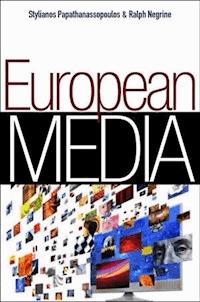
European Media provides a clear, concise account of the structures, dynamics and realities of the changing face of media in Europe. It offers a timely and illuminating appraisal of the issues surrounding the development of new media in Europe and explores debates about the role of the media in the formation of a European public sphere and a European identity.
The book argues that Europe offers an ideal context for examining interactions between global, regional and national media processes and its individual chapters consider: the changing structure of the European media; the development of new media; the Europeanization of the media in the region; the challenges for the content; and audiences. Special emphasis is given to the transformation of political communication in Europe and the alleged emergence of a European public sphere and identity.
European Media: Structures, Politics and Identity is an invaluable text for courses on media and international studies as well as courses dealing with European and national policy studies. It is also helpful to students, researchers and professionals in the media sector since it combines hard facts with theoretical insight.
Sie lesen das E-Book in den Legimi-Apps auf:
Seitenzahl: 410
Veröffentlichungsjahr: 2013
Ähnliche



















European Media
Global Media and Communication
Arab Media, Noha Mellor, Khalil Rinnawi, Nabil Dajani and Muhammad I. Ayish
European Media, Stylianos Papathanassopoulos and Ralph Negrine
European Media
Structures, Policies and Identity
STYLIANOS PAPATHANASSOPOULOS AND RALPH NEGRINE
polity
Copyright © Stylianos Papathanassopoulos and Ralph M. Negrine 2011
The right of Stylianos Papathanassopoulos and Ralph M. Negrine to be identified as Authors of this Work has been asserted in accordance with the UK Copyright, Designs and Patents Act 1988.
First published in 2011 by Polity Press
Polity Press
65 Bridge Street
Cambridge CB2 1UR, UK
Polity Press
350 Main Street
Malden, MA 02148, USA
All rights reserved. Except for the quotation of short passages for the purpose of criticism and review, no part of this publication may be reproduced, stored in a retrieval system, or transmitted, in any form or by any means, electronic, mechanical, photocopying, recording or otherwise, without the prior permission of the publisher.
ISBN-13: 978-0-7456-3734-1
A catalogue record for this book is available from the British Library.
Typeset in 11 on 13 pt Adobe Garamond Pro
by Servis Filmsetting Ltd, Stockport, Cheshire
Printed and bound in Great Britain by MPG Books Group Limited, Bodmin, Cornwall
The publisher has used its best endeavours to ensure that the URLs for external websites referred to in this book are correct and active at the time of going to press. However, the publisher has no responsibility for the websites and can make no guarantee that a site will remain live or that the content is or will remain appropriate.
Every effort has been made to trace all copyright holders, but if any have been inadvertently overlooked the publisher will be pleased to include any necessary credits in any subsequent reprint or edition.
For further information on Polity, visit our website: www.politybooks.com
Contents
Detailed Contents
List of Illustrations
List of Abbreviations
Acknowledgements
1
Introduction: The Media in the European Context
Part I The Political Economy of Media in Europe
2
The Structure of (Old) Media in Europe
3
The New Media in Europe
Part II The Europeanization of the European Media
4
Europeanizing the Media of Europe
5
The Question of Content: Quality, Availability and Production
6
Audiences and Consumption
Part III Europe as a Cultural and Political Project
7
Public Communication in Europe: Constructing Europe and the European Public Sphere
8
Media and European Identity
9
Conclusions
Appendix
Notes
References and Bibliography
Index
Detailed Contents
List of Illustrations
List of Abbreviations
Acknowledgements
1
Introduction: The Media in the European Context
Dimensions of Europeanization
The organization of the book
Part I
The Political Economy of Media in Europe
2
The Structure of (Old) Media in Europe
Media models
The challenges to public broadcasting systems
The consolidation of the media industry
The foundation of new regulatory bodies
The newspaper sector
Summary
3
The New Media in Europe
The new media and European industrial policy
The penetration of the internet in Europe
The development of digital television
Internet protocol television (IPTV)
Mobile TV
High definition TV (HDTV)
From VCR to DVD
Radio: the analogue medium?
Newspapers: between the internet and the freesheets
Summary
Part II
The Europeanization of the European Media
4
Europeanizing the Media of Europe
Audiovisual policy: from ‘Television without Frontiers’ to ‘Audiovisual Media Services’
Country of origin
Linear and non-linear audiovisual services
Advertising
Product placement
Support schemes
EU policy on media ownership
Public broadcasting and the EU
Summary
5
The Question of Content: Quality, Availability and Production
New media, new content
The EU and the new media ‘content’
Television content
The increase in the volume of programming
A new ‘défiaméricain’
The increase in the volume of European productions
The MEDIA programme
The importance of programme rights
Copyright
Summary
6
Audiences and Consumption
A media-rich society
Changing media, changing patterns of consumption
The impact of the internet
TV versus internet
Cable and satellite TV
Different patterns of media consumption
Preferences in TV programmes
Media consumption at home
Summary: the multimedia environment and multitasking
Part III
Europe as a Cultural and Political Project
7
Public Communication in Europe: Constructing Europe and the European Public Sphere
EU media studies
The European public sphere – what is it, is there one and do we need it?
The European public sphere
EU journalism and the European public sphere
What drives EU news coverage? What are the news values adopted? How do journalists work?
Too much or too little coverage of the EU?
The EU communicating the EU: Plan D for Democracy, Dialogue and Debate
Media and politics in a European context
Change at the level of media and media practice
Changes at the level of the political party
Media and politics in the era of the internet
Summary
8
Media and European Identity
Europe and Europeanness: Where is Europe? What is the European Union?
Becoming European
European identity
Being part of Europe
How Europe sees itself and others: the coverage of Turkey’s accession bid in 2004
Turkey, the EU and accession talks in 2004: newspaper coverage in some member states
The place of history, culture and memory in the French and British press coverage
Summary
9
Conclusions
Appendix
Notes
References and Bibliography
Index
List of Illustrations
Tables
2.1
Typology of national broadcasting systems in Western Europe
2.2
Broadcasting regulatory authorities in selected European countries
3.1
Digital TV in Europe (and timetable for DTT)
3.2
Paid-for and free dailies in the USA and Europe
3.3
Share of newspapers of total advertising spend, selected European countries
5.1
Uptake of digital distribution/exploitation of content in Europe – key figures
5.2
EU programming in European television, 2007–8
7.1
Hallin and Mancini’s classification of media and political systems
7.2
Interest in what is going on in the European Parliament
7.3
Turnout in European parliamentary elections, selected countries
7.4
Different types of advocacy
8.1
Conceptual definition and operationalization of European identity variables
8.2
Reasons mentioned why talks should not proceed
Figures
3.1
Stages in the European television industry
3.2
Digital TV households in Europe, by platform
3.3
Broadcast mobile TV subscriber uptake
3.4
HDTV channels in Europe, 2009
3.5
HDTV channels in Europe, by means of delivery, 2009
5.1
Nationwide TV channels available in the EU-27, plus Croatia and Turkey, by genre
5.2
US programming in European television, 2007–8
5.3
uropean works on European channels
6.1
hanges of internet use in Europe
6.2
Media use in the EU-15, 2010
6.3
Average time spent viewing TV in Europe, 1995–2009
6.4
Paid-for dailies: average number of copies per thousand of population
6.5
Numbers and types of specialist channels viewed in the EU
6.6
Technology at home
7.1
Lack of trust in political parties in the European Union
Boxes
4.1
MEDIA Plus and MEDIA Training – key figures
Abbreviations
ACT
Association of Commercial Television in Europe
ADSL
asymmetrical digital subscriber line
AER
Association Européene des Radios
AMS
Audiovisual Media Services
ARD
Arbeitsgemeinschaft der Öffentlichrechtlichen Rundfunkanstalten der Bundesrepublik Deutschland
BBC
British Broadcasting Corporation
BSkyB
British Sky Broadcasting
CFI
Court of First Instance
CLT
Compagnie Luxembourgeoise de Télédiffusion
DAB
digital audio broadcasting
DMB
digital multimedia broadcasting
DMP
digital media player
DRM
digital rights management system
DSL
digital subscriber line
DTH
direct-to-home
DTT
digital terrestrial television
DVB
digital video broadcasting
DVB-H
digital video broadcasting - handheld
DVD
digital video disk
EBU
European Broadcasting Union
EC
European Commission
ECJ
European Court of Justice
EICTA
European Information and Communications Technology Industry Association
EPC
European Publishers Council
EU
European Union
GATS
General Agreement on Trade in Services
GDP
gross domestic product
GPS
global positioning system
HDTV
high definition TV
IDATE
Institut de l’Audiovisuel et des Télécommunications en Europe
IP
internet protocol
IPTV
internet protocol television
ISDN
integrated services digital network
ISP
internet service provider
LAN
local area network
NOS
Nederlandse Omroep Stichting
Ofcom
Office of Communications
PDA
personal digital assistant
PSB
public service broadcasting
RAI
Radio Televisione Italiana
RTE
Radio Telefís Éireann
RTL
Radio Télévision Luxembourgeoise
RTVE
Radio Televisión Española
SHDSL
single-pair high-speed digital subscriber line
STB
set top box
TWF
Television without Frontiers
VCR
video cassette recorder
VDSL (VHDSL)
very-high-bitrate digital subscriber line
VHS
video home system
VoD
video-on-demand
VRT
Vlaamse Radio en Televisie
WIPO
World International Property Organization
WTN
World Television News
To Katia, Thanassis and Aphrodite for their continuous support, good humour and patience
To Angie
Acknowledgements
Many people helped in the making of this book. In particular, we would like to thank the National and Kapodistrian University of Athens for its financial assistance at various stages of the research in the last three years. Our thanks go also to the many journalists who helped us with our research and patiently answered our questions, as well as the two anonymous readers at Polity for their valuable comments and thoughts on our typescript.
Our special thanks go to John Thompson and Andrea Drugan at Polity Press who have enthusiastically supported the whole project. We would like to express our sincere thanks to Caroline Richmond, who has shown professionalism and patience throughout the process of putting this book together. Needless to say, all responsibility for shortcomings and inaccuracies are ours.
Stelios Papathanassopoulos, Ralph Negrine
1
Introduction: The Media in the European Context
The media in European states have experienced a period of continuous change from the 1980s onwards. This period has been associated with changes in media policy as well as a series of technological developments which have, either directly or indirectly, had an influence on policy choices towards the media sector, and especially television. Emerging channels, including the internet, mobile and other interactive media, are outperforming their traditional counterparts and seizing market share from them. In the past, European media systems were characterized by simplicity – there were usually only a small handful of public-owned TV and radio stations, newspapers were available at specific times of the day and distributed in specific places. Today’s media systems, however, are characterized by complexity: processes of technological convergence and digitalization have dramatically changed the media landscape. Cable and satellite services deliver hundreds of channels; broadband links and websites allow anyone to distribute video to millions of people; and mobile phones connect subscribers to each other but also to television and to web services. The simplicity of yesteryear has given rise to a multiplicity of services that connect to one another but also compete with one another for shares of subscribers. To give one obvious example, internet service providers supply services to customers but also supply news – thus competing with traditional news outlets – and business information.
Lesen Sie weiter in der vollständigen Ausgabe!
Lesen Sie weiter in der vollständigen Ausgabe!
Lesen Sie weiter in der vollständigen Ausgabe!
Lesen Sie weiter in der vollständigen Ausgabe!
Lesen Sie weiter in der vollständigen Ausgabe!
Lesen Sie weiter in der vollständigen Ausgabe!
Lesen Sie weiter in der vollständigen Ausgabe!
Lesen Sie weiter in der vollständigen Ausgabe!
Lesen Sie weiter in der vollständigen Ausgabe!
Lesen Sie weiter in der vollständigen Ausgabe!
Lesen Sie weiter in der vollständigen Ausgabe!
Lesen Sie weiter in der vollständigen Ausgabe!
Lesen Sie weiter in der vollständigen Ausgabe!
Lesen Sie weiter in der vollständigen Ausgabe!
Lesen Sie weiter in der vollständigen Ausgabe!




