


22,49 €
Mehr erfahren.
- Herausgeber: The Crowood Press
- Kategorie: Lebensstil
- Sprache: Englisch
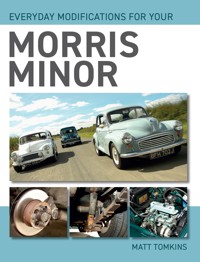
Morris Minor expert Matt Tomkins provides practical advice on maintaining and modifying your Morris Minor. With safety information throughout, this book provides a number of step-by-step guides on how to fit a wide range of simple and more sophisticated upgrades to bring your Morris Minor into the 21st century. Includes sections on Routine servicing of the engine, gearbox, clutch, differential, brakes, suspension, electrics and structure. Modifications and upgrades to the engine, gearbox, wheels and tyres, brakes, suspension, electrics and seats. Modifying the body including GRP panels, weather strips and identifying chop top convertibles. Fitting mod cons such as gauges, heaters, radio/ICE, 12 volt accessory sockets, sound deadening, heated screens, wiper upgrades. With six case studies to show what other owners have achieved
Das E-Book können Sie in Legimi-Apps oder einer beliebigen App lesen, die das folgende Format unterstützen:
Seitenzahl: 283
Veröffentlichungsjahr: 2023
Ähnliche


















First published in 2023 byThe Crowood Press LtdRamsbury, MarlboroughWiltshire SN8 2HR
www.crowood.com
This e-book first published in 2023
© Matt Tomkins 2023
All rights reserved. This e-book is copyright material and must not be copied, reproduced, transferred, distributed, leased, licensed or publicly performed or used in any way except as specifically permitted in writing by the publishers, as allowed under the terms and conditions under which it was purchased or as strictly permitted by applicable copyright law. Any unauthorised distribution or use of this text may be a direct infringement of the author’s and publisher’s rights, and those responsible may be liable in law accordingly.
British Library Cataloguing-in-Publication DataA catalogue record for this book is available from the British Library.
ISBN 978 0 7198 4198 9
DedicationIt would not have been possible to produce this book without the help and support of a great many people over a number of years. Friendship has surrounded my involvement with these little cars, and there are too many people to mention in my journey from learner driver through to motoring journalist who have shaped me, taught me and inspired me. This book is the culmination of twelve years’ advice received and errors made. I must thank everyone who has contributed images, or allowed me to photograph their car for this book. I must also thank my wonderful wife, Emmy, for putting up with my endless hours of scribbling, researching and spanner-spinning during the production of this title.
Photographic acknowledgementsThe majority of the pictures in this book were taken by the author or Tom Critchell. The author would like to thank the following for supplying the other images, as follows: Andrew Clark, pp. 59 and 98 (bottom); Andrew Curran, p.112; ESM Morris Minors, pp.12, 20, 22, 29, 30, 53 (left), 61 (middle right), 62 (top right), 63 (top), 74 (left, both), 79 (bottom), 80, 81 (bottom), 85 (top left), 90, 97, 104, 105 (bottom) and 120 (right); Stephen Gordon , p.60; JLH Morris Minors, pp.86 (middle) and 98 (top); Longstone Tyres, p.68; Machine Mart, p.9; Andrew Bywater, Mirabelle Classic Cars, p.61; Ethan Morris, p.114 (right); Newton Commercial, p.113; Nuffield Organisation, pp.49 (right) and 76; Retronics (p.121); Chris Ryder, pp.62 (left), 62 (bottom), 82 (top left) and 86 (middle); Luke Tomkins, pp.85 and 86; and Brian Wood, p.61 (left).
Cover design by Blue Sunflower Creative
Contents
Part I The Basics
Introduction
1 Safety
2 Morris Minors and Modern Fuels
3 Access All Areas
4 Servicing – Do You Really Need to Upgrade?
Part II Modifying the Morris Minor
5 Engines
6 Gearboxes
7 Final Drive and Differential Differences
8 Wheels and Tyres
9 Drum Brake Modifications
10 Convert to Disc Brakes
11 Suspension Modifications
12 Electrics
13 Are You Sitting Comfortably?
14 Mod Cons
15 Towing With Your Minor
16 Body Modifications
17 Other Accessories
18 Case Studies
Index
Part I: The Basics
Introduction
Drive a Morris Minor and the world seems a happier place. People on the street smile as you parp past, and you will strike up conversations with strangers every time you fill the tank with petrol. You attract cheery waves from other road users and, whether you remember these cars in use in their own period or not, the sense of nostalgia for a time gone by is enormous.
Limiting the use of your Morris Minor only to trips to classic car shows or Sunday picnics, then, would be to miss out on a huge amount of potential pleasure and enjoyment. However, the world has changed since the Minor was ubiquitous on Britain’s roads, with higher speeds and greater volume of traffic on the road, so using a Minor regularly in its standard form can present some challenges and require certain compromises.
Many of these compromises were addressed to some extent by the manufacturer throughout the car’s impressive 23-year production span. Indeed, the Minor outlived the Riley One-Point-Five and Wolseley 1500 Models that were intended to replace it, and it was not until the introduction of the Morris Marina (itself mechanically very similar to the Minor and therefore the victim over the years of much parts pillaging), that the Minor’s reign as the British-built family car of choice came to an end.
Unveiled on 27 October 1948 at the British Motor Show held at Earl’s Court, Series MM ‘lowlight’ Minors and the earliest ‘high light’ cars were fitted with sidevalve engines and a number of other running gear components carried over from the pre-war Morris 8 Series E, built between 1938 and 1948. There will not be much focus on these very early cars in this book, as their numbers are relatively limited now and they are unlikely to be modified for daily use, given their historic significance. That said, much of what follows will be applicable to these cars with some detail changes, which we will explore in brief later in this book.
In 1952, the Morris Minor received a major re-work for the Series II. The sidevalve engine was replaced by the now ubiquitous A-series (in 803cc form), and much of the running gear was updated, from which all later variations evolved. The introduction of the 948cc A-series engine, accompanied by the ‘Minor 1000’ moniker and numerous other drivetrain alterations in 1956 coincided with the dawn of the motorway era and was intended to keep the Minor relevant in that modern era which continues to this day.
The final significant change to the Minor’s drivetrain came in 1962, with the Series V cars. A 1098cc A-series engine replaced the 948cc unit with larger drum brakes (seven inches increased to eight), improved gearbox and taller final drive, making this the most usable of all of the factory-original Morris Minors on 21st-century roads.
The Minor is blessed with an incredibly strong aftermarket parts supply from a number of specialists, an active owners club and many specialist businesses with a wealth of knowledge when it comes to maintaining and modifying these cars. There is a precedent for most modifications possible on the Minor and so seeking advice or specialist assistance should not prove too difficult.
The Morris Minor Owners Club (MMOC) organises events throughout the year, including its infamous Minors On Tour (European) and Minors On Tour UK events, both of which are focused on useability over originality. You will not be chased off the rally field for upgrading your engine or brakes – rather, you will be joining a band of enthusiasts for whom enabling the continued everyday enjoyment of the cars which the club celebrates is as important as preserving low-mileage original cars with crossply tyres and seven-inch drum brakes. Indeed, at the time of writing, the Chairman of the MMOC owns and drives a 1275-propelled Traveller with a five-speed gearbox, the Secretary’s lowlight tourer has an aftermarket Alta cylinder head fitted to its sidevalve engine and the Webmaster runs a splendid modified Traveller with a rather highly strung 1380 A+ under its bonnet.
Alongside its own club and marque specialists, the Minor also benefits from the overarching umbrella that is the wider BMC and BL family of models. The Morris Marina, MG Midget, Mini, ADO16s, Wolseley 1500 and Riley One-Point-Five, Austin A35s and A40s and more all yield parts and knowledge both from their own development story and subsequent use and modification which can be used to develop your Morris Minor. Many of these interchangeable parts are in good supply thanks to strong enthusiast bases for these classics, so sourcing upgrades for your Minor which are standard parts for an MG Midget or Mini, for example, should provide no problem at all.
In this book, we will look into a number of sensible everyday modifications that you can make to your own Morris Minor, or look for in a prospective purchase, which will serve to make the car more usable on the roads of today. These range from upgrading engines, gearboxes and brakes with components from within the Morris Minor’s own evolution to seeking parts and inspiration from elsewhere within the BMC range and beyond. We will also explore the wealth of aftermarket parts, accessories and expertise which makes modifying the Morris Minor a well-trodden path with myriad options available to you, depending on your own needs and desires.
Many of the bolt-on modifications that we will cover are supplied with detailed instructions for their fitting when purchased from specialist suppliers, so we will be introducing you to the pros and cons of these modifications and when and why you might need them, rather than providing detailed step-by-step instructions in every case, as kits can change and evolve and our advice may well be out of date by the time you read this. We will, however, be covering in more detail some of the tweaks and adjustments, such as lowering the suspension ride height, which you can do at home without the need to purchase any bolt-on components.
Do not think of what follows as a list of modifications that should all be done immediately. In fact, we will start by asking the question as to whether you need to upgrade at all, working through common service tasks and seeking to ensure that you are starting from a good basis before using modifications as sticking plaster solutions to mask the effects of disrepair. We will also ask at each juncture exactly what it is you want your Minor to be. Are you looking for a B-road bumbler or a motorway mile-muncher? Because the approaches you will need to take in each case will differ considerably.
The following advice, then, is intended less as a set menu, but more as a guided tour of a buffet. In this, we will explore which flavours work well together to produce the ultimate Morris Minor sandwich. We will also take a brief wander to the far end of the table where we will find the olives, Stinking Bishop cheese and anchovies as we take a look at some more radical modifications which, despite their bold flavours, may only appeal to a few people’s palettes.
Once we have familiarised ourselves with the selection of ingredients on offer, we will glance at a few plates put together by experienced Morris Minor chefs, through a series of road tests to see what flavour combinations work well together. Just as in the case of chilli and chocolate, there may well be a few surprises along the way…
1
Safety
Everything in this book is intended as guidance, not as specific instructions, and it is your responsibility to ensure that you are working safely and that you are competent enough to complete work on your car both in a safe manner and to a safe standard. Working on a car carries risks, and it is also your responsibility to identify and mitigate these risks. If you are not confident in doing a job yourself, what follows in this book will still be a useful guide to allow you to commission a specialist, garage or mobile mechanic to carry out the work for you.
Always carry out due diligence when it comes to choosing someone to work on your Minor. Seek recommendations from other owners who have used the company or individual for work in the past and inspect examples of previous work carefully. Be sure to get quotes for the cost of any work up front and in writing and ask to be kept informed as the project develops.
It is important to say at this point that there is no such thing as a stupid question. If you are unsure about any aspect of working on your car, especially something safety-critical, it pays to ask for advice. Whether you choose to attend a course on vehicle maintenance (there are several available, including lectures and workshops days at the British Motor Museum, Gaydon, and short courses though the Heritage Skills Academy based at Bicester Heritage), or you can simply join your local branch of the Morris Minor Owners Club. Advice is readily on hand from a variety of sources with a growing desire within the classic car community to share skills and keep the hobby alive in an ever more digital-focused world.
Alongside your spanners, screwdrivers and socket sets should sit safety goggles, gloves, steel toe-capped boots, and masks, all of which should be worn where appropriate. It is also worthwhile equipping your workshop with a fire extinguisher of appropriate size and type for the work being undertaken. An extinguisher and leather welding gauntlets are also a worthwhile addition to your Minor, in an easily accessible place, to allow you to tackle a fire out on the road – if it is safe to do so – before it takes hold.
SAFE LIFTING
In almost any aspect of maintaining or modifying your Morris Minor, you will need to raise and support the car for access to the underside or to enable the removal of suspension components. Doing so safely is crucial and care must be taken to assess the risks involved from the outset.
The first and most important piece of advice is NEVER to work beneath a car supported only by a jack. Axle stands, properly and securely positioned, are essential when it comes to working on any car. Jacks and axle stands should be carefully inspected before each use to ensure that they are in good condition, jack hydraulics are not leaking, frameworks are not bent, and welds inspected for cracking or failure. Of course, all jacking equipment should be sufficiently weight-rated, too.
Achieving altitude is essential for most tasks. However, extreme care must be taken to ensure the car cannot fall on you.
Factory-supplied jack is flimsy and relies on the jacking point being perfectly solid. Its use is not recommended.
A quality trolley jack is essential for workshop tasks. Aluminium items as pictured offer a great advantage in reduced weight.
Smaller trolley jacks may be carried in the car for roadside repairs. Folding axle stands and chocks are also available for this purpose.
Bottle jacks are compact enough to keep below the boot floor and lift in a fixed vertical plane.
A quality set of axle stands is essential. Never get under a car supported only on a jack.
Strengthened tie rod mounts on the chassis legs make ideal jacking points.
A jack may be placed under the centre of the axle casing, and stands under the axle itself.
If you choose to use drive-on car ramps, inspect these carefully as well and ensure that they are anchored before attempting to drive onto them, as these ramps can easily slip forward. Ensure you use a spotter to ensure you are driving onto the ramps squarely and that you stop before over-running the stop. Always use a secondary set of supports (for example, axle stands) beneath the car when using drive-on ramps, too, to catch the car in the event of ramp failure. The higher the drive-on ramp, the more difficult it will be to drive onto it. Consider investing in a set of hydraulically operated self-raising ramps, which allow a good raised height to be achieved without the need to drive up a steep sloping ramp. These are ideal for lowered cars which could foul their bumpers on steeper ramps.
If you intend to undertake a large amount of work on your Minor, and your budget and workspace allow, you may consider investing in a centre-rise scissor lift, or even a commercial-style two- or four-post lift. These certainly make work much easier; however, financially they are beyond the reach of most home mechanics so, for the most part, when discussing the processes involved in certain maintenance and modification procedures, we will assume that you are working on axle stands in a private garage or driveway. Rollover jigs and rotisseries are especially helpful for restoration work, and have reduced in price significantly in recent years. There is also a buoyant second-hand market for such items, as they are bulky to store once a restoration for which they were originally purchased has been completed.
The Minor’s factory-supplied jack (apart from on very early cars or vans which had jacking points positioned on front and rear inner wings) fits into the jacking points on each end of the central cross-member. These jacking points are notorious rot spots, so an original jack should only be used if the jacking point’s condition is known to be excellent, and even then, only really in an emergency for changing a wheel and such like. Instruction on how to use the original-style jack can be found in the original factory operation manual.
A good quality trolley jack, then, is a sound investment, as are a pair of good quality axle stands. Choose a good quality set-up from a trusted supplier. Cheap imitations of older designs might appear to be an online bargain, but the material and construction quality can leave much to be desired, with reports of weld and hydraulic failures early in service life quite commonplace. A small portable jack should be more than up to most tasks; however, a larger jack with a wider base size and a higher lift will be more useful, and is the safest option, so one of these is a sound investment if your storage space and budget allow. Lightweight aluminium versions of these larger jacks – originally designed for racing teams that require maximum portability – are becoming increasingly affordable for the home user. They are well worth considering if moving a heavy steel jack around your workspace lacks appeal.
Bottle or scissor jacks are useful for keeping in the boot of the car for on the road repairs such as replacing a wheel, and can be neatly stowed alongside (or inside, in the case of some smaller screw-type jacks) the spare wheel under the boot floor, while folding axle stands are available which make a great addition to a tool kit for running repairs while touring. It pays to keep an offcut of hardwood in the boot as well, to spread the load of a jack on the underbody of the car. To prevent unwanted rattles and damage to paintwork, it is worth wrapping these boot-stowed jack and stands in rags or an offcut of carpet and securing them where possible.
When positioning either a jack or axle stands, first it is important to establish that the vehicle structure onto which they are to be positioned is in good, solid condition. The ground onto which the jack or stand is to be placed should be solid and level, and consideration should be given to the weight distribution, centre of balance and the areas of the car to which access will be required. Also note whether a task will need the suspension to be in droop or compression, as the positioning of jacks and supports will differ. Finally, consider whether a task (such as removing the engine) may change the centre of balance mid-way through a job and render the car unstable.
Raising the front
At the front of the car, the best jacking point is the strengthened portion of the chassis legs where the tie rod mounts. Raising the car from here allows the suspension to droop and an axle stand to be positioned further back along the chassis leg. If the suspension needs to be compressed, a jack may be positioned beneath the lower wish-bones, but care must be taken to avoid the jack slipping when the angle of the suspension component changes as the car is raised/lowered.
Raising the rear
At the back, the centre of the axle casing makes for the strongest jacking point, and allows both sides of the car to be raised simultaneously. With the car raised in this fashion, axle stands may be placed either side of the axle, although care must be taken to avoid damaging the brake lines as the car is lowered onto the stands. If the suspension is required to be in droop, axle stands may be placed just behind the rear spring hangers and the jack lowered to allow the rear leaf springs to become uncompressed.
ELECTRICAL SAFETY
Before commencing any work on your Morris Minor, it pays to get into the habit of disconnecting the battery, as an electrical short can endanger both you and your Minor’s wiring loom. Never place parts or tools on top of your Minor’s battery (tempting as it is, located at the rear of the engine bay at a convenient height) as a direct short circuit between the two battery terminals could result in explosion, fire and/or leak of acid from the battery.
Always disconnect the battery earth terminal first, and reconnect it last. This way, should your spanner touch the bodywork or battery clamp while tightening the live terminal, the circuit is not completed and a dead short is avoided. Similarly, if the spanner being used to tighten the earth lead touches the body of the car, that side of the circuit is already connected together, so there is no harm done.
A battery cut-off is a useful upgrade to prevent the need for the battery to be continually disconnected for work, and also offers a quick and easy way of disconnecting the car’s power in the event of a fire or as an additional security measure. We will cover fitting a battery cut-off and the various types of this item that are available in Chapter 12.
FUEL SAFETY
Petrol, by its very nature, is extremely volatile, and so care must be taken to ensure that sources of ignition or heat are kept away from any pools of petrol, fuel lines and tank. Inspect the entirety of your fuel system regularly and thoroughly for leaks or deterioration and rectify any issues as a matter of urgency. Don’t forget to inspect the fuel filler neck to tank pipe and the condition of the cork gasket where the fuel level sender mounts into the top of the tank. We will discuss hose specifications recommended when using modern fuels in Chapter 2.
Fuel tanks are available brand new and not as expensive as you might think. Well worth the investment over risking a dangerous repair.
Never weld near fuel lines or the fuel tank. It is a straightforward enough, if time-consuming, job to remove a Minor’s fuel tank and drain down the carburettor and fuel lines if major welding work is to be undertaken. A drain plug is positioned on the bottom of the petrol tank; however, it is recommended that the tank is removed completely from the vehicle before hot work is undertaken in its proximity, as an empty tank can still explode if exposed to a source of ignition due to the vapours which will remain inside. Never attempt to weld a fuel tank. Replacements are available in standard and large-capacity forms, brand new for a modest cost and well worth the investment, given the dangers associated with attempting a welded repair on a tank that has been already exposed to petrol.
WORKING ON BRAKES
Failure to accomplish engine work successfully can be frustrating, but failure to stop is far more dangerous than a failure to proceed. If you are to embark on working on your Minor’s brakes, it is critical that you are competent in doing so and that all work carried out is to the highest of standards with the best available components.
One of the most common points of failure in a hydraulic system is fluid leaking around an incorrectly flared union. This can be avoided by purchasing, at very modest cost, pre-made brake lines for the areas to be disturbed (or a complete kit), which are pre-cut to the required lengths and have professionally fitted flares and brand new unions of the correct thread diameter and pitch already fitted.
After disturbing the hydraulic system, it pays to check very carefully for leaks once the job is complete and the system bled. Ask an assistant to sit in the driver’s seat and apply pressure to the brake pedal. It should not sink. If it does, either there is a leak in the system or failure of the internal seals within the master cylinder. If it takes a few pumps of the pedal to establish a firm pedal, but no sinking occurs thereafter, suspect air in the system and re-bleed.
With constant pressure applied to the brake pedal, carefully inspect all unions with a torch for leakage and rectify any issues found immediately and before taking the car on the road. Like most cars of its era, the Minor employs a single circuit braking system, meaning that all of the brakes are operated by the same master cylinder. In the event of master cylinder failure or a fluid leak from either a pipe, union or slave cylinder (or caliper, in the case of cars upgraded to disc brakes), total brake failure may occur. It is therefore essential that the braking system is maintained to the highest order, including the handbrake, which also serves as an emergency brake should fluid pressure be lost.
HAZARDOUS SUBSTANCES
Brake dust, paint fumes, exhaust gases and engine oil all carry their own health risks, as do many other substances and processes associated with car repair, modification and maintenance, and as such it is essential that safety measures are taken to mitigate their impact.
Never blow away brake dust, always clean it down wet; it can be hazardous to health.
Very old braking or clutch components may contain asbestos in the friction material and, although sale of such components as replacement parts is now banned under REACH (UK Registration, Evaluation, Authorisation and restriction of CHemicals) legislation, your Morris Minor may still be fitted with such linings and appropriate care must be taken to mitigate risks while working on these systems. Never blow away brake or clutch dust – always damp it down either with soapy water or brake and clutch cleaner.
Petrol is volatile by its very nature and oils, brake fluid and battery acid are all hazardous both to health and to the environment. Therefore, they should always be disposed of in the correct manner. If in any doubt, consult your local council on the best methods and locations for disposal of hazardous materials in your area.
INSURANCE, MOTS AND HISTORIC INTEREST
It is important to take note that any modifications you make to your Morris Minor should be declared to your insurance company. Failure to do so could result in a claim being refused, and potentially a legal battle on your hands in the event of an accident. Even if you feel an upgrade is for safety’s sake rather than performance, it must be declared. Transparency is by far the best policy and any increase in premium will be far less than the cost of a refused claim.
The good news is that there is a precedent for almost every modification possible to the Morris Minor (and certainly for everything covered in this book), and most specialist classic insurers will be more than happy to take note of any changes from standard specification with very little increase in premium.
Acceptable changes.
At the time of writing, any car built more than 40 years ago is defined as a ‘Vehicle of Historic Interest’ and does not require, by law, an MOT test unless ‘substantially changed’ in the past 30 years. Take some time to study the definition of substantial changes here: https://www.gov.uk/government/publications/historic-classic-vehiclesmot-exemption-criteria.
Guidance on what are considered acceptable changes can be found in the image above taken from the Department for Transport website.
This ruling came about in response to an EU directive on roadworthiness through the work of the Federation of British Historic Vehicle Clubs (FBHVC) and the body’s continued work to ensure unhindered use of historic vehicles on the roads of tomorrow. The Federation’s website offers up-to-date information about MOT exemption, fuels and more and is well worth a read. Click to www.fbhvc.co.uk
Almost all of the modifications and upgrades which will be discussed in the following pages, including engine changes within the ‘A-series family’, fall into either of two categories of acceptable change. Either they are ‘changes of a type which can be demonstrated to have been made when vehicles of the type were in production or within ten years of the end of production,’ or ‘axles and running gear have been changed to improve efficiency, safety or environmental performance.’
Later chapters will briefly discuss upgrading to more modern engines, which could result in the car falling outside of the MOT exemption criteria. However, it is the opinion of the author that submitting your Morris Minor, whether modified or not, for a voluntary MOT test with a tester who is familiar with the age of the car is a good idea. At the very least, an MOT test gives the opportunity for a second, independent pair of eyes to check your handiwork. It’s all too easy to become ‘snow blind’ when working on your own car.
2
Morris Minors and Modern Fuels
The liquid chemistry of the petrol on sale when the Minor was designed and built was significantly different to what is on sale today. There is no need to panic, though, as with a little knowledge, a few tweaks and a keen eye, there is every reason to continue using pump petrol in your Minor for many years to come.
Modern fuels need not be a cause for concern with a little diligence.
UNLEADED PETROL
When the Morris Minor was first built, the petrol with which it was designed to be filled contained a substance called ‘tetraethyl lead’. Tetraethyl lead was originally added to petrol in the 1920s in order to prevent pre-ignition or ‘pinking’ under load. However, it was also found to offer lubrication and protection to the top end of the engine, including protecting valves and cast-iron valve seats from being burned and damaged.
By 1989, however, a change to unleaded petrol was seen as inevitable, with research proving links between lead pollution and brain damage in children. Autocar magazine reported in 1989 that the UK was pumping three thousand tonnes of the stuff into the atmosphere every year. Under EU rules at the start of 2000, lead was removed from standard pump petrol in Britain. This raised great concern in the classic car community, with many fearing that their classics would suffer irreparable damage by using the new unleaded petrol. Lead replacement additives were made available by a number of suppliers and many owners removed cylinder heads to fit hardened valve seats. These prevented the risk of burning original valve seats that were cut directly into the cast cylinder head in order to cope with the unleaded fuel.
Pump petrol should still be available well into the future.
The Federation of British Historic Vehicle Clubs (FBHVC) has conducted a great deal of research into the subject, the conclusions of which can be found on their website at www.fbhvc.co.uk. For our purposes, however, in the present day, we must only consider the cylinder head in respect of the effect of the removal of lead from petrol, and the potential damage that may be caused to the valve seats by its use. Of course, different octane ratings and volatility will also have an effect on the running of the vehicle, but in the present day we will cover these as service adjustments rather than a transition from leaded to unleaded fuel.
So What Can Be Done?
Additives such as Valvemaster Plus or Tetraboost may be used to protect against the effect of unleaded fuel on classic car cylinder heads. However, many owners choose to fit hardened valve seats to the cylinder head to allow the use of modern fuel without an additive. In order to modify a cylinder head to be suitable for use with unleaded fuel, first it needs to be removed from the engine. Luckily, in the case of the Morris Minor this process is incredibly straightforward and can be undertaken within an hour by a competent home mechanic with just a few tools.
At this point you may choose to strip and inspect the cylinder head yourself, removing valves, checking for play in the valve guides necessitating replacement and checking valve springs for any signs of damage, before sending the bare casting to a machine shop to have hardened valve seats fitted and cut. Alternatively, you may choose to send the cylinder head complete to the machine shop for them to undertake the work as a whole. Note that new valves will need to be fitted at the same time, as will new valve stem oil seals, and it is a good idea to have the ’head checked for flatness and skimmed to remove any distortion at the same time. It may be more cost- and timeeffective, if you are not set on keeping the original cylinder head for your car, to simply exchange your original cylinder head for one already converted on an exchange basis from one of the many specialist suppliers for the Morris Minor.
Of course, there are also those who simply choose to use unleaded fuel with neither an unleaded converted cylinder head or lead additive, and whose circumstantial evidence proves at least in many cases that the resilient A-series engine can be run for many miles without issue. Many take the view that ‘if and when a valve seat is burned, then is the time to remove the cylinder head and fit hardened valve seats using the cash saved from not using additives.’




