


22,99 €
Mehr erfahren.
- Herausgeber: John Wiley & Sons
- Kategorie: Geisteswissenschaft
- Sprache: Englisch
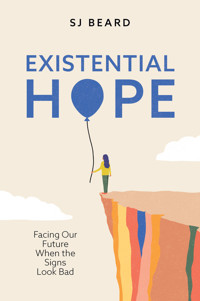
We live in an era of existential risk, facing multiple threats to the survival of our species. We also face an epidemic of existential anxiety, struggling to find meaning and purpose in a complex and dehumanizing world. In such times, hope can be hard to find.
Yet, we are not alone with these problems. They have troubled people for centuries now and, with eight billion fellow human beings to work with, we can and will rise to their challenge.
In this wide-ranging exploration of humanity’s existential predicament, SJ Beard, philosopher, futurist, and pioneer of Existential Risk Studies, takes stock of why humanity got into this mess, what we have learned about ourselves, and how we can move forward in our quest for meaning, safety, and flourishing.
Ultimately, SJ argues, our future depends on breaking free from a sense of individual powerlessness to discover shared hopes, collective wisdom, and common humanity, then using them to address the many challenges we face.
Sie lesen das E-Book in den Legimi-Apps auf:
Seitenzahl: 528
Veröffentlichungsjahr: 2025
Ähnliche


















Table of Contents
Cover
Dedication
Title Page
Copyright Page
Notes
Introduction: Beyond Risk and Anxiety
Existential risk and anxiety
Existential hope
References
Notes
PART I The Ends of the World
References
1 Scanning the Trees
Deadly diseases
Planetary disasters
Artificial Intelligence
Environmental breakdown
Nuclear war
Confronting the tiger king
References
Notes
2 Who Would Destroy the World?
Omnicidal actors
Understanding evil
Accidental and latent risk
How institutions and systems create foreseeable harm
The possibility of goodness
References
Notes
PART II How Did We Get Here?
References
3 Thinking Machines
Mechanical marvels
An artificial life
Mysteries of minds
Possibilities foreclosed
References
Notes
4 Unmasking the Powers
The dawn of colonialism
The first modern corporation
Where we went next
Extraordinary waste
How we forgot
References
Notes
5 Utopia is a Dangerous Place
A golden age
Finding Nowhere
Journeying through imagined lands
From Utopia to Uchronia
How to get somewhere
References
Notes
6 A Point of Inflection
The revolutionary significance of the future
The revolution controversy
From the social contract to the greatest good
Monstrous visions
Going back to the beginning
Working together
References
Notes
PART III Working Together
7 Steering the Centuries
The roofs of Oxford
Seeing the wood for the trees
The good steersman
Cybernetics and humanity
References
Notes
8 Not With A Bang
Thinking in systems
Impact cascades
Vulnerabilities and exposures
Tipping points
Runaway technology
Spontaneous collapse
The human element
References
Notes
9 How (Not) to Save the World
Seeing it coming
Prepping for doomsday
Uniting nations
We don’t need another hero
References
Notes
PART IV Preserving Humanity
References
10 You Are Here
Basic drives
Rationality
Freedom
Going back to our roots
References
Notes
11 Standing at the Shoreline
The edges of decision
Crucial and alone
Like bread in our children’s mouths
It is better to speak
Who is meant to survive?
References
Notes
12 Young, Curious, and Brave
Moving forward
Finding our own way
Tell me a story
Saving humanity
Epilogue
References
Notes
Origins and Gratitude
Index
End User License Agreement
Guide
Cover
Table of Contents
Begin Reading
Pages
ii
iii
iv
vi
1
2
3
4
5
6
7
8
9
10
11
12
13
14
15
16
17
18
19
20
21
22
23
24
25
26
27
28
29
30
31
32
33
34
35
36
37
38
39
40
41
42
43
44
45
46
47
48
49
50
51
52
53
54
55
56
57
58
59
60
61
62
63
64
65
66
67
68
69
70
71
72
73
74
75
76
77
78
79
80
81
82
83
84
85
86
87
88
89
90
91
92
93
94
95
96
97
98
99
100
101
102
103
104
105
106
107
108
109
110
111
112
113
114
115
116
117
118
119
120
121
122
123
124
125
126
127
128
129
130
131
132
133
134
135
136
137
138
139
140
141
142
143
144
145
146
147
148
149
150
151
152
153
154
155
156
157
158
159
160
161
162
163
164
165
166
167
168
169
170
171
172
173
174
175
176
177
178
179
180
181
182
183
184
185
186
187
188
189
190
191
192
193
194
195
196
197
198
199
200
201
202
203
204
205
206
207
208
209
210
211
212
213
214
215
216
217
218
219
220
221
222
223
246
247
248
249
250
251
252
Dedication
To my parents
Susanne and Andrew
Who gave me this precious life
And to my friends
Who danced it out of me
Existential Hope
Facing Our Future When the Signs Look Bad
SJ Beard
polity
Copyright Page
Copyright © SJ Beard 2025
The right of SJ Beard to be identified as Author of this Work has been asserted in accordance with the UK Copyright, Designs and Patents Act 1988.
First published in 2025 by Polity Press Ltd.
Polity Press Ltd.
65 Bridge Street
Cambridge CB2 1UR, UK
Polity Press Ltd.
111 River Street
Hoboken, NJ 07030, USA
All rights reserved. Except for the quotation of short passages for the purpose of criticism and review, no part of this publication may be reproduced, stored in a retrieval system or transmitted, in any form or by any means, electronic, mechanical, photocopying, recording or otherwise, without the prior permission of the publisher.
ISBN-13: 978-1-5095-6304-3
A catalogue record for this book is available from the British Library.
Library of Congress Control Number: 2025932169
by Fakenham Prepress Solutions, Fakenham, Norfolk NR21 8NL
The publisher has used its best endeavours to ensure that the URLs for external websites referred to in this book are correct and active at the time of going to press. However, the publisher has no responsibility for the websites and can make no guarantee that a site will remain live or that the content is or will remain appropriate.
Every effort has been made to trace all copyright holders, but if any have been overlooked the publisher will be pleased to include any necessary credits in any subsequent reprint or edition.
For further information on Polity, visit our website: politybooks.com
Notes
A note on notes.*
* I grew up reading Terry Pratchett. Indeed, given the significant challenges I faced as a blind dyslexic person learning how to read, I am not sure how I would have ever found the motivation to become a truly proficient reader without his fierce and unrelenting humour. Pratchett taught me that notes were often the very best part of a book, adding tangential remarks that made you see the text in new and exciting ways. Then, when I started doing more serious reading, I found that they were often used quite differently, and an exciting-looking * would merely lead to a dry citation I couldn’t even make sense of at first. Needless to say, I eventually reached a point in my academic development where these citations became just as exciting and insightful as Pratchett’s footnotes, if I took the trouble to follow them up. Nevertheless, I would rather spare my reader such disappointments. So, in this book I will include two types of note. First, those marked with an asterisk, like this one, which can be found in the Notes section at the very end of the book, listed by page number and the last few words leading up to the asterisk. These try to say things or make suggestions for further reading that I hope could be at least as accessible as this book. Second, those marked with a superscript numeral appear in the References section and contain academic citations.
Introduction: Beyond Risk and Anxiety
There once was a man who encountered a tiger. He fled, the tiger after him. Coming to a precipice, he caught hold of the root of a wild vine and swung himself down over the edge. The tiger sniffed at him from above. Trembling, the man looked down to where, far below, another tiger was waiting to eat him. Only the vine sustained him. Two mice, one white and one black, started to gnaw away at the vine. The man saw a luscious strawberry near him. Grasping the vine with one hand, he plucked the strawberry with the other. How sweet it tasted!1
This little parable, associated with the Japanese Zen tradition, captures something important about the human condition. According to a modern Buddhist interpretation,* we are, since birth, driven forward by our desires and needs and our fear of not getting them met, until we notice that ahead of us lies an inescapable death. Tigers above, tigers below, we desperately cling on to anything we think might preserve us, but know that inevitably this will not last long. However, the universe does offer us one alternative to this duality of fears. To face each moment exactly as it is, take ourselves just as we are, and accept it all without judgement. An opportunity of genuine sweetness to free ourselves from the suffering of life.2
Right now, however, this parable reminds me of the extinction event taking place in my kitchen. A short while ago, I mixed together water, salt, sugar, oil, flour, and a little dried yeast and put it in my breadmaker. The delicious smell of baking tells me that the breadmaker’s warmth has reactivated the yeast, which is currently feasting on some of the sugars in the dough and producing carbon dioxide, which causes it to rise into a light fluffy loaf. However, as the number of yeast organisms quickly grows, they will soon run into a problem. When the sugars run out and the carbon dioxide levels increase, the yeast will struggle and die. Victims of their own success.
It would be easy to apply the parable of the tiger and the strawberry to this yeast. Driven by its need to feed and reproduce, the yeast runs quickly over a cliff and gets caught by the tigers of famine and poison. Perhaps when we tell this story we feel that the yeast is being industrious and helpful and regret its demise, or perhaps we see it as greedy and profligate. However, these are human judgements and do not really belong in the yeast’s story. Yeasts are not aware of their fate and they do not entertain a desire to avoid it. Nor do yeasts appreciate their situation, or take joy in the bread they are making.
However, humans can and will do both these things. Right now, we are in a real mess. My breadmaker is not merely the cause of a very local extinction event, but a symptom of a much larger one. In its own small way, it speaks directly to my species’ desire to reshape and repurpose life on our planet, to consume and to own far more than we need, and to automate basic human tasks and activities. These desires are another kind of tiger, pushing humanity, as a whole, to a point of real danger.
However, in this respect we are really just like bigger versions of yeast. What differentiates us is that we also have an understanding of this crisis and a belief that we may have the power to avert it. That is a truly exceptional situation. The dinosaurs never knew anything about the asteroid that wiped them out and, even if they had, they would not have been able to formulate a planetary defence strategy to save themselves. We are the first species in the history of our planet to have this power; it’s not impossible that we are the first in our universe.
This power may yet turn out to be a wild vine, a hubristic belief that we can transcend the inevitable rise and fall of species that will only lead us into making things worse. Yet, it could be a genuine strawberry. A realization that the underlying reality of our existential predicament points the way to a deeper fulfilment of our human potential. That’s the possibility I want to explore.
Existential risk and anxiety
Existential is not an inherently scary word; it just means ‘relating to existence’. Yet, over the last two centuries, it has come to describe two of the most complex and off-putting subjects of human enquiry. In my experience, introducing the term existential into conversations is seriously off putting. Yet, it seems increasingly hard to avoid.
The first existential problem is Existential Risk, the risk that human existence, as a species, may be coming to an end.* Historically, this has generally been thought to be impossible; the world might end but humanity will surely either survive, if only in heaven, or remerge at some point in the future. Perhaps the first popular presentation of the idea that humanity could just go extinct, in a secular and naturalistic context, was in Mary Shelley’s 1826 novel The Last Man,3 in which she imagines a global catastrophe at the end of the twenty-first century, combining a great plague and series of extreme weather events (including heatwaves, floods, and storms), that gradually wipe out every human but one, who is left to roam an empty world. More recently, researchers have discovered many possible pathways to such a global catastrophe, and this risk has moved from the realm of speculative fiction to the forefront of scientific research and global policy.
Our second problem is Existential Anxiety. First developed by the Danish philosopher Søren Kierkegaard in his 1844 treatise The Concept of Anxiety,4 this relates to the unnerving feeling many people have from the state of existing as a human being, with apparent freedom to make their own decisions. While this freedom can be exhilarating, but it is also unsettling. As an example, Kierkegaard describes the disturbing realization many of us have when standing at the edge of a cliff, that there is nothing to stop us from jumping off except our continuing to choose not to do so. To make matters worse, it is often hard to determine the right thing to do, or to do what we believe is right even once we have worked that out. The consequences of our actions cannot be known in advance and yet, regardless of our intentions, we must face these consequences whatever they may be. While we long for an ultimate source of meaning or purpose to guide us, many feel that either there is no such metaphysical answer to the riddle of our lives or that, if there is, then we will never fully understand it.* This does not mean we are absolutely alone. We can and do connect with other people and things that bring us reassurance in life. However, every one of these is just as existentially precarious as we are, and trusting too heavily in them only serves to obscure our authentic freedom. So, ultimately, there is nothing for us to fall back on but ourselves.
Both these ideas rocketed into widespread consciousness in the aftermath of the Second World War, when people all over the world were forced to come to terms with both humanity’s incredible moral capacity to do terrible things and our accelerating technological capacity to cause death and destruction on a global scale. These ideas speak to the profound social, cultural, technological, and environmental challenges of our age, yet they are quite different in origin and meaning. People, like me, who work on dealing with one of these problems can end up spending a lot of time explaining the difference between them. However, I have started thinking that this may be a mistake.
Existential hope
The differences between existential anxiety and existential risk become blurry when we ask ourselves about their opposite, about what kinds of lives and futures we actually want – in short, about Existential Hope. To be sure, existential hope is a term that has been used in many ways: to assert our ability to express our authentic nature beyond culture and context,5 our capacity to find meaning and purpose in even the bleakest of situations,6 and our potential to make our collective futures substantially better.7 It is my contention that these various uses of the term end up describing the same thing.
As an existential risk researcher, I do not think that this hope is to be found in technocratic solutions to scientific or political problems, although both technological and social innovation are certainly needed. Solutions to the pressing global challenges that threaten our species, from climate change to transformative AI, will not simply come fully formed from clever people in elite positions of authority working out what everybody else ought to do. A complex system of 8,200,000,000 humans simply does not work like that!
Achieving existential security and sustainability for our species requires systemic solutions that are adaptable and long-lasting and so must involve all of us. Even if we manage to halt climate change and safely navigate the development of beneficial AI, I believe the ultimate causes of our problems lie far deeper in the human condition.
Homo sapiens emerged perhaps 300,000 years ago. The average mammalian species can expect to last for ten times as long.8 Yet, we have been living with industrial technologies, secular philosophies, massive populations, and globe-spanning institutions for only around 300 years; 0.1 per cent of our history. It is no wonder that we feel lost and confused and struggle not to harm ourselves with these new and powerful playthings. We still have a lot of growing up to do, a lot of learning about ourselves and our environment, understanding our capabilities and weaknesses, establishing sensible boundaries, and making wise choices.
I believe in the possibility of existential hope; that there are things human beings can do now that, collectively, will move us towards safe, joyous, and inclusive futures, and I believe that finding our place in this collective project is precisely the kind of authentic expression that can help us come to terms with our place in this beautiful and dangerous universe.
However, I sometimes feel that when I talk about hope I mean something slightly different from many other people. Emily Dickinson once wrote a poem about hope as a ‘thing with feathers’ that always keeps singing and never asks even a crumb from us in return.9 Perhaps that kind of hope does exist. However, when I talk about existential hope, I mean more than just feeling good about ourselves and our futures. When I say that I believe in hope, I do not mean that I think everything will necessarily be OK in the end. In my experience, one can be almost certain that something will go well and yet terrified that it might not. Similarly, one can be up against immense odds and yet motivated by the hope that things just might work out.
A formative experience behind this thinking occurred when I was aged eleven and my house tutor, Mr Young, told us about a book he was reading, in which the author explained that human beings do not simply run away from things because they are afraid; we are also afraid because we run away. In my experience, this is spot on, and I think the same is true about hope. Hope is born inside us, when we decide not to turn away from our problems but begin taking ownership of them and how we can respond to them. We do not feel hope because we think things are going to work out. Rather it is only when we really face up to our problems and try to resolve them that we find hope, or at least existential hope. In this sense, my understanding of hope is similar to Joanna Macy’s in her book Active Hope10 and Rebecca Solnit’s in her book Hope in the Dark,11 although this book is not like either of those.
In this book, I want to take you on a journey to where and how I find my existential hope. In that sense, it feels like a very personal book, not just to myself but to myself right now, and the discoveries and insights that have led me to this point. For me, now, existential hope has some important qualities:
It is engaged and non-judgemental: resisting the urge to externalize risk, while not rushing to judge humans as inherently bad or deserving of punishment.
It is counter-utopian: seeking to understand how we got where we are and what that tells us about where we are going, and focusing on how we can make our futures better without postulating some perfect ‘end goal’ for humanity.
It is communal: understanding that behind talk about ‘technologies’, ‘institutions’, and ‘systems’ there are always real human beings working together to achieve shared goals.
It is reasonably demanding: requiring substantial commitments from us to maintain it, while still allowing that we are imperfect and limited in our capacities and abilities.
The four sections of this book will each explore one of these themes, while building up towards a fuller understanding of the many difficult problems facing humanity. I understand that for many people the idea of having hope in our future, or hope in humanity, can sound unrealistic or even unfair. There is a lot of pain and injustice in the world. I do not think that existential hope is something we instinctively feel, and it doesn’t say anything about you if it isn’t something to which you can relate. However, hope is something we can all cultivate if we face our existential predicament with genuine courage (to acknowledge these problems), curiosity (to understand them) and compassion (to work on solving them together).
Arthur – Is that all it’s got to say? One word? ‘Harmless?’ What the hell’s that supposed to mean?
Ford – Well, there are a hundred billion stars in the galaxy and only a limited amount of space in the book. And no one knew much about the Earth of course.
Arthur – Well, I hope you’ve managed to rectify that a little?
Ford – Yes, I transmitted a new entry off to the editor. He had to trim it a bit but it’s still an improvement.
Arthur – What does it say now?
Ford – ‘Mostly harmless.’
Douglas Adams, The Hitchhiker’s Guide to the Galaxy, Fit the First (1978).12
References
1
Senzaki, Nyogen and Paul Reps, ‘A Parable’. In David McKay,
101 Zen Stories
. Abe Books, 1939: 38.
2
Chödrön, Pema,
The Wisdom of No Escape: And the Path of Loving Kindness
. Shambhala, 2001: 31–2.
3
Lynskey, D., ‘The Last Man’. In
Everything Must Go: The Stories We Tell Ourselves About the End of the World
. Picador, 2024.
4
Kierkegaard, Søren,
The Concept Of Anxiety: A Simple Psychologically Oriented Deliberation in View of the Dogmatic Problem of Hereditary Sin
. W.W. Norton & Co., 2014.
5
Gourko, Helena, ‘Heideggerian hope’.
Analecta Husserliana
, 39, 1993: 283–8.
6
Kovacs, George, ‘The philosophy of death in Viktor E. Frankl’.
Journal of Phenomenological Psychology
13 (2), 1982: 197.
7
Cotton-Barratt, Owen and Toby Ord, ‘Existential risk and existential hope: definitions’. Future of Humanity Institute, 2015.
8
Prothero, Donald R., ‘Species longevity in North American fossil mammals’.
Integrative Zoology
9 (4), 2014: 383–93.
9
Dickinson, Emily, ‘“Hope” is the thing with feathers’. In R. W. Franklin (ed.)
The Poems of Emily Dickinson
. Belknap Press, 1999.
10
Macy, Joanna,
Active Hope: How to Face the Mess We’re in Without Going Crazy
. New World Library, 2012.
11
Solnit, Rebecca,
Hope in the Dark: The Untold History of People Power
. Canongate Books, 2010.
12
Adams, Douglas,
The Hitchhiker’s Guide to the Galaxy Original Radio Scripts
. Pan Macmillan, 2003: 30. Reproduced with permission of Curtis Brown Ltd., London, on behalf of Completely Unexpected Productions. Copyright © Serious Productions Ltd.
Notes
modern Buddhist interpretation:
The origin of this story is somewhat obscure. I first came across it in Leo Tolstoy’s 1882 autobiographical account of an existential crisis,
A Confession
. Earlier versions seems to have been given quite a different moral, that people will seek after pleasure even when it clearly does them no good. That is also relevant to existential anxiety and risk, but it’s not the meaning on which I intend to focus.
coming to an end:
There have been many attempts to define the concept of existential risk. For technical risk assessment and mitigation purposes it is important that we know what exactly we are talking about. However, this book is not a technical one, so I will be using the term quite loosely. In some cases, people familiar with the field of Existential Risk Studies may feel that it would have been more appropriate for me to use the terms ‘extinction risk’ and/or ‘global catastrophic risk’ instead, and I will not dispute this. However, putting too much weight on fine distinctions between the definition of distinct kinds of risk may neglect just how uncertain we are about the risk itself. For more on these definitions see the introduction to my co-edited book
The Era of Global Risk
and Zoe Kremer and Luke Kemp’s paper ‘Democratising risk: In search of a methodology to study existential risk’.
fully understand it:
Indeed, as Douglas Adams pointed out, we don’t even really know what the question is.
PART IThe Ends of the World
Once upon a time, most people knew how the world would end. Sure, they might disagree with one another on the exact details, but all things come to an end and why should our world be any different? To people living in an uncertain, and often cruel, world, speculating about its eventual destruction has been a source of both horror and comfort . So, it is only natural that we have told so many stories about it.
In Hinduism there is the prophesy that the great god Vishnu will appear in his tenth, and final, incarnation, Kalki, riding a white horse and wielding a flaming sword. He will bring to a close the Kali Yuga, the Great Age in which we live, and which is marked by misery and unrighteousness. In doing so, however, the cosmic cycle will return to Satya Yuga, the first and most virtuous age.13
For the Aztecs, the world had already been destroyed and recreated four times, under the protection of five different suns. According to this story, the most recent apocalypse, caused by a world spanning flood, was supposed to be final, but Quetzalcoatl was unwilling to accept the destruction of his beloved humans, so he stole back our bones from the underworld to repopulate the Earth. However, our current age is vulnerable, because our sun Tezcatlipoca must share the sky with many stars who are jealous of his light and wage war on him every night. The Aztecs believed they had to offer human sacrifices to ensure he prevailed each dawn; but, should these cease, then our sun will go dark and the world will be destroyed by earthquakes.14
For the ancient Zoroastrian religion of Persia, the end of the world would be marked by a great battle between good and evil, which would end with the final triumph of Ahura Mazda, the god of the sky, over his adversary Angra Mainyu, leading to the final renovation of the universe. This myth had a profound effect on subsequent religious thinking in the area, including that of Judaism, Christianity, and Islam.15
These are but a few of the many stories people have told about the end of the world. They clearly have many differences, but they also have some important similarities. Firstly, in all these stories the end is never really understood to be The End. Just as night follows day, day also follows night, and we instinctively believe that there will be a ‘time after’ in which some version of humanity might continue, in an eternal heaven or a rejuvenated Earth. Secondly, it is not humanity that brings about its destruction but an external force, usually either God or a god, who decides to end things. However, thirdly, even though we lack the power to bring about the end of the world, these stories often conclude that we deserve it. In cultures all over the world, the end is a result of humanity’s flaws, and only through this final act of destruction can we be redeemed. Ultimately, stories about the end of the world exist as morality tales that help people relate their own ethical situation in a grand cosmic narrative, with the promise that if we get things right then either the world will not end in our times, or at least that we will be among the favoured ones when it does.
People working on existential risk often get told that we are simply providing a new genre of apocalyptic visions to make up for the fact that some people no longer believe these older ones. However, in these core respects, I think the kinds of stories we have to tell are very different from these ancient myths. We really are talking about the possibility of a final end for the human species, in which none will be favoured and there will be no coming back. The reality is that human beings really are causing most of the things that could lead to our extinction, but the reality is also that there is no cosmic narrative making us deserve that fate.
References
13
Geraci, Robert M., ‘A tale of two futures: Techno-eschatology in the US and India’.
Social Compass
63 (3), 2016: 319–34.
14
Smith, Michael E., ‘Creation, death, and the gods’. In
The Aztecs
, 3rd edn. Blackwell, 2013.
15
Lynskey, D., ‘Prologue: God’. In
Everything Must Go: The Stories We Tell Ourselves About the End of the World
. Picador, 2024.
1Scanning the Trees
Do you ever find yourself worrying about the worst things that could happen? If so, it’s not your fault and you are not alone. Our brains feature a Default Mode Network that is activated whenever we don’t have much else to focus on. This web of tightly connected neurones, across the medial prefrontal cortex, posterior cingulate cortex and angular gyrus, is responsible for many of the unbidden thoughts that come to us in such times. It is there to help us make use of our brains when they would otherwise be underoccupied, by guiding us to reflect on our goals, review our relationships, and scan our environment for possible threats, like tigers lurking in the trees. In our ancestral environment, humans used this part of our brains less often, because we had so much to keep us occupied, and, when we did, it helped us take action to stay safe, develop ourselves, and strengthen our relationships. However, in our present environment we are often understimulated, meaning it engages more often, but we also lack clear opportunities to improve our situation. This is why our minds gravitate chronically towards personal inadequacies and everything that could possibly go wrong.*
Right now, there is a lot that could go wrong. In one hundred years’ time there might be no humans still alive. Or it could be that while some of us survive we do so in conditions of squalor, conflict, and isolation, which many reading this book would struggle to imagine. Neither of these outcomes is guaranteed, far from it, but they are certainly possible.
I work in the emerging field of Existential Risk Studies; I spend my days thinking about these possibilities and how to avoid them. It would be nice to say, ‘I spend my days thinking about this, so you don’t have to.’ However, I don’t think that would be very helpful. For one thing, my thoughts may not be the right ones. For another, I certainly wouldn’t want to say that I could do this by myself. And, for a third; well, I suspect a lot of you may be thinking about these possibilities anyway. So, I would rather say ‘I spend my days thinking about these possibilities so that, when you do so, your thoughts might go beyond worry and doubt and be constructive and hopeful.’ That is why I am writing this book.
A question that I am often asked is ‘what should I be most afraid of?’ And my answer is always the same. I don’t want you to be afraid of anything, so in the pages that follow I will do my best to talk honestly and candidly about humanity’s existential predicament with as little alarmism and as few triggers as I can. I don’t want you to be afraid, because fear is not a very motivating emotion. Fear, for me, is something that makes me pull the duvet over my head. For our ancestors, fear was something that made them scan the trees, stay still, or find shelter, even if that meant putting off food gathering, camp building, or other essential activities. However, I don’t think you should do that. I think that, by now, most of us have a pretty good idea where the danger lies, and we increasingly understand what to do about it. We gained this knowledge from hundreds of years of work by scientists and visionaries, authors and activists standing on each other’s shoulders. What we lack are 8,200,000,000 humans who all feel empowered to go out and use it!
Still, it’s helpful to briefly scan the trees and remind ourselves where those tigers are before proceeding.
Deadly diseases
A fear that has dogged humanity since the dawn of civilization is disease.16 We live in a complex and flourishing microbiome: every breath of air you take, every sip of water you drink, and every patch of earth you stand upon is literally teeming with microscopic life. All but a tiny, tiny fraction of these organisms are no threat to us whatsoever. For instance, there are more cells in your body that belong to microorganisms than there are human cells; most of them are helpful and without them you would be very unwell. Some microorganisms are helpful if they are in some parts of our bodies (such as our gut) but can be harmful in others. Only a few have evolved to have purely pathological relationships with us, making us sick. However, even these pathogens will normally harm us only to the extent that this is helpful to them (such as by hijacking our cells to replicate themselves). If they harm us too much, then that is likely to harm them as well (the death of a host often means death for their pathogens too). It is a fundamental law that whatever reproduces the most will spread, and this is generally not the most harmful form a pathogen could take. Evolution works by harnessing this simple fact to power processes of variation, in which possibilities are created, and selection, in which those that spread will tend to replace those that do not.*
However, as we know, a few pathogens can and do make us very sick and even kill us in large numbers. Sometimes this is because facts about us (such as age, malnutrition, or multiple infections) make us especially vulnerable to them. Poverty, population ageing, urbanization, and global travel all serve to increase these vulnerabilities.17 However, pathogens can also be deadly because evolution sometimes works in unusual ways. For instance, it is generally the case that when people get slightly sick, they carry on moving about, infecting others as they go, but when they get very sick, they stay put and don’t see others.* This tends to give an evolutionary advantage to milder pathogens, leading them to outcompete their more deadly peers. However, in certain extreme conditions, like disasters and wars, the opposite can happen. People who are slightly ill may stay put and only the sickest are evacuated for treatment elsewhere. This helps deadlier strains of diseases to spread, giving them the evolutionary advantage. It is thought to be one reason why the 1918 influenza pandemic at the end of the First World War was the deadliest of the century – killing more than twenty million people, many of whom were young and fit.18
The other way that pathogens become very harmful is when they are (relatively) new and evolution hasn’t had time to work yet. Deadly pathogens often emerge when a disease is transmitted from one animal (in which it may only cause a mild illness) to another (in which it may be, accidentally, far more lethal). This is called zoonosis, and it is the origin story for many of our most feared plagues – from smallpox (originating from gerbils about 4,000 years ago) to HIV (from chimpanzees in the early twentieth century) to Ebola (from fruit bats in the 1970s). Other pathogens, like influenza, experience relatively frequent retransmission between species, occasionally causing new flare-ups of significantly more dangerous disease. To be clear, most zoonotic diseases are neither deadly nor transmissible between humans.* However, due to their unpredictability, zoonotic diseases can be far more dangerous than those endemic to our species.
Yet, these are unlikely to remain the most dangerous of diseases humanity will ever face. This is because, even though zoonosis can circumvent evolutionary pressures that tend to make diseases less dangerous, at least they are not designed to be as dangerous as possible. At some point, we are going to have to contend with pathogens that have been so designed, by scientists working in laboratories. In fact, such pathogens are already being developed both for important medical research, to investigate how new pathogens might emerge and what we can do about them,19 and (probably) to develop bioweapons.20 This work is carried out under strict safety protocols. However, as these kinds of dangerous research become cheaper and easier, the number and diversity of people working on them is growing, increasing the risk that pathogens will either be released accidentally, because of unforeseen escape routes or simple human error, or intentionally used to cause harm.21 Estimating this risk is very challenging. Rival studies in 2014 and 2015 put the expected number of deaths from one laboratory working on this kind of research for one year between 0.0000222 and 1,400,000.23 This has not been made any easier by the significant controversy surrounding the idea that COVID-19 may have originated from such experiments – my own view is that it almost certainly did not.
However, we will not have to face those threats empty-handed. While much of human history has seen a rising tide of deadly diseases, caused by urbanization, agricultural intensification, global trade, colonialism, and war, the last 250 years have seen us turn that tide, at least to some extent. The greatest advances came from the discovery of vaccines in the eighteenth century (using weakened or altered forms of pathogens to train our immune systems to fight them more effectively),* improvements in sanitation during the nineteenth century (especially clean drinking water, widespread hand washing, pasteurization, and refrigeration), and the development of antibiotics in the twentieth century (harnessing the natural tools moulds develop to fight bacteria). Meanwhile, the same biotechnologies that create the possibility of engineered pathogens are also paving the way for further developments that may be even more significant than these in the fight against disease. We are also starting to better understand social responses to disease (both positive and negative) and how these can be used to buy crucial time in the early stages of an outbreak.
Many of the problems we face in using these tools are ethical and policy-based. How can we ensure antibiotics are available for all who need their assistance to fight off bacterial infections without them being overused in ways that encourage the development of antibiotic-resistant bacteria?24 How can we ensure adequate uptake of vaccinations to prevent future disease outbreaks, while respecting individual autonomy?25 How can we ensure adequate healthcare in places where new diseases are most likely to emerge and create responsible early warning systems that serve the interests of the communities they monitor?26 There is still a lot of work to be done but, in general, the threat of disease looks to be more under control now than at any point in the last 12,000 years.
Planetary disasters
Another threat that humanity has lived with for thousands of years is that of explosive disasters that could be triggered by asteroids, volcanoes, or solar flares. Certainly our ancestors experienced the awesome power of such planetary events, such as the eruption of Mount Toba 75,000 years ago (that may have cooled the climates of Asia and North America by four degrees),27 or the asteroids that struck Kalli (in Estonia), Campo del Cielo (in Argentina) and Henderson (in Australia) between 1,000 and 3,000 bce, causing explosions, comparable to those of an atomic bomb, that are still remembered in traditional folklore of these areas.28
However, people only became concerned about the planetary risk of such disasters towards the end of the seventeenth century, when the development of infinitesimal calculus and Newton’s theory of gravity made it possible, for the first time, to reliably predict the trajectories of objects through space. One of the earliest applications of these tools was by the astronomer Edmond Halley, who was able accurately to predict the return of a comet he had observed in 1682, which now bears his name. Halley was spurred to conjecture that some of these comets could have collided with Earth in the past, and even that this might be the reality behind the biblical story of Noah’s flood. He also thought it was possible that Earth might be struck again in the future.29
This idea gained scientific support over the years but was also a topic of ridicule. In his 1726 satirical novel Gulliver’s Travels, Jonathan Swift writes of the scientists of Laputa who ‘are under continual disquietudes, never enjoying a minute’s peace of mind’ out of fear of cosmic catastrophes, for instance that ‘the Earth, very narrowly escaped a brush from the tail of the last comet, which would have infallibly reduced it to ashes; and that the next, which they have calculated for one and thirty years hence, will probably destroy us’.30
However, other authors were more sympathetic with these concerns and began speculating about how to alleviate them. For instance, Lord Byron, the radical poet and close friend of Mary Shelley, not only worried deeply about the risk posed by comets and other celestial bodies but proposed to his friend Thomas Medwin that ‘when a comet shall approach this globe to destroy it, as it often has been and will be destroyed’ we might ‘hurl mountains, as the giants are said to have done, against the flaming mass’.31
As with diseases, both our understanding of the risk posed by asteroids and comets and our ability to mitigate it have come a long way. Nowadays NASA runs a Near Earth Object Observation Programme, to detect, track, and evaluate any large object with the potential to collide with our planet, and a Planetary Defence Coordination Office, to assess and respond to the risk they pose.*32 Contrary to popular belief, the best response to an asteroid or comet that may impact Earth isn’t to try to blow it up – large objects may well reform under their own gravity and even many smaller impacts could still pose significant risk to humanity (with a greater chance of one of them hitting a large city or other vulnerable target). It is far safer to change their trajectories so that they are less likely to cause damage, such as the impact deflection method demonstrated by NASA’s DART mission in 2022. Still, as with biotechnology, these methods are dual use, in that any technique that would allow states to deflect asteroids away from our planet could also be used to deflect them towards it or to influence which part of the planet they strike.33
For other planetary natural disasters, such as large volcanic eruptions, we have made far less progress. Both predicting and preventing large volcanic eruptions presents significant challenges and are not seen as realistic possibilities any time soon. However, that does not mean we are powerless against them. Decades of disaster research has taught us that there is no such thing as a ‘natural’ disaster and that in reality all disasters take place because of the interface between the natural world and human societies.* For instance, volcanic eruptions are most likely to have global impacts when they occur in areas with globally important infrastructure, such as the 2010 eruption of the Eyjafjallajökull in Iceland that temporarily closed much of Europe’s airspace.34 By studying these infrastructure vulnerabilities, we can greatly increase our collective resilience to future eruptions. Even in the worst case, such as a volcanic eruption large enough to block sunlight and cool Earth’s climate, the greatest disaster would be a failure of food supplies caused by loss of agricultural production. However, researchers are working on strategies that could significantly reduce this risk, even if the resulting global calamity would still be terrible.* We will consider this further in Chapter 8.
Artificial Intelligence
It was Lord Byron’s daughter, Ada, Countess of Lovelace, who helped to introduce humanity to our next potential threat. Lovelace’s mission in life was to combine the imagination and creativity of her father with the analytical reasoning of her mother, the mathematician Anabella Millbank, to help shape the future. Her first project, taken up at age twelve, was to devise a method for humans to fly. However, when she was eighteen her mother took Lovelace to meet her fellow mathematician Charles Babbage, and she learned of his work to develop a machine to solve complex polynomial equations and his still more ambitious plans to produce one capable of any mathematical operation. Lovelace was instantly captivated by the possibilities of this machine and was the first person to see that such computing machines might not only be used for mathematics but also ‘other things besides number, were objects found whose mutual fundamental relations could be expressed by those of the abstract science of operations’ such as composing music.35
However, Lovelace was not only interested in the potential of this new technology but also its wider social implications. Byron had been one of the few prominent people of his day to support the Luddites, who smashed newfangled industrial machines to preserve their traditional livelihoods, and this was a cause dear to his daughter as well. In thinking about all the potentialities inherent in a computing machine like Babbage’s, it therefore made sense for Lovelace to ask whether it could ever replace human beings. Her answer was a definite no, having ‘no pretensions whatsoever to originate anything … Its province is to assist us in making available what we are already acquainted with.’36 That didn’t mean computers would not transform society, but their transformative power would be indirect: by augmenting people’s reasoning capacity, they could enhance our ability to understand and change the world.*
However, other developers of computers have not shared this conviction. In the subsequent history of computing, there have broadly speaking been three responses to Lovelace’s initial assessment that raise the prospect that computers might come to possess an artificial intelligence with the capacity to replace or eliminate humanity.
The first of these responses broadly accepts that computers are merely servants of human creativity but argues that this does not mean they cannot have disastrous consequences for us, via their transformative impact on our society alone. For instance, in his 1863 essay Darwin Among the Machines and his 1872 utopian novel Erewhon,37 Samuel Butler considered the development of technology from the (then newly discovered) perspective of evolutionary theory. He argued that technological developments were following the same evolutionary forces as living organisms (such as those affecting pathogens that we described above). However, in this case the key selection pressure would be for machines to be more and more useful to the humans who created them – since any development that improved usability was likely to replicated and thus become more prevalent and be further developed in future. That might sound great at first, but the result, he concluded, would be that ‘day by day we are becoming more subservient to [machines]’. Even if we remain responsible for their development, instruction, and supervision, Butler feared our role would gradually become that of servants, tending to the needs of masters we had lost the ability to live without. Thus, he claimed, we were developing our own successors as the dominant species on Earth.*
The other two responses rely on the notion that, contrary to Lady Lovelace’s belief, computers are capable of original thought and action, or perhaps we should say that ‘thinking’ is not as metaphysically creative as Lovelace implies (this is a rather knotty philosophical question we shall consider in Chapter 3 and Chapter 11). The first, and far less interesting of these, is the idea that thinking computers may develop malevolent intentions towards humanity; think of the Terminator or the Matrix. Yes, this makes good screenplays and click bait, but it is little more than a modern retelling of the tales of Frankenstein and Faust. As the science-fiction author Isaac Asimov noted:
I was an ardent science-fiction reader in the 1930s and I became tired of the ever-repeated robot plot. I didn’t see robots that way. I saw them as machines – advanced machines – but machines. They might be dangerous but surely safety factors would be built in. The safety factors might be faulty or inadequate or might fail under unexpected types of stresses, but such failures could always yield experience that could be used to improve the models.38
While it may tell us something about our own subconscious fears, this idea of malicious robots is not what concerns people working on AI today.
The final, and most interesting, response is something of an extension of Butler’s concerns, that in developing Artificial Intelligence we may unwittingly become victims of our own success. The key concern here is that, assuming AI does benevolently serve our intentions, how do we know what we should tell it to do, or even how it will respond to our instructions? Humanity has a long history of trying to do things that seemed very clever at the time (like controlling an invasive pest by introducing another species we hope will act as its predator) but turned out to be very stupid in the end (as the little old lady who swallowed a fly could have told them).*
We might hope that machines more intelligent than us would do a better job, but that will only work if we don’t give them instructions so tightly specified that they cannot avoid repeating our mistakes. However, the more open and general the instructions we give to a machine, the harder to it is to predict how it will respond, or if it will interpret these instructions in the way we intended. Maybe you would think that we just tell the AI to make people happy and let it figure out the details for itself? However, humans have never been able to agree about what happiness really means or how to achieve it; and we should probably hope that any future AI given such an instruction didn’t chose to side with the ancient Greek philosopher statesman Solon, who argued that one should ‘call no man happy until he is dead’.*
Working out how to manage AIs that are more intelligent than we are is the task of researchers in AI safety and AI ethics. While we are making progress in these fields,* there are few who believe this is anywhere near sufficient to match the phenomenal pace of breakthroughs in the development of AI, such as the emergence of Large Language Models (LLMs) able to produce compelling answers to any question or game-playing engines able to outperform human players at just about any contest. As one prominent researcher in the field, Eliezer Yudkowsky, puts it ‘The AI does not hate you, nor does it love you, but you are made out of atoms which it can use for something else.’39
Environmental breakdown
While surprisingly longstanding, fears about the threat posed by automation and AI are hardly the only concerns arising from technological progress. People have long feared that the growth of cities, agriculture, and industry were doing irreparable damage to our environment and the complex web of life on which we depend, including air and water pollution, biodiversity loss, and soil erosion.40 In recent years one environmental change, heating Earth’s climate, has become especially prevalent but it never has been, and never will be, the only environmental issue of concern.
The underlying mechanics of climate change deserve a brief explanation. While they may appear transparent to us, most gases absorb a certain amount of light as it passes through them, which they turn into heat; it’s just that many of them only absorb light at wavelengths that the human eye cannot see. They do this because they are made of asymmetrical molecules, with atoms revolving in irregular orbits. These atoms’ charges thus create tiny electromagnetic fields that interfere with light waves. Only a few gases, either consisting of single atoms (like argon) or molecules of two identical atoms (like oxygen) lack this property and allow light to pass freely through without heating up at all. More than 99 per cent of the Earth’s atmosphere is made up of these, unusual fully transparent gases, with only a small proportion of the others, known as greenhouse gases. However, if you take a molecule of one of these non-greenhouse gases, oxygen, break it apart, and combine its individual atoms with atoms of a different kind, such as carbon or hydrogen, this will usually release a lot of energy. That is why burning carbon in oxygen creates heat, and also how living organisms power themselves through respiration. It is also the reason so many other chemical and industrial processes, from creating fertilizers to setting concrete, are so likely to produce greenhouse gases.
However, that likelihood does not mean that global heating is inevitable. Life on Earth has evolved into many different forms while still maintaining, for the most part, this delicate balance of gases in our atmosphere. However, this has certainly been a long and complicated process, with many bumps along the way. For instance, beginning in the late Devonian period, about 375 million years ago, the emergence of large plants across the Earth’s land surface saw the level of carbon dioxide in the atmosphere decrease, as more and more of it was photosynthesized into oxygen. This in turn triggered a prolonged period of global cooling, known as the Late Palaeozoic Ice Age. The following fifty million years would witness three of the most severe mass extinction events in Earth’s history.* However, the huge amount of carbon now stored within these abundant plants, combined with climatic conditions that slowed the rate of decomposition, made the resulting Carboniferous period one in which ninety per cent of all Earth’s coal was deposited. Eventually carbon dioxide and temperature levels bottomed out around 305 million years ago, due to the ‘Carboniferous Rainforest Collapse’. Still, the long-term success of our biosphere shows the possibility of life flourishing within the physical constraints of atmospheric chemistry; something we will explore further in Chapter 8.
The challenge we now face is how to replicate this success. That is a technical challenge of gargantuan proportions (although it is perhaps the subject of more coordinated scientific effort than anything else in history). However, simply knowing what needs to be done (for instance, transitioning all energy-consuming domestic and industrial processes to electrical power, while simultaneously transitioning all electricity production to low emission sources) does not mean knowing how to achieve this, let alone how to do so fairly and fast. Like many other problems we have mentioned in this chapter, it is a technical challenge that is wrapped inside an economic quandary, political predicament, and social catastrophe. In part, this is because of how invested we (and especially the economic and political institutions we have created) are in doing things the way we currently do them – damaging or not!
Nuclear war
The last major threat to emerge historically is also perhaps the one that first springs to mind for many today: nuclear weapons. These work by harnessing the forces within atomic nuclei. Put simply, nuclei consist of protons and neutrons that are held together by the ‘strong nuclear force’, while simultaneously being pushed apart by electromagnetic repulsion between positively charged protons. The balance of these two forces means that if a large atom is split into two smaller ones (fission), or if two small atoms join together (fusion), then this can produce a very large amount of energy, which can be put to explosive effect.
Scientists began to unravel this physics at the end of the nineteenth century. However, to begin with, the only forms of atomic energy release they could observe were gradual and long lasting. For instance, in 1909 the pioneering nuclear physicist Frederick Soddy described how the newly discovered element of radon undertook a continuous and prolonged process of gradual nuclear fission to give out heat and light ‘like an Aladdin’s Lamp’.41 Once again, however, it was speculative fiction authors who first really got to grips with the implications of this discovery. The idea that nuclear physics might one day be used in weapons of mass destruction was first explored by the pioneering science-fiction author H. G. Wells in his 1914 novel The World Set Free (which came out just a few months before the start of the First World War), in which he invented the concept of atomic bombs.* Consistent with Soddy’s discovery, Wells’s bombs were long-lasting weapons that continued emitting destructive power for years, not the ferocious explosives we know today (indeed, our understanding of the risks posed by nuclear weapons continues developing as we become more aware of their wider health and environmental impacts). Nevertheless, Wells predicted that harnessing the power of the atomic nucleus for military purposes might pose an existential threat to humanity. He proposed that the only way of responding to this was to establish a world government to prevent their future use, as I discuss in Chapter 9.
Initially, nuclear physicists were highly sceptical of Wells’s ideas. The only ways they had found to actively split atomic nuclei to release energy on demand required more energy be spent splitting atoms than could be released from them. Most were thus convinced that their




