


SONDERANGEBOT
SONDERANGEBOT
5,99 €
Niedrigster Preis in 30 Tagen: 5,49 €
5,99 €
Niedrigster Preis in 30 Tagen: 5,49 €
Niedrigster Preis in 30 Tagen: 5,49 €
oder
-100%
Sammeln Sie Punkte in unserem Gutscheinprogramm und kaufen Sie E-Books und Hörbücher mit bis zu 100% Rabatt.
Mehr erfahren.
Mehr erfahren.
- Herausgeber: W. M. Raebeck
- Kategorie: Lebensstil
- Sprache: Englisch
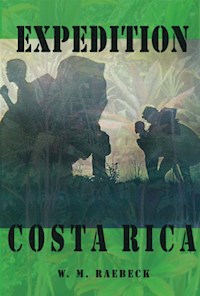
Expedition Costa Rica
Das E-Book können Sie in Legimi-Apps oder einer beliebigen App lesen, die das folgende Format unterstützen:
Veröffentlichungsjahr: 2016
0,0
Bewertungen werden von Nutzern von Legimi sowie anderen Partner-Webseiten vergeben.
Legimi prüft nicht, ob Rezensionen von Nutzern stammen, die den betreffenden Titel tatsächlich gekauft oder gelesen/gehört haben. Wir entfernen aber gefälschte Rezensionen.
Ähnliche


















“Expedition Costa Rica”© copyright 2016 Hula Cat Press all rights reserved
Cover design and cover photos by W. M. Raebeck.
No part of this book may be copied, reproduced, or used in any way without express permission from Hula Cat Press or the author.
The characters and place names in “Expedition Costa Rica”
are fictitious, used for literary purposes only.
Library of Congress number 2015908823
ISBN 978-1-938691-07-2
At least 20% of the proceeds from “Expedition Costa Rica” goes directly to protecting wilderness, wildlife, all creatures, and oceans from human violation, insensitivity, and ignorance.
This book is sourced from a responsibly managed N. American forest, meeting the requirements of the Independent Sustainable Forestry Initiative Program ®.
Visit ‘WendyRaebeck.com’ for other books by W. M. Raebeck, and special discounts.
HULA CAT MEDIA
PO Box 510058
Kealia, Hi [email protected]
To Leonardo
~ muchas gracias~
Contents
Acknowledgements
Prologue
Notes
PART I - In Gear
Preparations
East Coast
‘Training’
Setting Out
Day One
PART II - Rio Relibo
Day Two
Day Three
Day Four
Day Five
Day Six
Day Seven
Day Eight
Day Nine
Day Ten
Day Eleven
PART III - U-Turn
Day Twelve
Day Thirteen
Day Fourteen
Day Fifteen
Day Sixteen
Day Seventeen
Day Eighteen
Day Nineteen
PART IV - Last Gasp
Day Twenty
Day Twenty-One
Day Twenty-Two
Day Twenty-Three
Day Twenty-Four
Cielo Grande
San Jose
Epilogue
~ acknowledgements ~
With gratitude to Marcie Powers
for her unwavering enthusiasm, patience, and clarity in helping me
fine-tune this journal.
And heartfelt thanks to Terry Patterson for bringing me this adventure,
and for being my traveling soul sister through the decades.
~ November 1985
SOME THINGS YOU DON’T EVEN KNOW you’re wishing. Some childhood dreams go wherever childhood went—the visions of ourselves on sailing ships, on isles of unnamed oceans, on expeditions crossing lands without maps. Different dreams come true instead, other islands are loved. And it’s okay to never have chopped through the jungle with a machete or slept outside in the rain forest or known there were more days left on a journey than food to eat.
And when you’re little, thinking about Huckleberry Finn, Swiss Family Robinson, Tarzan, and Balboa, you don’t think about their feelings, just their determination, their distance, their guts, their guile. And you build forts, and everything happens fast. If it’s exciting you jump up and down, and if it’s awful you die quick. You don’t reenact Christopher Columbus sitting in his cabin, head in hands, aching for Mrs. Columbus. You don’t imagine loneliness or despair. And when there’s mutiny on the bounty, it’s the bad old captain’s own stupid fault for being a mean, horrible person. You don’t think that he might’ve been nice once but everything got too rough, that he never envisioned how difficult the quest would become.
And when we’re older, maybe teenagers, maybe adults, we do think about the downside of adventure—the risks, the losses. And we choose safer journeys; we don’t want to suffer. Besides, how do you get invited on an arctic expedition? How do you get chummy with Jacques Cousteau? How do you get on staff at National Geographic? And who’s going to foot the bill? And how do you drop everything, grab your Swiss army knife, and head for parts unknown? You don’t. You dream smaller and take more manageable journeys.
But you are what you are. You’ve still got your atlas at arm’s length, open horizons still call. One way tickets are a gamble, but round trip is impossible…
My soul was stewing last spring. Having worked much too hard for a year and a half in the anti-nuclear movement, I was now wondering where to reinsert myself. I made a list of what still held interest at 35 years of age. It was short: travel, photography, nature, possibility. But soon, with a practical shrug, I said goodbye to philosophical indulgence, found two jobs, and camouflaged myself into the sixty-houra-week set. Both gigs were novel enough to temporarily hold my attention. Though out of place, I laughed a lot—mind over matter is a fine drug. I hid my list, and performed my jobs with a satisfaction akin to that of tossing a bottle into a garbage can from thirty feet off, “Wow, I can do it.”
Four weeks into this behavior, I received a phone call that cancelled the solvent perspective and shot me straight back to the tree-house. I was invited on an expedition.
Suddenly all that spiritual tenacity and material skepticism were rewarded! It was okay to be someone who’d drop everything for a great adventure, someone with nothing to lose. Those are the kind of people required for expeditions.
The intent was to march into the Costa Rican rain forest from the east coast, locate a tribe, visit with them a day or two, then hike out the other side, emerging from the jungle on the Pacific coast. Orlando (my eccentric in-law) said the trek would take about eight days.
My employers could see by the light in my eyes that I was already on the plane, and agreed to hold my job for two weeks.
I would go, with the same abandon one might go to heaven. In five days I’d be on a flight from L.A. to San Jose, Costa Rica. A wish had been granted…or looked like it was about to be. A journey to take us outside our customary minds.
In recounting this story, the names of places have been changed to protect the undisturbed nature and indigenous people. Today this expanse of land remains under strict governmental preservation, for the ecosystems and the people who call it home.
If you resonate with this tale, if you’re moved by our experiences, let the book be your expedition, too. Hold the place sacred, knowing it’s out there somewhere complete unto itself. It would be devastating for this book to negatively affect that region.
Thank you for understanding.
This account was written as the experience was unfolding. I could never have remembered the details otherwise, nor recorded the emotional and physical highs and lows at some later date. When the journey was over, the book was done.
Since then, I‘ve edited the manuscript numerous times—clarifying and streamlining things but never touching the story itself in even the smallest way.
At the end of some passages are dates. These record the actual day that entry was written, often not the date of the action described. So don’t be confused; I wanted to retain the journal as originally written, for the record.
~ W.M.R.
MOIST CLOUDS AND LIGHT WINDS made San Jose balmy and clear, and a familial tranquility inhabited the townspeople’s faces. With no falseness, no hard sell, they seemed refreshingly shy.
Perhaps the most courageous of our group, my sister Darcy had arrived first, with Maya and Marco, aged two and a half, and eight months. And, at Orlando’s suggestion, the exhausted little trio even met me at the airport when I touched down from L.A. Orlando himself, Darcy’s husband, arrived the following day and, here in his native land, was more relaxed than I’d ever seen him. Everything worked for him here, from friends and relatives to simple happiness at being home. In New York he was flamboyant and odd, here he was glorious and grand. And his care for a growing family added a practical dimension much welcomed by all who knew him. At dinner that night, I asked him how long he’d been preparing for this expedition. “Twenty years,” he answered, with far-away eyes.
Orlando Nelson is a man of forty-nine who maintains a twenty-five-year-old’s strength and physique. On the phone a few months earlier, Darcy had said, “Remember when I told you Orlando can run twenty miles on the beach? Well, make it twenty-seven.” His outrageous generosity baffles people, and his extravagance throws mud at the notion of earning interest. Human interest, though, he’s earned—from his Mayan excursion in Mexico to his art-related enterprises in Australia to his jungle treks in every Central American country.
The purpose of this one was to find a tribe reputedly living deep in the jungle of a region called Karakima, nearly ten thousand feet up into the mountains. What little information Orlando had gathered, from other tribes less remote, was that this one, the Locandias, had chosen to stay permanently apart from civilization. Anthropologically, there’s surely a term for seeking out an unknown people, but our motivations were lastly scholastic. Exhilaration, curiosity, and a yearning for closeness with nature and the Unknowable Great seemed the common incentive of the participants now gathering in San Jose.
After Orlando, came Brett, Stacy, and “Mr. Garcia,” all burned out from preparations and delays in New York. Brett, big and blond, was Orlando’s trainer from the New York gym. Raised in the Missouri woods, and part Comanche, he looked physically suited for the outing. Stacy, Brett’s girlfriend, a strapping Midwestern farmer’s daughter, made an equally sturdy first impression. A jewelry designer, she’d left a whole season of orders in New York to make this trip. Tomas Garcia, a staff photographer from Time Magazine, so impressed Orlando that he dared not even call Tomas by his first name. Originally from South America, Tomas brought to the group the welcome reserve of a non-American.
Because Darcy couldn’t possibly make the journey with two tots, Orlando had invited me—to “witness it for her” and share it with her when (if) we returned. Over the phone, he had said sincerely that it wasn’t easy finding the right women for this mission. When it was down to the wire, despite our acknowledged personality differences, he decided I was a viable candidate. I was reassured that someone who knew me so superficially had still seen my stuff underneath. Orlando’s instinct crackled around him like electricity, and he adhered to it like law. So I resolved to tone down my own electrics on this trek and follow his lead.
Stacy and I would each have balked at being the only woman. And naturally we had both immediately asked Orlando if other females were being enlisted. Slightly ahead of the truth, as he could sometimes be, he’d told each of us that the other was, at that moment, packing.
~ May 7, 1985, San Jose, Costa Rica
BUT WHAT HAD BECOME OF ALL THE CARGO shipped from New York? After waiting three days in San Jose, the fourth morning we barreled out to the airport in full force. Tall, proud, and annoyed, we marched from cargo terminal to office to warehouse and around again for the next eight hours. Five hundred bucks later, those troubles behind us, we loaded the gear into Orlando’s Jeep and a rented van, then checked out of our hotel.
That night, numbering nine (including Orlando’s brother, who was helping by driving the van), we headed for Costa Rica’s east coast under starry skies.
The drive was about a hundred miles. Halfway there, we rolled to a stop in front of a blue painted rooming house in the town of Turrialba. Orlando hopped out and disappeared inside. Moments later, he reappeared on the porch with a kind-faced black gentleman in a suit and hat. We took turns shaking the old hand and looking into the weathered face of Orlando’s father. Darcy, meanwhile, tried to tally up for him how many grandchildren he had, coming up with forty—ten more than his own count. As our Jeep soon pulled back out to the main road, behind the rented van, Orlando told Darcy and I that his father earns money by selling peanuts in the park each day, and had been counting out the day’s profits ($2.00) when Orlando walked in. This was the second time Orlando had seen his father in twenty years; the first had been two months earlier.
We reached the east coast exhausted, then turned in the direction of Orlando’s hometown, farther along the silent road. The tropics inhaled us as we caravaned down the dark, desolate, palm-lined lane.
Punta del Sol had one no-star hotel, one bar, one store, and a post office. The roads were unpaved and few, cars fewer. Caribbean blacks, a few foreigners, and a potpourri of mixed children lived in small wooden houses on stilts. The paint was faded, windows stayed open, porches were gathering places in the rain. Both English and Spanish were known by all. Fishing was a big thing, the fish were bigger things, tourism was a little thing. And the folks were friendly but not the first to smile.
Orlando had rented two little houses for all of us. And, at the decision of the rooster next door, we woke to a shimmering dawn behind a green-gold screen of coconut palms.
AS PROMISED, ORLANDO ROUSED EVERYONE at six a.m. to begin our physical training. After little sleep in San Jose and less in Punta del Sol, and knowing fatigue as my proven adversary, I rolled over for another forty winks, as I’d promised. But crossing Orlando, especially so early in the game, was like thumbing my nose at the whole expedition. The others dutifully attended his boot camp.
But when they all dragged in from their five-mile run, half on sand, then slept all day, I felt excellent being rested instead. Tomas had damaged a knee and could no longer run at all, and Stacy had twisted an ankle. (Stacy and Brett were also suffering the side effects of malaria pills, in addition to five other precautionary shots they’d each had in New York.)
The second morning at six, we ran three and a half miles along a jungly trail by the beach. A twenty-two-yearold native from Punta del Sol, Ernesto, had now joined the team—Spanish speaking and lithe and agile as a dancer. He had the face of a Lancelot, and his mere presence pleased everyone. He was the first of the young men we’d recruit to help with cargo. (When Orlando had done the twenty-seven-mile run two months earlier, along that road we’d just traveled, Ernesto had accompanied him on a bicycle.)
Running on the trail now, I was winded and floundering a half mile behind the pack, slower than even “Mr. Garcia,” who was walking! When I finally caught up to where the others were running in place by a lagoon, Orlando pushed us into a series of aerobic strength exercises, all lost on me in a blur of heavy panting.
The third morning—after the men took a three-hour hunting trip in the middle of the night—we didn’t commence our workout till a tardy seven o’clock. We ran only two miles, then for the next two hours did body-building on a wooden rack Orlando had constructed by the houses.
Being driven like an ensign was counter to my yoga-based notions of fitness training. Brett, our trainer, had allegedly been lifting weights for twenty-four years—impressive considering he was twenty-six. Soul-mate Stacy was no cream-puff either, and half their conversations were in some gym lingo I couldn’t decipher. And Orlando could knock off twenty or thirty miles in a morning, and generally took life at a gallop—leaving only “Mr. Garcia,” i.e. Tomas, as my possible equal. But he was a man; relegating me the uncontested runt of the litter.
I enjoyed this distinction so little that I decided to punish myself no further. Despite the once-in-a-lifetime opportunity before us, I felt my safety at stake under this ‘training.‘ Plus I was alienated for being openly contrary. Without an ally it seemed dicey to venture into the unknown…
So I detached from the group. I’d continue the training, but not to over-exertion. I had to be true to myself, and would even throw in the towel if too compromised.
The days blended together in a series of pre-expedition emotions and sore muscles. Our core group of five (Orlando, Tomas, Brett, Stacy, and I) spent the week as a unit, and though our differences became clearer, mutual excitement bound us. There were exhilarating periods of fearlessness, joy, and trust—but, simultaneously, for me, stubborn withdrawn times after clashing with the macho drive of Orlando and Brett. Nature had always been fair with me, and I knew machismo wouldn’t fool the weather or the mountains. Reliant for so long on my own instincts, it was tough taking commands now. Orlando was our leader, yet I wondered where he’d lead us when I saw all the rifles and ammo, Brett’s bullwhip, bow, and arrows. Were we going exploring or hunting? Both, said Orlando and Brett.
Before leaving New York though, Brett, Stacy, and Tomas had made a commitment to follow Orlando through thick and thin. Now those three told me, in unison, that it was imperative I do the same.
“Look,” I responded to their serious faces around the table after dinner one night in Punta del Sol, “I’ve known Orlando for eight years. I wouldn’t be here if I didn’t feel I was up to the task…that’s probably why he asked me to come. I’m going to do my best not to assert my independence, and simply do what’s required of me out there—I’m going forward with that understanding—but I’m not going to swear that in any situation I’ll do whatever Orlando says…or as you said, Brett, ‘jump off a cliff if he says jump off a cliff.’ I might—but with my life on deposit, I might not. If that really isn’t enough, then you will go without me.”
There was another week before they’d set out for the upper jungles of Karakima. We all continued enjoying the Caribbean waters, the glorious palm trees, scrumptious fruits, and tranquil sounds. Experiencing health again, after city life, is always a rebirth. And there was quiet time to meander, sleep, and mentally ruminate past and future.




