


41,99 €
Mehr erfahren.
- Herausgeber: John Wiley & Sons
- Kategorie: Fachliteratur
- Serie: Wiley Finance Series
- Sprache: Englisch
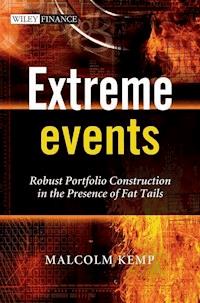
Taking due account of extreme events when constructing portfolios of assets or liabilities is a key discipline for market professionals. Extreme events are a fact of life in how markets operate. In Extreme Events: Robust Portfolio Construction in the Presence of Fat Tails, leading expert Malcolm Kemp shows readers how to analyse market data to uncover fat-tailed behaviour, how to incorporate expert judgement in the handling of such information, and how to refine portfolio construction methodologies to make portfolios less vulnerable to extreme events or to benefit more from them. This is the only text that combines a comprehensive treatment of modern risk budgeting and portfolio construction techniques with the specific refinements needed for them to handle extreme events. It explains in a logical sequence what constitutes fat-tailed behaviour and why it arises, how we can analyse such behaviour, at aggregate, sector or instrument level, and how we can then take advantage of this analysis. Along the way, it provides a rigorous, comprehensive and clear development of traditional portfolio construction methodologies applicable if fat-tails are absent. It then explains how to refine these methodologies to accommodate real world behaviour. Throughout, the book highlights the importance of expert opinion, showing that even the most data-centric portfolio construction approaches ultimately depend on practitioner assumptions about how the world might behave. The book includes: * Key concepts and methods involved in analysing extreme events * A comprehensive treatment of mean-variance investing, Bayesian methods, market consistent approaches, risk budgeting, and their application to manager and instrument selection * A systematic development of the refinements needed to traditional portfolio construction methodologies to cater for fat-tailed behaviour * Latest developments in stress testing and back testing methodologies * A strong focus on the practical implementation challenges that can arise at each step in the process and on how to overcome these challenges "Understanding how to model and analyse the risk of extreme events is a crucial part of the risk management process. This book provides a set of techniques that allow practitioners to do this comprehensively." Paul Sweeting, Professor of Actuarial Science, University of Kent "How can the likeliness of crises affect the construction of portfolios? This question is highly topical in times where we still have to digest the last financial collapse. Malcolm Kemp gives the answer. His book is highly recommended to experts as well as to students in the financial field." Christoph Krischanitz, President Actuarial Association of Austria, Chairman WG "Market Consistency" of Groupe Consultatif
Sie lesen das E-Book in den Legimi-Apps auf:
Seitenzahl: 744
Veröffentlichungsjahr: 2011
Ähnliche

















Contents
Cover
Half Title page
Title page
Copyright page
Preface
Acknowledgements
Abbreviations
Notation
Chapter 1: Introduction
1.1 Extreme Events
1.2 The Portfolio Construction Problem
1.3 Coping with Really Extreme Events
1.4 Risk Budgeting
1.5 Elements Designed to Maximise Benefit to Readers
1.6 Book Structure
Chapter 2: Fat Tails – In Single (i.e., Univariate) Return Series
2.1 Introduction
2.2 A Fat Tail Relative to What?
2.3 Empirical Examples of Fat-Tailed Behaviour in Return Series
2.4 Characterising Fat-Tailed Distributions by Their Moments
2.5 What Causes Fat Tails?
2.6 Lack of Diversification
2.7 A Time-Varying World
2.8 Stable Distributions
2.9 Extreme Value Theory (EVT)
2.10 Parsimony
2.11 Combining Different Possible Source Mechanisms
2.12 The Practitioner Perspective
2.13 Implementation Challenges
Chapter 3: Fat Tails – In Joint (i.e., Multivariate) Return Series
3.1 Introduction
3.2 Visualisation of Fat Tails in Multiple Return Series
3.3 Copulas and Marginals – Sklar’s Theorem
3.4 Example Analytical Copulas
3.5 Empirical Estimation of Fat Tails in Joint Return Series
3.6 Causal Dependency Models
3.7 The Practitioner Perspective
3.8 Implementation Challenges
Chapter 4: Identifying Factors That Significantly Influence Markets
4.1 Introduction
4.2 Portfolio Risk Models
4.3 Signal Extraction and Principal Components Analysis
4.4 Independent Components Analysis
4.5 Blending Together Principal Components Analysis and Independent Components Analysis
4.6 The Potential Importance of Selection Effects
4.7 Market Dynamics
4.8 Distributional Mixtures
4.9 The Practitioner Perspective
4.10 Implementation Challenges
Chapter 5: Traditional Portfolio Construction Techniques
5.1 Introduction
5.2 Quantitative Versus Qualitative Approaches?
5.3 Risk-Return Optimisation
5.4 More General Features of Mean-Variance Optimisation
5.5 Manager Selection
5.6 Dynamic Optimisation
5.7 Portfolio Construction in the Presence of Transaction Costs
5.8 Risk Budgeting
5.9 Backtesting Portfolio Construction Techniques
5.10 Reverse Optimisation and Implied View Analysis
5.11 Portfolio Optimisation with Options
5.12 The Practitioner Perspective
5.13 Implementation Challenges
Chapter 6: Robust Mean-Variance Portfolio Construction
6.1 Introduction
6.2 Sensitivity to the Input Assumptions
6.3 Certainty Equivalence, Credibility Weighting and Bayesian Statistics
6.4 Traditional Robust Portfolio Construction Approaches
6.5 Shrinkage
6.6 Bayesian Approaches Applied to Position Sizes
6.7 The ‘Universality’ of Bayesian Approaches
6.8 Market Consistent Portfolio Construction
6.9 Resampled Mean-Variance Portfolio Optimisation
6.10 The Practitioner Perspective
6.11 Implementation Challenges
Chapter 7: Regime Switching and Time-Varying Risk and Return Parameters
7.1 Introduction
7.2 Regime Switching
7.3 Investor Utilities
7.4 Optimal Portfolio Allocations for Regime Switching Models
7.5 Links with Derivative Pricing Theory
7.6 Transaction Costs
7.7 Incorporating More Complex Autoregressive Behaviour
7.8 Incorporating More Intrinsically Fat-Tailed Behaviour
7.9 More Heuristic Ways of Handling Fat Tails
7.10 The Practitioner Perspective
7.11 Implementation Challenges
Chapter 8: Stress Testing
8.1 Introduction
8.2 Limitations of Current Stress Testing Methodologies
8.3 Traditional Stress Testing Approaches
8.4 Reverse Stress Testing
8.5 Taking Due Account of Stress Tests in Portfolio Construction
8.6 Designing Stress Tests Statistically
8.7 The Practitioner Perspective
8.8 Implementation Challenges
Chapter 9: Really Extreme Events
9.1 Introduction
9.2 Thinking Outside the Box
9.3 Portfolio Purpose
9.4 Uncertainty As A Fact of Life
9.5 Market Implied Data
9.6 The Importance of Good Governance and Operational Management
9.7 The Practitioner Perspective
9.8 Implementation Challenges
Chapter 10: The Final Word
10.1 Conclusions
10.2 Portfolio Construction Principles in the Presence of Fat Tails
Appendix: Exercises
A.1 Introduction
A.2 Fat Tails – in Single (i.e., Univariate) Return Series
A.3 Fat Tails – in Joint (i.e., Multivariate) Return Series
A.4 Identifying Factors that Significantly Influence Markets
A.5 Traditional Portfolio Construction Techniques
A.6 Robust Mean-Variance Portfolio Construction
A.7 Regime Switching and Time-Varying Risk and Return Parameters
A.8 Stress Testing
A.9 Really Extreme Events
References
Index
Extreme Events
For other titles in the Wiley Finance series please see www.wiley.com/finance
This edition first published 2011©2011 John Wiley & Sons, Ltd
Registered office
John Wiley & Sons Ltd, The Atrium, Southern Gate, Chichester, West Sussex, PO19 8SQ, United Kingdom
For details of our global editorial offices, for customer services and for information about how to apply for permission to reuse the copyright material in this book please see our website at www.wiley.com.
The right of the author to be identified as the author of this work has been asserted in accordance with theCopyright, Designs and Patents Act 1988.
All rights reserved. No part of this publication may be reproduced, stored in a retrieval system, or transmitted, in any form or by any means, electronic, mechanical, photocopying, recording or otherwise, except as permitted by theUK Copyright, Designs and Patents Act 1988, without the prior permission of the publisher.
Wiley also publishes its books in a variety of electronic formats. Some content that appears in print may not be available in electronic books.
Designations used by companies to distinguish their products are often claimed as trademarks. All brand names and product names used in this book are trade names, service marks, trademarks or registered trademarks of their respective owners. The publisher is not associated with any product or vendor mentioned in this book. This publication is designed to provide accurate and authoritative information in regard to the subject matter covered. It is sold on the understanding that the publisher is not engaged in rendering professional services. If professional advice or other expert assistance is required, the services of a competent professional should be sought.
Library of Congress Cataloging-in-Publication Data
A catalog record for this book is available from the Library of Congress.
ISBN: 978-0-470-75013-1
A catalogue record for this book is available from the British Library.
Preface
There are two reasons for writing this book. The first is timing. This book has been written during a worldwide credit and economic crisis. The crisis has reminded us that extreme events can occur more frequently than we might like. It followed an extended period of relative stability and economic growth that, with hindsight, was the calm before a storm. Throughout this book, this crisis is referred to as the ‘2007–09 credit crisis’.
During the preceding relatively stable times, people had, maybe, paid less attention than they should have to the possibility of extreme events occurring. Perhaps you were one of them. Perhaps I was too. Adversity is always a good spur to careful articulation of underlying reality.
Extreme events were evident even right at the start of the 2007–09 credit crisis, at the end of July 2007 and in the first two weeks of August 2007. This marked the time when previously ruling relationships between interbank money market rates for different deposit terms first started to unravel. It also coincided with some sudden and unexpectedly large losses being incurred by some high profile (quantitatively run) hedge funds that unwound some of their positions when banks cut funding and liquidity lines to them. Other investors suffered unusually large losses on positions they held that had similar economic sensitivities to the ones that these hedge funds were liquidating.
During 2007 investors were also becoming more wary of US sub-prime debt. But, even as late as April 2008, central banks were still expecting markets gradually to regain their poise. It was not to be. In late 2008 the credit crisis erupted into a full-blown global banking crisis with the collapse of Lehman Brothers, the need for Western governments to shore up their banking systems and economies across the globe entering recessions. Market volatility during these troubled times was exceptional, reaching levels not seen since the Great Depression in the early 1930s. Extreme events had well and truly returned to the financial landscape.
The second reason for writing this book is that it naturally follows on from my earlier book on Market Consistency; see Kemp (2009). Market consistency was defined there as the activity of taking account of ‘what the market has to say’ in financial practice. In Market Consistency I argued that portfolio construction should be viewed as the third strand in a single overarching branch of financial theory and practice, the other two strands being valuation methodology and risk management processes. However, I also noted that the application of market consistency to portfolio construction was in some sense simultaneously both core and peripheral. It was ‘core’, in the sense that ultimately there is little point in merely valuing and measuring positions or risk; the focus should also be on managing them. It was also ‘peripheral’, because portfolio management generally also involves taking views about when the market is right and when it is wrong, and then acting accordingly, i.e., it necessarily does not always agree with ‘what the market has to say’.
These different drivers meant that Market Consistency naturally focused more on valuation methodology and risk management and less on portfolio construction. So, this book seeks to balance the exposition in Market Consistency by exploring in more depth the portfolio construction problem. It is particularly aimed at those practitioners, students and others who, like me, find portfolio construction a fascinating topic to study or a useful discipline to apply in practice.
The style I have adopted when writing this book is similar to the one used for Market Consistency. This involves aiming simultaneously to write both a discursive text and a reference book. Readers will no doubt want a reference book to help them navigate through the many techniques that can be applied to portfolio construction. However, undue focus on the ‘how to’ rather than also on the ‘why should I want to’ or ‘what are the strengths and weaknesses of doing so’ is typically not the right way to help people in practice. Instead, readers ideally also expect authors to express opinions about the intrinsic usefulness of different techniques.
As in Market Consistency I have tried to find a suitable balance between mathematical depth and readability, to avoid some readers being overly daunted by unduly complicated mathematics. The book focuses on core principles and on illuminating them where appropriate with suitably pitched mathematics. Readers wanting a more detailed articulation of the underlying mathematics are directed towards the portfolio construction pages of the www.nematrian.com website, referred to throughout this book as Kemp (2010). Kemp (2010) also makes available a wide range of online tools that, inter alia, can be applied to the portfolio construction problem. Most of the charts in this book and the analyses on which they are based use these tools, and where copyrighted are reproduced with kind permission from Nematrian Limited. A few of the charts and principles quoted in this book are copied from ones already contained in Market Consistency and are reproduced with permission from John Wiley & Sons, Ltd.
Acknowledgements
I would like to thank Pete Baker, Aimee Dibbens and their colleagues at Wiley for encouraging me to embark on writing this book. Thanks are also due to Colin Wilson and others who have read parts of this manuscript and provided helpful comments on how it might be improved. A special appreciation goes to my wife and family for supporting me as this book took shape.
However, while I am very grateful for the support I have received from various sources when writing this book, I still take sole responsibility for any errors and omissions that it contains.
Abbreviations
ALMasset-liability managementAPTArbitrage Pricing TheoryARautoregressiveARMAautoregressive moving averageBLBlack-Littermanbpbasis pointCAPMCapital Asset Pricing ModelCDOcollateralised debt obligationcdfcumulative distribution functionCDScredit default swapCMLcapital market lineCOSOCommittee of Sponsoring Organisations of the Treadway CommissionCPPIconstant proportional portfolio insuranceCROchief risk officerCRRAconstant relative risk aversionCVaRconditional Value-at-Risk (aka TVaR and Expected Shortfall)EMexpectation-maximisation algorithmEMHefficient markets hypothesisERMenterprise risk managementESGeconomic scenario generatorEUEuropean UnionEVDextreme value distributionEVTextreme value theoryFOCfirst order conditionsFSAFinancial Services Authority (UK)GAAPGenerally Accepted Accounting PrinciplesGMMGaussian (i.e., multivariate Normal) mixture modelsGRS F-testGibbons, Ross and Shanken (Econometrica 1989) F-testHHIHerfindahl Hirshman Indexi.i.d.independent and identically distributedIASInternational Accounting StandardsIASBInternational Accounting Standards BoardICAindependent components analysisITinformation technologylpmlower partial momentLTCMLong Term Capital ManagementMAmoving averageMCMCMarkov chain Monte CarloMDAmaximum domain of attractionMRPminimum risk portfolioOLSordinary least squaresORSAOwn Risk and Solvency AssessmentOSLLout-of-sample log-likelihoodPCAprincipal components analysispdfprobability density functionQQquantile–quantileREresampled efficiencyRSregime switchingS&Ls(US) savings and loans associationsSCRSolvency Capital RequirementSETARself-exciting threshold autoregressiveSIVstructured investment vehicleSYSCSenior Management Arrangements, Systems and ControlsTARthreshold autoregressiveTVaRtail Value-at-Risk (aka CVaR and Expected Shortfall)UKUnited Kingdom of Great Britain and Northern IrelandUS and USAUnited States of AmericaVaRValue-at-RiskChapter 1
Introduction
1.1 Extreme Events
This book is about how best to construct investment portfolios if a priori it is reasonable to assume that markets might exhibit fat-tailed behaviour. It is designed to appeal to a wide variety of practitioners, students, researchers and general readers who may be interested in extreme events or portfolio construction theory either in isolation or in combination. It achieves this aim by
(a) Exploring extreme events, why they might arise in a financial context and how we might best analyse them.
(b) Separately exploring all the main topics in portfolio construction theory applicable even in the absence of fat tails. A special case of any more general approach capable of effectively handling extreme events is the situation where the extent of fat-tailed behaviour is too small to be discernible.
(c) Blending points (a) and (b) together to identify portfolio construction methodologies better able to cater for possible fat-tailed behaviour in the underlying assets or liabilities.
Given its wide intended audience, the book covers these topics both from a more qualitative perspective (particularly in the earlier and later chapters) and from a more quantitative (i.e., mathematical) perspective (particularly in the middle chapters). Where possible, this book has been segmented so that valuable insights can be gained without necessarily having to read the whole text. Conversely, in the author’s opinion, valuable insights arise throughout the book, including the parts that are more mathematical in nature. More general readers are therefore encouraged not to skip over these parts completely, although they do not need to worry too much about following all the details.
By fat-tailed behaviour we mean that the distribution of future returns is expected to involve more extreme events than might be expected to occur were returns to follow the (multivariate) (log-) Normal distributions often assumed to apply to markets in basic portfolio construction texts.1
Most practitioners believe that most markets are ‘fat-tailed’ given this terminology. There is a wide body of empirical academic literature that supports this stance, based on analysis of past market behaviour. There is also a growing body of academic theory, including some involving behavioural finance, explaining why fat-tailed behaviour seems so widespread. So, we might also characterise this book as exploring how best to construct investment portfolios in the real world.
Of course, practitioners and academics alike are not themselves immune from behavioural biases. It is one thing to agree to pay lip service to the notion that market behaviour can be fat-tailed, but quite another to take this into account in how portfolios are actually constructed. Following the dot.com boom and bust in the late 1990s and early 2000s, markets settled into a period of unusually low volatility. Strategies that benefited from stable economic conditions, e.g., ones that followed so-called ‘carry’ trades or strategies relying on continuing ready access to liquidity, proved successful, for a time. The 2007–09 credit crisis, however, painfully reminded the complacent that markets and economies more generally can and do experience extreme events.
1.2 The Portfolio Construction Problem
We do not live in a world in which we have perfect foresight. Instead, portfolio construction always involves striking a balance between risk and reward, i.e., the risk that the views implicit in our portfolio construction will prove erroneous versus the rewards that will accrue if our views prove correct. Everyone involved in the management of portfolios, whether of assets or of liabilities, faces a portfolio construction problem. How do we best balance risk and return? Indeed, what do we mean by ‘best’?
Given the lack of perfect foresight that all mortals face, it is not reasonable to expect a book like this to set out guaranteed ways of profiting from investment conditions come what may. Instead, it seeks to achieve the lesser but more realistic goal of exploring the following:
(a) core elements of portfolio construction;
(b) mathematical tools that can be used to assist with the portfolio construction problem, and their strengths and weaknesses;
(c) ways of refining these tools to cater better for fat-tailed market behaviour;
(d) mindsets best able to cope well with extreme events, and the pitfalls that can occur if we do not adopt these mindsets.
1.3 Coping with Really Extreme Events
Lack of perfect foresight is not just limited to a lack of knowledge about exactly what the future holds. Typically in an investment context we also do not know how uncertain the future will be. Using statistical terminology, we do not even know the precise form of the probability distribution characterising how the future might evolve.
The differentiation between ‘risk’ and ‘uncertainty’ is a topic that several popular writers have sought to explore in recent times, e.g., Taleb (2004, 2007). In this context ‘risk’ is usually taken to mean some measurable assessment of the spread of possible future outcomes, with ‘uncertainty’ then taken to mean lack of knowledge, even (or particularly) concerning the size of this spread.
In this book, we take up this baton particularly in Chapters 8 and 9. Holding such an insight in mind is, I think, an important contributor to successful portfolio construction. In particular, it reminds us that really extreme events seem to have a nasty habit of occurring more often than we might like. Put statistically, if there is a 1 in 1010 (1 in 10 billion) chance of an event occurring given some model we have adopted, and there is a 1 in 106 (1 in a million) chance that our model is fundamentally wrong, then any really extreme events are far more likely to be due to our model being wrong than representing random (if unlikely) draws from our original model.2
Yet such insights can also be overplayed. The portfolio construction problem does not go away merely because the future is uncertain. Given a portfolio of assets, someone, ultimately, needs to choose how to invest these assets. Although it is arguably very sensible for them to bear in mind intrinsic limitations on what might be knowable about the future, they also need some framework for choosing between different ways of structuring the portfolio.
This framework might be qualitatively formulated, perhaps as someone’s ‘gut feel’. Alternatively, it might be quantitatively structured, based on a more mathematical analysis of the problem at hand. It is not really the purpose of this book to argue between these two approaches. Indeed, we shall see later that the outcome of essentially any qualitative judgemental process can be reformulated as if it were coming from a mathematical model (and arguably vice versa).
Perhaps the answer is to hold onto wealth lightly. All of us are mortal. The more religious among us, myself included, might warm to this philosophy. But again, such an answer primarily characterises a mindset to adopt, rather than providing specific analytical tools that we can apply to the problem at hand.
1.4 Risk Budgeting
Some practitioners point to the merits of risk budgeting. This involves identifying the total risk that we are prepared to run, identifying its decomposition between different parts of the investment process and altering this decomposition to maximise expected value-added for a given level of risk. It is a concept that has wide applicability and is difficult to fault. What business does not plan its evolution via forecasts, budgets and the like? Indeed, put like this risk budgeting can be seen to be common sense.
Again, though, we have here principally a language that we can use to describe how to apply investment principles. Risk budgeting principally inhabits the ‘mindset’ sphere rather than constituting an explicit practical toolset directly applicable to the problem at hand. This should not surprise us. Although sensible businesses clearly do use budgeting techniques to good effect, budgeting per se does not guarantee success. So it is with risk budgeting.3
However, language is the medium through which we exchange ideas and so cannot be ignored. Throughout this book, we aim to explain emerging ideas using terms that can be traced back to risk budgeting concepts. This helps clarify the main aspects of the methodology under discussion. It also helps us understand what assumptions need to be made for the relevant methodology to be valid.
1.5 Elements Designed to Maximise Benefit to Readers
As explained in Section 1.1, this book aims to appeal to a wide variety of audiences. To do this, I have, as with my earlier book on Market Consistency, sought a suitable balance between mathematical depth and readability, to avoid some readers being overly daunted by unduly complicated mathematics. The book focuses on core principles and on illuminating them where appropriate with suitably pitched mathematics. Readers wanting a more detailed articulation of the underlying mathematics are directed towards the portfolio construction pages of the www.nematrian.com website, referred to throughout this book as Kemp (2010).
To maximise the benefit that both practitioners and students can gain from this book, I include two sections at the end of each main chapter that provide:
(a) Comments specifically focusing on the practitioner perspective. To navigate successfully around markets typically requires an enquiring yet somewhat sceptical mindset, questioning whether the perceived benefits put forward for some particular technique really are as strong as some might argue. So, these sections either focus on the ways that practitioners might be able to apply insights set out earlier in the relevant chapter in their day-to-day work, or highlight some of the practical strengths and weaknesses of techniques that might be missed in a purely theoretical discussion of their attributes.
(b) A discussion of some of the more important implementation challenges that practitioners may face when trying to apply the techniques introduced in that chapter. Where the same challenge arises more than once, I generally discuss the topic at the first available opportunity, unless consideration of the challenge naturally fits better in a later chapter.
The book also includes an Appendix containing some exercises for use by students and lecturers. Each main chapter of the book has associated exercises that further illustrate the topics discussed in that chapter. The exercises are reproduced with kind permission from Nematrian Limited. Hints and model solutions are available on the www.nematrian.com website, as are any analytical tools needed to solve the exercises.
Throughout the book, I draw out principles (i.e., guidance, mainly for practitioners) that have relatively universal application. Within the text these principles are indented and shown in bold, and are referenced by P1, P2, etc.
1.6 Book Structure
The main title of this book is Extreme Events. It therefore seems appropriate to focus first, in Chapters 2 and 3, on fat tails and extreme events. We explore some of the ways in which fat-tailed behaviour can be analysed and the existence or otherwise of extreme events confirmed or rejected. We differentiate between analysis of fat tails in single return series in Chapter 2 and analysis of fat tails in joint (i.e., multiple) return series in Chapter 3. The shift from ‘one’ to ‘more than one’ significantly extends the nature of the problem.
Before moving on to portfolio construction per se, we consider in Chapter 4 some ways in which we can identify what seems to be driving market behaviour. Without some underlying model of market behaviour, it is essentially impossible to assess the merits of different possible approaches to portfolio construction (or risk modelling). We consider tools such as principal components analysis and independent components analysis, and we highlight their links with other statistical and econometric tools such as multivariate regression.
In Chapters 5--7 we turn our attention to the portfolio construction problem.
Chapter 5 summarises the basic elements of portfolio construction, both from a quantitative and from a qualitative (i.e., ‘fundamental’) perspective, if fat tails are not present. At a suitably high level, both perspectives can be viewed as equivalent, apart perhaps from the mindset involved. In Chapter 5 we also explore some of the basic mathematical tools that commentators have developed to analyse the portfolio construction problem from a quantitative perspective. The focus here (and in Chapter 6) is on mean-variance portfolio optimisation (more specifically, mean-variance optimisation assuming time stationarity). We consider its application both in a single-period and in a multi-period world.
In Chapter 6 we highlight the sensitivity of the results of portfolio construction analyses to the input assumptions, and the tendency of portfolio optimisers to maximise ‘model error’ rather than ‘risk-return trade-off’. We explore ways of making the results more robust to errors affecting these input assumptions. The academic literature typically assumes that input assumptions are estimated in part from past data. We might argue that asset allocation is a forward-looking discipline, and that the assumptions we input into portfolio construction algorithms should properly reflect our views about what might happen in the future (rather than about what has happened in the past). However, some reference to past data nearly always arises in such analyses. We pay particular attention to Bayesian approaches in which we have some prior (‘intrinsic’) views about the answers or input parameters that might be ‘reasonable’ for the problem and we give partial weight to these alongside partial weight to external (often past) data. The best-known example of this is probably the Black-Litterman approach. Some Bayesian approaches can also be viewed as justifying heuristic4 techniques that can be applied to the portfolio construction problem. This again highlights the high-level equivalence that exists between quantitative and qualitative approaches to portfolio construction.
In Chapter 6 we also introduce ‘market consistent’ portfolio construction, in which we derive input assumptions not from past data but from market implied data. Such an approach is ‘robust’ in the sense that the input assumptions are in theory not subject to the same sorts of estimation errors as ones derived from historical behaviour. We also explore tools that practitioners less keen on Bayesian approaches have developed to tackle estimation error, particularly resampled portfolio optimisation. We show that they are less divorced from Bayesian approaches than might appear at first sight.
In Chapter 7 we identify how to incorporate fat tails into portfolio construction theory. We start by exploring what happens when we relax the assumption of time stationarity, by introducing the concept of regime shifting. This involves assuming that the world is, at any point in time, in one of several possible states, characterised by different distributions of returns on the different assets and liabilities under consideration. The mixing of distributions introduced in such a model naturally leads to fat-tailed behaviour. We then extend these ideas to encompass more general ways of incorporating fat-tailed behaviour. We focus mainly but not exclusively on situations where the regime is characterised not by a single Normal distribution but by a distributional mixture of Normal distributions (because this type of model is sufficiently general that it can approximate other ways in which fat tails might arise). We also explore approaches that involve continuously varying parameterisations of the different regimes and focus on behaviour in continuous rather than discrete time.
Chapters 2 to 7 are largely concerned with a probability-theoretic view of portfolio construction. In them, we identify, somehow or other, a distributional form to which we believe future outcomes will adhere (or more than one in the case of regime shifting). At least in principle, this involves specifying a likelihood of occurrence for any given future scenario. However, the belief that we can in all cases actually identify such likelihoods arguably involves an overly rosy view about our ability to understand the future. More to the point, regulators and other bodies who specify how financial services entities should operate may want to ensure that entities do not put too many of their eggs into what may prove an uncertain basket.
In recent years this has led to an increased focus on stress testing, which we explore in Chapter 8. Stress testing, in this context, generally involves placing less emphasis on likelihood and more emphasis on magnitude (if large and adverse) and on what might make the scenario adverse. We can view ‘reverse stress testing’ and ‘testing to destruction’ as being at one extreme of this trend. In the latter, we hypothesise a scenario adverse enough to wipe out the business model of the firm in question (or the equivalent if we are considering a portfolio) irrespective of how likely or unlikely it might be to come to pass. We then focus on what might cause such a scenario to arise and whether there are any strategies that we can adopt that might mitigate these risks.
Chapter 9 extends the ideas implicit in Chapter 8 to consider ‘really extreme’ events. It is more heuristic and ‘mindset-orientated’ than the rest of the book. This is inevitable. Such events will almost certainly be so rare that there will be little if any directly relevant data on them. Market implied portfolio construction techniques potentially take on added importance here. Merely because events are rare does not mean that others are not exposed to them too. The views of others, distilled into the market prices of such risks, may be subject to behavioural biases, but may still help us in our search to handle extreme events better.
Finally, in Chapter 10 we collate and summarise in one place all the principles highlighted elsewhere in the book.
1 By ‘multivariate’ we mean that the returns on different return series have a joint distribution, the characterisation of which includes not only how individual return series in isolation might behave, but also how they behave when considered in tandem, see Chapter 3. By ‘(log-) Normal’ we mean that the natural logarithm of 1 + r is Normally distributed, where the return, r, is expressed in fractional form, see Section 2.3.1.
2 More precisely, in this situation we need the probability of occurrence of the event that we are considering to be much higher (on average) than 1 in 10,000 in the 1 in a million circumstances when our underlying model is assumed to prove to be fundamentally wrong. This, however, is typically what is implied by use of the term ‘fundamentally wrong’. For example, suppose that our model presupposes that possible outcomes are Normally distributed with zero mean and standard deviation of 1. Then the likelihood of an outcome worse than c. –6.4 is 1 in 10 billion. However, suppose that there is actually a one in a million chance that our model is ‘fundamentally wrong’ and that the standard deviation is not 1 but 10. Roughly 26% of outcomes when the standard deviation is 10 will involve an outcome worse than c. –6.4. So, in this instance an event this extreme is roughly 40 times as likely to be a result of our original model being ‘fundamentally wrong’ as it is to be a fluke draw from the original model.
3 Likewise, no portfolio construction technique is able to guarantee success.
4 In this context, a ‘heuristic’ technique is one that is akin to a rule of thumb that is not principally proposed on the basis of some formal mathematical justification but more because the approach is relatively convenient to implement.




