


Erhalten Sie Zugang zu diesem und mehr als 300000 Büchern ab EUR 5,99 monatlich.
- Herausgeber: Birlinn
- Kategorie: Geisteswissenschaft
- Sprache: Englisch
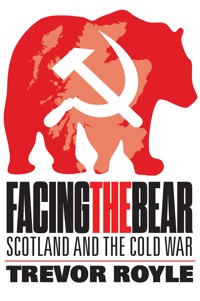
Between the end of the Second World War and the collapse of Communism confrontation with the Soviet Union was an everyday reality. As part of Nato's response, Scotland played a key role in the alliance's forward maritime defence strategy, aimed at containing the Soviet threat from naval and air forces. During this period 10 per cent of the UK's naval and air forces were based in Scotland, and there was a substantial US presence as well as top secret satellite and command stations. In this book Trevor Royle paints a fascinating portrait of this extraordinary period, examining not just the wider military and political contexts, but also showing how the defence industry brought huge economic benefits, how CND maintained a high-profile presence, and how anti-nuclear sentiments underpinned much of the left's thinking in Scotland and contributed to the hegemony enjoyed by the Labour Party in Scotland during the Cold War.
Sie lesen das E-Book in den Legimi-Apps auf:
Seitenzahl: 697
Veröffentlichungsjahr: 2019
Das E-Book (TTS) können Sie hören im Abo „Legimi Premium” in Legimi-Apps auf:
Ähnliche

















FACING THE BEAR
First published in 2019 by
Birlinn Ltd
West Newington House
10 Newington Road
Edinburgh
EH9 1QS
www.birlinn.co.uk
ISBN: 978 1 78885 085 8
Copyright © Trevor Royle 2019
The right of Trevor Royle be identified as the author of this work has been asserted by him in accordance with the Copyright, Designs and Patents Act, 1988
All rights reserved. No part of this publication may be reproduced, stored, or transmitted in any form, or by any means, electronic, mechanical or photocopying, recording or otherwise, without the express written permission of the publisher.
British Library Cataloguing-in-Publication Data
A catalogue record for this book is available on request from the British Library
Typeset by Biblichor Ltd, Edinburgh
Printed and bound in Britain by Gutenberg Press, Malta
Contents
List of Plates
Picture Credits
List of Abbreviations
Preface and Acknowledgements
Prologue: Saxa Vord
1. Last Shots, First Shots
2. When Cold War Became Hot War
3. The Yanks Are Coming
4. Frontline Scotland
5. Ding Dong Dollar: Opposing Armageddon
6. The Past Is a Foreign Country: Families on the Front Line
7. The Watch on the Rhine: Scots in Germany and on Other Fronts
8. Ploughshares into Swords: Profiting from the Cold War
9. War in the Shadows
10. Trident and Thatcher
11. The Walls Came Tumbling Down
Epilogue: A New Cold War?
Notes
Select Bibliography
Index
List of Plates
RAF Saxa Vord
The Berlin Blockade, 1948
The 1st Black Watch during the Korean War
The floating dock Los Alamos, Holy Loch
Launching a Polaris missile
CND protest, Paisley, 1961
‘Ding Dong Dollar’: the anthem of the anti-Polaris movement
Taxis await off-duty US sailors, Dunoon
Elvis Presley passes through Prestwick Airport, 1960
Inside the nuclear bunker at Turnhouse Airport, Edinburgh
Ferranti, Scotland’s largest defence contractor
Royal Scots on patrol in Belfast, 1970
A BRIXMIS car after being rammed by an NVA Tatra-148 truck, 1982
The damage to HMS Diomeid after a run-in with an Icelandic patrol vessel
A Soviet Tu-95 aircraft
An Avro Vulcan nuclear bomber
A demonstration scramble, RAF Cottesmore, 1959
A Russian Foxtrot diesel-electric submarine
A mobile SS-20 IRBM missile
Mikhail Gorbachev visits Edinburgh, 1984
Nuclear warheads en route to Coulport from Aldermaston and Burghfield
HMS Vanguard
Picture Credits
p. 1 (top) Geography Photos/Getty Images; (middle) Imperial War Museum, London; (bottom) Black Watch and Americans Black Watch Museum, Perth
p. 2 (top) The Scotsman Publications Ltd; (middle) Photoshop/Getty Images; (bottom) Newsquest (Herald & Times)
p. 3 (bottom) Newsquest (Herald & Times)
p. 4 (top) The Scotsman Publications Ltd; (middle) The Scotsman Publications Ltd; (bottom) The Royal Scots
p. 5 (middle) The Scotsman Publications Ltd; (bottom) Fasttailwind/Shutterstock
p. 6 (top) Sue Burton Photography/Shutterstock; (middle) Imperial War Museum, London; (bottom) James Steidl/Shutterstock
p. 7 (top) Yuri Mykhaylov/Shutterstock; (bottom) Newsquest (Herald & Times)
p. 8 (top) Ben Gingell/Shutterstock
List of Abbreviations
ABM
anti-ballistic missile
AGI
Auxiliary, General Intelligence (trawler)
AOSNI
Air Officer Scotland and Northern Ireland
ASUR
Anti Surface Unit Role
ASW
anti-submarine warfare
BEWC
British East–West Centre
CEW
Centrimetric Early Warning
CPGB
Communist Party of Great Britain
DAC
Direct Action Committee Against Nuclear War (AKA Emergency Committee for Direct Action Against Nuclear War)
DERA
Defence Evaluation and Research Agency
EVW
European Voluntary Workers
FCO
Foreign and Commonwealth Office
FOSNI
Flag Officer Scotland and Northern Ireland
GIUK
Greenland–Iceland–United Kingdom (gap)
GLCM
Ground Launched Cruise Missile
HF/DF
high frequency direction finder
HSF
Home Service Force
ICBM
intercontinental ballistic missile
INF
Intermediate-Range Nuclear Forces (treaty)
IRBM
intermediate-range ballistic missile
JIC
Joint Intelligence Committee
LSL
Landing Ship Logistic
MAC
Military Airlift Command
MIRV
multiple independently targetable re-entry vehicle
NCANWT
National Committee for the Abolition of Nuclear Weapons Tests
NOSS
Navy Ocean Surveillance Satellites
NUM
National Union of Mineworkers
PRA
Permanently Restricted Area
QRA
Quick Reaction Alert
RNTF
Royal Naval Torpedo Factory
SAC
Strategic Air Command
SALT
Strategic Arms Limitation Talks
SAM
surface-to-air missile
SAR
Search and Rescue
SNP
Scottish National Party
SSBN
Ship Submersible Ballistic Nuclear
SSN
Submarine Nuclear (attack or hunter-killer)
SSOD
Union of Soviet Societies for Friendship
START 1
Strategic Arms Reduction (treaty)
TRA
Temporary Restricted Area
UKASACS
United Kingdom Air Surveillance and Control System
Preface and Acknowledgements
IT WAS ON the road from Moscow to Zagorsk in November 1977 that I began to understand that the Cold War might be something of a fraud, a confrontation dreamed up by politicians, East and West, to scare us all senseless and to swell the pockets of arms manufacturers. I was part of a small group of writers visiting the Soviet Union at the invitation of the Soviet Writers’ Union, the others being the poet Liz Lochhead and the novelist Allan Massie, and we were late for lunch. As our guide and translator became more agitated I suggested that we phone ahead from one of the towns which lined the road. It soon became clear that this would be impossible for all sorts of nonsensical technical reasons. The Russian capital is only 75 km from the town which houses the Trinity-Sergius Monastery we were due to visit, but a simple phone call was off limits. Coming on top of the scantily filled department stores in Moscow (even the world-famed GUM in Red Square was a disappointment) and the shabby restaurants reserved for nomenklatura who had access to the foreign-currency Beryozka shops, this seemed to be a different place from the Soviet Union which was leading the space race and whose nuclear missiles threatened the West on a daily basis. And it was indeed another world. For a group from Scotland, a country which was on the front line throughout the confrontation thanks to its geographical position and the presence of American and British nuclear weaponry, the road to Zagorsk was a real eye-opener.
Not that our hosts were inhospitable. On the contrary, they went out of their way – within reason – to make us feel welcome. After a few days in Moscow we took the overnight train to Leningrad, as it then was, before flying to Tbilisi in Georgia which offered a completely different experience. For a start Georgians considered themselves to be an independent people with their own language and culture, and the country was also home to Stalin’s birthplace at Gori, which we duly visited. But the highlight was our last night back in Moscow, when we were entertained to dinner at the British Embassy. Our host was the resident minister, a brilliant if unorthodox diplomat, Robert Wade-Gery, whose previous appointment had been Madrid and who likened the experience of transferring to Leonid Brezhnev’s Moscow as ‘like going into a dark tunnel’. To our delight the other guests were the distinguished poet Yevgeny Yevtushenko and his British-born partner and soon-to-be wife, the translator Jan Butler; after dinner we all piled into an embassy car to drive to Peredelkino, south-west of Moscow, to light candles at the grave of Boris Pasternak. At the time the village with its church and cemetery had not yet been designated a ‘historical and cultural reserve’ and was supposedly off limits, but with Wade-Gery and Yevtushenko at the helm there were no problems. Until I visited the Soviet Union the true significance of Pasternak had escaped me. In the West we take so many freedoms for granted that it is difficult to realise fully the courage of Pasternak’s rebellion against authority, the clearness of his voice in speaking to the outside world at a time when his seminal novel Dr Zhivago had been refused publication in the Soviet Union. He died in May 1960 but it was to be another 28 years before Dr Zhivago saw the light of day in Moscow; it had taken a man strong in spirit to risk its publication in the West during the tortured days of the 1950s and then to accept the Nobel Prize for Literature, which his son said had caused Pasternak nothing but grief and harassment at the hands of the state. More than any other factor, the Soviet treatment of Pasternak underscored the madness of the period and reinforced the importance of our visit to Peredelkino, where my diary tells me ‘we stood around the grave talking without false seriousness and hugging each other for warmth and in affection beneath the snow-filled sky’.
In most respects the Cold War was a pale imitation of a conflict, being an ideological bipolar confrontation between the Soviet Union and its Warsaw Pact allies and the United States of America (USA) and its allies in the North Atlantic Treaty Organisation (NATO). It ran roughly from the end of the Second World War until the events following the fall of the Berlin Wall in 1989 which led to the collapse of the Communist system of government in eastern Europe two years later, and during that time it consumed huge resources and created dangerous international tensions. Although it never quite descended into ‘hot’ war with open hostilities – the Berlin airlift of 1948, the Cuban missile crisis of 1962 and the Yom Kippur War in 1973 were exceptional near-misses – much of the confrontation was dominated by intensive espionage and counter-espionage, ‘proxy’ wars in Africa and the Middle East, and by the Korean War (1950–3) and the Vietnam War (1955–75) in which both sides tested their weaponry and each other’s resolve. The Cold War also sparked an expensive and dangerous arms race which hastened the development of weapons of mass destruction and introduced the fear of nuclear annihilation – the US had nuclear weapons in 1945 and the Soviet Union exploded its first atomic bomb in 1949, although the Soviets did not achieve parity in nuclear warheads and delivery systems until the 1970s.
For much of the period Scotland was on the front line, mainly due to its position on NATO’s ‘northern flank’ – the waters of the north-east Atlantic and the Norwegian and Barents Seas with the vital Greenland-Iceland–UK (GIUK) gap through which Soviet nuclear-armed submarines and strategic bombers would have attacked in the event of an outbreak of hostilities. That made Scotland the first major obstacle: it would have been in those northern seas and over Scottish skies that the first battles would have been fought. That accounted for the build-up of sophisticated anti-submarine warfare facilities and air defences in Scotland and it was from the American and British bases on the Clyde that the strategic submarines would have launched the response by way of Polaris and Poseidon missiles, each one of them capable of destroying Hiroshima several times over. If Scotland had not existed NATO would have been hard pressed to invent a similar facility. It should also be remembered that Scots military personnel made a substantial contribution to NATO forces in West Germany and that Scottish soldiers, sailors and airmen saw active service in the Korean War, many of them being conscripts doing their National Service.
The presence of so much weaponry in Scotland, particularly of the nuclear variety, prompted protest and this had an effect on the body politic. When the US Navy sited Polaris-equipped submarines at Holy Loch near the Clyde following a US–UK deal in 1960 the area became a focal point for protestors under the banner of the Campaign for Nuclear Disarmament (CND) which had been founded two years earlier to mobilise opposition to the nuclear deterrent. The movement attracted pacifists, Christians, environmentalists, trade unionists and politicians and it became a vocal and highly visible component of the Scottish political scene, particularly on the left although the only party to espouse outright opposition to nuclear weapons was the Scottish National Party (SNP). Throughout that time, it is safe to say that Scotland would have been a prime target for enemy planners and perhaps that helps to explain the personal concern of those who supported CND in Scotland. As more than one commentator has pointed out, the campaign against nuclear weapons is one of the longest-running single issues in Scottish politics and continued into the twenty-first century as a devolved Scotland maintained its opposition to the presence of nuclear-armed Trident submarines at the Royal Navy’s base at Faslane on the Clyde.
For Scotland the end of the Cold War in the 1990s saw a vast reduction in military activity and associated UK defence expenditure. The US submarines left their forward operating base at Holy Loch in 1992, presumably never to return, and consecutive defence reviews changed forever Scotland’s Cold War infrastructure. Two of the three RAF bases in Scotland, at Kinloss and Leuchars, were closed in 2012 and 2015 respectively and re-emerged as army barracks, leaving only RAF Lossiemouth with its Eurofighter Typhoons to continue the watch in northern skies. Previously secretive facilities such as the US Navy listening post at RAF Edzell were abandoned in 1997 or were turned over to automated operations, as happened at RAF Buchan in 2004, and the Army also contracted, with all the surviving line infantry regiments being amalgamated in 2006 in the multi-battalion Royal Regiment of Scotland. When the maritime headquarters at Pitreavie closed in 1996 and its command bunker was sealed it seemed as if the final vestige of Cold War history in Scotland had been eradicated, but it was not the final curtain for the nuclear presence. Far from it: the Royal Navy’s black-hulled strategic submarines remained in Scottish waters and their Trident missiles continued to have a global reach. First developed as a submarine base during the Second World War, Faslane on the eastern shore of the Gare Loch became the RN Clyde Submarine Base (HMS Neptune) in 1967 and was home to the UK nuclear deterrent in the shape of four Resolution-class strategic submarines equipped with Polaris/Chevaline missiles. It also housed a squadron of hunter-killer submarines and other related units and was the centre for the Navy’s submarine training programme. Together with the armaments depot at nearby Coulport on Loch Long, which housed and maintained the missiles and their warheads, it was the main facility for housing the UK’s nuclear weapons.
The base not only survived the end of the Cold War but prospered. In the 1980s the government decided to replace Polaris with the new missile system known as Trident, also designed and built in the US, which would be bigger and more powerful than its predecessor. As such it needed a new delivery system and the decision was taken to construct four new Vanguard strategic submarines which would be based at an expanded and modernised Faslane. The first boat, HMS Vanguard, arrived in July 1992 and the last Polaris boat, HMS Repulse, left the base four years later to be decommissioned at Rosyth. That same year, 1996, Faslane became HM Naval Base Clyde and the centre of all maritime operations in Scotland under the command of a Commodore; it is also home to the Royal Navy’s senior officer in Scotland, the Flag Officer Scotland and Northern Ireland (FOSNI) and is the equal of similar UK naval bases in Portsmouth and Plymouth. At the same time the Royal Dockyard at Rosyth was closed as a naval base and transferred to the private sector (Babcock Thorne) at a selling price of £20.5 million. Although the new naval base at Faslane was also home to the Navy’s minor war vessels – patrol boats and mine counter measure vessels – the presence of the four Trident boats and the associated nuclear facilities at Coulport was an affront to those who oppose nuclear weapons, and the base remained a focus for demonstrations by protestors. The issue also provoked heated debates during the referendum campaign to vote on independence for Scotland in 2014. The SNP, the Scottish Socialist Party and the Scottish Green Party are all opposed to the development of nuclear weapons and their presence in Scotland and if there had been a majority ‘yes’ vote in the referendum on 18 September 2014, an independent Scotland would have demanded the removal of the Trident boats and their nuclear-armed missiles. In that case, although the Cold War had come to an end, its aftershock was still being felt in Scotland over a quarter of a century later.
In writing this book I owe several debts of gratitude. No book of this kind could have been written without access to the pioneering investigative work undertaken by Duncan Campbell and Malcolm Spaven in their excellent studies, respectively, The Unsinkable Aircraft Carrier and Fortress Scotland. I was also helped by the publication of the papers from the Scotland’s Cold War conference held at Glasgow Caledonian University in January 2003 and expertly edited by Brian P. Jamieson, whose doctoral thesis on the introduction of the Trident system is now in the public domain at https://theses.gla.ac.uk/6551/. At a late stage in my research I was greatly helped by Ann Galliard of Sandbank near Dunoon, who provided much useful local knowledge about the period known as the ‘American years’ when the Holy Loch and its US strategic submarines put the Cowal peninsula firmly in the line of fire. On that score I must thank Arlene Messersmith for recording the memories of those who lived through the American deployment at Holy Loch and in similar fashion my thanks go to Iain Ballantyne and Jim Ring for their pioneering work in interviewing Britain’s Cold War nuclear submariners and creating two fine naval histories which helped immeasurably in my researches. Not for the first time in my writing career I am indebted to my old friend Lieutenant-Colonel Willie Macnair, late Queen’s Own Highlanders, who read the chapter on the espionage and counter-espionage war and made many helpful suggestions – although I must insist that any remaining errors are my responsibility alone.
I have a personal motivation for writing this book. During the latter stages of the Cold War I was invited to write on defence matters for the newspaper Scotland on Sunday, at that time edited by my old friend Andrew Jaspan, and he encouraged me to write a series of articles which examined Scotland’s role in the UK defence structure. Without his support and encouragement this book would not have been written. I also commented extensively on the same subject for BBC Scotland and it would be remiss of me not to remember my main producers, Jack Regan and Geoff Cameron, both alas no longer with us but certainly not forgotten. This is my third book examining Scotland’s role in the wars of the twentieth century, and they would never have been published but for the enthusiastic support of Hugh Andrew, the estimable publisher of Birlinn Books. He and his team made the task a pleasure and I am particularly grateful to Andrew Simmons and Helen Bleck for overseeing the production process with their usual aplomb and professionalism.
Trevor RoyleEdinburgh/AngusJanuary 2019
Prologue
Saxa Vord
HERE THE NEEDLE starts north.1 Unst is the northernmost extremity in Scotland and the United Kingdom. Part of the Shetland Islands group, the island is only 12 miles long and 5 miles wide, it is home to around 700 people and lies just to the north of the adjoining islands of Yell and Fetlar. A remote and unforgiving place with low rocky shores and occasional sandy beaches, its northern coast is bisected by the inlet of Burra Firth, an austere yet wildly beautiful rock-strewn bay overlooked by high cliffs where the land gives way to the waters of the Norwegian Sea. At this point the seascape is dominated by the rocky protuberances of Out Stack and Muckle Flugga with its famous lighthouse (now no longer inhabited) but the land is overshadowed by a low-lying hill to the east. Known as Saxa Vord and named after a Norse giant called Saxi, it is instantly recognisable by virtue of the camouflaged ‘golf ball’ style radome and its associated buildings, standing sentinel on this far-flung frontier. To begin with the military presence in such a remote wilderness comes as a shock and the tarmacked road seems out of place as it meanders up the 950-foot slope, but this is where the country’s front-line began during the years of the Cold War. Known to the military planners as Royal Air Force Station Saxa Vord, it opened in 1957 and was home to No. 91 Signal Unit, whose task was to monitor the skies to the north as part of the United Kingdom Air Surveillance and Control System (UKASACS). In short, this was the first line of defence against encroaching Soviet aircraft, a watching and listening post whose sole purpose was to make good the station’s motto, Praemoneo de Periculis (‘Forewarn of Danger’), mounted fittingly on a crest which represented an oncoming Viking longboat warship.
The site’s value to the country’s defences had become apparent during the Second World War, when it was developed by the Royal Navy in February 1940 as Admiralty Experimental Station No. 4, equipped with radar equipment to track German surface ships and submarines attempting to break out into the North Atlantic and to intercept hostile aircraft in the skies above. Although it ceased operations in July 1945 it was not the end of the story. In 1956 the site was redeveloped by the RAF as part of its Centrimetric Early Warning (CEW) system known as ROTOR 3 which provided low-level and surface cover to the north and west of the British Isles. Other CEW stations in Scotland were also opened at Aird Uig on the island of Lewis and Faraid Head in Sutherland, but Saxa Vord was the longstop. Over the years the site was developed and improved as radar systems became more sophisticated, and in 1962 the radome was constructed to give much-needed protection to the array of radar equipment – some idea of the problem had come three years earlier when the Type 80 equipment was blown away in a gale, and 30 years later the same station was in the grip of a wind recorded at 197 miles per hour, an unofficial British record for wind speed. Never populated by more than 200 service personnel, RAF Saxa Vord was one of the service’s most remote and challenging postings, but judging from the recorded reminiscences few seem to have been unimpressed by the island’s raw beauty and by the knowledge that it was a job worth doing.2 The official line was that they were there to intercept potentially hostile aircraft entering UK airspace and the RAF made much of the fact that ‘enemy’ bombers were intercepted regularly and effectively by Quick Reaction Alert (QRA) fighters from stations such as Leuchars or further south from Lincolnshire. RAF figures claim that between 1957 and 1987 the station controlled 442 separate sorties, resulting in the interception of more than 800 Soviet bomber and reconnaissance aircraft, but the reality was that the majority of the intercepted Soviet aircraft were maritime patrol aircraft going about their legal business, usually in transit to exercises over the Atlantic. Later, as the Cold War became less tense, the station’s work ran down, so much so that by 1982 it was reported that interceptions of hostile aircraft had been reduced to around one a week.3
Nevertheless, RAF Saxa Vord was an integral part of the country’s defences in a period when Scotland was called upon to play a key role in NATO’s forward maritime defence strategy aimed at containing a Soviet threat from its naval and air forces based in Murmansk and the Kola Peninsula. This was recognised in 1972, when a secret government report listing possible targets in the event of a nuclear war revealed that Saxa Vord would probably be hit by a three-megaton bomb.4Perceived by some strategists as a well-equipped (though land-locked) aircraft carrier, Scotland had two roles: to guard the North Atlantic approaches in time of war and to provide the forward base for prosecuting any naval war which might have broken out in the Norwegian Sea as Soviet naval and air forces attempted to win control of the vital Iceland–Greenland gap. In the spring of 1989, just months before the collapse of the Warsaw Pact which presaged the end of the Cold War the following decade, Air Vice-Marshal David Brook, the senior RAF commander in Scotland, paraphrased the position when he said: ‘Scotland is very much the forward base in the UK for maritime operations as we perceive them, with NATO’s forward strategy of prosecuting any war which might occur in the Norwegian Sea.’5
To meet the challenge as Brook and his NATO colleagues saw it in the early 1990s, some 10 per cent of the UK’s naval and air forces were deployed in Scotland. For the Royal Navy this meant 10,000 personnel and 52 warships, including four Type 42 destroyers, 35 minor war vessels (minehunters, minesweepers and Fisheries Protection Squadron patrol vessels), nine fleet and patrol submarines plus four Resolution-class strategic submarines equipped with Polaris nuclear missiles at Faslane on the Clyde, while the main RAF stations were at Leuchars in Fife (two squadrons of Tornado F3 air defence fighters), Lossiemouth in Moray (two squadrons of Tornado GR1 maritime strike aircraft) and Kinloss, also in Moray which housed the Nimrod MR2 maritime patrol aircraft. Both the senior naval and air force commanders shared headquarters at Pitreavie Castle near Dunfermline in Fife with a command bunker which would have become the UK’s strategic nerve centre if Fleet Headquarters at Northwood outside London had been destroyed in the event of a major war. All this was in addition to a substantial US presence in Scotland, the most obvious being the ten strategic submarines equipped with Poseidon nuclear missiles which had been based at the Holy Loch on the west coast since the 1960s. Other US facilities included the satellite communications and command stations at Forss and West Murkle in Caithness and Mormond Hill in Aberdeenshire, the Naval Security Group surveillance centre at Edzell in Angus, reserve air bases at Stornoway in the Western Isles and Machrihanish in Kintyre and the Military Airlift Command staging post at Prestwick in Ayrshire, but by the 1980s their days were numbered.
For RAF Saxa Vord the end came in the summer of 2005 when the Ministry of Defence announced that the facility would be mothballed and closed in ‘all but name’, with the loss of around 100 jobs. Operations ceased on 10 October and the base was put on a care and maintenance basis. A year later, in April 2006, the station was finally closed and the sensitive electronic equipment was removed, although the distinctive radome remained in place. At the time fears were expressed by the local community about the economic consequences of the closure and the loss of essential facilities supplied by the RAF such as dentistry and fire-fighting, but help was at hand. The site was bought for redevelopment and opened as a holiday resort, making use of the former RAF accommodation to provide self-catering and hostel accommodation as well as a restaurant and bar. Also included in the site are a small chocolate factory, a brewery and a distillery, and the resort and its attraction feature prominently in Shetland publicity to market Unst as a tourist destination.6
Fortunately for defence purposes, the radar head and associated buildings were retained by the Ministry of Defence which announced in the autumn of 2017 that Saxa Vord would be reactivated as a remote radar station to provide improved coverage of the airspace to the north of the UK. The decision was taken in response to increased Russian military activity in the area and to an unexpected surge in incursions by Russian aircraft and submarines. The cost of reactivation was £10 million but for the time being the station would be unmanned, with information being relayed to RAF Lossiemouth and RAF Coningsby, home to the RAF’s Quick Reaction Alert flights.7 Today the electronic paraphernalia, a Lockheed Martin AN/FPS-117 three-dimensional radar set, is contained within a new radome which gives a sense of continuity to the pedigree of the original base. If ever there was a Cold War structure which typified the long-drawn-out confrontation between the Soviet Union and the Western allies, this is it. The former RAF station and its successor stands on the same latitude as Anchorage in Alaska and is further north than the Russian city of St Petersburg, known as Leningrad throughout the Cold War. From the hill above the Burra Firth the visitor looks north across the grey waters of the Norwegian Sea and, ignoring Muckle Flugga and Out Stack, there is no land mass before the Arctic polar cap and the approaches to the North Pole. Seen from that vantage Saxa Vord is the end of all things.
1
Last Shots, First Shots
IN COMMON WITH every other participant in the Second World War, Scotland emerged from the fighting exhausted, battle-weary and anxious to make a fresh start. It had been a long and bruising six years and thanks to wartime conscription few people had been left unaffected by the conflict, with its casualties, hardships and deprivations; yet in spite of those setbacks there was a sense of expectation in the summer of 1945 that things could only get better. Partly this was due to the onset of confidence that accompanies the end of any war, partly it was prompted by a sense of relief that the fighting was over, but the biggest single impulse in creating a feel-good factor was the creation of the Welfare State and the promises that it seemed to hold for the creation of a better life. The election of a Labour government in July in the so-called ‘khaki election’ only served to underline the anticipation which grew throughout the early summer. Shortly before polling day on 12 July a Gallup poll conducted in 195 of the UK’s 640 constituencies gave Labour a narrow lead, but the election itself was followed by the anti-climax of having to wait another three weeks for the result to be known, the hiatus being caused by the delay in counting the votes cast by service personnel. The outcome was astonishing. When the result was announced on 26 July Labour had won 393 seats to the Conservative’s 213, while the Liberals all but disappeared with only 12 seats. With 47.8 per cent of the vote Labour had a majority of 146 seats, many of them in southern England, the heartland of Conservative support, and Clement Attlee became prime minister.
There was, of course, still a war to be won, for although Nazi Germany had surrendered on 8 May the fighting against the Japanese continued until atomic bombs were dropped on the cities of Hiroshima and Nagasaki in August. For the Scottish regiments involved in this phase of the war it meant a hard summer campaigning in the jungles of Burma where the Japanese would fight to the last round rather than surrender to the advancing British and Indian forces. Those killed in Japan during the last days of the war were part of the estimated 57 million people who died during the conflict – the exact figure will probably never be known. Of the estimated 380,000 British war deaths, some 10 per cent would have been Scots, although it is difficult to compute a precise figure as conscription was carried out on a UK basis. All told, some 60,000 civilians were killed in the whole of the United Kingdom, mainly as a result of bombing, and of those 2,520 were killed in Scotland with a further 5,725 injured or detained in hospital. The territorial connections of the Scottish regiments had also been loosened during the conflict and this brought about a reduction in casualties. As the war progressed, reinforcements and battlefield casualty replacements came from all over the UK, with the result that most Scottish infantry regiments contained large numbers of soldiers from outside Scotland and their traditional recruiting areas. As was the case with the First World War, it will probably never be known with any exactitude how many Scots died on active service.
One thing was certain. The war had introduced conscription on a large scale and men and women were anxious to get out of uniform and return to their civilian lives. This proved to be a problem for the incoming Labour government, which had to balance the demands of returning service personnel with an equally pressing programme of social and political reform. Unlike the experience of 1919, demobilisation was carried out more equitably, with a points system based on age and length of service at home or abroad. All service personnel were divided into two categories, Class A, the majority, who had to wait their turn and Class B, who were counted as ‘key men’ whose skills were needed for the vital work of reconstruction – miners, engineers, teachers, police and so on. Release groups were known in advance and the rules were straightforward and, above all else, fair. As was noted at the time the system had no loopholes and enjoyed ‘the main virtues of being clear-cut and unambiguous’, with the result that returning service personnel could find very little to criticise.1
At the time there were ten Scottish line infantry regiments, each with two regular battalions and a varying number of Territorial Army battalions which had all been actively involved in the fighting on the war’s main battle fronts. In the early summer of 1945 their locations were as follows:
India: 1st Royal Scots, 1st Royal Scots Fusiliers, 2nd King’s Own Scottish Borderers, 1st Cameronians, 2nd Black Watch, 1st Seaforth Highlanders, 1st Cameron Highlanders, 9th Gordon Highlanders
Palestine: 2nd Royal Scots, 6th Gordon Highlanders
Germany: 7th/9th Royal Scots, 8th Royal Scots, 2nd Royal Scots Fusiliers, 4th/5th Royal Scots Fusiliers; 6th Royal Scots Fusiliers, 11th Royal Scots Fusiliers, 1st King’s Own Scottish Borderers, 4th King’s Own Scottish Borderers, 5th King’s Own Scottish Borderers, 2nd Cameronians, 6th Cameronians, 7th Cameronians, 9th Cameronians, 1st Black Watch, 5th Black Watch, 7th Black Watch, 1st Highland Light Infantry, 5th Highland Light Infantry, 6th Highland Light Infantry, 9th Highland Light Infantry, 10th Highland Light Infantry 2nd Seaforth Highlanders, 5th Seaforth Highlanders, 7th Seaforth Highlanders, 5th Cameron Highlanders, 1st Gordon Highlanders, 2nd Gordon Highlanders, 5th/7th Gordon Highlanders, 2nd Argyll and Sutherland Highlanders, 7th Argyll and Sutherland Highlanders
Italy, Greece and Austria: 6th Black Watch, 2nd Cameron Highlanders, 1st Argyll and Sutherland Highlanders, 8th Argyll and Sutherland Highlanders
There were also three battalions of Scots Guards and the Royal Scots Greys armoured regiment which all ended the war in Germany. Scots also served in the Royal Artillery and specialist corps such as the Royal Engineers, the Royal Signals, the Royal Electrical and Mechanical Engineers, the Royal Army Service Corps and the Royal Army Ordnance Corps, all of which had expanded massively during the conflict. These were in addition to the uncounted numbers of Scots who were serving in the Royal Navy, the Merchant Navy and the Royal Air Force. Given the parlous nature of the UK’s post-war economic situation there had to be a good deal of retrenchment, which basically entailed cuts in the defence budget because the possession of large armed forces was a luxury the country could ill afford. Fighting the war had cost the country £3 billion and there remained a high level of debt arising from loans made by the US during and after the conflict; exports had fallen to new low levels and sterling was weak. As a result, in the three armed forces cutbacks and scaling-down became the order of the day. Between 1946 and 1948 the RAF Estimates shrank from £255.5 million to £173 million. The Naval Estimates for 1949 totalled £153 million, a decrease on the previous year’s expenditure of £44 million and the government urged further economies on both services in personnel and materiel. Expenditure on the Army was also reduced, from £350 million to £270 million, and Second World War equipment was not replaced in any quantity until the 1950s, forcing Field Marshal Viscount Montgomery of Alamein, Chief of the Imperial General Staff between 1946 and 1948, to complain that ‘the Army was in a parlous condition, and was in a complete state of unreadiness and unpreparedness for war’.2 By 1951 the size of the infantry had shrunk to 20 per cent of the Army’s total size – 88,100 soldiers out of a total strength of 417,800, all line infantry regiments (including the ten existing Scottish regiments), had been reduced to a single battalion by a process of amalgamation, wartime Territorial battalions had been scrapped or amalgamated and the combat units had fallen to 184, consisting of 77 infantry battalions, eight Gurkha battalions, 69 artillery regiments and 30 armoured regiments.
At the same time the country retained most of its pre-war strategic obligations and still needed soldiers on the ground to maintain them. The scale of the commitments meant that manpower became a problem for all three services, especially for the Army, which was in danger of being over-stretched. Although the government had a commitment to demobilise war service men and women it still needed a regular supply of trained soldiers for a wide variety of tasks. Wartime legislation for conscription was therefore kept in place and under a succession of National Service Acts every male citizen was obliged to register at his local branch of the Ministry of Labour and National Service as soon as he became 18 (women were excluded from the legislation). Between the end of the war and the final phasing out of conscription in 1963, 2.3 million men served as National Servicemen, the majority in the Army. In its final form the period of conscription was two years, following two earlier periods of 12 and 18 months and like every other part of the British Army the Scottish regiments benefited from the contribution made by men who were the first peacetime conscripts in British history.
National Service proved to be a mixed experience. Some undoubtedly enjoyed their time in the armed forces, learned a trade, passed their driving tests or travelled abroad for the first time in their lives. A few gained commissions; others just took to service life and, like Private Alexander Robb from Aberdeen who did his National Service in 1st Seaforth Highlanders, enjoyed the companionship of barrack life and the character training that came with pride and discipline.
We had three super instructors, Sergeant Rennie, Corporal Le Page and Corporal Baker who were very strict but fair to all. Sergeant Rennie told us that he had never had a squad win the passing-out parade at the end of six weeks’ training – at Redford Barracks in Edinburgh there were six Highland regiments, HLI, Argylls, Seaforths, Black Watch, Camerons and Gordons. As none of us had much money, around £1 a week, Saturday was the only day any of us went out, either to Tynecastle or Easter Road to watch football, then a fish supper and a stroll round the centre of Edinburgh before the tram back to Redford. We all decided we would try our best not to let Sergeant Rennie down. We used to practise what we had learned during the day in barrack-room after cleaning our kit. On the two passing out days we won the cross-country run, weapon-training, PT, turn-out and drill and came second in shooting. First overall. As we sat at our passing-out meal – of course we were at the top table – it gave us all satisfaction to see Sergeant Rennie’s face completely light up, as proud as Punch.3
Of course, in contrast, there were also former National Servicemen who had somewhat different memories of their time in uniform, remembering only bullying NCOs, indifferent food, the loss of liberty and counting the days to demob, but as with so many other things in life it all depended on what the individual was prepared to put into the experience. One major gripe was that many of the conscripts were placed in formations which failed to make use of the civilian skills they could bring to service life. Amongst those who felt that way was Corporal Iain Colquhoun from Glasgow, who ended up in the Royal Engineers but was appalled by the apparent wastefulness of the system he encountered while sharing a billet with ‘a cascade of Royal Signals troops’ at Longmoor in Hampshire. ‘Look at all of us! [said one of the Signallers, a Cockney] A painter, four plumbers, a carpenter, two motor mechanics, a plate-layer, two shipbuilders (I forget all the others) and what do we do? March about the square, stand in queues for kit all day, obey orders from stupid bastards who couldn’t get by in civvy street . . . And look around any town in Britain – slums, broken-down buildings, chaotic railways and buses, and where are we, who could fix it all up into a decent country? We’re here, saluting snivelling idiots who don’t know whether their arsehole’s bored or punched!’4
As Colquhoun ‘slowly grasped the non-technical meaning of entropy’, he wryly noted that those men were needed to get the country back on its feet again and should not have been in uniform. A vast rebuilding programme had been instituted to make good the nation’s already inadequate housing stock and to repair wartime bomb damage, the tax-funded National Health Service had come into being and there were ambitious plans to nationalise the coal industry and the railways. All in all, the Labour government was intent on creating a ‘New Britain’ which would make unemployment a thing of the past and introduce a fresh system of benefits under the banner of the ‘Welfare State’; this would address poverty, health care and education and in so doing produce ‘cradle to the grave security’ for the people of the UK.
Even before the fighting stopped and peace of a kind returned to a shattered globe the first steps had been taken to try to ensure that it would be ‘a world fit for heroes’. In fact, the theme was much more intense than a simple appeal to the optimism that had accompanied the end of the previous conflict. For the beleaguered British people who had withstood almost six years of continuous warfare, when for much of the time they themselves had been on the front line, the predominant emotion was ‘never again’. They had seen what could be achieved when people combined in common cause, and the experience of coalition government with united war aims had provided them with the foundations for a new beginning. Now it was their time and they were determined to make the most of it. Many of their hopes were based on the principles embodied in the radical report Social Insurance and Allied Services, which had provided the blueprint for a comprehensive post-war welfare state. Written by the visionary social scientist William Beveridge and published in December 1942 its timing was doubly fortuitous. Not only did it bring the promise of change by challenging the scourges of ‘idleness, ignorance, disease, squalor, and want’ but it provided hope at the very moment when it seemed that the war could be won following the victories at El Alamein and Stalingrad. Not surprisingly perhaps, because it caught the mood of the moment, it became an instant bestseller with a print run of over 600,000 copies plus many thousands more in a truncated version which was distributed to members of the armed forces. Within a few weeks of publication it was estimated that 19 out of 20 people had heard of the report and mainly understood the gist of its findings. From that point onwards support for the Labour Party began to grow and although the wartime electoral truce held firm and support for Churchill as wartime leader never wavered, there was a distinct shift leftwards in the second half of the war as people dared to dream of a New Jerusalem.
Such attitudes were not altogether surprising. During the war people had become used to a collectivist approach to government. They could see what might be achieved by state interventionism on a grand scale and did not want to return to the laissez-faire free market attitudes of the 1930s which had failed to deliver economic recovery and which seemed to have encouraged the policy of appeasement with Nazi Germany. The coalition government had demonstrated what could be done when the will of the country was bent towards defeating the enemy, and with over 5 million men and women conscripted into National Service they wanted that mood to continue into the peacetime years. Nothing else would do. If the evil of fascism could be extirpated by united national resolve then surely a similar effort could be made to defeat poverty, unemployment and social exclusion. There was, too, the added incentive that thousands of men and women had fought and risked their lives on the front line and were not prepared to see their sacrifices dissipated by political inaction. The real problem, though, had little to do with implementing those hopes; it was finding the money in a world which found Britain economically exhausted and saddled with a huge national debt. Hopes were all very well, but the stark reality was that money was in desperately short supply.
Britain also had to deal with its Empire and to determine its future in the much-changed conditions of the post-war world. In 1945 the Empire remained at the heart of British foreign policy and military strategy and Foreign Office officials now led by former trade union leader Ernest Bevin warned that calls for independence in the colonies had to be balanced by the need to maintain Britain’s world position, otherwise the country would be irremediably weakened. In the nearby War Office in Horse Guards Parade maps showed that scores of British military bases still dotted the globe stretching from Gibraltar, Cyprus and Malta in the Mediterranean to Palestine and Egypt, and then beyond the Middle East to India, Burma and across Asia to Malaya and Hong Kong. In Africa, there were British military outposts scattered from Cairo to Cape Town but already in the post-war world nationalist movements across the Empire were making their presence felt and calls for independence from British rule were becoming shrill and insistent.
This applied specially to India, the so-called ‘jewel in the crown’, and one of the first seismic changes in the post-war world was the decision to quit the sub-continent. During the war it had become painfully obvious that the Indian nationalist movement was not an ephemeral movement but the expression of an overwhelming demand for independence, as was the equally insistent demand for the creation of an independent Islamic state to cater for the aspirations of the Muslim population. Britain was also under pressure from the United States to give way to those claims, and at breakneck speed Prime Minister Clement Attlee pushed through a rapid countdown to independence and the partition of the sub-continent into two new countries, India and Pakistan. Guided by the last viceroy, Admiral Lord Louis Mountbatten, the plans were hurriedly shaped and finalised and on 14 August 1947 the new state of Pakistan came into being followed a day later by the creation of India. Amongst the Scottish regiments present in the sub-continent was 1st Royal Scots, whose war had been spent fighting the Japanese in Burma before moving in January 1947 to Karachi, where they took part in the celebrations by providing the guard of honour and street liners for the ceremony marking the official transfer of power. The occasion could have been marred by a threat to the life of the new leader of Pakistan, Dr Muhammad Ali Jinnah, but both he and Mountbatten agreed that the formal procession and the official opening of the Pakistan Constituent Assembly should go ahead as planned. Mountbatten’s words for the occasion were prescient: ‘We who are making history today are caught and carried on in the swift current of events; there is no time to look back – there is time only to look forward.’5 Four months later the Royals were on the move again. In the middle of December the 1st battalion left Karachi, boarding the troopship SS Empire Halladale after marching through the city with colours flying, bayonets drawn and the pipes and drums playing.
Due to the need to keep order during the transfer of power, a continued British presence was required in Pakistan, and in those final days in the sub-continent this was provided by 2nd Black Watch, which had served in Burma during the latter years of the war. The battalion remained on internal security duties in the North-West Frontier Province, scene of so many earlier altercations between British forces and local tribesmen; following independence it was based at Malir cantonment, where it received the news that under post-war defence cuts it would be reduced to cadre form and its soldiers transferred to other Scottish regiments. Meanwhile it would stay in the country until Britain’s last interests had been secured. As a result, 2nd Black Watch had the honour of being the last British regiment to leave Pakistan, thereby ending a military connection with the sub-continent which had lasted for the better part of two centuries.
Although depleted by demobilisation, the battalion put on a fine show when the men marched through Karachi on 26 February 1948 with colours flying, bayonets fixed and pipes and drums playing. The commanding officer, Lieutenant-Colonel Neville Blair, had been opposed to an official send-off but at the insistence of Major-General Mohammed Akhbar Khan the battalion left Pakistan with full military ceremonial. Their day began at 9 a.m. when a convoy of trucks took the battalion from Malir to the assembly point in the grounds of St Catherine’s School in Karachi. From there, behind the pipes and drums, the men marched through the streets of the Empress Market and down Elphinstone Street to the official residence of the Governor-General, where they formed up and accorded a Royal Salute to the country’s new leader, Dr Jinnah. In his speech of farewell Jinnah made the customary remarks about the spirit of friendship which existed between military men of the two countries; then, for a moment he lost his composure and almost broke down. ‘I couldn’t believe that I would ever be entitled to a Royal Salute from a British regiment,’ he confided to a clearly embarrassed Blair.6
Once the civil ceremony had been completed the battalion then embussed for the military farewell at Karachi’s docks. Their own pipes and drums were silent now but at the dockside waited the massed pipes and drums of two battalions of the Baluch Regiment and the 2nd/16th Punjab Regiment. Also waiting was a huge crowd which had assembled to watch The Black Watch marching off with their colours. With the men formed up in hollow square, facing the troopship the Empire Halladale, the speech of farewell was read by General Akhbar Khan and then a be-garlanded Blair asked permission to continue the parade. As the battalion presented arms the colours were marched out of the hollow square and the colour party took up station to the flank and in front of a guard of honour found from the Punjab Regiment. The guard presented arms and, with the massed pipes and drums playing, the colours were slow-marched up the gangway into the grey side of the troopship. It was a simple and impressive ceremony, bringing to an end 167 years of regimental service in the sub-continent. Touchingly, the last set to be played by the massed bands was the slow march, ‘Will Ye No Come Back Again?’ Before leaving Pakistan, Blair had received news of a further change: ‘Amalgamation with the 1st battalion is now our destiny; not reduction – for which we are all thankful,’ he noted at the time. ‘The future of the battalion’s property is thereby partly solved, and its proud history will not be forgotten.’7 A month later, on 20 March, the Empire Halladale slipped up the Firth of Clyde into Glasgow’s King George V Docks where trains waited to take them back to Perth. After home leave final preparations were made for the amalgamation with the 1st battalion at Duisberg in West Germany and the 2nd battalion went into a state of ‘suspended animation’. (But not for long: it was reconstituted in 1951 during the Korean War.)
It was not as if the armed services had nothing to do. Far from it: peace might have brought an end to the fighting but it had not produced any lasting stability and the threat of further violence was never far away. While India had progressed towards partition and independence and the move had been largely welcomed – not least by the USA, which had pushed for it during the war – there remained similar post-colonial problems in South-East Asia, notably in Indochina (later Vietnam) and the Netherlands East Indies (later Indonesia). Both were former colonies of close allies (France and the Netherlands), both were claimed by indigenous nationalist movements (Viet Minh and Indonesia) and both came under the aegis of Britain’s South-East Asia Command, which had to deal with the problem with limited forces and very little American support. In both countries there were violent confrontations and in both countries the British were forced to use Japanese prisoners-of-war to help restore order. Commanding the British garrison in Indonesia was Lieutenant-General Sir Philip Christison, a Cameron Highlander, who had served with distinction in Burma and who was told by Mountbatten that he was ‘in for a sticky time’.8 Under his command was 1st Seaforth Highlanders, which had been training for the invasion of Malaya and had arrived in Jakarta in September; significantly, they were the descendants of the 78th Highlanders, which had taken part in the capture of the island of Java in 1811. In a grim foretaste of what would happen during future decolonisation Christison found himself having to deal with civil disobedience, rioting and violence in which his forces had to hold the ring as Indonesian nationalists fought for their independence from the Dutch, who regarded British involvement as a gross betrayal by a wartime ally. It was the same story in Indochina where the French felt equally let down while the British were ‘both unprepared and under-resourced to deal with the rise of Vietnamese nationalism’.9
Closer to home there were also difficulties in readjusting to the differing demands of peacetime and the growing needs of people demanding self-determination. Within weeks of the end of the war in Europe the western Allies found themselves confronting their erstwhile comrades-in-arms, the Soviet Union, when British troops were involved in clashes with Communist forces in Yugoslavia and Greece. By far the most dangerous of these incidents was the Trieste crisis which erupted at the end of April 1945 when the first Allied troops of the British Eighth Army (2nd New Zealand Division) entered Trieste in the Italian province of Venezia Giulia to find themselves confronted by the Yugoslav 4th Army which clearly intended to annex the area. Feelings were running high not least because the German forces had no intention of surrendering to the Yugoslavs whom they rightly feared would treat them harshly and Field Marshal Sir Harold Alexander, the Supreme Allied Commander Mediterranean had no clear idea of the policy to be pursued. With good reason he also feared that a clash with the Yugoslavs could either be the last battle of the Second World War or the flashpoint for a third world war. On 1 May Alexander wrote to Churchill warning of the danger facing the Eighth Army: ‘If I am ordered by the Combined Chiefs of Staff to occupy the whole of Venezia Giulia by force if necessary, we shall certainly be committed to a fight with the Yugoslav Army, who will have the moral backing at least of the Russians.’10 He also expressed doubts about the reaction of the troops under his command if he was forced to order his forces to turn their guns on their former Yugoslav allies under the overall command of Marshal Tito, the leader of the wartime Yugoslavian partisans.
In many respects this confrontation was a foretaste of what would lie ahead for the Allies in the aftermath of the final defeat of Nazi Germany as the differences between the West and the Soviet Union became more pronounced. In the case of Trieste Churchill felt that Communist intransigence should be resisted and he was backed by the new American leader, President Harry Truman, who agreed that a strong line had to be taken to prevent further aggression. By the middle of May the problem was resolved when Yugoslav forces withdrew across the Isonzo River, the province was divided into two parts and according to the regiment’s Official History ‘the crisis died away as if it had all been a great misunderstanding.’11 Amongst the regiments involved in BETFOR (British Element Trieste Force) during the initial stages were 1st Scots Guards and 1st London Scottish, which were both based at Rossetti. They were replaced in successive years by 2nd Cameron Highlanders, 2nd Royal Scots and 1st Cameronians before the BETFOR deployment came to an end in 1954. As the Official History noted, ‘the Italian Campaign had finally ended and the first battle of the Cold War had been won by well-staged deterrence.’12
Less satisfying in its outcome was the treatment meted out to the prisoners from the surrendered German Army who belonged to racial groupings hated and despised by the Soviets because of their wartime support for the Nazis. These included 46,000 Cossacks, 25,000 Croats and 24,000 Slovenes plus their families, whose fate had been decided by the Yalta Conference signed on 9 February 1945 – all Soviet citizens liberated by the Allies and all British subjects liberated by forces under Soviet command were to be handed over to their national forces, and this included the Russian Cossacks and the Croats and Slovenes who had become embroiled on the Nazi side in the Balkans. For most of them the decision was a death sentence and it fell to soldiers of the British Army to take part in what the War Diary of one Foot Guards battalion described as an ‘order of most sinister duplicity’.13 Amongst those involved in the operation was 8th Argyll and Sutherland Highlanders, a Territorial Army battalion from Argyllshire, which had fought in North Africa and Italy with the Eighth Army and, much to its disgust, became involved in the ‘most unsavoury business’ of handing over Cossack prisoners of war to the Red Army at Lienz on the River Drau in the Austrian province of Carpathia. For a battalion which had fought so hard and over so many months it was a dispiriting way in which to end the war.
Equally contentious was the treatment of Ukrainian forces which had served under Nazi colours and fought against the Red Army right up to the dying days of the war and beyond. Of all the displaced persons in post-war Europe the Ukrainians were perhaps the most difficult to understand, basically because there seemed to be two Ukraines. Those from the east of the River Dnieper had been subjects of the Russian




