


33,99 €
Mehr erfahren.
- Herausgeber: John Wiley & Sons
- Kategorie: Geisteswissenschaft
- Sprache: Englisch
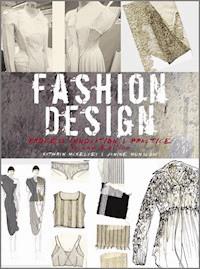
Shows how the design process can be successfully applied to satisfy market needs and trends Fashion design seems to be a glamorous mystery for which only the fortunate few have sufficient talent to succeed. In reality, commercially successful results can be achieved if the right processes are followed in the early design process. Fashion Design sets out basic principles and exercises in order to make fashion design a logical process, providing a framework from which they can expand your skills steadily. Fashion Design, 2nd Edition: * Shows how the design process can be successfully applied to satisfy market needs and trends * Has a problem solving approach, with practical design projects and portfolio exercises to encourage readers to develop their innovation, experimentation and versatility * Pays special attention to computer-aided design (CAD) and employment opportunities, including an overview of what is involved in studying and becoming a designer in the contemporary fashion industry.
Sie lesen das E-Book in den Legimi-Apps auf:
Seitenzahl: 194
Veröffentlichungsjahr: 2011
Ähnliche




















Contents
Acknowledgements
Preface
Introduction
Analysing the Brief
Innovation
Quickstart Exercise
Research
Inspiration
Direction
Observation
Trends
Sub-Cultures - Street
Fashion & Art
Fashion Forecasting
Design Process
Development
Colour
Texture
Silhouette
Proportion
Understanding Fabric
Innovative Developments in Fabrics
Construction
Shirt
Blouse
Dress
Bodice
Skirt
Jacket
Coat
Trouser
Sleeves
Collars
Prototypes
Flat Pattern Cutting
Embellishment
Pleating
Specialist Markets
Sportswear
Lingerie
Accessories
Knitwear
Collections
Decision Making
Using the Computer
Promoting the Range
The Styling Shoot
The Portfolio
Fashion Careers
Dressing the Windows
Case Studies
Bibliography
Index
This edition first published 2012
© 2012 Kathryn McKelvey and Janine Munslow
Registered office
John Wiley & Sons Ltd, The Atrium, Southern Gate, Chichester, West Sussex, PO19 8SQ, United Kingdom
Editorial office
John Wiley & Sons Ltd, The Atrium, Southern Gate, Chichester, West Sussex, PO19 8SQ, United Kingdom
For details of our global editorial offices, for customer services and for information about how to apply for permission to reuse the copyright material in this book please see our website at www.wiley.com.
The rights of Kathryn McKelvey and Janine Munslow to be identified as the authors of this work have been asserted in accordance with the UK Copyright, Designs and Patents Act 1988.
All rights reserved. No part of this publication may be reproduced, stored in a retrieval system, or transmitted, in any form or by any means, electronic, mechanical, photocopying, recording or otherwise, except as permitted by the UK Copyright, Designs and Patents Act 1988, without the prior permission of the publisher.
Designations used by companies to distinguish their products are often claimed as trademarks. All brand names and product names used in this book are trade names, service marks, trademarks or registered trademarks of their respective owners. The publisher is not associated with any product or vendor mentioned in this book. This publication is designed to provide accurate and authoritative information in regard to the subject matter covered. It is sold on the understanding that the publisher is not engaged in rendering professional services. If professional advice or other expert assistance is required, the services of a competent professional should be sought.
Wiley publishes in a variety of print and electronic formats and by print-on-demand. Some material included with standard print versions of this book may not be included in e-books or in print-on-demand. If this book refers to media such as a CD or DVD that is not included in the version you purchased, you may download this material at http://booksupport.wiley.com. For more information about Wiley products, visit www.wiley.com.
A catalogue record for this book is available from the British Library.
ISBN: 978-0-470-65577-1(pbk); 978-1-119-95243-5 (ebk) 978-1-119-95244-2 (ebk);
978-1-119-95245-9
Acknowledgements
Kathryn and Janine would like to thank the following for their excellent contributions to this book!
Colleagues Dr. Kevin Hilton for his contribution to Analysing the Brief and the Innovation chapter and Nick Sellars for his help with the Portfolio chapter. Paul Goodfellow for inspiring Kathryn with the visual part of the Innovation chapter and for his very original thinking. Fiona Raeside Elliot for her work in the Design Using the Computer section.
Students and graduates, namely: Helen Ingrey, Michael Laine, Steven Kelly, Koroku Matsuura, Katie Lay, James Dennehy, Alexandra Embleton, Holly Armitage, Helen Eckersley, Amelia Chester, Victoria Kirby, Kate Eldridge, Neil Barraclough, Joe Coulam, Husam Elfaki, Jack Merrell, Steven Myers, Callum Best, Marek Czyzewski, David Finnegan, Liam Owen, Alex Rossell, Patrick Niall McGoldrick, Alex Steven, and Liam Viney, Sarah Grant, Jenny Harvey, Benjamin Munslow, Luke Richardson, Ruth Capstick, Rosie Sugden, Lucy Anderson, Natalie Antonopoulos, Carly Blade, Catriona Boyle, Alexandria Bradley, Samantha Burlison, Sophie Byrne, Lucy Christian, Charlotte Cook, Rachael Jane Davies, Cora Drew, Romy Elsom, Carly Grant, Jennifer Gresham, Ember Halpin, Rebecca Harrison, Rachel Heley, Katherine Hilton, Arabella James, Karina Lucy Jones, Lydia King, Chloe Latto, Aidan MacGregor, Nina Miljus, Bindi Mistry, Natalie Oldham, Jess Oxley, Emma Pettinger, Stacey Potts, Martin Priestley, Amy Quickfall, Amy Robertson, C. Fay Roxburgh, Charlotte Sanders-Yeomans, Hilbre Stafford, Gemma Stokes, Carly Turnbull, Emma Valenghi, Brett Roddis, Nicola Morgan, Kayleigh Dunn, Ruth Davies, Miriam Sucis, Charlotte Simpson, Gabrielle Schoenenberger, Hannah Earnshaw, Stephanie Butler, Amber Little, Naomi New, Alison Winstanley, Holly Storer, Maxwell Holmes, Emilia Boulton, Sally Bound, Dulcie Dryden, Hannah Casen Seawright Caroline Rowland, Jemma Page, Stacey Beggs, Holly Farrar, Ledina Zhang, Daniel Hull and Adam Wright and anyone we have accidentally missed off the list.
Big thanks to the Fashion Design, Fashion Marketing, Motion Graphics & Animation and Interactive Media Design programmes in the School of Design at Northumbria University.
Thank you to Drew Kennerley and Wiley Blackwell for giving us another opportunity to indulge ourselves for a while.
Kathryn McKelvey
On a personal note I would like to thank my family, particularly Ian, Emily, Lucy and Jack, for their support and patience. Thanks is also due to my mum for always showing enthusiasm and interest in whatever I have done.
Janine Munslow
I would like to thank my family, friends and colleagues for their help and support and the staff, students and graduates of Fashion at the School of Design, Northumbria whose creativity and ingenuity has provided so much of the content and inspiration for this revised edition.
Preface
As a book on fashion design, this has been very stimulating to create. It is interesting and difficult to try and place the right information on the page in a form that communicates clearly. There is so much that becomes second nature during a career in design and teaching. Putting yourself back in the novice designer’s shoes requires some effort!
Fashion is fleeting. Decision making on the kind of examples included will always have pitfalls, potentially dating the book. But the examples are here to make points and the points will always be pertinent regardless of any changes in technology and upheavals in the industry.
Successful design is about thinking and communicating the thoughts, on paper, or wherever, and realizing them through prototyping, solving any problems along the way. There will never be a substitute for good ideas and these must be the focus of problem solving.
All of the ingredients for successful design are contained herein, it is up to the individual to put their personal design stamp on the world, whether it be by becoming a known designer, by working for a retail chain, by supplying others with products, or by moving into new media and flying the ‘fashion’ flag; all areas are equally valid and require the same commitment and enthusiasm.
When starting out as a designer or student, try to dispel preconceived ideas about design, try not to start a project with the end product as the focus. Taking the journey prescribed in this book may well turn up surprises and delights that may never have been considered, leaving room for the new and innovative. If each element of the process is explored thoroughly the actual development should be very exciting and each solution always unique. The skill comes in allowing preparatory work to influence design; how much or how little is a matter of judgement.
The book is called Fashion Design: Process, Innovation and Practice and at the risk of being repetitive it works like this: the process has been demonstrated clearly enough and in enough ways for it to become well established. The innovation comes from thinking in different ways, having different approaches, by searching for something new and not settling for the ‘tried and tested’. The innovation exercises may be used as often as desired. The practice is obviously the Fashion Careers and the Case Studies; there is a lot of information here and the links between the careers and the common elements of design help to gain understanding and put the design well into context.
It is hoped that this book gives some indication of what is expected from the design process. Above all, it has been very broad in applying the process to investigate graphics and styling too.
As a student, one of the hardest aspects of study to come to terms with is the sheer volume of information to learn. Don’t lose sight of what the short-term goals are. With every design project completed comes more experience. Career choices need to be made along the way as the paths that are possible are many. For instance, you could become a textile designer, or a fashion stylist, or a womenswear designer, or a fashion/graphic designer; whatever the choice it really is up to the individual and their skill and judgement. Each aspect of designing fashion garments could be studied in it’s own right.
More than anything though, in design, there are no right or wrong solutions to a design problem (in the commercial world, success depends very much on the sales of any given product), it will always have a personal stamp upon it, as long as the solution fulfills the brief in a creative and relevant manner...
Enjoy the process, give time for innovation and you will love the practice!
Introduction
The very word fashion signifies change. This pace of change shows no sign of halting and designers are under constant pressure to maintain their creative momentum. New developments in mass production and information technology have helped to increase this speed of change by decreasing the lead time between design and finished stock entering the retail environment, quickly turning catwalk fashion into high street equivalents. Brands spread their influences, constantly diversifying into new product areas. In such an arena there is a need for well trained designers and other personnel to take up a variety of related career paths such as buyers and stylists.
Universities and colleges run degree courses and other specialist courses to provide a solid grounding in fashion education. This book is intended for anyone aspiring to a career in fashion and design.
There are so many approaches to designing clothes and so many factors to take into consideration that many beginners are daunted by the prospect; this book sets out basic principles and exercises in order to make fashion design a logical process, providing limits from which to expand skills steadily. This design process can be learned.
It should also be emphasized that there is more than one path to take when developing designs and it is the individual’s input and the forming of their personal philosophy that helps to decide on the path taken. This philosophy develops with experience as does the ability to tell good design from bad, how materials are best used and handled and what is a long-term trend or a fad. Lack of experience need not be a barrier; being observant and aware of what is happening in the world can feed into design. Being enthusiastic, keen to learn and having an enquiring mind is a necessity.
This book presents an overview of what is involved in studying and becoming a designer in the contemporary fashion industry. It is intended to show the breadth of the industry rather than in-depth views of any particular area. For reasons of size it does not set out to be, nor could it be, fully comprehensive in its contents. Its aim is to pull together in one book the basic knowledge and skills necessary to begin designing. The various stages of the design process are investigated, from research inspiration, direction and design development, to how to plan collections and ranges and promotion.
This book uses a variety of problem-solving approaches to encourage the development of innovation, experimentation and versatility. What is often referred to as ‘flair’ is analysed through a logical approach so that anyone can improve their skills with the exercises included. The innovation section exercises can be used over and over again.
The design process indicated here of research, development and prototyping is as valid for the promotional and graphical side of design. The ideal would be that this process becomes second nature to the designer.
The analytical problem-solving approach is illustrated in the case studies located towards the back of the book.
Consideration is also given to the portfolio and a chapter deals with the types of career available within the fashion industry in an attempt to provide some sort of direction to graduating students, or students who are taking up work placements within the industry.
Because we are dealing with the basic design process there is not space here to discuss pattern cutting in depth. However, pattern cutting is an implicit part of the process and, as with many other areas discussed, it could be that ‘creative cutting’ and construction is the direction that one may take as opposed to designing garments that are, for example, ‘print based’. Often the amount of construction included in garments becomes a ‘fashion’ issue as does the input of all the other areas mentioned. Further reading into pattern cutting is recommended.
There are many books on the theory of design. Questions concerning what makes a good design or what is good taste are part of an ongoing debate in the design world Overleaf is a simplistic flow chart indicating the way the design process works.
Analysing the Brief
Before work is begun, it is very important to understand exactly what is required for a client or project. Reading a brief and carefully dissecting it can make the difference between a success or a failure. Asking the right questions is essential!
Lesen Sie weiter in der vollständigen Ausgabe!
Lesen Sie weiter in der vollständigen Ausgabe!
Lesen Sie weiter in der vollständigen Ausgabe!
Lesen Sie weiter in der vollständigen Ausgabe!
Lesen Sie weiter in der vollständigen Ausgabe!
Lesen Sie weiter in der vollständigen Ausgabe!
Lesen Sie weiter in der vollständigen Ausgabe!
Lesen Sie weiter in der vollständigen Ausgabe!
Lesen Sie weiter in der vollständigen Ausgabe!
Lesen Sie weiter in der vollständigen Ausgabe!
Lesen Sie weiter in der vollständigen Ausgabe!
Lesen Sie weiter in der vollständigen Ausgabe!
Lesen Sie weiter in der vollständigen Ausgabe!
Lesen Sie weiter in der vollständigen Ausgabe!
Lesen Sie weiter in der vollständigen Ausgabe!
Lesen Sie weiter in der vollständigen Ausgabe!
Lesen Sie weiter in der vollständigen Ausgabe!
Lesen Sie weiter in der vollständigen Ausgabe!
Lesen Sie weiter in der vollständigen Ausgabe!
Lesen Sie weiter in der vollständigen Ausgabe!




