


13,99 €
Mehr erfahren.
- Herausgeber: Spellmount
- Kategorie: Geisteswissenschaft
- Sprache: Englisch
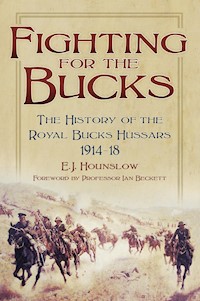
From the hell of Gallipoli to the deserts of the Holy Land, torpedoed in the Mediterranean before finally posted to the mud and trenches of the Western Front, the experiences of the Royal Bucks Hussars were as fascinating and bloody as any during the First World War. Condemned by Lord Kitchener as mere play boys, they were able to prove him unequivocally wrong by the end of the war. Sons of privileged backgrounds they may have been, but the war was indiscriminate in its killing, and war memorials and gravestones from Gallipoli to Ypres proves that the Buckinghamshire gentry were just as ready to die for their country as the average man on the street in any British town. They went to war on horseback, relics of a gentler age, but finished up as machine-gunners in a mechanised war during the final push on the Western front which broke the back of the German Army. This is their story.
Das E-Book können Sie in Legimi-Apps oder einer beliebigen App lesen, die das folgende Format unterstützen:
Veröffentlichungsjahr: 2013
Ähnliche



















The Buckinghamshire Military Museum Trust
This book has been produced in association with the Buckinghamshire Military Museum Trust. The Trust preserves the heritage of the local military units raised in the historic county of Buckinghamshire in England from the 1500s onwards, including the militia, yeomanry, volunteers, Territorials and Home Guard. The Trust preserves uniforms, flags, weapons, equipment, documents, paintings, and photographs relating to the amateur military forces raised in Bucks since the 1500s. Intended mainly for home defence against foreign invasion – from the Spanish Armada to Napoleon and Hitler – these citizen soldiers were just as significant for their high visibility in the local community, involving a far wider section of society in military affairs than the small regular army, which was often out of sight and out of mind serving overseas. The Trust’s collections reflect this dual military and social function.
For further information on the Buckinghamshire Military Museum trust see www.bmmt.co.uk
CONTENTS
Title Page
Foreword by Professor Ian Beckett
1 Introduction
2 Early days
3 Bucks Yeomanry
4 The start of war and the origins of the Gallipoli Campaign
5 Suvla Bay, Gallipoli
6 Egypt
7 Crossing the Sinai Desert and the battles for Gaza
8 General Allenby and the Third Battle for Gaza
9 Turkish retreat and the capture of Jerusalem
10 The sinking of HMT Leasowe Castle
11 France
12 Peace
13 Those who fought with and alongside the Royal Bucks Hussars
References
Notes
Copyright
FOREWORD
Since the revival of popular interest in the First World War at the time of the fiftieth anniversary, there has been a great deal of attention paid to the ‘New Armies’ of Kitchener volunteers in 1914, especially the ‘Pals Battalions’ that were mostly raised from urban areas in the Midlands and the North. By contrast, there has been far less awareness of the Territorial Force, the successor to a far older ‘amateur military tradition’ stretching back at least to the fifteenth century and, in some respects, to the Anglo-Saxon kingdoms. It is true that there have been studies of Territorial infantry battalions in recent years, but the county yeomanry regiments have attracted little notice. In part, this reflects the fact that their service was not on the Western Front but at Gallipoli, in the Western Desert and in Palestine, though several returned to France and Flanders in a dismounted role later in the war. As we now approach the centenary, John Hounslow’s study of the Royal Bucks Hussars is thus especially welcome.
I particularly appreciate it as both John and I grew up in Buckinghamshire villages at about the same time. Like John, I was very aware of the many Great War veterans of the Bucks Battalions and the Royal Bucks Hussars still living around me. Although my father and his generation had fought in the Second World War, that earlier global conflict seemed to hold more significance for so many of my grandfather’s generation among whom I grew up. Among the sixteen war dead commemorated on the memorial in Whitchurch Parish Church are five from the Bucks Battalions and three from the Royal Bucks Hussars. Of the latter, two were killed at Gallipoli on the same day – 21 August 1915 – while the third was my cousin’s maternal grandfather. Many years later I have seen, too, their graves or names on memorials to the missing in foreign fields. Far too late, in the 1980s, I was privileged to interview the few Royal Bucks Hussars who were still alive. Fortunately, as John’s splendid book shows, there are sufficient archive sources remaining to do justice to a regiment that, like the other yeomanry units, was unique to itself, not least in its mingling of the very wealthy, like the Rothschilds – one of whom lies still in Palestine – with the farmers and farm labourers, the jockeys, and the mounted policemen. Some of the records come from the collection of the Buckinghamshire Military Museum Trust, of which I have the honour to be Secretary, and which preserves the memory of all the auxiliary forces of the historic (pre-1974) County of Buckinghamshire.
I am delighted to have been invited to contribute the foreword to John’s book. It is a diligently researched and very worthy tribute to a regiment that I hold dear. More to the point, it is a very necessary contribution to the historiography of the yeomanry, the Territorials and the Great War. We need far more studies like it.
Professor Ian Beckett
University of Kent
Bill Cowell aged 19 and recently enlisted in the Royal Bucks Hussars. (Bill Cowell)
1
INTRODUCTION
There were the flies, the heat, the noise of battle and the alien landscape, but for the young men of the Royal Bucks Hussars they were not the greatest problem. The worst thing was fear, and not just fear of being killed or maimed, although that was real enough: it was also fear of the unknown, of letting your mates down and not knowing how you will perform in battle.
One of the men was a 20-year-old youth called Bill Cowell, and today was to be his first experience of coming under fire. He wasn’t alone; it was the first combat experience for the vast majority of the soldiers with him. They were too young to have fought the last time the Royal Bucks Hussars had gone to war. That had been in South Africa against the Boers at the beginning of the twentieth century. This day, at 3.30 in the afternoon on 21 August 1915, was different. This was part of a world war, not just a colonial fight against an ill-equipped and weaker opposition. As they sheltered behind the small hill, the soldiers knew that they would soon be ordered to march forward in an assault against an enemy entrenched in hills over 2 miles away overlooking the coastal position where they waited.
The date of 21 August 1915 was to be engraved many times on war memorials. The next few hours proved to be the first and last experience of war for so many of these young men. They were waiting to go into battle on a long, mountainous peninsula jutting out into the Aegean Sea. It was called Gallipoli, a place name which, until the Allied invasion, most had never heard of, but which now figures large in the national consciousness of Australians, New Zealanders, the French, Turks and, of course, the British.
Bill Cowell and his comrades were originally recruited from farms in and around Buckinghamshire. In peacetime many had been neighbours and had known each other well, but now they could do little to help each other except perhaps to grin nervously and whisper good luck. Their orders were to keep the lines and their discipline as they advanced, and not to stop to help comrades who were hit or wounded.
In order to reach the enemy positions they first had to march across a dried-out salt lake followed by a large flattish plain overlooked by hills on which were situated Turkish artillery, machine guns and snipers. These were to take a heavy toll of the young soldiers and most of those who died that afternoon did so having never seen the enemy they were attacking. It was ironic that their first experience of battle was as infantry soldiers; having been trained as cavalry troops, they would have expected to ride into battle. When they had enlisted, these young men would have dreamed of going to war as cavalry soldiers, on horseback, with swords in hand. The reality was to be very different.
Bill Cowell survived the day unscathed, and this book tells his story and that of his fighting comrades in the Royal Bucks Hussars. It tells how and why they arrived at Suvla Bay in Gallipoli and what happened there and in the other theatres of war; how Bill Cowell was one of those lucky ones who eventually returned to the farm and took up his normal life again. He was my grandfather, so this story is part of my family story.
This is a history book deliberately narrow in its focus. It concerns itself solely with the Bucks Hussars rather than the Great War as a whole. It concentrates on the actions in which the Bucks Hussars were involved and, although it is inspired by my memories of my grandfather, it is impossible from official records to pick out one person unless they are an officer or of special distinction. Bill Cowell was neither of these and I am therefore dependent on photographs he took, family history and private sources, letters etc., to piece together the whole story. Britain was still a hierarchical society and particularly so in the military. Whilst official records and regimental diaries frequently refer to officers by their names, they refer to the other ranks as simply ‘O/R’. A further difficulty for all who try to study this part of our country’s history is that many of the soldiers’ records were kept in London and unfortunately fell victim to the Second World War when they were destroyed in the Blitz.
Britain had always relied on an extremely small professional standing army so that in times of great national emergency, when the size of the peacetime army would not suffice, the country relied on allies, mercenaries and the proverbial butcher, baker and candlestick maker – the ordinary man in the street – to fight our national battles.
Bill Cowell was just such a man – a tenant farmer, as his father had been before him. It is hard for us who live in the twenty-first century to understand what these young men went through during the four years beginning in the summer of 1914. Bill Cowell and his friends, along with many other young men of his generation, were participants in truly extraordinary events. The peaceful Edwardian age in which they had grown up exploded into an orgy of killing – put simply, everything that they were brought up to understand and cherish was changed by the next four years. Bill Cowell was aged 20 at the outbreak of war and it was to provide him with the most dramatic of educations.
All of the inventions and mass industrialisation that had taken place over the past fifty years were subordinated into the one objective of slaughter. The European nations embarked on a war which they appeared helpless to prevent. A complex system of treaties and alliances, which had been designed to keep peace in Europe through a balance of power, proved to have exactly the opposite effect. It dragged some reluctant nations into a world war and ensured others were forced to pick sides in order to protect their own interests. No war prior to 1914 had seen killing on this scale and the young men of Britain could not possibly anticipate what awaited them. Far more importantly, those in power – the chiefs of staff, the politicians and the generals tasked with actually fighting the war – were all equally unprepared. In his famously outspoken diaries published after the war, David Lloyd George comments:
How was it that the world was so unexpectedly plunged into this terrible conflict? Who was responsible? Not even the astutest and most far-seeing statesman foresaw in the early summer of 1914 that the autumn would find nations of the world interlocked in the most terrible conflict that had ever been witnessed in the history of mankind: and if you came to the ordinary men and women who were engaged in their daily avocations in all countries there was not one of them who suspected the imminence of such catastrophe. Of those who, in the first weeks of July, were employed in garnering their hay or corn harvests, either in this country or on the Continent of Europe, it is safe to say that no one ever contemplated the possibility that another month would find them called to the Colours and organised in battle array for a struggle that would end in the violent death of millions of them, and in the mutilation of many more millions. The nations slithered over the brink into the boiling cauldron of war without any trace of apprehension or dismay.
The outbreak of war found this country totally unprepared for land hostilities on a Continental scale. Our traditional defence force has always been our Navy, and this weapon has been kept efficient and ready at all times. But our Army, mainly used for policing our widely scattered Empire, was a small, highly trained force of professional soldiers, excellent for their normal tasks, but lacking both the numbers and the equipment for large-scale fighting against European armies.1
Lloyd George’s memoirs, like all political autobiographies, are self-serving. Written in retrospect with all of the wisdom that brings, and coupled with his almost demonic hatred of the military, the politician castigates the military machine for its unpreparedness and training procedures based on wars which had been fought in the past rather than the war to come. It is true that one of the key criteria of great military leaders is combat experience, but there must be a caveat attached which is that training, tactics and strategy derived from that experience should be relevant to the war about to be fought rather than that which preceded it. All too often Britain, with its huge empire, had fought battles and minor wars to hold onto its colonial possessions, which provided plenty of combat experience and ensured a ready supply of battle-hardened senior military officers who had earned their spurs. The problem is that experience and those lessons learnt did not necessarily transfer seamlessly into a full-scale European, or indeed, a world war. Technology moves on, as do the strategy and tactics of war. Unfortunately, because British military experience had been limited to these colonial wars carried out far from the prying eyes of the press and usually against a foe far less technologically advanced than Britain, the learning curve for all involved in the Great War was to prove extremely steep.
Further difficulties for the Army were caused by the political desire to keep peacetime defence budgets to a minimum. At the start of the twentieth century, Britain put most of its defence eggs in the Royal Navy’s basket. Britain had two major imperatives: first, to protect the British mainland, for which command of the English Channel was paramount; second, to keep the links to the rest of the Empire open, for which wider control of the high seas was vital. Most of the defence budget was therefore taken up with Admiral ‘Jackie’ Fisher’s dreadnought-class battleships. With the Royal Navy seen as the key element in this homeland defence strategy, the Army inevitably came a distinctly poor second in the distribution of resources. There was another reason for this lack of investment in the Army. British politicians considered, quite correctly, that the main threat was from Germany and therefore the first, and perhaps most important part of the British defence lay in the hands of the French Army. It was considered far preferable to reinforce the French with a British Expeditionary Force and to fight on their territory than to consider the alternative of having what would today be described as an independent deterrent. In short, Britain was part of a complex defensive international coalition and was contributing the minimum number of ground forces to ensure their credibility.
This is not to say that some good work was not carried out in the years immediately preceding the Great War. The Boer War had seen the experiences of our armies incorporated into standard operating procedures as promulgated by the then Secretary of State for War, Richard Haldane. The British armies also owed a lot to a junior lieutenant general who worked closely with the politicians on the reforms of the army. His name was Douglas Haig and he was to figure prominently in the war to come. However, despite these reforms, which were undoubtedly necessary and timely, the central point remained that the last time Britain had fought a truly continental war was in the first decades of the nineteenth century, when Arthur Wellesley (Lord Wellington) had faced Napoleon Bonaparte. Probably the only lesson still relevant from that war was the overriding need to keep international coalitions together when facing a common foe.
If most of the military and political leaders were unprepared, some members of society did have premonitions of war. In 1896, A.E. Houseman wrote the following prophetic words in his masterpiece ‘A Shropshire Lad’:
On the idle hill of summer,
Sleepy with the flow of streams,
Far I hear the steady drummer,
Drumming like a noise in dreams.
Far and near and low and louder
On the roads of earth go by,
Dear to friends and food for powder
Soldiers marching, all to die.
East and west on fields forgotten
Bleach the bones of comrades slain,
Lovely lads and dead and rotten;
None that go return again.
Far the calling bugles hollo,
High the screaming fife replies,
Gay the files of scarlet follow:
Women bore me, I will rise.2
In writing about such a traumatic period of our history it is tempting to move into colourful emotional prose which would perhaps have been an embarrassment to those who fought. Following a spell in a dug-out situated in front of the ‘front line’, the famous poet Wilfred Owen wrote home to his mother to describe his emotions, fears and terror during the period when he and his platoon sheltered in no-man’s-land whilst the Germans did their best to drive them out. In his description Owen uses the word ‘sheer’ to describe the experience, an unconventional and yet graphic way of describing the fear. But the powers to describe raw emotion in such ways would be far beyond the vocabulary of the ordinary soldier.3
Today, with the wealth of published First World War poetry, we are perhaps inclined to imagine that all regiments marched off to war with the resident poet/artist in their ranks or that the ordinary soldier was capable of revealing the true emotions felt during the abnormal experience of total war. This was not the case, and most contemporary accounts display the stilted, emotional denial of a Victorian/Edwardian male upbringing. The accounts written by the soldiers are also produced, at the very least, some days after the events they describe, often after the war itself. The mind has had a chance to settle, the nerves to repair and thus the language is frequently more prosaic and matter of fact than the events may warrant.
Nevertheless, soldiers’ accounts still offer the best description we have and I have tried whenever possible to use the words of the actual combatants to describe the actions. Readers will have to use their imagination to understand really what it must have been like for these young men, how they felt, and what their emotional state was.
2
EARLY DAYS
For me, the story of the Great War began one summer’s day in the late 1950s when I spotted a peculiar-looking, wobbly flower pot adjacent to the farmhouse at Dodley Hill Farm just outside Swanbourne. When I asked, it turned out to be my grandfather’s steel helmet brought back from the war. In a gentle and amused fashion he explained how he had come by it. It was hard at the age of 7 to reconcile the image of a kindly, white-haired, old gentleman with that of a soldier going to war. He was one of those rare adults who had an instinctive rapport with young children. He went up a notch or two in my estimation when he explained that he had been a soldier who had gone to war on a horse and finished up as a machine gunner.
For a 1950s boy this was truly manna from heaven. At that time, we were surrounded by memories of two world wars; indeed the Second World War had only been over some seven years when I was born and most boys’ comics and books deified ‘our soldiers’ whilst at the same time demonising the ‘Hun’ or ‘Boche’ as the German soldiers were described. I was the only boy in my family, with three elder sisters. We lived some way from the nearest village and I spent a lot of my early days running around by myself in an imaginary world fighting German and Japanese soldiers. In that imaginary world it was only me against the enemy and it was my job to fight them off. When my grandfather allowed me to take the helmet home it became my treasured possession and, though it was several sizes too large, I wore it with pride.
But how different was the England of 1894, the year of Bill Cowell’s birth? It was a peaceful age when the wars that involved Britain were fought far away in parts of the Empire that were just names on the map. They did not affect the ordinary man in the street unless he had a family member who was in the military.
Bill Cowell was born into a farming family that lived and worked in a small part of North Buckinghamshire which borders the east and south-east of Buckingham. Nash, Addington, Winslow, Swanbourne and Verney Junction were the village names where Bill grew up. The area is not dramatic: it has no significant hills, no mountains, no great rivers or lakes; what it does have is a quiet and dignified beauty of its own. It is intrinsically English and understated. The war was to take the men of Bucks to places that were very different, but Buckinghamshire was a homely place to remember and letters home show the fond memories that helped the soldiers whilst serving their country overseas.
The year 1894 saw Queen Victoria moving into the final stages of her sixty-year reign over a huge swathe of the world. This was a time when the United Kingdom was one of the super powers both militarily and commercially. In North Buckinghamshire, which had never been at the cutting edge of progress, most people were employed in agriculture or the industries that lived indirectly off the proceeds of agriculture. Bill Cowell’s father was a tenant farmer who at one time had worked as farm steward to Lord Wyfold and, although he now worked in Buckinghamshire, the family had originated from Essex. Bill was the second youngest of six children.
In July 1913, Bill Cowell made the decision to join the Territorials. He enlisted in the Royal Buckinghamshire Hussars Yeomanry, a mounted regiment (cavalry regiment) of the Territorial Force. This decision can probably be explained by an autobiography of one of the officers of the Bucks Hussars, Lieutenant Colonel (The Honourable) Fred Cripps (Lord Parmoor), who mentioned that he ensured that tenants’ sons were aware of and, if possible, joined the yeomanry.4 Lord Wyfold’s estates were adjacent to those of Lord Parmoor and it seems quite possible that suggestions as to the desirability of yeomanry enrolment were made.
Whatever the reason behind this decision it was unlikely to be a direct response to rumours of war. There were signs of forthcoming conflict in Europe throughout the latter part of the nineteenth century and the early years of the twentieth: Prussia invading France some forty years earlier, the gradual decline of the Austro-Hungarian and Ottoman empires and the unification and militarisation of Greater Germany. However, I suspect these events did not figure in everyday conversation in North Bucks.
Surely, even if there was a certain amount of moral pressure from the Lord of the Manor, the attraction of charging around on a horse at weekends, wearing a soldier’s uniform and the opportunity to get hold of military weapons would be of considerable interest to any red-blooded young man. Bill Cowell was 19 when he signed up for the yeomanry, an age when many young men are far more interested in cutting a dash with women than in distant boring talk of possible unrest in Europe.
It is fairly certain that Bill Cowell would not have travelled outside of England prior to the mobilisation of the army. However, the next few years would have certainly sated any wanderlust that he may have had. Indeed, as far as I am aware, after the armistice and demobilisation he never ventured abroad again. He was 20 when war broke out and almost immediately he volunteered for overseas duty as the terms under which he had enlisted with the yeomanry only required him to serve in his home country.
3
BUCKS YEOMANRY
Yeomanry regiment units were originally formed in the eighteenth century as instruments of repression and to protect the country from invasion. If there was one thing the British ruling classes feared worse than a revolutionary Frenchman, it was their own tenants in revolt. The French were at least separated by 22 miles of salt water which was firmly under the control of the British Navy, but control of the seas could do nothing about preventing the spread of ideas, and what the British ruling classes feared most was the spread of revolutionary ideas and sedition. A home defence force, therefore, loyal to the Crown and with a stake in the status quo, was an attractive proposition to the government of the day, especially if it could be formed cheaply.
The Royal Buckinghamshire Yeomanry (motto: ‘Yeomen of Bucks, strike home’) was formed in May 1794. King George III was on the throne, William Pitt the Younger was Prime Minister and earlier, in 1793, the government had legislated to allow for the inclusion of voluntary yeomanry units within the coastal defence militia. Britain undoubtedly felt threatened by the French, who had gathered an army of over half a million men, but, as already stated, the threat of revolutionary propaganda was of more significance to the reactionary British Government. France was, after all, the nation that had executed its legal ruler, King Louis XVI, and such ideas threatened the British way of life. The irony of the fact that the French had borrowed the idea of regicide from the British would have been lost on Pitt’s government. They felt more secure having armed personnel in every county, especially when they were recruited from the conservative core of society. Arming such men, who had a vested interest in maintaining the status quo, men who owned and farmed the land, fitted in with the mood of deep conservatism.
Buckinghamshire was not slow to act following Parliament’s mandate to recruit volunteer yeomanry cavalry units which could be called on by the king or by the lord lieutenant to defend the country against invasion or, if necessary, to subdue any civil or revolutionary disorder within the country. In May 1794 a subscription was opened for home defence and over £5,000 was pledged within the first month, although the majority of the money came from the Marquess of Buckingham. He had more reason than most to wish for security, having just spent a large fortune on renovating and modifying his Buckinghamshire home, Stowe House.
Bill Cowell (second left) and colleagues at camp on Salisbury Plain. (Bill Cowell)
Yeomen were typically small landholders and tenant farmers, originally defined as those with an income of greater than £100 p.a. They were usually men who hunted regularly and were used to horse-riding. Their military training was, however, likely to be more haphazard as many of the yeomanry regiments had been maintained by the largesse of the local lord. The Bucks Yeomanry were formed following a public meeting convened on 3 May 1794 at Aylesbury Town Hall. The meeting was followed by the publication of a resolution.
How these yeomanry forces were to be used is shown in the following events. Contemporary reports of Luddite riots in Nottinghamshire describe extensive use of the yeomanry, including calling out of regiments some distance from the scenes of disorder. In November 1811, both the Bucks and the Nottingham Yeomanry were called out to prevent Luddites destroying the cotton looms in Sutton and in Ashfield, and several times the troops confronted and dispersed what contemporary accounts refer to as ‘dangerous mobs’. It was the job of the lord lieutenant of the county to decide whether or not the yeomanry should be called out.
The second and even more famous event in the history of the yeomanry forces was to provide a smear on their name, especially amongst the poorer classes. The so-called ‘Peterloo massacre’ of Monday 16 August 1819 was to provide a deep well of hatred against yeomanry forces which lasted for many years. From the end of the eighteenth century through the revolutionary wars with France and the early nineteenth century, Manchester and its surrounding cotton towns had been a centre of radical thinkers and those wishing to see reform of British political institutions. In August of 1819 the leading members of these freethinking reformers invited Henry Hunt to address an open-air public meeting aimed at bringing pressure on Parliament for reform and universal suffrage. Both the organisers and Hunt went to great lengths to stress that this was to be a peaceful meeting.
The Royal Bucks Hussars muster for war, 10 August 1914. (Mike Holland)
A fully kitted-out yeoman’s horse from the Royal Bucks Hussars on Salisbury Plain. (Bill Cowell)
A Squadron from the Royal Bucks Hussars taken before the outbreak of war. (Bill Cowell)
Nevertheless, the local gentry and, importantly, the magistrates were concerned that this meeting was a possible spark which would inflame revolution, much as had been seen recently in France. The comparatively newly formed yeomanry troops gave the forces of law and order a tool which they fully intended to use in bringing the meeting to a speedy conclusion. Local magistrates signed the requisite orders and the Manchester, Salford and Cheshire Yeomanry troops were called out, in addition to regular troops from the 15th Hussars and the Royal Horse Artillery.
By 11.00 a.m. it was estimated by eye-witnesses that some 50,000 people had gathered in St Peter’s Field and following the speakers’ arrival the press of people was such that the authorities ordered the arrest of the speakers. The yeomanry were ordered to disperse the crowd so that constables could arrest the main speakers, but when the crowds linked hands in an attempt to thwart the arrest, the yeomen panicked and began to hack and slash at the unarmed crowd with their cavalry sabres. The situation rapidly deteriorated, worsened by the fact that the army had sealed off the exits from the public space, presumably to prevent the speakers escaping.5
The regular army wrongly interpreted the disturbances as an assault on the yeomanry, and the Hussars were therefore ordered into the field to disperse the crowd. The 15th Hussars formed themselves into a line stretching across the eastern end of St Peter’s Field and charged into the crowd, but at the same time the Cheshire Yeomanry charged from the southern edge of the field. As foot soldiers had blocked the main exit route into Peter Street, the crowd simply had nowhere to escape. Now out of control, the yeomanry troops slashed indiscriminately at the crowd with their sabres. One officer of the 15th Hussars was heard trying to restrain the Manchester and Salford Yeomanry by shouting, ‘For shame! For shame! Gentlemen: forbear, forbear! The people cannot get away!’ By the end of the day there were eleven dead and over 600 injured, and the yeomanry’s reputation was badly besmirched.
The terms under which the yeomanry forces were formed, however, make it clear that such demonstrations as those at Peterloo were exactly what the yeomanry forces were created to suppress. The Bucks Yeomanry declaration reads as follows:
That we the Gentlemen, Clergy, Freeholders, Yeomen and substantial inhabitants of the County of Buckingham, desire to take this public mode of expressing our zeal and willingness to exert ourselves at all times by whatever legal and constitutional means we may, in defence of our King and Country.
That in the present very important moment we deem it to be peculiarly useful and meritorious, voluntarily to stand forward in the support of such measures as may best contribute both to the internal and external security of the free and happy Country.
That considering the local circumstances of the County of Buckingham and the augmentation actually making to its Militia, it seems expedient to adopt the most practical part of the fourth proposition from among those plans of defence which have been communicated to the meeting.
That the Gentlemen, Yeomen and substantial Inhabitants of the County be accordingly invited to enrol themselves in their several respective neighbourhoods into different troops of men armed and mounted on horseback attached to the Central Body, to be known by the name of THE ARMED YEOMANRY OF THE COUNTY OF BUCKS under command of the Lord Lieutenant.6
Recruitment began shortly after this meeting, with the ‘substantial inhabitants’ signing up to the following terms and conditions:
We whose names are hereunto subscribed, being freeholders, Yeomen, or substantial Inhabitants of the County of Bucks, in pursuance of an Act of Parliament entitled An Act for the encouragement and disciplining of such Corps or Companies of men as shall voluntarily enrol themselves for the defence of their Towns, or Coasts, or for the general defence of the Kingdom during the present war, do voluntarily enrol themselves to form a body to be called the Armed Yeomanry of the County of Bucks for the internal defence and security of the Kingdom during the present war on the following conditions:
1st
To receive no pay unless when embodied or called out, but to attend, mounted on a serviceable gelding or mare to be approved of by the Commanding Officer of each Troop, and not less than fourteen hands high, for the purpose of meeting at such times and places as shall be fixed by such commanding Officer with the approbation of the Field Officer commanding the whole Body.
2nd
The times and places of meeting to be fixed on such days and such hours as may interfere the least with the other occupations of the persons composing the respective Troops.
3rd
The Corps to be subject to be embodied within the County by special direction from His Majesty on appearance of invasion and to be called out of the County by the like Authority from His Majesty in case of actual invasion.
4th
To be liable to be called upon by order from His Majesty or by the Lord-Lieutenant, or by the Sheriff of the County for the suppression of riots and tumults within the country.
5th
In all cases when embodied, or called out as above to receive pay as Cavalry and to be subject to the provisions of the Mutiny Bill.
6th
Each person attending on the day of meeting to wear a uniform to be provided at the expense of the County subscription together with arms and accoutrements.
7th
Each troop to consist of not less than fifty men (officers included) to be under the particular command of the officers belonging to it whilst assembled in their respective districts but the whole body to be under the general superintendence of the Field Officers; if six troops or more, three Field Officers, if four two Field Officers if two only one Field Officer.
Captain
1
Corporals
3
Lieutenants
2
Trumpeter
1
Qr Master
1
Farrier
1
Sergeants
3
Privates
38
8th
Persons desirous of furnishing a substitute may do so, on condition that he be a man of good character having a fixed residence within the county, that he is accustomed to riding, that he is not a person likely to enlist in the Army, Navy or Militia, and that he be approved by a majority of those persons who compose the Troop in which he is to serve.
9th
The substitutes to be equipped and mounted in the same manner as those who serve for themselves, and their clothes and horses to be provided at the expense of those persons by whom they are brought forward.
10th
Whereas several gentlemen who offer their personal service may be desirous of rendering further assistance towards the formation of this body by furnishing men and horses to make up the complement of any Troop, Persons so brought forward and furnished with horses may be accepted on the same conditions as the substitutes above mentioned.
Officers of the Royal Bucks Hussars. Standing (left to right): Lt T.C. Smith, Captain E. Pauncefort-Duncombe, Captain L.E.W. Egerton, Major A. Grenfell, Captain G. Gardiner, Lt J. Bogue, Captain E. Rothschild, Lt G.B. Pearson. Sitting (left to right): Major G.W. Swire, Major J.P. Grenfell, Col C.A. Grenfell, Major W.E. St John, Major F. Cripps. On the ground (left to right): Lt C.L.C. Clarke, Lt H.L. Jones, Lt F. Lawson, Lt A.G. de Rothschild, Captain T. Agar Robartes, Lt P. Barker, Lt J. Crocker Bulteel. (Bucks Military Museum)




