


Erhalten Sie Zugang zu diesem und mehr als 300000 Büchern ab EUR 5,99 monatlich.
- Herausgeber: The History Press
- Kategorie: Sachliteratur, Reportagen, Biografien
- Sprache: Englisch
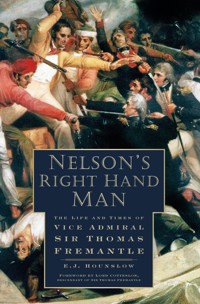
This is the story of Thomas Fremantle, one of Britain's greatest naval captains and Lord Nelson's closest friend and ally. The two, bound in friendship, were part of a Navy that ensured Napoleon could never invade Britain. The naval campaign culminated in the great victory at Trafalgar and, with the fleet in mourning for the loss of Admiral Nelson, it was Thomas Fremantle who towed the shattered Victory and Nelson's body back to Gibraltar. Promoted to Vice Admiral, Fremantle liberated the whole of the Adriatic from the clutches of the French revolutionary government and in doing so captured many ships, thus earning him and his family a fortune in prize money. Yet, there is more to Thomas Fremantle's story than his accomplishments at sea. He was also a lover, a husband and a doting father to his large family. Together with Betsey Wynne, the woman he wooed and subsequently married in Italy, he created a domestic idyll in the small Buckinghamshire village of Swanbourne. It is through Betsey's comprehensive diaries that we are able to gain a fascinating insight into her husband, the man behind the uniform.
Sie lesen das E-Book in den Legimi-Apps auf:
Seitenzahl: 521
Veröffentlichungsjahr: 2016
Das E-Book (TTS) können Sie hören im Abo „Legimi Premium” in Legimi-Apps auf:
Ähnliche


















NELSON’S RIGHT HAND MAN
THE LIFE AND TIMES OF
VICE ADMIRAL
SIR THOMAS FREMANTLE
E. J. HOUNSLOW
First published in 2016
The History Press
The Mill, Brimscombe Port
Stroud, Gloucestershire, GL5 2QG
www.thehistorypress.co.uk
This ebook edition first published in 2016
All rights reserved
© E.J. Hounslow, 2016
The right of E.J. Hounslow to be identified as the Author of this work has been asserted in accordance with the Copyright, Designs and Patents Act 1988.
This ebook is copyright material and must not be copied, reproduced, transferred, distributed, leased, licensed or publicly performed or used in any way except as specifically permitted in writing by the publishers, as allowed under the terms and conditions under which it was purchased or as strictly permitted by applicable copyright law. Any unauthorised distribution or use of this text may be a direct infringement of the author’s and publisher’s rights, and those responsible may be liable in law accordingly.
EPUB ISBN 978 0 7509 6946 8
Original typesetting by The History Press
Ebook compilation by RefineCatch Limited, Bungay, Suffolk
CONTENTS
Foreword by Lord Cottesloe, Great-Great-Great-Grandson of Admiral Sir Thomas Fremantle
Acknowledgements
1 Introduction
2 Early Days, 1765–1787
3 London Life and Early Commands, 1787–1793
4 Post-Captain, May 1793
5 Service in Italy and Marriage
6 Service in the Baltic and the Battle of Copenhagen
7 Portsmouth to Trafalgar
8 Politics and Promotion, 1806–1810
9 Life as an Admiral, 1810–1814
10 Death of an Admiral, 1814–1819
11 The Man, the Legacy and Swanbourne
Notes
Bibliography
FOREWORD
By Lord Cottesloe, Great-Great-Great-Grandson of Admiral Sir Thomas Fremantle
It is my privilege to write a few words for Mr Hounslow’s book regarding my forebear.
He was one of that ‘splendid band of brothers’ of Nelson’s captains who lived when Britannia ruled the waves and the British Empire was at its height and arguably a force for order. He was present at Santa Cruz, Copenhagen and Trafalgar.
There were four Fremantle admirals with the Knight Grand Cross (GCB) of the Most Honourable Order of the Bath in four generations, the last one being Sidney Fremantle, who was Vice Chief of Naval Staff during the First World War and commander-in-chief at Portsmouth during the post-war years. So he had positions of power and influence at a time when the British Empire was at its most powerful and the world was arguably a better place for it.
Admiral Sir Thomas Fremantle did not only start our family’s tradition of naval service but, in buying The Old House in Swanbourne, he unwittingly started our family’s relationship with this beautiful Buckinghamshire village that has lasted some 220 years through to the present day. Later, his son Charles, the second of the four Fremantle admirals, was to carry the family name to Australia when he commanded the first British naval expedition to Western Australia that resulted in the Australian city of Fremantle.
ACKNOWLEDGEMENTS
The production of this book was made possible by a number of people, all of whom have contributed in various ways. I owe them all a debt of thanks.
Firstly, the team at The History Press; they have been incredibly kind and helpful and have contributed their professional expertise to ensure a high standard to the final product. Equally important has been the contribution made by Tina Gossage, whose meticulous checking and corrections ensured my manuscript reached the publishers in a legible state. Her patience and enthusiasm were invaluable.
Fundamental to the whole project was the kindness and co-operation of Lord Cottesloe, who graciously gave his blessing to this work, and also his daughter, Mrs Duncan Smith, who helped both with the illustrations used in the book and with permissions to quote from the family records. Cdr Charles Fremantle’s expertise on the history of the Fremantle family has been vital and, together with Caroline’s kind hospitality, have made this task so much easier and more pleasant than might have been the case.
Professor Elaine Chalus’s advice and her insights into the eighteenth-century mind have helped me enormously and I am greatly indebted to her for the time she has spent helping me.
Many of the illustrations have been provided by Mr Andrew Tibbets, who is the great-great-great-grandson of Admiral Sir Andrew Green. I feel privileged to have seen the mementoes left by his ancestor, who was such a close friend of Admiral Thomas Fremantle.
Thanks are also due to Will Atkins for the maps, and while I am conscious that many others, not specifically named above, have also helped me, hopefully they will accept my assurances that I am extremely grateful.
1
INTRODUCTION
By the end of the eighteenth century Britain had one of the most dominant fighting forces the world had seen since the eclipse of the Roman legions. The Royal Navy ruled supreme over the world’s oceans, exerting control, protecting the empire’s trade and demonstrating Britain’s power such that this small maritime nation was able to build, and retain, one of the world’s largest empires. The Royal Navy possessed no ‘secret weapon’, nor any significant technological advantage unknown to other navies. What it relied upon was the quality of the crews and officers manning the ships. Their offensive spirit gave them self-confidence and a belief that, man for man, they could out-sail and out-fight any opposition.
Other nations might covet the size of the markets and the riches the British derived from their empire, but until they could defeat them at sea, there appeared to be little possibility of changing the status quo. The Royal Navy had such influence on Britain’s defensive strategy that even 100 years later, the then First Lord of the Admiralty, Jacky Fisher, was able to boast, ‘The Empire floats on the Royal Navy.’1 At the beginning of the nineteenth century, however, a challenge was to emerge. Napoleon Bonaparte had gathered his fearsome Armée de l’Angleterre along the northern coast of France. Numerically superior to anything Britain could muster and already master of the vast majority of Continental Europe, Napoleon boasted, ‘Let us be masters of the Channel for six hours and we are masters of the world.’2 He would have undoubtedly needed more than six hours but it was no idle boast. He had already divided and beaten the land-based coalitions that British subsidies had cobbled together and were he to gain control of the Channel, albeit for a limited period and if the weather was suitable, the vast armadas of invasion barges stored in Boulogne and along the northern coast of France could have transported the troops, artillery and supplies such that a successful occupation of the British Isles appeared a serious threat.
Britain’s main credible defence against invasion was sea power, not just to police the Channel but to actively blockade the enemy fleets in their home ports, to attack French interests throughout the Mediterranean and the Caribbean and, where possible, to intercept and prevent trading vessels reaching France and assisting their war effort. That they were able to carry out these tasks successfully was mainly due to the skill and efforts of men such as Thomas Francis Fremantle. The experienced, battle-hardened officers commanding the Royal Navy vessels and fleets were at the peak of their profession and at the apex of this group was Nelson’s ‘band of brothers’. They were a small number of tough, aggressive sea captains who were both his professional colleagues of choice and, in many cases, his close, personal friends. Among this latter group was Fremantle.
A mark of the confidence that ran through the Royal Navy was contained in a letter that Admiral John Jervis, 1st Earl of St Vincent, wrote to the Board of the Admiralty in 1801 stating, ‘I do not say they [the French] cannot come, I only say they cannot come by sea.’3 How the British navy achieved and then exercised this dominance is intertwined closely with the story of Fremantle for, from the age of 11 until his untimely death at the age of 54, the Royal Navy was central to his life. It was not to be the whole story, for Fremantle was also a family man and his life was influenced strongly by his wife, Elizabeth Wynne, usually known as Betsey. The Royal Navy was instrumental in bringing them together but her strength of character and her ability to build a home for the family in rural Buckinghamshire provided another narrative thread running through this story. It is also through her inveterate diary-keeping that we are able to get a glimpse of her husband, the private man behind the uniform.
How was Britain able to ensure that naval standards remained so high? The eighteenth and nineteenth centuries were hardly known as periods when merit automatically met with career advancement. Rather, it was an age of vested interest, family networks and, in many cases, blatant nepotism. This, after all, was the age when army commissions were often bought and sold like any other commercial product, and promotions during peacetime frequently went to those rich enough to purchase them. Although the Royal Navy had no comparable system, the chances of naval officers making their way in the service without mentors in positions of influence were remarkably slim. Fremantle was not immune from this system and he needed to operate within the complex rules and norms that governed advancement in the navy, both in public life and in society generally. Indeed, this was not just an eighteenth-century phenomenon. In the early part of the twentieth century Fremantle’s grandson, Sir Edmund Fremantle, a distinguished and very senior admiral, wrote:4
A distinguished naval officer, has I think said that success in the navy is one third interest and two-thirds luck. This is a paradoxical view which I entirely deny. There is interest, of course, and thirty or forty years ago there was much more, and there always must be some. Luck also comes in, and there is some wisdom in speaking of the ‘bark which carried Caesar and his fortunes;’ but I should be inclined to put at least half down to pure merit, which is certain to be recognised in the Navy.
To judge Fremantle’s progress through the naval hierarchy by twenty-first-century mores is therefore irrelevant. The concepts of open competition and equal opportunities were simply non-existent. The parts played by such figures as Admiral Sir Hyde Parker, Admiral Lord Nelson, the Marquess of Buckingham and, indeed, Fremantle’s own younger brother, Sir William Fremantle, are essential to the understanding of this remarkable man’s life. It was not simply a case of preference or privilege smoothing an inevitable path to advancement, for both the mentor and the pupil had something to gain from the relationship. No senior officer would lavish patronage on someone who they felt would be unworthy of their attentions; the relationship was seen as a two-way street, beneficial to both the donor and the recipient.
In short, the more successful an officer, the more patronage he could expect to receive, and the possibility of serious riches through the system of prize money added further fuel to this system. Flag officers could expect to receive a share of the value for every ship and cargo captured in their area of command, which was ‘condemned’ by the High Court of the Admiralty. Therefore, a strong financial incentive existed for admirals to push for young, aggressive frigate captains to be included within their command. It was the roving, fast sailing frigates that were most likely to snap up vessels with valuable cargos and it was the smaller ships that were usually commanded by the most junior captains. It was rumoured that Sir Hyde Parker made some £200,000 from prize money while in command of the lucrative West Indies fleet.5 Despite its obvious imperfections, somehow the system generally succeeded in ensuring the best did reach the most important positions of command.
Fremantle and his naval colleagues were lucky. They were joining a navy that had already been significantly reformed during the years immediately preceding their careers. For this they had Admiral Sir George Anson to thank. He had joined the Royal Navy as a boy volunteer in February 1712, aged 15. He was from a distinguished family. George’s father was William Anson of Shugborough Hall in Staffordshire and his mother was Isabella Carrier, who was the sister-in-law of Thomas Parker, 1st Earl of Macclesfield, the Lord Chancellor. This relationship was to prove very useful to the future admiral, who was destined to be one of Britain’s greatest admirals, immortalised for his circumnavigation of the globe between 1740 and 1744. On his return to England, the prizes he had taken made certain that the rest of his life was to be one of considerable wealth.
What distinguished Anson’s subsequent career was not that he was a gifted naval officer, which he most certainly was, but that he adjusted to and manipulated the political aspects of his career so successfully, a talent given to few sailors. On his return to the UK he became an MP. At this stage of his career the Royal Navy was at the nadir of its fortunes with aged admirals who in battle displayed indecision, sclerotic thinking and, in some cases, blatant cowardice.
Anson was to prove an honourable exception to this malaise. In May 1747, he commanded the fleet that defeated the French Admiral de la Jonquière at the First Battle of Cape Finisterre, capturing four ships of the line, two frigates and seven merchantmen. This victory, together with his heroic circumnavigation that had brought so much treasure back to the exchequer, made Anson a national hero. His fame, coupled to his excellent political contacts, meant he became the man the navy and the government looked to to turn its fortunes around.
He was promoted to rear and then vice admiral and elevated to the peerage as Lord Anson, Baron of Soberton, in the County of Southampton. However, it was in June 1751 when he was appointed to the Admiralty that his career as a naval administrator took off and he introduced a series of reforms that were to change the navy forever, placing it in a position where it would dominate the world’s oceans. He ensured the navy was equipped with both the ships and structures from which Lord Nelson and the other captains such as Fremantle would benefit. His tenure at the Admiralty was to continue until his death in June 1762, just three years before the birth of Fremantle.
As First Lord of the Admiralty, Anson served throughout the Seven Years War and, along with Pitt the Elder (Lord Chatham) as Secretary of State for War, he was able to provide an efficient naval service, enabling the simultaneous protection of the Channel, attacks on France’s Atlantic coast, blockading of the main French seaports and support for the army’s efforts in recapturing Québec and the Canadian provinces. It was the ultimate proof of Anson’s reforms and the Royal Navy did not let him down.
His reforms were varied and touched most aspects of naval life. They included the transfer of the marines from army to navy authority and proper uniforms for commissioned officers. With the creation of the temporary rank of commodore, he at last gave admirals a chance to promote young, effective, forceful post-captains above their time-serving older and more senior colleagues. He reputedly stated that in his opinion ‘a person entrusted with command may and ought to exceed his orders and dispense with the common rules of proceeding when extraordinary occasions require’.6
He ensured that those officers who were too old, or incompetent, retired on half-pay and placed revised Articles of War before Parliament that tightened discipline throughout the navy. Two of his most important reforms were instigating the systems that allowed both close and open blockades of enemy ports and overseeing reforms of the shipbuilding programme to ensure that far more third-rate seventy-four-gun two-deckers were built. These were ships that were eventually to prove invaluable in the wars with France.
Thanks to his supply-side reforms, Britain was able to keep ships on station, blockading French and Spanish ports for months on end without unacceptable losses to scurvy and illness. He appointed businessmen to the Victualling Board and ensured that fresh produce got regularly to ships on patrol, lessening the illnesses that had inevitably occurred on ships stocked only with salted goods.
Thus, Fremantle was joining a military force that had been improved out of all recognition. It was a navy made more professional with a greater war readiness and backed by a vast industry on shore. More importantly, it had captured both the imagination and the love of the British public to a degree the army never had. Despite these reforms, Fremantle would also require one other important ingredient: opportunity. A naval officer’s career in the Georgian age needed this as much as talent and courage, for without opportunity even the most promising of careers could be stillborn. Only wars could provide a plentiful source of opportunities for promotion. In war, new ships would be commissioned and only in times of war would early deaths and injuries among senior officers result in increased opportunities for young, ambitious naval officers. Indeed, the traditional toast of the navy was ‘A Bloody War or a Sickly Season’ (and a quick promotion!). When Fremantle joined the navy in 1777 there was undoubtedly a relatively elderly ‘blockage’ of senior officers holding up promotion for younger men. Sixteen years later, in 1793, the two key commanders-in-chief of the Mediterranean and the Channel were Hood and Howe, 69 and 67 respectively. However, just a few short years later in 1798 the average age of Royal Navy post-captains and above had fallen by an average of ten years.7
During peacetime the Royal Navy relied on a system whereby ships were laid up in estuaries and anchorages around Britain known as ‘in ordinary’. Ships in such a condition would receive minimum maintenance, be stripped of rigging, supplies and such like, and be left in a condition whereby, should war threaten, they could easily be brought back into a seaworthy, fighting condition with the least possible expense and delay. The system suited the exchequer but for young officers, especially those with little influence in Admiralty circles, peace was the death knell to career prospects.
There had been a few, albeit short, periods of peace in the years preceding Fremantle’s birth but, as already stated, the Seven Years War (1756–63) had involved most European powers, in particular Britain, France, Prussia and Austria, and had served in building up both the quantity and quality of British warships.
For the main two protagonists, France and Britain, it had been a lengthy and expensive slogging match primarily fought over who should control the colonies of America. The conflict had raised the British national debt by a staggering 80 per cent. Now the Treasury was keen that the colonies, which had been the subject of the conflict, should contribute their share to the national finances. So, in 1765, the Whig administration of George Grenville introduced the infamous Stamp Act. The Grenville family was to have a lasting impact on the fate of Fremantle. Both George Grenville and his second son, who subsequently became the 1st Marquess of Buckingham, became great friends and mentors to the Fremantle family. It was ironic that a Grenville administration lit the first match leading to the American War of Independence and unwittingly providing young Fremantle with his first experience of war.
The Stamp Act required the American colonies to pay taxes on all paper used for legal documents, newspapers, etc. The revenue was collected in British currency, not in colonial paper money, and proved to be extremely unpopular. Of course, any new tax is likely to be unpopular but the Stamp Act proved to be extraordinarily so and united the people of the east coast states of America, making it impossible to collect the monies due. Although the following Whig administration of Lord Rockingham repealed the act rapidly, the damage had already been done. The nascent states of America had experienced the heady feeling of power and inexorably the path to revolution and independence was opening up. It would not be long before the Royal Navy would be needed again. By the time Fremantle was almost 10 years old, and just two years before the youngster went to sea for the first time, Britain was at war again. The war was being waged some 3,000 miles from Britain and the Royal Navy would play a key role.
Ships began to be taken out of ‘ordinary’ and new ships lain down in the shipyards dotted around the south coast of Britain. It would not be long before France and Spain would ally themselves with the rebellious states of America, seeing the ideal opportunity to both embarrass and possibly seize British colonies in the West Indies and, for Spain, the chance to take back Gibraltar. From the outbreak of the American Wars in 1775 until Napoleon’s abdication in 1815, no British government had any real option other than to keep a strong navy.
Fremantle’s forty-two-year career was to coincide with Britain’s greatest period of need for naval power, as the following table shows. Only in 1817, two years before his death, was there a significant downturn in Royal Navy ship numbers. His career coincided with, and was made possible by, this growth and constant need for a strong navy.
2
EARLY DAYS, 1765–1787
The Fremantle family’s origins are not clear but the most likely origin is that the founders of this remarkable dynasty came over with William the Conqueror. There is a village named Fromantel in Normandy some 35 miles south of Caen, and another named St Jean-Frommantel between Orleans and Le Mans, either of which could have been the origin of the family name. Hampshire county records from the thirteenth century show several references to ‘de Fremantle’ with differing spellings of the last name.1 This would indicate French origins and there are several place names in and around Southampton and Bournemouth that possibly indicate the Fremantles had come over as part of the Norman invasion force and acquired land during the immediate aftermath of William’s successful takeover of the English throne.
A further clue to the family’s origins is supplied by John Fremantle, father of Thomas, who applied for a Grant of Arms in 1761. He received back from Garter and Clarenceux King at Arms a grant that confirmed him as ‘John Fremantle of St Paul’s, Covent Garden, son of John Fremantle, late of the City of London and grandson of John Fremantle of the County of Hampshire descended from the ancient Fremantles of Fremantle Park and hath always borne a Coat of Arms and Crest as from his ancestors of whom honourable mention is made in sundry books in print and manuscript’.2
The very fact that John Fremantle had gone to the trouble of making such an application indicates here was a man determined to better himself and to assert his place in society.
By the seventeenth century the Fremantle family were well established in and around Southampton. In 1660 one of the family moved to Northamptonshire in order to take up the post of land agent for Lord Crewe. He had considerable estates in and around the small Northamptonshire village of Brackley centred on Steane Park, a magnificent country residence, approximately 1 mile north of Brackley. John Fremantle moved to Moreton Pinkney, a small village a further 6 miles north of Steane Park, where he and his wife Bridget Howes had four children between 1665 and 1673: Thomas the eldest, John, Samuel and Walgrave.3
Thomas studied at Lincoln College, Oxford, before joining the Church and subsequently becoming rector of Hinton-in-the-Hedges, near Aynho, also in Northamptonshire. With its geographical proximity to Steane Park it was almost certainly a rectorship that was within the gift of Lord Crewe, hence it was likely that he also owed his livelihood to the Crewe family.
The second son, John, seemed to be of a more independent mindset. After marrying Catherine Carter he embarked on a career as a merchant in Lisbon. Precisely what type of trade he was in was not documented but it is likely, from British interests in Lisbon at the time, that it was either shipping or the wine trade that provided the family income. The couple’s first child was a girl (Maria) but their second was a boy also named John, who grew up in Portugal but subsequently crossed over the border to Spain to become secretary of the British Legation at Madrid. There he met and married a Spanish girl, Maria Teresa de Castro.
In her diaries,4 Betsey Wynne describes Maria Teresa as being, according to Fremantle family legend, a mere schoolgirl when she married and also of ‘extreme ugliness’. Whatever the truth was concerning her looks she certainly passed on the Mediterranean characteristics of dark hair and eyes that seemed to have been passed down in the family for at least a couple of generations as people who met her grandson, Thomas, frequently commented on the darkness of his eyes.
After his marriage, John Fremantle and his wife moved back to Britain to take up a senior post of Secretary to the Board of Customs. The couple lived in the City of London close to John’s place of work and had seven children, of which only four survived into adulthood. The eldest child, also christened John, was to be Thomas’s father.
John was born in 1737 and while still a young man, according to family legend, he eloped from a ball with a young girl and subsequently married her. The young girl in question, Frances Edwards, was the daughter of a rich Bristol merchant. Whether the story regarding the unorthodox courtship is true or apocryphal, he certainly married Frances Edwards, who proved a valuable addition to the Fremantle fortunes. Whatever the truth was as to the start of their marriage it did not seem to alienate the Edwards family5 as they were still living in close proximity to the newly-weds by the time Thomas Francis was born and subsequently christened in Hampstead Parish Church.6
Thomas Francis was the couple’s third son and was born at 9 a.m. on 20 November 1765.7 Soon after his birth, the Fremantle family moved from Hampstead to Astons Abbotts, beginning a family relationship with the county of Buckinghamshire that has lasted to this day. Thomas’s father bought a house in Aston Abbotts probably with the dowry provided by his wife’s family as he did not appear to have a significant source of income of his own.
More importantly for Thomas’s future career, by moving to Aston Abbots the Fremantle family were brought into the nearby Grenville-Temple family’s circle. Their country house at Stowe was just outside the town of Buckingham, less than 20 miles from Aston Abbotts. John Fremantle was already active in Whig politics when he moved to Buckinghamshire so nothing could have been more natural than that he should become known to the local Whig grandees, the Temple-Grenville family.
As one of the most prominent Whig families in the country, it was entirely possible that the Temple-Grenvilles first met the Fremantles because of their geographical proximity and their shared politics. When the Fremantles first moved to Aston Abbotts the incumbent of Stowe House was Richard Grenville-Temple, the second Earl Temple. His sister, Hester, married William Pitt (later the Earl of Chatham) and his younger brother George Grenville was Prime Minister from 1763 to 1765. Luckily for the Fremantles, Earl Temple died in September 1779 for he was renowned as one of the most argumentative persons of his age. He reputedly libelled many who opposed his views, was said to love faction and had the money to pursue his feuds. He died without leaving a direct heir and the title was inherited by his nephew, the son of his younger brother, George. George Nugent-Temple-Grenville became the third Earl Temple and proved to be a staunch friend to the Fremantles. Had John Fremantle planned it, he could not have come up with better patrons than the rich, politically minded Grenville-Temple family.
Wherever and however the first meeting was contrived between these two families, it was Thomas’s younger brother William who was to tie them together in a relationship that initially spanned across quite a wide social divide but eventually became one of friendship and mutual dependence. Such is the importance of the relationship between the Grenville-Temple family and the Fremantles that it is worth diverting from the story of Thomas Fremantle for an instant to cover that of his brother, William, and his relationship with the George Nugent-Temple-Grenville, who was to become the 1st Marquess of Buckingham – two individuals who would be pivotal in Thomas’s life.
William Henry Fremantle was born on 28 December 1766, making him just over a year and a month younger than Thomas. When he was 16 he was bought a commission in the army in the 66th (Berkshire) Regiment of Foot. Of far greater importance to the family fortunes was that he was appointed to the office of Earl Temple (later 1st Marquess of Buckingham) in July 1782 during the earl’s first period as Lord Lieutenant of Ireland. The relationship obviously worked well and was to last throughout Earl Temple’s political career.
In February 1789, when Buckingham was again in Dublin as viceroy, William Fremantle sold his army commission as a captain and bought an interest in the office of Irish Secretary, albeit resident in London. While living and working in Dublin William became a friend of Arthur Wellesley and the two of them were arrested and fined £10 each by magistrates for assault. This family friendship between the Fremantles and Wellesley was to pay further dividends when Wellesley, as the Duke of Wellington, would appoint Thomas Fremantle’s nephew, John, as his senior aide-de-camp (ADC) at the Battle of Waterloo.
William was subsequently prepared, if Buckingham agreed, to return to Ireland as private secretary to his successor, Lord Westmorland, with the offices of black rod and first secretary, ‘relinquishing all profits and emoluments from the latter’. Nothing materialised from this idea and instead Buckingham managed to find him an appointment as deputy teller of the Exchequer.
William Fremantle’s various Irish sinecures were abolished under the 1801 Act of Union that created the United Kingdom by the incorporation of the Kingdom of Ireland into that of Great Britain. He became very dissatisfied with the compensation he received and, once again, it was the (by now) Marquess of Buckingham who led William’s appeal for better terms from the Addington government. The outcome was a pension of £1,027, and Selina Hervey, whom he had married in September 1797, received £722 as ‘keeper of the late parliament house’.1
William was extremely adept at forming influential connections and by 1800 he started to become a favourite of King George III. Living near Windsor allowed him easy access to the royal family and in April 1802 he wrote to the King soliciting a royal household appointment in lieu of his deputy tellership. His close association with the Grenville family told against him for the King had a particular dislike of all Whigs. Despite William’s protestations that he differed markedly from the marquess in his political thinking, the post was never offered to him. He remained on good terms with King George, somehow steering the difficult course between the royal household and his Whig friends and remaining in harmony with both sides. He thereby demonstrated a degree of subtlety and subterfuge that Thomas would never have been able to emulate.
The death of William Pitt in January 1806 led to Lord Grenville’s formation of a new administration and naturally William expected a post somewhere in government. Despite Grenville’s attempts to find him a post in the Treasury his hands were tied by the close links with the Prince of Wales, who regarded Grenville’s Whig administration as his particular supporters and it would be his nominees who had to take precedent.
William was disappointed and, although the Marquess of Buckingham continued to press his case, it was not until July 1806 that he was eventually found a post as patronage secretary to the Treasury. It was to be during this administration that William’s elder brother, Thomas, had his one and only flirtation with political power.
William continued his career in politics after Thomas’s rapid departure from the Admiralty and continued to play an influential and advisory role even when Thomas was an admiral. William’s access to the highest reaches of British political society and his subtle manipulation of both royal and Buckingham influences played key roles in Thomas’s career advancement. There are numerous examples of letters written by the Grenvilles to assure the smooth passage of Fremantle’s naval career. Although it would be overstating the case to say Thomas owed his career to William and the Marquess of Buckingham’s influence, it was certainly extremely helpful to have such mentors.
The young Fremantle was fulfilling the role of so many well-to-do family sons by taking up a post in the navy. The eldest, John, had gone to the army, William had initially had a commission in the army before taking up his career in politics and, although there is little information about the early years of Thomas’s life, we do know that on 24 July 1777 at the age of 11 he joined the navy. He went to sea on HMS Hussar initially as a captain’s servant, subsequently as a midshipman. He must have already received adequate schooling because, although the navy provided education, it did expect its young recruits to have a basic grounding in arithmetic, reading and writing. From that base of knowledge, the navy was content to take over all subsequent education in trigonometry, celestial navigation and all the other essential skills expected of an eighteenth-century naval officer.
Midshipmen were officer cadets and for many the rank of midshipman represented the first step to becoming an officer in the Royal Navy. Midshipmen were taken on personally by seagoing captains and it was important the family had influence either with an existing seagoing captain in order to get a berth or with the Admiralty itself, who could order a captain to take on a midshipman. Such was the reality of Royal Navy recruitment in late eighteenth-century Britain.
Midshipmen were accounted for as part of the ship’s complement. Numbers on board ran from a full complement of twenty-four on a first rate man-of-war to six on a frigate and, possibly, only two on a sloop. The idea was that they would learn the principles of seamanship and naval command in a practical environment so that after six years they would be in a position to take their lieutenant’s examination. The reality was that many were mature men who had failed their examination consistently. Indeed, there was one character, Billy Culmer, who boasted he was the oldest midshipman in the navy and, as he was not promoted to lieutenant until he was 57, he was probably correct.8
Midshipmen were expected to stand a watch on the ship, learn navigation, seamanship, mathematics and other accomplishments considered essential to young naval gentlemen. These included how to eat properly at formal mess occasions, how to handle their drink and generally the rudiments of commanding the crew of a man-of-war. They would also be expected to be familiar with rigging sails, watchkeeping and supervising a gun battery. Midshipmen kept detailed navigational logs, which would be shown regularly to the captain so he could keep an eye on their progress. Indeed, a good captain would institute a regular system of education for his midshipmen that closely resembled a school at sea. Some of the bigger ships actually had a schoolmaster on their complement. It was, however, a rough and ready environment, especially for an 11-year-old. Like many schools, especially those of the eighteenth century, bullying was rife. The midshipmen were traditionally housed, as their name suggests, amidships on the main gun deck under the paternal eye of the ship’s gunner. The midshipmen lived here in a world halfway between the crew, who messed on the gun decks, and the officers in the wardroom. Being watched over by the ship’s gunner did not necessarily prevent bullying as, with the best will in the world, a seaman who already had his hands full with other seagoing duties could not keep his eyes on them at all times. A certain degree of high spirits was considered an essential part of these young men’s character development. The term ‘skylarking’ is derived from the eighteenth-century navy where the term was used to describe the young midshipmen’s games of playing in the rigging of ships when off duty.
Thomas would have been thrown into this rough and ready man’s world surrounded by members of a crew who represented a social class of men totally outside his previous experience. Typically, a crew were made up of a mixture of long-serving seamen, some with specialist skills such as gunners, carpenters and sail makers. At the other extreme were landsmen who were often ‘pressed’, that is inducted forcibly into the navy, and even criminals whom the courts had given a choice between jail or serving in one of His Majesty’s warships. Another method used commonly to enlist men was known as ‘crimping’, whereby unwary young men were entrapped by free drink and/or the lure of female company only to wake up from a hard night’s drinking or similar to find themselves enlisted on one of His Majesty’s men-of-war. Thomas would have been thrown into this maelstrom and potentially violent world, and would soon have been expected to take charge of small numbers of the crew in command of a gun station or one of the ship’s boats. It is difficult to think of a more complete change for a young boy, or a more complex and demanding education.
However, it would be equally wrong to suppose that life as a midshipman was totally brutal and unbearable. Most young boys, and Thomas going to sea at the age of 11 was by no means unique, managed to thoroughly enjoy themselves. Vice Admiral William Stanhope Lovell describes his own experiences as a midshipman thus:9
We lived in the gun room on the lower deck, and in fine weather had daylight, which was better in many respects than the old midshipmen’s berths in the cockpit. Amongst the youngsters were some within a year or two as young as myself; nice boys, full of fun and mischief, who soon initiated me in the sea pranks of ‘sawing your bed-posts,’ – cutting you down head and foot; ‘reefing your bed-clothes,’ – making them up into hard balls which, if properly done, will take one unpractised in the art a good half hour or more to undo. It used to be a great annoyance to come off deck after a first or middle watch (from eight at night to twelve, or from twelve to four in the morning), perhaps quite wet through, thinking on being relieved, what a nice sleep you would have, to find, ongoing to your hammock, all your sheets and blankets made up into hard balls, and a good half-hour’s work in the dark to undo them, particularly when tired and sleepy. During your labour to effect this, you had the pleasure of hearing the mischievous fellows that had a hand in doing it, laughing in their hammocks, and offering their condolences by saying what a shame it was to play such tricks when you had been sent on deck, keeping your watch, and recommending you to lick them all round, if you were able, or at all events to retaliate at the first opportunity.
Blowing the grampus (sluicing you with water), and many other tricks used to be resorted to occasionally. Taking it all in good part, from the persuasion that it was the customary initiation to a sea life, my torments were few, for when the art of tormenting ceases to irritate, it loses the effect intended, and it generally ends by your shipmates saying, ‘well you are a good-natured fellow, and shall not be annoyed anymore.’
Thomas’s first ship, the frigate HMS Hussar, was equipped with twenty-eight guns, twenty-four of which were 9lb guns situated on the main deck and four 3lb cannons on the quarterdeck. She was a standard Royal Navy frigate of the era, designed by Sir Thomas Slade who was the Royal Navy’s chief surveyor and during the mid 1770s he was responsible for the standardised design of many of the navy’s fighting ships. HMS Hussar was one of the ‘Mermaid’ class frigates designed more for their excellent sailing qualities rather than the ability to be involved in major naval battles. Frigates were not considered big enough to participate in the ‘line of battle’ but they were fast and manoeuvrable and their main task was to act as the eyes and ears of a fleet.
From the comparative luxury of his home in Buckinghamshire, Thomas’s world shrank to that of a wooden ship just 124ft long by 33ft in breadth and he was to share this with nearly 200 other men. The Hussar had been built at Deptford and launched in 1763. In 1774 she returned to Woolwich Dockyard for a major refit and it was at the completion of this refit that young Fremantle joined her. She was commanded by Capt. Elliott Salter, who was also a Buckinghamshire man, coming from Stoke Poges. It may well have been the first example of the Buckingham influence working on behalf of Fremantle, as the Salters were well known to the Grenville family.
HMS Hussar was to join the fleet cruising off the coast of Portugal and for the next two years Thomas learnt the basics of life in His Majesty’s Navy. He soon showed an aptitude for the job, which brought him to the attention of both his captain and other officers. During his time on board he had the excitement of being part of a diplomatic row between Britain and one of its oldest allies when HMS Hussar was in collision with a Portuguese ship, the São Boaventura, in the mouth of the Tagus. Her captain, Joaquin José de Lima, lodged a formal complaint with the Portuguese government and pending the account of the relevant authorities in Portugal, HMS Hussar was held at Lisbon.10
Unsurprisingly, the British crew were held to be responsible as the collision had occurred when HMS Hussar had forced the merchant vessel to ‘hove to’ pending their inspection of the cargo. Some years later this policy of stop and search would push neutral governments into more drastic action that, in turn, would play a key role in Fremantle’s career. The matter was finally settled after some very high-level wrangling between the relevant Secretary of State, Lord Weymouth and his opposite number in Portugal. After a certain amount of posturing from both sides, Queen Maria I of Portugal relented and allowed Capt. Salter and his ship to sail. It was not to be the last time that Fremantle was in the midst of diplomatic rows and it would be interesting to know how much the strength of the British government’s stance in refusing to pay damages influenced his thinking when, much later in his career, he was asked to negotiate with foreign governments.
There was a curious postscript to the story of Fremantle’s first ship, HMS Hussar. A year after he left her she was under the command of Capt. Charles Pole, who unwisely tried to bring her through the treacherous straits between Manhattan Island and Long Island. In so doing, she was swept on to the Pot Rock and subsequently sank in more than 100ft of water. Salvage attempts were fuelled by rumours that she was carrying a fortune in British gold, although none was recovered. What was salvaged were some of her cannons and these were put on display in Central Park. Two hundred and thirty years later in January 2013, during routine maintenance, it was found that one of the cannons was still loaded with cannonball, wadding and black powder. It was disposed of by the New York Police Department with the comment that ‘we silenced British cannon fire in 1776 and we don’t want to hear it again in Central Park’.11
Thomas moved on and after two years, on 1 December 1779, he was posted to HMS Phoenix under Capt. Sir Hyde Parker, who was to play a significantly beneficial role in his early career. HMS Phoenix was part of the Jamaica squadron. The primary role of the British squadron was to safeguard British mercantile interests in this important market while at the same time trying to strangle that of the American states. America had commissioned a number of privateers, which were basically privately owned ships issued with a letter of authority by the provisional colonial American assemblies. The amount of British trade in the West Indies gave ample opportunity for the American privateers to make a nuisance of themselves and, incidentally, to make some money out of the war. It was during this phase of the war that Capt. John Paul Jones became the first American naval hero with his daring raids on British shipping and even an armed raid on British soil when he attacked the Cumbrian port of Whitehaven.
What really changed the situation, so far as the Royal Navy was concerned, was not the raiding of the Americans but Benjamin Franklin’s successful spell as American ambassador to France. In 1778 he arranged a military alliance between France and America that saw French forces enter the conflict in July 1778 when a French fleet under the command of the Comte d’Estaing reached the eastern seaboard of America. In truth, Franklin had been pushing against an open door. With British forces facing military setbacks on land and the French desire to take over British colonies in the West Indies, the situation must have appeared ripe for intervention to French eyes.
The young Fremantle was, therefore, serving in an area of the globe that was of key strategic importance for British interests and one where there should be opportunities to expand his experience of naval combat. Despite this, it was the Caribbean climate that was to provide the next major challenge to the young midshipman.
While his early experience on HMS Phoenix was humdrum, the year was to end in the most dramatic way and provide him with possibly his closest brush with death prior to his battles under Nelson’s command. During the first week of October 1780, HMS Phoenix was cruising off the coast of Jamaica midway in the channel between Jamaica and Cuba. She was struck by one of the most powerful hurricanes that the Caribbean region had seen for many years and blown helplessly towards the Cuban coast by winds that exceeded 100mph. An eyewitness account was provided by the ship’s first lieutenant, George Archer:12
At eleven at night it began to snuffle, with a monstrous heavy appearance from the eastward. Close reefed the top-sails. Sir Hyde sent for me: ‘What sort of weather have we, Archer!’ ‘It blows a little, and has a very ugly look: if in any other quarter but this, I should say we were going to have a gale of wind.’ ‘Ay, it looks so very often here when there is no winds at all; however, don’t hoist the top-sails till it clears a little, there is no trusting any country.’
At twelve, the gale still increasing, wore ship,2 to keep as near mid-channel between Jamaica and Cuba, as possible; at one the gale increasing still; at two, harder yet, it still blows harder! Reefed the courses, and furled them; brought to under a foul mizzen stay-sail, head to the northward. In the evening no sign of the weather taking off, but every appearance of the storm increasing, prepared for a proper gale of wind; secured all the sails with spare gaskets; good rolling tackles upon the yards; squared the booms; saw the boats all made fast; new lashed the guns; double breeched the lower deckers; saw that the carpenters had the tarpaulings and battens all ready for hatchways; got the top-gallant-mast down upon the deck; jib-boom and sprit-sail-yard fore and aft; in fact everything we could think of to make a snug ship … by sending about two hundred people into the fore-rigging, after a hard struggle, she wore; found she did not make so good weather on this tack as on the other; for as the sea began to run across, she had not time to rise from one sea before another lashed against her. Began to think we should lose our masts, as the ship lay very much along, by the pressure of the wind constantly upon the yards and masts alone: for the poor mizzen-stay-sail had gone in shreds long before, and the sails began to fly from the yards through the gaskets into coach whips. My God! To think that the wind could have such force!
Sir Hyde upon deck lashed to windward! I soon lashed myself alongside of him, and told him the situation of things below, saying the ship did not make more water than might be expected in such weather, and that I was only afraid of a gun breaking loose. ‘I am not in the least afraid of that; I have commanded her six years, and have had many a gale of wind in her; so that her iron work, which always gives way first, is pretty well tried. Hold fast! that was an ugly sea; we must lower the yards, I believe, Archer; the ship is much pressed.’ ‘If we attempt it, Sir, we shall lose them, for a man aloft can do nothing; besides their being down would ease the ship very little; the mainmast is a sprung mast; I wish it was overboard without carrying anything else along with it; but that can soon be done, the gale cannot last for ever; ’twill soon be daylight now.’
Found by the master’s watch that it was five o’clock, though but a little after four by ours; glad it was so near daylight, and looked for it with much anxiety. Cuba, thou art much in our way! Another ugly sea: sent a midshipman to bring news from the pumps: the ship was gaining on them very much, for they had broken one of their chains, but it was almost mended again. News from the pump again. ‘She still gains! a heavy lee!’ Back-water from leeward, half-way up the quarter-deck; filled one of the cutters upon the booms, and tore her all to pieces; the ship lying almost on her beam ends, and not attempting to right again. Word from below that the ship still gained on them, as they could not stand to the pumps, she lay so much along. I said to Sir Hyde: ‘This is no time, Sir, to think of saving the masts, shall we cut the mainmast away?’ ‘Ay! as fast as you can.’ I accordingly went into the weather chains with a pole-axe, to cut away the lanyards; the boatswain went to leeward, and the carpenters stood by the mast. We were all ready, when a very violent sea broke right on board of us, carried everything upon deck away, filled the ship with water, the main and mizzen masts went, the ship righted, but was in the last struggle of sinking under us.
As soon as we could shake our heads above water, Sir Hyde exclaimed: ‘We are gone, at last, Archer! Foundered at sea!’ ‘Yes, Sir, farewell, and the Lord have mercy upon us!’ I then turned about to look forward at the ship; and thought she was struggling to get rid of some of the water; but all in vain, she was almost full below. ‘Almighty God! I thank thee, that now I am leaving this world, which I have always considered as only a passage to a better, I die with a full hope of the mercies, through the merits of Jesus Christ, thy son, our Saviour!’
I then felt sorry that I could swim, as by that means I might be a quarter of an hour longer dying than a man who could not, and it is impossible to divest ourselves of a wish to preserve life. At the end of these reflections I thought I heard the ship thump and grinding under our feet; it was so. ‘Sir, the ship is ashore!’ ‘What do you say?’ ‘The ship is ashore, and we may save ourselves yet!’ By this time the quarter-deck was full of men who had come up from below; and ‘the Lord have mercy upon us,’ flying about from all quarters. The ship now made every body sensible that she was ashore, for every stroke threatened a total dissolution of her whole frame; found she was stern ashore, and the bow broke the sea a good deal, though it was washing clean over at every stroke.
Sir Hyde cried out: ‘Keep to the quarter-deck, my lads, when she goes to pieces, ’tis your best chance!’ Providentially got the foremast cut away, that she might not pay round broad-side. Lost five men cutting away the foremast, by the breaking of a sea on board just as the mast went. That was nothing; everyone expected it would be his own fate next; looked for daybreak with the greatest impatience. At last it came; but what a scene did it show us! The ship upon a bed of rocks, mountains of them on one side, and Cordilleras of water on the other; our poor ship grinding and crying out at every stroke between them; going away by piecemeal. However, to show the unaccountable workings of Providence, that which often appears to be the greatest evil, proved to be the greatest good! That unmerciful sea lifted and beat us up so high among the rocks, that at last the ship scarcely moved. She was very strong, and did not go to pieces at the first thumping, though her decks tumbled in. We found afterwards that she had beat over a ledge of rocks, almost a quarter of a mile in extent beyond us, where, if she had struck, every soul of us must have perished.
I now began to think of getting on shore, so stripped off my coat and shoes for a swim, and looked for a line to carry the end with me. Luckily could not find one, which gave me time for recollection. ‘This won’t do for me, to be the first man out of the ship, and first lieutenant; we may get to England again, and people may think I paid a great deal of attention to myself and did not care for anybody else. No, that won’t do; instead of being the first, I’ll see every man, sick and well, out of her before me.’
I now thought there was no probability of the ship’s soon going to pieces, therefore had not a thought of instant death: took a look round with a kind of philosophic eye, to see how the same situation affected my companions, and was surprised to find the most swaggering, swearing bullies in fine weather, now the most pitiful wretches on earth, when death appeared before them. However, two got safe; by which means, with a line, we got a hawser on shore, and made fast to the rocks, upon which many ventured and arrived safe. There were some sick and wounded on board, who could not avail themselves of this method; we, therefore, got a spare top-sail-yard from the chains and placed one end ashore and the other on the cabin-window, so that most of the sick got ashore this way.
As I had determined, so I was the last man out of the ship; this was about ten o’clock. The gale now began to break. Sir Hyde came to me, and taking me by the hand was so affected that he was scarcely able to speak ‘Archer, I am happy beyond expression, to see you on shore, but look at our poor Phœnix!’ I turned about, but could not say a single word, being too full: my mind had been too intensely occupied before; but everything now rushed upon me at once, so that I could not contain myself, and I indulged for a full quarter of an hour in tears.
The ship had been driven helpless on to the shore at Cabo de Cruz, a peninsula running southward from the south-eastern end of Cuba. There is a long reef running broadly south-westerly from the tip of the peninsula that, with the ship being driven helplessly northwards, inevitably caught her and completed the process of breaking up the hull, which had previously survived the 100mph winds. The crew were lucky in that the majority were able to struggle ashore, as described in Lt Archer’s graphic letter.
They were ashore and, for the time being, safe from the hurricane. However, Capt. Hyde Parker and his officers were all too aware that Cuba was a Spanish colony and that, as Spain had declared for America, a rescue might well end with them imprisoned by the Spanish authorities in Havana. The next morning, when the hurricane had subsided as rapidly as it had previously arisen, they were able to assess their position more fully. One of the ship’s boats had survived the foundering. With timber from some of the other wrecked ship’s boats they were able to patch her up sufficiently for Lt Archer and a couple of volunteers to sail across the 100-mile channel back to British-held Jamaica. Within a matter of ten days of being shipwrecked, Fremantle, Capt. Hyde Parker and the majority of Phoenix’s crew were taken off the coast of Cuba by a British vessel called out from the Jamaica station by the redoubtable Lt Archer. They were taken back to Port Royal, the home port of the Jamaica squadron.
Midshipman Fremantle spent a few days in Jamaica, presumably gathering his wits after his recent experiences and buying himself a new set of seagoing kit. The Royal Navy was obviously a believer in the old adage of immediately remounting once thrown from a horse for, on 26 October 1780, Fremantle was metaphorically ‘back in the saddle’ on HMS Ruby and after four months he was transferred to HMS Ramillies, where, in an important step in his early naval career, he was re-rated to master’s mate.13
HMS Ramillies was a seventy-four-gun third-rate ship of the line and Fremantle was to serve on her under Capt. John Cowling for just over a year. He obviously made quite an impression on the captain as when he moved to HMS Sandwich on 1 March 1782 he took Fremantle with him.
His rating as master’s mate was not a formal rank. However, to be rated as a master’s mate on the ship’s complement demonstrated that Fremantle was now a competent mariner, ready for responsibility and, in all probability, to take his lieutenant’s examination. This proved to be the case for, after just thirteen days serving as a master’s mate on HMS Sandwich, Thomas came ashore to take this test.
Promotion to lieutenant was by formal examination. Officially, a prospective lieutenant had to be at least 19 years old with a minimum of six years’ seagoing experience. He was expected to produce proof of his service, which would include certificates from his commanders and journals kept while a midshipman. Both of these qualifications were elastic. Boards often got around the age qualification by stating that the applicant appeared to be of a certain age and the concept of seagoing experience was abused routinely by a captain keeping a lad’s name on the ships complement despite the fact he was somewhere completely different.14
The candidate was summoned before a board of three captains and questioned about seamanship, navigation and discipline. It was the last chance the navy had to formally assess the competence of their officer class. From this point onwards a navy officer’s career was by appointment and the only recourse, should an officer prove to be professionally weak, was simply not to appoint him to ships.
The boards were usually rigorous although a degree of ‘interest’ still found its way into the proceedings on occasions, as in all other areas of eighteenth-century life. A midshipman by the name of Boteler reported that he was summoned before the usual board of three experienced post-captains to find that one of them was his previous captain. He persuaded the other two board members to pass him based on his experience with him on board and, indeed, answered some of the questions on his behalf.15




