


103,99 €
Mehr erfahren.
- Herausgeber: John Wiley & Sons
- Kategorie: Fachliteratur
- Sprache: Englisch
The finite element method (FEM) is a computational tool widely used to design and analyse complex structures. Currently, there are a number of different approaches to analysis using the FEM that vary according to the type of structure being analysed: beams and plates may use 1D or 2D approaches, shells and solids 2D or 3D approaches, and methods that work for one structure are typically not optimized to work for another.
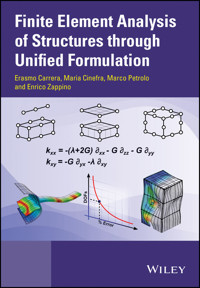
Finite Element Analysis of Structures Through Unified Formulation deals with the FEM used for the analysis of the mechanics of structures in the case of linear elasticity. The novelty of this book is that the finite elements (FEs) are formulated on the basis of a class of theories of structures known as the Carrera Unified Formulation (CUF). It formulates 1D, 2D and 3D FEs on the basis of the same 'fundamental nucleus' that comes from geometrical relations and Hooke's law, and presents both 1D and 2D refined FEs that only have displacement variables as in 3D elements. It also covers 1D and 2D FEs that make use of 'real' physical surfaces rather than ’artificial’ mathematical surfaces which are difficult to interface in CAD/CAE software.
Key features:
- Covers how the refined formulation can be easily and conveniently used to analyse laminated structures, such as sandwich and composite structures, and to deal with multifield problems
- Shows the performance of different FE models through the 'best theory diagram' which allows different models to be compared in terms of accuracy and computational cost
- Introduces an axiomatic/asymptotic approach that reduces the computational cost of the structural analysis without affecting the accuracy
- Introduces an innovative 'component-wise' approach to deal with complex structures
- Accompanied by a website hosting the dedicated software package MUL2 (www.mul2.com)
Finite Element Analysis of Structures Through Unified Formulation is a valuable reference for researchers and practitioners, and is also a useful source of information for graduate students in civil, mechanical and aerospace engineering.
Sie lesen das E-Book in den Legimi-Apps auf:
Seitenzahl: 481
Veröffentlichungsjahr: 2014
Ähnliche

















FINITE ELEMENT ANALYSIS OF STRUCTURES THROUGH UNIFIED FORMULATION
Erasmo Carrera
Department of Mechanical and Aerospace Engineering, Politecnico di Torino, Italy School of Aerospace, Mechanical and Manufacturing Engineering, RMIT University, Australia
Maria Cinefra
Enrico Zappino
Department of Mechanical and Aerospace Engineering, Politecnico di Torino, Italy
Marco Petrolo
School of Aerospace, Mechanical and Manufacturing Engineering,
This edition first published 2014 © 2014 John Wiley & Sons Ltd
Registered officeJohn Wiley & Sons Ltd, The Atrium, Southern Gate, Chichester, West Sussex, PO198SQ, United Kingdom
For details of our global editorial offices, for customer services and for information about how to apply for permission to reuse the copyright material in this book please see our website at www.wiley.com.
The right of the author to be identified as the author of this work has been asserted in accordance with the Copyright, Designs and Patents Act 1988.
All rights reserved. No part of this publication may be reproduced, stored in a retrieval system, or transmitted, in any form or by any means, electronic, mechanical, photocopying, recording or otherwise, except as permitted by the UK Copyright, Designs and Patents Act 1988, without the prior permission of the publisher.
Wiley also publishes its books in a variety of electronic formats. Some content that appears in print may not be available in electronic books.
Designations used by companies to distinguish their products are often claimed as trademarks. All brand names and product names used in this book are trade names, service marks, trademarks or registered trademarks of their respective owners. The publisher is not associated with any product or vendor mentioned in this book.
Limit of Liability/Disclaimer of Warranty: While the publisher and author have used their best efforts in preparing this book, they make no representations or warranties with respect to the accuracy or completeness of the contents of this book and specifically disclaim any implied warranties of merchantability or fitness for a particular purpose. It is sold on the understanding that the publisher is not engaged in rendering professional services and neither the publisher nor the author shall be liable for damages arising herefrom. If professional advice or other expert assistance is required, the services of a competent professional should be sought.
Library of Congress Cataloging-in-Publication Data
Carrera, Erasmo. Finite element analysis of structures through unified formulation / Erasmo Carrera, Maria Cinefra, Marco Petrolo, Enrico Zappino. pages cm Includes bibliographical references and index. ISBN 978-1-119-94121-7 (cloth) 1. Finite element method. 2. Numerical analysis. I. Cinefra, Maria. II. Petrolo, Marco. III. Zappino, Enrico. IV. Title. QC20.7.F56C37 2014 518′.25–dc23
2014013805
A catalogue record for this book is available from the British Library.
ISBN: 9781119941217
List of Tables
Preface
Table 1
Chapter 1
Table 1.1
Chapter 6
Table 6.1
Chapter 7
Table 7.1
Table 7.2
Table 7.3
Chapter 8
Table 8.1
Table 8.2
Table 8.3
Table 8.4
Table 8.5
Table 8.6
Table 8.7
Table 8.8
Table 8.9
Table 8.10
Table 8.11
Chapter 9
Table 9.1
Table 9.2
Table 9.3
Table 9.4
Table 9.5
Table 9.6
Table 9.7
Table 9.8
Table 9.9
Table 9.10
Table 9.11
Table 9.12
Table 9.13
Table 9.14
Table 9.15
Table 9.16
Table 9.17
Table 9.18
Table 9.19
Table 9.20
Table 9.21
Table 9.22
Table 9.23
Chapter 10
Table 10.1
Table 10.2
Table 10.3
Table 10.4
Table 10.5
Table 10.6
Table 10.7
Chapter 11
Table 11.1
Table 11.2
Table 11.3
Table 11.4
Table 11.5
Chapter 12
Table 12.1
Table 12.2
Chapter 13
Table 13.1
Table 13.2
Table 13.3
Table 13.4
Table 13.5
Table 13.6
Table 13.7
Table 13.8
Table 13.9
Table 13.10
Table 13.11
Table 13.12
Table 13.13
Table 13.14
Table 13.15
Table 13.16
Table 13.17
Table 13.18
Table 13.19
Table 13.20
Table 13.21
Table 13.22
Table 13.23
Table 13.24
Table 13.25
Table 13.26
Table 13.27
Table 13.28
Table 13.29
Table 13.30
Table 13.31
Table 13.32
Table 13.33
Table 13.34
Table 13.35
Chapter 14
Table 14.1
Table 14.2
Table 14.3
Chapter 15
Table 15.1
Table 15.2
Table 15.3
Chapter 16
Table 16.1
Table 16.2
Table 16.3
Appendix A
Table A.1
Appendix B
Table B.1
Table B.2
Table B.3
Table B.4
Table B.5
Table B.6
Table B.7
Table B.8
Table B.9
Table B.10
Table B.11
Table B.12
Guide
Cover
Table of Contents
Preface
Pages
xiii
xiv
xv
xvii
xviii
xix
xxi
xxii
xxiii
1
2
3
4
5
6
7
8
9
10
11
12
13
14
15
16
17
18
19
20
21
22
23
24
25
26
27
28
29
30
31
32
33
35
36
37
38
39
40
41
42
43
44
45
46
47
48
49
51
52
53
54
55
56
57
58
59
60
61
62
63
64
65
66
67
68
69
71
72
73
74
75
76
77
78
79
80
81
82
83
84
85
86
87
88
89
90
91
92
93
94
95
96
97
98
99
100
101
102
103
105
106
107
108
109
110
111
112
113
114
115
116
117
118
119
120
121
122
123
124
125
126
127
128
129
130
131
132
133
134
135
136
137
138
139
140
141
142
143
144
145
146
147
148
149
150
151
152
153
154
155
156
157
158
159
160
161
162
163
164
165
166
167
168
169
170
171
172
173
174
175
176
177
178
179
180
181
182
183
184
185
186
187
188
189
190
191
192
193
194
195
196
197
198
199
200
201
202
203
204
205
206
207
208
209
210
211
212
213
214
215
216
217
218
219
220
221
222
223
224
225
226
227
228
229
230
231
232
233
234
235
236
237
238
239
240
241
242
243
244
245
246
247
248
249
250
251
253
254
255
256
257
258
259
260
261
262
263
264
265
266
267
268
269
270
271
272
273
274
275
276
277
278
279
280
281
282
283
284
285
286
287
288
289
290
291
292
293
294
295
296
297
298
299
300
301
303
304
305
306
307
308
309
310
311
312
313
314
315
316
317
318
319
320
321
322
323
324
325
326
327
328
329
330
331
332
333
334
335
336
337
338
339
340
341
342
343
344
345
346
347
348
349
351
352
353
354
355
356
357
358
359
360
361
362
363
364
365
366
367
368
369
370
371
372
373
374
375
376
377
378
379
381
382
383
384
385
About the Authors
Erasmo Carrera
Erasmo Carrera graduated in Aeronautics in 1986 and in Space Engineering in 1988 from the Politecnico di Torino. He obtained a PhD in Aerospace Engineering in 1991 within the framework of a joint PhD programme between the Politecnico di Milano, the Politecnico di Torino and the Università di Pisa. He became assistant professor in 1992. He has continuously held courses at Bachelor, Master and PhD levels on Fundamentals of Theory of Structures, Aerospace Structures, Nonlinear Problems, Plates and Shells, Thermal Stress, Composite Materials, Multifield Problems and Computational Aeroelasticity. Currently he is a full professor in the Department of Mechanical and Aerospace Engineering. He has also been a visiting professor at the University of Stuttgart, Virginia Tech, Supmeca and the Centre of Research Public Henri Tudor.
His research topics cover: composite materials, nonlinear problems and the stability of structures, contact mechanics, multibody dynamics, finite elements, path-following methods in nonlinear finite element (FE) analysis, meshless methods, unconventional lifting systems, smart structures, thermal stress for coupled and uncoupled problems, multifield interaction, aeroelasticity, panel flutter, wind blades, explosion effects on flying aircraft, advanced theories for beams, plates and shells, mixed variational methods; zigzag, mixed and layer-wise modellings for multilayered beams, plates and shells; local--global methods and the Arlequin-type approach; advanced structural models for wings, fuselage and complete aircraft/spacecraft through the introduction of the so-called component-wise approach; failure and progressive failure analysis of laminated structures; inflatable structures for manned and unmanned space applications; and the design and analysis of full composite aircraft, including trikes and unmanned aerial vehicles (UAVs).
Professor Carrera developed the Reissner mixed variational theorem (RMVT) as a natural extension of the principle of virtual displacements to layered structure analysis. He introduced the unified formulation, or CUF (Carrera Unified Formulation), as a tool to establish a new framework in which beam, plate and shell theories can be developed for metallic and composite multilayered structures under mechanical, thermal, electrical and magnetic loadings. The CUF has been applied extensively to both strong and weak forms (FE and meshless solutions). The main feature of the CUF is that it permits any expansion of the unknown variables over the thickness/cross-section domain to be handled in a compact manner. Governing equations are in fact obtained in terms of a few fundamental nuclei whose forms do not depend on either the order of the expansion or the base functions used. As a result, the CUF allows the so-called best theory diagram (BTD) (which shows the minimum number of unknown variables vs the error on an assigned parameter) to be computed for a given problem. The BTD is a way of enhancing axiomatic and asymptotic approaches in the theory of structures.
Professor Carrera is the author and coauthor of about 500 papers on the above topics, most of which have been published in primary international journals, as well as of two recent books published by John Wiley & Sons, Ltd. His papers have received about 5000 citations with an h-index=39 (data from Scopus). He has held invited seminars in various European and North American universities, as well as plenary talks at international conferences. Professor Carrera serves as the Associate Editor for Composite Structures, Journal of Thermal Stress, Mechanics of Advanced Structures, Computer and Structures and the International Journal of Aeronautical and Space Sciences. He is founder and Editor-in-Chief of Advances in Aircraft and Spacecraft Science; acts as a reviewer for about 80 journals; and is on the Editorial Board of many international conferences. He is also in charge of the chapter on `Shells' in the Encyclopedia of Thermal Stress, published by Springer. Professor Carrera is the founder of the non-profit international conference DeMEASS and the main organizer of ICMNMMCS (Turin, June 2012, co-chaired by Professor A. Ferreira), the ECCOMASS SMART 13 conference (Turin, June 2013) and ISVCS IX (Courmayeur, July 2013). He is member of the Distinguished Professor Board at King Abdulaziz University (Saudi Arabia). He has been a member of PhD and Habilitation committees in Germany, France, the Netherlands and Portugal. He is president of the Piedmont Section of AIDAA (Associazione Italiana di Aeronautica ed Astronautica).
Professor Carrera has been responsible for various research contracts granted by public and private national (including regional) and international institutions such as IVECO, the Italian Ministry of Education, the European Community, the European Space Agency, Alenia Spazio, Thales Alenia Space and Regione Piemonte. Among other projects, he has been responsible for the structural design and analysis of a full composite aircraft, named Sky-Y, by Alenia Aeronautica Torino, the first fully composite UAV made in Europe.
Professor Carrera is founder and leader of the MUL2 Group at the Politecnico di Torino. This group is considered one of the most active research teams in the Politecnico; it has acquired a significant international reputation in the field of multilayered structures subjected to multifield loadings; see also www.mul2.com. He is one of the Highly Cited Researchers by Thomson Reuters in both the Engineering and Materials Sections.
Maria Cinefra
Maria Cinefra is a research assistant at the Politecnico di Torino. She gained a BSc in Aerospace Engineering at the Politecnico di Torino in March 2007 with a thesis on the finite element method (FEM) in elliptic differential equations. Afterwards, she undertook an MSc in Aerospace Engineering at the Politecnico di Torino and gained her Master's degree, summa cum laude, in December 2008 from her work on the thermomechanical analysis of functionally graded material (FGM) shells. She began her PhD in January 2009, under the supervision of Professor Erasmo Carrera, on a research project related to the thermomechanical design of multilayered plates and shells embedding FGM layers. She was enrolled in a PhD with a foreign co-advisor, Professor Olivier Polit, at the University of Paris Ouest Nanterre. Her research project was funded by the Fonds National de la Recherche of Luxembourg and was performed in collaboration with the CRP Henri Tudor of Esch (Luxembourg). She was given the award for the best PhD paper (Ian Marshall's Award) at the 16th International Conference on Composite Structures (28--30 June 2011, Porto, Portugal). In January 2012, she was admitted to the final exam of her PhD and presented the defence of her thesis in April 2012. Since 2010, she has worked as a teaching assistant at the Politecnico di Torino on the courses Nonlinear Analysis of Structures, Structures for Space Vehicles and Fundamentals of Structural Mechanics. She is currently collaborating with the Department of Mathematics at Pavia University in order to develop a mixed shell FE based on the CUF for analysing composite structures. She has collaborated with Professor Ferreira, Editor of the Composite Structures Journal, on the radial basis functions method combined with the CUF. Dr Cinefra works as a reviewer for international journals such as Composite Structures and Mechanics of Advanced Materials and Structures. She is currently working on the STEPS regional project, in collaboration with Thales Alenia Space, and is also working on an extension of the shell FE, based on the CUF, to the analysis of multifield problems.
Marco Petrolo
Marco Petrolo is a Research Fellow at the School of Aerospace, Mechanical and Manufacturing Engineering, RMIT University, Melbourne, Australia. He was Post-Doc fellow at the Politecnico di Torino, Italy. He works in Professor Carrera's research group on various topics related to the development of refined structural models of composite structures. His research activity is connected with the structural analysis of composite lifting surfaces; refined beam, plate and shell models; component-wise approaches; and axiomatic/asymptotic analyses. He is the author and coauthor of some 50 publications, including 2 books and 25 articles that have been published in peer-reviewed journals.
Dr Petrolo gained his PhD in Aerospace Engineering at the Politecnico di Torino in April 2012, presenting a thesis on advanced aeroelastic models for the analysis of lifting surfaces made of composite materials. He also has an MSc in Aerospace Engineering from the Politecnico di Torino, an MSc in Aerospace Engineering from TU Delft (the Netherlands) and a BSc in Aerospace Engineering from the Politecnico di Torino. He has worked as an intern at EADS (Germany) and, as a Fulbright scholar, spent research periods at San Diego State University and the University of Michigan (USA). Dr Petrolo was appointed Adjunct Professor in Fundamentals of Strength of Materials (part of the BSc in Mechanical Engineering at the Turin Polytechnic University in Tashkent, Uzbekistan).
Enrico Zappino
Enrico Zappino is a post-doctoral fellow at the Politecnico di Torino. He has been in Professor Carrera's research group since 2010. His research activities concern structural analysis using classical and advanced models, multi-field analysis, and composite materials analysis. He is the coauthor of many works published in several international peer-reviewed journals. He obtained his PhD in April 2014, presenting a thesis on variable kinematic 1D, 2D, and 3D models for the analysis of aerospace structures. He also gained his BSc in Aerospace Engineering at the Politecnico di Torino in October 2007, presenting a thesis on advanced wing structures. He then obtained an MSc from the same university in July 2010, with a thesis on higher-order one-dimensional structural models applied to static, dynamic, and aeroelastic analysis. He was involved in many research programs supported by the European Space Agency and the European Union in cooperation with many European industrial and academic partners. From 2011, Dr. Zappino has worked as a teaching assistant at the Politecnico di Torino on the course of Aeroelasticity. In 2014, he was appointed as Adjunct Professor in Fundamentals of Strength of Materials at the Turin Polytechnic University in Tashkent, Uzbekistan.
Preface
This book deals with the finite element method (FEM) used for analysing the mechanics of structures in the case of linear elasticity. The novelty of this book is that the finite elements (FEs) are formulated on the basis of a class of theories of structures known as the Carrera Unified Formulation (CUF).
The CUF provides one-dimensional (beam) and two-dimensional (plate and shell) theories that go beyond classical theories (those of Euler, Kirchhoff, Reissner, Mindlin, Love) by exploiting a condensed notation and by expressing the displacement fields over the cross-section (the beam case) and along the thickness (plate and shell cases) in terms of base functions whose forms and orders are arbitrary. The condensed notation leads to the so-called fundamental nucleus (FN) of all the FEM matrices and vectors involved. The fundamental nuclei (FNs) and the related assembly technique are schematically shown in Table 1. The FNs consist of a few mathematical statements whose forms are independent of the theory of structures (TOS) employed. The FNs stem from the 3D elasticity equations via the principle of virtual displacements (PVD) and can be easily obtained for the 3D, 2D and 1D cases. This table will be reintroduced at the beginning of each chapter of this book that deals with 3D, 2D and 1D models to highlight the relevant fundamental nucleus.
Table 1 A schematic description of the CUF and the related fundamental nucleus of the stiffness matrix for 3D, 2D and 1D models
The 1D and 2D FEs that stem from the CUF have enhanced capabilities since they can obtain results that are usually only provided by 3D elements with much lower computational costs. The 1D elements are particularly advantageous since they can deal with 2D and 3D problems in a proper manner.
The 1D and 2D CUF models are described in various chapters of this book. Particular attention has been paid to 1D and 2D FEs with only pure displacement degrees of freedom. The displacement unknowns of such FEs are defined over the physical surfaces of the real 3D body; this means that the definitions of mathematical reference axes (for beams) or reference surfaces (for plates and shells) are not needed. This capability is extremely important in an FEM/CAD coupling scenario. The modifications carried out in an FEM model can, in fact, be implemented directly in a CAD model (and vice versa) since physical surfaces are taken into account.
The concluding chapters of the book offer an overview of some of the most important features of the CUF models. In particular, the following topics are emphasized: multifield loads can be easily implemented; layered structures can be analysed; 1D, 2D and 3D models can be combined straightforwardly; and the CUF can lead to a definition of the BTD to evaluate the effectiveness of any structural theory. Numerical examples appear throughout the book on classical and non-classical TOS problems.
This book follows on from two recent books where the CUF was applied to shell, plate and beam models: Plates and Shells for Smart Structures: Classical and Advanced Theories for Modeling and Analysis (E. Carrera, S. Brischetto and P. Nali, John Wiley & Sons, Ltd, 2011) deals with refined shell and plate models for smart structures; and Beam Structures: Classical and Advanced Theories (E. Carrera, G. Giunta and M. Petrolo, John Wiley & Sons, Ltd, 2011) deals with refined beam models. Analytical and FE formulations were introduced in both these books.
Nomenclature and Acronyms
The main symbols and acronyms that are defined in the book are listed below. Unless otherwise stated, the following definitions will be valid throughout the entire book.
Symbols
B
,
b
Differential operator of the strain--displacements relations
B2, B3, B4
Beam elements with two, three and four nodes
C
Hooke's law stiffness matrix
C
11
,
C
12
,
C
21
,
C
13
,
C
23
,
C
44
Hooke's law stiffness coefficients
E
Young's modulus
F
τ
,
F
s
Expansion functions
G
Shear modulus
g
Body forces per unit volume vector
g
x
,
g
y
,
g
z
Body forces per unit volume components
H
Metric factor
i
,
j
Shape function indexes
k
Layer index
K




