


89,99 €
Mehr erfahren.
- Herausgeber: John Wiley & Sons
- Kategorie: Fachliteratur
- Sprache: Englisch
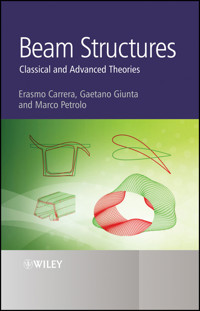
Beam theories are exploited worldwide to analyze civil, mechanical, automotive, and aerospace structures. Many beam approaches have been proposed during the last centuries by eminent scientists such as Euler, Bernoulli, Navier, Timoshenko, Vlasov, etc. Most of these models are problem dependent: they provide reliable results for a given problem, for instance a given section and cannot be applied to a different one.
Beam Structures: Classical and Advanced Theories proposes a new original unified approach to beam theory that includes practically all classical and advanced models for beams and which has become established and recognised globally as the most important contribution to the field in the last quarter of a century.
The Carrera Unified Formulation (CUF) has hierarchical properties, that is, the error can be reduced by increasing the number of the unknown variables. This formulation is extremely suitable for computer implementations and can deal with most typical engineering challenges. It overcomes the problem of classical formulae that require different formulas for tension, bending, shear and torsion; it can be applied to any beam geometries and loading conditions, reaching a high level of accuracy with low computational cost, and can tackle problems that in most cases are solved by employing plate/shell and 3D formulations.
Key features:
- compares classical and modern approaches to beam theory, including classical well-known results related to Euler-Bernoulli and Timoshenko beam theories
- pays particular attention to typical applications related to bridge structures, aircraft wings, helicopters and propeller blades
- provides a number of numerical examples including typical Aerospace and Civil Engineering problems
- proposes many benchmark assessments to help the reader implement the CUF if they wish to do so
- accompanied by a companion website hosting dedicated software MUL2 that is used to obtain the numerical solutions in the book, allowing the reader to reproduce the examples given in the book as well as to solve other problems of their own www.mul2.com
Researchers of continuum mechanics of solids and structures and structural analysts in industry will find this book extremely insightful. It will also be of great interest to graduate and postgraduate students of mechanical, civil and aerospace engineering.
Sie lesen das E-Book in den Legimi-Apps auf:
Seitenzahl: 179
Veröffentlichungsjahr: 2011
Ähnliche
















This edition first published 2011 © 2011 John Wiley & Sons, Ltd
Registered office John Wiley & Sons Ltd, The Atrium, Southern Gate, Chichester, West Sussex, PO19 8SQ, United Kingdom
For details of our global editorial offices, for customer services and for information about how to apply for permission to reuse the copyright material in this book please see our website at www.wiley.com.
The right of the author to be identified as the author of this work has been asserted in accordance with the Copyright, Designs and Patents Act 1988.
All rights reserved. No part of this publication may be reproduced, stored in a retrieval system, or transmitted, in any form or by any means, electronic, mechanical, photocopying, recording or otherwise, except as permitted by the UK Copyright, Designs and Patents Act 1988, without the prior permission of the publisher.
Wiley also publishes its books in a variety of electronic formats. Some content that appears in print may not be available in electronic books.
Designations used by companies to distinguish their products are often claimed as trademarks. All brand names and product names used in this book are trade names, service marks, trademarks or registered trademarks of their respective owners. The publisher is not associated with any product or vendor mentioned in this book. This publication is designed to provide accurate and authoritative information in regard to the subject matter covered. It is sold on the understanding that the publisher is not engaged in rendering professional services. If professional advice or other expert assistance is required, the services of a competent professional should be sought.
Library of Congress Cataloguing-in-Publication Data
Carrera, Erasmo.
Beam structures : classical and advanced theories / Erasmo Carrera, Gaetano Giunta,
Marco Petrolo. – 1st ed.
p. cm.
Includes bibliographical references and index.
ISBN 978-0-470-97200-7 (hardback)
1. Girders. I. Giunta, Gaetano. II. Petrolo, Marco. III. Title.
TA492.G5C37 2011
624.1′7723–dc23
2011019533
A catalogue record for this book is available from the British Library.
Print ISBN:9780470972007
ePDF ISBN: 9781119978572
Obook ISBN: 9781119978565
ePub ISBN: 9781119951049
Mobi ISBN: 9781119951056
About the Authors
Erasmo Carrera
After earning two degrees (Aeronautics, 1986, and Aerospace Engineering, 1988) at the Politecnico di Torino, Erasmo Carrera received his PhD degree in Aerospace Engineering jointly at the Politecnico di Milano, Politecnico di Torino, and Università di Pisa in 1991. He began working as a Researcher in the Department of Aerospace for the Politecnico di Torino in 1992 where he held courses on Missiles and Aerospace Structure Design, Plates and Shells, and the Finite Element Method. He became Associate Professor of Aerospace Structures and Computational Aeroelasticity in 2000, and Full Professor at the Politecnico di Torino in 2011. He has visited the Institute für Statik und Dynamik, Universität Stuttgart twice, the first time as a PhD student (six months in 1991) and then as Visiting Scientist under a GKKS Grant (18 months in 1995--1996). In the summers of 1996, 2003 and 2009, he was Visiting Professor at the ESM Department of Virginia Tech, at SUPMECA in Paris (France) and at the CRP TUDOR in Luxembourg, respectively. His main research topics are: inflatable structures, composite materials, finite elements, plates and shells, postbuckling and stability, smart structures, thermal stress, aeroelasticity, multibody dynamics, and the design and analysis of non-classical lifting systems. He is author of more than 300 articles on these topics, many of which have been published in international journals. He serves as referee for international journals, and as a contributing editor for Mechanics of Advanced Materials and Structures, Composite Structures and Journal of Thermal Stress.
Gaetano Giunta
Gaetano Giunta graduated in Aerospace Engineering at the Politecnico di Torino in 2004. In 2007 he defended his PhD thesis on “Deterministic and Stochastic Hierarchical Analysis of Failure and Vibration of Composites Plates and Shells” at the Politecnico di Torino. Dr Giunta carried out his post-doc at the Centre de Recherche Public Henri Tudor in Luxembourg and the Politecnico di Torino from February 2008 to January 2010. Currently he is an R&D Engineer at the Centre de Recherche Public Henri Tudor and is working on the project FNR CORE C09/MS/05 FUNCTIONALLY on “Functionally Graded Materials: Multi-Scale Modelling, Design and Optimisation” funded by the Fonds National de la Recherche Luxembourg (FNR). Dr Giunta would like to acknowledge the FNR for its support. His research covers the formulation of hierarchical analytical and finite element models for the static, free vibration, buckling and failure analysis of beam, plate, and shell structures made of conventional and advanced materials.
Marco Petrolo
Marco Petrolo is an Aerospace Engineer and a PhD student at the Politecnico di Torino. He has a BSc in Aerospace Engineering at the Politecnico di Torino and an MSc degree in Aerospace Engineering in a joint program between the Politecnico di Torino, TU Delft, and EADS. He is a Fulbright alumnus, and, as a such, he has spent research periods at the San Diego State University and at the University of Michigan. His research activity is focused on the development of refined models for the structural and aeroelastic design of composite and metallic structures. He works in Professor Carrera's research group in Turin on different aerospace applications, such as the structural analysis of composite lifting surfaces, multiscale problems, and nonlinear problems.
Preface
Beam models have made it possible to solve a large number of engineering problems over the last two centuries. Early developments, based on kinematic intuitions (bending theories), by pioneers such as Leonardo da Vinci, Euler, Bernoulli, Navier, and Barre de Saint Venant, have permitted us to consider the most general three-dimensional (3D) problem as a one-dimensional (1D) problem in which the unknowns only depend on the beam-axis position. These early theories are known as engineering beam theories (EBTs) or the Euler--Bernoulli beam theory (EBBT). Recent historical reviews have proposed that these theories should be referred to as the DaVinci--Euler--Bernoulli beam theory (DEBBT). The drawbacks of EBT are due to the intrinsic decoupling of bending and torsion (cross-section warping is not addressed by EBT) as well as to the difficulties involved in evaluating the additional five (normal and shear) stress components that are not provided by the Navier formula. Many torsion-beam theories which are effective for different types of beam sections are known. Many refinements of original EBT kinematics have been proposed. Amongst these, the one attributed to Timoshenko in which transverse shear deformations are included should be mentioned. The other refined theories mentioned herein are those by Vlasov and by Wagner, both of which lead to improved strain/stress field descriptions.
Over the last few decades, computational methods, in particular the finite element method, have made the use of classical beam theories much more successful and attractive. The possibility of solving complex framed structures with very different boundary conditions (mechanical and geometrical) has made it possible to analyze many complex problems involving thousands of degrees of freedom (DOFs) with acceptable accuracy. However, the difficulty of obtaining a complete stress/strain field in those sections with complex geometries or thin walls still remains an open question which can be addressed by refined and advanced beam theories.
During the last decade, the first author of this book proposed the Carrera Unified Formulation (CUF), which was first applied to plates and shells and then recently extended to beams. The CUF permits one to develop a large number of beam theories with a variable number of displacement unknowns by means of a concise notation and by referring to a few fundamental nuclei. Higher-order beam theories can easily be implemented on the basis of the CUF, and the accuracy of a large variety of beam theories can be established in a hierarchical and/or axiomatic vs. asymptotic sense. A modern form of beam theories can therefore be constructed in a hierarchical manner. The number of unknown variables is a free parameter of the problem. A 3D stress/strain field can be obtained by an appropriate choice of these variables for any type of beam problem: compact sections, thin-walled sections, bending, torsion, shear, localized loadings, static and dynamic problems.
This book details classical and modern beam theories. Accuracy of the known theories is established by using the modern technique in the CUF. Various beam problems, in particular beam sections from civil to aerospace applications (wing airfoils), are considered in static and dynamic problems. Numerical results are obtained using the MUL2 software, which is available on the web site www.mul2.com.
www.wiley.com/go/carrera
Introduction
A brief introduction to the contents of the book is given here together with an overview of the milestone contributions to beam structure analysis.
Why another book on beams?
There is no need for another book on beam theories. Many books are, in fact, available, which have been written by some of the most eminent and talented scientists in the theory of elasticity and structures. It would be extremely difficult to write a better book. So, why a new book on beam theories? The reason is the following: this book presents a method to deal with beam theories that has never been considered before. As will be explained in the following chapters, the method introduced by the first author over the last decade for plates and shells is applied here to beams to build a large class of 1D (beam) hierarchical (variable kinematic) theories, which are based on automatic techniques to build governing equations and/or finite element matrices. The resulting theories permit one to deal with any section geometries subjected to any loading conditions and, at the same time, to reach quasi-3D solutions. Such results make the present book unique.
Lesen Sie weiter in der vollständigen Ausgabe!
Lesen Sie weiter in der vollständigen Ausgabe!
Lesen Sie weiter in der vollständigen Ausgabe!
Lesen Sie weiter in der vollständigen Ausgabe!
Lesen Sie weiter in der vollständigen Ausgabe!
Lesen Sie weiter in der vollständigen Ausgabe!
Lesen Sie weiter in der vollständigen Ausgabe!
Lesen Sie weiter in der vollständigen Ausgabe!
Lesen Sie weiter in der vollständigen Ausgabe!
Lesen Sie weiter in der vollständigen Ausgabe!
Lesen Sie weiter in der vollständigen Ausgabe!
Lesen Sie weiter in der vollständigen Ausgabe!
Lesen Sie weiter in der vollständigen Ausgabe!




