


Erhalten Sie Zugang zu diesem und mehr als 300000 Büchern ab EUR 5,99 monatlich.
- Herausgeber: Luath Press
- Kategorie: Geisteswissenschaft
- Sprache: Englisch
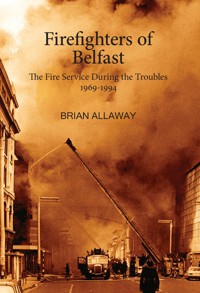
The firefighters responded to every incident during the Troubles, wherever it was located, seeing the best and worst of humanity.The years 1969 to 1994 were particularly difficult for Northern Ireland, and what would become known as 'the Troubles' would test the firefighters of Belfast to their limits. This book provides a record of that time from a firefighter's perspective, combining thorough research and contemporary records with first hand accounts from people who were involved, bringing these significant events to life through the words of the people who lived through them.Full of character and characters, this personal account places on record the dedicated service and invaluable contribution made by firefighters to the people of Belfast when the city needed them most. Firefighters of Belfast is ultimately an uplifting portrait of human courage and resilience during the most difficult of times.
Sie lesen das E-Book in den Legimi-Apps auf:
Seitenzahl: 450
Veröffentlichungsjahr: 2020
Das E-Book (TTS) können Sie hören im Abo „Legimi Premium” in Legimi-Apps auf:
Ähnliche



















BRIAN ALLAWAY is a retired firefighter. In 1969, at the age of 16, Brian joined the Belfast Fire Brigade and served in Northern Ireland during the Troubles. In 1994, he transferred to Lothian and Borders Fire Brigade in Edinburgh and was promoted to Firemaster in 2002, the last person to hold that title. He has a BA from the Open University, an MSSc from the Queen’s University of Belfast and a PhD from The University of Edinburgh. His first book, Culture, Identity and Change in the Fire and Rescue Service, was published in 2011 by the Institute of Fire Engineers. A Fellow of the Institution of Fire Engineers and recipient of the Queen’s Fire Service Medal, Brian lives in Edinburgh.
First Published 2018
e-ISBN: 978-1-912387-20-5
The author’s right to be identified as author of this book under the Copyright, Designs and Patents Act 1988 has been asserted.
The paper used in this book is recyclable. It is made from low chlorine pulps produced in a low energy, low emission manner from renewable forests.
Printed and bound by Bell & Bain Ltd., Glasgow
Typeset in 11 point Sabon by Lapiz
Photographs, unless otherwise indicated, reproduced with the kind permission of the Northern Ireland Fire and Rescue Service
© Brian Allaway 2018
Dedicated to the firefighters of Belfast, past, present and future.
Contents
Foreword
Acknowledgements
Map of Belfast
Glossary and Abbreviations
Contributors
Chronology
Introduction
PART ONE 1969 to 1971: The Descent into Chaos
PART TWO 1971 to 1976: The Blood and Screams of Daily Life in Belfast
PART THREE 1976 to 1983: A Plateau of Death and Destruction
PART FOUR 1983 to 1989: The Long Road to Peace
PART FIVE 1989 to 1994: Things Get Worse Before They Get Better
PART SIX The Damage Done
Bibliography
Foreword
THE PERIOD OF HISTORY that is the subject of this book was an important time for the Northern Ireland Fire Brigade. Because of the situation in Northern Ireland, many of those who served at this time were involved in incidents that were unique for a United Kingdom Fire Service. Much of what happened during these difficult days was horrific, and this book tells the story of events seen through the eyes of the Brigade. I believe this book also provides an insight into the humanity and spirit of the firefighters, as well as the impact on them at a personal level.
When I joined the Fire Brigade in the 1980s, I learned about my new career in a number of ways. There was the formal teaching environment that I experienced during my training, but probably much more effective (and longer lasting!) was the wealth of information that came to me as a young fireman through the stories and traditions that were a part of everyday life. The list of contributors that appears in the early pages of this book reads like a nominal roll from my early career. These people were my educators and role models; their experiences were passed on as part of the folklore and the culture of the Fire Brigade.
This book contains a record of the events of that time from a Fire Brigade’s perspective, and for me the real attraction is that it combines these records with first hand accounts from people that were involved, bringing these significant events to life in the words of the people who lived through them.
As I approach the end of my career, I am conscious that I am just the latest in a line of fire fighters that have had the huge privilege of leading an amazing group of people, and I reflect on the fact that the Fire & Rescue Service of today has changed in many ways. However, there is much that remains the same. The selfless dedication, the courage and the calm ‘can-do’ attitude is still prevalent among the young firefighters, just as it has always been.
The Northern Ireland Fire & Rescue Service of today looks to the future and we continue to be very proud of where we have come from and our unique history. It is my pleasure to commend Dr Brian Allaway on his work and to recommend it to all those who have an interest in an amazing organisation at a unique time in its history.
Dale Ashford QFSM.Chief Fire and Rescue Officer, Northern Ireland Fire Brigade (retired).
Acknowledgements
I HAVE VALUED THE help, advice and encouragement of many people during the development of this book and I would like to place on record my thanks to all of them. In particular I must thank the contributors, who are listed prior to the introduction, for the time and memories they so freely gave to me. It was a great pleasure to meet up with them, share experiences, have a beer and often a laugh, fight old fires and ‘swing the lights’ a little. Memory can be a fickle thing and often the contributors did not remember specific dates or addresses. However, I have done my best to corroborate everything that is in this book and any mistakes are, of course, mine alone. I am grateful to Mags McKay, who did the brilliant job of putting together the map of Belfast and making the chronology look better than I could, and to my publishers, Luath Press, particularly Alice Latchford, who made many helpful suggestions to improve the initial manuscript. I must also thank the Belfast Corporation, Fire Authority for Northern Ireland and Lothian and Borders Fire and Rescue Board for employing and developing me during my 41 years in the fire and rescue service. They also provided systems which allowed their employees to enhance their education, and I am just one of many who are grateful for the opportunities this gave to those of us who started our careers with little in the way of formal qualifications. I am also indebted to the many members of the fire and rescue services with whom I have served and enjoyed a great comradeship, and not a few laughs, despite some of the difficult situations we had to deal with. I am sure that it is due in no small measure to these people that I am who I am. Last but not least I must thank my children, Kerry and Steven, and grandchildren, Luke, Amy, Hayley, Abbie, Dylan and Matthew, and in particular my wife Diane, all of whom I care for deeply and who all seem to put up with me. Diane also deserves the credit for her magnificent proof reading and for correcting my terrible grammar and spelling! (It’s a little known fact that when I left Red Watch Ardoyne, among the parting gifts they gave me was a rubber and a dictionary).
Glossary and Abbreviations
Appliance – A generic term for a fire engine used within the service (machine is also used for this purpose.)
ATO – Ammunition Technical Officer – Mainly used for bomb disposal in Northern Ireland, although they have a wider responsibility for all aspects of ammunition within the British army.
BA – Breathing Apparatus – Self-contained device worn by firefighters, which provides breathable air in a hazardous atmosphere.
Catholic Ex-Servicemen’s Association – A nationalist vigilante group, formed in the early 1970s and mainly confined to west and north Belfast.
Claymore – A generic term used to describe an anti-personnel mine.
CS gas – A tear gas used in riot control. It worked by causing a burning sensation and irritation to the eyes, nose, mouth and throat. Makes it difficult to breathe and see.
DUP – Democratic Unionist Party – Founded in 1971, it attracted a strong working class Protestant vote but in recent years has tried to widen its appeal. It is currently the largest party in the power-sharing Northern Ireland Assembly.
Ferret – A five-ton light armoured patrol car with a Browning machine gun mounted on top, the army used it during the early part of the Troubles.
H-Blocks – Compounds in the Maze Prison. Named because of their shape, they contained 200 cells each.
Height Appliance – A generic term, used within the fire service, for a hydraulic platform or turntable ladder.
HP – Hydraulic Platform – In addition to the functions of the turntable ladder this vehicle also provides a secure platform from which firefighters can operate. The operating arm can bend in one or more places and this allows more flexibility in positioning and manoeuvring the platform.
Kneecapping – A form of punishment shooting used by the paramilitaries during the Troubles. A shot was fired through the knee of the victim causing permanent damage.
Orange Order – Founded in County Armagh in 1795. By the time of the late 19th century it had expanded into a political and religious grouping, which opposed nationalism and British government efforts towards constitutional change. Its tradition of marching, sometimes through nationalist districts, can cause controversy.
Peace line – Originally large fences made from corrugated metal, the army erected them in the early 1970s to provide a physical barrier between Catholic and Protestant areas. They are located mainly in north and west Belfast and some of them have been replaced with high brick walls.
Pig – The nickname of a one-ton Humber armoured car, used throughout the first two decades of the Troubles by the army as an armoured personnel carrier.
Retained Firefighter – A firefighter who typically works at another job, and is alerted to come into their fire station when there is a fire call. Predominantly used outside larger towns and cities, this type of firefighter was employed throughout Northern Ireland, with the exception of Belfast and Derry/Londonderry, at the start of the Troubles.
Robot used by the ATO – See wheelbarrow.
RPG-7 – An anti-tank, rocket-propelled grenade, which was shoulder-fired. The IRA, and occasionally loyalist groups, used it. It had a very effective penetrating capability if it hit the target, but it was inaccurate and would self-destruct at about 1,000 metres.
RTA – Road traffic accident.
RUC – Royal Ulster Constabulary.
Provisional Irish Republican Army – Generally known as the IRA, or PIRA to the security forces. The largest of the republican paramilitary groups it was formed after a split from the official IRA.
Proxy bombs – In order to reduce the risk to themselves, bombers would often hi-jack a vehicle with two occupants, or a vehicle from an owner, hold one of the occupants of the vehicle or a member of the owner’s family hostage, load a bomb onto the vehicle and order the driver or owner to drive the vehicle and bomb to a target. Many of these attacks would be less than successful since the frightened driver would often abandon the vehicle before it was fully taken to the target.
Rubber bullet – A weapon used by the security forces, said to be less lethal than gunfire. Replaced by plastic bullets in 1975 and officially called a baton round.
Sangar – A sandbagged or concrete emplacement, usually providing observation at the corner of a barracks building or a lookout position.
Saracen – A six-wheel drive, ten-ton armoured personnel carrier, used throughout the Troubles.
SDLP – Social Democratic and Labour Party – A nationalist political party, it was founded in 1970 with the aim of promoting a united Ireland by peaceful means. It was the largest nationalist party in Northern Ireland but since the 1990s it has lost considerable ground to Sinn Féin.
77 (seven-seven) – Brigade code for an explosive device, an actuated 77 was a device that had detonated.
SAS – Special Air Service – A special forces unit of the British Army.
Sinn Féin – Initially regarded as the political wing of the IRA. An all-Ireland political organisation claiming descent from a party formed in 1904 by Arthur Griffith, which took its current form in 1970. Currently it is part of the power sharing Northern Ireland Assembly where it is the second largest party.
Stormont – The building, completed in 1929, which housed the Northern Ireland parliament until it was dissolved in 1972. It became the seat of the Assembly established after the 1998 Good Friday Agreement.
TL – Turntable Ladder – A telescopic ladder, mounted on a turntable and used to gain access to fires at height. Can allow for a jet of water to be directed into the upper floors of a building or provide an external staircase for rescue purposes.
UDA – Ulster Defence Association – The largest Protestant paramilitary organisation. Established in Belfast in 1971.
Ulster Unionist Party – A unionist party in Northern Ireland that ran the state from 1920 to 1972. It was called the Official Unionist Party to distinguish it from the DUP and other splinter groups that emerged during the 1970s. Since the 1990s it has lost considerable ground to the DUP.
UVF – Ulster Volunteer Force – A loyalist paramilitary group established in the mid 1960s by Shankill Road loyalists. It carried out the first killings of the Troubles.
Ulster Workers Council – Linked to the UDA it emerged in order to organise the loyalist strike that brought down the power-sharing executive in 1974.
Wheelbarrow – A sophisticated piece of equipment used by the ATO, it is remote controlled, mounted on tank-tracks, has a weapons platform and a television camera. It can carry a variety of equipment, explosives and weapons. The main limitations were the batteries that powered it, which could run out of power, the 100m-control cable, that could get trapped or damaged, and difficulty in operating on soft ground, despite the tank-tracks.
Wholetime Firefighter – A firefighter who works full time for the fire service, typically on a watch based shift system, or nine to five in fire prevention. Employed in cities or larger towns, this type of firefighter was employed in Belfast and Derry/Londonderry during the Troubles.
Contributors
Brian Dynes: Joined the Brigade 1963, left the Brigade 1986.
Jimmy Armstrong: Joined the Brigade 1965, left the Brigade 1996.
Ken Harper: Joined the Brigade 1965, left the Brigade 1999.
Dessie McCullough: Joined the Brigade 1966, left the Brigade 1996.
Bob Pollock: Joined the Brigade 1966, left the Brigade 1998.
Roger Dawson: Joined the Brigade 1969, left the Brigade 2004.
Ken Spence: Joined the Brigade 1969, left the Brigade 2007.
Jim Hughes: Joined the Brigade 1970, left the Brigade 2000.
Stanley Spray: Joined the Brigade 1970, left the Brigade 2004.
Charlie Hughes: Joined the Brigade 1971, left the Brigade 1999.
Ken McClune: Joined the Brigade 1971, left the Brigade 2001.
Harry Welsh: Joined the Brigade 1971, left the Brigade 2003.
William Hoey: Joined the Brigade 1972, left the Brigade 1996.
Walter Mason: Joined the Brigade 1974, left the Brigade 2004.
Joe Sloan: Joined the Brigade 1974, left the Brigade 2002.
William McClay: Joined the Brigade 1975, left the Brigade 1997.
Gordon McKee: Joined the Brigade 1975, left the Brigade 2005.
Kenneth McLaughlin: Joined the Brigade 1975, left the Brigade 2010.
Murray Armstrong: Joined the Brigade 1977, left the Brigade 2009.
Wesley Currie: Joined the Brigade 1977, left the Brigade 2010.
Colin Lammy: Joined the Brigade 1977, left the Brigade 2010.
Louis Jones: Joined the Brigade 1978, left the Brigade 2010.
Gordon Latimer: Joined the Brigade 1978, left the Brigade 2009.
Gordon Galbraith: Joined the Brigade 1981, left the Brigade 2006.
Nick Allaway: Joined the Brigade 1984, left the Brigade 1994.
Brian McClintock: Joined the Brigade 1984, left the Brigade 2015.
Chris Kerr: Joined the Brigade 1985, left the Brigade 2015.
Jim Quinn: Joined the Brigade 1986, to date (2018).
Where the contributors are referenced, their words have been edited to prevent repetition and improve readability. However, great care has been taken to be true to their meaning and their actual words have been used as much as possible, to ensure that their own voices are heard. They all served in a number of Belfast stations, the exception being Jim Quinn who served in the emergency control centre. Some remained station based for all of their careers, some were promoted through the ranks and some were trade union representatives.
Introduction
EVEN THOUGH BELFAST WAS not always a sectarian city, the roots of sectarian violence can be traced back to the early 19th century when the city was industrialising and growing rapidly. One early example of sectarian violence occurred on the evening of 12 July 1813 when some local people attacked an Orange procession attempting to march down Royal Avenue. Some of the Orangemen involved went to get muskets and shot dead two bystanders, who happened to be Protestants. Four Orangemen were convicted of murder and four Catholics were found guilty of riot. However, the wider implication was that the bitter ethnic rivalries, which at the time existed in parts of rural Ulster, were brought into town.1 Street rioting, following Orange Order marches, continued through the 1800s and Catholics and Protestants started to segregate into separate areas. Driven by rumour, counter-rumour and violence on both sides, waves of savage disturbances occurred periodically throughout the rest of the 1800s and well into the 1900s, with an upsurge in violence in 1921, due to the division of Ireland into two jurisdictions. There are relatively few records of Fire Brigade involvement in dealing with disturbances during this time but it is known that, following the violence, which occurred in 1864, the Belfast Fire Brigade were paid £12 for extinguishing fires that were started by rioters.2
During the Second World War, Belfast was a target for German bombing and the city suffered badly during the Blitz.3 The tragedy was that most of the bombs fell not on strategic targets, but on the densely populated residential streets from which very few people had been evacuated. In all, nearly half the housing stock in the city was affected, and thousands were left homeless. However, the fire service gained valuable experience, which would serve it well in the years to come.
While there was some sectarian violence between 1935 and 1962, 1963 saw a rise in street violence in Belfast in what came to be called ‘the Battle of Divis Street’, when the Royal Ulster Constabulary removed the Irish Tricolour from the headquarters of the Republican Party. In 1966, the Ulster Volunteer Force was formed on the Shankill Road, taking its name from a pre-1914 unionist private army raised against home rule, and, between 1967 and 1969, politics returned to the streets during the rise of the civil rights movement and loyalist reaction to it.4
Despite, or maybe because of, their shared Troubles, the people of Belfast are great, resilient and friendly. They can also be ‘candid, very frank and not afraid to give you advice or encouragement, positive or negative’.5 The Brigade’s firefighters are an integral part of the city and share many of the characteristics of its people. All of their resourcefulness, experience and competence were required as the Troubles developed in 1969 and continued for the 25 years or more that followed. They were required to face vicious rioting, bombing, burning and killing, dealing with Troubles-related incidents on an almost daily basis; and often several times a day, unarmed and with very basic protective clothing. Throughout this time, they delivered a fully competent emergency service to all sections of Northern Ireland society, without fear or favour and at great personal risk. They lived and worked in Belfast, many of them in areas that saw the Troubles first hand, but they left their personal beliefs and loyalties behind when they came into the fire station and looked after each other and the people of their city. The firefighters responded to every incident during the Troubles, wherever it was located, seeing the best and worst of humanity, and in this way they provided an almost unique example of courage and compassion in very difficult circumstances.
Even though there is not enough room to describe every incident, or tell the story of every firefighter, I hope that the examples included here will give a strong flavour of ‘how it was’ for those who were there at the time. Extraordinary things were achieved by ordinary firefighters and I hope this book does them justice.
1 Hepburn (1996).
2 Boyd (1969).
3 Maguire (2009).
4 Boyd (1969).
5 Chris Kerr.
PART ONE1969 to 1971The Descent into Chaos
1969
NINETEEN-SIXTY-NINE is the year generally regarded as the beginning of what has come to be known as the Troubles, witnessing as it did the first deaths since 1966 and the arrival of the army on the streets.6 The first quarter of the year reflected Northern Ireland’s occasionally violent and sectarian history, with hints of the death and destruction yet to come. 1 January 1969 saw the start of a three-day march, organised by the Peoples Democracy, from Belfast to Londonderry in support of civil rights for Catholics in Northern Ireland. Although the march began peacefully, counter demonstrations were organised in Protestant areas and, despite a police presence, fights soon broke out when stones were thrown at the marchers. Similar scenes were seen in Newry where another civil rights march ended in violence. However, for the firefighters of Belfast, things carried on more or less as normal for a city-based emergency service.
The Belfast Fire Brigade at the Beginning of 1969
At the start of 1969 the Brigade had a total establishment of approximately 300 personnel, with firefighters based in five stations: Central (which was also the Brigade Headquarters), Ardoyne, Whitla Street, Knock and Cadogan. They operated a ‘three, three and three shift’ system with three day shifts of nine hours on duty, followed by three night shifts of 15 hours, followed by three days off. Therefore, there would be approximately 65 firefighters, with ten pumping appliances, three height appliances, a foam tender and an emergency tender, on duty at any given time. The firefighters’ personal protective equipment was pretty basic at that time. It comprised of: a cork helmet to protect the head; a woollen fire tunic with a leather belt, to which was attached a belt line (a short, narrow diameter rope used for various purposes) and a firefighter’s axe; a pair of black rubberised leggings, one for each leg, they came up in a point at the front where they were attached to the belt of the trousers by a button and dog clip (their shape meant that your backside was always getting wet); and rubber boots with steel toe caps and soles.
The Brigade had a fully developed organisational culture, similar to that of many other Brigades in Great Britain. It was traditional, hierarchical and autocratic in its nature, with a militaristic management style that could be seen as petty at times:7
Your axe had to be polished and your belt had to be polished, your leggings had to be polished. It was really very regimental in those days.8
You were terrified of the Station Officer and there were certain things that had to be done, like floors washed and stairs washed. The brasses out the front had to be done as well; if you hadn’t cleaned them properly you had to stay after nine to make sure they were cleaned properly. They had all sorts of devious things. They used to put chalk marks under the mudguards to see if the fire engine had been cleaned during the day.9
The Brigade was an integral part of the local community and provided a well-regarded service to it:
It was fantastic, you had to do everything. You had to clean out sewers in the Markets. You were the doctor’s surgery for the Markets. ‘You may come round me Da’s beating me Mother’, and the Land Rover had to go round and sort things out. It was just the place they would come if they were in trouble at all.10
Whitla was like a first aid post on a Saturday night for all the drunks coming out from the dock area, they didn’t go to the doctor they went to Whitla Fire Station. These two guys arrived at the door and this wee man was bent double. ‘My mate’s broke his back!’ The two of them were drunk as skunks. So they sort of shuffled him in: ‘what’s wrong?’ ‘I can’t straighten up! I can’t straighten up!’ So we took off his coat and everybody was falling about laughing. He had braces on and he had buttoned the braces to his spur, to the buttons on his trousers. They were holding him down.11
Even though the workload was similar to other large cities, the Brigade in 1969 was relatively quiet in comparison to what was to come:
It was quiet in the sense that it was house fires, normal type fires, but you were busy enough.12
This relatively peaceful existence started to change in April, when a series of explosions hit the water supplies of the city, causing days of water shortages. On 4 April, the Dunadry water installation was hit, on 20 April the Silent Valley water pipeline, on 24 April the water pipeline from Lough Neagh and on 25 April there was an explosion in Annalong.
The burning had started. On 7 April four fire engines dealt with a fire started by a petrol bomb in Queen’s University. The fire wasn’t particularly big or difficult to deal with and it was under control within 15 minutes. A more serious fire was started on 9 April in Donaghy and Kelly’s, a three-storey upholstery warehouse in Corporation Street. This fire was much more difficult to extinguish and it took 35 firefighters three hours to bring under control. During the night of 20 April, at about 11.00pm, ten post offices and a bus depot on the Falls Road were petrol bombed in a seemingly co-ordinated attack. Two of the post offices were completely burnt out, one was badly damaged, and the rest, together with the bus depot, were only slightly damaged.
On 28 May there was a major fire in the Grand Central Hotel. Guests climbed onto window ledges to escape from the blaze and a turntable ladder was used to carry out rescues from the upper floors. Eighteen guests were taken to hospital for medical attention. On 5 June fire destroyed the Wimpey Bar in Wellington Place. During the course of the incident two firefighters were blown out of the front of the building when the fire flashed over and burst the plate glass window at the front of the restaurant; a third firefighter was taken to hospital with cuts to his hands.
The City Erupts
In the middle of July 1969, street rioting returned to parts of the city.13 Stones and petrol bombs were thrown, with at least one car and several buildings damaged. The violence worsened at the beginning of August and the Brigade was often caught in the middle of riots after being called into action. On one Sunday alone, 19 fire calls were received from the Shankill/Crumlin Road area. A number of public houses and off-licences were set on fire and petrol bombs were thrown into the Holy Cross School. Cars and vans were destroyed by fire and one firefighter was injured. Things became even more dangerous when hostile crowds set a number of houses on fire and, in Hooker Street, firefighters were petrol-bombed by rioters when they were called to the scene:
I think once the Troubles started it just hit us with a bang, because they were burning everything. We were leaving the station at maybe half six at night and never got back till after nine in the morning; you were just going from one call to the other. They just burnt everything in sight, they really did.14
Dickie Sefton and Billy White
After a few days of relative calm, the violence and destruction started again on the night of 13 August. The trouble started in the west of the city when a crowd of about 200 people attacked Springfield Road Police Station, which was in the process of being rebuilt at the time. Arming themselves with sticks, stones and bricks from the building site the crowd marched down the Falls Road, breaking shop windows as they went. The police dispersed them into side streets, but they soon reformed at Divis Street where they attacked the Hastings Street Police Station with petrol bombs. During this attack a young girl was enveloped in flames when her clothing caught fire. Burning barricades were formed and burning tyres were used to set fire to two factories in Northumberland Street. Petrol bombs were thrown into a car showroom and a number of cars were taken and used to form a burning barricade, which blocked the Falls Road.
In response to this event, pairs of Brigade officers were given the job of assessing the various situations happening across the city in order to prioritise the workload of the Brigade and help in mobilisation decisions. As the Falls Road team made their way down the Falls Road, two petrol bombs were thrown into their car, the interior of which was immediately engulfed in fire, and the two men were immersed in the flames. Assistant Divisional Officer Richard (Dickie) Sefton lost control of the car and it careered from one side of the road to the other and hit a pedestrian, eventually coming to a stop, still on fire, at the side of the road against the gable end of a house in Peel Street.
Richard Sefton, on recalling the incident, said:
That was really the first big night of the rioting and the Assistant Chief Officer, Billy White, and I went out to survey the situation. We drove down the Falls Road, the rioting crowd surrounded us, then smashed our windscreen and chucked in two petrol bombs. Consequently the car went out of control and I remember knocking down somebody but I couldn’t see, and then I lost control completely and mounted the footpath, eventually crashed into the gable of Peel Street where the doors, lucky enough, burst open. Now if we had been wearing seat belts we would have been burnt to death. Billy White got out, and I rolled out and tried to roll (the fire on) myself out. At this time I couldn’t get oxygen because the flames were starting to suffocate me. I gathered later that some old lady from Peel Street ran over and beat me out with her bare hands, and then ran off. While I was lying there I heard this voice saying, ‘That’s not a policeman that’s a fireman’ and another voice said, ‘Let the bastard burn’. After that the ambulance duly arrived and I was taken to hospital, and then, for three days, I didn’t know whether I was blind because my eyes were fused shut, and then my hands were stuck together. So after that it took a period of two years with all the operations, 15 operations.15
At the time, this incident was seen as one of the worst cases to come out of the rioting in the city and the injuries to both men were horrific. They had suffered permanent and severe scarring to their faces, ears and particularly their necks and hands, every exposed part of their bodies had been badly burnt. Both men endured their terrific pain with fortitude and courage. Dickie had suffered horrendous damage to his appearance, but the worst damage was to his hands, both of which were permanently disfigured. Even though the effects of the burning were permanent, both men returned to duty in the fire service. During this incident, though they had been advised by the police to stay out of the area, the Brigade continued to provide a service to all the residents of the city. A local Member of Parliament, Paddy Devlin, paid tribute to the Brigade saying that, ‘firemen showed real courage in front of a violent mob’.16
**
On 14 August troops arrived on the streets of Belfast. I lived just off the Upper Crumlin Road at that time and, together with two of my friends, decided to take a walk down the Crumlin Road to see what was going on. Soldiers were lined up in the middle of the road, more or less on the white line, about a metre apart and facing in alternate directions. As we walked past an army Ferret armoured car, which was also in the middle of the road, its turret-mounted gun followed us down the street. It was a strange, somewhat surreal experience, but there was nobody apart from the soldiers about and somehow the area seemed quite calm.
Unfortunately the arrival of the army on the streets did not stop what was by then being called ‘The Troubles’, and that night was a night of riots and arson, with over 30 major fires and hundreds of petrol bombs being thrown by rival mobs.
There was more trouble on the 15 August when barricades of lorries and buses were erected and set on fire. By dawn of 16 August, firefighters had dealt with hundreds of fires and the smoke had gathered over the city in one massive pall. There was a palpable smell of smoke and burnt timber in the air and several large fires were still burning. A Fire Brigade spokesman said of the night that ‘more than 100 houses had been on fire and, in Bombay Street alone, 33 house were blazing. The fireman have been working nonstop throughout the night’.17
In Bombay Street, there were ‘only two jets in use, one at the end of each street. [By the time the firefighters] reached the middle of the street, the houses were falling down’.18
Having finished school that June, I was looking for a job. I watched the smoke, which engulfed the city from a vantage point on the Crumlin Road, and in response to an advert in the Belfast Telegraph that read:
Left school this year? Don’t settle for an ordinary job, choose a career with an exciting future! Be a JUNIOR FIREMAN in the Belfast Fire Brigade. Age limit – Over 16, under 17 on 1 August 1969. Pay – £340 p.a. at 17, £765 p.a. at 18. Free Uniform – Promotion Prospects – Day Release. Four weeks holiday. Closing Date – Monday, 25 August, 1969.
I decided to apply for a job with the Belfast Fire Brigade, a decision which would shape the rest of my life and one that I would never regret. Station Officer Paddy Heggarty was in charge of the training centre when I joined the Brigade; he was a jovial character and his son Joe would later be on the same watch as me in Chichester Street. Paddy was an amusing guy who used stories to illustrate his message when training recruits. He used one, told in a humorous manner but nonetheless giving a message, to let us junior firefighters know where we fitted in the hierarchy of the organisation:
Let me tell you where you fit into the Brigade. If I come in in a bad mood one morning I’ll shout at the Sub Officer, he’ll shout at the Leading Fireman who’ll shout at a fireman. The fireman will kick the station dog, which will bite the station cat and the station cat will scratch you, and that’s where you fit in.
But it was Leading Firefighter Ronnie (Dinger) Bell who with humour, patience and discipline, when necessary, seemed to know how to keep a bunch of 16-year-olds interested in, and committed to, the Fire Brigade. And it would be Ronnie who, for the next two years, would be responsible for turning us raw recruits into firefighters.
At the same time others were making similar decisions to mine, some of them in much more difficult circumstances:
In August 1969, our house was burnt down, the Fire Brigade were involved but had to evacuate. A street called Bombay Street basically disappeared. There was large scale rioting, the firefighters were coming under immense pressure, they were evacuated in the back of an ambulance out of the area and they had to leave their appliance. Stoned, petrol bombed, the whole heap, there was actually gunfire at times. Anybody who was in uniform, anyone who looked as though they came from authority, were targets. My father, who had been a firefighter, my two brothers, a couple of other people and I used the fire engine that was left to try and put out the flames. Got a lot of publicity, so when I tried to join the Fire Brigade, which I had done prior to this, I certainly found it slightly easier to get in on that second attempt than the first attempt.19
Although the death, damage and destruction didn’t rise to the levels seen in August of the year, the last four months of 1969 continued in more or less the same vein. One incident of particular note seemed to bode ill for the city when, on 21 September at about 6.30pm, a bomb, made from gelignite with a slow burning fuse and wrapped in brown paper, exploded in the docks area. On 5 November there was an explosion at the Ormeau Road gas works near the city centre when a small charge of gelignite started a fire in a gasholder. Despite the obvious danger, 30 firefighters fought the blaze using jets of water; they managed to extinguish it in about 30 minutes. It was a ‘dangerous’ incident, brought under control by setting up a ‘water curtain between the blazing gasholder and another curtain about 120 ft. away to stop the fire spreading’.20 This all happened alongside the ‘normal’ incidents of fire that were happening continuously across the city.
Peace line
The rioting in Belfast and the burning of hundreds of houses in the city left thousands of people, mainly but not exclusively Catholics, homeless. By 18 August, 400 refugees were accommodated in army camps south of the border. By the end of the month 1800 families had moved homes as a result of the disturbances.21 In an attempt to provide at least some protection, barricades were erected by local people on both sides of Cupar Street, between the Falls and Shankill Roads, as communities continued to segregate. Consequently, when the army completed a ‘peace line’ on 10 September22 by erecting iron sheets as a barrier, it was a physical recognition of a division that already existed. Over the following years peace line between Protestant and Catholic areas were expanded and their construction became more sophisticated and permanent. By 2007 there were approximately 40 peace walls in Belfast, stretching nearly 13 miles in total.23
In an early recognition of the realities of the situation, and in an attempt to help its members gain access to the areas worst affected by the unrest, the Brigade delivered hundreds of leaflets to the effected areas at the beginning of September 1969:
Your barricades have been erected to protect you: help us to ensure that they do not kill you.
Fire is still the greatest enemy of life and property and while your barricades may allay your fears, they will hinder the Fire Brigade from giving you assistance. Do not forget the lessons of the past; these show that during the year there are likely to be 500 houses burned, 1,000 chimney fires, 50 persons severely burned and five deaths from fires. Belfast Fire Brigade has been helping you since 1845. It exists to save life and to protect property. It turns out 12-15 seconds after a call is received. This can be wasted if we cannot get through to help. Two minutes may make a small fire a big fire and may be the difference between life and death. Help us to help you. Please make your barricades such that you can move them quickly when the emergency arises – it may be your child, or your wife, or your home that is in danger.
1970
FOR THE FIRE Brigade in Belfast in 1970 the normal work continued, much as it had in 1969. There were the usual fires in the home and loss of life to contend with, for example, at about 10.00am on the morning of 9 February, a team of workers were laying water pipes in a ten-foot deep trench at Stranmillis College, when suddenly the trench collapsed. The two men who were working in the trench at the time tried to escape by running out of the danger area. Unfortunately they were unsuccessful and were both trapped under tons of earth, at opposite ends of the trench. Their workmates tried frantically to rescue them. Firefighters arrived within minutes and joined the rescue efforts but to no avail. Workmen stood around in shock while firefighters removed pieces of wooden shoring and tons of clay to get to the trapped men. Both men were given first aid at the scene but they were pronounced ‘dead on arrival’ at hospital. On 18 March firefighters carried out an animal rescue when a donkey was rescued from deep mud at the side of the Holywood Road. The next evening there was a fire in three bitumen storage tanks at the Belfast Gasworks. This fire started as workers were breaking up the 500 gallon tanks and a spark caused the bitumen sludge in the bottom of one of the tanks to ignite. This kind of fire is particularly difficult, and often dangerous, to deal with and the specialist foam tender was used to extinguish it with a covering of foam.
There were also a number of more unusual incidents to be dealt with and, in February, a soldier received slight burns to his face when an oil stove was accidentally overturned setting fire to his observation post. Several rounds of ammunition detonated but thankfully no one was injured. In May, during a particularly violent storm, a fire that was started by lightning damaged two semi-detached houses.
Despite the obvious challenges these incidents brought to firefighters, they were overshadowed by the necessity of delivering a service in what was rapidly becoming a war zone. Although the future could not be predicted at the time, 1970 foreshadowed all of the additional difficulties and challenges that firefighters would have to face over the following decades of the Troubles. Rioting, shooting, burning caused by rioters, petrol bombs, firebombs, incendiary devices, and bombings. All of these factors would increase and worsen in the years to come.
The Rioting and Shooting Intensify
When the army arrived in Belfast during August 1969, Catholics had generally welcomed them as a protection against loyalist attacks. However, this situation changed over the following months, and, in April 1970, Ballymurphy saw the first major clashes between nationalists and the army.24 The violence continued, and, over the second weekend in May, the rioting moved to the New Lodge Road with five hours of bitter street-fighting on the Saturday night. As the army kept rival mobs apart, fires were started in several areas of the city with petrol bombs, keeping the Brigade very busy. The trouble continued until daybreak.
On the Sunday night of the following weekend the army fought continuous battles with street mobs in two areas of the city – Ardoyne and the New Lodge. The disorder began after three petrol bombs were thrown through the front window of a garage at the junction of Alliance Avenue and Alliance Road in Ardoyne. The office of the garage was soon well alight but, as the Brigade were dealing with the incident, the army and police arrived. This seemed to incense the crowd that had gathered and very soon rioters were throwing bricks, stones and petrol bombs, the army responding with CS gas as the Fire Brigade tried to extinguish the fire. Meanwhile three storeys of a spinning mill were burning in Flax Street and the Brigade required army protection from a crowd of youths who stopped them from attending the incident.
The shooting and rioting made things very difficult for the Brigade as they dealt with the various fires, but even in the most difficult circumstances the characters involved could keep life interesting:
I remember many, many occasions where we had to stand behind barricades where the police and the army were… Churchill Street, round Hooker Street, all round the whole Ardoyne area, Twaddell Avenue, stretching right up and across the West Circular… that whole segment had street violence almost on a daily basis. There was a lady known as Skinny Lizzie who was the only Protestant in Hooker Street and she decided she would fly the Union Jack on the 12th. They burnt Skinny Lizzie out eight times and we rescued her twice, resuscitated her once and eventually the poor old girl in her late ’70s died. She was a big woman over six foot and she didn’t take any nonsense from anybody.25
By the beginning of July a second peace line had been built on the Crumlin Road to prevent violence in the Hooker Street, Disraeli Street area. Over the first weekend of August, soldiers fought running battles with rioters in Ardoyne, Andersonstown, the Falls Road and the New Lodge, and shots were fired at soldiers in the Whiterock area. Trouble also flared at Ballymurphy and Divis Flats. On the sixth night of rioting, the rent offices of the Northern Ireland Housing Trust were seriously damaged by fire following a petrol bomb attack. Two banks and nearby shops were also attacked with petrol bombs. Firefighters extinguished the fires at the banks and shops as the disturbances continued, but despite their attempts to contain the fire at the housing trust the building was badly damaged. There was also a certain amount of stupidity, brought about by drink. On 26 August, the Brigade was called to a house fire, which was caused by a petrol bomb. The three men in the house were drunk and had been trying out a petrol bomb to see if it would work; it did. Thankfully, even though there were six children in the house at the time, no one was seriously hurt. The rioting continued sporadically throughout the rest of the year with lorries and vans being hijacked and used as barricades and often being set on fire.
Burning
1970 saw the initial use of explosive incendiary devices in the city and on 13 July an explosion badly damaged the foyer and ground floor of a hotel on the Antrim Road. A fire followed the explosion and it was believed that an incendiary device had been used. A fire in the Old Lyceum Cinema, which was used to store thousands of feature films for the Rank Organisation, illustrates the difficulties faced by firefighters at this time. Nearly three thousand films, about five years of Ulster cinema entertainment, were destroyed during rioting on 31 July. The Brigade was called and attended but initially were unable to attack the fire for some time, due to the rioting. By the time firefighters were able to gain access to the building it was well alight. The fire was brought under control using six jets of water but, largely due to the delay in getting to work, the building was severely damaged and all of the films were destroyed.
Bombs
The year saw the first bombs planted by the Provisional IRA, and the UVF planted a number of small devices at the homes of pro-reform politicians.26 The early bombs were quite primitive: they used timers comprising clothes pegs held open by rubber bands with tintacks as contacts. The spring in the clothes peg gradually overcame the strength of the rubber band and when the tintacks came together the device would detonate.27 When these devices were pre-prepared they would often have a piece of dowelling inserted in the clothes peg to keep the contacts apart and the device was primed by removing the dowelling.
The Role of the Brigade at Explosions
The role of the Fire Brigade had been well defined for generations of firefighters before the Troubles started. It was to ‘save life, protect property and to carry out such humanitarian duties as may be necessary’. These underlying requirements of the job were taught to all fire service recruits and were well understood and internalised within the culture of the service. There was a statutory requirement to fight fires contained in legislation, but bombs were something different. At normal air pressure and normal temperature the pressure inside and outside a person’s body is 14.7 lbs per square inch. An explosion causes a wave of energy to pass over a person and if the pressure increases by more than five lbs the lungs collapse, limbs can be torn off and the person dies. If the detonation is in an enclosed space, such as a room in a building, the damage to people and the building are magnified.28
Nonetheless the role of the Brigade at bombing incidents was never questioned by its firefighters. We fully accepted that we would attend to save life where we could, to protect and make safe property and to do what was necessary to carry out our humanitarian duty. If a fire was involved the senior fire officer present would take command. Where there was no fire the police had overall control, while firefighters worked to carry out rescues, made the buildings or vehicles involved as safe as possible and turned off the gas and electricity or other potential sources of ignition. Often, our main task was body recovery.
A number of devices exploded during 1970. To take just one example, on 26 February an explosion badly damaged the Belfast Corporation Electricity Club in Upper Donegal Street. The 25-year-old barman was blown through the doorway:
There was a sudden thud and a ringing in my ear and I was blown through the door into the club. As I lay there I could see the bar moving sideways and bottles and crates falling on top of my colleagues. At first I thought it was a beer barrel or a gas cylinder exploding then someone shouted, ‘It’s a bomb! It’s a bomb’.29
In July the bombing escalated and between Friday 3 July and Saturday 4 July, bombs damaged six buildings. On 16 July, 24 people were injured, three of them seriously, when a bomb detonated at the Northern Bank in the High Street. Glass panelling and brickwork were blown out of the front of the bank and broken glass and flying debris injured both passers-by and customers. Three fire engines attended to assist with the casualties and make the building safe. The bombing continued for the rest of the year.
1971
NINETEEN-SEVENTY-ONE SAW A MAJOR escalation of violence, and the death toll rose sharply following the introduction of internment in August. Amid the continuing political upheaval the rioting and bombing got worse, and gunfights between the army and the IRA, often associated with major civil disorder, became commonplace. Rioting continued in several areas of the city, with bottles, stones, petrol bombs and nail bombs being thrown. Even more worryingly, the rioters used machine guns, bottles of acid, even steel tipped arrows from a bow, and on several occasions firefighters were attacked when attending fires in difficult parts of the city.
The Rise of the Incendiary Device
On the night of 15 January the first concerted incendiary attack was carried out in the centre of Belfast.
The burning started at about 5.15pm when staff at Robb’s in Castle Place found a device under a cushion in the shop. The small fire it started was quickly extinguished and there was little damage done. An hour or so later a fire broke out in a furniture shop in York Street. This was a more significant fire and firefighters struggled to bring it under control. Showrooms and offices were destroyed as the fire damaged the upper floors and roof of the building. At 7pm, Boots the Chemist in Cornmarket was on fire. This was a slightly easier fire to deal with, due to a lesser fire loading, and firefighters restricted it to the upper floor, preventing serious damage to the rest of the building. Fifteen minutes later a fire was started by an incendiary device hidden in one of the pockets of clothing for sale in Fraser’s outfitters, but only the clothing itself was damaged. At about 7.45pm, as firefighters were still dealing with the fire in Boots, they noticed smoke issuing from the furniture store of Hanna and Brown in Arthur Street. This was the most difficult fire of the night and firefighters needed to wear breathing apparatus to enter the building in order to fight the fire at close quarters. The shop and its contents were badly damaged before the fire could be extinguished. At about midnight an incendiary device was spotted in a letterbox in Talbot Street. Although the device had ignited there was no fire spread and little damage was done.
At about the same time there was a small fire in the Gibraltar Bar in York Street. Firefighters were quickly on the scene and extinguished it. At about 3.00am on 16 January, a major fire was discovered in the Star and Garter Bar in Rosemary Street. Firefighters used five jets of water to contain the blaze but the three-storey building was extensively damaged before the fire could be extinguished. The Brigade was still in attendance, damping down the debris and rubble, several hours later. As firefighters fought to control the spate of incidents the key-holders of shops and offices in the city were asked to return to their premises and check them for devices, as firefighters found several undetonated ‘clothes-peg’ incendiary devices at a number of the incidents they were dealing with.
On 20 January a number of incendiary devices were planted in Wilson Brothers Sack Merchants in Hill Street. Firefighters quickly put out a relatively small fire in the 12 bales of sacks involved and there was no damage to the building. A clothes-peg incendiary device, which hadn’t detonated, was found in the building and it was believed that a number of similar devices started the fire. Another incendiary device was found at 5.00am on the 22nd in a bus at Smithfield Bus Station; it did not ignite and was disposed of by putting it into a bucket of water. As the Brigade was attending this incident a fire engine was stoned while attending a malicious call in Andersonstown. It was thought that the call had been made deliberately to try and tie up fire engines as incendiaries in the city detonated. All in all the first month of the year had been so busy that a local paper reported on the 27th that ‘Belfast had a relatively quiet night, the only incidents being two small blasts and the discovery of two incendiary devices’.30




