


14,39 €
Mehr erfahren.
- Herausgeber: Fernhurst Books Limited
- Kategorie: Fachliteratur
- Sprache: Englisch
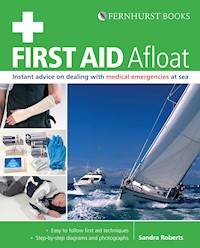
Aimed at the novice first-aider, this book is intended to be used at the time of the accident or illness. Each topic is designed to be read at a glance: the language kept short and simple and, where appropriate, photo sequences show exactly what to do. As long as you can read, you can help. Straightforward advice allows you to take control of the situation, stabalise the casualty and provide the appropriate treatment at sea. This is an essential guide for all who go afloat.
Das E-Book können Sie in Legimi-Apps oder einer beliebigen App lesen, die das folgende Format unterstützen:
Veröffentlichungsjahr: 2010
Ähnliche


















Copyright © 2017 Fernhurst Books Limited
62 Brandon Parade, Holly Walk, Leamington Spa, Warwickshire, CV32 4JE, UK
+44 (0) 1926 337488 | www.ferhurstbooks.com
The right of the author to be identified as the author of this work has been asserted in accordance with the Copyright, Designs and Patents Act 1988.
This edition first published in 2011 by John WIley & Sons Ltd
All rights reserved. No part of this publication may be reproduced, stored in a retrieval system or transmitted, in any form or by any means, electronic, mechanical, photocopying, recording, scanning or otherwise, except under the terms of the Copyright, Designs and Patents Act 1988 or under the terms of a license issued by The Copyright Licensing Agency Ltd, Saffron House, 6-10 Kirby Street, London EC1N 8TS, UK, without the permission in writing of the Publisher.
Designations used by companies to distinguish their products are often claimed as trademarks. All brand names and product names used in this book are trade names, service marks, trademarks or registered trademarks of their respective owners. The Publisher is not associated with any product or vendor mentioned in this book.
This publication is designed to provide accurate and authoritative information in regard to the subject matter covered. It is sold on the understanding that the Publisher is not engaged in rendering professional services. If professional advice or other expert assistance is required, the services of a competent professional should be sought. The Publisher accepts no responsibility for any errors or omissions, or for any accidents or mishaps which may arise from the use of this publication.
The first aid information provided herein is intended as general guidance only and is not a substitute for formal first aid training or for the medical advice of a doctor or any other health care professional. The publisher is not responsible or liable for any diagnosis made by a user based on the content of this book or for the outcome of any recommended treatment. If in any doubt and/or where injuries are clearly serious, casualties should be referred to a doctor or a hospital.
Thanks to Helly Hansen (www.hellyhansen.com) for supplying clothes for the photo shoot.
Design by Nigel Pell
British Library Cataloguing in Publication Data
A catalogue record for this book is available from the British Library
ISBN 978-0-470-68207-4 (paperback)
ISBN 978-1-912177-55-4 (eBook) ISBN 978-1-912177-56-1 (Mobi)
CONTENTS
Preface
CHAPTER 1 FIRST AID
First Aid
Anatomy and Physiology
Managing an Incident
General Casualty Assessment
CHAPTER 2 RESUSCITATION
Basic Life Support
Drowning
The Choking Casualty
The Unconscious Casualty
Shock
CHAPTER 3 WOUNDS
External Bleeding
Internal Bleeding
Nose Bleeds
Burns (Hot and Cold)
CHAPTER 4 INJURIES
Fractures
Dislocation
Sprains and Strains
Immobilisation
Eye Injury
Head Injury
Chest Injury
Abdominal Injury
Spinal Injury
CHAPTER 5 ENVIRONMENTAL INJURY
Seasickness
Heat Exhaustion
Heatstroke
Sunburn
Hypothermia
Frostbite
Immersion Foot
CHAPTER 6 ILLNESS AND MEDICAL EMERGENCIES
Chest Pain
Seizures
Diabetes
Asthma
Poisoning
Bites and Stings
CHAPTER 7 CHILDREN AND INFANTS
Resuscitation of Children and Infants
The Choking Child
CHAPTER 8 HELP
Moving a Casualty
Evacuation of a Casualty
Transfer to Rescue Vessel
Radio Medical Advice
First Aid Equipment
Medicines
Hygiene
Index
PREFACE
When out sailing, everyone expects to enjoy the trip without mishaps. Unfortunately, accidents and illness do happen and everyone setting foot on a yacht or small craft should know how to deal with them. Getting help for a casualty takes longer at sea than ashore.
This book presents the fundamental first aid that everyone setting sail should know. It should complement, and not replace, practical instruction. Along with survival, fire and radio training, completing a first aid course should be a part of every yachtsman’s basic preparation for sailing. All of these are readily available from a number of organisations.
Read this book and be familiar with its advice before you have to provide first aid to a casualty!
FIRST AID
This chapter introduces first aid, with an overview of how to manage an incident occurring at sea that results in injury or illness.
• First Aid
• Anatomy and Physiology
• Managing an Incident
• General Casualty Assessment
FIRST AID
DEFINITION
First aid is the initial assistance given to a person who has taken ill suddenly or has been injured in an accident.
AIMS AND OBJECTIVES
The aims and objectives of first aid may be summarised as preserving life, preventing further harm and promoting recovery.
PRIORITIES
In any first aid situation, the priority in terms of the casualty is always to ensure they have a clear airway and are able to breathe. However, the rescuer first needs to make sure the environment is safe.
ANATOMY AND PHYSIOLOGY
Having a basic understanding of how the body works will enable the first aider to understand what is happening to the casualty and why the actions they take actually assist the casualty.
Oxygen is required by all the cells in the body. Without it, we die. In first aid, efforts are made to ensure oxygen continues to reach vital organs.
Oxygen is breathed in, and is then circulated around the body in the blood by the pumping action of the heart. If breathing or circulation is affected by illness or injury, this will result in body tissue being deprived of oxygen and it will be permanently damaged or even die. Brain cells start to die off after a few minutes. Without oxygen, the heart stops working.
Blood vessels that carry the oxygenated blood to the tissues are called arteries. When an artery is cut the blood spurts out with each heartbeat and, because it contains oxygen, it is bright red. Blood vessels that take blood back to the heart are called veins. When these are cut the blood is not under such great pressure and does not contain oxygen, so it is a darker red and does not spurt, but flows or gushes out. Capillaries are the smallest blood vessels and when they are damaged they ooze blood.
When a casualty is bleeding it is important to recognise which type of bleeding is happening, as this will dictate the speed of action taken.
The musculoskeletal system is made up of bones, muscles, tendons and ligaments. The skeleton provides a framework to support and move the body and also gives some protection to internal structures. Muscles move the skeleton and are attached to bones by tendons. Ligaments bind bone ends together in joints and also support internal organs.
A first aider does not need to know the individual names of these different structures. When describing an injury it is best to use simple terminology such as “thigh” or “upper arm”.
MANAGING AN INCIDENT
At any first aid incident, the rescuer will follow a plan of action. This will take place in any setting, either afloat or ashore. The situation and casualty will be assessed, help sought, the casualty treated and any aftermath dealt with. The time it takes, and the methods used, may change according to the circumstances and the severity of the situation, but this process will always be carried out.
Assessing the situation
Check that there is no danger to self or the casualty, and if there is, make it safe. Remember that the danger may not be obvious. Think hygiene and personal safety.
Think about the immediate space around your casualty (e.g. spillages on deck, trip hazards, broken glass, wood splinters). Think about the dangers peculiar to your own environment (e.g. swinging boom, open hatches, loose ropes, rough seas).
Look for clues to work out what has happened.
Assessing the casualty
The initial assessment of your casualty is called the primary survey. This is the priority in any first aid situation.
Does the casualty have an airway? Is the casualty breathing? Remember that if the casualty is able to speak or make sounds, they are breathing.
What injuries are there? Can you see any obvious bleeding or broken bones? What can the casualty tell you?
Getting help
Shout for help so others on board are alerted.
Ensure everyone on board knows how to summon help on the radio in an emergency.
When calling for help, the information required will be the identity of the yacht and your location, what has happened and what help is required, how many casualties there may be and what their injuries are.
Treating the casualty
Constantly be aware of any danger to you and your casualty while treating them.
Remember: the priorities of first aid are AIRWAY and BREATHING.
This book shows how to recognise and carry out basic treatments for a number of injuries and illnesses.
Dealing with the aftermath
This includes the completion of reports in log books, restocking first aid kits, and cleaning up body fluid spillages in a safe manner.
As well as dealing with practical issues, consideration needs to be given to emotional needs. If a major incident has been dealt with, this can be very traumatic for all involved. Though you may react well and deal with the situation at the time, afterwards it is important not to be afraid to talk about how you feel.
GENERAL CASUALTY ASSESSMENT
After assessing and treating any obvious injuries a casualty may have, it is important to check them over physically in case they have sustained other injuries.
THE SECONDARY SURVEY
The secondary survey establishes what other injuries the casualty may have that were not identified initially. The casualty may be able to tell you but you may have to search for them. The secondary survey is also called the “top to toe” or “head to toe” survey because it describes what the first aider does.
The first aider should work down the body from the head, feeling for lumps and bumps and looking for wounds. Note if it is tender to touch anywhere. Ideally, this should be done wearing gloves to protect the rescuer from contact with blood or other body fluids.
As well as looking for other injuries, the survey may help to establish the reason why someone has become ill or is unconscious. The first aider becomes a detective. Items found in the casualty’s pockets or smells on the casualty’s breath may help identify the problem.
If a casualty is unconscious they should be placed in the recovery position before the secondary survey is carried out.
OBSERVATIONS
While waiting for help to arrive, you will need to monitor the condition of the casualty. You may need to write down what you find, or get someone else to do it for you. The frequency will depend on the condition of the casualty but usually most observations will be done every ten minutes. Breathing checks will be more frequent than this. Your checks will include the following.
Breathing
Is the casualty actually breathing? Check this every one to two minutes in a casualty who is unconscious.
How fast is the breathing? Count the breaths per minute. Is it deep or shallow breathing?
Is the breathing noisy? Is the casualty coughing?
Is the chest moving evenly? Is the casualty distressed when breathing?
Level of consciousness
Use the letters AVPU to remember what needs to be done.
A – is the casualty alert? Can they tell you their name and where they are?
V – does the casualty respond to your voice when you ask them to do something? How well do they respond?
P – does the casualty respond to simple physical stimulation like shoulder shaking? If not, do they respond to pain?
U – is the casualty unresponsive?
Pupils
In the eyes, are the casualty’s pupils the same size and shape?
Do the pupils react by constricting quickly when a light is shone into them? Is the reaction the same in both eyes?
Pulse
The pulse may be felt at the side of the wrist near the base of the thumb. In a seriously ill, very cold or injured casualty, feel at the neck at the side of the voice box.
What is the pulse count per minute? Is it regular? Is it strong or weak?
Skin
What colour is the casualty’s skin? Is it pale and ashen, or red and flushed? Is there any blueness around the mouth and face?
Is the skin hot or cold to touch? Dry or wet?
Are any marks visible?
Wounds and fractures
Is the wound still bleeding?
Check the circulation below the dressing or fracture. If the skin is pressed, does it go white then come back to pink quickly on release of pressure? Does the limb feel cold to touch? Is the casualty complaining of pins and needles?
This is all important information about the casualty that you will need to pass on when medical help is sought. This is in addition to all the other information you will be required to give regarding the casualty’s injuries and the first aid that has been carried out already.
RESUSCITATION
This chapter details how to manage life threatening situations, some of which may require resuscitation.
• Basic Life Support
• Drowning
• The Choking Casualty
• The Unconscious Casualty
• Shock
BASIC LIFE SUPPORT
Heart disease is the main cause of death in the United Kingdom. It may be slow and progressive, often with no external signs or symptoms until illness suddenly presents.




