


Erhalten Sie Zugang zu diesem und mehr als 300000 Büchern ab EUR 5,99 monatlich.
- Herausgeber: Dog Horn Publishing
- Kategorie: Gesellschafts- und Liebesromane
- Sprache: Englisch
'This story makes the dangerous crossing from symbols of ink to the reader's heart in a way indicative of a classic. Unlike so many English fantasies, it is not ashamed to be funny and wild and rumbustious and devilish and romantic…It has a simple grandeur, a complexity which is scarce aware of itself, a ripeness… It grapples with Milton and turns him upside-down, but doesn't steal anything that falls out of his pockets. The difference between this and so many other modern fantasies which imitate and feed off each other is the difference between imagining a man kissing a woman and kissing her yourself…This book, I predict, is destined to become a modern cosmic comedy fantasy classic.' Rhys Hughes, author of Mister Gum
Sie lesen das E-Book in den Legimi-Apps auf:
Seitenzahl: 476
Veröffentlichungsjahr: 2015
Das E-Book (TTS) können Sie hören im Abo „Legimi Premium” in Legimi-Apps auf:
Ähnliche



















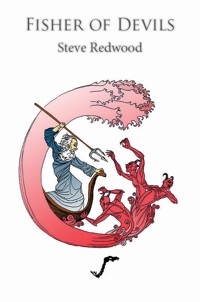
THE FISHER OF DEVILS
(A LOVE STORY)
BYSTEVE REDWOOD
The Fisher of Devils
Published by Dog Horn Publishing at Smashwords
Copyright 2011 Steve Redwood
TABLE OF CONTENTS
PART ONE
THE TREATY OF EDEN
1. Eve (and Adam)
2. The Devil Drops In
3. Death of a Sardine
4. The Devil Meets His Match
5. God Has a Rather Good Idea
6. The Archangel’s Arent Happy
7. Surrender!
8. The Treaty of Eden
9. An Apple is Eaten
10. God Plays Dirty
PART TWO
A VISIT TO HELL
11. Journey to a Very Warm Place
12. The Kings of Hell
13. First Encounter
14. Belail is Suspicious
15. A Stroll Through Hell
16. The Immaculate Infant
17. Bugrot
18. Fisher of Devils
19. Belial isn’t Fooled
20. Mephistopheles
PART THREE
BLOOD OVER HEAVEN
21. Atrocity in Limbo
22. An Old Acquaintance
23. The Message of the Serpents
24. The Devil Hears Confession
25. Blood Over Heaven
26. Judgment
27. Beginnings
PART ONE
THE TREATY OF EDEN
Chapter One
EVE (AND ADAM)
Finally, the Lord God formed man of the Clay of Zindor, and breathed into his nostrils the breath of life: and man became a living soul. And he planted a garden eastward in Eden; and he took the man, and put him into the Garden of Eden to dress it and to keep it.
And regretted it almost at once.
For this man proved to be a troublesome creature, always moaning: the flowers were too fragrant, the honey too sweet, the air too balmy, God too bright...
And what on earth, he demanded the first evening, was he supposed to do with that thing dangling between his legs?
“It’s for you to play with,” said God, a little crossly.
“To play with?”
“Yes, it’s quite easy: you just grab it with your hand, like this, and...”
“But that’s ridiculous,” said Adam – for that was the name of the man – as God, in human form, of course, demonstrated how to activate the toy. “You look so silly! If that’s all you’ve given me to play with, then, quite frankly, I don’t think much of it.”
God stopped, hurt. “It’s an organ of exquisite pleasure, it’s...”
“What’s the thing called, anyway?”
“It’s a dangly.”
“And these?”
“Wobblies.”
“Hmm, pretty useless things, if you ask me! Dropping off, were you, when you made them, having a doze?”
And to God’s amazement, he marched off, muttering something about gross ineptitude, and tripping on a serpent lying on the ground meditating. He prodded it angrily to one side.
“Hey, God!” shouted the serpent indignantly, “did you see that?”
“Oh, shut up, you elongated maggot!” snorted Adam, and plodded on.
“Oh dear,” said God, “what have I done?”
**********
On the second day, however, the man busied himself with his gardening, and made no more allusions to his dangly. Indeed, he would frequently disappear behind a bush, to emerge slightly out of breath and with a satisfied smile on his face.
But another problem immediately arose. God had asked the Archangel Gabriel to organise a small band of angels to keep a protective eye on the Garden, and late in the afternoon Adam met him. After less than five minutes’ conversation with the Archangel, he came storming up to God, who was having a quiet chat with the trilobite, and demanded brusquely:
“Is it true you made Gabriel?”
“Why, yes.”
“Just like you made me?”
“Well, yes.” No need to mention that man had been an afterthought.
“Then why,” said Adam, in an ominous tone, “is Gabriel bigger and brighter than me?”
A small silence. God licked his lips. “Well, he’s an angel, and you’re a man...”
Another silence thinly coated with the grinding of Adam’s teeth.
“And angels are, I mean, they happen to be...er...well, bigger and brighter than a man.”
“And just why do angels happen to be bigger and brighter?”
God pondered this while Adam’s teeth continued to engage in civil war. He was, being a god, rapidly able to establish a powerful synthesis of the latest findings of anthropology and angelology, to subject this to rigorous teleological and cosmogonical principles, and to arrive at the following irrefutable conclusion:
“That’s the way it is.”
“That,” stated Adam severely, “won’t do. There are too many things that just happen to be the way they are. That awful serpent, for instance, insolent worm! Whatever possessed you to make such an execrable excrescence?”
“The serpent is a fine philosopher, an excellent...”
“Jumped-up spaghetti, that’s all he is! And all those other ridiculous creatures I have to put up with here! The frog, the ostrich, the poodle – and that silly sea urchin and hedgehog you’re so fond of!”
“And just what,” inquired God in a dangerously quiet tone, “do you consider silly about the sea urchin and the hedgehog?”
“Just look at them! A bunch of spines, that’s all. What earthly good are they?”
“Could you,” retorted God, stung, “ever have conceived of making living creatures from spines?”
“Certainly not, that’s just my point! The whole Garden is a biological shambles, and I’m expected to look after it. And on top of it all, you go and make the angels bigger than me.”
“And brighter!” chortled a voice from the undergrowth.
“It’s that dressed-up worm again!” shouted Adam furiously. “Creeping and sneaking around all the time...”
“I wasn’t creeping or sneaking: I just happen to locomote this way. You might try doing the same, so we wouldn’t have to put up with the sight of you all the time. This place was a paradise until you came.”
“You hear that? Not a leg to stand on, and this overgrown slug dares to argue with me! And it’s high time you did something about all those other animals wandering around here. This morning I found a giant – a giant – elephant dropping right next to my bower! Have you ever tried picking up a giant elephant dropping?”
“Gods,” replied God with dignity, “do not go around picking up elephant droppings, giant or otherwise.”
“Exactly! Yet you expect me to! There’s going to have to be some changes around here, let me tell you! And soon, too!”
And again he stormed off, nearly slipping on a fallen apple as he did so.
“And that’s another thing,” he yelled, “when are we going to get some decent food? Fruit, fruit, fruit, and nothing but fruit! I’m sick of it!” His voice trailed off as he receded into the distance. Then, “I wonder what serpent tandoori would taste like!”
God stroked the trembling serpent. “Oh dear,” he said again, “what have I done?”
**********
On the third day, God was tempted to forego his evening stroll round the Garden, but decided this would be akin to cowardice. Sure enough, though, no sooner had he Manifested himself than he heard the clomp of very determined feet, and a voice announced without any preamble:
“I want a new dangly.”
God decided to count to ten, but before he reached three, Adam continued:
“How many angels did you say you’d made?”
“A hundred thousand.”
“And they all have danglies?”
“Certainly.”
“So it’s fair to say you’ve had some experience in making danglies?”
“I”, said God proudly, “am the greatest dangly-maker in the universe.” Perhaps not completely accurate, but Adam wasn’t to know about the Saragashim in Hell.
“So how come mine’s breaking down already?”
“Breaking down!”
“Yes, breaking down, broken down, kaput, dead! Most of yesterday it was OK. But last night it just didn’t feel the same, the third time it took ages, the next time it actually hurt, before breakfast this morning it was hardly a trickle, and after breakfast,” Adam’s voice rose, “not so much as a shudder!”
“Oh well, of course, in that case,” God felt immensely relieved, “what can you expect? You’re not supposed to activate it that often.”
“Is that so? And just how long am I supposed to wait before I can activate it again?”
“It should be fine by tomorrow morning,” God assured him.
“Tomorrow morning! And what about tonight?”
“I’m afraid you’ll have to wait.”
“So what you’re saying is, you’ve fobbed me off with a dangly that won’t work more than three times a day! Can’t you do anything right?”
And yet again he stomped off, stepping on the serpent who had come to enjoy the altercation.
“Hey, God, did you see that?”
When God didn’t answer, the serpent looked at him closely. To the serpent, of course, he appeared to be a serpent.
“Why, God, what’s the matter?”
**********
Back, back in a time before time, he has almost finished making his first angel, a magnificent combination of head, torso, and limbs, and nothing else. Realising that getting rid of waste matter through the mouth might well affect the sweetness of the angel’s breath, he makes a hole between the legs, and slaps on a bit of Zindor Clay to cover it, a kind of small hemisphere with a valve that can be moved aside when necessary.
His Clay is still a bit too wet. His neat hemisphere loses its shape and drips downwards into three unequal blobs. He mutters a Nebulan imprecation, and is about to tear them off and start again, when he stops, stands back, and begins to smile. He can’t help it: the blobs are so odd, so incongruous. Almost a pity to remove them, but of course he can’t expect anyone to walk around with such quaint appendages as these...
Or can he?
The universe is a violent, wild, ultimately deadly place. Novas, supernovas, exploding galaxies – why must everything be conflagration, cataclysm, and catastrophe? Destruction, doom, and disaster? Why is there no humour in it? Nothing to smile at?
He gazes at his angel: by the Cosmic Crab, he’ll do it! Other gods will wander past, and see one of these angels, and chuckle, and go and tell others, and they too will come to look and chuckle, and the universe will be altogether a chucklier place.. He can just imagine his old friend Xonophix hearing about it...
What to call them? Well, the longer bit in the middle dangles, so let it be a dangly; and those kiwi-shaped blobs, they wobble, so let them be wobblies.
But at this point he quails before his own audacity. Whatever will these new creatures think if they find themselves saddled with these odd lumps? Compassion floods him, and he again stretches out his hand to remove them, but then the answer comes to him!
Build in a pleasure principle! If these angels could derive pleasure from their blobs, surely they would soon get over their whimsical appearance. If intense pleasure were within reach at all times...
He teaches himself the rudiments of hydraulics, applies these principles in his own idiosyncratic fashion, and within a few hours has produced the first working prototype.
“God,” he says to himself, as he shapes a dainty waterproof cap for the dangly, “though I say it myself, there’s a touch of genius in you.”
Well, there’s thefirst angel completed, and very nice it is, too. Raphael. God gives the heart an almighty thump to get it going – his methods aren’t too refined as yet – and steps back, feeling not a little nervous. This, after all, is his first independent act of Shaping. Raphael blinks, says hello in a friendly yet respectful manner, flexes a couple of muscles, and nods approvingly at God, who smiles shyly and feels it’s all been worth it. But then he notices his appendages, frowns, mutters “What’s this?”, and tries to pull them off.
“Wait,” says God, “you mustn’t do that! Just hold the thing in the middle, and you should get a feeling of intense pleasure.”
The angel looks a bit dubious, but dutifully does as God suggests. A minute passes, nothing happens, and he looks even more dubious.
“That’s odd,” says God, “I don’t underst... ah, maybe it needs winding up. Try rubbing it a bit to get the blood flowing. Here, let me help you. There, you see! Now you do it yourself.”
And he watches proudly as his angel expresses his satisfaction.
“Hey, that was great!” exclaims Raphael when he gets his breath back. “Allow me to say I’m more than pleased to have had you as my creator.”
It is moments like these that make it worthwhile being a god.
So he goes ahead and incorporates danglies into all the other angels. And then what joy it is to witness them gratefully and vigorously disporting themselves, panting loud hosannas in his praise. Of course, the Saragashim Affair in Hell will later be a great shock, but for the moment God feels serenely proud.
*********
On the fourth day, God did some yoga relaxation exercises, calming his mind for the inevitable evening encounter. And sure enough, he had been in the Garden for only a few minutes, chatting with the duck-billed platypus, when his Mistake approached.
“Ah, Adam, perhaps you could help me. My friend here isn’t sure which species he belongs to. If you could...”
“No, I couldn’t! I’ve got all my time cut out doing the gardening, let alone bother with all this naming of the species.”
“Yes, yes, but if you could just tell him which...”
“How should I know? Looks like a bungled attempt at a duck to me, but I won’t know until I can examine him properly, and I can’t do that until I’ve finished with the insects.”
“What, you haven’t finished them yet?”
“No, I have not! Do you realise how many you made?”
“Maybe a million.” Pause. “Or two,” he added.
“Or three! Perhaps if you’d spent more time on my dangly instead of piddling around with all those bugs...anyway, since you’ve brought the subject up, I need help.”
“I’ll ask Gabriel to...”
“Bugger Gabriel! Ruins my eyes just looking at him! No, I want you to make another man.”
“Another man!”
“Yes. To help me get through all this work.”
“I’m sorry, but I used up my last bit of Clay making the anteater.”
“The anteater?”
“The anteater.”
“Is it supposed by any chance to eat ants?”
“It may be,” snapped God, “that sometimes in a mysterious way I move my wonders to perform, but in this case, yes, I made an anteater to eat ants.”
“Better make some ants then, hadn’t you?”
“I made some, you bad-mannered biped!” So much for yoga!
Adam glared at him. “Well, I haven’t seen any.”
“What do you think those are? Those, near that stone over there.”
“Those scarab beetles?”
“Scarab beetles? They’re ants!”
“Excuse me, I should know! I named them. They’re scarab beetles: order Coleoptera, genus Geptrupes Typhoeus.”
“Excuse ME, I should know! I MADE them! They’re ants.”
“You mean order hymenoptera?”
“Er, well, erm...”
“There, you see, you’ve no idea! You may have made some creatures – right little horrors they are, too! – that you thought were ants, but since you gave me the job of naming everything here, and since I named those things scarab beetles, then scarab beetles they are. I don’t take it on myself to go around making things, which is your job, and I’d thank you not to go around naming things I’ve already named, which happens to be my job. I certainly hope this kind of thing won’t happen again.”
For a weak moment, God imagined an Adam-eater. His mouth watered.
“However,” his Mistake went on, “I’m a reasonable man. You say you’ve made an anteater, and so I suppose you’ve designed it – though one can never be sure with you – to eat those beetles over there, so, just this once, I’ll rename them ants. And don’t you look at me like that,” he added to the platypus, who had been listening to all this with open-billed indignation, “or I’ll rename the lion a platypus-eater! And the next unnamed insect I see I’ll call a scarab beetle. Can’t be fairer than that. However,” and he gave God a no-nonsense look, “there is a quid pro quo.”
“Which is...?”
“Another man to help me here. An odd job man.”
“I’ve already told you, I...”
“...used up all the Clay! Bit careless, wasn’t it? Rather cocksure? Well, you’ll just have to undo something. You could start with the serpent. Or the elephant, who, when he isn’t leaving giant droppings everywhere, is always playing with that utterly silly sardine, when he could be helping me shift logs. Make him smaller. Or send away for more Clay. Do something! You’re the god, not me. But just don’t take too long about it.”
Yet again Adam marched off, not stepping on the serpent this time only because the latter had taken the precaution of hanging from a tree.
Undo something! The words rolled round God’s mind like a particularly delicious peach. He knew temptation.
The platypus said quietly: “The whole Garden would understand. Adam is not good for the Garden. He will destroy it one day. He does not love the Garden.”
God nodded slowly. Yet he had made Adam what he was. Did not the fault lie rather with the creator than the created? And could he destroy what he himself had created, destroy therefore a part of himself, and remain a god? Why, after all, had he not destroyed Lucifer?
“No,” he said, “Adam has committed no crime. I’ll get Gabriel to ask the other animals if they would be willing to give up some of their flesh. But”, he added lightly, “that’s a job for tomorrow. The hedgehog has, I believe, prepared a surprise supper for me, so I must get ready to be surprised.”
**********
The fifth day God arrived early to confer with Gabriel, but the news was bad. Nobody wanted another man, so nobody would give up any flesh. God took a deep breath, and went to find Adam.
“Right, that settles it!” shouted that personage. “I’ve already put up with too much, from now on I’m working to rule – if I work at all!”
And, furious, he slung his shovel away. By chance it landed right on the serpent’s forehead, scoring a nasty V-shaped scar.
“Hey God!” spluttered the serpent, “did you see that? I’m telling you, I’ll swing for him one day, so help me, I’ll swing for him!”
“Oh shut up, you herpetological horror!”
“Adam,” God reprimanded severely, “you ought to show more goodwill and care towards the other creatures here. They have rights too, you know.”
“Acting as if I meant to drop the shovel on his silly head! ‘God, oh look, Adam’s done this, God, oh look, Adam’s done that!’ all the time! If he did a bit of work instead of always getting under my feet, it wouldn’t happen. I’m the one who does all the work. Look at my hands! Bet you don’t have calluses like that! Come on, feel them! Feel them!”
“Gods,” replied God with dignity (and just a twinge of guilt?) “do not go around feeling calluses!”
“...any more than they go around picking up elephant droppings, of course! ‘Adam, do this, Adam, do that’! Well, that’s it, until I get an assistant, I’m going on strike.”
And go on strike he did. For seven days he just reclined in his bower and, like Achilles in his tent, disdained to venture forth when God paid his daily visits. The Garden itself profited from this inaction, the vegetation and foliage swiftly recovering from the scars inflicted by the man in his attempts to impose an alien geometric order upon it. Once again, impossible colours gambolled through the bushes, skitted over the ponds and rivers, leapt recklessly from tree to tree, while a myriad fragrances intertwined in dizzying airborne dances, gyrating to the sensuous pulse of bud and blossom. True it was that the as yet unnamed creatures queued up glumly day after day, clutching their blank name tags, but the other denizens walked with a lighter step, freed from the disturbing presence of man.
God, however, was troubled. For now he knew the answer to the riddle of Adam’s behaviour. Before Adam, every animal, every bird, every fish, every insect, had burned pure and fresh from his mind into the glowing Clay of Zindor. Tremendous forces had fused and exploded, and something of that power, of that sheer exhilaration of Shaping, had entered every creature.
But Adam hadn’t been a new MindShape, merely a reduced copy of the angels who had gone before him. Why am I not as big and bright as the angels? Because he’d been created with practised, effortless ease, almost as an afterthought: it had seemed natural to create an angeliform animal to be titular head of the Garden.
Adam had, God realised sadly, been born without love and wonder.
So he resolved that he would, after all – somehow – make a helpmeet for Adam, a man to share his work and, more important, give him companionship and understanding. On the evening of the seventh day of Adam’s protest, therefore, he glided towards his bower. His thoughts on the task ahead, he stumbled over the serpent who was as usual stretched out in meditation – this time upon a thesis he planned to write proving beyond all reasonable - and unreasonable – doubt that horizontal forms of life were innately superior to vertical ones.
“Hey, God, did you see that?” shouted the serpent before he realised who it was.
Adam was prodding his dangly tentatively, as if wondering whether it was ready for another outing, when the Lord God caused a deep sleep to fall upon him.
Then he eviscerated him.
“Oh lovely, lovely, lovely!” chanted the serpent, before God’s frown silenced him.
God removed most of the three-foot-long appendix, four of the six kidneys, and half a dozen ribs, sure that Adam would have been unaware of the existence of the kidneys, or the appendix – he couldn’t even remember himself what it had been for – and hoping that he hadn’t got round to counting his ribs. Nowhere near enough. Better have half the liver, too: what remained should just about be enough, if treated with care.
He contemplated the Clay thus released, while the serpent drooled in ecstasy. Still not enough. He’d have to make Adam – and the new man – smaller than before. And that would mean trouble!
The rest of Adam snored blissfully as God surveyed his innards.
Just then the dog came by and urinated. The puddle was quite large. Not for the first time, God found himself wondering whether his system of ingestion, digestion, and elimination was not perhaps unnecessarily complicated. But there was something so satisfying and almost mathematical about the various circulatory and lubricating systems. About a quarter of the body weight of his mammals, for instance, consisted of water.
Water! Of course!
One quarter. Two quarters. Three quarters. Did it matter?
All he had to do was top Adam up with water to replace the purloined innards, and then do the same after forming the second man!
Whistling an ancient Nebulan starsong, he rearranged the depleted contents of Adam’s body, added water, and then, to the serpent’s great disappointment, carefully replaced the skin so that, externally, Adam was exactly the same as before.
“He’ll sleep now for a few hours,” he told the serpent, “and when he wakes up, you’re to say nothing about all this. You understand? Nothing.”
“Does he have to wake up so soon? Oh well. But won’t he guess what you’ve done? He knows you had no more...what do you call that stuff?”
“Zindor Clay? You’re going to tell him I found some, after all.”
“I’m going to tell him?”
“Yes.”
“And why not you?”
“Gods,” said God with dignity, “do not go around telling lies.”
“Oh, of course. Silly me!”
God carried the purloined innards to the spot where the Cloud of Unknowing narrowed down into four dimensions: he might need to draw on some of that power. There, he first cast a rough mould of the new man, watched by the serpent, who looked a bit unhappy, but said nothing. Remembering Adam’s complaints, he wondered whether he should perhaps dispense with the dangly and wobblies. But in that case the new man would be without a pleasure principle...
And then he remembered the Saragashim.
**********
After the creation of the angels, a few centuries years passed before some early explorers, led by the Archangel Michael, returned from an expedition with halo-raising stories of a hideous cauldron of a planet called Sheol, and of a savage cannibalistic race, the Saragashim, who peopled the smouldering shores of a huge brimstone lake.
Some of the Saragashim had danglies!
Not exactly the same as the angels’, it is true: there were three wobblies instead of two, and the dangly itself, which was apparently used in combat as a last resort, had a sharp serrated edge on the underside; but danglies and wobblies they undoubtedly were.
God felt quite miffed by the discovery. Surely only he was capable of MindShaping a system at once so intricate and idiosyncratic. Unless...could it possibly have been Xonophix? His old Nebulan classmate rarely billowed outside his own galaxy, but who else could it be? The similarity of their artistic temperament had frequently been noted. Well, that question would soon be settled at the next Godmeet, scheduled only a few aeons hence.
But just as remarkable as the existence of another dangly was the simultaneous discovery of what could only be termed an anti-dangly. Where the dangly came out, the anti-dangly went in. As simple as that. A blank. An emptiness. The natives had even given it a name: snuggery.
And what really shocked the explorers was that the danglied natives, instead of derivingpleasure in the proper angelic manner, enthusiastically directed their danglies into any available snuggeries, and then wriggled and squiggled in a most unbecoming and undignified way which made a mockery of the whole noble concept of the dangly. Worse, the snuggery owners seemed to take a perverse delight in contributing to this abomination, wriggling and squiggling, and even giggling, in their turn, before finally ejecting the dangly-owners yards into the air to the accompaniment of wild abandoned screams. This heinous desecration of the dangly, moreover, was performed half a score or more times a day.
The reaction of the angels to this barbaric ritual was extremely restrained. They said “Yuk!”, and vomited all over the participants, a fact the latter didn’t notice until they had finished their frenzied grappling.
A day later, an even blacker abomination came to light.
Once again, the whole expedition yukked uncontrollably, clutching their stomachs or writhing on the ground in sheer horror. The Saragashim gathered round in some consternation, seeking to help the stricken angels to their feet. But they were pushed away with loathing and disgust, the angels preferring to bury their heads in their own steaming yukhills rather than have to look at the baffl ed natives. When they recovered, they determined to return to Heaven, and seek permission from God to come back and exterminate these creatures.
It had at least been possible to understand, if not condone, the insertion of danglies into snuggeries for purposes of pleasure, utterly perverted though that pleasure might be. The dangly had been designed as an instrument of joy, and what was at fault here was not the end in itself, but the means chosen to achieve that end: for a quiet, personal, contemplative rapture, the Saragashim had substituted a noisy, violent, wanton public demonstration; still, the principle of recreation remained.
Recreation. Notprocreation.
For the second mass yuk had been brought on by the horrendous discovery that these Sheolites had the effrontery to reproduce themselves, committing this ultimate sacrilege through the selfsame abuse of the dangly! There existed, therefore, sentient monstrosities WHO HAD NOT BEEN CREATED BY A GOD!
Anathema! Uncreated beings, begotten of savages, twice-removed from the Wellheads of Zindor! UnShaped, unBlessed by the hand of any god!
The Archangel Michael trembled as he reported these depravities to God, half expecting to be incinerated in a flash of almighty wrath.
“Fascinating,” said God – was there a touch of envy in his voice? – “really most remarkable. Now calm down, and tell me again...”
A hundred thousand angels. It had been gruelling work. By the time he’d finished, he’d been on the point of collapse. A hundred thousand angels – when he could have made a couple of hundred, and left them to reproduce themselves!
If only he’d thought of it!
*********
He had not, of course, allowed the destruction of the Saragashim, but neither had he allowed any more angels to visit their planet; the trauma would clearly be too great for them. And it became doubly off bounds when Lucifer and his followers happened to fall to the same place, which they renamed Hell, to reflect their opinion of its less desirable properties. As time passed, God gradually forgot the whole Saragashim affair, and the unique symbiosis of dangly and snuggery. When he came to make Adam, he simply made him, on a smaller scale, the same way he had made the angels.
But now, about to create his second man, he remembered the Saragashim. And he realised he might be able to solve the problem of man.
He had brought into being an extremely flawed creature, and since the fault lay with himself, not with Adam, uncreation was not a solution to be seriously considered, even if occasionally drooled over. Was the purity of the Garden, therefore, to be forever vitiated by the presence of this imperfect man? Must he face the mute reproach of the sea urchin and hedgehog day after day?
But if he could adopt the Saragash system, and if Adam and the new man could together reproduce a third, maybe that third man would have only half of Adam’s faults; and if that third man also reproduced, might not the fourth have even fewer?
“Quick,” he shouted, “bring me some peas!”
Why he chose peas will never be known, but he planted them in a patch of earth touched by the Cloud of Unknowing, and with the aid of that power, grew and crossbred them, and worked out the Mendelian laws of inheritance, all within half an hour.
It worked! By number twenty, man could become very different from the first man. And, with twenty men to help him, even Adam would have little cause for complaint.
Almost trembling with excitement, God rapidly gauged out an anti-dangly in his new man, made a few internal alterations to produce a reproductive system, and stepped back to observe the effect. Yes, it was OK. Slap hair on all over the place, breathe life into him, and the job would be done.
Before he could finish, the serpent spoke.
“Now don’t misunderstand me, God, as usual you’ve done a fine job, an excellent job, but...isn’t he just a little bit too much like Adam?”
“Well, of course,” answered God, surprised. “I’m making another man, so what do you expect?”
“Well,” said the serpent, with some degree of embarrassment, “this may appear presumptuous, but...well, does this man have to look exactly the same as the first one? I mean, he’s already a dangly short. Does he need to have hair all over him, for example? I think I may say in all modesty that my own person shows how attractive a smooth skin can be. And perhaps if you altered the face – just a little – so he wouldn’t remind everyone so much of Adam...”
“Serpent,” exclaimed God, ripping off the beard he’d just stuck on his new man, “you’re absolutely right! Sometimes I overlook the most elementary things, I don’t know why. By the Great Crab, I’ll show you whether I can make a worthwhile man or not!”
Later, much later, when he stood shyly in the Amphitheatre of the Universe to receive the Grand Prix for Creation, the greatest moment came, not with the presentation of a beautiful gift-wrapped galaxy for his own personal use, but when Xonophix (who had indeed been responsible for the creation of the Saragashim) approached and bowed smiling before him, saying simply, “’Il miglior fabbro’”. And this despite the fact that the two main innovations, the antidangly and the breasts – a portmanteau combination of ‘brace of chests’ – had both been based on the Saragash prototype.
He worked with Cloudlight throughout the whole night, softening, curving, rounding, refining. The breasts he reShaped a thousand times until they seemed less like additions to the basic Adam-body than the very essence of the new being. They swelled in a warm-cool pledge of joy and peace and excitement all at once; offering so much, the unknown with the known, assured yet strangely vulnerable, the mischievous triumphant thrust of the nipple suggesting, too, the hesitant bud of the unborn flower. They promised a world of dreams while pleading to be clasped lest they fade into dreams themselves. They swept forward with sensual defiance, yet swayed to the gentlest touch like unopened Andromedan wraith-bells bobbing in their silver pools.
The snuggery, too, became so much more than the mere absence of a dangly. God MindShaped the Clay with such intensity that the flesh itself became subtly different, moist and resilient, strange potencies wound within, deceptively cloaked with delicate folds of skin that beckoned and siren-smiled, and urgently whispered of fire and sanctuary, puissance and surrender. If the dangly lay poised to flare in a quick, impetuous conflagration, this new wonder simmered and smouldered and hinted at a peace that passeth all understanding.
But these were just the more superficial differences. There were a myriad other minute changes, a perceptible softening of the whole body – softening, not weakening, for the brash physical strength of Adam’s muscles had been squeezed out and distilled into the poignant power of beauty: the slope of the neck; slender arms with just a trace of fine down and an undercurrent of timid veins; the sweeping andante of waist and hips, curling arpeggios of hair stroking the belly, cool languid cadences of thigh and calf. A new kind of beauty. A new kind of harmony. A new kind of power.
Power. For as dawn broke, other animals came to join the serpent, who had curled himself round a branch overhanging the crucible of creation and gazed, transfixed by the great thaumaturge, throughout the hours of darkness. Even though they could not yet see the face, hidden by a gleaming mass of dark hair, they already felt the power, and croaked and quacked, squeaked and clucked, and barked and bleated, bayed, brayed, and buzzed, their awed delight.
And finally God looked up, seeming to shimmer and waver before them, for the effort had drained him, and only with diffi culty could he retain the thousands of shapes whereby he appeared to each in his own image.
“Behold,” he said, “Woman!”
And he breathed gently into the mouth, and for a second an eerie blue glow hung over the body – was the Zindor Clay itself paying final homage to him? – and then the breasts rose in the first breath of life.
“’Wo’”, remarked the hedgehog, whose eyesight was rather poor, and who was therefore less spellbound than the others, “is an ancient Nebulan word meaning ‘that which goes beyond’ or, more precisely, ‘that which contains within itself the potential to go beyond’, and is often, as in this case, used to denote a new development, generally of a self-sustaining nature, from which further, but not entirely predictable, developments might be expected to arise, provided that the original development does not retrogress into what might be called the larval stage which preceded the application of the ‘Wo’ principle.”
God had lent him a small booklet containing the basic billion trillion words necessary to accomplish phatic communion within the Nebula Cluster, and he was delighted to be able to display his knowledge so soon, even though he felt his definition was a bit rough and ready.
But no one was listening to him.
For when the Woman sat up and swept back her hair from her face, all the animals fell quiet; and the breeze, though the tree-tops still swayed and the leaves still fluttered, seemed to hover in silence; and the serpent’s eyes glazed over and, murmuring “My Queen!”, he slipped from his bough and thudded to the ground.
And even God gazed at her wonderingly, before he said, “At last.”
It was not just the beauty of the Woman that brought this sudden hush over Eden. There was something else...
**********
A long, long time later, as Eve sat by her pool in Heaven, staring unmoving into the depths, Raphael murmured to St. Peter, who was gazing at her, troubled and fascinated:
“Yes, Peter, it’s as if God trapped himself, a part of himself, in his creation, and it is weeping to escape.”
And St. Paul once called her, enigmatically, ‘the unfinished one’, and it wasn’t until much, much later, as she leaned sobbing over a broken Archangel, that Peter realised he meant she was greater than them, not lesser.
**********
No such thoughts as these occurred to the animals as they clustered round the new creation. They were conscious only of the beauty, and did not ask themselves why, or how, the Woman could appear so beautiful, when each had such differing conceptions of what beauty was. Yes, her hair was rich and midnight-gleaming and rainbowed out slivers of light and sparkled and crackled, and her cheeks were smooth and petal-clear, and her nose nestled delicately above lips of dawn promise and sunset fulfilment. But what was the tenderness of her skin to the crocodile, the roundness of her lip to the pelican, the suppleness and grace of her body to the barnacle? Would moonlight-smooth skin impress the eel, would the wasp wonder at the narrowness of her waist?
Only the serpent had understood what the other animals had seen and responded to without understanding why, for he had felt the blazing power and love of God. It had been the eyes, the eyes, ocean-green with purple-blue depths, deep, deep, some other reality rocking behind them...
And then they were just the puzzled but calm eyes of a being facing life for the first time.
“Hello,” said Eve, “who are you?”
God smiled, for Adam, as Lucifer so long before him, had said, “Who am I?”
Chapter Two
THE DEVIL DROPS IN
Satan arrived in Eden a week later: by then, a small problem had arisen with God’s plan to generate twenty human beings.
Adam refused point-blank to go through the requisite actions.
It was partly to do with Eve’s birth. At first, he had loved and admired her as much as anyone else. He had touched her hair wonderingly, felt dizzy looking into her eyes, run his fingers over neck and shoulder and breast. The love that was within her swept over him like warmth from a sun just freed from a cloud, and he felt at one with the others, and put a beetle back on its feet, and even told the dinosaur his dancing was coming on nicely.
It was therefore quite by accident that he once again stepped on the serpent. Both of them were so busy thinking about Eve that neither was really looking where he was going. But the serpent thought it was deliberate as usual.
“God, did you see that? I’ll do him one day, the ribless cretin!”
Unfortunately, God wasn’t there, and Adam enquired, while banging the serpent’s head against a tree to a steady woodpecker rhythm, why he had chosen to use the word ‘ribless’.
The spluttered answer quite destroyed his good mood, and that evening he accosted God and complained with great vehemence about the unauthorised intrusion into his internal structure and the purloining of parts.
“Adam,” said God quietly, too quietly, “I made Eve for your sake, to help you and to give you pleasure. Your ingratitude doesn’t please me. In fact, it displeases me greatly. Indeed, I’ll even go so far as to say you’re beginning to get up my nose: and if you travel any further up my nose, I may be left with no choice but to sneeze you back into Clay, and let Eve alone represent the human race.”
Now this was pretty tough talk from God, but he was very proud of Eve; it wasn’t every day that four kidneys, six ribs, a couple of feet of appendix, and a slice of liver underwent such a wonderful metamorphosis. Moreover, he was angry about the further damage inflicted on the serpent, whose head, from once being a perfect oval, was now looking both flat and splintered.
He wasn’t aware of it at the time, but he was suffering his first attack of Righteous Indignation, later bouts of which were to prove so costly to the human race in general, and the Sodomites, Egyptians, and Philistines in particular. He reflected afterwards that he might have been more understanding towards Adam’s sense of outrage.
But the damage was already done. Until now, Adam had shared in the general admiration of Eve, but now that God had not only shamelessly ransacked his body, but had even threatened to supplant him with the new creation, he saw in her only his stolen organs, and a threat to his own continued existence.
And the love that Eve inspired in all the other creatures only fuelled his resentment. They much preferred her to him, and the smaller and slower ones made no secret of it when he wasn’t around, while the larger and fleeter ones made no secret of it even when he was around. The giraffe would pick the most succulent fruit for her, the termite would build mounds for her to sit on and the weaver bird matting for her to lie on, the crocodile would raft her along the streams, the hedgehog would scratch her back. And the serpent worshipped not only the very ground she walked on, but even the ground she might walk on.
They all found her beautiful because she found them beautiful, they loved her because the love she gave them filled their beings and left a surplus. Every creature had felt the love of God, but just because he was God, because he was their creator, the love they returned was filtered through respect and gratitude. When they loved Eve, they were responding to the aura of himself that her creator had left in her, but now it was love between equals. She gave every creature significance and dignity. It was, for instance, generally agreed that the hedgehog was horrendously erudite and the slug regrettably unintellectual; and when she spoke to the hedgehog, he still felt erudite; but when she spoke to the slug, he also felt, if not exactly erudite, at least interesting, and soon discovered that he really did have ideas hidden under his sloth.
Eve loved Adam, too. But she was still young, and didn’t understand that the human male is a weak, insecure creature who needs to be loved more than others. Instead of being healed by her love, he only became more resentful; resentful that she loved others, resentful that others loved her.
Under these circumstances, it was not surprising that his dangly continued to visibly sulk in her company, and when once or twice, it did show an inclination to defy both its master and gravity in her honour, Adam marched away and put down the rising as he had done before.
And it wasn’t long before he became aware that Eve’s admirers weren’t limited to the animals in the Garden.
**********
The Archangel Gabriel – Seraph of the First Circle, Deputy Vice-President of the Council of Seven, Protector of the Garden of Eden – was not, despite the titles, overmuch concerned with rank or hierarchy. If he’d thought about it – which he rarely did – he would have made a simple distinction: God – and Everything Else. God was God and that was that. So when God had announced his intention of performing a second Creation, Gabriel had been mildly surprised but otherwise quite unruffl ed. God was God, and if he chose to create more beings, that was his privilege.
Nevertheless, when it was done, and the Whiteguard took their first walk around the Garden, Gabriel did wonder why God had bothered to make all that effort. There was clearly only one reasonable shape – angeliform – and an optimum size – his own: was it not just a little bit ludicrous to be a spider or a starfish, just a little bit pointless to be a tick or a bacterium?
So he was polite and courteous towards each creature, but a little distant because he couldn’t really see the point of their existence. Perhaps the nearest he came to friendship was with the dinosaur, with whom he had good-natured wrestling matches. There was, of course, the man, Adam, who had the right shape and a size not to be ashamed of, with whom he was quite prepared to be friendly; but the man spent all his time complaining, an attitude which Gabriel found both offensive and shocking.
He was therefore only mildly interested when word came to him on the thirteenth day that God had created a second human, and Eve was already half a day old before he finally flew across to meet her. The creatures surrounding her parted for him as he approached, and he saw Woman for the first time.
And stared straight into his own worst nightmares!
For beneath the calm pragmatic Gabriel of the daytime lurked the furtive sweating angel of the night, tormented by the images brought back millennia before by the explorers who had discovered the Saragashim. He had listened in horror to the lurid descriptions of the Saragash rituals. But that night, his own dangly had glowed in the darkness as he recalled with terrified fascination the stories he had heard.
From then onwards he had lived a double existence, deeply ashamed of the dreams that ravaged the dark hours, until with the passage of time they came less and less frequently, and he began to feel that he was at last cured.
But now a creature far more desirable than any he had ever imagined was standing naked in front of him with an open smile and, worse, a hint, just a hint, of the first anti-dangly he had ever seen, and he knew at once, from the throbbing in his head and veins, that his disease had never been truly vanquished, but had simply lain dormant. He noticed his treacherous dangly begin to glow, and tried to bring his wings round to cover it, but they would not reach, and all he could do was stammer a quick greeting and stutter that he was needed elsewhere, then stumble away terrified of his sudden desire, knocking over the elephant in his flight.
“Oh dear, doesn’t he like me?” asked Eve anxiously.
Not until the terrible business of the Virgin Mary was Gabriel to suffer such torment as he did that afternoon. He had been able to live with his fantasies for a few thousand years, since they had been totally removed from his daily existence, but how was he going to live with himself now that there was a real snuggery in the Garden?
That very evening, however, God explained his plan to dilute Adam, as it were, by letting the humans produce eighteen more of themselves. He also explained how it would be done. For most of the angels, it was a severe shock: the underlying assumption of all angelic thought, the foundation of their morality, was that danglies were for self-gratification only, in no way designed to probe and pry in other bodies.
But Gabriel was delighted. God obviously felt it was OK for human danglies to venture into realms unknown, and though it was true he hadn’t had the same intentions for angel danglies, that was, as he had just openly admitted, simply because he hadn’t thought of it. The idea was not, after all, as unnatural as he had thought.
And so, freed from guilt, Gabriel allowed himself to fall in love with Eve. Not in the innocent, asexual way of the other creatures: if the serpent always chose to lie curled round her breast, it was simply because he found the nipple so handy for resting his head on; if the spider liked to snuggle up in her pubic hair, it was because it saved him the effort of weaving a web. It was only Gabriel who felt excited by these things.
But was it fair that the one and only snuggery in Heaven and Earth had been reserved for a rude surly fellow like Adam?
*********
For the unfortunate Adam, Gabriel’s open admiration for Eve was yet another reason for turning against her. He felt inferior to Gabriel. He was inferior, the fact was self-evident. Not through his own fault, but through the injustice of God, who had made them both. And now even this superior being seemed to lose no opportunity to be near Eve. All right, so everyone loved her! Well, he, Adam, would show her she couldn’t have it all her own way! Let her play for admiration and worship! He would not be so easily added to her list of adulators! And he certainly wouldn’t give her the pleasure of taking advantage of his dangly! So there!
So when, seven days after Eve’s birth, Satan arrived in Paradise, the two humans were far from being the happy couple Adam, in his memoirs, later claimed them to have been.
**********
Satan, who had heard of this new world from two Saragash Fliers, had fully intended - or so he had convinced himself - to sweep into Eden with the fury of a thousand tornadoes, dealing death and destruction to all. But the damage inflicted on his wings in the Great Rebellion and during his submersion in the Brimstone Lake, and the further ravages of centuries of hell-fire, poor nutrition and extremely bad habits, had so weakened him that he was hardly able to withstand the four days’ buffeting by the nightmare storms of Chaos. When he finally reached the new world, the first thing he saw was the dinosaur trying out some new ballet steps, and he just had time to wonder whether he had pushed himself past the point of sanity before his wings gave one last despairing flutter, and he plummeted like some monstrous wounded bird into the Garden itself.
It was lucky for him that the Whiteguard, and most of the inhabitants, were on the far side of the Garden, where they had been summoned by Gabriel to witness Adam stand trial on a charge of nothing less than attempted murder. Only the serpent was on this side of the Garden for, just before Gabriel’s summons, he had been trodden on yet again by Adam – deliberately this time – and had come here knowing it to be one of Eve’s favourite haunts, and hoping to bump into her and get some sympathy.
He was smearing some ointment on his latest bruise and limning, in his imagination, a new treatise he intended to bring out, arguing that homicide in certain circumstances – i. e. the gratuitous abuse of serpents – was morally defensible, and perhaps even imperative, when Satan’s clumsy landing jerked him out of these pleasant ruminations. He slithered painfully towards the source of the noise.
“Blimey!” he said. He could see that the creature was an angel, although he had never come across a pitch black one before.
Satan’s first instinct was to destroy this odd-looking creature before it could raise the alarm, but he could hardly move and, besides, it immediately began to rub some of his worst abrasions with some ointment.
“I don’t remember seeing you before,” the serpent said, “is this your first visit here?”
Satan cautiously answered that this was so, asked the serpent to tell him about the place, and had soon learnt, among other things, that one of the humans, Adam, was a detestable creature who ought to be done away with, and – more important – that there were twenty angels protecting the Garden, including Gabriel himself.
Gabriel! Solid, blunt, blindly loyal to God, never a close friend like Raphael or Beelzebub, but nevertheless a link to the past, a pillar of the edifice that he had brought crashing down to his own destruction.
Satan fought down the feelings, the memories. Hope had given him the strength to get here, the hope of striking back at God by destroying his new creation. But the Saragashim had not mentioned the Whiteguard. Even in his wildest self-deceptions, he knew he could never defeat twenty angels. It was no longer a case of easy revenge, but a question of his own liberty.
“You look like an angel,” the serpent was saying, “but why are you so dirty, the wrong colour...?”
Satan switched on Automatic Lie while he pondered his next move.
“The right colour! In my line of work, it wouldn’t do to reveal how bright I really am.”
“You mean, God made you as bright as the others?”
“Made me? Do you think your God would be capable of making someone like me?”
“Why not?” asked the serpent, unaware that in other circumstances this reply would have meant the end of him.
Satan forced a smile. “I can see your experience of the Universe is rather limited. Indeed, this world here, from what you’ve told me, is quite primitive. The man, Adam, head of the Garden? Ridiculous! In the worlds I protect, serpents are the dominant life form, not humans.”
The serpent nodded. He wasn’t really surprised.
“In fact,” Satan went on, realising the value of having an ally here, “if you want, I could take this Adam away with me, if he really treats you as badly as you say.”
The slight doubts the serpent had felt about this new angel were immediately dispelled. He was prepared to like anyone willing to remove the owner of the heel which constantly bruised him.
“But that’s a wonderful idea! I’ll take you to him now, if you like. Or shall I ask Gabriel to help carry you?”
“No, no, it’s better if we keep this to ourselves. I’m really here to defend you from the Foe, and if...”
At that moment, he heard a sound he had not heard since his Fall. Singing. He had, reluctantly, on the insistence of Belial, his éminence grise, had singing banned in Hell, for it was an action too closely interwoven with praising God, too symbolic of all that they had fought against. But this singing was different. Not a massed, exultant, reverberating paean of praise, but a little, plaintive melody, unsure of itself, sad, lost.
As thin as a blade of grass, it lanced into Satan’s being.
“Don’t worry,” said the serpent, mistaking the reason for the spasm that crossed the visitor’s face, “it’s only Eve, she won’t hurt you.”
Then she appeared, the melody stopped, she gasped.
One of the oldest beings in the Universe and the newest gazed at each other: he, blackened, scarred, feverish, huge but huddled into himself, shock and disbelief in his eyes, and something like fear; she, slight, delicately strong, the afternoon sun behind her silvering even her midnight hair, and projecting her forward as if she had stepped from its very heart. Light and dark, heat and cold, promise and despair. The serpent gazed from one to the other wonderingly. Then the tableau cracked, and she who was to be the Mother of Mankind uttered her first words to he who was to be the Adversary.
“Oh dear, you’ve been cooked!”
Satan had long ago left the straight and narrow path of the angels and most of the devils, and was therefore no stranger to the female form – the Saragash female form. This being was different. Beautiful, at first glance, she was not. On the contrary, she was quite odd: no claws, no fur on her chest, and her teeth just didn’t seem long or sharp enough to tear living flesh; neither was she as supple, as gracefully deadly, as the Saragash Fliers. And yet everything that Satan once was, and might have been, ached towards her and, without knowing why, he felt the same pain he had felt when he had first pushed his way to the shore of the Great Lake and turned round and seen his followers still writhing and screaming in the brimstone. A repetition of that pain was too much, a shutter snapped down in his mind and screened him from her influence and even from his own real existence. The puppet that Belial had helped to create and sustain took over.




