


13,99 €
Mehr erfahren.
- Herausgeber: John Wiley & Sons
- Kategorie: Fachliteratur
- Sprache: Englisch
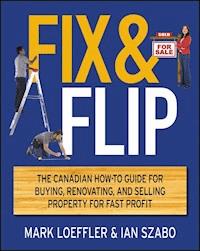
The ultimate how-to guide to fixing-and-flipping properties Judging from the number of reality TV shows devoted to home renovation, it's easy to think that fixing-and-flipping is a sure-fire, straightforward way to make money, fast. But there's a lot more to the real estate business than a little hard work and some basic DIY skills. Just like every other business venture, to be successful you need to understand the potential pitfalls as well as the possible profits before diving in, and Fix and Flip: The Canadian How-To Guide for Buying, Renovating and Selling Property for Fast Profit is designed to help you do just that. Putting everything you need to know about how the business of fix-and-flips work right at your fingertips, authors Mark Loeffler and Ian Szabo are the perfect pair for the job, bringing you both the financing and contracting expertise that has made their own renovation business a huge success. Offering step-by-step guidance on exactly how to effectively renovate and sell, Loeffler and Szabo walk you through the skills you need to get started, how to identify properties with potential, saving money on materials, preparing to sell, and much, much more. * Packed with expert advice on both the financing and contracting aspects of fixing-and-flipping properties * Filled with checklists and practical techniques to help you get to work right away * Explains the pitfalls to avoid and the profits to be made in the fix-and-flip business Packed with invaluable tips, handy checklists, and time- and cost-saving techniques to help you make the most money you can from distressed properties, this is the only book you need to start fixing-and-flipping like a pro.
Sie lesen das E-Book in den Legimi-Apps auf:
Seitenzahl: 430
Veröffentlichungsjahr: 2012
Ähnliche

















Contents
Cover
Title Page
Copyright
Dedication
Acknowledgements
Mark Loeffler
Ian Szabo
Introduction
The Most Common Perceptions of Fixing and Flipping
Fixing and Flipping – The New Model
Part 1: The Basics
Chapter 1: What Is a Fix and Flip?
Adding Value
The Fix-and-Flip Success Formula
Chapter 2: What Are the Differences between Flipping and Speculating?
Have Multiple Exit Strategies
Chapter 3: How Much Profit Can I Expect?
The Beauty of Wholesaling
The Reality of Profit Expectations
Chapter 4: How Much Money Do I Need to Get Started?
Financing the Purchase
Financing the Renovation
Financing the Carrying and Closing Costs
So, How Much?
Chapter 5: How Long Does It Take to Put a Property on the Market?
Cosmetic Flips
Gut Flips
So, How Much Time?
Chapter 6: What Skills Do I Need to Bring on Board for Fixing and Flipping?
Skill Sets and Backgrounds
What Makes a Successful Flipper?
What Does It All Mean?
Part 2: The Essentials
Chapter 7: Set Up Your Team
Agent
Inspector
Designer
Lawyer
Accountant
Bookkeeper
Mortgage Broker
Chapter 8: How to Find the Right Contractor
Driving to a New Destination – without a Roadmap or GPS
The Differences between a Contractor and a Sub-contractor (and Types of Contractors)
A Mixed Bag of MDs and TGVs
Partnering with a Pro
The Middle Ground
Chapter 9: How to Break Down a Contractor's Costs versus Materials Costs
How to Create a Scope of Work
Get Detailed Quotes
Using Scope of Work to Source Contractors
Scope of Work Is Not Just for Advanced Flippers
Chapter 10: How to Set Up a Joint Venture
“Creative” Partnerships and Strategies
Partnership Structures
Part 3: Searching for Properties: The Fundamentals
Chapter 11: Identifying Areas and Homes that Make Good Potential Flips
Start with the End in Mind
Chapter 12: Types of Homes: The Pros and Cons of Townhouses, Semis, Detached Homes, and Condos
Condominium Townhouses
Semi-detached and Freehold Townhouses
Detached
Apartment Condos
Which One Is Right for You?
Chapter 13: Where to Add Value – And Avoid the Money Pit
Who Is Your Target Market: Investors, Homeowners, or Renters?
Chapter 14: Financing Your Fix and Flip
Building Your Financing Team
Getting Money Sources to Say Yes
Buy-and-Hold Model vs. Fix-and-Flip Model
Developing “The Knack”
Financial Models for Fixing and Flipping
Insurance Needs
Chapter 15: Getting Started in Real Estate, Making Money, and Joint Ventures
Chapter 16: Preparing a Property for Sale
Speed
Price
What Do You Want?
Do All the Little Things
Marketing a Property
Carrying Out a “Post-Mortem”
Appendix: Flip Horror Story
Experienced Real Estate Professional Barely Escapes from Tricky Situation
About the Authors
Mark Loeffler
Ian Szabo
Zander Robertson
Thomas Beyer
Index
Copyright © 2013 Mark Loeffler and Ian Szabo
Published by John Wiley & Sons Canada, Ltd.
All rights reserved. No part of this publication may be reproduced, stored in a retrieval system, or transmitted in any form or by any means, electronic, mechanical, photocopying, recording, scanning, or otherwise, without either the prior written permission of the publisher, or authorization through payment of the appropriate per-copy fee to the Canadian Copyright Licensing Agency (Access Copyright). For an Access Copyright licence, visit www.accesscopyright.ca or call toll free 1–800–893–5777. Requests to the Publisher for permission should be addressed to the Permissions Department, John Wiley & Sons Canada, Ltd., 6045 Freemont Boulevard, Mississauga, Ontario, L5R 4J3, or online at www.wiley.com/go/permissions.
MLS® and Multiple Listing Service® are trademarks of the Canadian Real Estate Association.
REALTOR® and REALTORS® are trademarks of REALTOR® Canada Inc., a corporation owned by the Canadian Real Estate Association and the National Association of REALTORS®.
While the publisher and author have used their best efforts in preparing this book, they make no representations or warranties with respect to the accuracy or completeness of the contents of this book and specifically disclaim any implied warranties of merchantability or fitness for a particular purpose. No warranty may be created or extended by sales representatives or written sales materials. The advice and strategies contained herein may not be suitable for your situation. You should consult with a professional where appropriate. Neither the publisher nor the author shall be liable for damages arising herefrom.
For general information about our other products and services, please contact our Customer Care Department within Canada at (800) 567–4797, outside Canada at (416) 236–4433, or fax (416) 236–8743.
Wiley publishes in a variety of print and electronic formats and by print-on-demand. Some material included with standard print versions of this book may not be included in e-books or in print-on-demand. If this book refers to media such as a CD or DVD that is not included in the version you purchased, you may download this material at http://booksupport.wiley.com. For more information about Wiley products, visit www.wiley.com.
Library and Archives Canada Cataloguing in Publication Data
Loeffler, Mark
Fix and flip : the Canadian how-to guide for buying, renovating and selling property for fast profit / Mark Loeffler and Ian Szabo.
Includes index.
Issued also in electronic formats.
ISBN 978-1-11818105-8
1. Flipping (Real estate investment)—Canada. 2. Dwellings—Maintenance and repair—Economic aspects--Canada. 3. Real estate investment—Canada. I. Szabo, Ian, 1976– II. Title.
HD1382.5.L63 2012 332.63'240971 C2012-906363-0
ISBN 978-1-118-23993-3 (ebk); 978-1-1182398-0 (ebk); 978-1-118-23988-9 (ebk)
Production Credits
Managing Editor: Alison Maclean
Executive Editor: Don Loney
Production Editor: Pauline Ricablanca
Assistant Editor: Brian Will
Cover Design: Adrian So
Cover Photography: Cover Image: Painter © Hemera Technologies / thinkstock; Agent © Hemera / thinkstock; Carpenter © istockphoto / thinkstock; For sale sign © istockphoto / thinkstock; Wooden board © ihoe / istockphoto
Composition: Thomson Digital
Mark Loeffler
To Fiona
Ian Szabo
To the Szabo men and the Hickey men, creating generational change.
Acknowledgements
Mark Loeffler
I have to thank our editor Don Loney and his fantastic team at John Wiley & Sons for all of their hard work and dedication putting this book together. As always Don, your patience and guiding hand were much appreciated.
I'm always grateful to Don R. Campbell and the Real Estate Investment Network (REIN) for providing world-class real estate investment education and providing the place and reason for us all to meet and learn. Thanks.
I'd like to thank all of the contributors to this book. Donna Ragona, Thomas Beyer, Gary McGowan, Wade Graham, Cindy Wennerstrom, Jeff Reed, and Sean Greene, your stories, successes, and difficulties have added much depth to the book. The readers will have a much richer experience because of your contributions.
Finally, I'd like to thank my wife, Mary, for her ongoing support. Without you this book and my whole career would not be possible. Thank you so much.
Ian Szabo
I'd like to thank my father, Tony Szabo. Dad, you got me into the renovations business, and I learned many practical strategies from you that I use today. More importantly, you taught me about work ethic and determination. Thank you.
Thanks to my father-in-law, Gary Williams. I know my actions don't always make sense to you, but you always support me and know I'll pull through. Your support means everything to me.
Thank you Adam Rosborough, you've always believed in me and trusted my path. Thanks for being a steadfast friend and supporter.
Huge thanks and much love to my wife, Tanya Williams, and my daughter, Brianna Szabo. Because of you two, I know that my life is complete. I don't need anything else to be happy in the world. Thanks for showing me what contentment looks like.
To my mentor, Philip McKernan, your Everest Business Mentoring program has helped change my life drastically for the better. Thanks also to the whole crazy crew of Everest participants. We've come a long way together, haven't we?
Introduction
The Most Common Perceptions of Fixing and Flipping
Thanks for reading our book! Fix and Flip covers a topic that is commonly talked about, but very little understood. There seem to be two common views about fixing and flipping real estate for profit:
Common View Number 1: Flipping Houses Is Not a Sound Investment Strategy
There are those who believe that flipping houses is fraught with risk. To some degree, they're right—if you don't know what you're doing. We've heard from people who think that fixing and flipping is some kind of scam—the flipper makes huge returns for little or no effort. But rest assured—the fix-and-flip strategy is far from a scam. It requires the same amount (or more) of due diligence and effort as a buy-and-hold or rent-to-own investment.
Our advice: ignore the naysayers. Fixing and flipping houses is not impossible, nor is the strategy a scam. It truly is possible to profit by fixing and flipping houses. What you'll learn from this book is that it's not a “fly by night” undertaking, and that there are some excellent reasons to fix and flip rather than buy and hold, even if you want to profit from real estate over the long term. One of the biggest revelations you may have is that fixing and flipping can be a long-term investment strategy, even while it provides a fast return.
Common View Number 2: Flipping Houses Is Easy
This attitude usually arises during a major boom in a real estate market. As with all real estate investments, fixing and flipping is easier to do in a strong real estate market (where purchasers exceed inventory) than a weak one. However, as we will teach you, successful fix and flippers will not rely solely on the market for their success. You can never outsmart the market, and we always recommend fixing and flipping strategically, in any market. A successful fix-and-flip investor will not rely on a strong market to turn a successful fix-and-flip project.
The misconception that fixing and flipping is easy is somewhat like a disease. Whenever people start to believe in this falsehood, the appearance of “easy money disease” causes people to do silly things. We've seen people buy properties at fair market value, spend tens of thousands fixing them, and then expect to make a profit. It defies all logic, because if you spend too much buying and renovating, and then can't exit for more than you've spent, it's the antithesis of profitability. Yet when people believe in the easy-money approach, they will make this most cardinal of errors.
A hard-charging market deludes people and, inevitably, there are fix-and-flip newbies who get stuck with an unsellable property on their hands. In the game of musical chairs, eventually the music stops, leaving someone without a chair; just like in musical chairs, some flippers are left out of the game when the music stops.
The Middle Road
The truth is somewhere in the middle of the two views we just discussed. Some people are full-time fix-and-flip experts. Of the two of us, Ian is a good example of that. Others use flipping as a supplement (or an accelerant) to their overall real estate investment strategy. Mark is a good example of that.
But even Ian, who flips houses full-time for a living, did not start out that way. He started out the way that we suggest you do it—slowly. First Ian was a full-time contractor doing the odd fix and flip, and then he was a part-time contractor/part-time flipper. Finally, he became a full-time flipper. How long did the entire genesis take? Eight years! This is not an overnight endeavour. We're not saying you can't build your business faster than that if you desire to be full time as a fix and flipper. But it will not happen overnight, nor should it. Take your time and make sure you have the right deal and that you're executing your strategy step by step. Use fixing and flipping as a supplement, and at the same time, keep your eye on the long-term horizon. You may or may not want to do it full-time. There are strong reasons for both, but for the most part the supplementary strategy is the best one.
This may be one of the most important themes of the book. We really want you to “get” this, because some of you may have bought this book with the idea of jumping from a different job in a different industry to becoming a full-time fix-and-flip professional immediately. We strongly caution against that.
Fixing and Flipping – The New Model
Most people consider the fix-and-flip model to be like this:
It's true that this is one strategy for fixing and flipping, but what will become very apparent to you throughout this book is that this traditional model of flipping is just one of many models.
Our model of fixing and flipping is the following:
Notice that the new model does not demand that you sell the asset. Through the value that you create as a fix and flipper, there are ways to remain the owner of the property and not leave any of your own money in the property. You can leave the bank's money in the property, and in certain circumstances you can leave an investment partner's money in the property too, but as a fix-and-flip investor, you will do everything you can to remove all of your own money from the property.
The new fix-and-flip specialists are sometimes selling and sometimes retaining ownership of the asset for future gain. Thus, when we say “exit,” we don't always mean to sell a property. Keep that in mind as you move through this book. Exiting a property does not necessarily mean selling. However, it does mean that you've removed all or most of your initial investment in the property, either through a sale or a refinance.
Is This Investment Strategy for You?
This kind of real estate investing is not easy. In fact, no model of real estate investing is easy, and it's not a quick path to wealth. There is no easy or quick path to wealth.
But in particular, fixing and flipping is very intense. There are strict deadlines—not the kind of deadlines that you may be accustomed to. Not the kind that come from a boss or a co-worker. These kind of deadlines are very real. They are the kind of deadlines that will cost you real money if you don't meet them.
There is generally more real cash put at risk when you start a fix and flip, so there's more of a chance of losing real money. Real cash means money from your own (or your investor's) pocket as opposed to financed money. The reason there's typically more real cash involved in a fix and flip is the added renovation expense. Carrying costs can also be higher, as you're working on the project before it hits the market.
We need you to ask yourself very carefully if this is for you or not. There is no shame if it's not. Treat it as a gift if you discover that it's not for you, and move on to what will work for you and what will make you happy.
By the same token, we don't want to scare you away from trying fix and flips. Doing it well is a matter of following the recipe and developing expertise. If you truly want it, you can do it. But, just telling you that you can do it is a simplistic formulation. There are considerations of time, family support, and money for such an endeavour as fixing and flipping. What we want you to know is that if you want it badly enough, you can develop the skills to do it. We never promise it will be easy.
If It Is for You . . .
If, after some soul-searching and research, you find that fixing and flipping is a strategy you would like to put to use, or if you have already done some fix and flips and want to get to another level, we suggest you think of it as a supplement or an accelerant to your existing career, or to your existing real estate investments. Especially at the beginning, don't try to make it your sole career. Do at least five fix-and-flip projects before you make that kind of decision.
Fixing and flipping can be a wonderful supplement to your existing career or your real estate investments. It can provide you with the one thing that most long-term buy and holds don't: significant cash in a relatively short time frame. And it can allow you to own a property long term with little or none of your own money in.
All this is possible only if you get the fundamentals right. Without a doubt, the two biggest fundamentals of fixing and flipping are the following:
You will see these themes recur over and over in this book, and many of the other topics we discuss in some way relate to these two fundamentals. The truth is that if you keep focused on these two fundamentals, and if you execute these two fundamentals correctly, then you will likely do well at fixing and flipping.
Through patience, practice, and focus, you can develop “the knack” for finding, fixing, and flipping properties. The knack is something you'll notice when you can look at a property and see potential that many others, perhaps a hundred others, have overlooked. The knack is that sudden insight that says that $10,000 worth of renovations can create a $20,000 lift in value. The knack is not understood by many, and that's why fixing and flipping is not for everyone. In reality, the knack is just practised focus on the fundamentals. You can develop the knack as well as anyone else.
Go Slow, Focus, and Relax
Enjoy this book, learn from this book, and most of all learn from yourself. Take whatever you read with a grain of salt. Remember that for us to do what we've been able to do, and for the people profiled in this book to do whatever they've been able to do, a certain level of experience had to be attained. Each of us has a different background.
Consider that Ian ran a renovation company for eight years before he became a full-time fix-and-flip expert. Consider that Mark had many successful years in sales and rent-to-own real estate investing before he started doing a lot of his fix-and-flip projects.
We invited Thomas Beyer to contribute a section in this book for you because we think he has one of the wisest and most balanced approaches to starting out in real estate of any we've seen. Heed Thomas's advice about getting started, and we promise, you'll enjoy the journey a lot more.
In case you don't know Thomas, he's a full-time real estate investor whose company, Prestigious Properties, manages around $100 million worth of real estate, mainly across western Canada, but also in the United States and eastern Canada. He started off a mere 15 years ago with only one property worth $80,000.
Thomas preaches patience and incremental progress. That's why we wanted him to contribute his wisdom to the book. Thomas always says, “Real estate isn't a get-rich-quick scheme; it's a get-rich-for-sure scheme.” Heed these words, and take it slow and steady.
Enjoy the book and please interact with both of us on our websites, or through Facebook, Twitter, YouTube, live events, and wherever else you might find us. Our contact information can be found on page 245.
Part 1
The Basics
1
What Is a Fix and Flip?
In this chapter, Ian talks about the fix-and-flip basics and how he came to understand it's not an easy path to wealth.
To put it in simple terms, a fix and flip is the process of:
buying a property at the right price;adding value through renovations; andexiting the property with a profit.You'll notice that I did not say “sell the property,” and the reason for this is that you won't always sell the property, although selling is one exit strategy I regularly use.
Adding Value
People often get into this game to “get rich.” Oftentimes they even think they'll be able to “get rich quick.” The truth is that if you're able to create wealth at this, it will be a direct result of how much value you add—value to your end user, value to renters, value to investors, value to lenders, and even value to your spouse and children. These are all necessary to create a successful life as a fix-and-flip investor. The creation of wealth is always a by-product of providing value.
Fixing and flipping, probably more than any other method of real estate investing, is the art of creating value and of problem solving. If you can solve a problem, then you're on your way to adding value.
When you go into a nice neighbourhood in a high-demand town, you're starting in the right place. From the beginning, you're working with a product that people will want. Now, you take a house that has been neglected, it's an eyesore, and it doesn't fit into its surroundings, and you've got something even better. You already know that people will pay a certain amount of money for a certain type of house in a certain neighbourhood in a certain town or city. So all you have to do is be the solution by providing that type of property. The raw material is the house that has been neglected, and your skill and expertise are the catalyst for turning that undervalued property into something of value. You are adding value by taking that property and bringing it up to the standard of the neighbourhood.
The world is in desperate need of people who can add real value. The economic collapse and uncertainty in much of the world, especially the United States, is a perfect example of the creation of false value. People believed that false value was real value. Eventually the movie ended and the acting stopped. All that false value was wiped out and along with it the savings of a lot of hard-working people. Be a creator of real value and you will do very well at the flipping game.
What's the Trick?
People often ask me, “What's the trick to flipping houses?” The reality is that there is no big trick or secret to it. There are a million small tricks that you will learn as you go along, but there is no single big trick.
People often get hung up on the money. They think they need a ton of money to get going in the business. Money doesn't hurt, but it's definitely not the key ingredient. In fact, if you start with a bunch of money but no skill, you'll probably end up with no money! You're better off looking at this as a game of skill rather than a money game.
There is a simple truth to this business that you may have heard elsewhere before: there is a lot more money out there looking for the right deal than there are deals looking for money.
Now, if you have the deals but no money, you'll need the skill in presenting that deal to get the money. You'll also need the skill to find the deals, and a certain set of skills to pull off the renovation aspect. I could list off a bunch of skills that make this business work (and I will below), but the fact is that it's skill, not money, that makes this business work.
Focus on having or finding the skills necessary in order to successfully flip houses, and the money will come. If you focus on the money instead, you will have a harder time finding the money.
There's a good chance you will have to use your own money to start off, but if your goal is to fix and flip regularly, you will find that money will be attracted to you. This is the truth for both Mark and me. We have a harder time finding the deals than the money, but the money comes because we bring the deals.
Fixing and Flipping Is about Putting on Hats
To do a flip successfully you need to focus on skill rather than money, but you don't need to have all the necessary skills in order to do a flip. However, you will need to supplement your own skills by leveraging the skills of others.
I don't personally possess all the necessary skills to do a flip myself, so I utilize other people's skills in order to do the job that I need done.
What the successful fix and flipper does is put on a few different hats to pull off a flip successfully. Putting on hats just means you're employing skills (your own and others'—in which case, you have to put on the management hat) to do the very unique job of fixing and flipping a house. Some of the hats include:
Deal Finding: This is the skill of sourcing a property and purchasing it. You need to know if you can buy it at a low enough price and exit it at a high enough price.Project Management: You have to manage a team whose members have their own special capabilities and skills. You have to understand your team and work to keep your team motivated and working well together. You also have to take care of the planning and scope of work necessary to complete the job. This is all under the banner of project management.Analyzing Your Exit Plan: You need to be able to analyze the deal that's in front of you and know what your exit strategies are. You have to know which one is Exit Plan A, Exit Plan B, and Exit Plan C. Then you have to have the skill and knowledge to execute your exit.Financing: This one forms a part of deal finding and analyzing your exit, but knowing how and where to get the money is a skill unto itself.Design: This is the skill of knowing what will truly raise the value of the property. It's also the skill of doing the renovations in such a way that your costs will not kill your profitability. The design hat is integrated with the project management hat to a large degree because only the skill of project management will allow you to carry out the design aspect with any success.Everyone Wants to Be a House Flipper
Whenever I'm in the company of a real estate crowd, I'm always amazed at how many people really want to be house flippers, or so they say. Flipping houses conjures up something romantic about buying and restoring a property for a large profit and the independence of being your own boss. I've actually seen people post photos online of themselves holding their big cheques. (I find this funny because a big cheque at the end of a job doesn't mean a big profit; there are still the bills to pay at the end of the job, after all!)
But the problem is that most people don't know what flipping houses is all about. In truth, there is nothing glamorous about the business at all. Just like any business, it takes commitment and determination, and the right blend of knowledge and skills to make it work.
My experience tells me that this business is not as easy as it seems. In spite of the fact that the definition provided at the beginning of this chapter is quite a simple one, and in spite of the fact that perhaps it's simple to grasp the concept that adding value is all you have to do to be successful at this business, the reality is that many people are not successful. Simple and easy are two different things. Often the simplest things to do are the hardest. Some people can't say the simple words “I love you” to their loved ones. Simple does not equal easy.
Take, for example, a guy I know who was trying to get into flipping. I'll call him Paul, although that's not his real name. He got into the flipping business with the best of intentions, and he even had a skill background that I highly respect. He was a renovator! Of all the skill sets to take into the house-flipping business, I think this is one of the best.
The problem with his first flip was that he couldn't get past the fact that he didn't have to take responsibility for what was behind the walls. In spite of the fact that he doesn't have X-ray vision, and he couldn't possibly know what was behind the walls, he still felt an obligation that if he was going to put his name to the flip, that he had to take responsibility for what was behind the walls.
Please don't misunderstand me here. If you know there is a problem behind a wall (mould, electrical, etc.) you absolutely have to fix it before you can sell it. In fact, not only is not doing it highly unethical, it's also illegal.
What I do mean to say is that you don't go ripping out walls when it's not necessary! Paul couldn't get past the fact that without him pulling apart the place, there was no way to know for certain that everything was up to snuff.
The lesson here is that flipping a house is about renovating what must be renovated at the lowest possible cost to you. It's not about having absolutely everything perfect so that your overactive imagination can rest.
Don't be like Paul! Please understand that although the definition of flipping seems very simple, it actually requires you to employ a bunch of different skill sets, or at least have a team that can employ their skill sets toward your cause. Paul had all the abilities and tools to do the job well, but he wasn't able to employ his “flipping muscle” to override his “renovator muscle.” His renovator instinct took over and he overbuilt—and overspent—on this particular flip.
Don't Get Discouraged!
Paul is a wonderful guy and a very talented renovator, but only time will tell if he's a flipper or a speculator (see the next chapter for a discussion of the difference). In the example I gave, he made a critical error, and it caused his project to suffer. But if Paul is able to use that experience to learn and then change some of his behaviours, he will be fine. If he doesn't, or if he throws up his arms and gives up, he'll never receive the benefit of that lesson.
I learned the same lessons as I got better and better at fixing and flipping houses, and so can Paul. The same words will apply to you as you develop your skills and learn how to employ them.
The Fix-and-Flip Success Formula
Fixing and flipping is an art that involves a) creation, and b) fixing a problem (that someone else created), specifically the problem of a house that has zero curb appeal. As a fix-and-flip investor, it's your modus operandi to make money solving that problem and creating something beautiful in the process. A well-renovated house that's ready to fulfill a family's dream is a beautiful thing, and I hope you never forget that.
When you add enough value through your work and expertise, you'll make a profit and have the recipe for a winning investment strategy. But there's a hidden risk to fixing and flipping. People often get deluded about what it means to be a fix and flipper, and they actually don't know how to do it. They often throw themselves in without getting the fundamental piece first and foremost. The most common mistakes people make are: a) overspending on the purchase of a fix-and-flip project; and b) overspending on the renovation of a project.
Fixing and flipping is a formula that takes practice to perfect, and you can improve at it just like I did over the many years that I've been working at it.
2
What Are the Differences between Flipping and Speculating?
In this chapter, Ian looks at the two very different approaches to fix-and-flip investment.
Some people hold the view that flipping is akin to speculating. In my opinion, if a flip is done right it is very different from speculating. It is a business like any other: if you successfully add value, you can make a consistent profit.
Speculating, on the other hand, is the activity of the get-rich-quick mindset type. Speculators will do well in a quickly rising market, simply because they bought at the right time and will sell at the right time. But they will get crushed over the long term. The long term favours the savvy fix-and-flip expert.
It could be argued that there is a certain skill to timing a hot market correctly, but the sad truth is that most of these speculators will only do really well at their “speculation flips” when the markets are up, and will get crushed when the markets are flat or down. Why? It's simple: because they're not adding any real value. Speculation flips are the equivalent to the experience of unskilful day traders who are successful at the stock market when the whole market is charging forward, but who are destroyed in a flat market.
Let's be honest—in a really hot market, you don't even have to add value through renovations to turn a profit. Just buying and selling a couple months later is good enough.
Being a flash in the pan might seem fun, but the real goal of fixing and flipping should be to create long-term success. Spend time becoming a true expert instead of a speculator. Below, I will discuss some of the key items that you will need to master in order to avoid being a speculator.
Have Multiple Exit Strategies
Successfully flipping in a flat market is very different from speculating. It requires work, study, and knowledge rather than dumb luck. When you undertake a fix and flip, you're essentially doing a whole case study about a specific property. It has to fit all the criteria that you know will allow you to add value and therefore consistently make a profit. You're basing your decisions on the past performance of a particular property and area, and you're going forward with a plan based on the criteria involved.
A speculator needs to sell a property at a much higher price in order to make the project a success. But a flipper actually doesn't have any attachment to a certain exit strategy because he or she will always have numerous possible options that will make the deal work. A successful flipper can do at least two of the following on any fix-and-flip project:
Wholesale: You get the property under contract but never actually renovate the property. You find a good deal on a property and sell the contract to another fix-and-flip investor. The new investor will do the work and likely take the most profit. You take a small profit and move onto your next deal. In some cases you do actually buy the property and then immediately sell it. This involves more closing costs than just flipping the contract, so if you do it this way, you must have more profit built into your end of the deal.Renovate and Sell: This is easy and clean. You move the property, cash out, take your profit, and move on to the next one. This is possible and desirable on a single-family home and a small multi-family home, as long as the numbers make sense.Renovate, Refinance, and Rent: This is a profitable strategy if the cash flow is very strong. I find that small multi-family properties are much better than single-family homes for this. Here, you remove all or most of your cash invested and then hold the property for a little or a long while. It's a great exit strategy if the property cash flows and if you get all or most of your money out on the refinance.Renovate and Rent: The only way this works is if you already have conventional financing on the property when you buy it, and therefore a manageably low interest rate. My problem with this is that the money you spent on the renovation is left in the property. The point of fixing and flipping is that you want to remove the initial cash invested as soon as possible, so doing a straight rental is against the nature of a fix and flip. However, if there is some sort of unforeseen emergency with the property and it simply isn't possible to refinance and pull out the cash (for example, if value wasn't created, or if the bank won't refinance), then doing a straight rental is the final backup plan. While not the goal of fixing and flipping, a straight rental is at times better than taking a loss on the property.Having multiple exit strategies is vital. The worst I've ever been stung on a fix-and-flip project was when I didn't have multiple exit strategies. Always cover yourself by knowing there is a way out if your initial plan fails.
Do Property Due Diligence
A successful fix and flip includes a lot of property due diligence. People often make the mistake of thinking that any property will do. This couldn't be further from the truth. In fact, there are not a lot of properties that work very well for a fix and flip. A strong fix-and-flip candidate doesn't come around every day, although it may come around every month or two (depending on how wide a net you're casting). And the grand slam of a fix and flip doesn't come around every month—my experience is that these properties can be found every six to 12 months, and only then if you're looking intensively.
You'll never find a good flip, and certainly not a grand slam unless you're well-versed in property due diligence. Included in property due diligence are:
talking to the neighbours about the property (they know things that realtors don't)walk-through of the property (will there be too many renovations to make it worthwhile?)scope of workproject budgetan accurate comparative market analysis (CMA) of the property (what it will sell for when done)Do Regional and Neighbourhood Due Diligence
You could flip a house anywhere, but in order to do it right you need to know what to reasonably expect from the property in the area you're in.
Regional due diligence is about understanding all the larger economic factors of the region you're fixing and flipping in. If you live in a lumber town where the sawmill is about to be closed down, or an automotive town where the plant is about to be shuttered, then it might not matter how well you do the rest of the fix and flip. When people leave an area in droves, you likely won't be able to profit from a fix and flip at that time.
Conversely, if a large source of employment is coming into a town, you will be in a better position to profit from the increased population numbers and the increased demand for good housing. No matter what, you can't be smarter than the market, so it's best to understand the market.
Neighbourhood due diligence takes a more microscopic view of the factors affecting the specific area you're fixing and flipping in. Are you doing it in a total dump of a neighbourhood where even the nicest house won't sell or rent? If so, you need to reconsider. On the flip side, are you fixing and flipping in the most sought-after neighbourhood in town? Will there be a lineup of wonderful buyers and tenants with money looking to get in when you're done your work?
Regional and neighbourhood due diligence are absolutely essential. Knowing, understanding, and applying the rules of proper due diligence constitute a topic of conversation unto itself. Its application is a skill that crosses beyond the borders of fixing and flipping into the realm of general real estate investing. (Don R. Campbell's book Real Estate Investing in Canada 2.0 is the bible of the real estate investing basics. It helped me, Mark, and thousands of other successful investors get into the real estate game.)
Consult Experts
As much as I know my business and how to make the numbers work properly, I still always check myself in with an expert.
I have wise advisors in my life who, when they walk through a property, might find something that I would have missed. I have other advisors who might look at the property as it's situated in the neighbourhood and make me aware of any possible problems with the property or the neighbourhood that would make this property difficult to sell or rent. Still others might tell me that the deal I'm looking at is not as strong as some of my other deals, and perhaps I should continue looking elsewhere.
Don't ever get too cocky thinking that you know everything. At the same time, don't take advice from the wrong people. Make sure that the people you rely on the most have a perspective that is valuable, and that they will always be honest with you.
Speculators will listen to other speculators or people who don't really know what they're talking about. Speculators might not have any trusted advisors at all.
Be Prepared for Preparation
A speculator will never be prepared, but a real house flipper puts many, many hours of preparation into each and every flip project that he or she does.
Part of the preparation is the property and regional due diligence that we've already spoken about. Another part is the project management–related issues.
A flipper will have all his or her contractors, sub-contractors, tradespeople, and service providers in place prior to the start of the job. A speculator will not take this necessary step. Instead, he'll fly by the seat of his pants and hope it will fall into place as things move forward.
A flipper will have his total scope of work ready before he starts the job. A speculator won't even know what a scope of work is. A flipper will have architectural drawings and permits in place prior to taking possession of the home. A speculator won't even know what these things are. A flipper will find out the cost of insurance and determine which insurance providers will insure them properly, and will have insurance in place on the property.
A flipper will also have all the pieces in place to execute each of his or her possible exit strategies. If wholesaling the property is one of the exit strategies, the flipper will have a list of potential wholesale buyers. If selling the property is one of the exit strategies, the flipper will have knowledge of the market and will have a realtor ready to help sell the property.
Get Good Financing
A flipper will have a good source of money ready to make the deal happen when it needs to happen.
I say a good source because not all money is the right kind of money. If the money comes with an interest rate that will completely destroy your profitability, then the money is no good. If the money comes attached to a money partner whose interventions might make your life a living hell, then the money is no good.
A speculator won't have access to the correct financing. He or she will always have to scramble just to get the money, and perhaps even tell lies in order to get it. A flipper can always be above board because the deal is good, and money always finds a good deal.
A flipper will build a presentation in order to show potential sources of money exactly how good the deal is. This presentation will result in the flipper finding the money, and if it doesn't now, it will eventually. But if it doesn't now, the flipper doesn't mind, because he or she can still wholesale the property.
Flippers don't lose a deal over financing. If the money isn't in place, the flipper simply wholesales the deal and moves on. Flippers have a list of buyers they can go to if they need to wholesale the property.
Stay in It for the Long Haul
As you've seen from the brief treatment we've given them thus far, speculating and flipping are very different. The reality is that flipping—if it's done right—is a sustainable business. If you strive to continually improve each of the areas that we've discussed (and a bunch more) you can improve and improve until you get yourself to a place where the business operates very smoothly, and you can actually make a very good living from it, both in terms of lifestyle and income.
That's the problem I find with speculators—they get in the game because they think it will be easy. This is a misconception that couldn't be further from the truth. It takes real work and real commitment to be able to properly fix and flip houses.
There was a time when my own actions more closely resembled those of a speculator than a flipper. During my first couple of flips, I went charging in without a proper plan. I bought the wrong house in the wrong neighbourhood for too much money. I falsely believed that if I just made my houses into the Taj Mahal, they'd sell for so much money that all my sins could be covered up.
I was dead wrong about all those things, and my first few flips were miserable failures. The only difference between me and a speculator at that point was that I was in the game to be a flipper, and I didn't plan on going away any time soon. So I learned from every little failure and from a few people who had knowledge that I didn't. Slowly, I turned into a flipper, and things got better with each passing job. To this day, my flips are becoming smoother and more profitable with each successive one.
Yours will too if you apply the rules of a fix and flipper: get better each time you flip a house; treat it like the business that it is; and stick around for the long haul.
The last one is no less important than the other attributes of a successful fix-and-flip investor. Be committed to sticking it out for the long haul. If you are, you're already over halfway to success.




