


3,65 €
Mehr erfahren.
- Herausgeber: Thunderchild Publishing
- Kategorie: Fantasy und Science-Fiction
- Sprache: Englisch
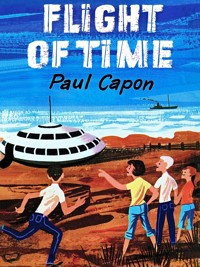
Four teenagers find a time-ship on a lonely stretch of shore. It has just brought two travelers-in-time from the future. When they leave the ship, Clive, Mark, Carol and Jill climb in. The ship starts off and they are carried on through the centuries at breathless speed until it comes to rest in A.D. 2260 and they step out into an unrecognizable England.
First the sea was pushed back to make room for the ever-increasing population, then cultivation was carried out in layers, with fields rising in tiers like giants' skyscrapers. The people are governed by an enormous electronic brain. The inhabitants of this extraordinary world plan to keep the children for ever, as
Das E-Book können Sie in Legimi-Apps oder einer beliebigen App lesen, die das folgende Format unterstützen:
Seitenzahl: 231
Veröffentlichungsjahr: 2024
Ähnliche


















FLIGHT OF TIME
Paul Capon
COPYRIGHT INFORMATION
This is a work of fiction. All of the characters, organizations,and events portrayed in this novel are either products ofthe author’s imagination or are used fictitiously.
Copyright © 1960 by Paul Capon (renewed 1988)
Published by arrangement with the Paul Capon literary estate.
All rights reserved.
Edited by Dan Thompson.
A Thunderchild eBook.
Published by Thunderchild Publishing.
First Edition: March 1960.
First Thunderchild eBook Edition: January 2015.
Cover illustration by Leslie Wood.
CHAPTER ONE
Jill sat on the sand facing the sea and closed her eyes. She started to count up to a hundred, counting slowly to give the others plenty of time to hide.
“One…two…three…four…”
She was feeling really happy for the first time in two days. She knew now that the holiday was going to be all right, but it hadn’t seemed like it at first. In fact, once the thrill of meeting two cousins from America for the first time had worn off, it had been quite a bit sticky. For one thing, there was the difference in their ages. Carol, at thirteen, was a year older than Jill; and Mark, at sixteen was a year older than Clive and seemed even more. It made things a little awkward and then the American children’s possessions — their clothes, cameras and watches — were all so much better than the English children’s, or at any rate, more expensive. “They seem quite nice,” Jill had whispered to Clive at bedtime on the first day, “but I wish they weren’t spending the whole of the holidays with us. What shall we do with them?”
“…twenty-eight…twenty-nine…thirty…”
The second day hadn’t really been a success, either. All four of them went swimming in the morning, but Mark and Carol had found the water terribly cold after Florida, and so the bathe was only a very quick one. And afterwards there somehow hadn’t seemed much to do. Clive would have liked to go fishing, but hadn’t suggested it, feeling that spinning for mackerel would seem a bit tame to the Americans, who were probably used to big-game fishing for marlin, tuna and that sort of thing. As for the poor old sailing-dinghy, well, he simply hadn’t mentioned it after hearing that Mark and Carol had a cabin-cruiser of their very own at Key West, to say nothing of a couple of fourteen-footers.
“…forty-five…forty-six…forty-seven…”
Today was the third day, and they had spent the morning wandering rather aimlessly over the sands until they had come to the part known as Wayland’s Waste, where there was nothing to be seen except the sea on one hand and sand-dunes on the other, miles of them without a house or a tree in sight. “Clive and I used to play hide-and-seek among the dunes when we were kids,” Jill had remarked, “but I suppose we’re all too old for that now.”
“Old?” queried Carol. “Guess I’m not too old. Why, back home we often play hide-and-seek. All us kids do. Don’t we, Mark?”
And that was how at last the ice had been broken.…
“…sixty-nine…seventy!…seventy-one…seventy-two…”
It was rather funny, really, and it was certainly a great weight off Jill’s mind. After all, if Mark and Carol were quite happy to play such a simple game as hide-and-seek, they’d probably enjoy messing about in the sailing-dinghy, or taking it in turns to ride the shaggy old pony that belonged to the farm. It made all the difference.
The others were getting impatient. She heard Clive yell: “Coo-eee!”, then a sort of Red Indian call from Mark.
She finished counting hurriedly : “…ninety-seven, ninety-eight, ninety-nine, a hundred! COMING!”
She opened her eyes and was just about to jump up when — whoosh ! — it happened. It was almost too amazing to believe. At one moment there was nothing in front of her except a flat expanse of sand and the sea, with no sign of life other than a small coaster right out on the horizon, and at the next there was a great shining object looking like a huge silver dish-cover.
It simply arrived from nowhere. It wasn’t there and then it was, and it arrived with a fierce yet hardly audible sigh, as if the air had been let out of a thousand toy balloons at once.
Jill rubbed her eyes, but there was no doubt about the object’s reality. It was too big and solid to be a sort of daydream. It was as big as an Eskimo’s igloo (and much the same shape), big enough, anyway, to house three or four men, and heavy enough to settle a foot or so deep into the wet sand as soon as it arrived. It was about fifty yards away, almost exactly half-way between Jill and the sea.
No one could have helped feeling a bit scared, and she backed quickly away until she was hidden from the gleaming object between two clumps of marram grass.
Clive shouted again, and she glanced impatiently over her shoulder.
“Come here, everybody!” she yelled. “Something’s happened and…”
She heard mocking laughter from among the dunes and Clive started to chant: “Silly-billy-jilly, can’t find us! Silly-billy-jilly…”
“Please, Clive! It’s import —”
She broke off as a sliding door opened in the strange object and a man got out. He was weirdly dressed, but Jill’s first sensation was one of relief to see that he was human. She had expected, well, almost anything!
No, the stranger was human all right, but he wasn’t much like anyone she had ever seen. He was exceptionally tall — nearly seven feet was her guess — and his complexion was as bronze in colour as a new penny. His head was shaven and he was bare-chested, but round his shoulders he wore a short blue cloak. For the rest he had on a spotless white shirt and knee-length blue stockings.
He stood with his back to her, gazing towards the sea, and he shouted something to someone still in the shining object. The breeze carried his words to her, but she couldn’t understand them. In fact, they hardly sounded like language at all. They were more like a sort of twittering.
Clive was evidently getting bored. “Come on, Jill ! You aren’t half taking your time.”
With the wind blowing from the sea there really wasn’t much risk of the stranger hearing him, but Jill was terrified and felt herself go hot and cold all over. “Shut up!” she hissed. “And come here!… No, don’t! Stay where you are and keep hidden. I’ll come to you.”
At last the others were beginning to realise that something unusual was going on. There was no more coo-eeing, and Jill wriggled cautiously backwards until she reached the first of the dunes.
She paused at that point, because someone else was getting out of the strange object. It was a girl this time, quite young, and she wore a skirt that looked as if it were made of gold. Above it she had on a white coatee, and her dark hair was arranged about her head in elaborate coils. Her skin was a little lighter than the man’s, but it could still be described as bronze.
She joined the man and he pointed across the sea to the distant coaster. They stared at it for several seconds, and it was almost as if they had never before seen a ship. Then they turned and made a careful survey of their surroundings.
Jill felt a slight movement at her side and gave a start. Out of the corner of her eye she glimpsed Mark’s blond crew-cut and whispered to him to keep well down. “And don’t move. They’re looking in this direction.”
“Who are they?”
“I don’t know.”
“Movie actors, maybe. And that gadget.… Is it something English?”
“No. It simply appeared. I’ll explain later.”
The two strangers were making their way up the beach, looking about them warily all the time. If they held to their present course they would arrive amongst the dunes some way from Jill and she felt fairly safe. As luck would have it the children hadn’t been on the beach since the tide went out so there were no footprints to give them away.
Jill was the youngest of the quartet, but somehow in this particular situation she felt she was in command. After all, she was the only one who had seen the object arrive and so she knew more about it than the others.
“Mark, can you round up Carol and Clive and get them here? Don’t let them show themselves for an instant!”
“Sure. I know where they’re hiding.”
The strangers arrived at the high-water mark and the man stooped to pick something up. He seemed quite excited over his find, although Jill knew it was only an empty can that had once contained tomato soup. She had noticed it earlier that morning and had kicked it a few yards along the beach. It wasn’t even a foreign can, yet the stranger could hardly have been more intrigued if it had been a golden chalice. He showed it to his companion and together they studied the lettering on its label. Finally, instead of throwing it away, the man carefully shook the sand from it and pushed it into the wallet that hung at his belt.
The couple resumed their walk up the beach and Jill glanced round to see the other children wriggling towards her on their stomachs.
Carol was in front and as soon as she saw the huge dome-shaped object she gave a gasp of amazement. “Holy smoke, what kind of a thing is that?”
Jill put her finger to her lips and rolled her eyes warningly in the direction of the strangers, who had nearly reached the point where the dunes started.
Her brother ignored her warning and flung himself down at her side. “Where did they come from, Jill?”
“S-sh! Better not talk.”
“Silly, they can’t possibly hear us. Where did they come from?”
“From…well, from nowhere.”
“Crazy! They can’t suddenly have appeared.”
“But they did, I tell you. Or, rather, that shiny thing down on the beach did, and then they got out of it.”
“Have a heart! It must have come from somewhere. You sure it didn’t come out of the sea?”
“No, Clive! I keep telling you — it justappeared! I saw it, and it made a funny noise. Shooooosh! Like that.”
“That’s right,” agreed Carol. “I heard it. Sort of like a rocket taking off. Only more like it was taking off backwards, if you get me.”
The children could no longer see the strangers and Mark cautiously raised his head.
“Where have they got to?” asked Jill.
“They’re among the dunes, still walking. The guy’s just pointed towards the ridge where the heath starts and that’s what they’re making for.”
“What do you think we should do?” asked Clive. “Any suggestions?”
“Well, I guess we’d better tell someone,” said Mark. “Maybe they’re spies or something.”
“Yes, but it would take us half an hour to get to the village,” objected Jill, “and by then that thing may have disappeared again. We’d look silly, shouldn’t we? No, I suggest we wait till they’re out of sight, and then investigate!”
“Maybe they won’t go out of sight,” murmured Carol. “Gee, I wish we’d brought a camera!”
Mark had almost to stand up straight to keep the strangers in view. “They’re scrambling up the ridge,” he reported. “The man’s got to the top and he’s giving the girl a hand.… Now they’re both up it and they’re just standing there, looking inland.”
“They can see the railway from there!” said Jill. “Yes, perhaps that’s it. Perhaps they’ve come to blow it up.”
Clive gave a hoot of laughter. “Just dig my crazy sister! That railway has exactly four trains a week, two up and two down, and each consisting of an engine, one coach, two trucks and a guard’s van. I suppose blowing it up would deal this country a blow from which it would never recover?”
“You never know,” said Jill darkly, and Mark announced that the strangers were moving off.
“I guess They’re going down towards the railroad,” he said, “so maybe Jill’s on to something.… Okay, they’re out of sight.”
“Good. Come on!” cried Jill, and they all scrambled to their feet and went racing down the beach towards the mysterious gadget.
They slowed up before they reached it and Clive voiced what they were all thinking. “Better take it easy, kids. There may still be someone on board.”
Actually, they could see quite a bit of the interior through the open door and Jill was the first to notice a most interesting feature. The wall of the strange object, as seen through the doorway, was transparent and through it they had a clear view of the beach and the sea beyond.
“That’s funny. I mean, it’s transparent!”
“Yeah, one-way transparent,” said Mark. “Anyone inside can see out, but no one outside can see in.”
“Looks kind of cosy in there,” Carol remarked. “There’re seats all round.”
The children came to a halt a few yards from the machine and Mark cast a glance towards the dunes. He satisfied himself that there was no sign of the strangers then turned back to the others.
“Better we don’t all go up to the door in a bunch,” he said. “Who’s it to be?”
“You,” said Jill.
“Okay.”
He gave a hitch to his jeans and strode forward. When he reached the machine, he peered in, but evidently there was no one in sight for he tapped politely on the object’s mirror-bright hull and called: “Anybody home?”
Nothing happened. The others ran forward and crowded round the narrow doorway.
“Are we going aboard?” asked Jill.
“Of course,” said Clive. “Come on!”
The interior of the machine seemed all cabin and the thing that chiefly struck the children was the absence of an instrument panel. In fact, there was no visible mechanism at all unless you could count as such a small fixed table with two glass press-studs let into it, one blue and one yellow.
“I guess the motors are in the base,” said Mark, “but how are they controlled? Why, there isn’t even a compass!”
None of the others quite believed Jill’s story about the machine appearing from nowhere and now, in contact with it as a solid reality, she began to have doubts herself. For it was extremely solid. The transparent walls were nearly a foot thick, the base was about three feet deep and when you sat on the comfortable seats that ran right round the cabin they practically engulfed you.
On the other hand, the machine hardly seemed to be equipped for a long voyage. It could scarcely, as Mark pointed out, have come from another planet. There was no room for much in the way of stores and there was no galley. It was all very bewildering.
“If I hadn’t seen this darn thing with my own eyes,” said Mark, “I wouldn’t have believed it.”
“Let’s try pressing those buttons,” suggested Jill.
“I guess nothing will happen. The motors are all switched off.”
“Still, try.”
Mark grinned at her and put his finger on the blue press-stud.
“See?” he murmured, when there was no response.
Clive said: “I’ll try the yellow one,” and promptly did so.
This time the response was immediate. The door slid to and the whole machine gave an extraordinary shudder.
“Holy cow, it’s moving!” gasped Carol, and flung herself at the door. However, there was no handle that she could grasp and the door stayed tight shut.
CHAPTER TWO
The machinewas moving, as Carol had said, and yet it wasn’t. Or at least it didn’t seem to be going anywhere. Certainly it was rocking and trembling in a very odd way, but it was still on the beach. Through the transparent walls they could see the sand and the sea, yet nothing seemed quite normal. The sea, in particular, looked fuzzy and out of focus and when Jill noticed the little black coasting steamer she had the shock of her life. It was racing along the horizon as if it were jet-propelled!
“Quick!” she shouted. “Press the other button!”
Clive obeyed her at once, pressing the button several times, but it had no effect at all. The weird shuddering continued and when the children next looked seaward the little coaster was out of sight.
Suddenly Carol pointed. “The water! Look — it’s coming up!”
She was right. The sea, which had been fifty yards away when they entered the machine, was racing up the beach at the speed of a tidal wave and within a matter of seconds it was all around them, green tumbling water that came halfway up the transparent walls. It danced and sparkled as if it were a livelier substance than water, and the noise it made was curiously thin and scratchy.
Evidently the machine was too heavy to float and before the children had recovered from their astonishment Mark pointed out that the water-level was going down again.
“But what’s happening?” asked Jill.
“I think I know,” he told her, “but give me a couple of minutes to get my ideas straightened out.…”
He was interrupted by darkness swooping down upon them with the suddenness of an avalanche. The girls screamed and clutched each other, and Mark shouted to them to take it easy.
“If what I think is right,” he said, “it’ll be light again in a minute.”
The sea came racing up again, making the same odd squeaking noise as before, and it was more noticeable in the darkness. It was as if the machine had been engulfed in a flood of mice.
“Sit down everybody and relax,” said Mark. “I guess we’re in no immediate danger and I’ll explain what I think has happened.”
His firmness was reassuring and the four of them threw themselves on to the comfortable seats, keeping as close to each other as possible. Splashes of scarlet fire lit the eastern horizon momentarily, then daylight flooded the world just as suddenly as darkness had swept down a minute or so before.
Mark said: “Did any of you ever read a story by Wells about the Time Traveller?”
“The Time Machine, by H. G. Wells,” put in Jill. “I haven’t read it, but it’s in our school library.”
“Yeah, that’s it. Well this guy, the Time Traveller, invented a machine that would travel about in time and he could make it go forward into the future or back into the past just as he liked.” He paused briefly, then finished: “Well, my guess is that that’s the sort of thing we’ve got ourselves mixed up in. I think this is a time-machine or a time-ship or whatever you like to call it.”
For nearly a minute, the others were too awed to speak. Shadows swung crazily across the machine’s floor as if it were turning on an axis, twice the sea rushed up, dancing and squeaking round the hull, then night flapped down once more like a shutter.
Clive said: “You mean, you think those two people came from the future?”
“Sure do, and I’ve a hunch we’re now travelling into the future they came from. It’s already tomorrow and before I can count up to fifty it’ll be the day after that.”
“How do we know it’s the future?” asked Jill. “It might be the past.”
“No, because of the way the sun goes. It still rises in the east and sets in the west. If we were travelling into the past we’d see it set before it rose.”
“But why does the sea ?” began Carol, then answered her own question: “Oh, I get it. It’s the tide that keeps coming up and down.”
“I suppose we’re travelling too fast for anyone on the beach to see?” remarked Jill. “Like you can’t see a bullet?”
“I guess so.”
The rhythm was getting faster. Night followed day so rapidly that soon it was little more than a continuous flicker. Every few seconds the sun raced across the sky like a rocket. The moon came and went, whipping through its phases as if it had gone mad. Rain was something you heard rather than saw, and the noise it made was a high-pitched whine. The tides succeeded each other so fast that they were no longer noticeable, and for a few fleeting moments the children caught glimpses of the beach deep in snow.
“Winter,” said Mark. “Half a year’s gone by. You know, we ought to keep a check. Anyone got a pencil?”
Clive had a ball-point and a pocket diary, and Mark appointed him the official time-keeper, with instructions to make a tick as each winter flashed by.
The experience as a whole was alarming, but at the same time it was exciting. At least it was a tremendous adventure. All four children were cheerful by nature, and it wasn’t long before they’d recovered from their fright and were enjoying themselves. They explored the time-ship as far as there was anything to explore, and Jill made an important discovery — the backs of all the scats were constructed to tip forward and behind them were lockers and, in some cases, complicated-looking pieces of equipment. The girls went wild at this and would have pulled down all the seat-backs in turn had not Mark suggested there was a better way of doing things.
“Let’s be systematic about this,” he said. “So’s we can find out just what we’ve got. Let’s put all the seats back and then work our way round one by one.”
Behind the first of the seat-backs was an elaborate apparatus consisting largely of clear plastic tubes grouped round a globular cell. The cell contained a bright green substance and the apparatus kept up a steady humming hardly louder than the murmur of bees in a hive. There were also two big nozzles, one at the top and one at the bottom, and air was being sucked into the upper one of these and expelled from the lower.
“What’s it for?” asked Jill.
“I guess it’s a sort of oxygen-generating plant,” Mark told her. “Well, not that exactly, but a gadget that sucks in the air we’ve used up and converts it back into oxygen. The guys that built it must be ’way ahead of us in their science.”
“Okay,” said Jill, briskly. “Next one, please.”
The locker behind the next seat-back wasn’t in the least mysterious. It contained, quite simply, apples — huge rosy apples, all carefully wrapped in soft paper and neatly packed in tiers.
“Gee, I’m hungry!” exclaimed Carol, who always was. “You know, it’s years since we had anything to eat.”
Clive, on the other side of the cabin, looked up from his diary. “Years is right,” he said. “Fifty-six, to be exact, and I’m getting bored.”
“Take him an apple, Carol,” said Mark. “We’ll all have one.”
It was an exciting idea, eating apples that had been grown in the future, and perhaps it was this that made them taste more delicious than any fruit the children had ever eaten. Also, they were very hungry and they all hoped they’d find other food in the time-ship besides apples.
Carol handed Clive his apple and watched him make a tick in his diary.
“Shall I do some of that?” she asked. “It’s not difficult, is it?”
“No, not difficult. Just dull. Look, the light gets stronger and weaker in waves, and each time at its darkest I reckon it’s winter and put a tick.”
The outside world had become extremely indistinct. Night followed day with scarcely more flicker than is given by a movie and the result was perpetual twilight. The sea was a blur of grey and the sand a smudge of pale brown, and both were unceasingly restless, heaving and surging. By Clive’s watch, the years were flashing past at almost exactly the rate of one to a minute.
He showed Carol how to keep the record, then joined Mark and Jill who were just about to open the third seat-back. Behind it was more apparatus and since its central unit was hot to the touch and near it was something that might have been a thermometer, Mark decided that the function of the gear was to control the cabin’s temperature.
Behind each of the next two seat-backs were water-tanks fitted with taps, and then came something that was a complete puzzle. It was simply a panel fitted with dials and switches, and there were also about thirty press-studs arranged in rows.
Mark’s spirits soared. “Maybe these are the controls we’ve been looking for,” he said. “Perhaps now we can get back to where we started from. Which shall I try first?”
“That switch,” said Jill, pointing to a large switch located at the centre of the panel.
Gingerly Marl, depressed it. It produced an immediate result, but not one that the children had either hoped for or expected. In fact, all that happened was that the huge dome above their heads was suddenly suffused with soft orange light, as if there were myriads of tiny filaments imbedded in its fabric.
“It’s cheerful, anyway,” said Jill, but Carol protested strongly.
“I can’t see out with that light on!” she exclaimed. “Mark, I’ll lose count.”
Her brother quickly switched out the offending light and touched one of the smaller switches. This time one small section of the dome lit up, and Carol was still able to see enough daylight to keep a check on the passing years.
“Try the press-studs, Mark,” said Clive.
“Sure. Any particular one?”
Clive shrugged and Mark pressed the first button in the top row. Immediately the cabin was filled with music — “Gee, it’s a juke-box of the future,” gasped Carol — and the children hadn’t listened to more than a few bars before they were gazing at each other in amazement. It wasn’t the strangeness of the music that astonished them, but its familiarity. The rhythm was unusual and the orchestration, featuring instruments whose form they couldn’t even guess at, was decidedly peculiar, but the tune, quite unmistakably, was “The Birth of the Blues”.
Jill was the first to find her tongue. “Well, what d’you know, Mark? That rather knocks your idea for a loop, doesn’t it?”
“Why?”
“That thing’s playing ‘The Birth of the Blues’. So this machine can hardly have come from the future, can it?”
“Why not? Maybe the two passengers were students of twentieth-century music. You know, as a sort of hobby. Music lasts a long time. Why, I’ve even heard a rock version of ‘Greensleeves’, and that’s hundreds of years old.”
Jill grinned. “Okay. You win.”
Mark pressed several more of the buttons in turn and each produced music, some of it recognisable, but most of it quite strange and difficult to understand.
“That’s enough,” said Jill, after a couple of minutes of it. “Let’s see what’s behind the next seat-back.”
To everyone’s relief, both the next two lockers contained food. There was no hint of refrigeration, but the food must have been preserved in some way for there were lettuces, radishes and tomatoes all as fresh as if they had just been gathered, as well as oranges, bananas and avocado pears. There were also some long knobbly loaves of bread, a jar of butter, several pots of honey and some dark-red slabs of a substance that the children couldn’t put a name to. However, it smelt good, so that each tasted a piece of it and found it delicious. It reminded them a little of strawberries and cream, and it was hard to believe that a substance that looked so dull could taste so wonderful.




