


Erhalten Sie Zugang zu diesem und mehr als 300000 Büchern ab EUR 5,99 monatlich.
- Herausgeber: The History Press
- Kategorie: Lebensstil
- Sprache: Englisch
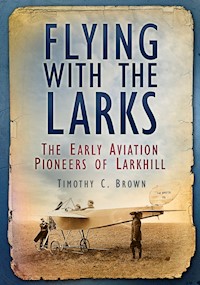
In 1903 the Wright Brothers achieved their dream of powered flight and from then on man's domination of the skies became a reality. The military potential of aircraft was obvious from the outset, first as a way of spying on the enemy with reconnaissance planes and balloons armed with early cameras, and then as a way of taking the battle into the skies, as planes became weapons of war. In Britain these early days of military aviation were pioneered by a group of enthusiastic civilians and military men who were based at Lark Hill, Wiltshire where the rolling plains became ideal flying grounds. Here, the first military aviation base came into existence. Flying with the Larks charts its early days and its influence on First World War aviation.
Sie lesen das E-Book in den Legimi-Apps auf:
Seitenzahl: 327
Veröffentlichungsjahr: 2013
Das E-Book (TTS) können Sie hören im Abo „Legimi Premium” in Legimi-Apps auf:
Ähnliche


















‘A new era in society will commence from the moment that aerial navigation is familiarly realised’
Sir George Cayley, Aeronautical Experimenter 1773–1857
This book is dedicated to the aviation pioneers, who lost their lives at Lark Hill and elsewhere, in the furtherance of British aviation, up to and including the outbreak of the First World War in 1914.
CONTENTS
Title Page
Epigraph
Dedication
Preface
Introduction
1. Soaring like an Eagle
2. Second to None
3. The Hill of Larks
4. The British & Colonial Aeroplane Company
5. Lark Hill Manoeuvres, 1910
6. The Position of the Sun Gap
7. The First Military Aeroplanes Arrive
8. Bristol Flying School
9. The Air Company
10. The Circuit of Britain Air Race, 1911
11. Developments within BCAC
12. Back on Manoeuvres
13. A Race to the Death
14. Formation of the Royal Flying Corps
15. Central Flying School
16. The Story Behind ‘Airman’s Cross’
17. British Military Aeroplane Competition, 1912
18. The Parke Dive
19. And the Winner is …
20. Monoplanes Grounded
21. Business as Normal
22. The Move to Netheravon
23. For Valour
24. The Lark Hill Military Light Railway (LMLR)
25. Closure
Appendices
A. RAeC Certificates Awarded at Lark Hill, 1910–14
B. Competitors in the Circuit of Britain Air Race, 1911
C. Entrants for the Military Trials, 1912
D. Royal Flying Corps Personnel, 1914
E. Aeroplanes believed to have been at Lark Hill, 1909–14
F. RFC photographs, 1914
G. Formation of the RAF, 1918
H. The Lives of Key Personnel
I. Who was the First British Pilot?
Bibliography and Further Recommended Reading
Notes
Plate Section
Copyright
PREFACE
As I finish writing this book I cannot help but relate to one of the characters in Proust, who describes a piece he has written as mostly accurate and must surely be of some interest. In the knowledge that many other authors have written informative books on early aviation history in Britain, comprising both the first-hand recollections of people actively involved in this period, and later knowledgeable historical studies, the reader may wonder why I am setting out to compile yet another volume, and what I think I might contribute? The events I will be describing are focused around one location, which seems to have faded in our collective memory when compared to, say, Farnborough, Brooklands and Hendon; but a location that, in my opinion, plays at least as important a part in the early story as any of those sites. Perhaps my first motivation is that the events I intend to describe occurred around 100 years ago, and as I started this project we were approaching numerous centenaries, which as I write have passed by largely unnoticed.
I have been fascinated by aviation history since leaving school and joining the Fleet Air Arm. Thirty years later I moved to Wiltshire, and it has been very exciting for me to discover the aviation legacy that surrounds me here; the downside is a profound disappointment that little is being done to preserve that heritage. The knowledge that structures such as the aeroplane sheds at Lark Hill, the balloon sheds at Rollestone Camp, the Royal Flying Corps Officers’ Messes at Upavon and Netheravon, and the airfield water tower at Lake Down still exist, provides us all with a tangible link to those early days. But we must not be complacent. Recently, the RFC Officers’ Mess at Netheravon and its associated chalets have been closed and are now boarded up, the de Havilland hangars on the airfield there are in a sorry state of repair. As are the RFC hangars at Old Sarum, and the hangars of similar vintage at Yatesbury are scheduled for demolition. Having evidence of the pioneering aviation activities on hand is for many as thrilling as, say, visiting Stonehenge, Wilton House or Salisbury Cathedral. Lark Hill was a key site to the beginnings of aviation in Britain, and I hope you enjoy reading its story and will join me in ensuring we try not to forget about it.
For clarity I have adopted a few language conventions in my text. To preserve accuracy, and a sense of period, I have used original quotations where they are available and these have retained the original spelling and grammar. In English vocabulary there are many words to describe flying machines, and perhaps the one in common-usage today, ‘aircraft’, is the most generic term. Balloons, gliders, and airships are all ‘aircraft’ in the broader sense. I prefer ‘aeroplane’ to the American ‘airplane’ when describing fixed-wing powered flying machines, and have used ‘aircraft’ only when a more general term is appropriate. The contemporary spelling ‘Lark Hill’ is used, except when referring to the present-day Army garrison, as the single-word version ‘Larkhill’ did not come into common usage until 1919 after the airfield closed. Likewise, ‘Hangar’ originates from a French word meaning a store, and was not in general use during the period in question, so I use ‘shed’ which is more chronologically correct. Debate raged at the beginning of the twentieth century over the correct use of the word ‘aerodrome’. The American Samuel Langley first coined the term for a flying machine not for a field for flying. ‘Airfield’ has been used throughout, as this seems an entirely appropriate description. Early airfields did not have runways per se, the term ‘flying ground’ denotes the manoeuvring area where take-offs and landings take place. Finally, I have followed the standard convention of adding the ‘RN’ suffix to distinguish the naval ranks of Lieutenant and Captain from Army ranks of the same name; and would remind readers that Captain RN is equivalent to Colonel, whilst Lieutenant RN is the equivalent of an Army Captain.
As my reading and research has progressed I have inevitably discovered many discrepancies and variations in the stories told, and unravelling them has been an impossible task. I feel sure there will be passages in my text that some readers will be adamant I have got wrong. My dilemma was that if I used solely corroborated facts it might render the story bland and uninteresting. Wherever possible, details have been checked and either the most reliable, or in my mind logical, version has been used. I realise, of course, that in retelling the story that way I may be creating more controversy, or simply adding to this confusion and apologise if that is indeed the case.
In preparing this account I have drawn on many sources, several of which warrant particular mention. Firstly, Wings over Wiltshire by Rod Priddle is a book that describes the history of aviation sites in the county. This monumental piece of research reminded me of stories I thought I had forgotten, and introduced me to many, many more. I can categorically state that reading Rod’s book provided me with the inspiration to research further and it was the stepping off point for this work. Next I was led to the Flight Global website. Flight magazine has been the leading aviation industry publication for many years, and they are rightly proud of our aviation heritage. Their website makes it possible to view back copies dating from January 1909 (when it was launched as the journal of the Aero Club of the United Kingdom). It is fascinating to be able to read contemporary accounts of key events, and it gave me invaluable access to several rare photographs that have brought this account to life. I am very grateful for the permission from Flight Global to reproduce photographs from this resource. The third source I will single out is Malcolm Hall’s book From Balloon to Box Kite. This immensely readable account is packed full of accounts and anecdotes, and describes the evolution of military aviation in the Royal Engineers in a level of detail missing in many other books. Finally, Peter Reese’s biography of Samuel Cody, The Flying Cowboy, is extremely well written and puts the story of Britain’s first airman straight.
I must mention my colleagues Ted Mustard and Roger Green. They introduced me to a very knowledgeable local historian, Norman Parker, and the Amesbury Aviation Heritage Centre, and were able to persuade me to join their small National Trust team leading guided walks around the aviation sites surrounding Stonehenge. I am grateful to the author Ray Sangar for his advice and guidance both about the subject and publishing in general, and for access to his own extensive library of books and photographs. My thanks go to Peter Capon, the archivist at the Museum of Army Aviation, Middle Wallop; to Capt. Geoff Bowker RN for his encouragement, and for putting me in touch with Air Cdre Bill Croydon CBE RAF(Retd), a knowledgeable expert on Eastchurch airfield, who previewed my early text and kindly allowed me access to his article on John Dunne. Thanks are due to Jimmy Fuller for permission to use so many of his grandfather’s images, to Sir George White, great-grandson of the founder of the Bristol Aeroplane Company, and David Dickson for their support and materials. Thanks also to Prof. Duncan Greenman of the Bristol Airchive for permission to use company photographs in his keeping. Finally thanks to Lucy Evershed at the Stonehenge Landscapes Estate Office and Grant Berry in the National Trust Offices at Swindon for their support and enthusiasm in the early stages that helped get this project off the ground. My wife, Lesley, deserves a mention for the patience she has shown during the hours I have spent in front of my iMac, and her forbearance when I have talked about my ‘exciting discoveries’ and the odd artefacts I have collected.
I have included a full list of sources and other recommended reading at the end of this book, and made efforts to obtain permission to use copyrighted material. I offer my apologies for any omissions or oversights in this respect, and I ask forbearance in such matters. I would be pleased to give credit, make the necessary acknowledgements and, if so required, delete any material used inappropriately from any future edition.
Timothy Brown
Staverton, 2012
INTRODUCTION
Salisbury Plain is a large area of chalk escarpment in southern central England, covering approximately one-tenth of the county of Wiltshire. Within the Plain sits the largest military training area in Britain. Although the British Army is proud of its long history and traditions, its permanent link with the Plain began relatively recently. On 25 March 1897, The War Office1 completed the purchase of 750 acres of land – on which now sits Bulford Camp – from Miss J. Seymour of East Knoyle, for the sum of £7,500. Over the next five years a further 40,000 acres (approximately 16,000 hectares) were purchased for around £550,000. One hundred years later, the Ministry of Defence owns some 92,000 acres on Salisbury Plain, an area of land equivalent in size to the Isle of Wight and estimated to be worth around £167 million.
Army balloon outside Bristol Flying School shed, c.1912. (J. Fuller)
Training areas will normally accommodate a wide range of activities, and among those conducted on Salisbury Plain from the outset was ballooning. Tethered balloons filled with either hydrogen gas, or sometimes coal gas, were raised as observation platforms for reconnaissance and used to spot the fall of artillery shells. The Warminster Journal describes such training, and provides us with one of the earliest references to Lark Hill in the context of aeronautical work when it reported in 1909, ’Experiments in shell firing at balloons will begin early this month on Salisbury Plain … The 12th Brigade RFA and No.2 Balloon Company RE proceeded to Salisbury Plain from Aldershot … in connection with the firing. The Balloon Company will go into camp at Durrington while the howitzer batteries will join the practice camp at Lark Hill … ’2
In fact, at that time the Army had been working with observation balloons for over twenty-five years. The Royal Engineers had opened the Balloon Equipment Store at Woolwich, and began constructing balloons on an experimental basis. Capt. James Lethbridge Brooke Templer, a militia officer serving with The Rifles, was given approval to construct a balloon. Its first flight was over Woolwich on 23 August 1878. Two years later the School of Ballooning had opened at Chatham in Kent. By 1887, Templer was appointed as Instructor in Ballooning on a salary of £600, and had acquired, at personal expense, training grounds near Maidstone. In 1890 the school relocated to Stanhope Lines at Aldershot and was established as a permanent unit. The War Office began to deploy balloon sections to conflicts in Bechuanaland (now Botswana) and Sudan during the latter part of the nineteenth century, but these forays were poorly funded and ineffective. The second Boer War proved to be a turning point. Thirty balloons that were sent to South Africa in 1899 were well utilised. A first-hand account written by John Lane, a Boer soldier on the receiving end, gives clear evidence of the effectiveness of balloon observation and the demoralizing effect they could have. Lane writes of how, on sighting a British balloon over their positions, ‘Some follows shouted to me to hide away … it does not matter now, its all up, they will be able to find out every hole we are in and will pour in a hell of shells.’3 A balloon section was present at the siege of Ladysmith, continuing operations until it ran out of gas.
The problem with gas-filled balloons was they could only be launched, and operate, in the lightest winds. The solution was thought to lie in airships and man-lifting kites, the latter actually thriving in stronger wind conditions; however, it was the development of another type of aircraft at the start of the twentieth century, the powered aeroplane, that would put a rather isolated corner of Salisbury Plain, known by locals as The Hill of Larks, onto the map.
Throughout the nineteenth century, various experimenters strived to achieve man’s long-held ambition to fly. It will be well known that in 1903, whilst the War Office was acquiring land on Salisbury Plain, Wilbur and Orville Wright, two bicycle makers from Ohio, and their oft forgotten mechanic Charles Turner, were getting closer to building a successful powered flying machine. The brothers had been fascinated by flight since childhood when, one day in the 1870s, their father brought home a flying toy helicopter. And it was around 1898 or 1899 that they began conducting serious research and experiments with gliders, hoping, in due course, to be able to fit one with a small engine and so enjoy unrestricted flight. They designed and built their own 8hp motor, which drove a propeller they had had made in their workshop beside their home in Dayton. Based on the recommendation of their friend, fellow experimenter and confident Octavus Chanute4, they chose to conduct their experiments in North Carolina, where they were advised they could expect strong and constant winds. When they wrote to the Postmaster on the small island of Kitty Hawk, enquiring whether it was a suitable area, he confirmed that, ‘The sand hills were round and soft, well fitted for boys playing with flying machines.’5
The Wright brothers’ work culminated there on 17 December 1903, where from sand dunes beside the Atlantic ocean known as Kill Devil Hills, Orville took off at 10.35 a.m in a machine the brothers termed a powered flyer, but which the Daily Mail naively announced to its British readership as a ‘balloonless airship’. That first flight lasted only twelve seconds, and covered a distance less than the wingspan of a Boeing 747 airliner. However, by the end of the day the brothers had each flown twice, and on one occasion had been airborne for almost a minute and flown a distance of around 850ft. Their last flight was made in testing winds of around 25kts but, unfortunately, like so many early flights, ended with a heavy landing that damaged their flyer. Nevertheless, their work that day entered the record books, and so began a chain of work and further development that would shape mankind’s progress through the twentieth century, and ultimately affect the lives of every person who would live on the planet in some way or another.
No.3 Sqn RFC Bristol Prier-Dickson monoplane at Lark Hill, c.1912. (J. Fuller)
Today, in Wiltshire, a few hundred yards south of an unclassified road known as The Packway, that runs between the villages of Durrington and Shrewton, stand five large corrugated iron sheds (Grid Reference: SU144437). Currently used to store surplus Army furniture, these listed structures, and a small stone memorial nearby, are the only visible evidence marking the site of Lark Hill airfield. This airfield had a short life from 1909-14, and in that time it was used by both military and civilian aviators. But by 1913, when the Royal Flying Corps was just one year old, most of the military activities had relocated elsewhere, and before the start of the Great War the airfield closed altogether. In the five years it had been in existence, Lark Hill was the location of one of the first flying schools in Britain, where many aviation pioneers learnt to fly, and the site where important trial and development work was undertaken. It lays claim to being Britain’s first military airfield and was also home to the first British military fixed-wing aeroplane squadron.
1
SOARING LIKE AN EAGLE
In 1903, news of the Wright brothers’ successful flight broke slowly. It is believed that the first report came via a telegraph operator who had intercepted a message the brothers sent to their father telling of their achievement. The message read, ‘Success four flights Thursday morning started from level with engine power alone … inform press … home Christmas’.1 The story reached a local newspaper, appropriately called the Virginian Pilot, on 18 December 1903, and they published a small news item that was picked up the following day by The Washington Post, under the somewhat extravagant headline ‘Soaring Like an Eagle’.
With hindsight, one might imagine the news of the first successful powered flight would be a massive scoop, however, at the time it almost passed by a sceptical public unnoticed. Many simply refused to believe the story, claiming flight was impossible or that it was a hoax; there were many more whom, whilst accepting the possibility of flight, saw it as mere folly and saw no value in its pursuance. Field Marshal Sir W.G. Nicholson, a British Army officer (who would become Chief of the Imperial General Staff 1909-12), was one of the latter school. An outspoken gentleman, he is said to have once proclaimed, ‘Aviation is a useless and expensive fad advocated by a few individuals whose ideas are unworthy of attention’,2 and Nicholson remained convinced that aeroplanes would be worthless as means of scouting, as it would surely be impossible to accurately observe activity on the ground whilst travelling at ‘high speed’ through the air. Nicholson’s statement, like others who later rejected the personal computer, and the decision not to sign up The Beatles, has gone down in history as profoundly wrong. Nevertheless, among those who shared his belief was the then editor of The Times Engineering Supplement. When Alliott V. Roe3 wrote to the paper in February 1906 his letter was dismissed as a cheap attempt to publicise Roe’s fanciful aeronautical experiments. Some months later the paper deigned to print Roe’s letter, but famously added the following caution; ‘All attempts at artificial aviation are … dangerous to human life (and) foredoomed to failure from the engineering standpoint.’4
Lt Col John Capper and Katherine Wright. (Flight)
Thankfully not everyone had such negative views. John Capper was a Lieutenant Colonel in the Royal Engineers. Capper was fascinated by the potential of heavier-than-air flying machines, and although he was once given the nickname ‘Stone-age’ by junior officers for his Luddite tendencies, this comment on his personality now appears quite undeserved. He had first experienced ballooning whilst training on Salisbury Plain, and in May 1906 was appointed Commandant of the Balloon School at Farnborough. In this role he would play a significant part in the start of aviation in Britain. Shortly after taking up that post he was invited to speak at the Royal United Services Institute where he told his audience: ‘In a few years we may expect to see men moving swiftly through the air on simple surfaces just as a gliding bird moves …’ 5
Capper’s involvement with aeroplanes began when he was asked by his commanding officer, now Col James Templer, to visit the St Louis Universal Exposition, or World’s Fair, in October 1904. The fair would include an International Aeronautical Congress, so Templer asked Capper to go along and see if there was anything of interest. Aware of the Wright brothers’ achievement, and realising this was an opportunity not to be missed, Capper obtained a letter of introduction to them from a mutual friend, Patrick Alexander, before he set sail for America with his wife Edith. Whilst Capper’s subsequent dealings with the Wright brothers have no direct relevance to the Lark Hill story, the difficult negotiations that follow over the next few years sets the scene for early aviation development in Europe, and, therefore, is an appropriate starting point of our story.
Britain was a world leader in balloon technology, so unsurprisingly Capper found little of interest in St Louis. He took leave with Edith for Ohio, where they received a congenial welcome from the Wright family. John and Edith got on remarkably well with Wilbur and Orville, their sister Katharine and father Milton, and they immediately became good friends. The Cappers were invited to stay with the Wrights at their home in Hawthorn Street, Dayton, where the brothers engaged John, exhaustively talking about their experiments.
They allowed him to read eyewitness accounts of their flights and showed him photographs of the flyer airborne. Capper could not fail to be impressed, later describing the brothers as well-educated men and capable mechanics; he did not for a moment think it strange he had not been shown the actual machine, as he was told it had been dismantled and was in storage.
Several sources claim that during this visit the Wrights made Capper an offer to work solely for the British Government, however, in his book Miracle at Kitty Hawk: The Letters of Wilbur & Orville Wright, Fred C. Kelly confirms it was Capper who made the approach, asking the brothers to make his government some kind of proposal. Orville had already described their first flights as, ‘very modest compared with that of birds’6 and he and his brother realised there was still a lot of work to do and improvements to make before their flyer was commercially viable, so they informed Capper they were not yet ready to talk business. The brothers set to work improving their machine, refining their piloting skills, and increased the flight distance and duration markedly. In January 1905 the brothers wrote to Capper saying, ‘We are ready to enter into a contract with the British Government to construct and deliver to it an aerial scouting machine of the aeroplane type …’ they added, ‘if you think it probable that an offer … would receive consideration from your Government at this time, we will be glad to give further consideration to matters of detail.’7 This approach has been wrongly interpreted as an offer to deal solely with the British Government. Nine days after posting their letter to Capper, and timed carefully so as to arrive at precisely the same time, the Wrights wrote to the U.S. Government. The letter said:
During the year 1904, one hundred and five flights were made at our experimenting station, on the Huffman prairie, east of the city; and though our experience in handling the machine has been too short to give any high degree of skill, we nevertheless succeeded, toward the end of the season, in making two flights of five minutes each, in which we sailed round and round the field until a distance of about three miles had been covered. The numerous flights have made it quite certain that flying has been brought to a point where it can be made of great practical use in various ways, one of which is that of scouting and carrying messages in time of war. If the latter features are of interest to our own government, we shall be pleased to take up the matter either on a basis of providing machines of agreed specification, at a contract price, or of furnishing all the scientific and practical information we have accumulated in these years of experimenting … 8
The Wright brothers had previously discussed making such an offer with their Congressman, Robert M. Nevin, and he had in turn agreed to personally recommend their proposal to the War Department. Unfortunately, Nevin was ill when the brothers’ letter arrived and his staff passed it directly to the Secretary of War, Congressman William H. Taft. He mistook this apparently unsolicited approach as a request for funding for experiments, and sent back a stock letter of rejection, not once but twice. The rebuff shocked the brothers, and when they were discussing it with Chanute he offered to take up the matter with President Jefferson, who he knew personally. But, on 1 June 1905, Wilbur informed Chanute, ‘It is no pleasant thought that any foreign country should take from America any share of the glory of having conquered the flying problem… it has been for years our business practice to sell goods to those who wished to buy, instead of trying to force goods upon people who did not want them. If the American government has decided to spend no money on flying machines… we are sorry, but we cannot reasonably object. They are the judges.’9 Their letter to Britain had indeed been more enthusiastically received. Capper had shown it to his superiors at Aldershot, who in turn passed it swiftly onto the Army Council in Whitehall. They proposed that Col Hubert J. Foster, the British Military Attaché in Washington, should visit the brothers and observe a flight. The council wrote back to the Wright brothers, requesting they make a definitive offer, and instructed Foster to make the necessary arrangements. But the letter to Foster arrived when he was away from his desk on duty in Mexico, and he did not receive it until some months later. When he eventually spoke to Wilbur on 18 November 1905 he learnt that the brothers were not prepared to demonstrate their machine, or even allow anyone to set eyes upon it, until the British Government had signed a binding contractual agreement.
On first encounter this seems an unlikely demand, and many have been puzzled by Wilbur’s intransigence. The brothers have been accused of not wanting to sell their invention and in the process holding back aviation development for years. Undoubtedly, Wilbur and Orville were guarded, and it might be said that they were protective, but they were not secretive. They invited the local communities to come out and witness their flights; they even welcomed newspaper reporters to attend on the understanding that no photographs were taken. They did insist any written reports should not be sensationalist, but this was a safety precaution to avoid attracting overlarge crowds, rather than a reluctance to show their work. This suggests that the men knew the value of their invention, but fully realised other ambitious aviators would be quite willing to steal their ideas. Indeed, their own government had previously shown, on several occasions, a willingness to purloin any innovative design, leaving the rightful owner no recourse other than legal action – a lengthy and costly process that the brothers knew they could not afford. They had applied for a patent for their invention on 23 March 1903, but two years later it had still not been granted. In fact, U.S. Patent No. 821393 was not issued until 22 May 1906, and then, owing to an oversight in their original application, it covered the system for operating the control surfaces of their flyer rather than the whole aeroplane and so gave little overall protection to their invention. When the reader learns that, despite their reticence, the brothers would subsequently enter into at least eleven legal actions for patent infringements, the cautious attitude they maintained towards their work may be better understood?
Wilbur and Orville Wright preparing for a flight. (Flight)
Unable to advise under precisely what terms they might sell a machine to the War Office, Wilbur and Orville suggested they would stage a demonstration and set their fee on the basis of £50 per mile flown. In Britain, there were rumours the brothers were preparing their machine for a 500-mile flight, and so it was assumed the final price might be as much as £25,000. Although this distance would have been a reasonable goal to demonstrate the viability of their flyer, the truth is the brothers were some way from achieving it at that time. Of the many flights they conducted in 1904 their longest was just five minutes and four seconds, and although improvements were being made during 1905, the best flight they achieved that year was still only thirty-eight minutes in duration and covered just 24 miles – a long way short of the alleged goal. However, the detractors continued to press the point, along with their view that a British aeroplane could be built for a fraction of the ‘assumed’ cost. So, in February 1906, without a firm offer being put on the table, the Director of Artillery, Colonel Charles Hadden, wrote to the brothers rejecting their proposal. Undaunted, Wilbur and Orville contacted the governments of Germany, Italy, Russia, Austria, France and Japan, before writing again to Britain in May 1906. This second approach resulted in a meeting with Foster’s replacement, Colonel Albert E. Gleichen the following August. The brothers answered Gleichen’s questions frankly and suggested they would be willing to sell the British Government an aeroplane for 100,000 dollars, plus a similar amount for their services, scientific knowledge and experimental results, and would continue to work for a further four years (the sum expected was around £40,000 at the prevailing rate of exchange). Upon hearing this, their compatriot Chanute commented that he thought their price was very high. Gliechen submitted his report to the War Office, who in turn passed it onto Capper, with the following comment, ‘The accompanying letters from the Wright Cycle Co. Ltd, and the military attaché Washington, are forwarded for your remarks, but there appears to be no probability of approval being given for the expenditure of the large sum asked for.’10 Considering the enthusiasm he had once shown, Capper’s response was surprising; ‘There appears to be little doubt that the machine has done all the brothers claim for it … (but) I cannot think that a machine so limited in capacity can have great practical value except as leading to the building of better ones and therefore the purchase would be of no great assistance to us.’11 It is, however, worth noting these decisions were being made against the background of a Liberal Government who had just defeated the Conservatives in the December 1905 General Election, with a manifesto promising to exercise strict economy in the field of defence expenditure.
As well as their dealings with the War Office, the Wright brothers had approached the Admiralty in the hope that the Royal Navy might also be interested in procuring a flyer. However, having consulted with his expert advisors Lord Tweedmouth, the First Sea Lord, wrote back thanking the brothers for their proposal, but saying that the Admiralty Board had, after careful consideration, arrived at the conclusion that their aeroplane would not be of any practical use to the Royal Navy. The Wright brothers became distracted by all these negotiations and stopped all experimentation. They did no flying from 1906 until they had negotiated an agreement with the French Government and staged flying demonstrations with their Wright Model A Flyer, a development of their original machine, during the summer of 1908.
2
SECOND TO NONE
Capper’s loss of confidence in Wilbur and Orville might be explained by another reason. Since 1905 he had become deeply involved in aviation experiments in Britain and had gone on record as saying, ‘We must do our utmost to build successful machines ourselves and learn their use’1; a proposal that would undoubtedly enhance the international reputation of the Balloon Factory and British aviation in general. In 1903, Capper had met a larger than life character by the name of Samuel Franklin Cowdery (aka Samuel ‘Colonel’ Cody). Cody first came to Britain several years earlier to sell horses to the Army. He met and fell in love with his agent’s married daughter, Lela. Cody returned to Britain several times, before persuading his wife Maud to travel with him and set up home permanently here. Cody was now styling himself on William ‘Buffalo Bill’ Cody; he had adopted the surname and established a spectacular touring show, in which he demonstrated his sharp-shooting skills and horsemanship, whilst Lela would be hoisted hundreds of feet above the audience in a basket suspended from a string of kites.
Samuel F. Cody. (Flight)
The first reference to Cody’s kite flying was a record of a demonstration he staged at Houghton House, Carlisle in April 1899, which was reported in the local press. It is stated, ’He flew kites of immense size and square shaped, sent up in tandem fashion one after another on strong steel piano wire. The third or fourth kite had a seat slung from it in which a man sat.’2 In 1901 Cody contacted the War Office offering to demonstrate the military potential of his kites. He was not completely unknown to them, having written to them during the Boer war, offering to train snipers for the British Army, but this proposal was rejected as he was not a British subject. In this second approach, Cody wrote, ‘I believe I possess certain secrets which could be of use to the government in the way of kite flying.’3 However, the letter appears to have remained in the army’s pending files. On 5 September 1902 Cody set a kite altitude record of 14,000ft, and, after competing in the International Kite Trials near Worthing, was elected a member of the Aeronautical Society of Great Britain. Another gentleman similarly honoured and attending the same enrolment ceremony, was Col Capper. This was the first time the two men had met.
Ever the experimenter, Cody completed a crossing of the English Channel in a canoe towed by a kite on 6 November 1903, and asked to demonstrate a ‘man-lifter’ kite to the Royal Navy. The trials were held at HMS Excellent on Whale Island, Portsmouth, but despite being impressed the Admiralty was hesitant. It did, however, suggest to the War Office that the kites might have military value, and shortly afterwards Cody was invited to the Balloon Factory at Farnborough.4 This demonstration was witnessed by Capper, who wrote, ‘I recommend that one set of man-lifting and one set of signal kites be purchased from Mr Cody … [he] is perhaps the greatest living expert in the art of kite flying [and] should be employed as an Instructor for at least three months.’5 Capper’s recommendation was accepted and the War Office appointed Cody as the Chief Kite Instructor on a salary of £50 a month in the spring of 1905.6 In accepting this position, Cody had to give up his Klondyke Nugget shows and the quite lucrative theatre appearances. He was also required to surrender the patent for his kites, although it would be more than seven years before he received payment for these, and only then by recourse of the law courts.
Officers of the Balloon Factory 1907. Front row: Lt John Dunne, Lt Col Capper and Samuel Cody. (Unknown)
Despite this, Cody enjoyed working with Capper and the resources that were made available to him at Farnborough. He shared the colonel’s dream of powered flight, and was working along similar lines to the Wright brothers i.e. a belief that the secret to successful powered flight was to have first mastered proper control of the glider. Cody’s experiments went well. Army personnel were soon airborne in kites that, on reaching an appropriate height, were released from their cables so the pilot could glide freely back to the ground. In 1906 Cody stated, ‘I do not wish to assert that I have produced a flying machine in the full sense but … I hope at no distant date to play an important part in the complete conquest of the air.’7 All he needed now was a suitably powerful, but lightweight, engine.
It should not be surprising to learn that Cody, as an employee at the Balloon Factory, had also been working on an airship known as British Army Airship No.1. Capper had initiated this project with the intention of staging an attention-grabbing flight in response to the news that the former German general, Count Zeppelin, was building and flying dirigibles (airships) over Lake Constance. Cody had been drafted in to help. He stopped his aeroplane experiments and, with funding from The Royal Engineers’ Committee, travelled to Paris where he bought a small marine engine from the Antoinette Company for £550. This was brought back to Farnborough and fitted to the airship they were constructing, which had been given the name Nulli Secundus (Second to None) by HRH King Edward VII. Having spent the morning of 5 October 1907 ensuring they were ready for flight, the airship took off at 11.00 a.m., their destination was London, 40 miles away. Cody sounded a klaxon as they approached the outskirts of the city, lest anyone failed to notice the large airship cruising at a speed of around 25kts at a height of 800ft above the ground. They literally did ‘stop traffic’ in the capital for about half an hour. After passing the Crystal Palace and Hyde Park, the airship flew low over Buckingham Palace and onto Whitehall, where they saluted notable members of the Army Council who had gathered on the roof of the War Office, before heading east towards St Paul’s Cathedral, which they orbited several times. But when they turned for home, high winds slowed their progress and the crew decided to land on the cycle track near Crystal Palace. The airship remained there for a few days when, on the grounds of safety, it was decided to dismantle it and return it to Farnborough by road. In the process of dismantling, its precious and delicate ‘goldbeaters skin’ gas envelopes were irreparably damaged.
The airship Nulli Secundus orbits St Paul’s Cathedral, 5 October 1907. (Author’s collection)




