


1,99 €
Mehr erfahren.
- Herausgeber: Publisher s13381
- Kategorie: Geisteswissenschaft
- Sprache: Englisch
Ford Madox Brown (1821 – 1893) was a French-born British painter of moral and historical subjects, notable for his distinctively graphic and often Hogarthian version of the Pre-Raphaelite style. Arguably, his most notable painting was Work (1852–65). Brown spent the latter years of his life painting the Manchester Murals, depicting Mancunian history, for Manchester Town Hall. (1821 – 1893) was a French-born British painter of moral and historical subjects, notable for his distinctively graphic and often Hogarthian version of the Pre-Raphaelite style. Arguably, his most notable painting was Work (1852–65). Brown spent the latter years of his life painting the Manchester Murals, depicting Mancunian history, for Manchester Town Hall.
Das E-Book können Sie in Legimi-Apps oder einer beliebigen App lesen, die das folgende Format unterstützen:
Veröffentlichungsjahr: 2017
Ähnliche




















Ford Madox Brown
Selected Paintings
By Hayward Macrae
––––––––
First Edition
*****
Copyright © 2017 by Hayward Macrae
Table of Contents
Title Page
Copyright Page
Foreword
Paintings
Foreword
Ford Madox Brown (1821 – 1893) was a French-born British painter of moral and historical subjects, notable for his distinctively graphic and often Hogarthian version of the Pre-Raphaelite style. Arguably, his most notable painting was Work (1852–65). Brown spent the latter years of his life painting the Manchester Murals, depicting Mancunian history, for Manchester Town Hall.
He first exhibited at the Royal Academy in 1840, a work inspired by Lord Byron's poem The Giaour and then completed a version of The Execution of Mary, Queen of Scots, with his cousin and future wife Elisabeth Bromley as one of his models. He lived in Montmartre with his new wife and aging father in 1841. He painted Manfred on the Jungfrau, inspired by Lord Byron's poem Manfred while he was in Paris.
In 1843 he submitted work to the Westminster Cartoon Competition, for compositions to decorate the new Palace of Westminster. His entry, The Body of Harold Brought before William, was not successful. His early works were, however, greatly admired by the young Dante Gabriel Rossetti, who asked him to become his tutor. Through Rossetti, Brown came into contact with the artists who went on to form the Pre-Raphaelite Brotherhood. Though closely linked to them, he was never actually a member of the brotherhood itself, but adopted the bright colours and realistic style of William Holman Hunt and John Everett Millais. He was also influenced by the works of Holbein that he saw in Basel in 1845, and by Friedrich Overbeck and Peter Cornelius, whom he met in Rome in 1845-46.
Brown struggled to make his mark in the 1850s, with his paintings failing to find buyers, and he considered emigrating to India. In 1852 he started work on two of his most significant works.
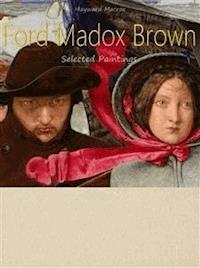
One of his most famous images is The Last of England, painted from 1852 to 1855. It depicts a pair of stricken emigrants as they sail away on the ship that will take them from England forever. It was inspired by the departure of the Pre-Raphaelite sculptor Thomas Woolner, who had left for Australia. In an unusual tondo format, the painting is structured with Brown's characteristic linear energy, and emphasis on apparently grotesque and banal details, such as the cabbages hanging from the ship's side. The husband and wife are portraits of Brown and his second wife Emma.




