


46,99 €
Mehr erfahren.
- Herausgeber: John Wiley & Sons
- Kategorie: Fachliteratur
- Sprache: Englisch
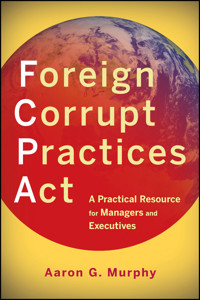
A thoroughly pragmatic guide to the U.S. Foreign Corrupt Practices Act (FCPA) This is a critical FCPA training resource for executives, managers, sales, marketing, finance and accounting personnel, as well as high level professionals. * The ideal resource for any business that takes FCPA compliance seriously and truly desires to foster a deep understanding of real-world corruption issues in their employees * A great resource for business school courses on international business or business ethics and anyone interested in understanding these issues for their own professional growth * Includes in-depth analysis of all major FCPA risk areas, including discussions of how FCPA issues arise in real-world business situations * Covers all aspects of bribery and FCPA compliance issues to ensure that your business is not exposing itself to financial scandal or criminal prosecution FCPA compliance is mandatory for nearly all international businesses operating in today's global economy. This book serves as the perfect training tool to mitigate your organization's risk to FCPA violations, which is one of the top enforcement priorities for the Department of Justice (DOJ) and the Securities and Exchange Commission (SEC).
Sie lesen das E-Book in den Legimi-Apps auf:
Seitenzahl: 395
Veröffentlichungsjahr: 2010
Ähnliche


















Contents
Cover
Praise
Title Page
Copyright
Dedication
Disclaimer
Foreword
Acknowledgments
Introduction: Who is This Book For?
Chapter 1: Basics of the Foreign Corrupt Practices Act
“Anything of Value” Can Be Considered a Bribe
The Corrupt Motive Problem: Don't Assume—Run It Up the Chain
Foreign Officials and Discretionary Authority
You Don't Need to Make the Payment—A Mere Offer or Promise Is Good Enough
It Doesn't Matter if the Bribe Works: The Focus Is on the Intent of the Giver, Not the Effect on the Recipient
The FCPA Applies to All U.S. Citizens—Anytime, Anywhere
“Defenses” That Don't Work
Chapter 2: What's the Big Deal? Billion-Dollar Fines and Jail Time
Important Lessons from Siemens: They Don't Need to Prove Bribery—Books and Records Violations Are Enough
Getting Thrown under the Bus: Understanding the Dynamics of Internal Investigations
A Little “CYA” Goes a Long Way
People Really Do Go to Jail
Chapter 3: You Do More with the Government Than You Think
Interactions with Customs
Interactions with Tax Authorities
Licensing, Inspections, and Specifications
Reducing Fines and Stopping Government Investigations
A Note on Foreign Litigation
Chapter 4: Know Your Customers and Suppliers: The Dangers of State-Owned Entities
Privatization of Former Government Agencies or Companies
Traditionally Controlled Industries
Businesses Owned by Individual Foreign Officials
A Note on Payments
Chapter 5: Guess Who's Coming to Dinner? The Dangers of Meals and Entertainment
Wining and Dining Customers
Be Attentive to the Costs
The Dangers of Entertainment
The Problem of the Fake Receipt
High-Risk Accounting Areas
Chapter 6: Ensuring That Business Trips Really Are for Business
Ensuring a Proper Business Purpose
Ensuring the Expenses Are Related to the Business Purpose
The Government Really Does Bring These Cases
Chapter 7: Gifts That Give Back
“Maintaining” Your Relationship with the Government
Donations
Support for Family Members of Foreign Officials
Chapter 8: Know Your Agents and Consultants
General Risks of Consultants and Third Parties
Who Are They? Due Diligence on Third Parties
What Are They Doing? Contracting with Third Parties
Typically High-Risk Engagements
The Sham Consultant
The Vaguely Understood or Unexplained Consultant
Distributors and Buy/Sell Arrangements
Dual Roles: Government Officials Moonlighting as Consultants
Chapter 9: So What Can You Do? Facilitating Payments and Other Exceptions
Things You Clearly Can Pay For
What a Facilitating Payment Is and Is Not
Promotional Expenses
Affirmative Defense for Actions That Are Legal under the Written Laws of the Local Country
Shakedowns and Threats
Chapter 10: Keeping Good Records and Maintaining Good Procedures
The Metaphysics of Record Keeping
Fake Documentation
What Are Internal Controls?
Good Records and Controls Can Keep You Out of Jail
Chapter 11: Are You Buying a Problem? Due Diligence in Acquisitions and Government Contracts
Tag, You're It: How Other People's Problems Become Yours
The Halliburton Opinion
Chapter 12: Time Off for Good Behavior: Why Compliance Matters
Good Compliance Programs Affect Charging Decisions
Good Compliance Programs Reduce Sentences
Appendix 1: Anti-Bribery, Record-Keeping, and Internal Controls Provisions of the Foreign Corrupt Practices Act
15 U.S.C. § 78m. Periodical and other reports
15 U.S.C. § 78dd-1 [Section 30A of the Securities & Exchange Act of 1934]
15 U.S.C. § 78dd-2. Prohibited foreign trade practices by domestic concerns
15 U.S.C. § 78dd-3. Prohibited foreign trade practices by persons other than issuers or domestic concerns
15 U.S.C. § 78ff. Penalties
Appendix 2: Relevant Provisions of the Principles of Federal Prosecution of BusinessOrganizations
United States Attorneys Manual Section 9-28.800
Appendix 3: Excerpts from the Federal Sentencing Guidelines Manual
Chapter Eight—Sentencing of Organizations
Part B – Remedying Harm From Criminal Conduct, and Effective Compliance and Ethics Program
Part C—Fines
About the Author
Index
Praise for Foreign Corrupt Practices Act: A Practical Resource for Managers and Executives
“Aaron Murphy's book is absolutely fantastic. As a seasoned lawyer and compliance professional, having worked for Fortune 100 companies with global operations for many years and being an FCPA expert myself, I have never come across a more detailed yet easy to read book on FCPA. It contains practical advice and provides examples that are put into context, that the reader can easily relate to and that take into consideration different cultures and customs. A must-read for any individual/organization doing business abroad.”
—Fabiana Lacera-Allen, Senior Vice President & Chief Compliance Officer, Elan Drug Technologies
“This book is essential reading for anyone conducting business outside U.S. borders. Executives, managers, sales, marketing, finance, and legal professionals will find sound practical advice to protect themselves and their companies from FCPA violations when operating globally. Much more than a general survey, this book offers scores of real-world examples and serves as an easy-to-read, how-to resource for employees at all levels of a company. It will be a valuable reference tool for many years to come.”
—Jeff Taylor, former U.S. Attorney for the District of Columbia and former counselor to Attorneys General John Ashcroft and Alberto Gonzales
“If you are a manager involved in any kind of international dealings—which is to say, if you work for any major firm in today's global marketplace—you need to study Aaron Murphy's comprehensive, precise, and highly readable analysis of life under the Foreign Corrupt Practices Act (FCPA). Few FCPA violations are intentional, yet the consequences even of unwitting violations can be drastic for you, your colleagues, and your firm. Murphy's book shows why business practices perfectly acceptable at home are federal crimes in other settings, how to think your way through ambiguous situations, and—perhaps most important—when to get expert advice. It is a field guide to a world where authority and discretion are all too often up for sale, and a resource that will help you avoid trouble—and even succeed—within the bounds of this crucial yet little-understood legislation.”
—Michael Johnston, Charles A. Dana Professor of Political Science, Colgate University
“Every businessperson working in the emerging markets should read and understand the way in which their actions and behaviour may fall subject to the FCPA. This book is a great practical guide to a complex law.”
—Scott Lane, Principal and CEO, The Red Flag Group
“Most business managers have heard of the FCPA, but few truly understand the breadth of the FCPA as applied to real-world scenarios. Murphy, an FCPA practitioner with extensive real-world experience, provides an easy-to-read FCPA handbook for business managers. This book is essential reading for business managers looking to develop and implement risk management policies and procedures in this era of aggressive FCPA enforcement.”
—Professor Mike Koehler, Butler University, Editor-FCPA Professor Blog
Copyright © 2011 by Aaron Gregory Murphy. All rights reserved.
Published by John Wiley & Sons, Inc., Hoboken, New Jersey.
Published simultaneously in Canada.
No part of this publication may be reproduced, stored in a retrieval system, or transmitted in any form or by any means, electronic, mechanical, photocopying, recording, scanning, or otherwise, except as permitted under Section 107 or 108 of the 1976 United States Copyright Act, without either the prior written permission of the Publisher, or authorization through payment of the appropriate per-copy fee to the Copyright Clearance Center, Inc., 222 Rosewood Drive, Danvers, MA 01923, (978) 750-8400, fax (978) 646-8600, or on the Web at www.copyright.com. Requests to the Publisher for permission should be addressed to the Permissions Department, John Wiley & Sons, Inc., 111 River Street, Hoboken, NJ 07030, (201) 748-6011, fax (201) 748-6008, or online at http://www.wiley.com/go/permissions.
Limit of Liability/Disclaimer of Warranty: While the publisher and author have used their best efforts in preparing this book, they make no representations or warranties with respect to the accuracy or completeness of the contents of this book and specifically disclaim any implied warranties of merchantability or fitness for a particular purpose. No warranty may be created or extended by sales representatives or written sales materials. The advice and strategies contained herein may not be suitable for your situation. You should consult with a professional where appropriate. Neither the publisher nor author shall be liable for any loss of profit or any other commercial damages, including but not limited to special, incidental, consequential, or other damages.
For general information on our other products and services or for technical support, please contact our Customer Care Department within the United States at (800) 762-2974, outside the United States at (317) 572-3993 or fax (317) 572-4002.
Wiley also publishes its books in a variety of electronic formats. Some content that appears in print may not be available in electronic formats. For more information about Wiley products, visit our Web site at www.wiley.com.
Library of Congress Cataloging-in-Publication Data:
Murphy, Aaron G.
Foreign corrupt practices act: a practical resource for managers and executives/Aaron G. Murphy.
p. cm.
Includes index.
ISBN 978-0-470-91800-5 (pbk.); ISBN 978-0-470-93962-8 (ebk);
ISBN 978-0-470-93963-5 (ebk); ISBN 978-0-470-94865-1 (ebk)
1. Business ethics—United States. 2. Management—Moral and ethical aspects—United States. 3. Bribery—United States. 4. Corporations—United States—Corrupt practices. 5. United States. Foreign Corrupt Practices Act of 1977. I. Title.
HF5387.M8757 2011
658.1'20973—dc22
2010032316
For Jennifer, Max, and Viv.
This book represents many hours away from home.
I intend to make it up to each of you.
Disclaimer
This book does not provide legal advice, nor does it create an attorney-client relationship between the author or the author's firm and anyone owning, possessing, or reading this book. The examples used in this book either come from published cases or are based on amalgamations from the author's own experience, modified for illustrative purposes. Any similarities between examples used herein and any actual events are purely coincidental. Because the resolution of legal questions is always fact-specific, always consult your own legal counsel about your particular situation.
Foreword
Aaron Murphy has written a marvelous book on the increasingly complex and difficult challenges posed by the Foreign Corrupt Practices Act (FCPA). The FCPA, enacted in 1977, was a revolutionary statute that outlawed corrupt payments to foreign government officials at a time when such bribery was all too common and, indeed, not prohibited (and indeed in many cases facilitated by tax laws) in the home countries of many corporations, like Germany and Japan.
Over time, that landscape has slowly changed. Many governments, notably in the OECD, have enacted laws forbidding bribery. And just as importantly, some governments have significantly increased their enforcement efforts. For example, prosecutors in Germany led the way in pursuing the landmark case against Siemens, something that would have been unthinkable ten years earlier. Just this year, the United Kingdom enacted a new and broader anti-corruption law that it has promised to vigorously enforce. Both strong laws and vigorous enforcement are critical to ensuring continued progress against improper payments.
As Aaron vividly describes, the United States—through both the Department of Justice and the Securities and Exchange Commission—has led the way in ramping up its enforcement efforts. The number of recent FCPA prosecutions and the penalties imposed (including lengthy prison sentences for company executives) eclipse the figures seen in previous decades. This is one of many good reasons to read Aaron's excellent book.
The FCPA is at one level deceptively simple, prohibiting corrupt payments to non-U.S. government officials and requiring accurate books and records and a system of sufficient internal controls. But that simplicity masks a host of complex issues—as does the increasingly aggressive enforcement of the FCPA. This is particularly so with the books and records and controls provisions of the FCPA. The resulting dilemmas, as Aaron discusses, can involve everything from mooncakes to charitable contributions to a bribe demand at 1 a.m. on a lonely highway in a faraway place. Aaron leads the reader through the thicket of issues raised by the FCPA and its enforcement in a practical and lively way—with more than a sprinkle of provocative (and, I might say, justified) controversy over some of the enforcement actions (or rather, settlements) Aaron discusses.
What I love most about Aaron's book, however, is its emphasis on culture, leadership, and process in addressing FCPA risk. As Aaron puts it, “it is poor recordkeeping and lack of procedures and controls that get most people in trouble.” Put succinctly, “[t]he single best way [to keep your company out of trouble] is to ensure that your company has the best compliance program possible.” That requires a focus on prevention, detection of potential issues and strong response—for no company is perfect and none is composed of 100 percent perfect employees, much less perfect agents, distributors, and other third parties. To translate these strategies into practice, companies must establish a forceful tone at the top (and in the middle), strong processes and procedures around FCPA (and other) risks, good mechanisms to detect issues (like an ombuds program), and no-nonsense response when an issue arises.
The FCPA has been a tremendous force for fair competition and the rule of law in the thirty-three years of its life. But it is not an easy law to understand or to keep abreast of in all its complexity. Aaron's book is an ideal and interesting walk through that landscape. It will be helpful to specialists, and even more so to business leaders and managers in doing what the overwhelming majority of those leaders and managers strive to do—lead with integrity.
Brackett Denniston
Senior Vice President and General Counsel
General Electric Company
August 2010
Acknowledgments
Writing a book is a lonely affair, but I have the very good fortune of being married to Jennifer Gully, a wonderful woman who is not merely supportive but also a talented lawyer and author in her own right. Without her insights, critical eye, and willingness to put up with my interminable talk about this project, I would never have finished it, and it wouldn't have been any good even if I had.
I also have to thank my colleagues David Schindler, Doug Greenburg, and Dan Seltzer for their thoughts and comments, both on this book and in general over the many thousands of hours we have worked together. In addition, my friends at Ernst & Young who reviewed the manuscript and offered critiques and insight also warrant mention here, particularly Amanda Massucci, Jonathan Feig, Richard Sibery, Brian Loughman, Chris Richardson, and Jeff Taylor.
And finally, this would not be a book at all were it not for Tim Burgard at John Wiley & Sons. His enthusiasm for this project meant the difference between a manuscript that sits in a desk drawer and the book in your hand. I could not have asked for better luck than I had when this project founds its way to his desk.
Introduction
Who Is This Book For?
This book is for managers.
Primarily, it is for managers in U.S. companies or companies listed on a U.S. stock exchange. And if you are a U.S. citizen (or national, or lawful permanent resident) working abroad, even for a non-U.S. company, this book is for you, too.
In either case, you are subject to the Foreign Corrupt Practices Act—more commonly called the FCPA. The FCPA is the United States' foreign anti-bribery law and, regardless of whether you work in a sales, marketing, business development, operations, or financial capacity, it governs your conduct anywhere in the world, any time.
Even if you are not on the ground in a foreign country right now, odds are that you will be one day or at least will be involved with foreign aspects of a company's business during the course of your career. Globalization being what it is, most U.S. businesses of any significant size have, or soon will have, operations abroad. In all such cases, FCPA compliance is mandatory.
I handle FCPA matters all around the world, and over the years I've seen the same scenario time and time again: Despite the existence of a corporate compliance program, despite having sat through a PowerPoint presentation about the basic elements of the FCPA, despite the best intentions of everyone, many managers still do not see real live FCPA problems until it's too late (if they see them at all). Later, when the internal or external auditors find them, or a call registers on the company's whistleblower hotline, or an in-house attorney is asked to consult on a transaction and learns about some suspicious activities that have already occurred, a lot of hard questions are asked and careers can be damaged or ruined. The goal of this book is to stop that from happening.
In my experience, almost no manager—whether young and looking ahead to a long and successful career, or very senior and looking ahead to a long and relaxing retirement—ever actually intends to violate the FCPA. (I've seen intentional violations, but they are rare.) Far more common is that a lower-level employee intends to get ahead (by boosting sales, landing a big account, or simply playing big shot by hobnobbing with important government officials) and the manager fails to catch it. When the post mortem is done months or even years later, by lawyers and forensic accountants, the red flags and warning signs seem to be everywhere. I've had many discussions with in-house lawyers and audit committee members where, when the facts are laid out, they all shake their heads and say, “What were they thinking? How could our managers have missed this?”
You don't want to be one of those managers.
As you might imagine, it's often the lower-level managers who get in the most trouble because they are the ones closest to the problem. In what may be the cruelest irony of all, those with the least experience doing business abroad are often the ones expected to spot all of the potential problems and raise questions to the appropriate people (their supervisors, the in-house legal department, compliance officer, etc.), and to do so while they are trying to get their hands around a new assignment in a new and often disorienting country and business culture.
This book is not intended to be an exhaustive course on the FCPA. As a manager, you have a business to run. If you wanted to become an expert in a highly nuanced legal specialty, you'd have gone to law school. Instead, this book is intended to be a discussion of what I see as the most common problem areas where managers get themselves into FCPA trouble. The impetus for this book was my conclusion that, although many companies have compliance and training programs, most materials that I have reviewed do not have examples from the real world. Managers walk out of trainings with a sense that it is all academic and that bribery could never happen on their watch. But bribery does happen, all the time.
Much of the education managers receive about the FCPA does not give them any sense of how violations often occur. Everyone understands that they can't trade money for a government contract, but very few understand that donating money to a perfectly legitimate charity that happens to be a pet project of a government official may also violate the FCPA. Or worse, that the supposedly fancy mooncakes you approved as Chinese New Year gifts might not be mooncakes at all, but gift certificates that are fully redeemable for cash.
I use these and many other examples from real cases that I have either seen myself or that are part of the FCPA literature, and I try to boil it all down into something that you can actually use in your day-to-day life.
To write this book, I asked myself what I would tell a mid-level manager about the FCPA during a two-hour dinner. My hope is that you have already seen the movies available on your twentieth flight to Hong Kong, Singapore, Dubai, or wherever it is you're headed next, and will find this book in your bag, crack it open, and be better prepared to deal with FCPA issues when you land than when you left.
And you'll know what you can and cannot do when that customs agent looks down at your passport, shakes his head, rubs his thumb and index finger together, and says with a grin: “This could take awhile.”
Chapter 1
Basics of the Foreign Corrupt Practices Act
In its most basic formulation, the Foreign Corrupt Practices Act (FCPA) prohibits bribery of foreign government officials. But, as with most things legal, it is far more complex than that.
The notion of foreign bribery conjures up an image of a briefcase full of cash being handed off at the edge of a dusty airstrip in some vaguely tropical locale, or handing over a passport with a folded sheaf of bills tucked inside to an armed member of a militia or police organization that may or may not have any real authority. In truth, the vast majority of foreign bribes are far more mundane (although I once was held at gunpoint in Indonesia, resulting in a payment that will be discussed in Chapter 9).
Lesen Sie weiter in der vollständigen Ausgabe!
Lesen Sie weiter in der vollständigen Ausgabe!
Lesen Sie weiter in der vollständigen Ausgabe!
Lesen Sie weiter in der vollständigen Ausgabe!
Lesen Sie weiter in der vollständigen Ausgabe!
Lesen Sie weiter in der vollständigen Ausgabe!
Lesen Sie weiter in der vollständigen Ausgabe!
Lesen Sie weiter in der vollständigen Ausgabe!
Lesen Sie weiter in der vollständigen Ausgabe!
Lesen Sie weiter in der vollständigen Ausgabe!
Lesen Sie weiter in der vollständigen Ausgabe!
Lesen Sie weiter in der vollständigen Ausgabe!
Lesen Sie weiter in der vollständigen Ausgabe!
Lesen Sie weiter in der vollständigen Ausgabe!
Lesen Sie weiter in der vollständigen Ausgabe!
Lesen Sie weiter in der vollständigen Ausgabe!




