


67,99 €
Mehr erfahren.
- Herausgeber: John Wiley & Sons
- Kategorie: Fachliteratur
- Serie: Wiley Finance Editions
- Sprache: Englisch
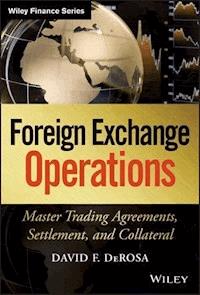
The ultimate nuts-and-bolts guide to foreign exchange operations The foreign exchange landscape is particularly risky since so much of the world is unregulated and takes place over the counter (off exchange). Brilliant traders and money managers who are profitable may find themselves underperforming, or worse, losing, simply because they failed to establish strong operations. In this book, David DeRosa provides industry players with everything they need for strong operational functions from all the types of trades to execution, master trading agreements, documentation, settlement, margin and collateral, and prime brokerage services. * Contains vital work flow solutions for trading in the volatile foreign exchange marketplace * Offers information for mastering the operational aspect of foreign exchange trading to help determine best partners such as prime brokers and others * Written by David DeRosa a leading foreign exchange expert who has consulted to hundreds of financial institutions Foreign Exchange Operations helps traders mitigate risks and offers a guide to all aspects of trading operations from mastering trading agreements to margin documentation.
Sie lesen das E-Book in den Legimi-Apps auf:
Seitenzahl: 367
Veröffentlichungsjahr: 2013
Ähnliche


















Contents
Cover
Series
Title Page
Copyright
Dedication
Preface
Acknowledgments
Chapter 1: Introduction to Foreign Exchange
DEFINING MONEY
PARTICIPANTS IN THE FOREIGN EXCHANGE MARKET
IDENTIFYING CURRENCIES AND EXCHANGE RATES
QUOTATION CONVENTIONS
THE FOREIGN EXCHANGE MARKET
FOREIGN EXCHANGE REGIMES
EXCHANGE RATE CONTROLS
THE STRUCTURE OF THE FOREIGN EXCHANGE MARKET
BANKS' IDENTIFICATION CODES
THE AUTHORITIES
SPOT FOREIGN EXCHANGE DEALS
PROFIT AND LOSS ON A SIMPLE TRADE
VALUE DATES
FORWARD FOREIGN EXCHANGE AND COVERED INTEREST PARITY
FORWARD SWAPS
NON-DELIVERABLE FORWARDS
SUMMARY
APPENDIX 1.1: ISO CURRENCY CODES
REFERENCES
Chapter 2: Options on Foreign Exchange
OPTION BASICS
PUT–CALL PARITY
THE IMPORTANCE OF OPTION MODELS
RISK PARAMETERS
THE MINOR GREEKS
MORE ON DELTA
PORTFOLIOS OF OPTIONS
AMERICAN EXERCISE MODELS
VOLATILITY
IMPORTANT OPTION STRATEGIES
OPTION MARKET MAKING
NON-DELIVERABLE OPTIONS
BARRIER OPTIONS
BINARY OPTIONS
BARRIER DETERMINATION AGENCY
OTHER EXOTIC OPTIONS
MORE ON OPTION-RELATED RISKS
SUMMARY
APPENDIX 2.1: FURTHER COMMENTS ON PUT–CALL PARITY
APPENDIX 2.2: BLACK-SCHOLES-MERTON MODEL
APPENDIX 2.3: BARRIER AND BINARY OPTIONS
REFERENCES
Chapter 3: How Trades Are Executed and Confirmed
SPOT FOREIGN EXCHANGE DEALS
FORWARD OUTRIGHT DEALS
FORWARD SWAP DEALS
OPTION TRADES
HOW FOREIGN EXCHANGE TRADES ARE EXECUTED
CONCENTRATION IN MARKET MAKING
EXAMPLE OF AN ELECTRONIC TRADING PLATFORM: FXALL
TRADE DOCUMENTATION CYCLE
INTERNAL OPERATIONS AND REPORTS FOR DEALERS
SUMMARY
APPENDIX 3.1: TRANSACTIONS AT DAILY FIXINGS
REFERENCES
Chapter 4: Foreign Exchange Settlement
SETTLEMENT INSTRUCTIONS FOR AN INDIVIDUAL SPOT FOREIGN EXCHANGE DEAL
OVERVIEW OF THE SETTLEMENT PROCESS
THE BRETTON WOODS–SMITHSONIAN PERIOD
THE HERSTATT LEGACY
SETTLEMENT RISK
NETTING
HOW THE MODERN SETTLEMENT SYSTEMS DEVELOPED
LARGE-VALUE TRANSFERS
CENTRAL BANK INVOLVEMENT
CORRESPONDENT BANKING
PAYMENT SYSTEMS
DESIGNATED-TIME NET SETTLEMENT (DTNS)
REAL-TIME GROSS SETTLEMENT (RTGS)
EXAMPLES OF MODERN PAYMENT SYSTEMS
CLS BANK
INTERNAL CONTROLS
SUMMARY
REFERENCES
Chapter 5: Master Agreements
MOTIVATION
THE ARCHITECTURE
THE FXC MASTER AGREEMENT FORMS
THE ISDA MASTER AGREEMENT FORMS
SINGLE AGREEMENT
NON-RELIANCE: PARTIES TO RELY ON THEIR OWN EXPERTISE
NETTING: PAYMENT OR SETTLEMENT NETTING AND NOVATION NETTING
EVENTS OF DEFAULT
TERMINATION EVENTS
ADDITIONAL TERMINATION EVENTS
CLOSE-OUT NETTING
SAFE HARBORS
EARLY TERMINATION
PAYMENTS UPON TERMINATION AND CLOSE-OUT AMOUNTS
CLOSE-OUT AMOUNT: 2002 ISDA
SET-OFF PROVISIONS
SPECIAL FEATURES FOR OPTIONS: ICOM AND FEOMA
SPECIAL FEATURES FOR NON-DELIVERABLE FORWARDS
MISCELLANEOUS ISSUES
MORE ON DEEDS OF ADHERENCE AND SCHEDULES
SUMMARY
APPENDIX 5.1: IFXCO TERMS
ANNEX 1
ANNEX 2A
ANNEX 2B
ANNEX 3
APPENDIX 5.2: IFXCO ADHERENCE AGREEMENT
REFERENCES
Chapter 6: Margin and Collateral
CREDIT AGREEMENTS
FRAMEWORK FOR THE ISDA CREDIT SUPPORT DEED AND THE FXC COLLATERAL ANNEX
FRAMEWORK FOR THE ISDA CREDIT SUPPORT ANNEXES
ENFORCEMENT RIGHTS OF THE SECURED PARTY
SOME ADDITIONAL FEATURES COMMONLY FOUND IN CREDIT SUPPORT DOCUMENTS
THE VALUE-AT-RISK CONCEPT
VaR FOR SPOT, FORWARD, AND VANILLA OPTIONS
PORTFOLIO VALUE-AT-RISK
SAMPLE CUSTOMER CREDIT SNAPSHOT
LIMITATIONS OF VaR
LIMITATIONS OF COLLATERALIZED AGREEMENTS
SUMMARY
APPENDIX 6.1: THE 1999 COLLATERAL ANNEX TO FEOMA, IFEMA, OR ICOM MASTER AGREEMENT
REFERENCES
Chapter 7: Foreign Exchange Prime Brokerage
OVERVIEW OF FX PRIME BROKERAGE
PROS AND CONS OF FX PRIME BROKERAGE
EXECUTION AND CONFIRMATION IN AN FX PRIME BROKERAGE ENVIRONMENT
THE LEGAL ARCHITECTURE OF FX PRIME BROKERAGE
THE FX PRIME BROKER AND THE EXECUTING DEALER
THE MASTER FX GIVE-UP AGREEMENT
OTHER ELEMENTS OF THE MASTER FX GIVE-UP AGREEMENT
THE FX PRIME BROKER AND THE DESIGNATED PARTY
THE EXECUTING DEALER AND THE DESIGNATED PARTY
REVERSE GIVE-UP RELATIONSHIPS
SUMMARY
APPENDIX 7.1: MASTER FX GIVE-UP AGREEMENT
REFERENCES
About the Author
Index
Founded in 1807, John Wiley & Sons is the oldest independent publishing company in the United States. With offices in North America, Europe, Australia, and Asia, Wiley is globally committed to developing and marketing print and electronic products and services for our customers' professional and personal knowledge and understanding.
The Wiley Finance series contains books written specifically for finance and investment professionals as well as sophisticated individual investors and their financial advisors. Book topics range from portfolio management to e-commerce, risk management, financial engineering, valuation and financial instrument analysis, as well as much more.
For a list of available titles, visit our website at www.WileyFinance.com.
Cover image: © iStockphoto.com / Oxford Cover design: Wiley
Copyright © 2014 by David F. DeRosa. All rights reserved.
Published by John Wiley & Sons, Inc., Hoboken, New Jersey. Published simultaneously in Canada.
No part of this publication may be reproduced, stored in a retrieval system, or transmitted in any form or by any means, electronic, mechanical, photocopying, recording, scanning, or otherwise, except as permitted under Section 107 or 108 of the 1976 United States Copyright Act, without either the prior written permission of the Publisher, or authorization through payment of the appropriate per-copy fee to the Copyright Clearance Center, Inc., 222 Rosewood Drive, Danvers, MA 01923, (978) 750-8400, fax (978) 646-8600, or on the Web at www.copyright.com. Requests to the Publisher for permission should be addressed to the Permissions Department, John Wiley & Sons, Inc., 111 River Street, Hoboken, NJ 07030, (201) 748-6011, fax (201) 748-6008, or online at http://www.wiley.com/go/permissions.
Limit of Liability/Disclaimer of Warranty: While the publisher and author have used their best efforts in preparing this book, they make no representations or warranties with respect to the accuracy or completeness of the contents of this book and specifically disclaim any implied warranties of merchantability or fitness for a particular purpose. No warranty may be created or extended by sales representatives or written sales materials. The advice and strategies contained herein may not be suitable for your situation. You should consult with a professional where appropriate. Neither the publisher nor author shall be liable for any loss of profit or any other commercial damages, including but not limited to special, incidental, consequential, or other damages.
For general information on our other products and services or for technical support, please contact our Customer Care Department within the United States at (800) 762-2974, outside the United States at (317) 572-3993, or fax (317) 572-4002.
Wiley publishes in a variety of print and electronic formats and by print-on-demand. Some material included with standard print versions of this book may not be included in e-books or in print-on-demand. If this book refers to media such as a CD or DVD that is not included in the version you purchased, you may download this material at http://booksupport.wiley.com. For more information about Wiley products, visit www.wiley.com.
Library of Congress Cataloging-in-Publication Data:DeRosa, David F. Foreign exchange operations : master trading agreements, settlement, and collateral/David F. DeRosa, PhD. 1 online resource. – (Wiley finance series) Includes bibliographical references and index. Description based on print version record and CIP data provided by publisher; resource not viewed. ISBN 978-0-470-93291-9 (cloth); ISBN 978-1-118-41839-0 (ePDF); ISBN 978-1-118-41555-9 (epub) 1. Foreign exchange. 2. Commercial treaties. 3. International trade. I. Title. HG3851 332.4′5–dc23
2013017690
For Francesca
Preface
The topic of this book is foreign exchange operations. At the outset, there is the question of why to study operations. The answer comes in three parts.
First, there are the practical reasons. The sums of money that are traded in the foreign exchange market are utterly massive. This makes for an enormous incentive to improve the functioning and accuracy of not just the dealing room but also the operations facility. Specifically, learning about operations can help to reduce costly mistakes. Mistakes can be expensive because they cause positions to be incorrectly hedged and create inadvertent exposure to risk. Additionally, there is always the possibility for fraud. Realistically, financial markets are natural breeding grounds for fraud, not just in sales and trading but also in operations. One objective in learning about operations should be to make fraud close to impossible to carry out, and, if it does occur, easy to discover.
The second reason for being interested in this subject is that digging into operations leads to encounters with financial history. One can learn how financial infrastructure developed as the product of changes in the foreign exchange market, legal practices, technology, and institutional arrangements.
The largest spur to the development of modern operations was the collapse of the Bretton Woods agreement in the early 1970s. This led to the creation of floating, or nearly floating, exchange rates among major currencies. During the next four decades, trading in foreign exchange and its related derivatives exploded in volume. This caused foreign-exchange-dealing banks, central banks, and industry groups to embark on a remarkable journey with the objective of creating efficient and safe operations and, in particular, a secure settlements environment.
Along the way:
The legal community, with the help of industry groups and central banks, designed the modern master agreements, confirmations, collateral agreements, and master give-up agreements. Particularly important was the development of closeout netting and bankruptcy-remote safe harbors for trading accounts.Specialized institutions came into prominence, including SWIFT (Society for Worldwide Interbank Financial Telecommunication, a communications network for secure messaging) and CLS Bank (for escrow-style bilateral settlements).Foreign-exchange-dealing banks acquired sophistication in the management of margin and collateral practices.Central banks established Real-Time Gross Settlements systems for large-scale money transfers.Trading desks have been automated in increasingly sophisticated ways. In Chapter 3, we look at an example of an electronic platform, FXall. Many of these platforms have direct linkages to operations departments.Foreign exchange dealers have capitalized on their existing operations technology to create new services for their trading customers. One example is foreign exchange prime brokerage, a subject to which I devote the whole of Chapter 7.The third reason for being interested in operations is that it reveals how the development of the foreign exchange market has evolved around sponsored transactional patterns.1 By this I mean transactional patterns that are facilitated by central banks and affiliated institutions. One normally thinks of a central bank as a creator of money, a regulator of commercial banks, and an authority in conducting monetary policy. There is another role that they play. Central banks have broad powers over the format of trading and the actual settlement of transactions simply by their affording the market efficient funds transfer systems. Prime examples are the real-time gross settlement systems that are operated by dozens of central banks. These systems are used in practically every foreign exchange settlement because they are an efficient and economical means of effecting large value transfers.
My primary intention is to convey the practical details of how foreign exchange operations work. For this reason I have prepared more than a hundred examples of trading conversations, SWIFT messages, confirmations, statements, and other types of reports.
I have adopted a somewhat broad definition of operations that includes many related topics, including:
Execution, documentation, and confirmation of trades.Trade settlement and funds transfers.Master agreements and other contractual arrangements that support trading and settlement.Margin and collateral practices.Foreign exchange prime brokerage.Before I can begin these topics I present two introductory chapters. Chapter 1 is about the size and nature of the foreign exchange market. Chapter 2 introduces the essential concepts of currency options.
David F. DeRosa June 2013
1 DeRosa, David F. 2013. Sponsored transactional patterns: Comments on Mehrling's “Essential hybridity: A money view of FX.” Journal of Comparative Economics, 41 (2) 364–366.
Acknowledgments
The Foreign Exchange Committee (FXC) has graciously given me permission to reprint several of its template agreements. The views expressed in this book are those of the author, and do not necessarily reflect the position of the Federal Reserve Bank of New York or the Federal Reserve System. It should not be assumed that the Federal Reserve Bank of New York or the Federal Reserve System endorse this book or any of the views expressed in this book.
I gratefully acknowledge permission from SWIFT to reprint information extracted from publicly available sources that may be subject to SWIFT copyrights and trademarks. Names and transaction details are fictitious. SWIFT is the trade name of S.W.I.F.T. SCRL. SWIFT Standards are licensed subject to the terms and conditions of the SWIFT Standards IPR Policy—End-User License Agreement (www.swift.com/about_swift/legal/swiftstandards_ipr_policy). The content of this material has not been reviewed by SWIFT for accuracy, nor is it endorsed by SWIFT.
I express gratitude to FXall for allowing me to reprint several of their transactions screens.
I give thanks to Mr. Bob Pepitone of The Clearing House for assistance in understanding payment systems.
Several persons have been of great assistance to me in the preparation of this book. I wish to give special thanks to John Goh. I also thank Catherine McGuinness, Jason Stemmler, Anu Khambete, Devin Brosseau, Inge Ivchenko, Michael F. Guarino, and Francesca DeRosa.
The author is solely responsible for any errors.
DFD
CHAPTER 1
Introduction to Foreign Exchange
The foreign exchange market is the market where currencies are traded. A currency is the money of a country. It serves as the country's legal tender, the medium with which debts can be discharged and taxes can be paid.
As a general rule, every country has its own currency, though there are some prominent exceptions. By extension, practically every country has a central bank (DeRosa 2009).
Large money-center banks are the primary dealers in foreign exchange, trading in spot, forward, forward swaps, and options. Central banks are also instrumental to the foreign exchange market, acting as policy agents for their respective governments and as operators of the primary settlements systems. This chapter will introduce the key players, the varieties of transactions, and the important conventions of the marketplace.
DEFINING MONEY
In an international context, we say currency, but in a local environment the term is money.
Currency, or money, is curious in at least one regard. At its core, it is a creation of a central bank. Monetary economists describe central bank money, or high-powered money, as the sum of currency outstanding and in the hands of the public plus commercial bank deposits (or reserves) held at the central bank. This part of the money supply is state created. Add to this the money that is created privately in the banking system through expansion because of fractional reserve requirements. The implication is that money is a hybrid concept, part state and part private in origin. Mehrling (2013) and DeRosa (2013) recognize this hybridity and call attention to the role of the central bank in establishing pricing parity between state money and private money.
Lesen Sie weiter in der vollständigen Ausgabe!
Lesen Sie weiter in der vollständigen Ausgabe!
Lesen Sie weiter in der vollständigen Ausgabe!
Lesen Sie weiter in der vollständigen Ausgabe!
Lesen Sie weiter in der vollständigen Ausgabe!
Lesen Sie weiter in der vollständigen Ausgabe!
Lesen Sie weiter in der vollständigen Ausgabe!
Lesen Sie weiter in der vollständigen Ausgabe!




