


8,49 €
Mehr erfahren.
- Herausgeber: The History Press
- Kategorie: Lebensstil
- Sprache: Englisch
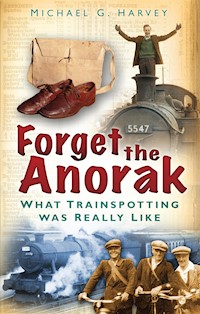
Michael Harvey's book brings to its readers the excitement of trainspotting in the 1950s and '60s, the hobby's heyday. It was the advent of the famous Ian Allan ABC Locospotters books that really gave the hobby its impetus, as they gave trainspotters all the information they required. Forget the Anorak sets out to provide the reader with a personal account of what the hobby entailed - teenagers roaming the railways of Britain, sleeping on deserted platforms on porters' trolleys, 'bunking' dimly lit depots and eluding capture, travelling hundreds of miles on a platform ticket, and stink bombs on the Underground. You'll be able to smell the steam, soot and unwashed socks, and taste the boiled egg sandwiches, the chips wrapped in newspaper and the hot jam doughnuts, all washed down with warm Tizer. Illustrated with Michael Harvey's own photographs and a selection of maps, Forget the Anorak appeals to anyone who experienced the golden days of trainspotting, as well as to anyone interested in the social history of Britain after the Second World War.
Das E-Book können Sie in Legimi-Apps oder einer beliebigen App lesen, die das folgende Format unterstützen:
Veröffentlichungsjahr: 2011
Ähnliche



















Acknowledgements
Ian Allan Publishing
Frank Allen
Denis Callender
Fionna Coles
Margaret Condon
David Copus (the late)
Jeni & Dave Darkins
The Dockyard Historical Trust
Tony Genower
Leslie Hyde (the late)
D.K. Jones Collection
John Kinchen
George Lee
Ray Masterton
Brian Mould
David Neil
Norman E. Preedy
David Rendell
Gordon K. Roberts
Trevor Robson
Eddie Rooke
Stephen Sainsbury
Sam Savage
Graham Scott
Allan Sommerfield Collection
John Spence
Ron White, Colour-Rail
Doug Willis
Unless otherwise indicated, all photographs and line drawings are by the author.
Contents
Title
Acknowledgements
Preface
Introduction
1Trainspotting, a Hobby
2The Focal Point
3My ‘Other World’
4Encounters of the Other Kind
5A Bygone Age on our Doorstep
6Always on a Sunday
7Ten Go into the Unknown
8No Time to Stop
9Kings Cross via Doncaster
10Look in the Directory
11Footbridge of Delight
12A Duo of Rovers
13Miniatures and Ghosts
14London, a 17-Hour Day
15Play Up Pompey!
16Eight Days on the Rails
17Plain Stupid, but Good Fun!
18Two in a Tent
19Pranks and Protection
20An Abundance of Pastimes
21Strict Parents
22A Tartan Escapade
23Another Camping Fiasco
24St James’s Park via JAP 591
25A Very Shrewd Transaction
26An Axe Falls and a Tent Rises
27The Change-Over
28The Sun Sets on the Southern
29A Trainspotter’s Farewell
Whatever Happened to …
Glossary
Copyright
Preface
The 1950s and 1960s were the heyday of trainspotting. It did exist before the Second World War, but it was the advent of the Ian Allan ABC Locospotters books from the late 1940s that really gave the hobby its impetus, providing an easy way of recording engine numbers in inexpensive pocket-sized books which were produced in large numbers.
The railways of Britain were particularly attractive to spotters in this period, and when the transition from steam to diesel and electric came about in the early and mid-1960s it provided immense variety and interest. For many trainspotters, however, the end of BR steam in 1968 was followed by a somewhat rapid decline of interest in the hobby and its less than total replacement by a more generalised railway enthusiasm.
By the mid-1950s trainspotting had become an organised hobby for those who wished to participate along those lines, and railway clubs provided cheap trips to virtually every corner of our railway system, which could result in anything up to eight days away from home.
For trainspotters to pursue their hobby vigorously they had to earn money for trips. Some kind of work was essential; for some this included an apprenticeship; for others it required odd jobs at weekends and evenings to bring in extra pocket money.
Introduction
The hobby of trainspotting in the 1950s and 1960s, in the days when steam trains ruled the British Railways system, was without a doubt a most fascinating, rewarding and healthy pastime. It certainly kept us teenagers off the streets of Portsmouth and out of any mischief, and it gave us an interesting hobby – one that we could easily and happily share with our school companions. As it transpired, many of my closest friends who shared this interest actually gained employment with British Railways when they left school and in subsequent years they worked their way up the ladder to achieve important and responsible jobs as firemen, drivers, guards and station staff.
I suppose it is not surprising that a fair percentage of the friends from my teenage years, many of whom have remained lifelong pals, originally came together while pursuing their hobby on station footbridges or platforms, or when visiting our local engine shed at Fratton. Similarly, numerous elderly railway enthusiasts whose interest in railways began as humble trainspotters with a notebook and Biro in their hand are nowadays actively involved in some aspect of steam railway preservation.
My own personal trainspotting adventures have been well chronicled in the two published volumes of my Diary of a Trainspotter books, where complete lists of ‘on shed’ notings and observations and relevant photographs have been included. In contrast, Forget the Anorak sets out to provide an often amusing personal and social perspective from which to portray some of our silly antics. Nevertheless, its aim is to include all my treasured memories, and those of my fellow companions, minus the lists of ‘on shed’ locomotives – and to include the classic trips not only by rail but also by scooter and car when something ‘unusual’ always seemed to crop up.
When we were involved in trainspotting trips I don’t think we ever thought that our lives might be in danger, especially when trudging the backstreets of Camden Town or Plaistow or similar locations in the West Midlands in search of some grimy, smoke-filled engine shed. Did we not realise the lurking dangers of dusk and night-time visits to dimly lit depots where our next step might prove fatal? We were oblivious to those kinds of danger, probably because we were teenagers, and teenagers in those days had precious little fear of anything or anyone. It was our determination to succeed in completing our scheduled timetables that spurred us on – we had set ourselves a target and would have felt defeated if it had not been fully achieved.
What a grand feeling and sense of achievement we humble trainspotters had as we totalled up our ‘cops’ on the homeward-bound train, knowing that we had successfully ‘bunked’ engine sheds crammed tight with living steam, eluded the foreman, made references and taken photographs (which in later years would become gems of nostalgia); and in addition to all this our travels always produced some very amusing stories. Our parents would always be somewhat anxious for our safe return, especially if we had been away for a weekend or a full week; my mum would welcome me home with a hot cup of tea and often with a generous slice of her home-made apple pie – it was then that I realised I was home.
1
Trainspotting, a Hobby
Trainspotting in its heyday between the mid-1950s and the late ’60s was definitely a hobby suited to the outdoor, adventurous type of youth, someone full of boundless energy and not afraid to travel, sometimes hundreds of miles, with a night or nights away from the comforts of home. These could be spent in a station waiting-room or on an overnight train, or sometimes in the company of drunks or tramps on a hard wooden station seat more than likely exposed to all the elements.
My personal experiences included all these aspects of night-time trainspotting, not to mention sleeping rough on porters’ trolleys amid the noise, steam and clanking movements of passing trains and engines, using only a plastic mac and cloth cap for cover and protection – and a cloth haversack as a pillow! I found the hobby a most fascinating one; while many of my schoolmates were roaming the streets of Portsmouth and Southsea in search of amusement, we trainspotters were often miles away travelling the railways of Great Britain and indulging in our adventurous hobby. It certainly kept us fully occupied, although with a few exceptions that will be revealed later.
There were of course other activities that kept the teenager of that era amused, including such diversions as stamp collecting, cigarette card collecting, I Spy books, the cinema, pop music and the inevitable encounters with the opposite sex!
The hobby of trainspotting inevitably involved a certain degree of risk, such as the illegal ‘bunking’ of British Railways engine sheds, workshops and other such installations. For us teenagers every trip undertaken was an adventure; sometimes we would acquire bogus permits or, more often, no permits at all, and these would be for engine shed visits miles away from our homes on trips that had been meticulously planned weeks ahead. I believe the non-existent paperwork added an air of excitement to many of our visits, and I think this is what helped to make the hobby both challenging and fulfilling.
Why did we on almost every trip inflict a rigorous, punishing, self-imposed time schedule on ourselves? It was, seemingly, only a harmless hobby but many of our non-railway pals and fellow schoolboys had the opinion that we were rather silly pursuing such a hobby, and it was common to hear such mundane remarks as ‘What do you do when you’ve collected all the numbers?’ or ‘Once you’ve seen one, you’ve seen them all’. Little did they realise that in later years many of these trainspotters critically abused by their school pals would find employment courtesy of British Railways, and that after 1968, when this country decided to make steam-hauled trains extinct, these trainspotters would be found active in the field of steam preservation.
St Mary’s Road bridge, my very first trainspotting location.
My First Glimpse
I recollect that I saw my very first British Railways steam locomotive of note, albeit from quite a distance, a ‘King Arthur’ class 4–6–0, when I was about twelve years old, living at that time with my mother and father in Fifth Street on the borders of the Kingston and Fratton districts of Portsmouth. Our house had a very long garden which included an apple tree and backed on to Kingston Cemetery. Beyond this area were the double-track main railway lines in and out of Portsmouth; when the trees were bare in the winter months I could plainly see the trains passing by from my bedroom window.
One of my treasured Christmas presents from my mum and dad was a shiny red scooter. I used this to investigate further my sightings of trains, as nearby St Mary’s Road bridge was an ideal point from which to watch. Unfortunately, with the passage of time the very early lists of steam engine and electric unit numbers noted at this spot have been lost. Now, whenever I travel over St Mary’s Road bridge, or more often than not travel under it by rail, it always brings back a tinge of nostalgia and rekindles my memory of first putting Biro to notebook and logging my first BR steam locomotive.
A Good Move
In the mid-1950s my parents decided to move from Fifth Street to Penhale Road in Fratton, a distance of approximately a mile and a half. This new district proved to be an excellent base from which to continue my interest in trains, since ‘Sooty Footbridge’ was just a matter of four or five minutes’ walk away. This footbridge, nicknamed by the local railwaymen for obvious reasons, was accessible via a narrow side entrance in the middle of the densely populated terraced-house area of Byerley and Walmer roads – and being adjacent to the then Fratton East signal-box it led directly into the locomotive depot yard. Naturally, this means of entry was very tempting for us young trainspotters, but with the signal-box nearby and railway workers constantly using the bridge. I never personally attempted to enter this way – but that’s not to say that some of my friends in later years were not successful. Sadly, the footbridge was demolished in the early 1960s and a few years later Fratton East signal-box suffered the same fate. Railway workers now had to enter the motive power depot via the main entrance in Goldsmith Avenue, a considerable distance away, especially if their homes were in the Fratton area.
About one hundred yards further north of Sooty Footbridge was, and still is, the location known as Milton Lane footbridge. This bridge comes alive whenever Portsmouth Football Club have a home fixture at the nearby Fratton Park; Milton Lane, a narrow pedestrian walkway, leads into what is known as Specks Lane and this in turn bounds the ‘Milton End’ of Fratton Park. Until the early 1960s there was on the northern side of the footbridge a sparsely used single-track branch line used only as a factories siding for the adjoining Rodney Road industrial estate. This line was no more than a few hundred yards in length, and when it was decided not to use it any more it became a siding for redundant wagons and eventually the track was lifted. The footbridge was not a very good location for photographs as it had a wire mesh all around, but nevertheless over the years I did obtain a few shots of trains from other angles on this bridge probably my most memorable being of ‘S15’ 4–6–0 No. 30839 in ex-works condition as it was hauling a freight out of Fratton goods yard.
Eddie Arrives on the Scene
Map of Fratton and area showing my former and my new home.
Being an only child and having just moved house, I needed a friend or friends to share the early years of my trainspotting interest. It just so happened that my mother had many years previously attended the same school at Martha Street in central Portsmouth as a certain Ivy Rooke, and was joyously reunited with her soon after moving. Naturally I became friendly with her son Eddie, their house being ideally situated in Sandringham Road, the next road to ours. It turned out that Eddie also had a mild interest in railways and, although I did not know it at the time, this new-found friendship would become a lifelong partnership as we subsequently travelled by rail, scooter and car over the next fourteen years or so visiting countless engine sheds, workshops, scrapyards and stations all over Great Britain.
We enjoyed a tremendous variety of day, weekend and full-week trainspotting trips, and in later years the addition of a small tent gave rise to many an amusing story or anecdote, as you will find out later. Eddie and I were educated at separate schools and had our own sets of pals, but over a very short period of time Eddie and David Copus and his friends would soon become ‘railway orientated’, especially as the Southern Grammar School for Boys which Eddie attended had a popular 00 gauge model railway club. This was soon transformed into a thriving trainspotting club!
If my mother (her name was Edith Jane but she was always known as Cis) had not met up with Ivy Rooke and I in turn with her son, I wonder whether I would ever have continued my interest in railways from those very early days when I happily scootered to St Mary’s Road bridge? Maybe I would have consigned myself to a pastime of fishing, cycling, aircraft-spotting, stamp-collecting or more than likely an interest in ships and the sea, as I did reside in a very famous naval port. I feel certain that whatever hobby may have constituted my lifelong interest it would have been considerably less interesting and no doubt a shade more boring. Looking back I could not imagine my life bereft of steam locomotives, group travelling, ‘bunking’ engine sheds and sleeping rough on railway stations – not forgetting those camping escapades and the great fun we derived from each and every trip undertaken, no matter what the mode of transport.
Had it not been for my interest in trains and Eddie’s appearance on the scene, I am sure I wouldn’t have travelled to all those towns and cities throughout Great Britain by any other means of transport, as neither my mum nor my dad had a car and had never driven a vehicle in their lives. I actually passed my driving test in 1968 in a Ford Anglia, but by this date the demise of British Railways steam power was virtually complete and I just could not face motoring around the country in search of diesels, multiple units and electric trains. To me they were lifeless and could not compare with a steam locomotive, a piece of live machinery breathing steam. I never took up the challenge of driving.
It’s all in the past now – and that is what this book is all about, all those incidents that inevitably occurred whenever a trainspotting trip was undertaken all those years ago. No one really wants to look too far into the future as it is scary and unpredictable; we will probably be best remembered by being labelled as ‘anoraks’, and the jokes about that word have really got a bit beyond their sell-by date. Anyway, we never wore anoraks – they didn’t become popular until the diesel age and that was another era.
We trainspotters, always harping on about the past and trying to relive old memories, are probably looked upon in today’s high-tech world as a collection of boring old farts, completely sexless, like stone statues standing at the end of busy railway station platforms oblivious to everything else around them. Let people think what they like – I see it in a different light. Nothing could be further from the truth. The majority of my railway enthusiast friends were very learned people both from grammar and secondary school education, who went on to hold important jobs – as employees of British Rail, as bankers, printers, caterers and office staff and as part of our local work-force of skilled craftsmen in the Royal Naval Dockyard in Portsmouth.
Be that as it may, it was the arrival of Eddie Rooke on the scene in the mid-1950s that provided a stepping-stone that enabled me to progress further with my early railway observations.
2
The Focal Point
It was only a ten-minute walk from Penhale Road to my local railway station of Fratton (built in 1885), the footbridge of which would become a focal point for railway enthusiasts and trainspotters both young and old; this ideal location remained a very popular meeting place right up to the demise of Southern Region steam-hauled trains in July 1967. In those years the footbridge was smartly painted in the SR colours of green and cream and it possessed a complete roof. Naturally, its windows were nearly always grimy and smoke-stained, especially those just above the three main- line railway tracks. I discovered at a later date that the ironwork used in the construction of the footbridge was shipped in from America.
Fratton station footbridge was an ideal meeting base for local trainspotters.
Adjacent to the footbridge and backing on to the brick wall in Goldsmith Avenue was Fratton West signal-box, sadly now demolished – the scars still remain to this day.
Many happy hours were idled away on the footbridge, as there was always a tremendous variety of both SR electric units and steam locomotive classes to be seen. For us ‘Portmuthians’ the direct line from London (Waterloo) had been electrified by the addition of a third rail in 1937 and electric units were part of the everyday scene. Sometimes we strained through binoculars to pick out the numbers of steam locomotives lined up in the distant Fratton depot yard and passed on details to our companions on the bridge. Beyond the depot and clearly visible from the footbridge was the unmistakable zigzag design of the roof of Fratton goods depot.
From the mid-1950s I had the use of my father’s Brownie box camera. I took most photographs in and around Fratton station and the nearby locomotive depot, but I gradually built up a collection from other local viewpoints. Over the years the camera was taken on SR and WR Rail Rovers and countless other trainspotting trips all over Great Britain. My dad paid the sum of 27s 6d when he purchased it in 1926. At the time this would have been quite a considerable sum of money and the camera was probably a luxury he saved up to purchase. I am very glad that he allowed me the use of it – and this camera is still with me and in working order to this day.
As a result of meeting other trainspotters on the footbridge, and our consequent sharing of railway information and discussion of trips and excursions, Eddie and I were tempted to make some speculative and grand plans to visit other stations, engine sheds and workshops all over the railway system between the mid-1950s and the end of BR steam in August 1968. Following the introduction of Sunday Excursion trains from Portsmouth Harbour station and Portsmouth Football Club away trip ‘Specials’, we obviously capitalised on the new accessibility of cities and towns which we would otherwise never have visited – especially since such trips cost only a cheap return fare, whereas some of our other trainspotting trips were undertaken on ordinary day return tickets. That would change when we began to use other types of tickets such as ‘group’ or ‘workman’s’ that gave us considerable fare reductions. An added bonus was that our travels around Britain increased our knowledge not only of the rail network but also of areas of geographical and industrial interest.
My very first engine shed visit was with Eddie Rooke to Eastleigh depot (71A), even before I had attempted my local depot of Fratton. The date will always stick in my mind – Wednesday 24 August 1955, during the summer holidays – and it started a trend that continued for a further thirteen years: the depot was ‘bunked’! I can still recall the smoke-filled panorama of the straight shed and yards tightly crammed with eighty-six steam engines, of which forty-three were main-line types. And to note no fewer than twenty-one Bulleid 4–6–2s in one swoop was pure bliss. We did not look back – our railway shed visits had begun and we wanted more!
Fratton station footbridge on a summer Saturday or Sunday was a guaranteed hive of activity. Apart from the usual SR electric unit trains to and from Waterloo, Victoria, Brighton and Chichester, there were the steam-hauled trains to and from Cardiff General, Bristol, Eastleigh, Southampton and Andover Junction, and the occasional working to Waterloo via Eastleigh and Basingstoke. In addition to these service trains one could expect to see holiday excursions from the Midlands or North London areas. In those days a factory would close its doors completely for two weeks, and its employees had the option of a special seaside excursion train laid on for them to ‘Sunny Southsea’, as the local brochure described our area. I am sure that most factory workers and staff took full advantage of this offer. Western Region classes would be widely used on these trains, the most common being the ‘Hall’ class 4–6–0s with their gleaming brass fittings and intriguing name-plates.
It was very satisfying for us local trainspotters to help passengers take their holiday luggage and heavy suitcases and bags up the steps from platforms 2 and 3. Sometimes we carried the luggage to a waiting taxi or to Platform 1 and usually – and joyfully – received a sixpenny tip for our efforts. The station staff obviously did not mind us performing these duties as it saved them the bother of having to push the luggage on trolleys across the double tracks at the Portsmouth end of the station platform.
Fratton engine shed could be viewed from the footbridge, but it was some distance away. The building was unique in being the only Southern Region depot with a complete roundhouse. In the mid-1950s its allocation of locomotives amounted to twenty-eight and it had the distinction of never having a diesel in its allocation, although several 0–6–0 shunters from Eastleigh could be found on shunting duties in the adjacent goods yards. Without a doubt the most loved engines at my local depot were the diminutive ‘AIX’ class 0–6–0 tanks affectionately known as ‘Hayling Billy’ engines because they were used on the nearby Havant to Hayling Island branch line.
Travels Widen
It was during the summer holidays of 1956 that at the tender age of fifteen I and a selection of my trainspotting pals from the station footbridge started our railway station and engine shed visits in earnest. We began by purchasing half-fare day return tickets to places not too distant such as London, Westbury, Salisbury, Swindon and Brighton and, at the start of the following year, took advantage of the popular Sunday Excursions that were laid on to such far-flung destinations as Wolverhampton and Cardiff. This was when my trainspotting hobby really got moving.
This was our route on the Workman’s train from Fratton to Waterloo via Petersfield.
A journey to London with its array of engine sheds, such as Camden, Cricklewood, Old Oak Common, Willesden and Neasden, and its famous terminus stations was always something special. To obtain the maximum number of hours in the capital our happy band of teenagers would depart from Fratton station at the unearthly hour of 5.32 a.m., on what was known as the ‘workman’s’ train!
This train would normally be a green-liveried Southern Region ‘2-BIL’ electric unit comprising four two-carriage units and displaying a ‘7’ headcode. Tickets had to be purchased in two separate stages. The first was Fratton to Petersfield, costing about 6s. On arrival at Petersfield, where a stop of five minutes was scheduled, one of our group would dash out of the train to the ticket office via the subway and buy the required number of Workman’s return tickets to Waterloo. In the late 1950s this would set us back about 8s. The complete return journey would cost us in the region of 14s. Unfortunately, the only drawback with this type of ticket was that the train would stop to pick up workmen at virtually every station and halt between Fratton and Waterloo – eventually arriving at 7.48 a.m.!




