


116,99 €
Mehr erfahren.
- Herausgeber: John Wiley & Sons
- Kategorie: Geisteswissenschaft
- Sprache: Englisch
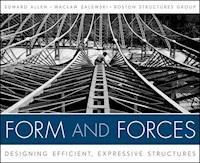
Here, in one volume, is all the architect needs to know to participate in the entire process of designing structures. Emphasizing bestselling author Edward Allen's graphical approach, the book enables you to quickly determine the desired form of a building or other structure and easily design it without the need for complex mathematics. This unique text teaches the whole process of structural design for architects, including selection of suitable materials, finding a suitable configuration, finding forces and size members, designing appropriate connections, and proposing a feasible method of erection. Chapters are centered on the design of a whole structure, from conception through construction planning.
Sie lesen das E-Book in den Legimi-Apps auf:
Seitenzahl: 1052
Veröffentlichungsjahr: 2012
Ähnliche

















Table of Contents
Title Page
Project Team and Contributors
Project Team and Contributors
Boston Structures Group
Acknowledgments
Introduction
Chapter 1: Designing a Series of Suspension Footbridges
Design Concept
The Challenge
Construction Details
Finding Forces in Bridge #1
Fundamental Concepts
Graphical Solutions
Finding the Forces in the Bridge Structure
Bridge #2
Bridge #3
Bridge #4
Bridge #5
Bridge #6
Bridge #7
Bridge #8
Erecting the Bridges
Resisting Lateral and Uplift Forces
Alternative Positions for the Rods
Looking Ahead
Another Challenge: Designing an Aerial Walkway
Chapter 2: Designing a Suspended Roof
The Challenge
Designing the Cable Roof
Steel Cables
Meeting the Challenge: Finding Form and Forces for the Cable
Learning More about the Force Polygon/Funicular Polygon Pair
Building the Suspended Roof
Next Steps
Chapter 3: Designing a Cylindrical Shell Roof
Finding the Pole
Approximating More Closely the Ideal Curve for the Vault
Adding Stiffness to the Vault
Constructing the Vault
Detailing the Vault
Designing the End Walls
Applications in Other Materials
Another Challenge
Chapter 4: Master Lesson: Designing a Trussed Roof
Chapter 5: Building on a Vertical Site
Schemes for Support
Developing a Support Scheme
Learning from the Playground: Moments of Forces
Equilibrium of Moments
Finding Beam and Truss Reactions
Finding the Reactions on a Beam with a Complex Loading
Finding Reactions Graphically
Further Applications of Moments of Force: Finding Reactions on a Beam with Inclined Loads
Applying Moment Analysis to a Portion of a Structure
Solving for the Forces on the Cliff Structure
A Graphical Solution
Sizing the Strut and Beams
Building the Observation Pavilion
Chapter 6: Designing with Multipanel Trusses
Developing the Design
Trusses
Designing Framing Schemes that Use Trusses
Trusses in Various Materials
Finding Forces in a Truss
Finding Forces in a Six-Panel Flat Truss
Understanding the Behavior of the Six-Panel Truss
Reversing the Directions of the Diagonal Members
Flat and Triangular Trusses
Reducing the Depth of a Flat Truss
A Truss with An Odd Number of Panels
Asymmetrical Loading Patterns
A Cantilever Truss
An Overhanging Truss
Completing the Design of the Summer Camp Truss
Finding Member Sizes
Detailing the Truss
Fabricating and Erecting the Trusses
Another Challenge
Chapter 7: Designing a Fanlike Roof
Fanlike Structures
Cable-Stayed Structures
A Cable-Stayed Bridge with Counterweight
Two Alpine Bridges
Dendriform Tensile Structures
Cable Stays in Three Dimensions
Compressive Fanlike Structures
Developing the Design of the Market Roof
Finding form for Dendriform Compressive Structures
A Formal Refinement
Developing the Tree Structure
Developing the Details
Three-Dimensional Dendriform Structures
Another Challenge
Chapter 8: Designing Unreinforced Masonry
Corbel and Tholos
Masonry Arches: Robert Hooke's Guiding Principle
The Quest for Height
Masonry Buttresses
From Arches to Vaults
Masonry Domes
Funicular Versus Geometrical Design in Masonry
Hanging Models
Initial Form-Finding Experiments
Extending the Design to Three Dimensions
Completing the Design
Chapter 9: Master Lesson: Designing a Concrete Shell Roof for a Grandstand
First Ideas
Developing the Idea
Finding Form and Forces for the Vaults
Finding Form and Forces for the Cantilevered Arch
Sizing the Arch
Designing the Strut and Ties
Forming the Concrete
Further Work
Chapter 10: Designing Efficient Trusses
Finding the Form of the Truss
A Graphical Method for Finding Form for a Constant-Force Truss
A Bottom-Loaded Constant-Force Truss
A Lenticular Truss
A Constant-Force Gable Truss
Efficient Cantilever Trusses
Constant-Force Truss Forms: The General Solution
Suboptimal Truss Forms: The Camelback Truss
Visualizing Form Improvements in Trusses of Nonoptimal Shape
Finding a Truss Form that has Constant Force in the Curving Chord
Designing the Trusses for the Museum Exhibit Hall
Another Challenge
Chapter 11: Designing Restraints for Funicular Structures
Restraint By Stays and Struts
Restraint By Prestressing Cables
Restraint of a Cable By An Inverted Arch
Restraint By Stiffening the Funicular Member
Restraint By Stiffening the Deck
Restraint By Trussing the Funicular Member and the Deck
Restraint By Diaphragm Action
Restraint By Folded Plate Stiffening
Chapter 12: Designing Shell and Membrane Structures
Membrane Structures
The Elements of a Membrane Structure
Shell Structures
Finding the Form of the Pavilion
Finding the Forces in the Membrane
Finding the Forces in the Support Structure
The Material of the Membrane
Environmental Factors
Cutting Patterns
Detailing the Membrane
Membrane Variations
Graphical Analysis of a Cone Membrane
Concrete and Masonry Shells
Analysis
Pneumatic Structures
Shells and Membranes Revisited
Chapter 13: Structural Materials
Granular Materials: Lessons From the Beach
Solid Materials
How Materials Break
A Ball-And-Spring Model of the Transmission of Forces in Solid Materials
The Characteristics of a Good Structural Material
Common Structural Materials
No Material Is Uniform
The Concept of Stress
Stresses and Strains
Factors of Safety
Summing Up
Chapter 14: Master Lesson: Designing with the Flow of Forces
Tilt-Up Construction
Constructing Flow Patterns
Flow of Water and Flow of Forces
Flow Patterns at Concentrated Loads
Saint-Venant's Principle
Forces at the Bottom of the Wall
Finding Forces in the Truss Model
Eccentrically Loaded Deep Walls
Looking at More Wall Panels
Force Flow in Long Walls
Openings and Notches
Tilt-Up Construction Revisited
The Meeting Ends
Chapter 15: Designing a Bay of Framing
Bays
Load Tracing
Lateral Loads
Floor and Roof Diaphragms
Placing Planes of Vertical Rigidity in Plan
Multiplying the Bay of Framing in the Horizontal Direction
Multiplying the Framed Floor in the Vertical Direction
Wind Trusses
Chapter 16: Bending Actions on Beams
Longitudinal and Transverse Loadings
Finding Values of Vertical Forces and Bending Moments
Graphical Construction of V and M Diagrams
Further Explorations of V and M Using the Graphical Method
Semigraphical Construction of V and M Diagrams
Overhangs
Continuous Spans
Encastered Beams
V and M Values for Many Beams
Bending Moments in Longitudinally Loaded Members
Looking Ahead
Chapter 17: How Beams Resist Bending
Walls Become Beams
Why the Lattice Pattern of Flow Predominates in Prismatic Beams
Flow of Forces in a Uniformly Loaded Beam
Evaluating Stresses in Beams of Rectangular Cross Section
Determining Maximum Longitudinal Stress in a Lattice Pattern
Why the Variation in Total Forces Creates the Lattice Pattern
Finding the Maximum Bending Stress in a Rectangular Beam
Determining Maximum Web Stress in Rectangular Beams
Checking Bearing Stress in Wood Beams
Deflections of Beams
Finding Member Sizes for a Wood Deck
Assigning Sizes to the Members of the Deck Frame
Detailing the Deck
Further Notes on Wood Structures
Shaping Beams for Greater Efficiency
Exploiting Continuity: Gerber Beams
Michell Structures
Chapter 18: Bending Resistance in Beams of Any Shape
Steel
The Vocabulary of Structural Steel Framing
Laying Out a Structural Steel Frame
Assigning Approximate Sizes to Members of the Frame
Sizing Nonrectangular Beams
Finding Moments of Inertia of Composite Shapes
Finding Bending Stresses in Standard Nonrectangular Beams
Web Stresses in Nonrectangular Beams
Nonrectangular Beams in Materials Other Than Steel
Selecting Beam and Girder Sections for a Steel-Framed Office Building
Other Factors in Selecting and Sizing Structural Steel Beams
The Importance of Finding Good Shapes for Beam Sections
Chapter 19: Designing Columns, Frames, and Load-Bearing Walls
Columns
Combining Beams and Columns: Rigid Frames
Multistory Rigid Frames
Good Shapes for Columns
Struts and Ties
Combined Members
Eccentrically Loaded Columns
Columns in Architecture
Load-Bearing Walls
Chapter 20: Designing a Sitecast Concrete Building
Building Code Requirements for the Structure
Selecting a Structural System
Sitecast Concrete Framing Systems
Formwork for Concrete
Sitecast Concrete One-Way Framing Systems
Sitecast Concrete Two-Way Framing Systems
Lateral Load Resistance of Concrete Building Frames
Selecting a Framing System for the Apartment Building
How Steel-Reinforced Concrete Beams Resist Bending
Innovative Sitecast Concrete Framing Systems
Chapter 21: Master Lesson: Designing in Precast Concrete
The Owner's Goals
Building Code Requirements
Mechanical Systems
Electrical and Communications Services
The Structural System
The Contractor's Perspective
A Design is Born
Is it Beautiful?
More Meetings
Chapter 22: Designing an Entrance Canopy
Developing the Idea
Designing the Beams
Assuring the Overall Stability of the Canopy in Cross Section
Checking the Maximum Stress in the Beam
Designing for Lateral and Uplift Forces
Detailing the Roof
Final Thoughts
Afterword: Engineers and Architects
Index
Text and equations were edited in WordPerfect 12 and Word 2003. The typeface for drawings is Tekton, and the typeface for the text is Garamond.
Hand-drawn illustrations are primarily by Edward Allen, with additional sketches by David M. Foxe, Robert Dermody, Wacław Zalewski, and others, as noted. Computer-based drawings were created and edited by Jeffrey Anderson and Kathryn Hriczo in Autodesk AutoCAD, Rhinoceros, Formfi nder, and Capri; images were further edited in Adobe Creative Suite. ANSYS output images are courtesy Bashar Altabba and the HNTB Corporation.
This book is printed on acid-free paper.
Copyright © 2010 by John Wiley & Sons, Inc. All rights reserved
Published by John Wiley & Sons, Inc., Hoboken, New Jersey
Published simultaneously in Canada
No part of this publication may be reproduced, stored in a retrieval system, or transmitted in any form or by any means, electronic, mechanical, photocopying, recording, scanning, or otherwise, except as permitted under Section 107 or 108 of the 1976 United States Copyright Act, without either the prior written permission of the Publisher, or authorization through payment of the appropriate per-copy fee to the Copyright Clearance Center, 222 Rosewood Drive, Danvers, MA 01923, (978) 750-8400, fax (978) 646-8600, or on the Web at www.copyright.com. Requests to the Publisher for permission should be addressed to the Permissions Department, John Wiley & Sons, Inc., 111 River Street, Hoboken, NJ 07030, (201) 748-6011, fax (201) 748-6008, or online at www.wiley.com/go/permissions.
Limit of Liability/Disclaimer of Warranty: While the Publisher and the author have used their best efforts in preparing this book, they make no representations or warranties with respect to the accuracy or completeness of the contents of this book and specifi - cally disclaim any implied warranties of merchantability or fi tness for a particular purpose. No warranty may be created or extended by sales representatives or written sales materials. The advice and strategies contained herein may not be suitable for your situation. You should consult with a professional where appropriate. Neither the Publisher nor the author shall be liable for any loss of profi t or any other commercial damages, including but not limited to special, incidental, consequential, or other damages.
For general information about our other products and services, please contact our Customer Care Department within the United States at (800) 762-2974, outside the United States at (317) 572-3993, or fax (317) 572-4002.
Wiley publishes in a variety of print and electronic formats and by print-on-demand. Some material included with standard print versions of this book may not be included in e-books or in print-on-demand. If this book refers to media such as a CD or DVD that is not included in the version you purchased, you may download this material at http://booksupport.wiley.com. For more information about Wiley products, visit www.wiley.com.
Library of Congress Cataloging-in-Publication Data:
Allen, Edward, 1938–
Form and forces: designing effi cient, expressive structures/Edward Allen and Wacław Zalewski; with contributions by lano … [et al.]
p. cm
Includes index.
ISBN 978-0-470-17465-4 (cloth)
1. Structural design. 2. Form (Aesthetics)
3. Structural dynamics. I. Zalewski, Wacław.
II. lano, Joseph. III. Title.
TA658. A44 2010
624.1′771—dc22
2009001793
Project Team and Contributors
Boston Structures Group
The Boston Structures Group is an informal association of structures teachers, engineers, and architects who share the belief that structures is a design discipline and should be taught as such.
Core Project Team
Edward Allen, FAIA,
Primary Author
Ed is a Fellow of the American Institute of Architects and a recipient of the Topaz Medallion for Excellence in Architectural Education. He has taught at the University of Oregon, Yale University, University of California–San Diego, Montana State University, Liverpool University, University of Washington, and at the Massachusetts Institute of Technology. He is the designer of more than 50 constructed buildings. His books are read and used in universities and professional offices throughout the world.
Wacław Zalewski, PhD, Dipl.Ing.,
Coauthor, Philosophy and Concepts
Wacław is a structural engineer, constructor, and Professor Emeritus of Structural Design at MIT. He is abeloved mentor to legions of former students and associates. His design work ranges from lightweight concrete shells to deployable trusses, and has been constructed across Poland, Venezuela, Spain, and South Korea. He is the author with Edward Allen of Shaping Structures: Statics (John Wiley & Sons, Inc., 1998).
David M. Foxe, M.Arch, M.Phil, SB,
Editorial Director
David is an architectural designer, author, teacher, and musician educated at MIT; he was a Marshall Scholar to Clare College, Cambridge University (United Kingdom). He practices at EYP/Architecture and Engineering in Boston.
Jeffrey Anderson, M.Arch, B.Des,
Art Director and Chief Illustrator
Jeff is an architectural designer educated at the University of Florida and MIT. He practices at TriPyramid Structures in Westford, Massachusetts.
Kathryn Hriczo, B.Arch,
Illustrator
Kate is an architectural designer educated at the University of Massachusetts and the Boston Architectural College. She practices at Miller Dyer Spears Architects in Boston.
Contributing Authors
John A. Ochsendorf, PhD, M.Sc.,
Contributing Author
John is a structural engineer and Associate Professor of Building Technology at the MIT Department of Architecture. He studied at Cornell, Princeton, and the University of Cambridge (United Kingdom). Heis a recipient of a 2008 MacArthur Grant for his research in structural engineering, and was a Fellow of the American Academy in Rome 2007–2008.
Michael H. Ramage, M.Arch, BSc,
Contributing Author and Illustrator
Michael is University Lecturer in the Department of Architecture at Cambridge University (United Kingdom). Educated in architecture at MIT, he specializes in the design and construction of structural masonry spans that have been built in the United States, England, and South Africa. He held a fellowship in the engineering firm of Conzett Bronzini Gartmann AG in Chur, Switzerland (2006).
Philippe Block, PhD, SMArchS,
Contributing Author and Illustrator
Philippe is a member of the structures faculty at the ETH (Swiss National Institute) in Zürich. He is an architectural engineer trained at the Vrije Universiteitin Brussels (Belgium). He recently completed a PhD inBuilding Technology at the MIT Department of Architecture in Cambridge, Massachusetts; his dissertation concerned the application of advanced graphical techniques to the design of masonry structures. He has been a researcher at the Institute for Lightweight Structures and Conceptual Design (ILEK) in Stuttgart (2008); and he has won the Hangai Prize from the International Association of Shell and Spatial Structures (2007).
Joseph Iano, RA,
Contributing Illustrator
Joseph is a practicing architect in Seattle, Washington, and a technical consultant to Olsen Sundberg Kundig Allen, Architects. He is coauthor of a number of books with Edward Allen, including Shaping Structures, Statics, from which many of his illustrations and DVD tutorial have been brought to this volume.
Contributors
Nicole Michel, RA, LEED AP, M.Arch,
Contributor
Nicole is a registered architect originally from Buenos Aires who studied at MIT and practiced architecture in New York City at Cannon Design and at Perkins + Will. Since 2006, she practices in Buenos Aires on projects both locally and abroad, and she is deeply involved with the creation of the Argentina Green Building Council.
Bashar Altabba, PE, M.Eng,
Contributor
Bashar Altabba is a bridge engineer with Parsons Corporation in New York City and a visiting faculty member of the Department of Civil and Environmental Engineering at MIT. He has appeared in several television documentaries on structures of historic importance.
Robert J. Dermody, RA, M.Arch, B.S.C.E.,
Contributor
Bob has degrees in both architecture and engineering, and is currently teaching structures as an Assistant Professor at the Roger Williams University School of Architecture, Art, and Historic Preservation, located in Bristol, Rhode Island. He has previously taught at the University of Illinois, first in Versailles and then in Champaign/Urbana.
William L. Thoen, PE, M.Eng,
Contributor
Bill is a structural engineer who was a principal for many years in LeMessurier Consultants, where he was involved in the design of many of their landmark projects.
Simon Greenwold, SM,
Contributor
Simon is a software developer who did graduate work at the MIT Media Lab. He has a special interest in interactive graphics, architecture, and engineering. His Active Statics program has won worldwide acclaim and has been translated into several foreign languages.
Acknowledgments
For their review of early versions of several chapters, we thank Prof. Richard Farley of the University of Pennsylvania, Prof. Martin Gehner of Yale University, and Prof. Kirk Martini of the University of Virginia. Our thanks also go to the many teachers and students who have tested tools and techniques as we have developed them, and who have often developed and sent to us innovations of their own. The influence of all these individuals is evident in many aspects of this work.
At John Wiley & Sons, Inc., Vice President and Publisher Amanda Miller has nurtured and encouraged this project since its inception. It could not have been brought to completion without the patience, understanding, skill, and astute guidance of Acquiring Editor Paul Drougas. Senior Production Editor Donna Conte overcame every obstacle, of which there were many, in managing the editing, composing, and printing of the book; she is unsurpassed at her difficult craft and remains a valued colleague after many projects together. We would also like to thank Janice Borzendowski for copyediting and Figaro for creating the graphic design.
Edward Allen and Wacław Zalewski are grateful for the extraordinary talents, tireless efforts, and buoyant enthusiasm of David M. Foxe, Jeffrey Anderson, and Kathryn Hriczo. Edward Allen thanks Donna Harris, who reintroduced him to graphic statics; Don Livingstone, whose student design project first revealed the potential of graphic statics to create efficient forms for structures; and Dr. William Abend, for his healing powers.
The members of the project team thank their colleagues, family, friends, and loved ones who have encouraged and assisted us during this long-running enterprise.
We dedicate this book to those students, teachers, and professionals who believe in the power of thoughtfully designed structures to support great loads, span vast distances, and nourish the human spirit.
Boston Structures Group
July 2009
Introduction
“Education is not the filling of a pail, but the lighting of a fire.”
—William Butler Yeats (Poet, 1865–1939)
“There is some evidence that traditional engineering courses reduce the creativity of students…”
—Alan Holgate (Engineer/Author, B.1937)
Form and Forces is a project-based introduction to the design of structures for buildings and bridges. It is intended as the text for a first year of study of structures for students of engineering or architecture. Practicing architects and structural engineers will also find it useful.
Each chapter follows the entire design process for a whole structure: It begins with the formation of structural ideas. It continues with development of the ideas into workable solutions, preliminary design of details, and preliminary determination of member sizes. It concludes with planning of the construction process. The projects, which are generally large in scale, long in span, and elegant in form, are carefully chosen to bring out specific lessons that constitute a complete course in statics and strength of materials.
Students are assumed to have had no prior course in structures, yet this book engages them from the beginning in designing grand, imaginative structures. The fundamentals of statics and strength of materialsemerge naturally in the context of the structural design process. Each principle or equation is introduced where it is first needed, so that the student understands its role. There is no need to teach “the basics” of statics and strength of materials in advance. In fact, to do so would risk diminishing the students’ interest in structural design: Numerical methods detached from their context and role in design tend to be dry at best.
Graphical methods for designing and analyzing structures are a key ingredient of this approach. They contribute to intuitive understanding and visualization of behavior. They greatly facilitate all statical operations. In early stages of design, they have significant advantages over numerical methods in their simplicity, speed, transparency, and ability to generate efficient forms for cables, arches, trusses, and other structural devices. They are also the source of most of the mathematical expressions used in structural analysis, and give the same answers.
Numerical methods are introduced where needed in the design process, so that students do not merely learn them, but also understand their relevance and the contexts in which they are useful. This makes them easier to remember and utilize in later projects.
Master lessons, which are fictitious but realistic design dialogues between an architect and an engineer, are a unique feature of Form and Forces. These are scattered throughout the book. They were inspired by Galileo's dialogues concerning structures; the format was adopted here to help exemplify issues such as the nature of the design process and the interactions between engineer and architect. They also provide a refreshing change of pace from the chapters that are more conventional in their presentation.
Many teachers will feel a natural reluctance to abandon a way of teaching structures that they have perfected over a number of years. Many will doubt their ability to learn graphic statics well enough to teach it. I am one of the many who did not learn graphical techniques in school, but picked them up later through self-study. This learning process was not merely easy and pleasant: It was like discovering hidden treasure. Graphical techniques are almost magical in their uncanny power to generate good form while finding forces simultaneously. Suddenly they made clear structural concepts that had not been previously understood. They have made it possible for me to teach successful architectural design studios for the design of long-span structures, including in one instance a studio in traditional unreinforced masonry vaulted structures. They are also the basis for classroom courses in structures that are exciting and empowering for students and teacher alike.
The web site accompanying this book contains three supplemental features that facilitate the teacher's learning of the tools, as well as the students': Joseph Iano's step-by-step “Form and Forces Graphical Techniques” is a set of tested, perfected lessons that relate directly to the designs undertaken in the book. Simon Greenwold's “Active Statics” contains vivid, interactive learning tools that encourage experimentation and exploration. Simon Greenwold also developed the special-purpose graphic statics solver program, “Statics Pad,” which makes it possible for teachers and students to do the graphical solutions in a neat, legible, precise manner, even if they are unskilled at drawing.
This book contains material from the earlier book by Wac?aw Zalewski and Edward Allen, Shaping Structures: Statics (John Wiley & Sons, Inc., 1998), to which it is a successor. Those who have used Shaping Structures will find the present volume to be substantially more comprehensive and more consistent in its approach.
All the great masters of structural design have reminded us repeatedly that structural design is not a science; it is a craft that relies on judgment rather than absolute certainty. This judgment must be based on a broad knowledge of structural principles, materials, details of construction, fabrication and erection processes, and analytical techniques both numerical and graphical. It is in this spirit that we offer Form and Forces, encouraging readers to develop this judgment by becoming active participants in the exciting process of designing efficient, expressive structures.
South Natick, Massachusetts
Edward Allen,
for the Boston Structures Group
Wiley publishes in a variety of print and electronic formats and by print-on-demand. Some material included with standard print versions of this book may not be included in e-books or in print-on-demand. If this book refers to media such as a CD or DVD that is not included in the version you purchased, you may download this material at http://booksupport.wiley.com. For more information about Wiley products, visit www.wiley.com.
Chapter 1
Designing a Series of Suspension Footbridges
Basic definitions of statics: loads, forces, tension, compression, stressFree-body diagrams; vectors and scalars; static equilibrium of concurrent forcesThe force polygon and funicular polygon for funicular structures; Bow's notationDetailing steel rod elements in tension, and anchoring to rockLateral stability; stiffening a tensile structureConstruction detailing and planningWe have been commissioned to design a series of footbridges for a new scenic trail that will wind through a deep, narrow canyon in a national park in the southwestern United States. The walls of the canyon are often vertical and sometimes overhang, so that the trail must move from one side of the canyon to the other at a number of locations to follow a route that will avoid the steepest walls and minimize excavation of the rock. The lengths (spans) of the bridges will vary between 40 and 100 ft. The decks of all the bridges (the walking surfaces) will be 4 ft wide.
Design Concept
We have already developed, in cooperation with the Park Service, a basic design concept and a simple system of components for making these bridges (Figures 1.1, 1.2). Because of the remoteness of the bridge sites and the difficulty of working in the narrow canyon while standing on narrow rock ledges, as much of the work as possible will be done on components in a contractor's workshop. They will then be trucked to the site, where a construction crew will assemble them.
Figure 1.1 This suspension span of 40 ft is the first bridge we will consider in this chapter.
Figure 1.2 An exploded view of the construction system for the suspension bridges in this chapter reveals its component parts.
The beams of each bridge are made of wood and will be brought to the site in 20-ft lengths. Shorter lengths can be cut as needed to adjust bridge lengths to particular sites. We will support the ends of the beams that occur over the empty space of the canyon on short wood crossbeams that hang from steel rods. The rods will transmit their forces to steel plates anchored into the rock of the canyon walls. The beams, crossbeams, and rods will be used as a modular system to build suspension bridges of any necessary length for this trail (Figure 1.3). Suspension bridges tend to be lighter in weight than any other kind of bridge, which makes them particularly appropriate for the remote, difficult sites where they must be built in this park.
Figure 1.3 The construction system is modular, enabling it to be used for bridges of various spans.
We have selected rods rather than cables because these bridges are small and the loads to be supported are correspondingly low. Cables, if we were to use them, would be very small in diameter, which would make them vulnerable to vandalism. Because the steel from which the rods are made is not as strong as that used in cables, the rods that we will use will be somewhat larger in diameter than cables of the same capacity. Rods are also easier and less costly to connect than cables. We will learn about cables and their connections in Chapter 2, in the context of a structure with much longer spans, where cables are appropriate and economical.
Lesen Sie weiter in der vollständigen Ausgabe!
Lesen Sie weiter in der vollständigen Ausgabe!
Lesen Sie weiter in der vollständigen Ausgabe!
Lesen Sie weiter in der vollständigen Ausgabe!
Lesen Sie weiter in der vollständigen Ausgabe!
Lesen Sie weiter in der vollständigen Ausgabe!
Lesen Sie weiter in der vollständigen Ausgabe!
Lesen Sie weiter in der vollständigen Ausgabe!
Lesen Sie weiter in der vollständigen Ausgabe!
Lesen Sie weiter in der vollständigen Ausgabe!
Lesen Sie weiter in der vollständigen Ausgabe!
Lesen Sie weiter in der vollständigen Ausgabe!
Lesen Sie weiter in der vollständigen Ausgabe!
Lesen Sie weiter in der vollständigen Ausgabe!
Lesen Sie weiter in der vollständigen Ausgabe!
Lesen Sie weiter in der vollständigen Ausgabe!
Lesen Sie weiter in der vollständigen Ausgabe!
Lesen Sie weiter in der vollständigen Ausgabe!
Lesen Sie weiter in der vollständigen Ausgabe!
Lesen Sie weiter in der vollständigen Ausgabe!
Lesen Sie weiter in der vollständigen Ausgabe!
Lesen Sie weiter in der vollständigen Ausgabe!
Lesen Sie weiter in der vollständigen Ausgabe!




