


Erhalten Sie Zugang zu diesem und mehr als 300000 Büchern ab EUR 5,99 monatlich.
- Herausgeber: The Crowood Press
- Kategorie: Lebensstil
- Serie: Crowood Collectors'
- Sprache: Englisch
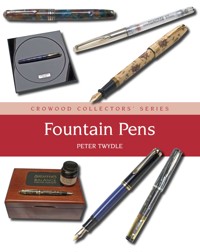
The fountain pen as we know it today developed over thousands of years, from the simple stylus used for cutting marks into clay tablets, to the brush, through the reed, the quill and the steel-nib dip pen, and finally to the self-contained fountain pen. The advent of electronic communication of the written word has failed to dim the appeal of the fountain pen, and names such as Parker, Waterman and Sheaffer remain household names. Fountain Pens covers the complete history of the fountain pen with useful advice on how to build a collection and where best to look for fountain pens, from car boot sales to the internet.
Sie lesen das E-Book in den Legimi-Apps auf:
Seitenzahl: 263
Veröffentlichungsjahr: 2009
Das E-Book (TTS) können Sie hören im Abo „Legimi Premium” in Legimi-Apps auf:
Ähnliche



















DEDICATION
To my late father, Arthur Twydle, 1918–2005.
A man who, before his death in 2005, was one of the most respected authorities on fountain pens in the world.
First published in 2009 byThe Crowood Press LtdRamsbury, MarlboroughWiltshire SN8 2HR
www.crowood.com
This e-book first published in 2023
This impression 2014
© Peter Twydle 2009
All rights reserved. This e-book is copyright material and must not be copied, reproduced, transferred, distributed, leased, licensed or publicly performed or used in any way except as specifically permitted in writing by the publishers, as allowed under the terms and conditions under which it was purchased or as strictly permitted by applicable copyright law. Any unauthorised distribution or use of this text may be a direct infringement of the author’s and publisher’s rights, and those responsible may be liable in law accordingly.
British Library Cataloguing-in-Publication Data
A catalogue record for this book is available from the British Library.
ISBN 978 0 7198 4354 9
CONTENTS
ACKNOWLEDGEMENTS
INTRODUCTION
1 UNDERSTANDING THE FOUNTAIN PEN
2 A HISTORY OF THE FOUNTAIN PEN
3 THE MANUFACTURERS
4 BUILDING YOUR COLLECTION
5 LOOKING AFTER FOUNTAIN PENS
6 THE RIGHT PEN FOR YOU
APPENDIX: ARTHUR TWYDLE
FURTHER INFORMATION
GLOSSARY
INDEX
Peter Twydle.
ACKNOWLEDGEMENTS
Primarily, I would like to acknowledge my late father, Arthur Twydle, from whom I inherited knowledge, the benefit of his experience, and ultimately The Pen Museum collection. His writings have also become a part of his legacy to me and I know he would not have minded me including some of them in this book.
I would like to thank Mark Cateley for his input in buying and selling on the Internet, and particularly his insights and experience of buying and selling fountain pens on eBay. Mark is also responsible for taking the majority of photographs herein, and has done a great job, as I am sure you will agree as you browse the pages. Chris Fletcher is responsible for the photographs of the author, so a big thanks goes to him too.
I would also like to thank Nicholas Banks for sharing his experiences of buying and selling pens at antique fairs. This is not something I have done much of and I am grateful that he was able to fill in the gaps in my knowledge.
Special thanks also to Dr Jim Marshall, a long-time friend and colleague of my father, for allowing me to delve into the archives of his magazine. I extracted some tasty tit-bits here, not least his insights into buying fountain pens at auction, and I discovered some of my father’s additional writings that I had long forgotten about. I would also like to thank Jim for his article A Tribute to Arthur Twydle at the end of the book. Jim was also kind enough to check the first draft of this book for technical errors and provide further suggestions.
My thanks also go to the pen companies who have kindly allowed me to reproduce photographs of their products, particularly The Onoto Pen Company, Classic Pens, Bexley and Conway Stewart. The rest of the photographs are nearly all of pens and ephemera taken from the shelves of The Pen Museum.
I have taken all the advertisements reproduced here from original newspaper cuttings in The Pen Museum archives, and I have chosen them for both their special interest and their relevance to the text. The patent diagrams and other drawings have all been updated and redrawn.
I have also used the following sources as references: various old company catalogues, patents, advertisements, information books and sales literature; Jim Marshall’s Marestin magazines; Arthur Twydle’s notes and diaries; the Internet and in particular Google and Wikipedia.
INTRODUCTION
My name is Peter Twydle, the only son of the master pensmith, Arthur Twydle, to whom this book is dedicated. I feel the need to mention this, since you would no doubt like to confirm my credentials for having the temerity to hold forth on the wonderful hobby of collecting fountain pens.
I have been involved in retailing, repairing, restoring and collecting fountain pens, in one form or another, for over forty years. As a child, I would often don a white overall, and help in one of my Dad’s specialist pen shops. I even did stints in the service department during school holidays where, for some strange reason, I had to wear a white shirt and tie while up to my elbows in blue ink as I learned how to repair pens.
When I left college in 1964, I joined the family business as my first proper job and was immediately despatched to Dover, where The Parker Pen Company trained me officially in fountain pen repair. I also attended a sales course at Parker’s headquarters, Bush House, in London. Many years earlier, my father had been on this course, which always ended with a test. The winner of this would win the prize of Parker’s top fountain pen of the day. Dad won, of course. My mother also attended some years later. She won too. There was no pressure on me then! The prize at that time was a Parker 61 Heirloom. Did I, like my parents before me, win? There is a photograph of a black Parker 61 Heirloom engraved with my name on it later in this book that answers that for me.
At the tender age of eighteen, I took over running one of the shops and added another to the chain a few years later. By this time, the fountain pen market was in decline and could no longer sustain specialist shops, so we had to introduce other lines in order to survive. Greeting cards and posters of the Bay City Rollers did not really interest me, so when my father first brought up the subject of retirement, I moved on to try my hand at other things. As I mention in the tribute to my father on page 149, Arthur Twydle never really retired but began to build a repair business and his famous Pen Museum, which became one of the largest collections of fountain pens, ball pens and pencils in the world.
This was more like it. So, like the prodigal son, I returned to the fold and spent a three-year apprenticeship working alongside the master, doing repairs that by now were coming in from all over the globe, and helping to organize his rapidly growing collection.
As a prequel to the silver surfer I was later to become, I launched The Pen Museum website, from which I once again began selling pens, only this time the emphasis was on the collector’s market.
Times change, and there is now an upsurge of interest in owning a fine writing instrument, born out by the healthy sales of those manufacturers who still believe in quality, which is the reason this book does not focus exclusively on vintage fountain pens and why I have thrown more of a spotlight on limited editions and pens that may well become collectible in the future.
Some of the beautiful pens being produced today are wonders to behold, and it is no surprise that there has arisen a breed of collector whose focus of attention lies with the new, alongside and sometimes instead of, the vintage. Manufacturers have responded to (or have they fuelled?) this modern trend as evidenced by the vast array of special and limited editions they produce annually, at prices only a dedicated collector would contemplate.
Not only collectors, but also the many people who wish to use a traditionally styled fountain pen can appreciate that modern materials and techniques are more often than not superior to the vintage, particularly in the manufacture of nibs, which today write more smoothly than the old nibs ever did.
One of the arguments people often levy against modern, quality fountain pens is that they are expensive. This is simply not true, or if it is, then it has always been so. For example, a Parker Duofold in 1928 cost thirty shillings, or £1.50, at a time when people earned a minimum of £1.60 a week. At the time of writing, a modern Parker Duofold costs £260 and the minimum wage is £276 for the same amount of hours worked. In other words, quality pens are almost the same price in real terms as they were in 1928.
This brings me, somewhat egotistically, to my purpose behind writing this book. It is certainly not to produce an encyclopaedia of fountain pens. Andreas Lambrou has already done that to impressive effect in his magnificent Fountain Pens of The World, a book still recognized as the bible for collectors. Nor is it my intention to provide detailed information on makes and models; there are several books by other knowledgeable writers that cover those subjects more than adequately. However, since they wrote those books, mainly in the 1990s, the Internet has gradually superseded the old ways of building a collection, and I felt there was a need for a book that recognized the new trends in collecting.
Of course, one of the problems with writing a book that references the Internet is that, unlike the written word, which is permanent, a website can disappear overnight, its words of wisdom along with it. Most of the websites I acknowledge in these pages have already had some degree of permanence but, of course, I cannot guarantee them as a future source of reference. No doubt new ones are appearing, even as I write.
As you will have already gathered, I am an Englishman born and bred. Not only an Englishman, a Yorkshireman to boot. While not biased in any way towards British pens (as you will discover when you come across my many references to Pelikan), until recently my retail experience has been predominantly in the British market place, which will inevitably give this book a United Kingdom slant. I hope my American, Spanish, French and Swiss friends and customers will understand this and forgive me these leanings.
Therefore, accepting my silver surfer status as I now do, I aim to present some essential knowledge for the collector in the light of the electronic age. I hope to provide a road map that will point you in the right direction, enabling you to develop your own collection using the virtual world, without making too many costly mistakes.
If I can also encourage new collectors to become absorbed in this fascinating hobby, then it will all have been worthwhile, and two generations of penmen will have contributed at least in some small way to the continuance of their life’s work.
A demonstration set of Montblanc pens comprising one each of every nib width.
CHAPTER ONE
UNDERSTANDING THE FOUNTAIN PEN
Terminology
Before you became interested in fountain pens, had you ever heard of the expressions ‘blind cap’, ‘ecossais’, or ‘overlay’? I doubt it. Yet, you will hear these words often in the pen trade. You see, every specialist field has its own vocabulary and terminology, and the world of fountain pens is no exception.
As we travel through the history of the fountain pen in Chapter 2, and the manufacturers who created that history in Chapter 3, we will need to use words and terms that the industry has used over the years. Some of these you will doubtless be familiar with; others may not be so familiar in the context of fountain pens. Industries such as the jewellery trade have given us a few, while some you will never have heard of at all.
As you become more and more involved, you are going to be talking to other collectors and dealers about filling systems, overlays, sections, ripples, clips and so on. So it will help immensely to know the correct words to describe the component parts of a fountain pen, its functions and appearance.
Collectors often use different words to describe the same part. Caps are sometimes lids or covers. Sacs are bladders and the one that irritates me most of all is jewel or pearl to describe the decorative button on the top of a Parker clip. To the best of my knowledge, Parker never referred to this as a jewel or pearl but as a bush or screw, with jewel being a later Americanism that just happened to stick.
So, if people have different words to describe these parts and attributes, what makes my terminology any more correct than that used by anybody else? Well, in my defence, I should state that, as a child in England in the 1940s and 1950s, I grew up in the world of pens and was hearing these words directly from the mouths of the penmen of those times. They in turn took them from the manufacturers and their original brochures and repair manuals so I guess they should know. Consequently, I will use those terms and expressions in this book.
I have repeated all the terms that I will be using in the glossary, together with some other strange-sounding words that you are likely to come across on your journey.
Parker button-filler.
Standard lever-filler.
Parker Vacumatic.
Parker 51.
Parker Duofold.
Sheaffer Snorkel.
Anatomy of a Fountain Pen
Let us begin with a definition of what a fountain pen actually is. A fountain pen is a writing instrument that has a nib and contains its own supply of ink, fed to the writing point by capillary attraction and gravity. Now let us break down a few pens and see the words used for their component parts.
NIBS
The business end of a fountain pen is, of course, the nib and its co-partner – the feed, which, as we shall see shortly, caused pen designers so much trouble in the early days.
The primary job of the feed is to control the flow of ink to the nib and allow air to flow back to replace the ink that is displaced. Its other purpose is to control that flow of ink against the vagaries of air pressure, temperature and humidity. It does this by the use of fins or combs cut into the sides of the feed that hold the excess ink by capillary attraction and thus prevent flooding.
The nib is the part of the pen whose tip makes contact with a writing surface in order to deposit ink. The width of the nib decides the thickness of the line.
The parts of a nib.
Esterbrook had the widest range of nibs possible, far more than this advert from 1953 shows.
The days when fountain pens came with a range of twenty or more different types of nib are now behind us. In fact, some of the pens made today come with medium nibs only and fine if you are lucky. There are still one or two manufacturers, notably Pelikan, who make a wider range of nibs, but the days of Manifold, Accountant, Shaded and other such once-popular nibpoints are long gone.
An advert extolling the virtues of Parker’s iridium tip.
STANDARD NIBS
The standard nibs are Extra Fine, Fine, Medium and Broad.
Some manufacturers extend this range at one end by Needlepoint (extra extra fine) and at the other by Double Broad and Triple Broad. A needlepoint nib is too fine for normal writing, as it cannot lay ink quickly enough to the paper, and you can use it only for fine figure work.
WHICH NIB POINT?
If you are choosing a nib for yourself, which width should you have? Always a personal preference, of course, but here is a simple rule of thumb: if, when writing normally, the centres of your letter ’e’s are filled in, then the nib you are using is too broad.
Nib-width comparison.
INK
There is a lot of nonsense talked about ink. For example: manufacturers have always recommended that you use only their own brand of ink in their fountain pens. Well, of course they do. They want to sell ink. It is significant though, that they always claim their ink is perfect for everybody else’s pen. Should you have an interest in these matters, you will come across forums on the Internet where aficionados discuss the qualities of different brands of ink at great length. The truth is that although different inks can have different qualities, any good quality fountain pen ink will work perfectly well in any fountain pen.
I would only add the one proviso, that should you wish to use any colour other than Washable Blue, then you need to flush out the pen with cold water after every two or three fills (simply by filling it and emptying it with the water). This is because coloured inks contain more sediment than Washable Blue, and will quickly start to clog up the feed channels.
Notice how this advert claims to make all pens write better.
OBLIQUE NIBS
Some people wrongly call oblique nibs left-handed nibs. This is because, viewed from the writing position, they are cut away from right to left. This leads people to believe that, if they are left-handed, they need an oblique nib. This is not necessarily so. What matters is not the hand you write with, but the angle at which you hold the nib to the paper. If you tilt the pen to the left, so that the right-hand point of the nib is not flat to the paper, then you need an oblique. Oblique nibs slant at an angle of 15 degrees or 30 degrees. Conversely, if you tilt it the other way, then you need a Reverse-Oblique.
Oblique nibs come in Fine, Medium and Broad, although Double Broad and even Triple Broad oblique nibs have been available from some manufacturers.
ITALIC AND STUB NIBS
An italic nib is a nib chiselled flat, so that when held at an angle of 45 degrees to the paper, the up stroke produces a thin line and the down stroke produces a thick line, necessary for italic writing. Again, these can come in Fine, Medium and Broad. There are Oblique Italics, but personally, I cannot see the point of them. Italic writing needs the nib held at 45 degrees to the paper. If the writer does not have the discipline to do this, then he or she is not doing italic writing.
A stub nib has only one size – Stub. It is the width of a Broad, but slightly flatter, so it falls about half way between a normal Broad and an Italic.
One of the problems with Obliques, Italics and Stubs is that different manufacturers have their own ideas as to how sharp they should be. Consequently, you will find that a Schaeffer stub is as sharp as a Parker italic. A Parker Oblique will be almost as sharp as an Italic, but a Pelikan Oblique will be no sharper than a Stub. Therefore, you cannot always get the kind of nib you want from your preferred manufacturer. The only answer is to have a specialist grind a nib for you.
OLD VERSUS NEW
One of the areas in which pens have improved in recent years is in the quality of the nib. Tips are much smoother than their former counterparts, and very few people who enjoy the feel of a modern nib will be happy with one of the old Conway Stewart or Swan nibs, which had much less iridium.
Pens do not come more basic than this Waterman eyedropper, c.1910. This enormous, hard rubber pen with no frills whatsoever is 7½ inches long with the cap posted.
However, the old, large, Waterman and Swan nibs were very flexible and it was possible to produce beautiful scripts with these. No one seems to make such flexible nibs these days, so the best to which you can aspire with a modern nib is semi-flexible, even with gold nibs. Modern steel nibs, of course, do not flex at all.
Most nibs in the old fountain pens that you collect will be fashioned from 14ct gold. Some, however, will be 18ct. In theory, an 18ct nib is softer and should be more flexible, but in practice, you would be hard pushed to tell the difference. By the way, do not be fooled into thinking that a gold plated nib will be more flexible than a steel nib. It is still just a steel nib but plated with gold, and will have a steel nib’s (none) flexibility.
18ct nibs tend to originate more on the Continent. This is because our continental cousins do not consider gold as gold, unless it is at least 18ct, although the manufacturers still produce 14ct nibs for export. Apparently, we are not quite so fussy in the United Kingdom. (But how long before Brussels dictates that all nibs must be at least 18ct?)
That takes care of the business end of the pen. The other part of our fountain pen definition states that it ‘contains its own supply of ink’, so we need to look at the many different ways the manufacturers have devised to actually get the ink into the pen.
THE EXCEPTIONS
Eyedropper: A pen filled by dropping ink directly into the barrel with an eyedropper or pipette.
Capillary: This is the Parker 61 filling system. After removing the barrel, you insert a Teflon-coated tube into the ink. Capillary attraction then draws the ink up and leads it to the feed by a series of ever-reducing capillaries.
Cartridge: Insert pre-filled tubes of ink into the front end of the pen, which usually contains a cutter to puncture them.
Convertible: Most modern pens use this. The filler unit, which is usually squeeze-fill or plunger-fill, is removable to enable you to insert a cartridge.
Filling Systems
With the exception of the eyedropper, the capillary and the cartridge systems, all filling systems are variations on the same principle. Creating, by one means or another, a vacuum inside the pen that draws in the ink.
Capillary Attraction
Capillary attraction is the basis behind every fountain pen, even down to the humble quill. The dictionary defines capillary attraction as:
A force that is the resultant of adhesion, cohesion, and surface tension in liquids which are in contact with solids, as in a capillary tube: when the cohesive force is greater, the surface of the liquid tends to rise in the tube. When the adhesive force is greater, the surface tends to be depressed.
Wikipedia further explains capillary action as follows:
A common apparatus used to demonstrate capillary action is the capillary tube. When the lower end of a vertical glass tube is placed in a liquid such as water, a concave meniscus forms. Surface tension pulls the liquid column up until there is a sufficient mass of liquid for gravitational forces to overcome the intermolecular forces. The weight of the liquid column is proportional to the square of the tube’s diameter, but the content length (around the edge) between the liquid and the tube is proportional only to the diameter of the tube, so a narrow tube will draw a liquid column higher than a wide tube. For example, a glass capillary tube 0.5mm in diameter will lift a theoretical 2.8cm column of water. Actual observations show shorter total distances.
Put simply, a fountain pen works due to a series of reducing capillaries: the feed, which takes the ink to the slit of the nib, which takes it to the point, drawn from there by the fine capillaries in the paper.
You can see capillary attraction in all pens, from the quill to the most obvious example of the Parker 61 in which even the filling system was a completely capillary one. By unscrewing the barrel and dipping the end, the 61 system drew ink up into a reservoir populated solely by capillaries and then fed it to the paper by way of feed, collector and nib. Unfortunately, this did not prove too successful because the ink capacity was small and the capillaries clogged easily.
We can subdivide the basic principle of the vacuum into three categories, which I will call: squeeze-fill, pump-fill and piston-fill.
Squeeze-fill
This uses various methods of squeezing the air from a rubber sac fitted inside the barrel. This is the most prolific of the older filling systems, of which there are many variations. Here are the most common:
Aerometric: This is the Parker 51 filling system. You expel air from a see-through sac by using the thumb to press a bar encased within a steel guard.
Click filler: This is an old Parker system. Push down a protruding tab with the thumbnail. A bar attached to the sac collapses it. When the pen is full, it produces a ‘click’.
Coin filler: This is a Conklin filling system, later used by Waterman. A coin is inserted through a slot in the barrel to push a bar, collapsing the sac.
Crescent filler: This is another Conklin filling system. A crescent-shaped tab attached to a bar protrudes from a slot in the barrel. When pressed, this depresses the sac.
Hatchet filler: A lever shaped like a small hatchet pushes down the pressure bar that deflates the sac.
Lever filler: Invented by W.A. Sheaffer, you raise a lever inlaid into the barrel, which pushes down the pressure bar to deflate the sac. This proved to be the most popular of the older systems.
Matchstick filler: A small hole in the barrel allows you to insert a matchstick to push the bar and deflate the sac.
Pneumatic (or blow) filler: This is a Chilton filling system. Blowing into the end of the barrel collapses the sac.
Sleeve filler: Slide a sleeve on the barrel (or sometimes the complete barrel itself) down to reveal the pressure bar, which you can then squeeze to collapse the sac.
A rare Waterman sleeve filler. The sleeve at the bottom of the barrel slides downwards.
A close-up showing the revealed bar.
Touchdown/Snorkel: A Sheaffer filling system in which the down stroke of a plunger collapses the sac, which subsequently expands again, sucking in the ink.
Twist filler: A Swan system, whereby turning a knob on the end of the barrel turns a bar inwards to collapse the sac. The A.A. Waterman Company also had a twist-fill system where you simply twisted the sac to expel the air.
Pump-fill
This pumps air from inside the barrel itself. There are three types of Vacumatic pump.
The three types of Vacumatic pump:
TOP: Speedline filler (takes a long blind cap).
CENTRE: Locking filler (takes a short blind cap).
BELOW: Plastic filler.
Vacumatic: This is Parker’s system, where you vigorously pump a small plunger on the end of the barrel. This expels air by means of a rubber diaphragm, causing a vacuum, which then sucks in the ink.
A Waterman Ink-Vue demonstrator showing the lever, bar and diaphragm mechanism.
Ink-Vue: This is Waterman’s system, where you pump a lever located on the end of the barrel that expels air in the same way as the Vacumatic.
Vac-fill: Sheaffer’s filling system where the depression of a plunger expels the air from the barrel creating a vacuum that then sucks in the ink. Onoto also used a similar system.
Piston-fill
This works by pushing air from the barrel and sucking in the ink. Popular with continental manufacturers such as Montblanc and Pelikan, a cork or nylon-ended piston sucks ink directly into the barrel. This results in the pen having a larger ink capacity, since it does not require a sac.
Piston-filler.
Many companies produced transparent versions of their pens in order to demonstrate their filling systems. On the following page are just a few.
Green demonstratorversion of the Pelikan M800.
A Montblanc demonstrator that clearly shows the piston-filling mechanism.
A Visconti demonstrator showing the plunger rod of this plunger-fill model.
A Delta demonstrator showing the lever attached to the bar, which lies on the sac.
Sometimes manufacturers used cutaway panels to demonstrate the filling mechanism, as in the case of this Montblanc pistonfill demonstrator.
This Waterman CF demonstrator contains a clean cartridge.
A demonstrator for the Sheaffer PFM.
This excellent demonstrator for the Sheaffer Lifetime shows the lever/bar/sac alignment particularly well.
A Parker 51 Vacumatic demonstrator clearly showing the diaphragm and pump mechanism.
A Parker 65 demonstrator showing the front end collector and the inner cap and clutch spring.
This Onoto demonstrator combines clear plastic with a cutaway barrel and section.
A close-up of the Onoto cutaway section showing the end the plunger rod.
FILLING INSTRUCTIONS
Here are the correct filling methods for the most popular filling systems. It is important to fill all pens according to the manufacturers’ instructions. What sometimes seems a minor point in the filling process can often be the key factor in the pen behaving as it should. Do not forget to read the actual instructions.
Eyedropper: Unscrew the section. Holding the barrel at an angle, gently drop ink into the barrel with an eyedropper or pipette until about ¼ in from the top. Screw barrel back on.
Lever-Filler: Raise the lever 90 degrees (although some do not raise that far) and immerse the section in the bottle, making sure that the end of the section is below the surface. Close the lever quickly. Wait ten seconds. Remove from ink and wipe clean.
Twist Filler (Swan): Turn the knob to the left as far as it will go. Immerse in ink, as above. Turn the knob back to the right. Wait five to six seconds. Remove from ink and wipe clean.
Vacumatic (Parker): Unscrew the blind cap. Immerse the nib in ink to halfway up the section. Pump the plunger quickly until you can hear no more air coming out (usually seven to twelve times). Remove from ink and wipe clean.
Aerometric (Parker): Remove the barrel. Immerse the shell or section in ink half way. Press the ribbed bar vigorously five to six times to expel all the air, pausing after each one. Remove from ink and wipe clean.
Piston Fillers (Pelikan, Montblanc etcetera): Unscrew the knob at the end of the barrel as far as it will go. Immerse in ink and screw up as far as it will go. Remove from the ink. Slowly unscrew the knob again to allow three to four drops of ink to fall back into the bottle. Turn the pen so the nib is facing upwards. Screw up and wipe clean.
Plunger Fillers (Onoto, Sheaffer): Unscrew the knob at the end of the barrel and pull it out as far as it will go. Immerse in ink and depress quickly (repeat three more times for the old Sheaffer model). Screw up the knob. Remove and wipe clean. (With the Onoto, you may have to wind the knob back a half-turn to release the ink to the feed.)
Button Fillers (Parker, Stephens, Summit and others): Remove the blind cap from the end of the barrel. Press the button and immerse the nib in the ink. Release quickly. Leave for ten seconds. Remove and wipe clean.
Snorkel Fillers (Sheaffer): Unscrew the knob at the end of the barrel and pull out the plunger. Immerse the snorkel tube in the ink and press down quickly. Wait five to six seconds. Remove and screw up knob.
Touchdown Fillers (Sheaffer): Same as above except there is no snorkel tube, so you must completely immerse the nib in ink. Remove and wipe clean.
Finishes
Another area that employs strange-sounding words is the materials used in the making of pens, and the patterns in which they are finished. Over the years, fountain pens have come with many different finishes, particularly gold and silver pens. Some of the names of these patterns are indigenous to the fountain pen, but many come from the jewellery trade. The table opposite shows the most popular, in alphabetical order.
Materials
STEEL, GOLD AND SILVER
When you are collecting pens, you will be confronted with several different expressions regarding gold, such as gold plated, gold filled, 14ct, 18kt etc. So let me try to simplify it for you so that you know exactly what these expressions mean when you hear and read them.
First, let me explain the difference between the two words used to define gold, namely Karat and Carat. Which one is correct?




