


Erhalten Sie Zugang zu diesem und mehr als 300000 Büchern ab EUR 5,99 monatlich.
- Herausgeber: Atlantic Books
- Kategorie: Geisteswissenschaft
- Sprache: Englisch
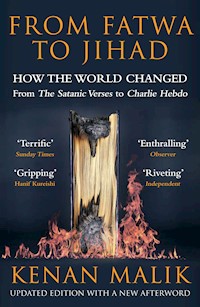
Longlisted for the Orwell Prize for Books 2010 The Number 1 international bestseller updated and reissued. Almost thirty years ago, the image of burning copies of Salman Rushdie's The Satanic Verses held aloft by thousand-strong mobs of protesters became an internationally familiar symbol of anger and offence. In From Fatwa to Jihad, Kenan Malik reveals how the Rushdie affair transformed the debate worldwide on multiculturalism, tolerance and free speech, helped fuel the rise of radical Islam and pointed the way to the horrors of 9/11 and 7/7. In this new edition, Malik examines the rise of home-grown jihadis, the threat of IS-inspired terrorism in Europe and how the West has failed to learn the lessons of the past.
Sie lesen das E-Book in den Legimi-Apps auf:
Seitenzahl: 580
Veröffentlichungsjahr: 2012
Das E-Book (TTS) können Sie hören im Abo „Legimi Premium” in Legimi-Apps auf:
Ähnliche



















For Carmen
Contents
Preface
INTRODUCTION:How Salman Rushdie changed my life
1Satanic delusions
2From street-fighters to book-burners
3The rage of Islam
4Bargains, resentments and hatreds
5God’s word and human freedom
6Monsters and myths
Afterword
Notes
Bibliography
Acknowledgements
Index
Preface
The first edition of From Fatwa to Jihad was published in 2009, on the twentieth anniversary of the Ayatollah Khomeini’s fatwa against Salman Rushdie. The fatwa had come as a great shock, both in Britain and globally, and its consequences reverberated through domestic and international politics alike in the two decades that followed. Much was written about it, yet there had been few serious attempts to place the Rushdie affair in a broader political and social context, to understand both the developments that enabled it and the developments that it shaped.
For me, the Rushdie affair was not just a political drama; it was a personal story too. I had grown up in a country very different to the Britain of today, a country in which racism was woven into the social fabric in a manner unimaginable now, a racism that was vicious and visceral and inescapable. It was a time when cultural and religious identities were relatively fluid and not like manacles on an individual, a time when minority communities did not seek to define themselves through their ‘differences’; a time when equality still meant the right to be treated equally, despite racial, religious or cultural differences, not, as it became later, the right to be treated differently because of them; a time when the ideas of the left still had purchase, and the left still stood for equality, free speech and universal values. The Rushdie affair gave notice that many of the defining features of the society in which I grew up were changing. It made me rethink my relationship to Britain, to politics, to religion. And it was out of that rethinking that From Fatwa to Jihad eventually emerged.
The book weaves together the personal, the political and the polemical. It is partly a memoir, partly a social history that tells the story of post war Britain from a distinct perspective – that of migrants and minority communities; and partly a series of polemical arguments, particularly on the importance of free speech and the problems of multicultural politics.
Rereading the book recently, it struck me how much of the discussion in From Fatwa to Jihad remains pertinent – perhaps even more so than in 2009. But it struck me, too, how much has changed. When I originally wrote the book, the debate about ‘home-grown’ jihads, for instance, was still in its infancy. The first European home-grown suicide bombers had carried out the London 7/7 bombings in 2005. The stories of Mohammad Sidique Khan, leader of the 7/7 bombers, and of other British jihadis were central to my narrative. Since 2009, however, the landscape of European jihadism has been transformed. The emergence of Islamic State, in particular, has recast both the political geography of the Middle East and North Africa and the character of jihadism in Europe. The fact that more than 4,000 Europeans now fight with Islamic State, and the threat posed by IS-inspired militants in Europe, has created a significantly different context for the debate about jihadism than that which existed in 2009.
The debate about social policy has also moved on. From Fatwa to Jihad explores at length the question of multiculturalism in Britain, tracing its development and providing an analysis of its impact on minority communities and on wider political events. Over time, however, the focus of discussion has shifted. It has in recent years become fashionable to criticize multiculturalism. Many of the criticisms are as problematic as multiculturalism itself, sometimes even more so. Where, for me, the critique of multicultural policies has always gone hand-in-hand with a defence of immigration, diversity and equality, what drives many contemporary critics is a hostility to all three.
At the same time, the focus of today’s discussion of the relationship between social policy and home-grown jihadism is as much on French assimilationism as on British multiculturalism. In the past, French commentators often suggested that France had steered clear of many of the problems faced by Britain because it had repudiated multiculturalism in favour of an assimilationist approach. In France, they insisted, unlike in Britain, every individual was treated as a citizen, not as a member of a particular racial or cultural group. Having rejected the divisive consequences of multiculturalism, France, they claimed, had avoided the British problem of home-grown jihadism. Today, though, it is clear that this problem is even greater in France than it is in Britain – France has suffered more grievously from jihadi terror, and as a society seems more fractured than Britain.
These new developments require fresh analysis. Hence this new edition of From Fatwa to Jihad. It retains the arguments and the narrative of the original, but develops them through an extended Afterword that brings the story up to date. The Afterword explores, for instance, the shifting terrain of European jihadism, and questions many of the assumptions about ‘radicalization’. It dissects the problems of French assimilationism and looks at what multiculturalism and assimilationism – two seemingly very different kinds of social policy – have in common.
The book has also a new subtitle: How the World Changed from The Satanic Verses to Charlie Hebdo. The attack in January 2015 on the Paris offices of the satirical magazine Charlie Hebdo, which left eleven dead, was as shocking as the fatwa. A key theme in this book is the way that the Satanic Verses controversy shaped attitudes towards free speech, helping to create a climate in which many saw it as morally unacceptable to give offence to other cultures or faiths. The Charlie Hebdo killings may not have as significant a long-term impact as the fatwa on Salman Rushdie, but the debate that followed the killings exposed with startling clarity the degree to which liberal attachment to free speech has already degenerated. ‘Perhaps no event’, as I suggest in the Afterword, ‘has more revealed the failure of liberals to stand up to liberal values than the Charlie Hebdo killings.’ Understanding the debate about Charlie Hebdo allows us to appreciate more keenly the political, social and cultural shifts that followed the Rushdie affair; unpicking the consequences of the Rushdie affair allows us to comprehend better the controversies over Charlie Hebdo.
The Afterword stands as an essay on its own. But it is also an integral part of this book, a means both of extending it and of throwing new light on the original work. My hope is that this new edition will continue to influence the way we think about the Rushdie affair and its legacy, and about key issues such as Islamism, multiculturalism, assimilationism and free speech. Most of all, I hope it encourages others to engage with, criticize and develop the arguments about these issues. As Salman Rushdie himself put it in his 1990 essay ‘In Good Faith’, we can only understand ourselves and shape the future ‘by arguing and challenging and questioning and saying the unsayable’.
INTRODUCTION
How Salman Rushdie changed my life
‘A poet’s work,’ he answers. ‘To name the unnamable, to point at frauds, to take sides, start arguments, shape the world and stop it from going to sleep.’ And if rivers of blood flow from the cuts his verses inflict, then they will nourish him.
Salman Rushdie, The Satanic Verses, p.97.
1
It was February 1989. I was in Bradford, a grey town in northern England. Nestled in the hills of West Yorkshire, it was a place dominated by its woollen mills, huge Victorian structures that seemed to reach up into the clouds, though by the late eighties few were still producing any wool. Surrounding the now derelict mills were row upon row of dreary back-to-back houses that had become as decayed as the textile industry itself. The mood of the town was not improved by a climate grey like its brickwork.
It was a town of which few people outside of Britain would have heard. Until, that is, a thousand Muslim protestors had, the previous month, paraded with a copy of Salman Rushdie’s The Satanic Verses, before ceremoniously burning the book. The novel was tied to a stake before being set alight in front of the police station. It was an act calculated to shock and offend. It did more than that. The burning book became an icon of the rage of Islam. Sent around the world by a multitude of photographers and TV cameras, the image proclaimed, ‘I am a portent of a new kind of conflict and of a new kind of world.’
Ten months after that January demonstration an even more arresting image captured the world’s imagination: protestors on top of the Berlin Wall hacking away at their imprisonment. These two images – the burning book in Bradford, the crumbling wall in Berlin – came in the following years to be inextricably linked in many people’s minds. As the Cold War ended, so the clash of ideologies that had defined the world since the Second World War seemed to give way to what the American political scientist Samuel Huntington would later make famous as ‘the clash of civilizations’ (a phrase he had borrowed from the historian Bernard Lewis). The conflicts that had convulsed Europe over the past centuries, Huntington wrote, from the wars of religion between Protestants and Catholics to the Cold War, were all ‘conflicts within Western civilization’. The ‘battle lines of the future’ would be between civilizations. Huntington identified a number of civilizations, including Confucian, Japanese, Hindu, Orthodox, Latin American and African. The primary struggle, however, would be, he believed, between the Christian West and the Islamic East. Such a struggle would be ‘far more fundamental’ than any war unleashed by ‘differences among political ideologies and political regimes’. The ‘people of different civilizations have different views on the relations between God and man, the individual and the group, the citizen and the state, parents and children, husband and wife, as well as differing views of the relative importance of rights and responsibilities, liberty and authority, equality and hierarchy’.
Huntington did not write those words until 1993. But already, four years earlier, many had seen in the battle over The Satanic Verses just such a civilizational struggle. On one side of the fault line stood the West, with its liberal democratic traditions, a scientific worldview and a secular, rationalist culture drawn from the Enlightenment; on the other was Islam, rooted in a pre-medieval theology, with its seeming disrespect for democracy, disdain for scientific rationalism and deeply illiberal attitudes on everything from crime to women’s rights. ‘All over again,’ the novelist Martin Amis would later write, ‘the West confronts an irrationalist, agonistic, theocratic/ideocratic system which is essentially and unappeasably opposed to its existence.’ Amis wrote that while still in shock over 9/11. The germ of the sentiment was planted much earlier, in the Rushdie affair.
Shocked by the sight of British Muslims threatening a British author and publicly burning his book, many people started asking a question that in 1989 was startlingly new: are Islamic values compatible with those of a modern, Western, liberal democracy? The Bible, the novelist, feminist and secularist Fay Weldon wrote in her pamphlet Sacred Cows, provides ‘food for thought’ out of which ‘You can build a decent society’. The Qur’an offers ‘food for no thought. It is not a poem on which a society can be safely or sensibly based. It forbids change, interpretation, self-knowledge, even art, for fear of treading on Allah’s creative toes.’ Or as the daytime TV chat-show host and one-time Labour MP Robert Kilroy-Silk put it, ‘If Britain’s resident ayatollahs cannot accept British values and laws then there is no reason at all why the British should feel any need, still less compulsion, to accommodate theirs.’
Even those who had originally welcomed Muslims into this country were having second thoughts. As one of Britain’s most liberal Home Secretaries, Roy Jenkins had, in 1966, announced an end to this country’s policy of assimilation and launched instead a new era of ‘cultural diversity, coupled with equal opportunity in an atmosphere of mutual tolerance’ – one of the first expressions of what came to be known as ‘multiculturalism’. Nearly a quarter of a century later, the now ennobled Lord Jenkins mused in the wake of the burning book that ‘in retrospect we might have been more cautious about allowing the creation in the 1950s of substantial Muslim communities here’.
I had watched the burning of The Satanic Verses with more than a passing interest. Like Salman Rushdie, I was born in India, in Secunderabad, not far from Rushdie’s own birthplace of Mumbai (or Bombay, as it was then), but brought up in Britain. Like Rushdie, I was of a generation that did not think of itself as ‘Muslim’ or ‘Hindu’ or ‘Sikh’, or even as ‘Asian’, but rather as ‘black’. ‘Black’ was for us not an ethnic label but a political badge (although we never defined who exactly could wear that badge). Unlike our parents’ generation, who had largely put up with discrimination, we were fierce in our opposition to racism. But we were equally hostile to the traditions that often marked immigrant communities, especially religious ones. Today, when people use the word ‘radical’ in an Islamic context, they usually have in mind a religious fundamentalist. Twenty years ago ‘radical’ meant the very opposite: someone who was militantly secular, self-consciously Western and avowedly left-wing. Someone like me.
I had grown up in communities in which Islam, while deeply embedded, was never all-consuming – indeed, communities that had never thought of themselves as ‘Muslim’, and for which religion expressed a relationship with God, not a sacrosanct public identity. ‘Officially, as it were,’ observes Jamal Khan, the narrator of Hanif Kureishi’s novel Something to Tell You, ‘we were called immigrants, I think. Later for political reasons we were “blacks” . . . In Britain we were still called Asians, though we’re no more Asian than the English are European. It was a long time before we became known as Muslims, a new imprimatur, and then for political reasons.’ So what, I wanted to know, as I watched the pictures of that demonstration, had changed? Why, I wondered, were people now proclaiming themselves to be Muslims and taking to the streets to burn books – especially the books of a writer celebrated for giving voice to the migrant experience? And was the dividing line really between a medieval theology and a modern Western society?
My day job then was as a research psychologist. But I also wrote the occasional article for the Voice, Britain’s leading black newspaper. When the editor asked me to write something about the Rushdie affair, I jumped at the chance. I already knew Bradford, and many of the players in the Rushdie drama, having organized anti-racist protests in the town, including a march against racist attacks in 1986. And so I arrived that February to talk to Sher Azam, president of the Bradford Council of Mosques, the man who had helped torch the book. I came also to try to answer my own questions. It was a journey that would transform my own views about myself, my politics and my faith – and continues to do so. Little did I know that those questions would return to haunt me again and again over the next twenty years, or that the issues raised by the Rushdie affair – the nature of Islam, its relationship to the West, the meaning of multiculturalism, the limits of tolerance in a liberal society – would become some of the defining problems of the age, linking the burning book in Bradford to the burning towers in Manhattan on 9/11 and the burning bus in London on 7/7.
2
When The Satanic Verses was published in September 1988, it had been expected to set the world alight, though not quite in the way that it did. Salman Rushdie was then perhaps the most celebrated British novelist of his generation. Not that he saw himself as British. He was, he said, someone inhabiting a world ‘in between’ three cultures: those of India, Pakistan and England. Midnight’s Children, his sprawling, panoramic, humorous mock-epic of post-independence India, was a literary sensation when it came out in 1981. It interlaced reality, myth, dream and fantasy, turned history into fable, and yet directly addressed highly charged contemporary political issues. The swagger of its historical sweep, the panache of its confident, modernist prose, the knowingness of its infectious humour, the confidence with which it drew upon European classics, Hindu myths, Persian fables, Islamic history, as well as popular cultures from Bollywood to Bob Dylan, and its insistence that the creative imagination was also a political imagination – all announced the arrival of not just a new literary voice but also a new kind of novel, the aim of which was to unlock the untold tales of those who, like Rushdie, inhabited the worlds ‘in between’. Politicians, Rushdie once remarked, ‘have got very good at inventing fictions which they tell us as the truth. It then becomes the job of the makers of fiction to start telling the real truth.’ Midnight’s Children won the Booker Prize in 1981, and went on to win in 1993 the Booker of Bookers, as the greatest of all Booker Prize winners. Fifteen years later, when Man Booker reran the competition to celebrate the fortieth anniversary of the prize, it again returned triumphant, having by now established itself as perhaps the most important British novel of the post-war years.
Two years after Midnight’s Children came Shame, which retold the history of Pakistan as a satirical fairy tale. Many saw it as a certainty to win the Booker Prize again, but it lost out to J.M. Coetzee’s Life and Times of Michael K. Nevertheless, Shame consolidated Rushdie’s reputation both as a novelist and as a controversialist. Midnight’s Children had been banned in India for its acid portrayal of the Nehru dynasty. Indira Gandhi sued for libel in a London court and won, which was not surprising, given that Britain’s libel laws were – and remain – as archaic as the regime that Rushdie was satirizing. Shame caused similar outrage among Pakistan’s political elite (the late Benazir Bhutto reputedly took particular exception to Rushdie’s mocking of her as the Virgin Ironpants) and was again banned.
And then came The Satanic Verses. Almost five years in the making, supported by a then virtually unheard-of $850,000 advance from his new publishers, Penguin, and published in the wake of a much talked-about split between Rushdie and his long-time friend and publisher, Liz Calder of Bloomsbury, the novel had become myth even before the public had read a word of it. Rushdie could undoubtedly have written an acidly baroque tale about its gestation.
In an interview in the Australian literary magazine Scripsi in 1985, Rushdie mentioned that he was working on two novels. One was ‘about God . . . that was not just a secular sneer’; the other was ‘a much larger project . . . a novel set in the West that deals with the idea of migration’. Over the next three years, the two became stitched together into a not altogether coherent whole: one a fantastic tale about the migrant experience in Britain, the other a fable about the origins of Islam. Rushdie himself seemed somewhat uncertain about the character of the novel, both describing it as ‘a serious attempt to write about religion and revelation from the point of view of a secular person’, and insisting that ‘the book isn’t actually about Islam, but about migration, metamorphosis, divided selves, love, death’.
The Satanic Verses opens with a hijacked jumbo jet exploding above the Sussex coast. There are only two survivors. Gibreel Farishta is a Bollywood superstar who depicts gods and is revered as one by his fans. Saladin Chamcha is an Anglophile – ‘more-loyal-than-the-Queen’ – so fanatically British that he wears a bowler hat even when tumbling from 29,002 feet (the height of Mount Everest and the very height at which the aircraft was blown up). As they fall, Saladin and Gibreel metamorphose. Saladin becomes hairy and goat-like, his feet turn to hoofs and he sprouts horns. Gibreel acquires a halo that he has to hide under a hat. The two men become the unwitting, and unwilling, protagonists in an eternal battle between good and evil, the divine and the satanic.
The progress of Saladin and Gibreel through the dark, surreal landscape of Vilayet (the Hindi word for ‘foreign place’, which Rushdie uses as a label for Britain) acts as the holding frame for the novel. Into this frame Rushdie inserts a number of novellas, each arising out of Gibreel’s dreams, and each of which confronts the nature of religion. The first tells the story of God’s revelation to the Prophet Mahound and how the new religion of Submission swept through Jahilia, a city built entirely of sand. This is a fictionalized, satirical account of the creation of Islam. Mahound is an ancient Christian derogatory name for Muhammad, Submission is the literal translation of ‘Islam’, and jahiliyyah is an Arabic word for ‘ignorance’, used by Muslims to describe the condition in which Arabs found themselves before the revelation of the Qur’an to Muhammad. The second novella concerns an imam in London (who, as Rushdie would put it, both is and is not Ayatollah Khomeini exiled in Paris) and his uncompromising struggle against the ruler of contemporary Jahilia. A third tells of Ayesha, a visionary peasant girl shrouded in butterflies, who leads her entire Indian village on a pilgrimage to Mecca during which they all walk into the sea and drown, a story based on a real event. Rushdie weaves into this tapestry the threads of other stories, of love and passion, betrayal and faith, reconciliation and death.
The Satanic Verses is held together not by a conventional narrative structure but by a cat’s cradle of cross-referenced names, images and allusions. Mount Cone is the mountain on which Mahound receives his revelation; Allie Cone is the mountaineer whom Gibreel loves. Allie Cone’s dream is a solo ascent of Everest; in Bombay, Gibreel lives at the very top of the Everest Apartments. Hind was the wife of the Grandee of Jahilia and Mahound’s mortal enemy; she is also the wife of Muhammed Sufyanin, in whose café Saladin finds refuge. Ayesha is the visionary who leads the suicidal pilgrimage to Mecca; she is also the empress of present-day Jahilia, against whom the exiled imam wages war. The imam’s henchmen are avatars of those in the service of Mahound. And so it goes on. The result is a complex, chaotic novel, the sheer bravura of which sweeps the reader along.
A work as boisterous, allusive and transgressive as The Satanic Verses would never give itself up to a single reading. Yet it was also, as Rushdie’s previous novels had been, a politically engaged work which, through its imaginative reworkings of modern Vilayet and ancient Jahilia, confronted many of the most charged questions of our time, religious and secular. Inevitably, many readers overlooked the unruliness of the novel and took instead a one-eyed view of Rushdie’s words. Western critics rarely saw beyond a migrant’s tale. Many Muslims were blind to anything aside from what they perceived as a gratuitously blasphemous assault on their faith. The Satanic Verses, the novelist Angela Carter observed in a review in the Guardian, was ‘an epic hung about with ragbag scraps of many different cultures’. It was peopled ‘mostly by displaced persons of one kind or another. Expatriates, immigrants, refugees.’ Not once in her review did she mention Islam. For the Muslim philosopher Shabbir Akhtar, on the other hand, Rushdie’s novel was an ‘inferior piece of hate literature’ which ‘falsified historical records’ in ‘a calculated attempt to vilify and slander Muhammad’. From the space between these two readings emerged the Rushdie affair.
3
The Rushdie affair was the moment at which a new Islam dramatically announced itself as a major political issue in Western society. It was also the moment when Britain realized it was facing a new kind of social conflict. From the very beginnings of post-war immigration, blacks and Asians had been involved in bitter conflicts with authority. In 1958 the Notting Hill race riots in west London led the local Labour MP George Rogers to declare that ‘the tremendous influx of coloured people from the Commonwealth’ had helped ‘foster vice, drugs, prostitution and the use of knives’. He added that ‘For years white people have been tolerant. Now their tempers are up.’ Two decades later, Notting Hill had become home to the largest carnival outside the Caribbean – and to explosive confrontations between police and black youth. In 1976, as reggae star Junior Murvin’s ‘Police and Thieves’ pumped out of the sound systems – ‘Police and thieves in the streets / Fighting the nation with their guns and ammunition’ – the carnival degenerated into bitter street battles. The following year came the Grunwick dispute, in which the struggle of a group of low-paid Asian women to form a union led to violent confrontation and became a national cause célèbre, with mass pickets outside the factory gates and miners and postal workers taking industrial action in support of the women. And, of course, there were the inner-city riots of the 1980s, culminating in the Broadwater Farm confrontation in 1985.
All these conflicts raised tensions and generated widespread and often fractious debates about the desirability of mass immigration. But these were also in the main political struggles, or issues of law and order. Confrontations over unionization or discrimination or police harassment were of a kind that was familiar even prior to mass immigration.
The Rushdie affair was different. It was the first major cultural conflict, a controversy quite unlike anything that Britain had previously experienced. Muslim fury seemed to be driven not by questions of harassment or discrimination or poverty, but by a sense of hurt that Salman Rushdie’s words had offended their deepest beliefs. Where did such hurt come from, and why was it being expressed now? How could a novel create such outrage? Could Muslim anguish be assuaged, and should it be? How did the anger on the streets of Bradford relate to traditional political questions about rights, duties and entitlements? Britain had never asked itself such questions before. Twenty years on, it is still groping for the answers.
4
The Rushdie affair was a turning point in the relationship between British society and its Muslim communities. It was a turning point for me too.
I was born in India, but came to Britain in the sixties as a five-year-old. My mother came from Tamil Nadu in southern India. She was Hindu. My father’s family had moved to India from Burma when the Japanese invaded in 1942. It is through him that I trace my Muslim heritage. Mine was not, however, a particularly religious upbringing. My parents forbade me (and my sisters) from attending religious education classes at school, because they did not want us to be force-fed Christianity. But we were not force-fed Islam or Hinduism either. I still barely know the Hindu scriptures, and while I read the Qur’an in my youth, it was only after the Rushdie affair that I took a serious interest in it.
What shaped my early experiences was not religion but racism. I arrived in Britain just as ‘Paki-bashing’ was becoming a national sport. ‘Paki’ was the abusive name for any Asian, and ‘Paki-bashing’ was what racists called their pastime of hunting out and beating up Asians. My main memory of growing up in the 1970s was of being involved almost daily in fights with racists, and of how normal it seemed to come home with a bloody nose or a black eye. (A few years ago I was making a TV documentary on which the runner was a young, hip, street-wise Asian, just out of university. During a conversation I happened to mention ‘Paki-bashing’. ‘What’s Paki-bashing?’ he asked, genuinely puzzled, never having heard the phrase, still less having experienced its effects – an indication of how much Britain has changed in the past thirty years.)
Like many Asians of my generation, I was drawn towards politics by my experience of racism. I was left-wing, and, indeed, joined a number of far-left organizations in my twenties. But if it was racism that drew me to politics, it was politics that made me see beyond the narrow confines of racism. I came to learn that there was more to social justice than the injustices done to me, and that a person’s skin colour, ethnicity or culture was no guide to the validity of his or her political beliefs. Through politics, I was introduced to the ideas of the Enlightenment, and to concepts of a common humanity and universal rights. Through politics, too, I discovered the writings of Marx and Mill, Kant and Locke, Paine and Condorcet, Frantz Fanon and C.L.R. James.
By the end of the 1980s, however, many of my friends had come to see such Enlightenment notions as dangerously naive. The Rushdie affair gave notice not just of a new Islam but also of a new left. Radicals slowly lost faith in secular universalism and began talking instead about multiculturalism and group rights. They became disenchanted with Enlightenment ideas of rationalism and humanism, and many began to decry the Enlightenment as a ‘Eurocentric’ project. Where once the left had argued that everyone should be treated equally, despite their racial, ethnic, religious or cultural differences, now it pushed the idea that different people should be treated differently because of such differences. Lee Jasper, who became the Mayor of London’s race advisor in 2000, cut his teeth in anti-racist campaigning in the late 1980s, being a founder member of such organizations as the National Black Caucus and the National Assembly Against Racism. ‘You have to treat people differently to treat them equally,’ he told me when I interviewed him for a Channel 4 TV documentary in 2003.
Over the past two decades many of the ideas of the so-called ‘politics of difference’ have become mainstream through the policies of multiculturalism. We’re All Multiculturalists Now, observed Nathan Glazer, the American sociologist and former critic of pluralism, in the title of a book. And indeed we are. The celebration of difference, respect for pluralism, avowal of identity politics – these have come to be regarded as the hallmarks of a progressive, anti-racist outlook and as the foundation stones of modern liberal democracies. Yet there is a much darker side to multiculturalism, as the Rushdie affair demonstrated. Multiculturalism has helped foster a more tribal nation and, within Muslim communities, has undermined progressive trends while strengthening the hand of conservative religious leaders. While it did not create militant Islam, it helped, as we shall see in this book, create for it a space within British Muslim communities that had not existed before.
5
I was in the drab Victorian semi near the university that housed the Bradford Council of Mosques, waiting to speak to the Council’s chairman, Sher Azam. Suddenly, I heard a familiar voice.
‘Hello, Kenan, what are you doing here?’
It was Hassan, a friend from London, whom I had not seen for over a year. ‘I’m doing some interviews about Rushdie,’ I told him. ‘But what are you doing in this God-forsaken place?’
Hassan laughed. ‘Trying to make it less God-forsaken,’ he said. ‘I’ve been up here a few months, helping in the campaign against Rushdie.’ And then he laughed again when he saw my face. ‘No need to look so shocked,’ he said. He had had it with the ‘white left’. He had got tired of all those dreary political meetings and the hours spent on street corners selling newspapers that no one wanted. But it had also become something more than simply disaffection with radical politics. He had, he said, lost his sense of who he was and where he’d come from. So he had returned to Bradford to try to rediscover it. And what he had found was a sense of community and a ‘need to defend our dignity as Muslims, to defend our values and beliefs’. He was not going to allow anyone – ‘racist or Rushdie’ – to trample over them.
The Hassan I had known in London had been a member of the far-left Socialist Workers Party (as I had been for a while). Apart from Trotskyism, his other indulgences were Southern Comfort, sex and Arsenal. We had watched the Specials and the Clash together, smoked dope together, argued together about football. We had marched together, chucked bricks together at the National Front, together been arrested.
There was nothing unusual about any of this. This was what it was like for many an Asian growing up in Britain in the 1980s. Hassan had been born, as I had, on the subcontinent (in Pakistan, not India) but brought up in Britain. His parents were observant Muslims, but, like many of their generation, were of the kind that only visited the mosque whenever the ‘Friday feeling’ gripped them. Hassan had attended mosque as a child, and learnt the Qur’an. But by the time he left school God had left him. ‘There’s a hole inside me where God used to be,’ Salman Rushdie once told an interviewer. I had never detected any such hole in Hassan. He seemed to have been hewn from secular rock. A football fanatic, the only God he worshipped was Liam Brady, Arsenal’s magical midfielder. But now here he was in Bradford, an errand boy to the mullahs, inspired by book-burners, willing to shed blood for a thousand-year-old fable that he had never believed in.
Unlike Gibreel Farishta and Saladin Chamcha, Hassan sported neither horns nor a halo. But his metamorphosis from left-wing wide boy to Islamic militant was no less extraordinary than that of the anti-heroes of The Satanic Verses. In that metamorphosis lies the story of the wider changes that were taking place both in Britain and in other Western nations, changes that made possible not just the Rushdie affair but eventually 9/11 and 7/7 too. This book is the story of that metamorphosis. It is a guidebook to the road from fatwa to jihad.
CHAPTER ONE
Satanic delusions
‘Chamcha,’ Mishal said excitedly, ‘you’re a hero. I mean, people can really identify with you. It’s an image white society has rejected for so long that we can really take it, you know, occupy it, inhabit it, reclaim it and make it our own. It’s time you considered action.’
‘Go away,’ cried Saladin, in his bewilderment. ‘That isn’t what I wanted. This is not what I meant, at all.’
Salman Rushdie, The Satanic Verses, pp.286–7.
1
‘It would be absurd to think that a book can cause riots,’ Salman Rushdie told the Indian journalist Shrabani Basu shortly before publication of The Satanic Verses. ‘That’s a strange sort of view of the world.’ It is in retrospect a comment either extraordinarily naive or piquantly ironic.
It was in India that the campaign against The Satanic Verses began. Even before it was published in Britain, Kushwant Singh, a distinguished novelist and journalist who acted as an editorial advisor for Penguin Books India, had raised concerns. He had read the book in typescript and ‘was positive it would cause a lot of trouble’. ‘There are,’ he told Chitrita Banerji of Sunday magazine, ‘several derogatory references to the Prophet and the Qur’an. Muhammad is made out to be a smalltime impostor.’ Penguin decided to publish the novel in India – but not under its own imprint.
On 5 October, barely a week after it had been published in Britain, the Indian ministry of finance placed The Satanic Verses on its list of proscribed books. The ban, the ministry proclaimed, ‘did not detract from the literary and artistic merit of Rushdie’s work’. To which Rushdie sardonically replied, ‘Thanks for the good review’ – while also wondering what the world might make of the fact ‘that it is the finance ministry that gets to decide what Indian readers may or may not read’. The ministry was in fact acting on orders from prime minister Rajiv Gandhi, who had been alerted to the issue by a letter from the MP Syed Shahabuddin, a member of the opposition Janata Party and a self-proclaimed champion of India’s 150 million-strong Muslim community.
‘The very title’ of Rushdie’s book, Shahabuddin complained in an article in the Times of India, was ‘suggestively derogatory’. In Islamic theology, the Qur’an is the word of God given to the Prophet Muhammad by the Archangel Gabriel. Muhammad excised two of the original verses believing them to have been inspired by Satan masquerading as Gabriel. These are the Satanic Verses. Rushdie presents the whole of the Qur’an as the work of Muhammad masquerading as the Prophet of God. Mahound, as Rushdie calls Muhammad, is an archaic name for the Prophet used as an insult by the crusaders. And most insultingly, Shahabuddin observed, Rushdie depicts the Prophet’s wives as prostitutes in a brothel called the Curtain, the literal translation of al-hijab, the Arabic word for the veil. In fact, as Rushdie himself has pointed out, Muhammad’s wives do not work in the brothel. Rather, the twelve prostitutes take on the names of the Prophet’s wives. For Shahabuddin, however, that amounted to the same.
Like virtually all of Rushdie’s opponents, Shahabuddin had not actually read The Satanic Verses. ‘I do not have to wade through a filthy drain to know what filth is,’ he retorted. He had been alerted to the novel’s significance by Jamaat-e-Islami activists. Jamaat-e-Islami is an Islamist organization founded in India in 1941 by Sayyid Abul A’la Maududi, one of the heroes of the modern jihadist movement. Rushdie had already taken aim at the Jamaat in Shame. Its response was the campaign against The Satanic Verses. It organized protests and petitioned Indian MPs. With a general election due in November, the result of which was too close to call, no politician was willing to alienate an important Islamic organization. A ban on The Satanic Verses was inevitable, whether or not anyone had read the book, and whatever its ‘literary and artistic merit’.
The Jamaat had a network of organizations in Britain, funded by the Saudi government, at the heart of which was the Islamic Foundation, based in Leicester. According to the Illustrated Weekly of India, Aslam Ejaz of the Islamic Foundation in Madras wrote to his friend Syed Faiyazuddin Ahmed, who had recently arrived at the Leicester centre, about the furore in India over The Satanic Verses and urged him to do God’s work in Britain. Ahmed bought the book, photocopied extracts, and mailed them to other Islamic groups in Britain and to the London embassies of Muslim countries. Soon afterwards, the Saudi-backed weekly Islamic magazine Impact International published a selection of the most controversial passages from The Satanic Verses, and Ahmed was invited to Saudi Arabia, where he briefed officials about the novel and mobilized Saudi support for a campaign against it.
The Saudis encouraged a number of Jamaat-influenced organizations in Britain to set up the United Kingdom Action Committee on Islamic Affairs (UKACIA) to coordinate the campaign against what one UKACIA circular described as ‘the most offensive, filthy and abusive book ever written by any hostile enemy of Islam’. But however overwrought the language, the Jamaat and the Saudis wanted to keep the anti-Rushdie campaign low-key. The Saudis’ style was that of back-room manoeuvrings rather than street protests. They hoped that a combination of diplomatic pressure and financial muscle could suppress The Satanic Verses, just as it had managed to ensure that Death of a Princess, a 1980 TV documentary hostile to the Saudis, was never reshown on British TV. This time the campaign had little success. Penguin refused to withdraw the book and the British government refused to ban it. Even Muslim states seemed barely interested. Few responded to the Saudi campaign or banned the novel. In November, Pakistan and South Africa followed India’s lead in proscribing the book, and soon afterwards Saudi Arabia, Egypt, Bangladesh, Malaysia and Sudan did so too. But in the majority of Muslim countries, including virtually all Arab states, The Satanic Versescontinued to be freely available, even after the Organization of the Islamic Conference had called for a ban.
In December – almost three months after the publication of the novel – came the first major street protest in Britain. Almost seven thousand Muslims marched through Bolton, another northern mill town, across the Pennines from Bradford. The demonstration was organized not by the Jamaat but by a rival Islamic faction, the Deobandis. The Jamaat possessed money and political influence, thanks to the Saudi connection, but little support on the ground. The majority of British Muslims were Barelwis, a Sufi-influenced tradition founded in India by Ahmad Raza Khan. Most mosques were run by the Deobandis, another movement founded in nineteenth-century British India with the aim of cleansing Islam, which placed particular stress on Qur’anic study and law. They created a network of madrasas throughout India (and subsequently Pakistan), the aim of which was to create a cadre of ulema, or religious leaders, capable of issuing fatwas on all aspects of everyday life based on a strict interpretation of the Qur’an. Most leaders of the Taliban, who came to power in Afghanistan in 1996, were trained in the Deobandi tradition. Conflict between Jamaatis, Barelwis and Deobandis was a feature of British Islam, and helped fuel the Rushdie controversy.
The Bolton protest was an impressive call to arms. Almost seven thousand protestors from across Britain marched through a town with a total Muslim population of around ten thousand. As in Bradford, they carried a copy of The Satanic Verses which they torched – the first time it had been burnt in anger in Britain. Yet almost no one took any notice. Whatever the grievances of British Muslims about The Satanic Verses, they had not yet registered on the national radar.
The Bradford protest the following month was different, partly because Bradford itself was different. In 1985 a Sufi mystic, Pir Maroof Hussain Shah, died. A poster in Urdu displayed in corner-shop windows throughout Britain urged his followers to attend a celebration of his life in Britain’s ‘Islamabad’ – the ‘city of Islam’. ‘Islamabad’ was Bradford. By the 1980s, this small northern town had become the heartbeat of Britain’s Muslim communities. The creation of the Bradford Council of Mosques in 1981, and the close relationship between the mosques, around half of which were controlled by the Deobandis, and Bradford City Council, provided the town’s imams with considerable political clout. Bradford’s heart also beat strongly to a secular pulse. The Asian Youth Movement, which gave voice to young radical Asians, and was as critical of the mosques as it was of racists, organized strongly in the town. More than a decade of militancy and protest had made Bradford’s Muslim leaders – religious and secular – politically astute and media savvy. They understood the gospel of Marshall McLuhan as well as the teachings of the Prophet Muhammad. The demonstrators videoed the protest and dispatched the images to media outlets across the world. The flames that incinerated The Satanic Verses were fanned into an international controversy.
In response to the Deobandi demonstrations the Jamaat organized its own street protests – not in Britain but in Pakistan, a country that had already banned the novel. But the Islamic Democratic Alliance, of which Jamaat-e-Islami was an influential part, had recently lost an election to Benazir Bhutto’s Pakistan People’s Party. ‘Was the agitation really against the book which has not been read in Pakistan, is not for sale in Pakistan,’ Bhutto wondered, or ‘was it a protest by those people who lost the election . . . to try and destabilize the process of democracy’? The Jamaat organized an anti-Rushdie demonstration on 12 February, targeting neither the British embassy nor the offices of Penguin Books, but the American Cultural Centre in Islamabad. An angry Jamaat-led mob, 2000-strong according to some reports, 10,000-strong according to others, tried to storm the centre, shouting ‘Allahu Akhbar’ and ‘American Dogs’. They pulled down the Stars and Stripes flying on top of the building and burnt it, along with an effigy of Salman Rushdie. Eyewitnesses described the police repeatedly firing into the crowd with semi-automatic rifles and pump-action shotguns. By the end of the day at least five people had been killed and more than a hundred injured – the first fatalities of the Rushdie affair.
Yet even now fury about The Satanic Verses was largely confined to Muslims in the Indian subcontinent and in Britain. Critics of Rushdie have consistently argued that the blasphemies in his novel caused mortal offence to all Muslims. ‘The life of the Prophet Muhammad’, the liberal Muslim writer Ziauddin Sardar has observed, ‘is the source of Muslim identity.’ Because ‘the Prophet and his personality define Islam’, so ‘every Muslim relates to him directly and personally’. That is why Sardar ‘felt that every word, every jibe, every obscenity in The Satanic Verses was directed at me – personally’. Every Muslim would have felt the same, Sardar insisted. ‘Just as people threatened with physical genocide react to defend themselves, Muslims en masse would protest against this annihilation of their cultural identity.’
Leaving aside the question of whether the blasphemies in The Satanic Verses are really any more offensive than, say, the attempt to compare the publication of a novel with the Final Solution, Sardar’s claim that all Muslims would see such blasphemies as the ‘annihilation of their cultural identity’ was not borne out by events. The novel had little impact on Muslims in other European countries. There is no evidence that on reading the book French or German Muslims imagined, as Sardar did, that ‘this is how . . . it must feel to be raped’. There was barely a squeak of protest in either country when the novel was published there. In America there was an organized letter campaign aimed at Viking Penguin, and bomb threats against its offices, but no mass protests as in Britain, India or Pakistan. Arabs and Turks, too, seemed as unmoved by Rushdie’s blasphemies as did their European and American brethren.
Even within the Islamic Republic of Iran there appeared to be little concern. Unlike the governments of India, Pakistan, Saudi Arabia and South Africa, Tehran’s revolutionary mullahs felt no need to ban the book. In December 1988, Kayhan Farangi, a leading Iranian literary journal, published a review. The Satanic Verses, it suggested, ‘contains a number of false interpretations about Islam and gives wrong portrayals of the Qur’an and the Prophet Muhammad. It also draws a caricaturelike and distorted image of Islamic principles which lacks even the slightest artistic credentials.’ Though highly critical of the novel, there was no intimation that the ‘distorted images’ amounted to blasphemy or that Rushdie’s ‘moral degradation’ constituted apostasy. Nor was there any suggestion that The Satanic Verses was, as the Jamaat-inspired United Kingdom Action Committee put it, ‘the most offensive, filthy and abusive book ever written by any hostile enemy of Islam’. Kayhan Farangi acknowledged Rushdie’s insistence ‘that his book is nothing more than a work of imagination which tries to investigate the birth of a major religion from the point of view of a secular individual’. It acknowledged, too, Rushdie’s fear that the campaign against the novel in the subcontinent was driven by politics rather than theology. As Indian politicians attempted to ‘win the hearts and minds of 100 million Muslims’, so The Satanic Verses had ‘become a ball in this political game’.
Today, Ghayasuddin Siddiqui is a founding trustee of British Muslims for Secular Democracy. Twenty years ago his views about Islam and secularism were very different. He was a great admirer of the Iranian revolution and, in 1974, one of the founders, together with the scholar Kalim Siddiqui and the writer Ziauddin Sardar, of the Muslim Institute, a London-based organization that was eventually entirely funded by Tehran. Sardar, who soon became disenchanted with the revolution, describes the Institute as ‘an extension of the Iranian embassy in London’. ‘Being the first Sunni organization to support the revolution, we had privileged access to the revolutionaries,’ says Ghayasuddin Siddiqui. He was frequently in Tehran and in the autumn of 1988 had plenty of discussions about The Satanic Verses, in street cafés and government ministries. ‘There was little hostility to the novel,’ he recalls. ‘It was widely discussed. There were even some good reviews in the press.’
2
It was the evening of 13 February 1989. Ghayasuddin Siddiqui and Kalim Siddiqui were in Tehran attending a conference. On the way home they were, as usual, ushered into the VIP lounge at the airport. Waiting for them was Mohammad Khatami. Almost a decade later Khatami would become the most liberal of Iran’s post-revolutionary presidents. In 1989 he was in charge of the Ministry of Religious Guidance. ‘He took Kalim aside,’ remembers Siddiqui, ‘and they were engaged in earnest discussion. When he came back, I asked him what that was about. “He wanted to know about Rushdie’s book,” Kalim said. “What did you tell him?” I asked. And Kalim said with a laugh, “I told him it was obnoxious.”’
At the same time as Kalim Siddiqui was conferring with Mohammad Khatami, on the other side of the city, in his modest house, Ayatollah Khomeini was summoning a secretary. He dictated a simple four-paragraph message:
In the name of Him, the Highest. There is only one God, to whom we shall all return. I inform all zealous Muslims of the world that the author of the book entitled The Satanic Verses – which has been compiled, printed and published in opposition to Islam, the Prophet and the Qur’an – and all those involved in its publication who were aware of its contents, are sentenced to death.
I call on all zealous Muslims to execute them quickly, wherever they may be found, so that no one else will dare to insult the Muslim sanctities. God willing, whoever is killed on this path is a martyr.
In addition, anyone who has access to the author of this book, but does not possess the power to execute him, should report him to the people so that he may be punished for his actions.
May peace and the mercy of God and His blessings be with you. Ruhollah al-Musavi al-Khomeini, 25 Bahman 1367
The following day – 14 February, Valentine’s Day – the sheet of paper was hand-delivered to Tehran Radio just before the 2 p.m. news, at the start of which it was read out. It was a message that was to transform the Rushdie affair.
At the very moment that Khomeini was dictating his death sentence, Salman Rushdie was attending a book party for his American wife Marianne Wiggins’s new novel John Dollar in the elegant art deco atrium of Michelin House on the Fulham Road in west London. They were planning a joint book tour of America. Apprehensive about the consequences of the riots in Pakistan, they spent that night with friends rather than in their Islington home. It was early next morning that a telephone call from the BBC World Service alerted Rushdie to the fatwa. Within hours he was in the BBC studios at Broadcasting House in central London responding to Khomeini’s edict. ‘I am very sad it should have happened,’ he said. ‘It is not true this book is a blasphemy against Islam. I doubt very much Khomeini or anyone else in Iran has read the book, or anything more than selected extracts taken out of context.’ Later, interviewed for the CBS This Morning television show in America, Rushdie added, ‘Frankly, I wish I had written a more critical book. A religion that claims it is able to behave like this, religious leaders who are able to behave like this, and then say this is a religion that must be above any kind of whisper of criticism: that doesn’t add up.’
‘By the time I came off the air,’ Rushdie recalled a year later, ‘Marianne had rung the studio and said, “Don’t come home, because everybody and his mother is parked on the pavement.”’ Rushdie was smuggled instead into his agent’s office, where ‘of course every telephone in the building was ringing non-stop and everybody was being told I wasn’t there’.
He was due that evening to attend a memorial service for the writer Bruce Chatwin, who had been ‘probably my closest writer friend’. Should he go? ‘It was very important for me to go to that service,’ Rushdie recalled, ‘but I had no way of knowing what I should or shouldn’t do. In the end I just said, “The hell with it, let’s go.”’ It was to be Rushdie’s last public appearance for years. ‘Your turn next,’ the travel writer Paul Theroux whispered to him on leaving the church. ‘I suppose we’ll be back here for you next week.’ ‘It wasn’t the funniest joke I ever heard,’ Rushdie later remarked, ‘but I did write him a letter subsequently saying that I was glad he’s a less good prophet than he’s a novelist.’
By the following morning there was not just a fatwa against Rushdie but a price on his head. Hossain San’ei, leader of the 15 Khordad, a Tehran-based charitable foundation set up to uphold Islamic principles in Iran, offered $3 million for the murder of Rushdie (or $1 million if the assassin happened to be non-Muslim). Rushdie was immediately given ‘grade one’ protection by Scotland Yard’s Special Branch and removed to a safe house. ‘I remember Salman as a hunted man,’ says the novelist Hanif Kureishi. ‘He was always on the move. It was very difficult to keep in touch, but he was desperate to see people. Sometimes he just popped up at a friend’s house, but always with his Special Branch minders. It was a harried existence.’
For a decade Rushdie was compelled to live like a fugitive, constantly moving from house to house – he was supposed to have slept in fifty-seven beds during the first five months of hiding – and forced into cloak and dagger operations in order to meet friends or journalists. He made the occasional surprise public appearance, such as joining Bono on stage at a U2 gig at Wembley in 1993. But it was not till 1998, when the Iranian government publicly declared that it would ‘neither support nor hinder assassination operations on Rushdie’ – the closest it would ever get to disowning the fatwa, which still stands – that he felt safe enough to return to the public glare.
3
Peter Mayer, Penguin’s CEO, was in New York on Valentine’s Day 1989. Early in the morning he received a call from Patrick Wright, the head of sales in London. ‘Have you seen the headlines?’ Wright asked. ‘What headlines?’ Mayer wanted to know. ‘The Ayatollah Khomeini’, Wright said, ‘has issued a fatwa against Salman Rushdie and his publisher.’ ‘What’s a fatwa?’ asked a bemused Mayer.
Mayer went out to get a paper. The news was splashed on the front page of the New York Times. ‘I was astonished’, he says, ‘to see the headlines. The New York Times dealt with world stories. I was just a publisher of a novel. I still did not see it as a world event.’
As Penguin CEO, Mayer was at the heart of the mayhem unleashed by the fatwa. He has never talked about it before, but it is an issue that twenty years on still causes him both pain and bafflement.
‘If you’re a publisher, you will always find people offended by books you publish,’ he observes. ‘That’s the fate of being a publisher. I have published books that have offended Jews and Christians. Five or six of them. People wrote to Penguin trying to suppress those books. I wrote back, explaining that as a publisher I cannot just publish books that offend no one. It was generally a civilized dialogue. We originally put The Satanic Verses controversy in the same category. We thought we were dealing with the same kind of thing, the same kind of offence. Our view was that it would soon be sorted out by dialogue, as these things always were. What we wanted to say to Muslims who were upset was that this was a novel, by a serious writer, and the right to publish included the right to publish such books. It’s what we said in all these cases. One relied on the sanity of secular democracy – that people met together, discussed their differences and sorted them out. It never occurred to us that this time it might be different or that it would become such a huge worldwide event.’
As a liberal, Mayer says, he ‘accepted that Muslims needed protection from discrimination and hatred. But the idea that non-Muslims should be prevented from reading a novel never entered my head. I never saw “rights” as meaning the right of the minority to impose on the majority. I saw it as meaning that the majority rules, but that minorities must have their rights protected. Those rights had to be based on the law of the land; they could not be rights that the minority simply arrogates to itself.’
When Mayer first read the manuscript of The Satanic Verses, he saw it quite straightforwardly as ‘a serious novel by a serious writer. I still don’t think that Penguin did anything extraordinary in publishing it. We never set out to incite or to inflame or to offend. We did not see the novel as blasphemous or anti-Islamic. The question never came up. Neither Salman Rushdie nor his agent alerted us to it being a controversial book. And a publisher should not have to be an authority on the Qur’an.’
The first intimation of trouble came with Kushwant Singh’s report on the possible reaction in India. ‘He opined that it might cause “communal violence”,’ says Mayer. ‘But Penguin only had a tiny office in India. We might have sold perhaps 150 hardcover copies. So we did not see it as a big issue.’
Even the protests in Britain barely registered. In hindsight the activities of the UKACIA and of the Bolton protestors, the intervention of Jamaat-e-Islami and the backroom manoeuvrings of the Saudi authorities all seem highly significant. In 1988, however, they caused hardly a ripple. ‘I cannot recall the protests here in the UK before the fatwa,’ Mayer admits. He cannot remember receiving any letter of complaint from the protestors, nor any request for a meeting. ‘If I had I would have responded as I did to all the other letters I received.’
The fatwa transformed the affair, an event both terrifying and confusing. ‘My immediate thought’, Mayer recalls, ‘was to be frightened for Salman. And frightened for Penguin staff. I didn’t know what the reach was of a fatwa, whether it could travel beyond Tehran.’
The day following the fatwa, armed police started patrolling the street outside Penguin offices. Special X-ray machines were installed to check packages for explosives. ‘My fear’, says Mayer, ‘was that a member of Penguin staff would be shot or stabbed to death and a note pinned on them, “This is what happens to people who work for Penguin”. I felt a terrible responsibility for all the staff. If anyone had been killed because of the decision to continue publishing The Satanic Verses I would have carried a sense of responsibilty to the end of my life.’
Mayer himself was subject to a vicious campaign of hatred and intimidation. ‘I had letters written in blood pushed under the door of my house. I had telephone calls in the middle of the night, saying not just that they would kill me but that they would take my daughter and smash her head against a concrete wall. Vile stuff.’ To this day he does not know from whom the letters and calls came.
The Special Branch offered Mayer armed protection and a bulletproof vest. ‘I said no. Of course I was scared. In New York I remember thinking, “I could come out of my apartment block, there might be a car waiting outside, engine revving, and I could get sprayed by a couple of machine guns. As easy as that.” But my view was that if my number’s up, my number’s up. And I did not want to live like a victim. I did not see myself as a victim.’




