


11,49 €
Mehr erfahren.
- Herausgeber: Atlantic Books
- Kategorie: Geisteswissenschaft
- Sprache: Englisch
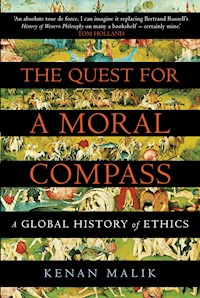
In this remarkable and groundbreaking book, Kenan Malik explores the history of moral thought as it has developed over three millennia, from Homer's Greece to Mao's China, from ancient India to modern America. It tells the stories of the great philosophers, and breathes life into their ideas, while also challenging many of our most cherished moral beliefs. Engaging and provocative, The Quest for a Moral Compass confronts some of humanity's deepest questions. Where do values come from? Is God necessary for moral guidance? Are there absolute moral truths? It also brings morality down to earth, showing how, throughout history, social needs and political desires have shaped moral thinking. It is a history of the world told through the history of moral thought, and a history of moral thought that casts new light on global history. At a time of great social turbulence and moral uncertainty, there will be few histories more important than this.
Das E-Book können Sie in Legimi-Apps oder einer beliebigen App lesen, die das folgende Format unterstützen:
Veröffentlichungsjahr: 2014
Ähnliche




















For Maya,the most moral person I know(though who will, no doubt, disagree with most of this),and for Carmen,whose moral sense already puts mine to shame
Contents
1
On the capriciousness of gods and the tragedy of Man
2
Gods of reason
3
On human flourishing
4
Heaven and hell
5
Nirvana
6
The view from the mountains
7
Faith and power
8
Reason and Revelation
9
The human challenge
10
The revolutionary spirit and the reactionary soul
11
The human triumph
12
Passion, duty and consequence
13
The challenge of history
14
The death of God, the end of morality
15
The anguish of freedom
16
The ethics of liberation
17
The unravelling of morality
18
The search for ethical concrete
19
Confucianism, communism and the clash of civilizations
20
The Fall of Man
Notes
Bibliography
Acknowledgements
Index
CHAPTER ONE
On the capriciousness of gods and the tragedy of Man
1
Sing, goddess, of the anger of Achilleus, son of Peleus, the accursed anger which brought uncounted anguish on the Achaians and hurled down to Hades many mighty souls of heroes, making their bodies the prey to dogs and the birds’ feasting; and this was the working of Zeus’ will. Sing from the time of the first quarrel which divided Atreus’ son, the lord of men, and godlike Achilleus.1
So opens the most celebrated work of Greek poetry, the earliest expression of European literature, and, to some, its greatest too. Homer’s Iliad tells the story of the Trojan War, the ten-year struggle by Achaean Greeks to avenge the abduction of Helen, wife of Menelaus, the king of Sparta, by Paris, son of the Trojan king Priam. (The Achaeans were the first Greek-speaking inhabitants of what we now call Greece.) The Iliad forms one half of a poetic diptych with the Odyssey, in which Homer recounts the tale of Odysseus’ struggle to return home after the fall of Troy, a struggle that was to last as long as the war itself.
Written in the eighth century BCE, the Iliad and the Odyssey are distilled from a long and rich tradition of oral poetry, the work of generations of illiterate singers in an illiterate age who composed and passed on their epics of men and gods, love and death, adventures and conquests, without the aid of writing. Over centuries these tales melded together into a stock of myths that gave the audience that listened to the itinerant poets a sense of time and place. The Homeric poems were both the culmination of this tradition and its transformation, works that drew upon the oral lore but whose depth of vision, breadth of imagination, and sheer ambition gave voice to a new kind of literature and to a new kind of myth. The Iliad and the Odyssey gave ancient Greeks a sense of their history, turned a fable about their origins into the foundation stone of their culture, nourished generations of poets and sculptors and artists and established a framework for their moral lives. It is a good place from which to embark on our journey of exploration through the history of moral thought.
The Iliad is a poem about the Trojan War. And yet it is not a poem about the Trojan War. The beginnings of the conflict and the sacking of Troy both lie offpage. The whole story of the Iliad is contained within a span of fifty-two days in the tenth and final year of the war. The main action, running through twenty-two of the poem’s twenty-four books, occupies just four days.
The quarrel of which Homer speaks in the opening line of the Iliad is not the quarrel between the Greeks and the Trojans, but that between Agamemnon, the leader of the Greek forces, and Achilles, son of the goddess Thetis and the most famous of the Greek warriors. Homer begins his tale by telling of how Chryses, priest to the god Apollo, asks Agamemnon to allow him to ransom his daughter Chryseis whom the Achaean king had captured as a war trophy and claimed as a slave. When Agamemnon rudely rejects him, Chryses prays to Apollo for help. Apollo sends a plague upon the Greeks. To pacify the god, an assembly of Greek warriors demands that Agamemnon return his slave girl to Chryses. Agamemnon agrees, but only if he be given, in exchange, Achilles’ concubine, Briseis, another prize captured in war. Humiliated and dishonoured, Achilles withdraws himself and his warriors from the conflict.
Agamemnon’s ‘wicked arrogance’ and the ‘ruinous wrath’ of Achilles provide the raw material for Homer. His theme is not the war but the tragedy of the human condition, the unintended consequences of human sentiment and the nature of fate in governing human life. All the major dramatic moments of the poem spring fatefully and inevitably from the quarrel between Achilles and Agamemnon. With Achilles out of the battle, Hector, brother of Paris, successfully breaches the Greek camp, with backing from the gods. Achilles’ closest friend, Patroclus, who had also withdrawn from the war, re-enters the fray, dressed in Achilles’ armour. He manages to repel the Trojans but is killed in battle by Hector. In revenge, a distraught Achilles defeats Hector in single combat, then defiles his corpse for days, until King Priam persuades him to give up the body. The Iliad ends with Hector’s funeral. The death of Achilles and the fall of Troy lie outside the narrative of the poem. But we know that both will happen, for they are as inevitable as were the deaths of Patroclus and Hector, two more moments in the unbroken sequence that had sprung from Achilles’ anger.
‘And so the plan of Zeus was fulfilled,’ Homer writes of the consequences of Achilles’ wrath. Achilles’ ‘accursed anger’ had set forth a train of events that had ‘brought uncounted anguish on the Achaeans and hurled down to Hades many mighty souls of heroes’. But both that anger and that train of events were also part of a divine plan. Throughout the Iliad, divine and human causation are inextricably linked. Achilles and Agamemnon are responsible for their actions. They – and not just they – have to pay the price for their pride, arrogance and folly. And yet their actions are shaped by the gods, and their fates decided by Zeus’ scales.
The drama on the battlefield is shadowed by the drama on Mount Olympus. We see the gods holding council, quarrelling and sulking, laughing and partying and making love, and descending from their Olympian heights to change the course of human affairs. When Achilles is dishonoured by Agamemnon, his distraught mother, the goddess Thetis, appeals to Zeus, who promises her major Trojan success so as to ‘bring honour to Achilles’. As Paris is about to be defeated by Menelaus in a duel he has foolishly called, Aphrodite ‘snatched him away with the ease of a god, wrapped him in thick mist, and set him down in his sweetly-scented bedroom’. When Hera, the wife of Zeus, who has championed the Achaeans, protests about her husband’s support for the Trojans, he accepts that she can have her way and see Troy sacked but also issues a warning: ‘Whenever I in my turn am eager to destroy a city peopled by men who are dear to you, do not try to thwart my anger, but let me have my way.’2
Homer’s gods are not wise and judicious like the later gods of Judaism, Christianity and Islam. Rather, they are capricious, vain, vicious and deceitful. But however savage and immoral the gods may be, they are also all-powerful, or seemingly so to humans. It is in part a reflection of the world as the Ancients saw it: messy, chaotic, largely unpredictable, barely controllable, and yet inescapable. Not only have human choices to be made against the background of divinely ordered fate, but the gods often force humans to act against their wishes. Perhaps no figure better expresses the conundrum of human choice than Helen, whose abduction launched the Trojan War. Trojans hold Helen responsible for the war and for the suffering that it has brought. Helen herself accepts responsibility for the tragedy. And yet she, and Homer, recognize that she has been manipulated by divine forces, and in particular by Aphrodite, who had engineered Helen’s initial seduction by Paris.
In one poignant passage, Aphrodite tries to force Helen into Paris’ bed against her will, to comfort the Trojan prince. ‘Go sit by him yourself,’ Helen retorts, ‘abandon the paths of the gods, never again turn your feet back to Olympus; no, stay with him, for ever whimpering around him and watching over him, until he makes you his wife – or else his slave.’ ‘I will not go to him,’ Helen insists, for ‘that would bring shame on me’ and ‘I have misery enough in my heart’.3 Yet, however much she detests the goddess’s imperatives, Helen knows that she is powerless to resist them. She follows Aphrodite to Paris’ bedroom.
This, for Homer, is the tragedy of being human: to desire freedom, and be tortured by a sense of autonomy, and yet be imprisoned by forces beyond our control. Fate, to Homer, is a social reality, and neither will nor cunning can evade it. Indeed, a man who does what he ought to moves steadily towards his fate and his death. Achilles and Hector go into battle knowing they are fated to die, but knowing, too, that without surrendering to their fate they would also surrender their honour.
With tragedy, however, comes dignity. Gods act according to whim; only humans are truly accountable for their actions. Human life is framed by the gods and yet humans cannot rely upon them. They must depend upon their own wit and resources. It is human reason that imposes order upon an unpredictable world, and discovers dignity and honour within it.
The fraught relationship between Man and God lies at the heart not just of Homer’s work, nor even just of Greek philosophy, but also at the heart of all moral thought. In part, the history of moral thought is the history of attempts to address the problem of reconciling fate and free will. It is a dilemma with which not just believers but atheists, too, have been forced to wrestle. When ‘we feel ourselves to be in control of an action’, the contemporary neuroscientist Colin Blakemore has suggested, ‘that feeling itself is the product of our brain, whose machinery has been designed, on the basis of its functional utility, by means of natural selection.’ According to Blakemore, ‘To choose a spouse, a job, a religious creed – or even to choose to rob a bank – is the peak of a causal chain that runs back to the origin of life and down to the nature of atoms and molecules.’4
For Blakemore, unlike for Homer, fate lies not in the hands of gods but in the nature of atoms and molecules. But the same questions are raised about human actions. If all action is predestined, what could free will mean? Or ethics? From the beginnings of the philosophical tradition to the latest thoughts on neuroscience, the questions of fate and free will have been inextricably bound together in an ethical knot. Part of the story of the quest for a moral compass is the story of the attempts to untie that knot, to understand it, to live with it.
2
As Agamemnon and Achilles quarrel over the slave girl Briseis at the council of warriors, the ageing King Nestor intervenes. ‘You, agathos though you are,’ he tells Agamemnon, ‘do not take the girl from him, but let her be, as the sons of the Achaians gave her to him in the beginning as his prize.’ Then turning to Achilles, Nestor warns, ‘Do not seek open quarrel with the king, since there is no equality with the honour granted to a sceptred king, whom Zeus has glorified. You may be a man of strength, with a goddess for your mother, but he is more powerful because his rule is wider.’5
The Iliad provided the ancient Greeks with a framework within which to understand the hopes and sorrows that shaped their lives. It told of the desires of Man, the capriciousness of gods and the implacability of fate, and of how all three knitted together. Homer’s epic was not, however, just a way of making sense of the tragedy of the human condition. It was also a way of understanding how to meet the challenge of being human. Nestor’s speech gives us a glimpse of the moral rules by which Homer’s heroes lived.
The Greek word αγαθоς (agathos), which Nestor uses to describe Agamemnon, is often translated as ‘good’, in the sense of an action or a trait that is morally admirable. It is also, in Homer, a description of a person’s standing. Indeed, in Nestor’s speech, agathos is often rendered in English as ‘great man’. In Agamemnon’s world, a man’s social status and his moral worth are almost indistinguishable.
In premodern societies, and especially in ‘heroic’ societies at the edge of historical records such as that which Homer describes, the structure of society is a given, as is the role that each individual occupies and the privileges and duties that derive from that role. A person knows who he is by knowing his role within society, and in knowing this he knows also what he owes and what is owed to him by every other individual.
Being king gives Agamemnon his agathos. Yet possessing agathos does not stop him taking Briseis. Nor does his taking of Briseis undermine his agathos. Agamemnon is to be judged – and defined – solely by his ability to be kingly. To be kingly one had to possess not just kingly virtues such as courage, cunning, military skill and the ability to command men, but also the wealth and leisure necessary for the development of such character and skill. To be good one must be born into a good family. The greater one’s nobility, the greater one’s goodness. Achilles may have been dishonoured by Agamemnon’s action, but his honour, as Nestor points out, could never be equal to that of Agamemnon because he is not king, and nor could his goodness equal Agamemnon’s.
Ordinary folk cannot, it seems, be good at all. The duties of a swineherd or a miller, as much as those of Agamemnon or Achilles, derive from the roles they occupy within the given structure of a community. Unlike for Agamemnon and Achilles, the rules that assign their roles and define their duties also determine that in lacking nobility they also lack agathos.
The Iliad is clearly a moral tale. But it describes an alien moral world, not simply because its moral rules are so different from those of our world but also because its very notion of what constitutes a moral rule is alien to us. When, as modern readers, we enter Homer’s world, it is almost inevitable that we pass judgements upon his characters that are different from those of Homer himself. Paris is a kidnapper, a shirker, a man whom we would probably describe as morally dissolute. Homer would not portray him as such. Even though Paris fails to perform the actions of a good man, he remains good in Homer’s eyes because his hereditary gifts, social background and material advantages embody such an important part of his agathos.
Agamemnon’s pride and arrogance led to the tragedy of the Trojan War. To a modern reader, this places upon him a moral responsibility for the conflict. To Homer, Agamemnon’s pride and arrogance are a matter not of morality but of fate. ‘I am not to blame,’ Agamemnon insists, the gods ‘put a cruel blindness in my mind at the assembly on that day when by my own act I took away his prize from Achilleus.’6
In the modern world, morality is inseparable from choice. Homer’s warriors cannot choose to be moral or not. Each is simply good or bad at performing the duties of his role. Human choice adds texture to the cloth already woven on the loom of fate, but cannot unpick the threads. There is in the Iliad and the Odyssey only the faintest glimmer of what we would recognize as free will or choice. Indeed, it is not clear that any of Homer’s characters possess a ‘mind’ as we understand it, nor an interior life. In Homer’s epics, the psychologist David Olson observes, ‘there is an absence of such terms as “decided”, “thought”, “believed”, “doubted” or “equivocated”.’7 Homer’s characters do all of these things, but not in the self-conscious way that we do them. Agamemnon’s wrath and Achilles’ pride describe not emotions inside their selves, but their actions and the actions of the gods that determine their fate.
Lacking a concept of an interior life, Homer turns that life into a spectacle of gods in battle over the human world. He cannot access the drama inside the human head, because he possesses no language through which to understand it. So the drama takes place outside human life through the gods’ quarrels, loves, obsessions and desires. Hence the humanness of Homer’s gods. So beautifully wrought is that divine drama that in the modern world we continually plunder it for metaphors through which to understand our own desires and motivations – think of the importance to modern psychoanalysis of Oedipus and Narcissus, Prometheus and Antigone.
Homer was wrestling with no mere metaphor. The inner world was opaque to him, but the divine world was a reality. Homeric gods form the cosmic intelligence that drives the universe. They form also the inner intelligence that drives every human being. The gods inhabit our heads as well as heaven.
Over time, the inner world became more transparent, but the divine world more opaque. The drama played out in myth was both an attempt to make sense of a disorderly world and an acceptance that such a world is too disorderly to make sense of. Increasingly philosophers discovered order in the world, and the rules by which nature was organized and that made natural events predictable. As the cosmos appeared more ordered and predictable, so the plurality of gods acting on whim and caprice came to be replaced with a single Creator who governed with reason and judgement. In time that single Creator was Himself dethroned and replaced by a mechanical universe. Just like the outer world, the inner world, too, came to be seen as ordered and, to a degree, predictable. At the same time, humans came increasingly to be seen as agents – wilful beings with minds of their own.
The moral world bound by myth is different to that embodied in religion or that which makes sense in a world that entrusts to science. Moral thought does not inhabit a sealed-off universe. It cannot but be closely related to the social structure of a community and to the perceptions within it of what it is to be human. Homeric values emerged from the structure of heroic society, shaped by its needs and constrained by its particular conception of human nature. As society changed, and as new languages developed through which to understand the human soul, the human mind and humanity’s place in the cosmos, so inevitably moral ideas also evolved.
3
Aeschylus’ magnificent Oresteian trilogy begins where the Iliad ends. Troy has fallen. Greek warriors are returning home. The first play, Agamemnon, opens with Clytemnestra, wife of the Greek king and sister of Helen, awaiting her husband’s homecoming in the city of Argos. She is brimming with fury and rage. Ten years previously, on the eve of the war, Agamemnon had sacrificed their daughter Iphigenia to placate the gods and ensure favourable winds. Now Clytemnestra wants revenge. The play climaxes with the brutal murder of Agamemnon, his wife hacking him down with an axe, as if she were ritually sacrificing an animal.
In The Choephoroi, the second of the Oresteian plays, Agamemnon’s son Orestes, who has lived his life in exile, returns to Argos at Apollo’s command to avenge his father. He is faced with a terrible dilemma: murder his mother or leave his father unavenged. He kills both Clytemnestra and her lover.
In the final part of the trilogy, The Eumenides, Orestes is pursued by the Furies, ancient pre-Olympian deities, more hag-like than god-like, whose role was to exact vengeance for major sins: blasphemy, treachery and the shedding of kindred blood. Orestes finds refuge in Athens where, on the Acropolis, Athena convenes a jury of twelve to try him.
Apollo acts as attorney for Orestes, while the Furies become advocates for the dead Clytemnestra. The jury is split. Athena casts her vote in favour of acquittal, a verdict that enrages the Furies, who accuse her, Apollo and the other ‘young gods’ of usurping the power of the older divinities whom they represent. Athena eventually wins them over, renaming them Eumenides (the Kindly Ones), and assuring them that they will now be honoured by the citizens of Athens.
Aeschylus wrote the Oresteia in the middle decades of the fifth century BCE. This was the dawn of the era of ‘classical Greece’, an era which saw an extraordinary flourishing of art, architecture and philosophy, and at the heart of which stood the city of Athens. In the 800 years between the fall of Troy and the rise of Athens there had been a great transformation in Greek life. Not long after the sacking of Troy, the Mycenaean civilization, to which Homer’s Achaean warriors belonged, itself collapsed, through a combination of economic decline, internal strife and invasion. The invaders were Dorians, like the Achaeans a Greek-speaking people from the north; their arrival ushered in what is often called the Greek Dark Ages. The kingdoms of Mycenaean Greece gave way to a more fragmented landscape of small, independent regions based around kinship groups. Famine led to the abandonment of cities. Art and culture became denuded. Written language seems to have disappeared.
Not for another three centuries, until the beginning of the eighth century BCE, is there evidence of economic recovery. With a rise in population, a new form of social organization, the city state, or polis, begins to develop out of the kinship-based communities. Cultural life re-emerges. A new alphabet is adopted from the Phoenicians. One of its first exponents is Homer.
‘Polis’ meant to the ancient Greeks much more than ‘city state’ means to us. It carried a spiritual sense and embodied a sense of ‘home’ and belonging. It embodied also the sense that only through membership of the polis was humanity raised above the level of barbarism. Most of the new city states began as monarchies. Through the eighth century many overthrew their kings and evolved into oligarchies, ruled largely by their wealthiest citizens. A few – most notably Athens – took the oligarchic experiment further, turning themselves into democracies. These were not democracies in a modern sense – women, foreigners and slaves were, for instance, all disbarred from governance. Athenian democracy nevertheless expressed the impulse that ‘rule by the many’ was better than ‘rule by the few’, an impulse that was to shape all progressive thought in the centuries that followed.
Athens had, by the beginning of the fifth century BCE, displaced Sparta as the dominant Greek city state, in large part because of its role in thwarting the ambitions of the Persian Empire. Twice, in 490 BCE and again ten years later, Persian forces attempted to invade the Greek mainland. Twice they were beaten back, thanks in great measure to Athenian naval prowess. Success in the Persian Wars brought with it not just prestige but wealth and power too. This wealth and power, together with the city’s democratic reforms, attracted to Athens artists and philosophers from all over Greece. It also created a leisure class able to afford them patronage. The result was an extraordinary explosion of intellectual energy. Socrates and Plato, Aristotle and Euripides, Aeschylus and Sophocles, Herodotus and Xenophon, Thucydides and Aristophanes, Phidias and Praxiteles – some of the greatest philosophers, playwrights, poets and sculptors lived in the city in the two centuries that followed Athens’ triumph.
Presiding over this intellectual pantheon was still the ghost of Homer. The virtues that made for a good citizen in a city in which all 21,000 free men of the right age could sit in the decision-making Assembly were necessarily different to those that had driven aristocratic warriors to submit to heroic fate. For Homer, honour was bound with nobility. In democratic Athens, the power of the nobility was constrained by the Assembly, and there existed a moral equality between commoners and nobles previously unknown. How could a moral code crafted in an age of warriors and heroes translate into an age of philosophers and democrats? Why should there be a moral equality between commoners and nobles? And what could justice mean when it was no longer linked to a warrior’s search for honour? These were the questions that Aeschylus addressed in his Oresteian trilogy.
The Furies, in the Oresteia, represent the old virtues of Homer, rooted in honour, blood and revenge. Athena embodies the new civic virtues of Athens, the determination to apply reason and the democratic spirit, rather than arbitrary divine fiat, to the application of justice. For Aeschylus, the Furies are arbitrary in their moral judgement – they condemn Orestes for the murder of Clytemnestra but not Clytemnestra for the murder of Agamemnon. They refuse to acknowledge the moral dilemma in which Orestes was placed, and they fail to recognize that justice cannot always be dispensed by following a set law. Athena’s judgement is righteous because she recognizes both the fallibilities of humans and the dilemmas that they face.
Like Homer, Aeschylus understands the human condition as tragic, caught as humans are between a yearning for freedom and the necessity of fate. The citizens of fifth-century Athens are, however, freer than the inhabitants of twelfth-century Troy. Their yearning for freedom has been given concrete expression in the political structures of democratic Athens. The moral code has, therefore, to reflect these new ideas of human sovereignty. Aeschylus does not want, though, to detach himself entirely from either Homer’s world or the ancient deities. He views human life as lived in the shadow of the gods and accepts fate as a fact of life. Not only are some questions too difficult for humans to resolve – Athena herself, after all, has finally to decide Orestes’ fate – but the Furies must not be discarded; rather they must be given an honourable, though different, role in the new moral cosmos. In democratic Athens, Greeks were freer than they had been in heroic Troy. But greater freedom only made even sharper the tragic condition in which humans find themselves.
4
The 800 years between the fall of Troy and the rise of Athens did not just see a transformation in what Greeks considered were virtues or in how they imagined the good life. Those eight centuries saw also a transformation in the very way that people came to reflect upon morality.
The Iliad and the Odyssey provided a means by which ancient Greeks made sense of their moral lives. They were, however, works of poetry, not of philosophy. Homer articulated no comprehensive philosophical framework, but imagined a story within which his readers, and listeners, found both an explicit history and an implicit morality. The history and the morality made sense because Homer shared with his audience an understanding about gods, fate and how they worked. As Achilles battles with Hector, Odysseus speaks with the dead in the Underworld, or Hera seduces Zeus while Poseidon rouses the Achaean army, so the Iliad and the Odyssey extend that common story and infuse it with new meaning. Myth gave moral texture to people’s lives, made manifest their sense of wonderment and fear and helped link their particular lives with the eternal.
From the sixth century BCE, a new kind of moral account began to develop in which ideas about what constituted a virtuous act or a good life were not implicitly crafted, and intuitively grasped, through the narrative of myth, but explicitly established through rational argument. These new accounts did not so much tell stories as ask questions. What is a virtue? Why should I behave virtuously? Why is justice good? And they answered such questions not by turning to their foundational myths but by attempting to reason from first principles. This was the emergence of philosophy as distinct from poetry and mythology.
The first of the new breed of thinkers who, in Aristotle’s words, ‘spoke by demonstration’ rather than ‘invent clever mythologies’ came to be called the ‘Presocratics’, because they had the misfortune, as Anthony Gottlieb has put it, ‘of being born before Socrates’.8 Both the Ancients and modern philosophers came to see Socrates as the man with whom philosophy, and in particular moral philosophy, began. Socrates was, as we shall see, a key turning point in the history of moral thought. The Presocratics were, however, far more than the amuse bouche to set before the Socratic feast. They were little interested in questions of morality, being captivated more by ‘numbers and movements, with the problem whence all things came, or whither they returned’, as Cicero was later to put it.9 But in investigating ‘the problem whence all things came, or whither they returned’, the Presocratics began to develop a way of thinking about the universe, and of humanity’s place in it, that was to have a profound impact on moral thought.
The earliest of the Presocratics was Thales, born in Miletus, on the Anatolian coast of what is now Turkey, around 580 BCE; the last was Democritus who survived Socrates by some twenty years. As they left only fragments of original work, almost all we know of them and their ideas comes through the comments of later philosophers, especially Aristotle, Plato and Theophrastus. They were not a homogeneous group. Some, like Anaximander and Heracletes, saw the world as a manifestation of divine justice. Others, such as Leucippus and Democritus, saw no place for a divine presence in the cosmos. What connected them all was a commitment to explain the world in terms of its own inherent principles. Unlike Homer, who viewed the world as fundamentally disorderly, the Presocratics saw order everywhere. The apparent chaos of the world concealed a permanent and intelligible organization, which could be accounted for by universal causes operating within nature itself. The best tool to discern such order was the human mind.
The Presocratic thinkers set out to explain the stuff of which the world was made and the principles by which that stuff interacted. This has led some to describe them as the ‘first scientists’. They were not. The Presocratics did not observe nature and draw conclusions from their observational data in the manner of a modern scientist. They speculated largely about the unobservable – the origin and destruction of the world, the nature of the heavenly bodies, the causes of motion and change. Their arguments can often seem as wild, visionary and mystical as those of Homer. Anaximenes defined the primary substance from which all is made as air which through ‘rarefaction and condensation … manifests in different forms in different things’. Anaximander thought the earth was ‘cylindrical in shape, and three times as wide as it is deep’. Anaxagoras believed that ‘Mind ordered all the things that were to be.’10
Such tales about the origins and functioning of the universe may seem to have more in common with creation myths than with rational cosmology. They were, in fact, a dramatic breakthrough; not because of what they told us about the cosmos, but because of what they told us about ourselves as human beings. To understand the world, the Presocratics argued, we need to go beyond the observable and comprehend the underlying principles at work. These underlying principles could not be explained through divine action that, by definition, was not regular and ordered, but capricious and unpredictable. Such principles had, the Presocratics insisted, to be both naturalistic and reductionist. Naturalistic because phenomena had to be explained without recourse to divine intervention but only by reference to natural causes and events; reductionist because complex phenomena could be understood in terms of simpler processes, and explanations of the world should rely on as few principles as possible. In a sense, the Presocratics depended as much on faith as did Homer, but it was a different kind of faith: faith that the world was ordered in such a way that it could be intelligible to reason; and faith in the capacity of reason to make sense of the ordered world. They did not know that the world was so ordered, or that reason was so capable. They simply believed it. And in believing it, they helped transform the way in which humans came to think about the world and their place in it.
Not just the natural world but human affairs, too, were, for the Presocratics, ordered by laws and regularities. Few concerned themselves with questions of human behaviour. However, their belief that human life could be studied like the stars and the stones influenced others, most notably Herodotus. Born around 485 BCE in the colony of Helicarnassus, near Bodrum in present-day Turkey, not far from Troy, he lived in the disputed borderland between Greece and Persia. It was to be the wars between the two, which began in 499 BCE and lasted for almost half a century, that formed the heart of his Histories, often seen as the first true historical work. Like Almásy’s notebook in Michael Ondaatje’s The English Patient, the Histories is cut and pasted from stories, observations, anecdotes and thoughts. It is, however, unlike any previous histories. Herodotus did not merely rely on myth to recreate the past; he attempted systematically to collect historical data and, to a degree, test their accuracy.
The language of Herodotus, and the manner of his tales, are rooted in the Homeric tradition. The Histories is an epic poem rendered in prose. ‘I see him’, Almásy tells Hana in The English Patient, ‘as one of those spare men of the desert who travel from oasis to oasis, trading legends as if it is the exchange of seeds, consuming everything without suspicion, piecing together a mirage.’11 Yet the Histories also belongs to a different world to that of the Iliad and the Odyssey. It is an historia, a word that until then had been used to describe an investigation of natural phenomena (a sense that was later to be preserved in the English phrase ‘natural history’). In appropriating that word, Herodotus reveals both his indebtedness to the Presocratics and his intention to march further.
Herodotus examines the customs, beliefs and institutions not just of the Greeks but also of Persians, Egyptians, Libyans, Scythians and Arabs. Differences, he insists, are neither accidental nor the result of divine intervention but derive from material, earthly causes. The Egyptians have unusual customs because of their need to deal with their unusual climate. The natural poverty of Greece encouraged its inhabitants to develop appropriate laws and institutions to overcome it. The success of the Athenians was rooted not simply in the endeavours of great individuals but also in a democratic system that had nurtured a sense of common responsibility.
Herodotus attempted to use rational explanations to understand the social and cultural differences between cities and nations, peoples and ages; he also believed that such differences helped in turn to explain the movement of history. The Trojan War, the rise of Athenian democracy, the Persian invasion of Greece, the conflict between Athens and Sparta – none could be explained by appealing simply to individual decisions or whims, whether human or divine. Each was also the result of the way in which people in a given society with particular customs could be expected to act in certain circumstances.
The early Presocratics had tried to account for natural phenomena by borrowing concepts used to describe human interactions. Anaximander, for instance, suggested that all things came in opposites, such as hot and cold, wet and dry. These opposites were kept in balance because they were in a state of war and had to ‘give justice and reparation to one another for their injustice in accordance with the ordinance of Time’.12 Naturalists they may have been, but the only language the early Presocratics possessed through which to understand the workings of the cosmos was the language of human action and agency. By seeing human history as the product not simply of individual agency but also of the environment, social, physical, cultural and historical, that the agents inhabited, Herodotus turned on its head this relationship between humans and nature. Human society was not a model for the understanding of nature. Nature provided a template for the understanding of human society. In this, the classicist David Sansone suggests, ‘Herodotus invented not only history, but the social sciences as well.’13 He also opened the way for a new way of understanding both human nature and human morality.
CHAPTER TWO
Gods of reason
1
He was poor, wrote nothing, claimed he knew nothing and acknowledged that he was ‘full of defects and always getting things wrong in some way or other’.1 Yet he is, in the eyes of most philosophers, the founding father of Western philosophy. Its first saint. And its first martyr. In 399 BCE a jury of Athenian citizens found Socrates, then aged seventy, guilty of impiety and of corrupting the minds of the youth of Athens. It condemned him to death by hemlock.
Few philosophers were held in greater esteem in the ancient world than Socrates. He was, wrote Cicero, ‘the first who brought down philosophy from the heavens, placed it in cities, introduced it into families, and obliged it to examine life and morals, and good and evil’.2 Why, then, did Athens put its most famous son to death? The trial of Socrates, and his execution, took place against the background of the Peloponnesian War. The twenty-seven-year conflict between Athens and Sparta had ended with Athenian defeat in 404 BCE, five years before the trial. Athens was reduced to a state of subjection, never regaining its pre-war influence or prosperity, while Sparta established itself as the leading power of Greece. Athenian democracy was overthrown and replaced by a Spartan-imposed oligarchy, a group of men who came to be known as the Thirty Tyrants.
‘Tyranny’ in ancient Greece meant not a cruel despotism but the concentration of political power in an individual other than a hereditary monarch. The Thirty were, however, tyrannical in a modern sense. They crushed the rights of Athenian citizens, restricting the franchise to the wealthiest, purged many of the democratic leaders, executed hundreds and forced thousands more into exile. The Tyrants were overthrown after a year of bloody mayhem; democracy was finally restored in 401 BCE. Sparta had not relinquished its influence, though. In 403 an amnesty was declared for all supporters of the Thirty, ostensibly to unify the city. Embittered democrats were left without a target for vengeance.
Socrates had close links to the Thirty. Critias, the leader, and a particularly bloodthirsty man, was a former disciple, as was Charmides, one of his deputies. It is unclear the degree to which Socrates supported the Thirty, but he openly espoused anti-democratic views, often praising the laws of Sparta.
It was not just Socrates’ politics, but his philosophy, too, that aroused suspicion. Many saw his teachings as undermining Athens by questioning traditional values. The ‘Socratic method’ sought to establish moral truth not directly by explaining what it was to be pious, courageous or virtuous but indirectly through questioning others’ beliefs about piety, courage or virtue, and showing them to be confused, contradictory or false. The relentless questioning seemed to many not to unearth the truth but to turn the world upside down.
Socrates could not be indicted on political charges because of the amnesty. He was arraigned instead for religious and moral transgressions that were, to many Athenians, as disturbing as the political crimes and physical savagery of the Thirty. Socrates was accused of rejecting the city’s recognized gods, of introducing new divinities and of corrupting the young men of Athens by ‘making the inferior argument superior’. Certainly, these were trumped-up charges. But they also gave a sense of the anxieties many Athenians felt about the dislocation of their lives during the course of the fifth century.
Lesen Sie weiter in der vollständigen Ausgabe!
Lesen Sie weiter in der vollständigen Ausgabe!
Lesen Sie weiter in der vollständigen Ausgabe!
Lesen Sie weiter in der vollständigen Ausgabe!
Lesen Sie weiter in der vollständigen Ausgabe!
Lesen Sie weiter in der vollständigen Ausgabe!
Lesen Sie weiter in der vollständigen Ausgabe!
Lesen Sie weiter in der vollständigen Ausgabe!
Lesen Sie weiter in der vollständigen Ausgabe!
Lesen Sie weiter in der vollständigen Ausgabe!
Lesen Sie weiter in der vollständigen Ausgabe!
Lesen Sie weiter in der vollständigen Ausgabe!
Lesen Sie weiter in der vollständigen Ausgabe!
Lesen Sie weiter in der vollständigen Ausgabe!
Lesen Sie weiter in der vollständigen Ausgabe!
Lesen Sie weiter in der vollständigen Ausgabe!
Lesen Sie weiter in der vollständigen Ausgabe!
Lesen Sie weiter in der vollständigen Ausgabe!
Lesen Sie weiter in der vollständigen Ausgabe!
Lesen Sie weiter in der vollständigen Ausgabe!
Lesen Sie weiter in der vollständigen Ausgabe!
Lesen Sie weiter in der vollständigen Ausgabe!
Lesen Sie weiter in der vollständigen Ausgabe!
Lesen Sie weiter in der vollständigen Ausgabe!
Lesen Sie weiter in der vollständigen Ausgabe!




