


15,99 €
Mehr erfahren.
- Herausgeber: John Wiley & Sons
- Kategorie: Fachliteratur
- Sprache: Englisch
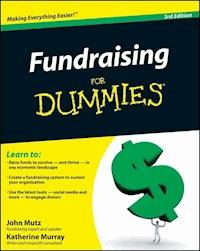
The fun and easy way to raise money for your cause Fundraising For Dummies, 3rd Edition shows you how to take advantage of the latest strategies and resources available for raising money through everything from special events to online donations, in both good and bad economic times. The authors teach you how to market your organization using the most up-to-date tools and technologies available through the Internet. This expanded edition also offers information about philanthropy and tax law. * Contains new tips and techniques for creating materials that bring in contributions and support for the more than 1.4 million charitable and nonprofit organizations in the United States * Explains how to use social media to keep donors and volunteers engaged through Facebook, LinkedIn, Twitter, and Web technologies * Covers grassroots online fundraising and how to host big events on a shoestring budget You'll also find tips on negotiating without alienating donors and developing long-term organizational goals. All these strategies are what makes this resource indispensable!
Sie lesen das E-Book in den Legimi-Apps auf:
Seitenzahl: 667
Veröffentlichungsjahr: 2010
Ähnliche


















Fundraising For Dummies®, 3rd Edition
Table of Contents
Introduction
About This Book
Conventions Used in This Book
What You’re Not to Read
Foolish Assumptions
How This Book Is Organized
Part I: Putting Your Fundraising Ducks in a Row
Part II: Finding — and Winning Over — Donors
Part III: Telling Your Story and Building Your Brand
Part IV: Engaging Your Givers with the Right Campaigns
Part V: The Part of Tens
Icons Used in This Book
Where to Go from Here
Part I: Putting Your Fundraising Ducks in a Row
Chapter 1: Fundraising in a Changing Economy
Looking at the Stark Realities
Identifying cutbacks and understanding the reasons for them
Coping with staff reductions and shrinking budgets
Dealing with hard times that linger
Finding reliable sources
Finding Your Opportunity: A Crisis Is Too Good to Waste
Revisiting your mission
Paring your services (or pairing up to provide them!)
Nurturing the donor-agency relationship
Turning to cost-effective processes
Talking Up Your Successes and Building Relationships
Telling your story well
Engaging people who care
Developing relationships with key businesses and funders
Doing Your Best to Bring In the Dollars
Preparing Now for When Things Start Looking Up
Laying the groundwork to take advantage of an economic recovery
Moving forward with hope
Chapter 2: Identifying the Fruits of Your Fundraising Passion
Sparking Fundraising Action
Remembering why you signed on
Helping your donor catch the spark
Talking the fundraising talk
Building on Passion in the Nonprofit World
Competing for dollars
Keeping your organization going
Demonstrating Your Connection with Social Media
Chapter 3: Finding the Right Perspective: Fundraising Issues and Ethics
Inspiring or Selling: The Fundraising Debate Continues
Living with the stigma
Combining sales and ideals
Understanding the Ethics of Fundraising
Finding ethical standards organizations
Familiarizing yourself with the fundraiser’s credo
Debunking Fundraising Myths
Myth 1: It’s all about the money
Myth 2: You lie to get what you want
Myth 3: Your donor owes the world something
Myth 4: Wining and dining donors is all you do
Chapter 4: Writing Your Case Statement: Your Agency’s Reason to Be
Stating Your Case
Understanding what the case statement is and how you use it
Getting started with your case statement
Making the Case Compelling
A Step-by-Step Guide to Writing the Case Statement
Step 1: The mission: Why are you here?
Step 2: The goals: What do you want to accomplish?
Step 3: The objectives: How will you reach your goals?
Step 4: Programs: What exactly do you provide?
Step 5: Governance: What’s the anatomy of your board?
Step 6: Staff: Who are the people behind your services?
Step 7: Location: Where do you live and work?
Step 8: Finances: Is your organization financially responsible?
Step 9: Development: What will you do in the future?
Step 10: History: What successes are you building on?
Overhauling an Outdated Case Statement
Sharing Your Case Statement
Formatting your case
From paper to online posts: Putting the case statement to work
Chapter 5: Organizing Your Team: Board Members and Volunteers
Seeing the Big Picture: How Boards and Fundraising Fit Together
Understanding the board’s duties
Knowing how your role fits with the board’s work
Enlisting the Board to Help Advance Your Cause
Helping the board help you in fundraising
Balancing the attraction of high-profile board members
Walking your Board through Tough Decisions
Slating and prioritizing your issues
Knowing when to use reserved funds
Figuring out when to launch into unchartered waters
Helping your organization find clarity in challenging times
Discovering the True Value of Volunteers
Seeking volunteers
Establishing a productive relationship
Using your volunteers as fundraisers
Making use of baby boomers: Retirees as volunteers
Chapter 6: Creating a Winning Fundraising Plan
Drafting the Perfect Plan
Starting with the case statement
Identifying your goals
Building a needs statement
Assessing your existing resources
Determining what you need
Setting your financial targets
Putting the all-powerful giving pyramid to work
Getting started with the right methods
Discovering fundraising markets
Avoiding Plan Busters like the Plague
Budgeting Your Fundraising Efforts
Making sure you include everything in your budget . . . but don’t overbudget
Figuring out the cost of raising money
Turning Elsewhere for Assistance
Knowing when to outsource
Using fundraising software
Part II: Finding — and Winning Over — Donors
Chapter 7: Getting the Lowdown on Your Donors
Finding Your Stakeholders
Recognizing Your Bread and Butter: Individual Donors
Understanding donor levels
Identifying possible donors
Doing Business with Corporate Donors
Finding Foundations That Care
Asking Your Board All the Right Questions
Where did you forget to expand your donor base?
Whom did you forget to ask?
Checking Out Potential Donors
Pursuing promising prospects
Finding the silver lining with unlikely prospects
Researching the Internet Way
Keeping Track of Your Donors and Their Contributions
Creating an effective donor information form
Keeping good donor records
Maintaining Confidence: The Issues and Ethics of Handling Personal Data
Chapter 8: Meeting Your Donor
Evaluating the Importance of a Visit
Preparing to Meet Potential Donors
Examining the Giving Relationship between the Donor and the Agency
Showing donors the value of their gifts
Getting more than money from your donors
Checking out what motivates giving
Considering Your Donor’s Context
Engaging donors with limited means (for now)
Connecting with affluent donors
Meeting reluctant retirees on their level
Cultivating the Initial Relationship
Chapter 9: Cultivating Major Givers
Seeking a Major Gift Today for Tomorrow
Finding the Holy Grail of Fundraising — The Major Gift
Planning your way to major gifts
Cultivating donors who have a lot to give
Recognizing Major Donors for Their Contributions
Meeting your donors’ expectations
Providing donor recognition
Chapter 10: Asking for a Major Gift
Pushing through the Fear by Focusing on the Greater Goal
Accepting that you have to talk about money
Understanding that no doesn’t equal failure
Remembering that you’re a donor, too
Checking Out Your Attitudes about Money
True or False: Money is an exchange mechanism
True or False: Money is the root of all evil
True or False: Money can’t buy happiness
True or False: Money talks
Figuring Out Who Should Ask for Money
Teaming up for dollars
Flying solo
Developing the Mechanics of Asking
Recognizing the equitable exchange
Using the tools of the trade
Knowing the donor
Checking out each step of “the Ask”
Moving Beyond No
Rating Your Yes-Ability
Following Up after “the Ask”
Chapter 11: Writing Winning Grant Proposals
Getting a Grip on Grants
Identifying Different Grant Givers
Choosing the Right Project to Get Funded
Starting from the ground up: Seed money
Expanding your reach: Program funds
Building for the future: Capital campaigns
Laying the Groundwork for Grant Seeking
Turning to your board for support
Developing a grant proposal writing strategy
Looking at the grant process, step by step
Finding the Right Funder
Starting your search for funders
Zeroing in on your fundraising category
Using local sources first
Working your way away from home
Digging deeper to find the right grantor
Inquiring about Letters of Inquiry and Grant Guidelines
Getting Down to Business: Writing the Proposal
Creating a comprehensive cover letter
Providing an overview with the executive summary
Introducing your idea
Stating your program’s needs
Outlining program goals, objectives, and evaluations
Detailing the program budget and budget narrative
Explaining your leadership, staffing, and location
Sharing your organization’s history
Including the necessary extras
Following Up on Your Proposal
Putting a Positive Spin on No
Seeing Your Grant as a Relationship
Part III: Telling Your Story and Building Your Brand
Chapter 12: Connecting for Profits: Sharing Your Story by Print, Mail, and Phone
Thinking through Your Communications Strategy
Evaluating your communications costs
Considering your communications options
Crafting a communications approach
The list! The list! Pull out your donor list!
Printing Only What You Need
Saving money on printing
Showing progress with an annual report
Taking the Direct (Mail) Approach
When direct mail works: Asking current donors to give again
When the most direct mail is e-mail
Figuring out what to send
To Call or Not to Call
Making your callers the good guys
Knowing your no-call responsibilities
Working the phones with a positive attitude
Chapter 13: Projecting Your Image in the Media
Getting the Media Exposure You Want
Realizing what the media can do for you
Making the first contact
Coming up with story ideas for the media
Working in Sound Bites: Public Service Announcements
Looking Good on Television
Seeking airtime on the small screen
Preparing for a television interview
Remembering on-air cues
Taking Advantage of Print Opportunities
Making yourself quotable
Fixing mistakes in print
Leveraging Online Coverage
Posting your story everywhere
Filling a need for news with news feeds and blogs
Crisis Control: When Media Attention Is Unwanted
Getting the crisis under control fast
Drafting a disaster control plan
Chapter 14: Social Networking: What’s the Connection for Your Organization?
Getting Started with Social Media
Surveying the basics of social media
Identifying who uses social media and what they can do for you
Building a Community of People Who Care
Feeling all a-Twitter
Connecting constituents with LinkedIn
Sharing the love on Facebook
Understanding What Your Social Media Users Want
Visibility and voice: Here we are!
Engagement and opportunity: Let me help
The freedom to choose: I want it my way
Taking the Plunge into Social Media
Making sure your messages work together
Tracking and evaluating results
Creating credibility and security in social media
The Big Dilemma: To Ask or Not to Ask?
Chapter 15: Getting the Most from E-Mail and E-Newsletters
Making the Case for E-Mail
Being Smart about E-Mail Campaigns
Figuring out who should receive your e-mails
Knowing what to say
Writing an e-mail that gets the results you’re looking for
Avoiding E-Mail Mistakes
Don’t use e-mail to spam
Don’t be a sloppy e-mailer
Understanding the Power of E-Newsletters
Catering to your donors’ interests
Creating your e-newsletter
Adding multimedia pizzazz
Automating e-newsletter delivery
Keep ’em coming back
Chapter 16: Ramping Up Your Web Site
Seeing How a Web Site Helps with Fundraising
Putting Your Web Site to Work for Your Organization
Evaluating your Web site
Building credibility for your organization
Adding Content and Keeping It Fresh
Putting your contact information front and center
Including information that saves time
Writing content yourself
Using existing materials
Linking to content on other Web sites
Considering the value of online media
Attracting Visitors to Your Site
Showing up in search engine results
Getting linked by other sites
Collecting Donations Online
Chapter 17: Extending Your Brand Online
Knowing Your Branding Basics
Assessing Your Brand
Tweaking your brand
Developing brand strategies
Blogging Your Way to Funds
Figuring the cost of blogs
Building your brand with an effective blog
Publishing Online to Boost Your Branding and Credibility
Getting published
Creating good online content
Joining Online Communities: Discussion Groups
Checking out nonprofit discussion groups
Promoting yourself through discussion groups
Partnering Online through Affinity Programs
Connecting with People through Association and Special-Interest Sites
Part IV: Engaging Your Givers with the Right Campaigns
Chapter 18: Organizing, Implementing, and Celebrating Your Annual Fund
Understanding the Basics of Annual Funds
Designing Your Annual Campaign
Setting your goals
Timing your annual fund
Assembling your team
Choosing your fundraising tools
Rating your organization
Putting the Plan in Place
Understanding your approach: Donor research and planning
Choosing your materials
Five signs your plan is falling flat (and what to do about it)
Evaluating (And Celebrating) Your Annual Fund Drive
Planning for Next Time
Chapter 19: Planning a Special Event
Seeing How a Special Event Benefits Your Organization
Planning, Planning, Planning!
Putting together the best team
Selecting an event
Deciding the when and where
Setting expectations
Budgeting for the special event
Setting a timeline
Black Tie Optional: Organizing an Online Event
Using Webinars to inform and persuade
Chatting online with celebrities
Following Up after the Big Event
Measuring goodwill
Evaluating the event’s outcomes
Saying “Thank you!”
Gathering event lessons for next time
Chapter 20: Building Buildings, Nonbuildings, and Futures: The Capital Campaign
Gearing Up for the Big Campaign
Exploring Capital Campaign Types
Building bricks-and-mortar campaigns
Checking out endowment campaigns
Putting together project campaigns
Running combined campaigns
Selecting a Champion
Staging the Campaign
Testing the waters: Campaign feasibility
Setting your goal
Identifying lead gifts and challenge gifts
Going public
Following up with your capital campaign
Debriefing everybody
Chapter 21: Securing Major Gifts, Planned Gifts, and the Challenge Grant
Making a Perfect Match
Deciding on the major gift amounts for your organization
Getting to the heart of the major giver
Valuing the relationship: Stewardship in action
Creating a major gift strategy
Preparing for Planned Gifts
Getting the gift that keeps on giving
Differentiating planned giving from other types of giving
Timing is key: Knowing when to start
Gearing up for planned giving
Making Money Go the Extra Mile: Challenge Grants
Understanding how challenge grants work
Managing a challenge grant
Chapter 22: Engaging the Corporate Giver
Understanding the Attitudes behind Corporate Giving
Making a difference in the community
You scratch my back, I’ll scratch yours: Cause-related marketing
Finding the Right Corporations for Your Organization
Using the local community hook
Discovering where the CEO’s heart lies
Finding out what serves the company’s interests
Approaching a Corporate Donor
Researching the corporation ahead of time
Knowing your value to the donor
Putting together your presentation
Following up in a businesslike way
Chapter 23: Building and Growing Endowments
Endowing the Future
Understanding what an endowment is
Deciding whether you can (and should) build an endowment
Building an Endowment
Getting your board to buy in
Explaining the value to donors
Making an endowment part of your overall fundraising effort
Managing an Endowment
Providing oversight and establishing policies
Seeking professional help to manage endowment dollars
Part V: The Part of Tens
Chapter 24: Ten Predictions about Fundraising
Huge Amounts of Wealth Will Be Transferred
Givers Will Become More Savvy
Attorneys General Will Become Major Regulators of Nonprofits
Women Will Play a Bigger Role in Giving
E-Giving Will Grow
Nonprofits Will Go Commercial
Nonprofits Will Increase Their Role in Community Leadership
Inheritance Tax Law Changes Will Change the Giving Game
Corporations Will Jump on the Cause-Related Marketing Bandwagon
Fundraising Costs Will Be Scrutinized
Chapter 25: Ten (Plus One) Great Opening Lines
“How about a little good news?”
“Would you like to watch the birth of a baby elephant?”
“Hi, Mrs. Jones, I just left a meeting where we were discussing . . .”
“I recently visited the program you sponsored. Very inspiring! I’d love to show it to you sometime.”
“Now, how can I help you?”
“Research shows that giving is good for your health.”
“You have no idea how much good your last gift did for our organization!”
“More people go to zoos today than go to all sports activities combined.”
“Seven out of ten of our city’s families use United Way services in their lifetime.”
“Hey, I just received this great picture! The new wing of the library is finished!”
“Cute dog!”
Fundraising For Dummies®, 3rd Edition
by John Mutz and Katherine Murray
Fundraising For Dummies®, 3rd Edition
Published byWiley Publishing, Inc.111 River St.Hoboken, NJ 07030-5774www.wiley.com
Copyright © 2010 by Wiley Publishing, Inc., Indianapolis, Indiana
Published by Wiley Publishing, Inc., Indianapolis, Indiana
Published simultaneously in Canada
No part of this publication may be reproduced, stored in a retrieval system, or transmitted in any form or by any means, electronic, mechanical, photocopying, recording, scanning, or otherwise, except as permitted under Sections 107 or 108 of the 1976 United States Copyright Act, without either the prior written permission of the Publisher, or authorization through payment of the appropriate per-copy fee to the Copyright Clearance Center, 222 Rosewood Drive, Danvers, MA 01923, 978-750-8400, fax 978-646-8600. Requests to the Publisher for permission should be addressed to the Permissions Department, John Wiley & Sons, Inc., 111 River Street, Hoboken, NJ 07030, (201) 748-6011, fax (201) 748-6008, or online at http://www.wiley.com/go/permissions.
Trademarks: Wiley, the Wiley Publishing logo, For Dummies, the Dummies Man logo, A Reference for the Rest of Us!, The Dummies Way, Dummies Daily, The Fun and Easy Way, Dummies.com, Making Everything Easier!, and related trade dress are trademarks or registered trademarks of John Wiley & Sons, Inc. and/or its affiliates in the United States and other countries, and may not be used without written permission. All other trademarks are the property of their respective owners. Wiley Publishing, Inc., is not associated with any product or vendor mentioned in this book.
Limit of Liability/Disclaimer of Warranty: The publisher and the author make no representations or warranties with respect to the accuracy or completeness of the contents of this work and specifically disclaim all warranties, including without limitation warranties of fitness for a particular purpose. No warranty may be created or extended by sales or promotional materials. The advice and strategies contained herein may not be suitable for every situation. This work is sold with the understanding that the publisher is not engaged in rendering legal, accounting, or other professional services. If professional assistance is required, the services of a competent professional person should be sought. Neither the publisher nor the author shall be liable for damages arising herefrom. The fact that an organization or Website is referred to in this work as a citation and/or a potential source of further information does not mean that the author or the publisher endorses the information the organization or Website may provide or recommendations it may make. Further, readers should be aware that Internet Websites listed in this work may have changed or disappeared between when this work was written and when it is read.
For general information on our other products and services, please contact our Customer Care Department within the U.S. at 877-762-2974, outside the U.S. at 317-572-3993, or fax 317-572-4002.
For technical support, please visit www.wiley.com/techsupport.
Wiley also publishes its books in a variety of electronic formats. Some content that appears in print may not be available in electronic books.
Library of Congress Control Number: 2010920656
ISBN: 978-0-470-56840-8
Manufactured in the United States of America
10 9 8 7 6 5 4 3 2 1
About the Authors
For more than two decades, Katherine Murray has specialized in writing how-to books for general audiences on a variety of topics, ranging from business to technology to parenting. A number of years ago, Katherine’s writing led her into the nonprofit world, when she volunteered her research and writing skills to help selected nonprofit organizations with missions close to her heart. Since that time, Katherine has completed a certification in Fundraising Management from the IU Center on Philanthropy and become a kind of “fundraising coach” for small and struggling nonprofits. Katherine’s recent books include Green Home Computing For Dummies with coauthor Woody Leonhard (Wiley) and First Look Microsoft Office 2010 (Microsoft Press). As a member of the Society for Environmental Journalists, she writes articles and blogs about earth-care issues. You can follow Katherine’s Twitter feed at http://twitter.com/kmurray230
John Mutz is a fundraising expert and speaker who has an extensive array of fundraising credits. He was named 1997 Volunteer Fundraiser of the Year by the Indiana Chapter of National Association of Fundraising Professionals. In 1999, John served as Chairman of the United Way of Central Indiana, which raised more than $36.5 million. From 1996 to 1998, John served as Chairman of the Indianapolis Zoo, where he chaired a $14.5 million fundraising campaign for White River State Park Gardens. From 1989 through 1994, John was the president of the Lilly Endowment, one of the nation’s five largest private foundations, which supports the causes of religion, education, and community development. The Endowment included in its grant-making activity special grants intended to improve the financial viability of nonprofit organizations. During his time there, the Lilly Endowment made the grant that brought the Fundraising School to the Center on Philanthropy at Indiana University Purdue University Indianapolis (IUPUI). In addition, the Endowment initiated the GIFT program, which utilized matching and challenge grants to create a network of community foundations that now covers all 92 of Indiana’s counties.
In 1988, John was the Republican Candidate for Governor of Indiana, during which time he raised $4 million for the campaign. He is also co-founder of the Indiana Donor’s Alliance, a statewide organization of community foundations. In addition to his board positions, John serves as a regular speaker for the Executive Leadership Institute (National Association of Fundraising Professionals), the National Council of Foundations, and the Center on Philanthropy. He has also been a speaker for the Rocky Mountain Council of Foundations and Hillsdale College and has given dozens of speeches to community foundations. John served as Indiana’s Lieutenant Governor from 1980 to 1988 and in 1999 retired as president of the state’s largest electric utility. He currently serves as Board Chairman of Lumina Foundation for Education, a billion-dollar private foundation which supports access and success in post-high school education.
Dedication
To the tens of thousands of caring volunteers, staff, and development professionals who do all they can to give of their time, effort, and wealth in supporting the causes close to their hearts. Because of you, the world keeps turning.
Authors' Acknowledgments
We would like to thank a number of people who have helped us by volunteering their anecdotes, fundraising tips, editorial prowess, and technical expertise during the writing of this book. First thanks go to Burton Weisbrod, Dan Yates, Marc Owens, Robert Payton, Ken Gladish, Peter Goldberg, Jeff Bonner, and Ken Bode, for their professional expertise and insights. Thanks also to the folks at Wiley, in particular Erin Calligan Mooney, Vicki Adang, and Amanda Langferman for their great, timely, and insightful help as we prepared this third edition. We are appreciative of Tammy Zonker, who reviewed the manuscript. A big thank you to our families for encouraging and supporting us in the midst of late nights, long hours, and looming deadlines. Special thanks go to Carolyn Mutz for getting us together to write this book and for creating the opportunity for a great collaboration.
Lastly, heartfelt thanks go to all the volunteers, staff members, and leaders in the many nonprofit organizations we have served throughout the years. We’ve been touched and inspired by your dedication and persistent work to make this world a better place, and we hope that this book makes your goals seem more reachable than ever.
Publisher’s Acknowledgments
We’re proud of this book; please send us your comments through our online registration form located at http://dummies.custhelp.com. For other comments, please contact our Customer Care Department within the U.S. at 877-762-2974, outside the U.S. at 317-572-3993, or fax 317-572-4002.
Some of the people who helped bring this book to market include the following:
Acquisitions, Editorial, and Media Development
Project Editor: Victoria M. Adang(Previous edition: Jennifer Connolly, Kristin DeMint)
Acquisitions Editor: Tracy Boggier
Copy Editors: Caitlin Copple, Amanda M. Langferman(Previous edition: Jennifer Connolly, Carrie A. Burchfield)
Assistant Editor: Erin Calligan Mooney
Editorial Program Coordinator: Joe Niesen
Technical Editor: Tammy Zonker
Editorial Manager: Michelle Hacker
Editorial Assistant: Jennette ElNaggar
Cover Photo: iStock
Cartoons: Rich Tennant (www.the5thwave.com)
Composition Services
Project Coordinator: Katherine Crocker
Layout and Graphics: Ashley Chamberlain, Samantha K. Cherolis, Nikki Gately
Proofreader: Laura L. Bowman
Indexer: Glassman Indexing Services
Publishing and Editorial for Consumer Dummies
Diane Graves Steele, Vice President and Publisher, Consumer Dummies
Kristin Ferguson-Wagstaffe, Product Development Director, Consumer Dummies
Ensley Eikenburg, Associate Publisher, Travel
Kelly Regan, Editorial Director, Travel
Publishing for Technology Dummies
Andy Cummings, Vice President and Publisher, Dummies Technology/General User
Composition Services
Debbie Stailey, Director of Composition Services
Introduction
Chances are you were initially drawn to nonprofit work because of a cause you cared about — whether that cause was homeless families, environmental concerns, cutbacks in the arts, or public policy issues. You heard or saw something that touched your heart, and your mind opened up to the possibilities of doing something to help. Maybe your checkbook opened up, too.
Whether you wound up helping as a volunteer, joining a staff, or serving on a board, you most likely connected with the agency because, first and foremost, you believed in the work it was doing. At some point, you realized that the role of the fundraiser is right at the heart of the organization. After all, without funding, the agency wouldn’t be able to do any of the good work that got you hooked in the first place.
As you certainly know, fundraising in any economic climate is a challenge, but raising funds in a time of financial upheaval is a challenge of new proportion. Not only is your organization vying with other groups for donors’ attention, compassion, and financial gifts, but now you must swim against the tide of economic uncertainty, reduced assets, and general insecurity in the market. How do you encourage donors to give when they’re fearful about their finances? How can you demonstrate the good stewardship of your group and share your success stories — all while reducing costs and furthering your reach? Is it possible to connect with your donors in new ways during economic hardship, honoring their contributions and inviting their engagement no matter how big the check they write today is?
Fundraising For Dummies, 3rd Edition, answers these questions and many more, offering practical, tried-and-true ways to raise the funds you need in any financial landscape. Whether you run a one-person development office or chair a 20-member board of directors, this bookwalks you through the process of assessing your fundraising climate, getting ready to raise funds, preparing a far-reaching fundraising plan, gathering your resources, and putting your plan in place. Additionally, this book shows you how to find and work with donors, set up a variety of fundraising campaigns, and explore effective, low-cost ways — such as reducing your four-color print budget and beginning to use social marketing techniques — to get the word out about the good your organization is doing in your community and around the world.
About This Book
No matter where you are on your fundraising journey, this book is here to help you find just what you need. You don’t have to read it cover to cover to find value, but we do suggest that you start by taking a look at Chapter 1, which gives you a sense of the factors that influence raising funds in a shifting economic landscape. Then feel free to wander where your interests and most urgent needs lead you. When we cover a particular topic in more detail elsewhere in the book, we include a cross-reference so you can easily jump from chapter to chapter to read up on the areas that interest you most.
Throughout the book, we strive to make ideas and phrases easy to understand, putting things in simple terms with advice straight from the school of practical experience. The idea is to give you effective fundraising techniques fast — ideas you can put in place right away — without requiring you to spend a lot of time with complicated concepts that will rarely, if ever, affect what you do in real-world fundraising for your organization.
Conventions Used in This Book
We use the following conventions consistently throughout the book:
New terms appear in italics and are closely followed by an easy-to-understand definition.
Boldface text either indicates keywords in bulleted lists or highlights action parts of numbered steps.
All Web and e-mail addresses appear in monofont.
When this book was printed, some Web addresses may have needed to break across two lines of text. If you come across a two-line Web address, rest assured that we haven’t put in any extra characters (such as hyphens) to indicate the break. So when you’re using one of these Web addresses, just type in exactly what you see in this book, pretending that the line break doesn’t exist.
What You’re Not to Read
Sidebars — the gray boxes set apart from the regular text — are side topics that may be interesting but aren’t exactly essential to the fundraising topics at hand. Sidebars may point out the background of a term or practice, for example, or give you additional details on a topic mentioned in the text. If you want to speed through the book and skip the sidebars, go ahead; no need to feel guilty.
Foolish Assumptions
We made some assumptions about you as we wrote this book. Basically, we think the following:
You’re a current or aspiring fundraiser.
You’re feeling the impact of the shifting economy and want practical ideas for effective fundraising.
Whether you have 20 years of experience or are just starting out, you’d like some fresh ideas and advice that will help you use the best approaches and technologies available today.
You may be anyone from a full-time staff member to a volunteer charged with fundraising tasks.
You don’t have a huge staff or open-ended budget.
You care about the mission you’re raising funds to support and want to make a positive difference.
You don’t have time to waste; you need to get to work right away with ideas and tools that can help you succeed.
How This Book Is Organized
Fundraising For Dummies, 3rd Edition, is organized into five different parts, with chapters arranged to walk you (more or less) through the process of preparing for, creating, implementing, and evaluating a cohesive fundraising system.
Part I: Putting Your Fundraising Ducks in a Row
Part I is all about your readiness — as an agency — to set up a fundraising system. Long before you start taking those checks to the bank, you need to make sure your organization is ready to raise funds. Getting ready involves gaining a sense of the climate in which you’re planning to raise funds and identifying the factors that may impact your efforts. It also means getting a clear sense of the organization. What’s your organization’s mission? Why do you do what you do? Whom does your agency help? What does your board do? This part of the book helps you evaluate and answer these questions — and many more — to make sure that you are, in fact, ready to roll out your own fundraising plan.
Part II: Finding — and Winning Over — Donors
Part II introduces the all-important donor and helps you understand what role he or she plays in the effectiveness of your overall fundraising plan. Who are your donors and where can you find them? What motivates a donor to give? How can you lessen your chances of hearing “No!” on your donor calls? How equitable is the agency-donor relationship? How can you write a winning grant proposal that speaks directly to the grantor about the good your organization does (and how a grant would help you do even more)? This part introduces you to these donor-related aspects of any fundraising system and helps you prepare for your eventual dialog with your donors.
Part III: Telling Your Story and Building Your Brand
Much of your work as a fundraiser involves telling the story of your organization in a compelling and engaging way. Whether you’re sending mail pieces, working with the media, writing grant proposals, using social media and e-mail approaches, or updating your Web site, understanding what your donors see, hear, and think about your organization is key to ensuring that you’re building the brand value you hope to create. When your name and work are synonymous with compassion, quality, service, and good work, your donors will be glad to be part of your organization and will undoubtedly want to get closer. This part helps you use all these means — and more — to engage your donors in a way that enables them to give gladly.
Part IV: Engaging Your Givers with the Right Campaigns
As a fundraiser, you find out quickly that different campaigns enable you to connect with different types of donors in different ways. You fund your year-in, year-out operations with your annual fund. You purchase new playground equipment with the help of a special event. You build the new library building thanks to the dollars raised for the capital campaign. You can go after major gifts from corporations and foundations, or you can decide to build an endowment for longer-term financial security. This part explores these different campaigns and provides advice about when you should use each campaign, what to expect from them, and how to evaluate the campaigns so you can do more of what works next time.
Part V: The Part of Tens
In typical For Dummies fashion, this part of the book lists a few collections of ten items, grouped around a particular subject. Chapter 24 offers ten interesting ideas about changes on the fundraising horizon that may impact your work in the years to come. Chapter 25 offers great opening lines that you can use to engage your donors right off the bat. You never know when one may come in handy.
Icons Used in This Book
If you’ve ever used a ForDummies book before, you know that each book has a lot of little pictures on the pages, showing you what’s special and important about a particular paragraph. Here are the icons we use throughout this book:
Anything having to do with money, people, and time lends itself to analysis. This icon draws attention to quantifiable ways that the fundraising landscape has changed over time.
This icon highlights useful concepts and practical information.
Basic “how-to-do-it-better” ideas appear with this icon so you can do things correctly from the start.
Pay close attention to the information listed with this icon, or your fundraising campaign could be a bomb.
Where to Go from Here
Well, you could take the afternoon off and go watch the Cubs play . . . but more than likely you’re now fired up and ready to tackle some of the fundraising issues you face. Before you begin, however, review the following fundraising truths:
Fundraising starts with passion.
People want to give — even in tough economic times.
You help donors achieve their goals. (Giving truly is good for both the donor and the organization.)
Fundraising is a noble endeavor.
Don’t believe these truths? By the time you’re done reading this book, you will. In the meantime, sit back, feel confident that you’re not alone out there in the big world of fundraising, and enjoy your trip through Fundraising For Dummies, 3rd Edition. Feel free to start at the beginning, or move to the topics that interest you most. Go wherever your fundraising heart takes you!
Part I
Putting Your Fundraising Ducks in a Row
In this part . . .
Before you can start bringing in the big bucks to fund your organization, you need to begin at the beginning — by figuring out the lay of the land and getting a sense of what’s possible in your fundraising environment. Anytime you start something new, you have to take some time to get your feet under you and become familiar with the basics of your task. And in times of economic upheaval, being able to assess your starting point — and envision your end goal — is more important than ever.
This part of the book introduces you to the foundation of your fundraising efforts: your passion, your mission, your board, and your message. Use this part to put the cornerstones in place as you begin building your fundraising approach.
Chapter 1
Fundraising in a Changing Economy
In This Chapter
Keeping your thumb on the pulse of the economy
Discovering your opportunity during an economic downturn
Finding success by building relationships
Taking advantage of an upcoming economic recovery
Chances are you love a challenge. You probably also enjoy people, have a passion for your cause, have skills that help you communicate easily, are personable, and know how to focus on details while keeping in mind the big picture. In your heart of hearts, you also may have a never-say-die belief that good causes need good people to raise the funds that keep them going.
Lesen Sie weiter in der vollständigen Ausgabe!
Lesen Sie weiter in der vollständigen Ausgabe!
Lesen Sie weiter in der vollständigen Ausgabe!
Lesen Sie weiter in der vollständigen Ausgabe!
Lesen Sie weiter in der vollständigen Ausgabe!
Lesen Sie weiter in der vollständigen Ausgabe!
Lesen Sie weiter in der vollständigen Ausgabe!
Lesen Sie weiter in der vollständigen Ausgabe!
Lesen Sie weiter in der vollständigen Ausgabe!
Lesen Sie weiter in der vollständigen Ausgabe!
Lesen Sie weiter in der vollständigen Ausgabe!
Lesen Sie weiter in der vollständigen Ausgabe!
Lesen Sie weiter in der vollständigen Ausgabe!
Lesen Sie weiter in der vollständigen Ausgabe!
Lesen Sie weiter in der vollständigen Ausgabe!
Lesen Sie weiter in der vollständigen Ausgabe!
Lesen Sie weiter in der vollständigen Ausgabe!
Lesen Sie weiter in der vollständigen Ausgabe!
Lesen Sie weiter in der vollständigen Ausgabe!
Lesen Sie weiter in der vollständigen Ausgabe!
Lesen Sie weiter in der vollständigen Ausgabe!
Lesen Sie weiter in der vollständigen Ausgabe!
Lesen Sie weiter in der vollständigen Ausgabe!
Lesen Sie weiter in der vollständigen Ausgabe!
Lesen Sie weiter in der vollständigen Ausgabe!
Lesen Sie weiter in der vollständigen Ausgabe!
Lesen Sie weiter in der vollständigen Ausgabe!
Lesen Sie weiter in der vollständigen Ausgabe!




