


18,99 €
Mehr erfahren.
- Herausgeber: John Wiley & Sons
- Kategorie: Fachliteratur
- Sprache: Englisch
With the right mindset and insight, anyone can become a millionaire.
Are you tired of just paying bills until you die? Are you wasting your life at a job that doesn't make you fulfilled or financially secure? Then Future Proofing You: Twelve Truths for Creating Opportunity, Maximizing Wealth, and Controlling Your Destiny in an Uncertain World is for you.
In this life-changing book, celebrated author and entrepreneur Jay Samit, who's worked with such visionaries as Bill Gates, Steve Jobs, Reid Hoffman, and hundreds of successful entrepreneurs, shares the key understandings and step-by-step process for becoming rich and never needing another job again. To prove the power of his 12 Truths, Samit also details the journey of how he mentored a broke millennial with these principles and empowered him to go from being on welfare to becoming a self-made millionaire in one year.
Building upon the principles in his internationally acclaimed book Disrupt You, Samit explains:
- How to identify an idea and market to start your business
- How to build a virtual company with little or no capital
- The latest free software tools for managing your business
- Ways to get a piece of a trillion-dollar opportunity bigger than mobile
- How to harness the three primary fears of others to generate more sales
- Strategies for finding the right mentors to accelerate your success
- Techniques to structure any deal for creating recurring revenue and lasting wealth
This book is perfect for anyone who is tired of jobs with no security, hopes to truly realize their professional and personal potential, and is looking for a way to build a better life for them and their family. Future Proofing You also belongs on the bookshelves of entrepreneurs and intrapreneurs everywhere who hope to inspire their teams to become something greater than what they already are.
Sie lesen das E-Book in den Legimi-Apps auf:
Seitenzahl: 433
Veröffentlichungsjahr: 2021
Ähnliche


















Table of Contents
Cover
Title Page
Copyright
Dedication
Foreword
Introduction
How Do You Go about Future Proofing You?
PART I: The Twelve Truths
1 The Growth Mindset
Truth #1 – You Must Have a Growth Mindset
How Do So Many Fail in a Land So Rich with Opportunity?
Job Security Is a Myth
Wealth Comes from Creating Money, Not Earning and Saving It
Fostering a Growth Mindset
Six Techniques for Developing a Growth Mindset
Notes
1.5 The
Future Proofing You
Experiment
Rules for the
Future Proofing You
Experiment
Finding a Mentee
2 Leveraging Obstacles for Success
Truth #2 – Obstacles Are Opportunities in Disguise
Finding Problems to Solve
Seven Steps for Problem Solving
What Problem Was Vin Clancy Going to Solve?
Vin's Million‐Dollar Idea
Notes
3 Harnessing Fear to Your Advantage
Truth #3 – Fear Is Good
Fear Inaction More than Action
Overcoming the Fear of No Funding
Overcoming the Fear of Going Broke
Proven Technique for Tackling Doubt
Harnessing the Three Primary Fears of Others
Notes
4 Embracing Failure as Part of the Journey
Truth #4 – Failure Is Great
Four Approaches to Embrace Failure
Reducing Your Chances of Failing
Notes
5 Igniting Your Superpower by Applying What Makes You Unique
Truth #5 – Your Unique Superpower Makes You Successful
Identifying Your Kryptonite
Notes
6 Turning Perseverance into Passion
Truth #6 – Passion Makes You Unstoppable
Four Questions for Cultivating Passion
Six Techniques for Maintaining Passion
Notes
7 Don't Fly Solo: Finding the Right Mentor for Each Phase of Your Career
Truth #7 – You Can't Go It Alone
Three Ways to Find a Mentor Using LinkedIn
Building a Network of Mentors
Finding a Partner
Using Mentorship to Build Your Team
Upscaling Your Team
Notes
8 Everything Is a Tech Startup. Yes, Everything!
Truth #8 – Everything Is a Tech Startup
Time Management Is a Competitive Edge
Three Tips for Increasing Productivity in a Digital World
Vin's Top 22 Growth‐Hacking Tools
Notes
9 Filling the Void
Truth #9 – You Must Fill a Void
Mortar and Use Case Voids
Cross‐Pollination
30‐Day Challenge Revisited
New Technology Solves Old Problems
Find Voids Others Are Too Busy to Fill
Vin's Void Vanishes
Notes
10 The Trillion‐Dollar Opportunity
Mobile Is Going Spatial
Truth #10 – Spatial Reality Is a Trillion‐Dollar Opportunity
The M.O.V.E. Method
Notes
11 Working Hard Doesn't Make You Rich
Truth #11 – Working Hard Doesn't Make You Rich; Working Smart Does
Deal Structure
Raising Capital
Reinvesting Profits
Notes
12 Remote Workers Are Your New Competitive Advantage
Truth #12 – Remote Workers Are Your New Competitive Advantage
Benefits of Employees Working from Home
Five Techniques for Managing Remote Workers
Notes
PART II: Future Proofing Your Business
13 Using Mergers and Acquisitions for Future Proofing You
The Art of the Exit
Why Large Companies Acquire Small Companies
Getting an Offer
Notes
14 Fulfilling the Need for Profitable Sustainability
Sustainable Capitalism
Purpose‐Driven Profits
The Sharing Economy
Four Questions for Creating Sustainability
Notes
15 Pay It Forward
Notes
Epilogue – Vin's Reflections
About the Author
Acknowledgments
Index
End User License Agreement
Guide
Cover Page
Table of Contents
Begin Reading
Pages
iii
iv
v
xi
xii
xiii
1
2
3
4
5
7
8
9
10
11
12
13
14
15
16
17
18
19
20
21
22
23
24
25
27
28
29
30
31
32
33
34
35
36
37
38
39
40
41
42
43
44
45
46
47
48
49
50
51
52
53
54
55
56
57
58
59
60
61
62
63
64
65
66
67
68
69
70
71
72
73
74
75
76
77
78
79
80
81
82
83
84
85
86
87
88
89
90
91
92
93
94
95
96
97
98
99
100
101
102
103
104
105
106
107
108
109
111
112
113
114
115
116
117
118
119
120
121
122
123
124
125
126
127
128
129
130
131
132
133
134
135
136
137
138
139
140
141
142
143
144
145
146
147
148
149
150
151
152
153
155
156
157
158
159
160
161
162
163
164
165
167
168
169
170
171
172
173
174
175
176
177
178
179
180
181
182
183
185
186
187
188
189
190
191
192
193
194
195
197
198
199
200
201
202
203
204
205
206
207
208
209
210
211
212
213
214
215
216
217
218
219
220
221
222
223
224
225
226
227
228
229
231
232
233
234
235
236
237
238
239
240
241
242
243
244
245
246
247
248
249
250
251
252
253
254
255
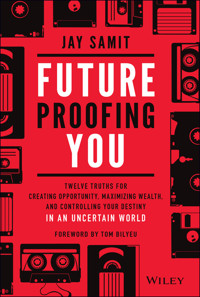
JAY SAMIT
FUTURE PROOFING YOU
TWELVE TRUTHS FOR CREATING OPPORTUNITY, MAXIMIZING WEALTH, AND CONTROLLING YOUR DESTINY IN AN UNCERTAIN WORLD
FOREWORD BY TOM BILYEU
Copyright © 2021 by Jay Samit. All rights reserved.
Published by John Wiley & Sons, Inc., Hoboken, New Jersey.
Published simultaneously in Canada.
No part of this publication may be reproduced, stored in a retrieval system, or transmitted in any form or by any means, electronic, mechanical, photocopying, recording, scanning, or otherwise, except as permitted under Section 107 or 108 of the 1976 United States Copyright Act, without either the prior written permission of the Publisher, or authorization through payment of the appropriate per‐copy fee to the Copyright Clearance Center, Inc., 222 Rosewood Drive, Danvers, MA 01923, (978) 750‐8400, fax (978) 646‐8600, or on the Web at www.copyright.com. Requests to the Publisher for permission should be addressed to the Permissions Department, John Wiley & Sons, Inc., 111 River Street, Hoboken, NJ 07030, (201) 748‐6011, fax (201) 748‐6008, or online at http://www.wiley.com/go/permissions.
Limit of Liability/Disclaimer of Warranty: While the publisher and author have used their best efforts in preparing this book, they make no representations or warranties with respect to the accuracy or completeness of the contents of this book and specifically disclaim any implied warranties of merchantability or fitness for a particular purpose. No warranty may be created or extended by sales representatives or written sales materials. The advice and strategies contained herein may not be suitable for your situation. You should consult with a professional where appropriate. Neither the publisher nor author shall be liable for any loss of profit or any other commercial damages, including but not limited to special, incidental, consequential, or other damages.
For general information on our other products and services or for technical support, please contact our Customer Care Department within the United States at (800) 762‐2974, outside the United States at (317) 572‐3993 or fax (317) 572‐4002.
Wiley publishes in a variety of print and electronic formats and by print‐on‐demand. Some material included with standard print versions of this book may not be included in ebooks or in print‐on‐demand. If this book refers to media such as a CD or DVD that is not included in the version you purchased, you may download this material at http://booksupport.wiley.com. For more information about Wiley products, visit www.wiley.com.
Library of Congress Cataloging‐in‐Publication Data is Available:
ISBN 9781119772064 (Hardcover)
ISBN 9781119772071 (ePDF)
ISBN 9781119772088 (ePub)
Cover Design: Wiley
Cover Image: © laski/Getty Images
To that one reader of Disrupt You! who emailed me saying that he didn't believe anyone could become a millionaire. You're wrong.
Foreword
IF YOU KNOW the premise of this book, then I'll assume that every fiber of your being is vibrating with skepticism. And why wouldn't it be? You're smart. You want to believe, but you know that library shelves are stocked full of books written by charlatans promising things that sound too good to be true, because they are. And don't get me started on the internet. Get‐rich‐quick gurus are pouring out of every nook and cranny – all too ready to relieve you of a coin or two thousand.
So, what makes this book different with its promise that just about anyone can become a millionaire? If ever there was a claim that's too good to be true, it's that. Right? If that claim was made 1,000,000 times, I wouldn't believe it 999,999 times. I would make just one exception. And that exception is if it's Jay Samit who's making the claim. In that case, I'd believe. Ten minutes with Jay and you just know he knows things – important things. Useful things. If you spend an hour with him, you're in awe. If you truly get to know him, you want to sit at his feet and learn. The second I read his previous book Disrupt You! I put it on my must‐read book list that I keep on my website for people wanting to know who I learn from, because from Jay I've learned a lot.
That's why when Jay came to me a couple years ago and told me that he was going to try an experiment, I was immediately intrigued. When he told me he was going to take an unknown kid raised in poverty, with no money and no connections, and help him generate $1,000,000 in revenue over the next year without giving him money or any introductions, I got the chills. Knowing how powerful Jay's knowledge is, I pitched him on doing a show documenting the journey, but ultimately I got busy with other projects and we only filmed one installment. Now that I've read this book, however, I'm absolutely crestfallen that I didn't see it through. What I would have captured is what follows in these pages – an incredible rags‐to‐riches story that I wouldn't believe if I didn't know the man behind it.
Make no mistake, what you hold in your hand is an instruction manual. This is as close to one‐on‐one mentorship with Jay as any of you will get. And what Jay lays out on these pages is nothing less than the elucidation of a formula – a formula for success. A formula for success that has been tested and shown to work. Now, I know some people will dismiss it out of hand (most without even bothering to read it). Others will say “Sure it worked once, but it would never work for me.” I implore you not to be like those people. It's true that no one can guarantee your success. Not myself, not Jay, not anyone. But what will dramatically increase your odds is a blueprint. If you're willing to move forward despite any fears and choose to believe that it's possible, then let me assure you, you're in the right place. You now have the blueprint you've been looking for. Just remember, if you're to build anything of import with it, you're going to be required to pay a heavy price. As they say, if it were easy, everyone would do it.
To all of you willing to put in the work, I will say this: I know many of you are afraid you don't have what it takes. But if my own journey from going from so broke I was scrounging in my couch cushions to find enough change to put gas in my car to building a billion‐dollar company shows, it's this: It doesn't matter who you are today. It only matters who you want to become and the price you're willing to pay to get there. Armed with the right information and an unbreakable will, the average human animal is truly capable of the extraordinary.
If you don't believe me, you need only read this book. People often say that success leaves clues, but I'll say it another way – success is a formula. Success has its own laws of physics. Through this book, you're going to see exactly what you need to do if you want to build a thriving business. It's going to be hard as hell (as you'll see through this thrilling Pygmalion journey), but hot damn, by the end of this you'll know it's possible and you'll know exactly what to do make your own dreams a reality.
One last thing before I hand you over to the game‐changing words in this book – I believe in you. If no one has ever believed in you before, let me be the first. I don't need to know you; I just need to know you're a human. Humans are designed to acquire new skills. New skills have utility. If you approach this book sincerely, and put its ideas to use, you will learn. You will grow. You will become capable of the extraordinary. You just have to absolutely, positively refuse to quit.
Go forth and become legendary, my friends.
Tom Bilyeu
CEO of Impact Theory and Co‐Founder of Quest Nutrition
PS: I hear people say quite often that the American dream is dead. And maybe it is. But this book will show you that something far better has taken its place. The king is dead. Long live the king.
Introduction
BEING A MILLIONAIRE. We've all had the dream. Picking the winning lottery ticket. Discovering a long‐lost Rembrandt painting in the attic. Or perhaps, learning that the Nigerian prince who emailed really is wiring you millions of dollars. No more debt or worries; just Lamborghinis, yachts, and magnums of champagne. But, while most people idly daydream about living the lifestyle of the rich and famous, many people just like you are actually doing it. I have tried to synthesize the most important lessons and knowledge that I have gained over the last three decades into 12 truths that make success possible for anyone. While these truths aren't taught in any business school, they are the foundation for wealth creation in the digital age. This book was written to be your indispensable guide for starting a business, growing a company, or creating a better life for you and your family in this post‐pandemic, technologically interconnected, globalized world.
Today, there are a total of 16.5 million millionaires around the world who have amassed an astonishing $63.5 trillion. What is even more amazing is the fact that a new billionaire is created every 48 hours. Think about that for a moment: Every two days a new billionaire is enjoying a life you can only imagine.
Now ask yourself, how did you spend yesterday and today? Are you any closer to your dreams of financial freedom? Or did you trade another precious day of your life for a job that you don't like? A job that will never provide you the lifestyle and independence that you so fervently desire. A job that pays you just enough not to quit, but not enough to live in the style you deserve. Be honest with yourself: Are you truly living life or just paying bills until you die?
How can you break out of this pernicious cycle?
In the history of mankind, it has never been easier than now to become financially independent and spend more time enjoying life with friends and family. The reasons for this massive accumulation of new wealth are simple. With mobile phones and the internet making our world more interconnected, and 7.6 billion potential customers just one click away, you only have to be right for a nanosecond to make millions. The right product or service, at the right time, and you can amass wealth to support your family for generations.
So, the real question is: If all of these millionaires and billionaires have the same 24 hours in a day that you do, what are they doing differently than you? How did they find the opportunities that eluded most people? How can you learn to see the world as they do?
The vast majority of the world's billionaires didn't come from wealthy families or positions of power. Most did not go to top Ivy League universities. And none of them sat at home waiting for the Publisher's Clearing House van to arrive. The honest truth is that most of today's wealthy are no different than you or me. If you would have told me when I was growing up in a row home in Philadelphia that dozens of the people I work with would become billionaires, I would have asked you what you were smoking. Yet, when I first worked with Bill Gates, Jeff Bezos, Paul Allen, Richard Branson, David Geffen, Reid Hoffman, Elon Musk, Brock Pierce, Eric Schmidt, and dozens of others, they hadn't yet attained the wealth that made them internationally famous. But what they had discovered was the secret path to Future Proofing their careers and businesses.
The secret is: our world is fundamentally different from the one we were taught about in school. All businesses are tech startups. Sustainability is profitable. The 12 truths in this book will shatter the misconceptions readers have on how to make a career and build a business. Warren Buffett built his wealth by slowly saving and investing over decades (he made 99 percent of his wealth after the age of 50), while social media star Kyle Jenner will be a self‐made billionaire by 22. Kyle grew up digital savvy while Buffett still refuses to use a smartphone. Which world do you want to live in?
The 12 truths in Future Proofing You are not about luck or astrological signs. They are surely not about grinding it out for 40 years, clipping coupons, and counting your pennies. The truths are all about leveraging a positive attitude in a highly interconnected world. Attitude is something each one of us can learn to enhance and control. You already have within you the power to become a millionaire. You've just never been shown a proven process to follow.
School was designed to get you to fall in line and get a job in someone else's company. Your natural curiosity was shackled into conformity. This book will help you break out of the employee mindset and teach you the 12 truths every twenty‐first‐century entrepreneur needs to embrace in order to achieve success. Most of your life you have been told to get the safe and steady job by people who had given up on their dreams years before you came along. How is that advice working out for you so far?
There is another way. The simple truth is that self‐made men and women just look at the world differently. Where most see problems, Future‐Proofers see unmet needs. Where most are afraid of failure, they embrace it and harness it. Those striving to achieve don't worry about what others think. Every billionaire's name that I just dropped was at one point along their journey written off as crazy or foolish. Lastly, where most are afraid to ask for help, a Future‐Proofer seeks out mentors to speed them on their journey.
Future Proofing You will walk you step‐by‐step through the process of attaining wealth and mastering your own life by shattering the misconceptions that hold most people back. This isn't a get‐rich‐quick scheme, and I am not trying to sell you anything. I want you to succeed for a very selfish reason: Our world needs more entrepreneurs. Entrepreneurs are the backbone of a free and stable society. No democracy can survive without a thriving middle class, and entrepreneurs are our job creators. They solve societal problems and are rewarded for the risks they take. I love living in a world that gets better each year. Each new innovation that creates a Future‐Proofer also makes our lives more productive, fun, and rewarding. Airbnb, Waze, and Uber started as half‐baked ideas from individuals who believed in themselves. I have had the privilege to work with some of the most successful billionaire innovators on the planet. With this book, I am paying what I learned over the past three decades forward so as to enjoy the astounding innovations that the next generation will create.
How Do You Go about Future Proofing You?
You will only need two things to achieve lasting success and a seven‐figure bank account. They are not money or connections. Success doesn't require a college degree nor a high IQ. You don't even have to live in a major city or first‐world nation. There are just two things that every self‐made woman or man must possess in order to succeed, one of which this book will provide and the other one you must bring with you to the Future‐Proofing process.
The only requirements for becoming Future Proof are insight and perseverance (as you will learn in the following chapters, everything else can be hired). Insight is all about finding opportunities and learning how to quickly capture the value created by changes in our society. We are living in an era of endless innovation where each new app, device, or service creates a new void upon which an insightful entrepreneur can quickly amass wealth. Wealth that can last generations can now be attained in the shortest time ever in history. My friend Brock Pierce, who Forbes magazine lists as one of the richest cryptocurrency billionaires, didn't invent Bitcoin. But Brock had the insight to leverage this innovation and make hundreds of millions of dollars in just a couple of years (with no employees, capital, or investors). Social media influencer Tom Bilyeu couldn't find a healthy good‐tasting protein bar to help his family lose weight, so he and his friends made one in their kitchen. A couple of years later, Quest Nutrition was a billion‐dollar company. Insights are the light that guide you down the path to success. As you will soon discover, the opportunities for success are all around you. You just have to learn what to look for and how to capture the value you create. Future Proofing You is the torch to illuminate your path.
While techniques for uncovering insights will be taught in this book, perseverance comes from deep within. You must make a personal commitment to see this journey through to the end. No one is going to hand success over to you. It must be earned. You will also learn how to bolster your perseverance by discovering your purpose. Becoming future proof doesn't happen overnight and it won't be easy. For many, it will take longer than a year, but the moment you commit to Future Proofing You, is when the journey begins. As the ancient Chinese philosopher Lao Tzu wrote, “The journey of a thousand miles begins with one step.” Only you can take the first step (and since you are reading this book – you are already on your path to prosperity).
But you won't have to walk this road alone. Your perseverance will be aided by the stories and techniques of other millionaires who have made the journey before you. As they share their trials and tribulations, you can acquire tools for coping with setbacks and strategies for conquering obstacles. You will learn to embrace your problems and your failures. You will learn how to prioritize and pivot. You will get an education in converting today's sweat equity into a lifetime of passive income. If you are willing to focus and work one year of your life like most people won't, then you can live the rest of your life in a way most people can't.
To prove that everyone is capable of becoming a Future Proof millionaire, I chose to put my knowledge and reputation to the test. While writing this book, I decided to mentor one young man and record his odyssey. This book follows one person's 12‐month journey from being a couch‐surfing unemployed millennial to a self‐made entrepreneur earning his first million dollars. This book documents every step of the way and provides guidance for you to achieve your own results as well as real‐world examples from dozens of others who have taken it upon themselves to become Future Proof millionaires. Of the more than 200,000 “success” books currently listed on Amazon that tout ways of how to think and grow rich, this is the first book ever to prove that its method really works. Future Proofing You will change lives.
PART IThe Twelve Truths
1The Growth Mindset
You were not born a winner, and you were not born a loser.
You are what you make yourself to be.
—Lou Holtz
WHILE VISITING A LOGGING CAMP in Myanmar, an American tourist watched how at the end of each day, the loggers secured their elephants with just a small piece of tattered rope tethered to a teak tree. The tourist couldn't understand how such a thin flimsy rope could restrain a powerful 8,000 lb. bull elephant. Having watched the pachyderm haul over a dozen one‐ton logs that afternoon, surely, thought the tourist, this massive creature had the brawn to destroy the cord and break free. Quite perplexed, the American asked the trainer, “Why don't the elephants just break free?” The trainer explained that from birth, the elephants are tied up with the same size rope, and since as babies they weren't strong enough to break free, they were conditioned to believe that the rope is inescapable. By the time they are full‐grown adults, they stopped trying and accepted their lot in life. What's tying up your future?
Truth #1 – You Must Have a Growth Mindset
If you are reading this book and are broke, here are three comforting facts: you are not alone, it's not your fault, and a year from now you can be a millionaire. While the stock market is at an all‐time high, the sad truth is that the vast majority of people are drowning in debt. Americans owe more than $1 trillion in credit card debt and another $1.5 trillion in student loans. According to a recent Bankrate survey, the majority of Americans don't even have the funds to cover an unanticipated $1,000 emergency. As the Covid‐19 virus pandemic taught all of us, life can be full of expensive surprises. Your car needs a new transmission, your appendix bursts, or you suddenly lose your job. The smallest financial challenge and you could be just weeks away from being on the street homeless. The income inequality gap in the US has never been wider, with the poorest half of Americans owning just 1 percent of the nation's wealth. According to recent research by the Institute for Policy Studies, 140 million Americans are poor or low‐income, living below 200 percent of the Census's supplemental measure of poverty. For almost half the US population, life is a never‐ending balancing act of juggling bills and paying off debts.1
Before you know it, retirement age creeps up, leaving one third of US households with nothing saved for their old age and the majority (56 percent) having managed to only stash away less than $10,000. Adding to these woes are the facts that younger people will be living longer and the Social Security trust in the US will run out of money by 2034!2 For most people, the golden years aren't so golden, with financial independence and security completely out of their reach.
How Do So Many Fail in a Land So Rich with Opportunity?
There are two reasons most people don't attain wealth: they didn't think they were smart enough to get rich and they were never taught how to create wealth. Let's dispense with the myth about intelligence and money. “There is no relationship between IQ scores and net wealth,” according to Ohio State University economist and research scientist Jay Zagorsky. Zagorsky tracked the progress of 10,000 participants from 1979 to the present.3 While those with higher IQs tended to earn more (each IQ point above average increased earnings from between $202 to $616 per year), smart people weren't any better at holding on to their money and building wealth. Surprisingly, those with higher IQs tended to have more problems. When Zagorsky compared people's IQ scores and their likelihood to have problems such as paying bills, declaring bankruptcy, and defaulting on credit cards, those with the highest IQs were more likely to have financial instability.
What if you didn't get good grades in school? That doesn't matter, either. Standardized tests and rigid curriculums do a poor job of measuring creativity and drive. As we will discuss in later chapters, effort, critical thinking, collaboration, and curiosity are the traits most needed for success. Unfortunately, just like the tethered elephants, too many people internalize failures at school into believing they will fail later in life. Average student Steven Spielberg, the genius director of Jaws, Indiana Jones, E.T., Jurassic Park, and Saving Private Ryan, was rejected twice by the University of Southern California's film school. (Decades later, multi billionaire Spielberg, whose films have grossed more than $9 billion, showed that there were no hard feelings when he donated $500,000 to USC's School of Cinematic Arts.) Even Nobel Laureate and renowned physicist Albert Einstein failed his entrance exam to the Zurich Polytechnic Institute. A recent study of 700 millionaires found that their average GPA was 2.9 out of 4; C students were the most likely to become millionaires.4 Forget about how you did in school. You don't become a success by looking in the rearview mirror.
Believing in your ability to succeed is the key to becoming Future Proof. Self‐perception is more important than any other factor in predicting success. Scientists at Basel University in Switzerland and the University of California analyzed the data of 1,824 people ranging from 16 to 97. “We established that self‐esteem is more likely to influence success than vice versa,” according to psychology professor Ulrich Orth who led the research.5 If you think you can or think you can't, you're right. Self‐made billionaire Larry Ellison dropped out of two colleges before co‐founding Oracle. “I studied everything but never topped,” the world's most successful average student Bill Gates once declared, “But today the toppers of the best universities are my employees.”
Most parents, having spent their lives struggling to make ends meet, encouraged their children to get good, steady jobs and then retire with a pension. In 1950, the average American family income was $3,300 a year and the median home price was $7,354.6 In other words, a house cost a little more than two years' wages. The American dream was within reach of most Americans. In postwar America, companies were adding jobs and the average worker stayed at his job for over 14 years. People felt secure in their work, financially secure about their future, and could send their children to college debt‐free. The greatest generation lived a Future Proof lifestyle. Such a halcyon world is long gone.
Job Security Is a Myth
Hundred‐year‐old companies are being displaced by newer, leaner startups. In a booming economy, retailers such as Radio Shack, Payless, Toys‐R‐Us, Kmart, and Macy's shuttered over 5,000 stores in 2017 displacing tens of thousands of workers. Of the original Fortune 500 companies, only 10.4 percent are still on the list.7 And when large companies fail, so do their underfunded pension plans. Over 120,000 retired United Airlines workers saw their former employer's pension fund collapse when the company filed for bankruptcy. The same thing happened to the pension funds of the once great industrial giants Delphi and Bethlehem Steel. So where are these so‐called secure jobs?
Manufacturing jobs in the United States peaked way back in 1979. Even if factories are coming back to America, they are going to be employing robots, not humans. According to the Washington Post, American factories now produce twice as much as they did in 1984, but with one‐third fewer workers.8 Studies show that each factory robot replaces six human jobs. Foxconn, the world's largest manufacture and maker of the iPhone, now has 10 lights‐out production lines. (The lights are out in the building because no humans work on those production lines.) In 2017, Foxconn announced that their goal was to replace all 1.2 million employees with automation.9 Our public school system was designed to educate workers with enough reading and math skills to boost factory productivity but not enough skills to venture out on their own. The standardized instruction and conformity we were taught in school leaves most people ill prepared for a postindustrial globalized world dominated by artificial intelligence and robotics.
Only one‐third of Americans have a college degree, and yet high school no longer prepares young adults for a trade or even how to find a job. And for those of you who racked up massive college debt, I am sorry to be the one to break the news to you but, research now shows that earning a degree from a major university has no long‐term impact on income, job satisfaction, or life satisfaction.
Security doesn't even exist for those working at the most prestigious corporations. Employees at successful tech companies, such as Microsoft, Google, Apple, and Amazon, keep their jobs on average for less than two years.10 Even for the most educated among us, there is no job security. The adage that security robs ambition needs to be updated: it isn't security that robs ambition, but the illusion of security that robs ambition. The good news is that it isn't too late to change your trajectory and learn how to make money.
Wealth Comes from Creating Money, Not Earning and Saving It
Before diving into the Future Proofing You process, it is important to dispel a major misconception about money that hinders most people's ability to create wealth. In the twenty‐first century, one doesn't get rich by accumulating and saving money. Slowly reread that sentence again: “One doesn't get rich by accumulating and saving money.” One gets rich by creating money. Money, and the value it represents, can be created from thin air as if by an alchemist using magic. Wealthy people create money that wouldn't have existed if not for their efforts. To comprehend this fundamental principle, we need to journey back to our formative years and revisit third‐grade arithmetic. In elementary school, most math problems went something like this:
If Jeff buys two bananas for one dollar each and sells them to Mark for two dollars each, how much did Jeff make?
In this example, the only way John makes his two‐dollar profit is by taking it from Mark's pocket. Jeff wins. Mark loses. While mathematically sound, this equation teaches children that in order to gain money, someone else has to lose money. In game theory, this is known as a zero‐sum game. Poker is a zero‐sum game. You can't win more money at a poker game than the other players bring to the table. Unfortunately, growing up with a zero‐sum perspective is like a horse wearing blinders – it limits the field of view for opportunity. For me to win, you must lose. Taken to the extreme, everyone in the world is your competition. There is only so much money to go around and if you don't take what you can, someone else will get it. As you begin your career, this point of view causes a scarcity mindset. There is never enough money to go around. At work, she got a raise so I can't. Immigrants are taking our jobs. Foreign nations are taking our jobs. Robots are taking our jobs. Technology is evil. Everyone is the enemy. Every day you live with this outlook, your life grows more and more stressful. Your life is reduced to a dog‐eat‐dog world filled with misery and despair. It is hard to have a positive outlook if this mindset has been drilled into you your whole life (and as you will soon realize, mindset is everything). But there is another perspective that is much more conducive to Future Proofing You and living a life of happiness and success.
Compare the zero‐sum game problem from your youth with this growth mindset example:
If Jeff starts a company with $1,000 and sells 10 percent of his company to investor Mark for $10,000, how much is Jeff now worth?
The answer: Jeff created a company valued at $100,000 with his $1,000 investment and still retains 90% ownership. So, Jeff is now worth $90,000. Looking at it from another angle, one person with only $1,000 and another person with only $10,000 created $90,000 from thin air. Viola! $90,000 that wasn't printed by the Federal Reserve or borrowed from a bank now exists. Jeff can spend it just as easily as you and I can spend cash. In this example, instead of the transaction being a zero‐sum game, by cooperating and working together, both Jeff and Mark made money. Jeff made so much money with this approach that he can stop purchasing bananas a few at a time and buy the whole food market! Now you understand how Amazon, which rarely turned a quarterly profit during its first 20 years in business, made Jeff Bezos the world's richest man with a whopping $188.7 billion. (On January 30, 2020, Bezos made a whopping $13.2 billion in just 15 minutes.)11 Or how Uber founder Travis Kalanick, who has never made a profit with his company or the other two companies he previously founded, is personally worth $4.8 billion. The proliferation of billionaires today is happening because it has never been easier to create vast sums of money. Startups that are valued by venture capital and investors at more than $1 billion are referred to as unicorns. In 2009 there were just four such rare creatures. As of April 2020, their number multiplied to 465.
Incredibly, each of us has the potential to be a modern‐day sorcerer with the Midas touch: we can turn anything we create into gold. What does this have to do with you making a million dollars and Future Proofing You? Everything.
The first decision you will have to make in building your fortune is to decide if you want to make money the way John Mackey did with Whole Foods Market – buying items at one price and reselling them at a higher price – or the way Jeff Bezos did with Amazon, by creating a new service with a business model that will be highly valued by investors. Both can earn you money, but only one is likely to make you a millionaire in a year.
Airbnb, Google's search engine, and cryptocurrencies such as Bitcoin are all examples of new business models that created billions of dollars that would not have otherwise existed. Airbnb monetized surplus rooms, thereby unlocking billions of dollars of stored value. Silicon Valley's venture capital firms are all based on this model. VCs look to invest in disruptive ideas that can generate at least a tenfold return on their money. The best of the best, venture capitalists who generate billions of dollars, are tracked on the Midas List. Sequoia Capital's Jim Goetz topped the 2017 Midas List by being the only person to invest in the 55‐person mobile app developer WhatsApp, which sold to Facebook for nearly $22 billion after only five years in business. What makes the WhatsApp story even more astounding is that its founder, Jan Koum, just prior to starting WhatsApp, had applied for a job to work at Facebook and was rejected. Without a job, he created his company and became one of the wealthiest billionaires on the planet. Koum, a college dropout and Ukrainian immigrant, made $7.5 billion on an idea he would have gladly given Mark Zuckerberg for free if only Facebook had hired him.12 Unlike the wealthy industrialists of the twentieth century, today's Future Proofing millionaires and billionaires don't amass wealth, they create it. And, so can you.
To benefit from the opportunities available in the twenty‐first century, you must first understand how businesses create value. As I illustrated with the previous arithmetic problems, you need to unlearn how you thought companies made money and look for ways that existing businesses can be disrupted. In my previous book, Disrupt You!, I walked readers through all the parts of the modern business value chain from research and development, design and production, through to marketing, sales, and distribution. New technologies such as mobile, social media, and blockchain provide opportunities for small startups to greatly improve upon one part of the chain and dislodge large, less nimble incumbents. Instagram upends Kodak. Netflix destroys Blockbuster and destabilizes Hollywood studios. Airbnb destabilizes the hotel industry. Uber disrupts 17 million taxi drivers. Depending on the industry, businesses can be disrupted at any link upon the chain and thereby release value that can be captured by new startups. (If you haven't read Disrupt You!, I highly suggest you do before launching your new business. If this was a college course, Disrupt You! would be the prerequisite for enrolling in Future Proofing You.) Beating the competition is but one path to financial success.
Fostering a Growth Mindset
Even more than I hate the zero‐sum mindset, I hate competition. I am one of the most competitive people you will ever meet and yet, I really hate having to compete. As confident and motivated as I may be on my best day, I am still pretty sure that there is someone out there that is better qualified, better financed, or just plain smarter than me. So, whenever I am starting a new business, I try to avoid competition for as long as possible. You will win every race as long as you are the only runner on the track. To increase my chances of winning, I go where there aren't any competitors. I always focus on the next new thing. I started on the internet in 1978, created software for the first personal computers in the 1980s, pioneered ecommerce in 1996, built a million‐member social network in 1998, launched a top 100 mobile app in 2011, and got involved with Bitcoin in 2013. I didn't invent the internet or the smartphone. I didn't create cryptocurrency. I am not even an engineer. I am just an entrepreneur looking for the next opportunity to disrupt the status quo. As the world's greatest hockey player Wayne Gretzky famously said, “I skate to where the puck is going to be, not where it has been.”
In my Ted talk It's Time to Disrupt You!, I pose this question to the audience, “Ever ask yourself where virtually reality experts or Internet of Things Experts or Bitcoin experts come from?” In reality they are people who started with no more expertise than the rest of us. They are all just self‐proclaimed experts who then worked hard to grow and defend the turf they so wisely staked out. They race to where the puck is going to be and then figure out how to skate. I live by the adage, “be the best at what you do or the only one doing it.” For if you are the only one doing it, by definition, you are the best. To succeed you need to embrace a growth mindset.
In her 2006 book, Mindset: The New Psychology of Success, Stanford Professor Carol Dweck coined the term growth mindset. Dweck spent decades researching students' attitudes about success and failure. She wanted to understand why some children could easily bounce back from major failure while others were completely devastated by the most minor of setbacks. The differences among children had less to do with the external circumstances of the specific task at hand and more to do with their preconceived notions of their own abilities. Some students, those with fixed mindsets, believed they were stupid and there was nothing they could do about it. I'm not bright enough to learn algebra. For them, intelligence was innate and failure was predestined. Why try when the outcome will always be disappointing? Remember the elephant with the fixed mindset at the beginning of this chapter?
On the other hand, students with a growth mindset saw the world completely differently. These students believe that with work and effort, they can improve and grow smarter. If I make flashcards, I'll ace the Spanish test. The more you believe that you can improve, the more effort you will put toward your goals. Over time, students with a growth mindset attain higher achievement and a more positive outlook on life. Positive thinking expands creativity, increases energy, raises intelligence, and even closes more sales. Success doesn't make you happy; being happy creates success. As long as you are in control of your happiness, you are future proof.
Having a growth mindset not only changes how you deal with setbacks; it actually rewires the physiology of your brain. The human brain is not hard‐wired from birth. Numerous studies in neuroscience have proven that the connectivity between neurons in the brain's neural networks grow with experience. The brain's plasticity, the degree to which it is malleable, can be improved by basic actions such as asking questions, eating healthy foods, and getting enough sleep. Turns out, science supports everything your mother told you to do as a kid. So how does an adult develop a growth mindset?
The first truth you must accept for Future Proofing You is that nothing can be achieved without a growth mindset. Developing and maintaining a growth mindset is the foundation upon which all other great accomplishments can be achieved.
“This growth mindset is based on the belief that your basic qualities are things you can cultivate through your efforts,” Carol Dweck writes in her book Mindset: The New Psychology of Success. “Although people may differ in every which way in their initial talents and aptitudes, interests, or temperaments, everyone can change and grow through application and experience,” Dweck explains.13
People with a fixed mindset see having to work hard at something as proof that they are not smart enough or good enough to achieve anything. I'll never become a real estate agent because I could never pass the exam. Every aspect of their lives is viewed through a lens of seeing their hard effort as needing to compensate for a lack of talent. A person with a fixed mindset thinks, for example, that they could never play basketball like Michael Jordan because he has natural talent. When in fact, a growth mindset is the real reason Michael Jordan became the greatest basketball player of all time.
“I've missed more than 9000 shots in my career. I've lost almost 300 games. 26 times, I've been trusted to take the game winning shot and missed. I've failed over and over and over again in my life,” Jordan famously said. “And that is why I succeed.”14
A fixed mindset not only limits your future, it can prevent you from enjoying every aspect of your life. Will doing this make me look stupid to co‐workers? Will I be rejected? If every social setting requires you to feel like you have to prove your self‐worth, life begins to feel like a never‐ending struggle. Quite simply, living with a fixed mindset is exhausting, and that is why too many people give up. Some of the most influential people in your life, parents and teachers, friends and spouses, discourage you from trying because they have given up on their dreams. Parents and spouses don't want to see you hurt as they may have been. If you train your own mind, it will silence all the naysayers in your life.
With a growth mindset, you teach yourself to reframe every fixed negative thought into a potentiality. Instead of thinking, “I tried and I failed,” ask yourself, “Are there other strategies I could try?” Start embracing obstacles as opportunities, or as Michael Jordan says, “If you're trying to achieve, there will be roadblocks. I've had them; everybody has had them. But obstacles don't have to stop you. If you run into a wall, don't turn around and give up. Figure out how to climb it, go through it, or work around it.”15
Remember, your future is mutable. My eldest son wanted to be a Hollywood screenwriter. It is an incredibly difficult industry to break into. Out of the thousands of screenplays written each year, only a couple dozen are produced into movies by the film studios. Many writers give up because, suffering from a fixed mindset and facing constant rejection, they are fearful of people asking the question: Have I seen any of your movies? And having to answer, no. To them, not having sold a script or having a film produced is an acknowledgment of their personal failure. They think of themselves as not good enough because no studio has made their movie. But my son has a growth mindset. For years, when people would ask Benji or his writing partner Dan Hernandez: Have I seen any of your movies? He would always answer, “Not yet.” Not yet implies it can and will happen. Today, after a decade of writing, when people ask the question, he can reply, “Did you see Pokémon Detective Pikachu? (And his proud father can add, “The second highest grossing film in the world in 2019!”)
As with screenwriting or basketball, developing a growth mindset takes practice and effort.
Six Techniques for Developing a Growth Mindset
Stop failing and start learning
. Every time something doesn't work out the way you would have liked, stop thinking of it in terms of winning or losing. You didn't fail, you just figured out a path that doesn't work. With that one approach out of the way, what is a different technique that might yield a better result? Learn to embrace your imperfections. Imperfections are not career‐ending flaws, but rather areas for personal growth and improvement. Once you focus on learning how to overcome obstacles, you will start to enjoy the journey (instead of constantly focusing on the ultimate destination).
You don't need others' approval. You need their criticism
. When you constantly seek validation, you are putting praise ahead of learning. Too many people's careers are ruined by praise instead of propelled by criticism. The only path to success is constant learning and improvement. As an adult, when I was taking painting lessons from a world‐famous artist, I didn't want him to tell me how good my watercolor pictures were. I didn't want him to hang it on his refrigerator like a first grader's mother would do. I wanted to know what could be improved. What wasn't working, and why? You should look at every day at work, every interaction with others, as a chance to learn. Your bosses and clients got to where they are by learning things from experiences you may not have had yet. Think of your job, even if it is a job you hate, as you getting paid to learn. You are getting a degree in business without any student debt.
Track your progress with a journal




