


Erhalten Sie Zugang zu diesem und mehr als 300000 Büchern ab EUR 5,99 monatlich.
- Herausgeber: The History Press
- Kategorie: Lebensstil
- Sprache: Englisch
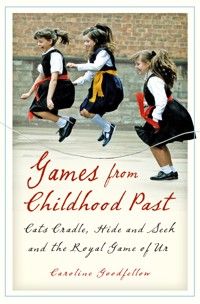
Games make up a huge part of childhood, and memories of specific games stay with us throughout our lives. They form an integral part of growing up and stimulate imagination and creativity. From hide and seek to complex card and board games, street games that require no equipment to elaborate rainy day amusements, we all have experience of entertaining ourselves as children. In this fascinating trip down memory lane Caroline Goodfellow explores the history of childhood games and how they have changed throughout the ages. From ancient board games to childhood pastimes of the Middle Ages through to the street games of the 1950s and '60s and the experiences of children in the current decade, she delves into the differences between games over time and region. Bound to awaken pleasant memories, Games of Childhood Past transports the reader to another time, providing a nostalgic look at how we played.
Sie lesen das E-Book in den Legimi-Apps auf:
Seitenzahl: 269
Veröffentlichungsjahr: 2008
Das E-Book (TTS) können Sie hören im Abo „Legimi Premium” in Legimi-Apps auf:
Ähnliche

















About the Author
Caroline Goodfellow was the Curator of Dolls and Toys for the Victoria and Albert Museum, London. She has written a number of books and articles on dolls and games and continues to lecture on these subjects as well as being an expert advisor for television and radio programmes. She is a member of Board Games Studies, an international society of experts studying board games.
First published 2008
This paperback edition first published 2023
The History Press
97 St George’s Place, Cheltenham,
Gloucestershire, GL50 3QB
www.thehistorypress.co.uk
© Caroline Goodfellow, 2008, 2011, 2023
The right of Caroline Goodfellow to be identified as the Author of this work has been asserted in accordance with the Copyright, Designs and Patents Act 1988.
All rights reserved. No part of this book may be reprinted or reproduced or utilised in any form or by any electronic, mechanical or other means, now known or hereafter invented, including photocopying and recording, or in any information storage or retrieval system, without the permission in writing from the Publishers.
British Library Cataloguing in Publication Data.
A catalogue record for this book is available from the British Library.
ISBN 978 0 75248 982 7
Typesetting and origination by The History Press
Printed and bound in Great Britain by TJ Books Limited, Padstow, Cornwall.
eBook converted by Geethik Technologies
Contents
List of Illustrations
Introduction
1 Games with Little or No Equipment
2 Games for One or More Players
3 Board Games
4 Race Games
5 Games for Juveniles of ‘Both Sexes’
6 History Made Easy
7 Morals
8 Snakes and Ladders
9 Monopoly and Cluedo
10 Spelling
11 Card Games
12 Dissected and Jigsaw Puzzles
Glossary
Notes
Bibliography
Acknowledgements
List of Illustrations
1 A game of Tag ((SIC) Designer Services.com/John Williams, © 2007)
2Blind Man’s Bluff ((SIC) Designer Services.com/John Williams, © 2007)
3 Three-legged race ((SIC) Designer Services.com/John Williams, © 2007)
4 Sack race ((SIC) Designer Services.com/John Williams, © 2007)
5 Victorian Greetings Card showing children playing a game similar to London Bridge is Falling Down
6Hop scotch ((SIC) Designer Services.com/John Williams, © 2007)
7Leap frog ((SIC) Designer Services.com/John Williams, © 2007)
8 Single skipping ((SIC) Designer Services.com/John Williams, © 2007)
9Hula Hoop ((SIC) Designer Services.com/John Williams, © 2007)
10Whipping Top. Illustrated on a child’s pewter dish that has letters of the alphabet around the outer edge. American, 1890–1910
11Hobby Horse ((SIC) Designer Services.com/John Williams, © 2007)
12Diabolo ((SIC) Designer Services.com/John Williams, © 2007)
13 Playing a game of marbles. Illustration from Wonderland of Work, published by Cassell, Petter, Galpin & Co., about 1880
14 Young women playing Knucklebones. Made of terracotta; said to be have been from Capua and made in Campania or Puglia, southern Italy; Hellenistic Greek, 330–300 BC (© The Trustees of the British Museum)
15Stilts ((SIC) Designer Services.com/John Williams, © 2007)
16 Flying a kite ((SIC) Designer Services.com/John Williams, © 2007)
17Piñata ((SIC) Designer Services.com/John Williams, © 2007)
18Solitaire board. Turned wood and glass marbles, English, 2004.
19Tangram. Polished wood. (© Design Master Associates, Made in China, 2005)
20Giant Dominoes. Hand-finished wood; designed by Justine Cardy and made by Garden Games Limited; English, 2004. (© Garden Games Limited, 2004)
21Noughts and Crosses. Wood, designed and made by Jaques & Co. Ltd, 2006. (© Jaques & Co. Ltd)
22Nine Men’s Morris. Polished and stained wood, made by James Masters. (© James Masters, English, 2006)
23Giant Connect 4. Plastic, designed by Justine Cardy and made by Garden Games Ltd, English, 2005. A large-scale wooden version of the game BIG 4 is also available but it is more suitable for indoor use. (© Garden Games Ltd)
24Balance Game. Turned and painted wood, with a die marked in colours rather than spots. (© Design Master Associates, Made in China, 2005)
25Chinese Checkers. Turned wood with glass marbles, English, 2004.
26Halma, set for two players. Polished and painted wood, made by James Masters. (© James Masters, English, 2006)
27Halma, set for four players. Polished and painted wood, made by James Masters. (© James Masters, English, 2006)
28The Royal Game of Ur. Made of shell, red limestone and lapis lazuli over a wooden base. Ur, Southern Iraq, 2600–2400 BC. (© The Trustees of the British Museum)
29 Game of Senet. New Kingdom, Egypt, 1550–1069 BC. (© The Trustees of the British Museum)
30 Satirical scene of animals playing Senet. Papyrus, possibly from Thebes, late New Kingdom Egypt, about 1100 BC. The scene is from a document satirising Egyptian society. (© The Trustees of the British Museum)
31 Spiral race game, possibly a board for Mehen. Limestone, Egypt, early Dynastic period (© The Trustees of the British Museum)
32Backgammon. Wood, made by Jaques & Co. Ltd, 2006 (© Jaques & Co. Ltd)
33Pencil Oware, closed. Carved and stained wood, made by James Masters, 2006. By having the game in this form it may be carried around by a player from place to place and of course, player to player. (© James Masters)
34Pencil Oware, open. Carved and stained wood, made by James Masters, 2006 (© James Masters)
35Table Owari. Carved wood, made by James Masters, 2006 (© James Masters)
36Go. Polished wood with slate and clamshell playing piece, made by James Masters, English, 2006 (© James Masters)
37Go. Close-up of the board showing the placement of the pieces on the lines and not within the squares (© James Masters)
39Nouveau Jeu de L’oie.1 Hand-coloured engraving mounted on card, French, about 1850.2
40The New and Favourite Game of Mother Goose and the Golden Egg.3 Published and sold wholesale by, John Wallis Sr, 13 Warwick Square and retail by John Wallis Jr, 188 The Strand, London, 13 November 1808. (©Victoria and Albert Museum)
41Dice. Made of pewter in the style of dice hammered from lead musket balls by soldiers in the field so they may play dice games. American, 2006. (© Cooperman Company)
42A New Royal Geographical Pastime for England and Wales. ‘Whereby the Distance of each Town is laid down from London in measured miles being a very amusing game to play with a teetotum, ivory pillars and counters.’ Published by Robert Sayer, No. 53 Fleet Street, London, 1 June 1787. (© Victoria and Albert Museum)
43The Panorama of Europe, A New Game. Published by J. & E. Wallis, 42 Skinner Street, London and I. Wallis Jr. Marine Library, Sidmouth, Devon, 1 November 1815. (© Victoria and Albert Museum)
44Walker’s New Geographical Game Exhibiting a Tour Through Europe. Published for the author and sold by W. & T. Darton, Holborn Hill, London, 1 May 1810. (© Victoria and Albert Museum)
45A Tour Through the British Colonies and Foreign Possessions and Dioramic Game of the Overland Route to India. Published by The Historical Games Company as a replica of the original game, English, 1994. (© Victoria and Albert Museum)
46The Noble Game of Elephant and Castle or Travelling in Asia. Published by The Historical Games Company as a replica of the original game, English, 1994. (© Victoria and Albert Museum)
47Wallis’s New Game of Universal History and Chronology. Published by The Historical Games Company as a replica of the original game, English, 1994 (©Victoria and Albert Museum)
48 Die, markers and counters. Issued with the new game and made of plastic representing bone.
49Historical Pastime, A New Game of the History of England. Published by Edward Wallis, No. 42 Skinner Street and J. Harris & Son, St Paul’s Churchyard, London, in 1828. (© Victoria and Albert Museum)
50British Sovereigns. Published by Edward Wallis, 42 Skinner Street, London about 1840. (© Victoria and Albert Museum)
51An Arithmetical Pastime, intended to infuse the rudiments of arithmetic, under the idea of amusement. Published by C. Taylor and later by John Wallis; Printed by Biggs & Co.; Crane Court, Fleet Street for John Wallis, 16 Ludgate Street, London, 1791 and 1798. (© Victoria and Albert Museum)
52British and Foreign Animals, a New Game, Moral, Instructive, and Amusing, designed to allure the minds of youth to an acquaintance with the wonders of nature; originally published by William Darton, 58 Holborn Hill, London, 1820. Published by The Historical Games Company as a replica of the original game, English, 1994. (© Victoria and Albert Museum)
53Cottage of Content. Published by The Historical Games Company as a replica of the original game, English, 1994 (© Victoria and Albert Museum)
54 Die, markers and counters. Issued with the new game and made of plastic representing bone.
55La Vie Humaine, Un Nouveau Jeu. Printed on silk and published by Simon Schropp; German, about 1800. (© Victoria and Albert Museum)
56 Laurie and Whittle’s New Moral and Entertaining Game of The Mansion Of Happiness4 subtitled Virtue Rewarded and Vice Punished Published by Robert Laurie and James Whittle, 53 Fleet Street, London, 13 October 1800. (© Victoria and Albert Museum)
57Every Man to His Station. Published by The Historical Games Company as a replica of the original game, English, 1994. (© Victoria and Albert Museum)
58Snakes and Ladders. ((SIC) Designer Services.com/John Williams, © 2007)
59Pachisi. Various woods and cowrie shells, made by James Masters, English, 2006 (© James Masters)
60Ludo. Wood, stained and painted, made by James Masters, English, 2006. (© James Masters)
61Monopoly.5 Manufactured and distributed by Waddington Games Ltd, England. (© 1993 Tonka Corporation)
62Cluedo. Printed and made in England by Waddington Games Ltd (© 1975 Waddington Games Ltd)
63221B Baker Street, The Master Detective Game. Published by H.P. Gibson & Sons Ltd (© Jay Moriarty, 1975)
64The Grosvenor Series. Published c. 1920 by Charles & Son
65Boggle. Tonka Corporation © 1992
66Pictionary. Published by Parker Games. (© 1987)
67Totally Dingbats. Published by Waddingtons Games Ltd, 1990/1992. Game devised by Paul Sellers. Dingbats ® is a registered trade mark of Paul Sellers, for the game manufactured and sold under exclusive licence to Waddingtons Games Ltd.
68My Word. Published by W.H. Storey & Co. Ltd of Croydon, c. 1930
69The Kings of England, William I to Queen Victoria. Dissected puzzle, hand-coloured engraving mounted on wood and cut into twenty-nine non-interlocking pieces. This puzzle was probably the work of Nicholas Carpenter, Goswell Terrace, London who produced a similar puzzle about 1832 using his own imprint in the space occupied by Queen Victoria. (© Victoria and Albert Museum)
70Authors Illustrated. Tokalon Series © 1893 by Clark & Sowdon, USA. Photograph by Bruce Whitehill from the Collection of the Big Game Hunter.
71Game of Authors. Published by Milton Bradley, USA, 1910. Photograph by Bruce Whitehill from the Collection of the Big Game Hunter.
72Vignette Authors. Published by E.G. Selchow & Company of New York, 1874. Photograph by Bruce Whitehill from the Collection of the Big Game Hunter.
Introduction
Games are played for enjoyment, as a way to actively pass the time. For some they are a method of relaxation and for others, ways to compete without the rivalry of serious business. Yet for others they are a method of testing the abilities of one’s opponents, and for some complete time wasting.
The age of the player does determine the games played, however, the same game may be played by people of different ages. Physical and mental development does have some bearing on the games. For example, Chess is unlikely to be the game of a one-year-old child whereas such a child would be happy playing Pat-a-Cake, Pat-a-Cake. Likewise, most children between the ages of five and twelve will enjoy running and jumping games as well as board games such as Chess. Families may play games together with the different ages equally sharing the enjoyment games present with older children and adults helping younger people with some of the more intricate or subtle rules. Some games seem to be adult only ones but when one considers that many of the board games developed in the eighteenth century were designed for children under the age of twelve the dividing lines become very blurred.
Some games have such long histories that it is not possible to assign particular age groups to them. However, illustrations do exist showing games being played. Egyptian wall paintings show pharaohs musing over their next move. Game boards have been found cut into stones between seats in Roman amphitheatres, which suggest that people played games while waiting for main events to be staged. Even today, men, women and children will be found playing board games in parks and cafés on formal boards or even on hastily cut boards dug into the ground. Many games cross the language divide too. People will often sit down at a game board in a strange country, start to play and attempt to converse while doing so.
Primarily this book is about children’s games. Those games played by children for their own amusement. The crossover between whether a game is for a child or an adult is very indistinct, with all ages lending its own weight to any particular activity. Running, skipping and jumping are very normal activities for young children but they are transformed into skilled Olympic feats for adults. These were the basic games of the original Olympic Games held in Greece. The games test the strength and agility of the competitors not dissimilar to the children running about in a park. They too are testing their own strength and agility.
Games are competitive, be they against oneself as in Solitaire or Hop Scotch, or against others. Physical games and board games for only two players are very competitive. Two players are pitting their abilities against each other, usually attempting to outwit each other or tempting the opponent to make a mistake. In fact, many board games for two players are referred to as Games of Strategy. As the number of players in a game increases, the competitiveness decreases. Many games for more than two rely on chance, the roll of dice and the spin of a teetotum or the turn of a card. Likewise, Tag with lots of players is easier than a running game with only two. All such games tend to be less serious, often more noisy and usually of a shorter duration than games for only one or two players.
Although the avid games player will take his game very seriously, the same game may be played just for fun but in both cases, the people involved are playing for enjoyment. It can be very difficult if one player is taking his game seriously while the others are not, this in its extreme can lead to arguments. Arguments may also occur when players are so competitive that they resent others winning. Cheating is also a good basis for arguments and it may result in players leaving a game with the statement, ‘If you are going to cheat I am not playing with you ever again.’ This rarely means what is says, it just means until the next time but beware.
Although some games are referred to in the book, they are not actively described. Games such as Chess and Backgammon are well documented and there are many books describing how to play them. This book describes some very well-known games as well as some more obscure ones. All were or are played by children or within the confines of a family. This is not to say that the games are never played with by older children or adults. Sometimes, a game designed for children is more often played and enjoyed by adults. Many modern games and a few much older ones are now played as international tournaments. Quite a number have been modified so they may be played on the Internet and others as computer games.
As the book was being researched, many new suggestions for games were added. By talking about the book, it triggered memories of childhood activities often with side comments such as, ‘I was so bad at skipping and hopping, I remember it seemed to become my job to turn the ropes.’ One of the most memorable occasions was a group dining out who recalled playing Pass the Button; they then made a game of it around the table. Like the games, this book should be enjoyed; it may even bring back happy memories.
So sit back and let play begin!
1
Games with Little or No Equipment
Anywhere there are children, they will be skipping or running, playing with a ball, or walking backwards. This is not restricted to school playgrounds or organised events, children use their bodies to express themselves, to show the sheer exuberance of being young and fit. Handstands, cartwheels and wheelbarrow races, intricate step movements and rolling on the ground are some of but many games children will play by themselves and with others without adult supervision.
One child or many children in any open space may play such games. At one time, children moved freely around their neighbourhoods, played in the parks, fields, school grounds and even in the streets. Sadly, many areas in the developed world are now restricted through health and safety or traffic. Parents and school authorities are often worried that their children will be harmed by games they themselves played. However, many adults do not see what the children get up to when by themselves; they will organise tag games and running games and play conkers.
Some games require an object to facilitate play and there is always a crossover between playing a game and playing with a toy. The simplest, or arguably the most complex, are games without equipment or formal rules. Many of these games formed the basis of the original Olympic Games which represented feats of skill and endurance.
Running Around
Running around is a real child characteristic, particularly for those under fourteen. It may be a simple chase between two, a well defined game of Tag or perhaps a run with a start and finish point.
The most common game is Tag. Found throughout the world, it has many names such as It, or Catch as Catch Can. This is a simple game requiring more than two people, with energy and imagination. The players divide with one person being the chaser or IT, and the rest being chased. The aim is for the single player to catch one of the others, so that the caught player becomes the IT. With the cooperation of all the players, games with more sophistication can be played. There are many variations and these are but a few of the well-known universal games.
Hide and Seek is the best known variation of Tag. The chaser must turn his back on the others, count as quickly as possible to a set number, usually 100, while the others attempt to hide. When the counting has finished the usual statement is, ‘Ready or not I am coming.’ The player turns, locates the others and chases around while attempting to catch one player from the group.
Some games bear simple names reflecting the activity. For example, the players may decide that some items may be deemed Safe Spots, such as trees if in a park, so any chased player is safe if he is touching one. Hold the Spot requires a player who has been caught to hold that part of his body that was touched by the chasing player. If it is a sunny day, a player may be caught if the chaser steps on his shadow, thus Shadow Tag.
Line Tag has lines of players, each holding the hand of the one in front, attempting to block the chasing player from attaching himself to the end of a line. Should he do so, the player at the front of the line becomes the chaser.
In Follow my Leader, the players form a circle by joining hands, with the IT inside and the player being chased outside. The chased player may go in and out of the circle, the others allowing him to do so by raising their hands and the IT must follow exactly or forfeit the game. When tagged, the player returns to the circle, the IT becomes the chased one and a player from the circle is chosen to be IT. A similar game of Cat and Mouse may be played where the cat inside the circle attempts to escape to catch the mouse. In this game, the hands are not linked but the players may use their bodies as blocks.
Another circle and blocking game, sometimes called Fox and Rabbits, can be played when there several children from which one is chosen to be the rabbit and one the fox. The rest of the group divide and link hands to form warrens, each with a resident rabbit, in which the chased rabbit may hide. The aim of the fox is to catch the rabbit, which may enter any of the warrens but in doing do displaces the resident rabbit who then must evade the fox. Once the fox catches a rabbit, he joins one of the warrens and the caught rabbit becomes the fox.
Blind Man’s Bluff also requires a circle but less running about. The chaser within the circle wears a blindfold and his aim is to chase another player. However, there are some rules to give him an advantage. Initially the players move round and when he says stop, he points and the player who is pointed at must move into the circle. If this player is caught, the chaser must identify him either by feeling his face or by asking questions. If successful, the chaser retires to join the circle.
All these variations require the group to play as a unit, all know the rules and yet there are no formal rules. Children of all cultures play these games and while there are many variations, the games of Tag are still ones of running and chasing and being chased.
Racing Games
Racing games are more formal than the Tag games as they have a start and finish point. Running in a straight line is the simplest but there are many variations, which bring skill as well as talent into the equation. To introduce a challenge to any race, these are a few of the changes players can make.
Three-Legged Racing with a partner requires much cooperation and coordination between the runners. One leg of each player is tied to his partner’s and together they must run the race as a unit. Not an easy exercise, which often results in laughter as the runners fall, get up and fall again. A variation of the game that is a combination with the Sack Race is to tie the legs of each runner together at the knee forcing them to hobble along rather than run or hop the race.
The Sack Race needs balance, speed and the ability to hop. The players are each in a sack or pillowcase, which they themselves must hold up. They travel the course hopping rather than running. Again, usually there are tumbles as feet are caught in the sacks thus overbalancing the child.
Follow My Leader, a slight variation on the game Simon Says, requires the runners to follow a variety of movements governed by a chosen leader. If he runs, the rest run, if he hops, the rest hop and so on. Anyone unable to follow drops out and the winner is the one who remains at the end. Many decide a time limit on this game otherwise the same person tends always to be the leader.
Egg and Spoon Race is often a more organised party game, as the eggs need to be hard boiled; however, it is a good race game where the winner is the first person to finish with his egg and spoon intact. Sometimes cheating is involved, usually holding on to the egg, but again it is a laughter run.
The game Musical Chairs requires the cooperation of an outsider, often a parent or older child who supervises the music. A group of chairs numbering one less than the number of children is placed in a circle. While the music plays the children run around the chairs and when the music stops they must gain a seat. The child who does not sit down leaves the game and a chair is removed. It is played until only one chair and two children remain and the child who sits on this last chair is the winner.
Relay Races are formally arranged with two or more groups competing to win. When seen in the Olympic Games there is a baton passed between the runners; however, in the less formal arrangements of a school or children simply enjoying this game, the runners tap the next people to run. This type of race may be augmented by having a goal at each lap such as carrying a spoonful of water to a receptacle while running, the winners being the ones who transport the most water in the quickest time.
And finally, the all-time favourite with a song to match is Oranges and Lemons. Two players, one the orange and the other the lemon, form an arch through which all the others must run. As the song reaches its end with the words ‘Chop! Chop! Chop!’, the ‘arch’ collapses trapping one of the runners. He must say either orange or lemon and replace the appropriate player forming the arch. As with many other games, this one reflects a period of brutality in London. Other such games are Mary, Mary Quite Contrary and London Bridge is Falling Down. This is not restricted to England; many European events are retold as children’s games, often with nursery rhymes to accompany them.
Hopping, Skipping and Jumping
Not all games require so much running around. There are hopping games such as Hop Scotch and Leap Frog, skipping games with one or two ropes and quieter games such as Conkers and Pass the Parcel.
The traditional game of Hop Scotch is played around the world. It requires a grid, marked out with chalk on a pavement or scratched into earth. Some school grounds have the design permanently painted on the tarmac. The grid may have as many as twelve or fifteen spaces, be a square, oblong or spiral. A counter is thrown onto the grid, sometimes square by square, and the child hops to that space, picks up the counter and tosses it forward again. The aim of the game is to throw and hop both up and down the grid without either the counter or the player’s foot touching a line. Variations include hopping with both feet together and hopping on alternate feet at each throw. Children often make their own rules for the game and, of course, it is a game that may be played by one child alone.
A rather aggressive hopping game, not encouraged now, had a number of different names but in England, it was called Cock Fighting. The players held on to one foot and hopped while attempting to push each other off balance so the opponent drops his foot or put his foot to the ground.
Leap Frog, on the other hand, needs more than one person. In recent years, however, cities and towns have provided ideal objects to be leapt in the form of bollards. These a child may leap instead of walking around often down the whole length of a road. In the original game, one child bends over to form an obstacle over which a second child leaps by placing his hands on the first child’s back. He then in turn bends over while the second child leaps. If there are more children, they can form teams and make the game into a race.
Skipping may be a simple step, somewhere between running and hopping or it might be hopping over puddles, sticks and other items found on the ground. However, skipping games tend to be augmented with a rope. It may be a rope about four feet long held by the skipper, or a much longer one held by two people for a third or more persons to skip. This may also become a set of two ropes, turned alternately for the more practised skipper. This is often referred to as Double Dutch Skipping. Skipping with ropes needs practice and some dexterity. It is also a favourite exercise form for boxers to maintain their agility.
A slight variation, especially if there are a number of children, is a game of Rope Skipping or Jumping. One child holds the rope quite close to the ground and spins it around for the others to jump over. It usually results in much pushing and shoving. The last child to remain standing is the winner and has the rather dubious pleasure of becoming the spinner.
One of the most popular running, skipping and jumping games, played for many centuries, has completely disappeared from most developed countries in the last fifty years – the Whipping Hoop. A small stick was used to propel a large hoop along the ground. A child could play with this toy by itself or with his friends. In the 1950s, the hoop was turned into the Hula Hoop. Said to have been based on seeing Australian children swinging bamboo hoops, Wham-O-Toys issued plastic hoops made from petroleum by-products in 1957. Swung around the body and kept up by moving and swaying the body the player aimed at the greatest number of turns of the hoop before it fell down.
Whipping Tops is a similar game to the Hoop but not as active, there is no running involved. The top is set spinning and kept spinning by ‘whipping’ it with a small stick or piece of leather.
A child sitting astride a stick, hopping and running in imitation of riding a horse is an old game, thought to have been played in Greek and Roman times. The Hobby Horse represents cowboys and indians, knights on horseback and warrior princes. On your own or with a group, games of all kinds could be played limited only by one’s imagination.
Less Running, Skipping and Jumping
Not all games require huge amounts of effort. Some require dexterity and agility. As with the more energetic games, most have been known for hundreds of years and are played all over the world by many different cultures.
The Yo-Yo, featured on a Greek vase, is still a favourite game requiring a fair degree of ability to keep the disc spinning. It is merely a slit disc tied to a length of string. As a player becomes more skilled, he may perform ‘tricks’ making the movement of the yo-yo a significant part of the exhibition. International competitions take place and it is often adults rather than children who enjoy the play.
Similarly, Cat’s Cradle may be played by all ages. A simple knotted length of string and a few hand movements create a web of patterns. This game was a particular favourite with the Inuit people of the Arctic long before Europeans explored the region. It may be because during some months each year it was impossible to be outside to exercise. There are also tales that it could only be played by girls or women as the string was too intricate for the male hand. However, some of the greatest exponents of the game are men.
Cup and Ball or Bilboquet is another international game now played by everyone. Eye and hand coordination skills are needed to catch a ball in a stick end. More recently in England, a like game was the Biff Bat, a table tennis bat with a small rubber ball attached by a length of elastic. The game was to count the number of times the ball could be hit before being missed.
Not seen in England for some years now but still a firm favourite in China is the Diabolo – a double cone shaped block




