


Erhalten Sie Zugang zu diesem und mehr als 300000 Büchern ab EUR 5,99 monatlich.
- Herausgeber: The History Press
- Kategorie: Lebensstil
- Sprache: Englisch
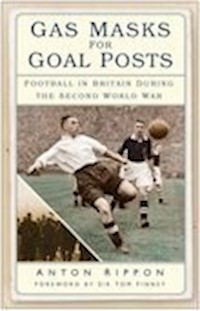
'I was 12th man for England against Wales at Wembley. Within a few minutes, the Welsh half-back broke his collar bone. They had no reserves and I as the only spare player to hand. That's how I made my international debut - for Wales.' - Stan Mortensen, Blackpool and England. When Britain declared war on Germany in September 1939, football came to an abrupt halt. Large crowds were banned, stadiums were given over to military use, most players joined up. Then it was realised that if victory was the national goal, soccer could help - and football went to war. For the next six years the game became hugely important to Britain. Boosting morale among servicemen, munitions workers and beleaguered citizens alike - and raising hundreds of thousands of pounds for war funds. It was a game with plenty of human stories. Some footballers were dubbed 'PT commandos' or 'D-Day dodgers'. Others, however, saw action. Pre-war heroes on the pitch became wartime heroes off it. This book captures the atmosphere of the time and tells the story of a unique period in football's history.
Sie lesen das E-Book in den Legimi-Apps auf:
Seitenzahl: 408
Veröffentlichungsjahr: 2011
Das E-Book (TTS) können Sie hören im Abo „Legimi Premium” in Legimi-Apps auf:
Ähnliche

















GAS MASKS
FOR
GOAL POSTS
GAS MASKS
FOR
GOAL POSTS
FOOTBALL IN BRITAIN DURING THE SECOND WORLD WAR
ANTON RIPPON
FOREWORD BY
SIR TOM FINNEY
First published in 2005
This edition first published in 2007
The History Press
The Mill, Brimscombe Port
Stroud, Gloucestershire, GL5 2QG
www.thehistorypress.co.uk
This ebook edition first published in 2011
All rights reserved
© Anton Rippon, 2011
The right of Anton Rippon, to be identified as the Author of this work has been asserted in accordance with the Copyrights, Designs and Patents Act 1988.
This ebook is copyright material and must not be copied, reproduced, transferred, distributed, leased, licensed or publicly performed or used in any way except as specifically permitted in writing by the publishers, as allowed under the terms and conditions under which it was purchased or as strictly permitted by applicable copyright law. Any unauthorised distribution or use of this text may be a direct infringement of the author’s and publisher’s rights, and those responsible may be liable in law accordingly.
EPUB ISBN 978 0 7524 7188 4
MOBI ISBN 978 0 7524 7187 7
Original typesetting by The History Press
CONTENTS
Foreword by Sir Tom Finney
Acknowledgements
1. A Stifling Afternoon
2. Phoney War, Phoney Football
3. In the Event of an Air Raid
4. Who’s Playing Today?
5. Spoils of War
6. Grounds for War
7. Bravery in the Field
8. Front-Line Footballers
9. It Is With Deep Regret . . .
10. Wartime Wembley
11. The Caps That Didn’t Count
12. Football’s Vera Lynns
13. Out of the Ashes
Bibliography
FOREWORD
by Sir Tom Finney
When war was declared in September 1939, I was 17 years old and serving my apprenticeship as a plumber, while at the same time making my way with Preston North End. None of us knew how the war would affect our lives, but for me it meant a chance in Preston’s first team a little sooner than might otherwise have been the case. I signed professional forms in January 1940, made my debut against Liverpool at Anfield at the start of the following season, and by the end of it was playing against Arsenal in a cup final. Facing players like Eddie Hapgood and Cliff Bastin at Wembley had been beyond my wildest dreams. For many other players, of course, the war had the opposite effect, ending their careers prematurely, robbing them of the last few years of their footballing days. Plenty of others, in their prime when war was declared, lost several years before picking up the pieces again in 1946. Some paid the ultimate price and never returned from the fighting. War changes the course of people’s lives for ever. Footballers are no different from any other.
My memories of wartime football are many and varied. I saw active service with the Royal Armoured Corps but also had the opportunity to play alongside and against some of the game’s finest players in services football, both at home and in the Middle East and Italy. My own club lost its ground for a couple of years and I can remember training on Tuesday and Thursday evenings at a Deepdale surrounded by barbed wire after it became a prisoner of war camp. It was an unusual time of regional football, guest players and many difficulties caused by travel restrictions and the like. Supporters would arrive at grounds not knowing who would be playing for their team. Sometimes they would have a pleasant surprise when a star guest had been enlisted for the afternoon. There are some hilarious tales of the lengths those players had gone to in order to play. Most of all, football was important to people. It kept morale high and helped give us a sense of normality in abnormal times.
It is a pleasure to provide the Foreword for Anton Rippon’s fascinating account of this unique era in football’s history. His book captures perfectly the atmosphere of the game in those difficult days from 1939 to 1945.
ACKNOWLEDGEMENTS
This book could not have been written without the help of a large number of people, not least the football historians who, since 1985 in particular, have published an astonishing wealth of information on their clubs; they should all be saluted. Their works are included in the Bibliography, but special thanks go to Scott Cheshire, Keith Farnsworth, Frank Grande, Martin Jarred, Robert McElroy, Fred Ollier and David Woods, all of whom were kind enough to answer specific queries. Where possible, I have gone back to original sources and this has sometimes resulted in my account differing from what has been previously published. Over the years, several former players, some of whom, alas, are no longer with us, have indulged me: Sam Bartram, Cliff Bastin, Frank Broome, Jimmy Bullions, Raich Carter, George Collin, Peter Doherty, Dally Duncan, Arnie Grace, Jimmy Hagan, Dennis Herod, Jack Howe, Tommy Lawton, Wilf Mannion, Jack Stamps, Bert Sproston, Ken Teasdale, Tim Ward and Jack Wheeler all gave me their time. Apart from answering my questions, Sir Tom Finney also did me the singular honour of providing the Foreword. Andrew Ward allowed me access to his own player interviews and also gave enormous support, encouragement and advice, as well as allowing me to use the description he coined: ‘Football’s Vera Lynns’. Geron Swann kindly made available material from his interview with Vic Barney. Thanks also go to Colin Bruce of the Imperial War Museum, Tim Challis of the RAF Personnel Management Agency, Carol Cooper of the Children and Families of Far East Prisoners of War, Peter Crocker of the Royal Welch Fusiliers, Geoff Cushing, Peter Drake of Birmingham Central Library, Howard Fear, Jezael Fritsche of the Swiss FA, Brian Harris, Peter Lockett, Derek Lockton, Tom Mason, David Murphy of the Royal Scots Regimental Museum, Jonathan and George Plunkett, Gordon Rosenthal, Harry Shinkfield of 77 Squadron Association, and Eddie Whyte. Thanks also to my agent, John Pawsey, and to Sarah Bryce of Sutton Publishing, both of whom showed enormous enthusiasm for the book. And thanks to Pat, and to Nicola, for indulging me, as always.
ONE
A STIFLING AFTERNOON
Surely there couldn’t be room for professional football in a world gone crazy? . . . I wound up my personal affairs, cursed Hitler and all his works, and, occasionally, sat down to think of what had been, and what might have been.
Tommy Lawton, Everton and England
There should have been plenty to talk about as football supporters all over Britain headed for the exits on 2 September 1939. On the second Saturday of the new season, Blackpool had beaten Wolves 2–1 at Bloomfield Road to lead the First Division with maximum points. Ted Drake had scored four times in Arsenal’s 5–2 win over Sunderland. In the Second Division, Newcastle United had put 8 goals past Swansea Town. In the Third Division South, Bournemouth and Boscombe Athletic had scored 10 against Northampton Town. The Glasgow giants, Celtic and Rangers, had both won, but in Edinburgh there was a surprise when Albion Rovers, relative newcomers to Scotland’s top division, beat Hibernian 5–3 at Easter Road. Yet on the trams and buses taking supporters home for their tea on that stifling, brooding afternoon, no-one said very much. It was the same in every dressing room. At the Baseball Ground, the Derby players who had just defeated Aston Villa decided to meet again that evening in a local pub, to discuss what the future might hold. At The Valley, the game between Charlton Athletic and Manchester United had been a tedious affair, the players’ apparent lack of interest mirroring that of the 8,608 supporters who had bothered to turn up to a ground which, the previous year, had housed 75,000. Even a 2–0 home win had failed to spark any celebrations. The mood of the Manchester City players who had beaten Chesterfield was not helped by the sight of barrage balloons on the skyline around Maine Road. At Highbury, where the kick-off had been put back for two hours because of traffic congestion as the first of London’s children were evacuated from the capital, the atmosphere was especially subdued. Even Ted Drake, rarely short of a few wisecracks, had little to say, despite his 4 goals. For once, the result of a football match seemed unimportant.
The previous day, Germany had invaded Poland. In Britain, military service had been made compulsory for fit young men between the ages of 18 and 41 – which, on the face of it, meant all professional footballers – and, for the second time in a generation, a world war appeared inevitable. At eleven o’clock the following morning at the Russell Hotel – half a mile from King’s Cross and ‘made of reinforced concrete’, the establishment boasted not all that reassuringly – the defeated Sunderland team gathered around a wireless set to hear the Prime Minister’s broadcast to the nation. When Neville Chamberlain reached the bit that everyone would remember – ‘. . . I have to tell you now, that no such undertaking has been received, and that, consequently, this country is at war with Germany’ – Raich Carter’s first thoughts were of how they would get back to Sunderland. Would the trains still be running now there was a war on? The Leicester City players who had beaten West Ham United at Upton Park the previous day were already safely home, but they had arrived back in Leicester late on Saturday evening to find the city’s blackout already in force. Despite the inconvenience, they noticed that there were still plenty of people about. It appeared that no-one wanted to go home, despite a fierce thunderstorm.
The war had come as no surprise. The whole of the previous season had been played out against a backdrop of almost unbearable tension as diplomats bluffed, bargained and threatened. It had been the same for years, one international crisis after another. Like the rest of Britain, football had tried to carry on as normal. Yet as far back as 1934, footballers had been one of the first sections of British society to see for themselves what was happening in Germany. In May that year, Derby County made a four-match visit there. By train to Dover and then a cross-Channel steamer to Ostend, the Derby party eventually reached the German border to find a country swathed in the swastika emblem. After Hitler’s success in the elections of March 1933, the Nazi State was firmly established. Dave Holford was a 19-year-old outside-left from Scarborough, excited to be included in the tour party despite his lack of experience: ‘Everywhere we went, the swastika was flying. If you said: “Good morning,” they’d reply with “Heil Hitler”. If you went into a cafe and said: “Good evening,” they would respond with “Heil Hitler”. Even then, you could see this was a country preparing for war.’ Derby lost three times and drew once. Twice they conceded 5 goals in a match and were surprised by the standard of their hosts’ game. All agreed, however, that if the football had been hard work, overall the tour had been an enjoyable one. Good hotels and plenty of time to relax and enjoy the scenery were just the ticket after a strenuous English season. There was, however, one overriding blot on the collective memory. Just as the England team would be obliged to do in Berlin, four years later, the Derby players of 1934 were ordered to give the Nazi salute before each game. Full-back George Collin, who captained the side when Tommy Cooper left for England duty, remembered their dilemma: ‘We told the manager, George Jobey, that we didn’t want to do it. He spoke with the directors, but they said that the British ambassador insisted we must. He said that the Foreign Office were afraid of causing an international incident if we refused. It would be a snub to Hitler at a time when international relations were so delicate. So we did as we were told. All except our goalkeeper, Jack Kirby, that is. Jack was adamant that he wouldn’t give the salute. When the time came, he just kept his arm down and almost turned his back on the dignitaries. If anyone noticed, they didn’t say anything.’
Thereafter, every British team that visited Germany had a similar story to tell, although when Manchester City went there in May 1937, at the end of a season in which they had won the Football League championship, they decided on a collective response to Hitler’s regime. Despite having just won the title, City, like Derby before them, found it hard going and won only one of their five matches. Peter Doherty, their Irish international inside-forward, brought back vivid memories of the trip:
Most of their players seemed to be in the German army already and were sent away to special camps to prepare for the games. It was a shock. We’d just had a long, hard season and went there for a holiday. One of the games was against a German representative team in the Olympic Stadium in Berlin, which had just staged the 1936 Games. The entire stadium was swarming with armed guards, all wearing swastikas. We knew we’d be expected to give the Nazi salute before the kick-off, but when the time came we just stood to attention. Afterwards we were treated with enormous kindness, though, and the Germans just seemed to want to send us away with a favourable impression of their country. But you couldn’t fail to see the military preparations everywhere. The whole country seemed to be one huge armed camp.
Frank Broome of Aston Villa had the unusual experience of being required to give the Nazi salute twice in as many days in May 1938. ‘The Germans had invaded Austria the previous March and now there wasn’t a separate Austrian international team – which had been one of the strongest on the continent – just one for “Greater Germany”. England were due to play in Berlin, but the FA told the Germans that they couldn’t include any Austrian internationals. They agreed on the proviso that Villa would play a German eleven the following day, and that could include Austrians. What struck me, though, was how the military was everywhere. You couldn’t possibly have visited Germany and not realised that they were gearing up for war.’ The FA’s hope that Germany would not benefit from the Anschluss – the annexation of Austria – was realised. England won 6–3 in the Olympic Stadium, although one of the German goals was still scored by an Austrian, Hans Presser from Rapid Vienna. The following day, Aston Villa beat a German Select XI 3–2 before 110,000 spectators who sweltered in 90-degree heat at the Reichssportfeld. This German team contained no less than nine Austrian internationals. Broome scored in both games, only 24 hours apart. Again there had been the controversial issue of the Nazi salute. Villa, like Manchester City, kept their hands by their sides. England gave the full-flung version after Sir Neville Henderson, the pro-appeasement British ambassador to Berlin, persuaded the FA secretary, Stanley Rous, and committee man, Charles Wreford Brown, that there would be an international incident if they did not; and anyway, he pointed out, it was simply a courtesy to their hosts, not an endorsement of Hitler’s regime. Perhaps most importantly, it would ‘get the crowd in a good mood’. The England captain, Eddie Hapgood, wrote later: ‘The worst moment in my life, and one I would not willingly go through again, was giving the Nazi salute in Berlin.’
Thus, sixteen months later, the nation’s footballers could hardly be surprised when their livelihood was interrupted by war with Germany. Indeed, by September 1939 the whole country was prepared. Unlike the world situation five years earlier, when Derby County’s players had been in a privileged position to see what was happening in Germany, now no-one needed a holiday on the Rhine before they realised the dangers. The 1939–40 football season was about to be interrupted, but it was surprising that the previous season had itself been completed. The international skies were already darkening as the first games were played on 27 August 1938, when Arsenal began their defence of the Football League championship with a comfortable home win over Portsmouth. By the time Derby County scored a surprise midweek victory at Highbury on 14 September, the world already knew that Hitler would invade Czechoslovakia if the Sudetenland was not annexed to Germany. The Nazi leader had made that much clear at a huge party rally in Nuremberg two days earlier. The fourth and fifth Saturdays of the new season were played out as Neville Chamberlain visited Hitler in Berchtesgaden and Bad Godesberg. Meanwhile, Everton put 5 goals past Portsmouth, and Liverpool beat Leeds 3–0, but even on Merseyside it was hard to concentrate on football.
There was enormous tension throughout the country. Gas masks were distributed, air raid shelters dug in public parks, and around London anti-aircraft batteries were sited to defend the capital in case of air attack. There was now every possibility that the next Saturday of the football season would see Britain at war. On Tuesday, 27 September, the Royal Navy was mobilised. The following afternoon, the Football League announced that the weekend’s fixtures would be fulfilled unless the worst had happened by then. Few people would have put money on the matches taking place, but Chamberlain returned home from a hastily arranged meeting in Munich, clutching a piece of paper. He had agreed to all Hitler’s demands. It was to be ‘peace in our time’. The immediate crisis had passed and football could continue. On Saturday, 1 October, before the start of every Football League game, a service of thanksgiving was held ‘to express thankfulness for the preservation of peace’. But if war had been averted for the time being, it was Easter before it could safely be assumed that the football season would be played to its natural conclusion. By then Hitler had occupied the rest of Czechoslovakia, and Everton were on their way to winning the First Division title. The Goodison club had begun the season with six consecutive victories, and even a sensational 7–0 defeat at Wolverhampton in February had not checked their stride. They had much the same team as the previous season, but this time their young centre-forward, Tommy Lawton, was receiving better service and would finish the season with 34 League goals. Portsmouth and Wolves, meanwhile, were looking forward to meeting in the FA Cup final.
Four days before the Wembley final, which Portsmouth would win 2–0, the Government announced the introduction of compulsory military service for men aged 20 and 21, limited to a period of six months’ training. Summing up the season, W.M. Johnston, compiler of an annual review, commented: ‘It is still too early to perceive the precise effect that this enactment will have upon the arrangements of [Football] League clubs, but at least it introduces a factor the consequences of which may be far-reaching.’ None the less, the 1938–9 football season survived to provide a list of winners. For Everton there was the League championship, for Portsmouth the FA Cup, which they would now famously hold for seven years. Birmingham and Leicester City dropped out of the top tier of English football, to be replaced by the champions of the Second Division, Blackburn Rovers, and the runners-up, Sheffield United. Norwich City and Tranmere Rovers disappeared into the Southern and Northern Sections of the Third Division respectively, while Barnsley, from the Third Division North, and Newport County, their southern counterparts, went up a division. Newport’s achievements were especially pleasing. It would be their first time in the Second Division. They had gone three months undefeated, a spell broken, remarkably, by an 8–0 thrashing at the hands of Swindon Town on Boxing Day. But they had recovered and now this ‘team without stars’ sailed into new waters. They would have to wait seven years to get properly under way.
While football was settling its own issues, Hitler had turned his attention to Poland, whose affairs were dominated by the 1919 Treaty of Versailles, which had settled Polish frontiers to the displeasure of her neighbours. On 24 March 1939, Britain and France had agreed to resist any German aggression against Belgium, Holland and Switzerland. One week later, as regulars of Fratton Park and Molineux wondered what would be their chances of obtaining a cup final ticket, Britain announced that she would stand by France in guaranteeing Poland’s frontiers. Football, however, had to go on. As soon as the 1938–9 season was over, the England team went on a three-match tour. At the rain-soaked San Siro Stadium in Milan, a German referee, Dr Bauwens, allowed an Italian goal, despite the ball being fisted into the net. An offer from the Italian Crown Prince to order Dr Bauwens to change his decision was politely declined by the FA, and the game ended 2–2 after a late England equaliser. After a long train journey to Belgrade, England lost 2–1 to Yugoslavia, and then Rumania were beaten 2–0 in an ill-tempered affair. When the referee blew his whistle to end the game in Bucharest, he brought down the curtain on England’s pre-war international programme. For the next seven years it would be ‘unofficial caps’ only. That summer the FA’s international committee toyed with the idea of organising a match against France in Paris for May 1940, but decided to defer the matter until a later date. It was a common-sense decision.
After Bucharest, the England party began the 24-hour train journey for home, across a Europe bracing itself for war. Just as the players of 1938 had seen for themselves the mood in Germany, so the 1939 team had, as they made their way through the streets of Milan towards the San Siro, witnessed the huge support for Mussolini. There could be little doubt in any of their minds that life would soon be changed irreversibly. At Basle, in the small hours of the morning, Tommy Lawton and Joe Mercer said goodbye to their teammates. They had agreed to travel on to Holland where their club, Everton, was making a short visit. On the steamer chugging across the Channel from Boulogne to Folkestone, Frank Broome lent alone on the ship’s rail, watching the French coast disappear and wondering if he would ever see it again.
England were not that summer’s only football tourists. Wales lost 2–1 in Paris on 20 May. Three days later, four English-based players – George MacKenzie (Southend United), Matt O’Mahoney (Bristol Rovers), Johnny Carey (Manchester United) and Jim Fallon (Sheffield Wednesday) – played in Bremen for the Republic of Ireland. As the local shipyard of A.G. Weser prepared to step up its production of U-boats, just down the road, a fine header from Paddy Bradshaw of Dublin’s St James’s Gate club earned the Irish a creditable 1–1 draw. From late May until early July, a strong FA team toured South Africa, winning all three ‘test matches’ but somehow managing to lose 1–0 to Southern Transvaal.
Back in Britain, while the FA XI was beating Natal 9–1, the Air Raid Precautions Department at the Home Office considered plans for closing all forms of entertainment upon the outbreak of hostilities. The FA, meanwhile, decided to convene a joint FA–League meeting as soon as war was declared. Essentially, it would decide ‘what to do next’. Many players had already done their bit, however, and by the time an FA circular exhorting footballers to join the Territorials was doing the rounds towards the end of the 1938–9 season, several clubs had already seen their entire playing staff ‘join up’. West Ham United had indulged in some forward planning; after the Munich Crisis of September 1938, the Hammers’ chairman, W.J. Cearns, suggested that first-team players joined the reserve police, and reserve players signed up with the Territorial Army. This way, West Ham could be sure of a decent first team who, if war did come, would all presumably be stationed close by. To be fair to Cearns, his son also enlisted in the ‘Terriers’ and when war did come, many Hammers players joined the forces and served together in a searchlight unit of the Essex Regiment in East Anglia. Twenty-three of Brentford’s thirty-man playing staff were in the reserve police, while Bolton Wanderers had signed up en bloc for the local Territorial artillery regiment.
Liverpool had been the first to join the Territorials as a club. Phil Taylor, a wing-half who had been transferred to Anfield from Bristol Rovers in March 1935, was one of them. He recalled a summer army camp in May 1939, when Liverpool had to send down their club trainer, Albert Shelley, to work on the footballers’ feet, blistered from days of long route marches in ill-fitting army boots. Almost all Football League clubs saw players signing up with the Territorial Army, a trend which led to the League issuing a statement to the effect that clubs were not obliged to pay players who were undergoing military training, unless those players were going to be made available on match days. On the eve of the season, the FA waived their rule that stated that no player serving in the armed forces could be registered as a professional footballer. The game was going on a war footing.
By then football had already suffered its first war casualties. In July, Portsmouth’s FA Cup final captain, Jimmy Guthrie, was seriously injured when the car he was driving crashed during a blackout practice near Harrogate. Everton’s Billy Cook and John Thomson, who were attending the same coaching course as Guthrie, received relatively minor injuries but Guthrie’s were life-threatening. Happily, he recovered and was able to watch some of Portsmouth’s practice matches as they prepared for the new season, for sport was carrying on as usual. Even as late as 20 August 1939, a British track and field athletics team was meeting a German team in Cologne. Six days later, the new Football League season kicked off on schedule when a goal from Tommy Lawton earned the reigning champions, Everton, a 1–1 draw with Brentford at Goodison Park. There was the usual crop of early-season midweek games; at Highbury on Wednesday 30 August, Cliff Bastin’s penalty was enough to defeat Blackburn Rovers. At Anfield that evening, Phil Taylor, his blistered feet now recovered, scored twice as Middlesbrough were beaten 4–1. Portsmouth, the FA Cup holders, lost 2–0 at Derby, where Dally Duncan and new signing Billy Redfern, from Luton Town, both scored.
Nine hundred miles away, the 1939 Polish championship had been whittled down to a four-club play-off between Slask Swietochlowice, Smigly Wilno (from what is now Vilnius, the capital of Lithuania), Junak Drohobycz (now part of the Ukraine) and Legia Poznan, but the title was never decided. Warsaw was preparing itself for war. Trenches were being dug and power stations sandbagged and people had started to carry gas masks. In Danzig, now the flashpoint of the conflict, bands of Nazis attacked Polish shops in the city and smashed their windows. On Friday 1 September, the Luftwaffe bombed the Polish capital as German tanks crashed their way over the country’s border. In Britain, theatres were closed, cricket matches abandoned, greyhound racing cancelled and the BBC wireless service changed to two wavelengths only. Many amateur football matches were cancelled, but the Football League pressed on for one more Saturday. The public were not sure what to do. Everywhere attendances were down. The first Saturday of the new season had attracted a total of 600,000 spectators to forty-four Football League games; seven days later, with the world teetering on the brink of war, the figure had slumped to well under 400,000. At only three grounds – Blackpool, Birmingham and Cardiff – was there an attendance in excess of 20,000. Arsenal’s gate for the game against Sunderland, not helped by the late kick-off, was just over 17,000, less than half the normal attendance for Highbury. Newport County were caught up in traffic and arrived three-quarters of an hour late for their game at Nottingham Forest. Everywhere clubs had struggled to find enough players.
Liverpool’s Territorials managed to persuade enough colleagues to stand in for them on sentry duty so that the players could travel to Anfield for the match against Chelsea. The Brentford match programme for the game against Huddersfield Town contained a cartoon of a man entering a turnstile, scowling over his shoulder at a storm cloud which bore the word ‘Crisis’. The caption read: ‘Let us forget our troubles for a while and see an honourable fight.’ Honourably or otherwise, Brentford won the match 1–0. The Arsenal players clattered back into their Highbury dressing room to find a letter waiting for each of them. The message was unequivocal: in the event of war being declared, their contracts would be cancelled until further notice. It was almost eight o’clock and dusk was setting in by the time they left for home, the sight of a barrage balloon moored on the club’s training pitch leaving them in little doubt that the afternoon’s victory over Sunderland would ultimately count for nothing.
That night, the Derby players met at the Angler’s Arms in Spondon, on the outskirts of the town. A violent thunderstorm was raging and one of the barrage balloons defending the Rolls-Royce aero-engine works near the Baseball Ground was struck by lightning and brought crashing down in flames. It seemed an appropriate, almost apocalyptic, backdrop. There was no chance of Germany withdrawing from Poland. ‘We’re out of a bloody job,’ growled the Derby centre-forward, Jack Stamps. No-one disagreed. In Liverpool, Norman Greenhalgh was going to be annoyed for several years to come. He had played in every game of the previous season when Everton won the League championship. They were due to meet Portsmouth, the FA Cup holders, in the traditional FA Charity Shield game at Goodison Park on 4 October: ‘We won the League and Portsmouth won the Cup, and we were supposed to play them. And what happened? Bloody Adolf Hitler stepped in, didn’t he, and the bloody war was on, and I lost a medal. That was always a bone of contention with me.’
Jack Wheeler, a young goalkeeper with Birmingham, was not too worried, though. On the Sunday morning, as was his custom, he left his digs and went down to St Andrew’s to take a shower and then enjoy a game of snooker with some of the junior players. On his way back home at lunchtime, someone told him that war had been declared: ‘I wasn’t really bothered. I was young, single and, let’s face it, it would all be over by Christmas.’
TWO
PHONEY WAR, PHONEY FOOTBALL
The first season was very strange. It was quite enjoyable but a lot of the matches were played in a half-hearted manner. No-one knew what was going to happen in the war. It wasn’t easy to concentrate on football.
Frank Broome, Aston Villa and England
On the second Saturday of the 1939–40 season, York City lost 1–0 at Rochdale in the Third Division North. In the early evening, the players travelled home across the Pennines from Spotland, wondering if they would still be playing Lincoln City in midweek. On the Monday morning, the York secretary, G.W. Sherrington, gathered the players in the home team dressing room at Bootham Crescent and told them what they already knew: as football had been suspended, the club had no prospects of any income and they were out of a job. Then he gave everyone their insurance cards, wished them luck and told them they could now go home. Lincoln City would have to wait. It was a scene played out at football grounds all over the country. In 1939, football’s first reaction was a determination not to make the same mistake as in 1914, when the Football League and the FA Cup had been allowed to continue for a whole season and everyone connected with the game had been denounced as both unpatriotic and unproductive. In November 1914, The Times had carried a letter from the historian A.H. Pollard: ‘Every club that employs a professional football player is bribing a much-needed recruit away from enlistment and every spectator who pays his gate money is contributing so much towards a German victory.’ The FA responded by claiming that 500,000 recruits had already been raised by football organisations, that of 5,000 professionals, some 2,000 were already in the services, and that only 600 unmarried professional footballers had failed to heed the call.
Some people in the game had taken particular exception to claims that football was not supportive of the war effort. Frederick Charrington, the heir to an East End brewery fortune, who had renounced his inheritance and found his way into the Temperance movement, had been given permission by the FA to make a speech on wartime recruitment during the half-time interval of a match at Craven Cottage. For patriots like Charrington, footballers and their supporters were cowards. He was also seen by many people as one of those grim Victorian philanthropists for whom any entertainment was morally suspect. Alas, no-one had thought to inform the club that he had been given permission to air his views and as soon as Charrington began to speak, two Fulham officials set upon him, dragged him down a gangway and threw him out of the ground. Of course, there were fundamental differences between 1914 and 1939. The First World War had been fought largely by volunteer soldiers. Conscription, introduced in 1939, prevented a repeat of that. And there was now the imminent threat of air attack. Almost every family in Britain had been touched by the First World War, but largely through their menfolk away fighting on the front line. By 1939, the prospect of German air raids on British cities had been in the public mind for several years. Thus, one of the Government’s first reactions after the declaration of war was to ban the assembly of crowds. That meant that all forms of public entertainment had to be suspended immediately. The Daily Mail of 4 September 1939 commented, ‘For the moment, all sport has been brought to a halt. The concentration of Britain’s whole effort on winning the war makes its continuance undesired and inappropriate.’
So, in contrast with the situation in 1914, football had no choice to make; the game could not carry on anyway. On 5 September, the Football League told all its member clubs to keep their players on standby. Then, after a hastily arranged meeting at Crewe, the League further informed clubs to release the players after all, paying them up to 6 September. Bonuses and any other additional payments should be settled at once, supporters would have to wait until it was decided what to do about refunding money for season tickets, and if the regular season could be resumed later, matches already played would count as cup games. As football hung in limbo, the players found themselves in a dreadful situation. The old retain-and-transfer system which was operating in 1939 – and which continued to do so until the 1960s – held all professional footballers in a feudal-like thrall. In the twenty-first century, when players and their agents rule the roost, it is hard to imagine a time when there was a maximum wage and a footballer could be tied to one club for life if that club so wished. That was indeed the case, but now, with a war on, the players were unceremoniously dumped by those same clubs. Their only immediate chance of earning a living was to join the armed forces. Even when, a few days after war had been declared, the Government lifted its ban on sporting activities outside highly populated areas such as London, Birmingham and Manchester, the players were not initially entitled to any payment above valid expenses, although they were insured under the Workmen’s Compensation Act.
On 9 September 1939, the first wartime football match took place behind closed doors at Loftus Road, when Queen’s Park Rangers put 10 goals past a hastily recruited army team. Just who the eleven servicemen were who were so roundly beaten, we shall never know: the army team was not published for ‘security reasons’. Soon, the areas where matches could be played were extended provided that local police did not object. The first friendlies when spectators could be admitted took place on 16 September with twenty-eight matches involving Football League teams in England and three games in Scotland. Attendances ranged from 2,000 to 9,000, and altogether totalled 117,000. That day Nottingham Forest lost 4–3 to Peterborough United of the Midland League. As the FA had rescinded all contracts, it was the first time that Forest had fielded an all-amateur team since 1891. Derby County did not play that day but when they did give it a go, on 30 September, only 1,805 people turned up at the Baseball Ground for a friendly game against Leeds United. That was enough to convince the Derby directors to shut up shop. It would be 1942–3 before they joined the war league. Mansfield Town announced that they were also closing down. Chairman W.M. Hornby told the Nottingham Evening Post: ‘We hope to come up smiling again and give Mansfield the sort of football it deserves.’ Within a few weeks the club had started up again. Ipswich Town, elected to the Third Division South in 1938, had enjoyed only one season in the Football League when the competition was suspended. Ten days after the outbreak of war, the club’s chairman, John Murray Cobbold, issued a statement on behalf of the board announcing that the club’s activities would be suspended indefinitely. Supporters’ representatives asked for a change of heart but at the end of the month, Cobbold told them, ‘ . . . it was decided in the interests of the club to close down all operations at Portman Road as and from 30 September 1939.’
By then, some restrictions had been relaxed. On 25 September, the stipulation that matches could be played only between clubs no more than 50 miles apart was altered to allow games where the away team could be ‘there and back in a day’. Three days earlier, attendances of up to 8,000 in evacuation areas and up to 15,000 in safer centres were allowed. There were stipulations, however. The limit of 8,000 could be no more than half the capacity of the stadium. The bigger grounds in the non-evacuation areas could admit up to 15,000 provided that tickets were sold in advance, an arrangement which soon proved impractical. Nevertheless, football supporters began to see their local grounds quickly reopened, although had the local chief constable had his way, Birmingham would never have played a home match during the Second World War. When football was allowed to resume, Cecil Moriarty was having none of it. In his opinion the area around St Andrew’s was a likely target for the Luftwaffe – as it turned out, he was right – and there would be the risk of serious loss of life if thousands of people were allowed to gather to watch football. The club did everything in their power to overturn his ruling and on 12 March 1940, Birmingham City Council passed a resolution asking the chief constable to reconsider. They argued that people who spent long hours working in munitions factories deserved some recreation, and that included watching football at Birmingham. The matter was raised in the House of Commons, but Home Secretary Sir John Anderson – after whom the cheap domestic air raid shelter had been named – declared that he could not intervene in such a local issue. A letter to the local Sports Argus accused Moriarty of ‘killing people’s Saturday afternoons’, adding, ‘He would change his views if he had to work in a factory for 50 or 60 hours a week.’ Eventually, when it was pointed out that St Andrew’s was the only football ground in Britain still closed, Chief Constable Moriarty, and the eight Birmingham councillors who had backed him, had no case. On 23 March 1940, the ground reopened and there was an attendance of 13,241 to see Birmingham play Walsall in a Midland Division game, for by then the wartime regional competitions were well under way.
The joint FA–League War Emergency Committee had announced its plans towards the end of September 1939. There were to be eight regional competitions. Two would be styled ‘South’, with divisions ‘A’ and ‘B’, and would comprise clubs from London and elsewhere in the south of England. The other sections would be East Midlands, Midlands, North-West, North-East, Western and South-Western. Six clubs decided not to take part: Aston Villa, Derby County, Exeter City, Gateshead, Ipswich Town and Sunderland. In Scotland there would be two divisions: East and West. As in England, six clubs declined: Brechin City, Edinburgh City, East Stirling, Forfar Athletic, Montrose and Leith Athletic. The Irish League decided to carry on as normal; the League of Ireland was unaffected because the Free State would remain neutral throughout the war. Players would be paid thirty shillings a match in England – where the maximum prewar weekly wage had been £8 – and £2 in Scotland. Guest players would be allowed, provided the player’s original club granted permission. Such a rearrangement of the Football League was bound to cause disaffection. Newcastle United found themselves in what was effectively a Yorkshire division with only lowly Hartlepool United and Darlington for company from the North East. Lancashire’s clubs were also separated. In the North-West Division, Preston North End, Bolton Wanderers, Blackpool and Burnley had to play against Carlisle United and Barrow, while the Merseyside and Manchester clubs were put in the Western Division, which no doubt pleased the likes of New Brighton, Crewe Alexandra and Chester, who joined them there. Luton Town might have hoped for a place in one of the southern sections, but instead lined up with Wolves, West Brom and Birmingham in the Midland Division. Some divisions were so small that the clubs would have to play each other four times over the season instead of the normal two. This inevitably meant that interest waned as the season wore on.
The biggest fall-out, however, was in the south, where an acrimonious split soon developed. Over twenty clubs had wanted to play in the London area sections, the obvious attraction being matches against Arsenal, which would generate bigger gate receipts. But it was now nearly October and there was room for a maximum programme of only thirty-three matches. The answer was to split the south into two divisions, which displeased the clubs who were not in Arsenal’s section. London clubs, meanwhile, objected to travelling to the south coast for matches when a perfectly workable competition could have been fashioned out of clubs from the capital alone. The London clubs pointed out that by taking just four clubs from outside their immediate area, they could have a competition where they each played twenty-eight matches. Also, they could not see why the Football League had to get involved. Such a league could be run by the London Combination and governed by the London FA. Eventually the eleven clubs from the capital agreed to the groupings – which provided two divisions with eighteen games for each club – provided that they could stage matches on consecutive playing days. This would allow them to run a similar competition in the latter half of the season, with the clubs shuffled around. This time the sections would recognise the pre-war divisions so that all the bigger clubs would be placed in the same section, the smaller ones in the other.
The new league season would begin on 21 October. In the meantime, friendly matches continued, although interest was minimal. Whereas an average attendance of 10,000 supporters had been watching each of the Nottingham clubs’ indifferent form in 1938–9 – Forest finished third from bottom of the Second Division, Notts County eleventh in the Third Division South – only 4,000 turned up for the first wartime derby game between the rivals on 14 October. Forest triumphed 2–1, their winning goal scored by a Coventry City player, Ellis Lager. The same day, several clubs fielded two teams: Birmingham lost 1–0 at Wolves and 3–2 at Stoke; Charlton lost 2–0 at Watford and 9–2 at West Ham; West Brom won 4–2 at home to Coventry and 5–1 at Kidderminster Harriers. The BBC’s wireless commentary of a friendly game between Blackpool and Manchester United was picked up by a French radio station and relayed to British troops of the BEF, who strained their ears for details of Blackpool’s 6–4 win. They were unaware of the fact that, a few hours earlier at Scapa Flow, HMS Royal Oak had been torpedoed by a German U-boat and had gone down with the loss of 833 lives.
Three days before the regional leagues got under way, Aldershot staged the first representative game of the war when an FA team met a combined Aldershot and army side in aid of the Red Cross and St John Ambulance. There were a dozen international stars on display including the Arsenal full-back pairing of Eddie Hapgood and George Male for the FA team, and Leeds United’s Wilf Copping and Eric Stephenson for the home side. The FA won 1–0, their goal coming from Barnet’s amateur international outside-left Lester Finch, who had played for Great Britain in the 1936 Berlin Olympics. The previous season Aldershot had recorded only one attendance in five figures, but now a crowd of 10,000 raised over £350 for charity; such matches were to become an integral part of wartime football in Britain. The attendance proved one thing: that people would certainly turn out for games where there was an abundance of talent on display, even if there was no truly competitive edge to the affair. It also reinforced the Government’s view that sport would have a beneficial effect on public morale. Even in the first few weeks of the war, Mass Observation, the organisation founded in 1937 to record public opinion, noted that the banning of competitive sports – and therefore the breaking of well-established routines – might have ‘deep repercussions’. In 1940, Mass Observation would report: ‘Sports like football have an absolute effect on the morale of the people and one Saturday afternoon of league matches could probably do more to affect people’s spirits than the recent £50,000 Government poster campaign urging cheerfulness.’ The organisation could not find one pre-war football supporter who thought that the game should be suspended for the duration of the war. Perhaps more significantly, they found that only 2 per cent of people not interested in football in peacetime were against sport being played in time of war. Alas, in 1940, Mass Observation also found that 65 per cent of supporters who attended pre-war matches could not now get to football because of Saturday shift work in factories, travel restrictions and family obligations.
When the first wartime league matches were played on 21 October 1939, the biggest attendance of the day was the 8,931 who saw tenants Arsenal beat Charlton Athletic 8–4 at White Hart Lane, to where the Gunners had removed on the outbreak of the war. Leslie Compton scored 4 goals, 3 of them from the penalty spot. Charlton’s goalkeeper, Sam Bartram, conceded only one of Compton’s spot-kicks. He left the field injured, to be replaced between the posts by the Torquay United left-back Ralph Calland, who was guesting that day. There was a crowd of 6,468 at Craven Cottage where 2 goals from Ronnie Rooke helped Fulham beat Portsmouth 2–1. At Griffin Park, 6,628 saw Brentford draw 2–2 with Chelsea. There were 4,000 at the Victoria Ground, Hartlepool, where the home side lost 2–1 to Newcastle United, despite the presence of seven Sunderland players in the Hartlepool team. The Manchester derby match at Old Trafford, where City won 4–0, attracted only 7,000. Perhaps the most surprising attendance on that opening day came at the far-flung football outpost of Carlisle. Accrington Stanley were the visitors to Brunton Park, where 4,500 watched a goalless draw between two clubs from the Third Division North. At the other end of the country, Plymouth Argyle’s home game with their nearest neighbours, Torquay United, brought 2,866 to Home Park. The home fans were rewarded with a 4–0 win.




