


Erhalten Sie Zugang zu diesem und mehr als 300000 Büchern ab EUR 5,99 monatlich.
- Herausgeber: The History Press
- Kategorie: Sachliteratur, Reportagen, Biografien
- Sprache: Englisch
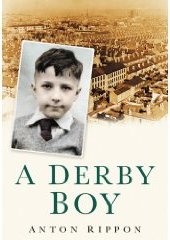
A biographical account of growing up in Derby in the 1940s and '50s from local author and columnist Anton Rippon.
Das E-Book A Derby Boy wird angeboten von The History Press und wurde mit folgenden Begriffen kategorisiert:
derbyshire,blackout,derby corporation bus driver,the derby evening telegraph,childhood,reminiscences,teenage years,nostalgia,memory lane,schooldays,porting life,national events,derbeians,1940s,'40s,forties
Sie lesen das E-Book in den Legimi-Apps auf:
Seitenzahl: 309
Veröffentlichungsjahr: 2011
Das E-Book (TTS) können Sie hören im Abo „Legimi Premium” in Legimi-Apps auf:
Ähnliche

















THE AUTHOR
Anton Rippon has spent the last forty-six years (apart from three helping to run a sports centre) in the newspaper and publishing industry. Between 1965 and 1975 he managed the Derby Evening Telegraph’s office at Burton upon Trent and later worked as a feature writer at the newspaper’s Derby office. As a freelance his work has appeared in national newspapers including The Times, Independent, Guardian and Sunday Telegraph, and many national magazines. Anton has written documentary series for BBC Radio Derby and appeared on national radio and regional television. He also wrote and co-produced the highly acclaimed documentary film The Derby County Story. He has had over twenty books published, mostly on sport but also on the history of his home town of Derby. Today he writes a popular weekly column in the Derby Evening Telegraph. For over twenty years he ran Breedon Publishing, the company he co-founded in 1982 and which he sold in 2003 to resume writing. Married to Pat, he lives in Mickleover. Their daughter, Nicola, is herself a freelance writer with several books to her name.
Contents
Title
About the Author
Introduction
1Roll Out the Barrel
2Our Mixed-up Family
3Dodgy Coalmen, Mad Butchers
4Becket School … and a Coronation
5Only Half a Mile Long
6Bemrose School … and a Shaving Lesson
7Journeys with My Father
8It Should Be a Good Match …
9Evenings around a Piano
10Meeting Tony Curtis
11They Shouldn’t Count Goals Like That
12Gone for a Burton
13Drink Your Beers, My Little Dears
14Ghosts
Copyright
Introduction
The first stirrings of this book came all of seventeen years ago, and in the unlikeliest of settings: a plush restaurant over Grand Central Station, high above Manhattan. I was there to lunch with a man called Clive Toye, a former Fleet Street journalist who had gone to the USA in the early 1970s to be in at the beginnings of the North American Soccer League. Clive eventually became general manager, and then president, of the world-famous New York Cosmos team. Now he was looking forward to the World Cup being staged in the States in 1994 and, with four years still to run, he was exploring various business opportunities. That was where I came in. At the time I owned a publishing company; Clive wanted to take our book on the World Cup and republish it on his side of the Atlantic. Business over, and coffee served, we began to talk of our own British origins. I remarked that, when I’d started grammar school in Derby, in 1956, places like America seemed inaccessible to a working-class boy like me. You might as well have told me that, one day, I would fly to the Moon as tell me that I’d eventually get to New York. By 1990, the United States was a country that I’d visited many times, but still I could never quite get over the wonder of it all. Even at that moment, as I looked down at the busy intersection of 42nd Street and Lexington Avenue, I marvelled at the fact that here I was, a lad from Gerard Street, sitting in New York talking to the man who signed Pele for the Cosmos. Then Clive said, ‘You know, you should write a book about it … about what it was like to grow up in a place like Derby after the war.’ When I got back to my hotel that evening – and with nothing much on the television – I began to make some notes. Then I put them away, returned to England the next morning, and left it at that. For the next few years I was too busy publishing other people’s books to write one myself.
In 2003 I sold the business and found myself a freelance writer once again, able to wander, in a literary sense at least, wherever I wanted. More easily managed working hours also meant that, with John Burns and Colin Shaw, boyhood pals from Gerard Street, I could relive parts of my childhood through long, lazy days revisiting old haunts: a sort of Last of the Summer Wine but without the scenery (we had firm ideas about who was cast as Compo, Clegg and Foggy). More often than not, however, I would make these journeys on my own. Every time I was in the vicinity I would be drawn back to the area where I’d grown up and which had shaped the person I became. In the summer of 2006 I went to visit a former neighbour, Jessie Manning, who lived in Webster Street, a few yards from our old back gate. It was a scorching summer’s day and I spent the afternoon in the cool of her living room, drinking tea, munching cakes, and taking the usual stroll down memory lane. Now it was time to leave. As I wandered back down Gerard Street, it occurred to me that now might be a good time to dust off that notebook and resurrect Clive Toye’s suggestion. So here we are.
What follows is my account of growing up in the East Midlands industrial town (as it then was) of Derby, from the end of the Second World War until 1975, by which time I’d married and become a father. The characters mentioned in the following pages are all real people and I’ve changed no names, although I haven’t dwelt on incidents that might unduly embarrass others. There is also the indulgence of a little family history in an attempt to describe Derby in the 100 or so years before I was born. The book ends in the middle of the 1970s simply because the second half of that decade heralded a significantly different sort of Derby; the purpose of telling my story was to attempt a picture of town life in an era that would be unfamiliar to anyone born later. The mid-1970s also saw my own life change. Working at Derby Sports Centre brought its own dramas before I returned to newspapers. There followed a spell as a feature writer back on the staff of the Derby Evening Telegraph, and a short stint in the features department of the Nottingham Evening Post, before the freelance life beckoned. There were happy years spent covering football for the Sunday Telegraph, and writing documentaries for BBC Radio Derby, all of which brought me into contact with many boyhood heroes, some of whom became good friends. Radio appearances on such varied shows as Pete Murray’s on Radio Two and Tommy Vance’s on British Forces Network also provided interesting diversions. There were also some books, mostly on sport but occasionally on the history of Derby; running a business can be hugely rewarding, but there is nothing to compare with the prospect of a day with nothing to do but write. Writing also presents the opportunity to dip in and out of other people’s lives. Now I am dipping back into my own.
There are a number of people to thank: Clive Toye, obviously, for suggesting that my memories might be worth recording; my agent, John Pawsey, for agreeing and for his advice which, as always, was priceless (but don’t tell him that); and Simon Fletcher at Sutton Publishing for also seeing merit in the idea. As always, my friend and occasional co-author, Andrew Ward, was full of encouragement; his filing system is also better than mine because he’d recorded stories that I’d told him years ago and then forgotten. Salaam Stanley Matthews, the autobiography of Poupee Gupta, a contemporary of mine at grammar school in Derby, provided inspiration on days when I was flagging. Other former schoolmates helped in diverse ways: Ken Walker encouraged me at every step; John Cheadle just took the mickey and kept my feet on the ground. My old pal, Ron Frost, entertained me with memories of his own early working life; I wish I had room to include them here. Jill Dean at the Derby Evening Telegraph was a great help with photographs.
Pat and Nicola, meanwhile, must hope that, now half a lifetime’s anecdotes have finally been committed to print, they will never have to listen to them again. But I wouldn’t put money on it.
Anton Rippon, Derby
CHAPTER ONE
Roll Out the Barrel
It was the last winter of the Second World War. Field Marshal Gerd von Rundstedt was making a desperate attempt to break through Allied lines in the Ardennes, American band leader Glenn Miller was missing over the English Channel, Norway was suffering an acute shortage of herring oil, and my heavily pregnant mother decided to come home from the butcher’s in Abbey Street on the back of a neighbour’s ancient motor-bike. Later that foggy Wednesday evening – 20 December 1944 – I was born in a front bedroom of our terrace house in Gerard Street, half a mile from Derby’s town centre. I hadn’t been due until the New Year but, the previous evening, my mother had fallen over a milk churn in the blackout. That, and being bounced around on a motor bike, apparently hastened my appearance. Everyone was surprised that I wasn’t a girl; there was a local saying that Abbey Street was so badly maintained by the council that it would have shaken the balls off anybody. What happened next has been only partially documented: von Rundstedt failed in his bid to change the course of the war; they never did find Glenn Miller; the Norwegians sorted out their herring oil problem; and I grew up in grey, austere postwar Derby.
Actually, 20 December was already an exciting day in the town, even before I made my unscheduled appearance. A few hundred yards from where I was born, six escaped German prisoners-of-war were being recaptured by two policemen and a Corporation bus driver outside the offices of the Derby Gas, Light and Coke Company in Friar Gate. The Germans had escaped from a POW camp in Staffordshire but their luck ran out, their stolen car breaking down opposite Derby’s Full Street police station. After a short chase through the town centre, they were rounded up, the last one collared by a bus driver on his way to start the early shift. As the bedraggled and thoroughly miserable Germans began their melancholy journey back to prison camp, my mother, unaware that the Wehrmacht had been just down the road, laboured away in a front bedroom with the assistance of the family physician, Dr Latham Brown, who, when he wasn’t introducing new Derbeians to the world, doubled up as the local police surgeon. My father sat downstairs fiddling with the wireless set, switching between The Bob Hope Programme on the General Forces station and Paul Adams and his Mayfair Music on the Midland Home Service. Eventually, getting on for midnight, I appeared, just in time for Christmas. I’ve always liked a party and obviously didn’t want to miss this one, even if it was to be blunted by blackout regulations, food rationing and the occasional marauding German looking for a spare part. My mother chose to name me after Anton Walbrook, the Viennese-born actor who’d just starred in the film Dangerous Moonlight. Considering that we were at war with the Hun, my father roundly disapproved of such a Germanic name, so much so that when he was despatched to register my birth ten days later, my mother wasn’t sure whether he would follow her wishes. She was relieved when she saw my birth certificate. I expect he just thought, ‘Anything for a quiet life.’ Whatever his reasoning, he spent the first ten years of my life calling me ‘Tich’, and then, until the day he died, by which time I was thirty-seven, ‘Mate’. I don’t remember him ever calling me ‘Anton’.
Although I was blissfully unaware of it, Derby was enduring an average sort of war. Years later, I read the statistics: 148 air-raid alerts; 45 civilian deaths due to enemy action; 152 high-explosive bombs; 164 incendiary bombs. Tragic though this was, compared to many British industrial towns and cities it was small beer. Indeed, a measure of how safe Derby could be considered in comparison to other places can be drawn from the fact that my parents had actually fled back to the town during the war. In 1937 my father, who was a newspaper linotype operator, had taken a job on the Hull Daily Mail. Two years later, on that historic Sunday morning of 3 September 1939, he and my mother were huddled round a wireless set in the front room of their house in Aisne Street, Hull, listening to Prime Minister Neville Chamberlain announce that ‘ … consequently, this country is at war with Germany’. According to my mother, my father sent her straight down to Hull Labour Exchange first thing on the Monday morning to register him in a reserved occupation so that he wouldn’t have to do military service. Not that either of them failed to see their fair share of danger. For the next two years, nights in the Rippons’ air-raid shelter were followed by tentative explorations to see what further damage had been wreaked by the Luftwaffe on what was to become one of the most heavily bombed British cities of the Second World War. As the centre of Hull was steadily being demolished by Goering’s air force, each morning my father picked his way through the previous night’s rubble to get to work wearing a Hull Daily Mail armband so that the police would let him through cordoned-off streets. Each teatime he would return with the news: ‘The docks copped it again last night’ or ‘There aren’t any houses left in Grindell Street.’ Parts of Jameson Street, where the Mail offices were situated, were badly damaged. Often he went straight down to work after a hair-raising night spent fire-watching on the roof of the Mail building.
Alec and Phyllis Rippon pictured shortly before they left Derby for Hull in 1937. (Author’s Collection)
The house in Ainse Street backed on to allotments and, long before the nightly warning siren wailed out, my parents knew that another raid was imminent because of the frantic activity around the anti-aircraft gun that was sited just over their garden fence. One night, tired of huddling in the shelter, they remained in the house. At the height of the raid, my mother got bored and stuck her head out of the back door to see what was going on. Suddenly there was a high-pitched whooshing noise and my father grabbed her by the hair and pulled her back in. I still have the large chunks of shrapnel that missed her by a few inches. Things got worse. A young girl was blown into their garden after a bomb fell nearby; the girl survived but her parents, neighbours of my mother and father, were killed. Down the street, three Scottish soldiers died when a blast bomb fell nearby, stripping them naked but leaving their bodies unmarked. Out doing the shopping one morning after a raid, my mother and a neighbour were stopped by an ARP warden who told them that a human ear had just been found in the road. More than 1,200 citizens of Hull were killed and 95 per cent of the city’s houses damaged in some way or other. When the houses directly opposite my parents’ home were flattened (the blast throwing my mother from one end of their hallway to the other), it was the final straw; they decided it was time to return to Derby. It was May 1941 and, had it not been for the war, they would have remained in Hull. So I have Adolf Hitler to thank for the fact that I wasn’t born a Yorkshireman. We have a saying in Derbyshire: you can always tell a Yorkshireman, but you can’t tell him much.
Back in Derby, my parents lodged at 147 Abbey Street before, in October that year, renting from the landlord of the Bell and Castle on Burton Road, a large end-of-terrace house on the corner of Webster Street and Gerard Street, not far from where my mother had grown up in Abbey Street. The Derby Evening Telegraph had no vacancies – a wartime shortage of newsprint meant that most newspapers were reduced to perhaps four or eight pages (and few businesses could afford to advertise anyway) – but my father had managed to get a job on the weekly Long Eaton Advertiser, which meant a tedious daily journey on a Barton’s bus that had its windows painted blue and its internal lights a dull amber to help maintain the blackout. He would set off at about six in the morning and sometimes didn’t return home until after ten at night, a routine that I remember well because it continued until he could get back on the Telegraph in the summer of 1956.
Life began to settle down again, the main improvement being that, compared with Hull, air-raids were few and far between and it was possible to get a good night’s sleep once more. My mother renewed pre-war Derby friendships, particularly with Stan and Dolly Gregory, a Sheffield couple who ran a fish and chip shop in Abbey Street. She joined the long queues that formed outside Derby’s shops, often without knowing what was actually on sale that day, and generally tried to carry on as normal until she received a rude awakening. One day, a man from the Ministry of Labour and National Service knocked on the door of the house in Gerard Street. My mother was still in her early thirties; she had to report for war work in one of the many Derby factories that had been turned over to producing munitions. This was a major shock because she hadn’t worked since 1935, when she’d left Dould’s mill in Spa Lane, to get married. There was an alternative, however: she could provide billets for servicemen instead, an option to which she quickly signed up. The men were from the Royal Signals and were stationed at the telephone exchange in nearby Colyear Street. One of them stood 6ft 8in tall and was universally known as Nelson, after the column, I suppose. Another, a Russian, was some kind of electronics genius. He was also an accomplished musician who spent his off-duty hours playing classical music on the family piano, to the delight of my parents and his army colleagues alike. Until, that is, he made a dramatic exit. One hot summer’s afternoon, two military policeman hammered on the front door, looking for the Russian. Seconds later, he leapt out of the open front-room window and fled down Gerard Street, the redcaps in pursuit. My parents never saw him again and never learned of his fate, although my mother soon discovered that, as he made his escape, the mysterious Russian had grabbed a row of pearls given to her by her cousin Fred, who, before the war, had been a rubber planter in Malaya.
‘Oh well,’ she said later, ‘I suppose he was desperate.’ She hadn’t a clue what he’d done to attract the attention of the authorities, and she didn’t really care. She always had a soft spot for a rebel and the Russian’s role in bringing a little colour into an otherwise drab and difficult world was more than sufficient compensation. For years after the war we had his business card, printed in the Cyrillic alphabet. Sadly, through several house moves, I lost it long before becoming interested enough in his story to research it further. I still do have, however, a pre-war Russian banknote that he left behind. Perhaps it was some kind of payment for the pearls after all.
By the time I was born, the war had taken a dramatic turn in the Allies’ favour. By the spring of 1944 the people of Derby realised that an Allied invasion of the European mainland couldn’t be far off. National Fire Service personnel, barrage balloons and heavy anti-aircraft batteries left the town to defend the Channel ports where there was a massive build-up of Allied troops. The defence of Derby was left in the hands of the local Home Guard units and their ‘Z’ rocket batteries. Road and rail traffic southwards increased and the canvas covers couldn’t disguise the tell-tale shapes of landing craft. Column after column of tanks and armoured cars snaked their way around the relatively new Derby ring road, heading south; overhead, Dakotas towed gliders through the skies. The military camps around Derby became deserted as the huge invasion army was assembled on the south coast. One night in April, everyone in the neighbourhood thought that the invasion had begun when a large air convoy created an impressive spectacle as the green and red navigation lights of both gliders and transport planes made a brilliant pattern in Derby’s night sky. That was a false alarm but, as invasion day grew ever nearer, the significance of this truly awesome adventure came home fully to the neighbours working long shifts to produce munitions in Derby’s factories, or simply gossiping in the pub – when beer was available – or the corner shop. As June 1944 came, they went to bed each night with a sense of great events impending. They knew that any day now would come news of the battle that would alter the course of their lives, and the lives of their children (I was now well on the way), for ever. On the morning of 6 June 1944, the newspapers and early morning radio news were full of the fall of Rome, which had been announced the day before. But just after 9 a.m. came the brief announcement: ‘Under the command of General Eisenhower, Allied naval forces supported by strong air forces began landing Allied armies this morning on the coast of France.’
Hardly had the Normandy beachheads been established when Derby began to see something of the other side of the picture. On 13 June, only a week after D-Day, the first convoy of wounded soldiers arrived at the Midland station. Waiting to meet a friend from Hull who was coming down for a few days’ visit, my pregnant mother watched a grim procession of stretchers carrying casualties from trains to the waiting ambulances. Men in hospital blue became a familiar sight in Derby. Before long, the effects of the Germans’ campaign of ‘flying-bombs’ – the V1s and later V2s which terrorised southern cities – began to be felt. Even though Derby was beyond the range of these latest weapons of destruction, the first ‘doodlebug’ evacuees began to arrive, first in a trickle and then in a flood as the official scheme was made fully operative. Between July and September, when the rocket sites in northern Holland were captured by the Allies, Derby received 8,000 evacuees. There was no question of any coming to live at our house in Gerard Street; it was still full of soldiers. December 1944 saw the Home Guard, including the lovely man who would one day become my father-in-law, lay down their arms. They had never been called into action, but they would have been ready to defend the town against German invaders had the call come. Two days before Christmas, Derby Corporation bus crews (when they weren’t recapturing escaped POWs) went on strike in a dispute over new timetables. Rumours of the action had spread and most shoppers had gone home at lunchtime, thus avoiding the disruption. Of course, I hardly needed a bus. I was only three days old. For my mother, there was always the back of that neighbour’s motor-bike.
A few weeks after I was born, Nelson and his fellow signallers took leave of our house. Nelson kept in touch, returning to visit a few times after the war. I have the faintest recollection of this giant in khaki, so I assume he must have remained in the services. Before he left Gerard Street, however, Nelson had one more duty to perform. A couple of weeks into January 1945, I was baptised at St Werburgh’s Church on the corner of Cheapside and Friar Gate, a few yards from where the German POWs had been recaptured three weeks earlier. Nelson was there, acting as a proxy godfather for Uncle Jack, my father’s brother and a Desert Rat who had fought with the Eighth Army at El Alamein. Uncle Jack was by now serving in Palestine; for some reason, the Army wouldn’t let him come back just for one day. My godmother was a lady called Sylvia, who ran a grocer’s shop at the corner of Gerard Street and Grey Street. I am unsure as to the exact duties of godparents, but my only recollection of Sylvia is of her husband bribing me with a penny to say ‘bugger’. That apart, she seems to have had no real impact on my life. Indeed, although St Werburgh’s was the oldest site of continuous Christian worship in Derby, my early introduction to such a venerable religious venue had no profound effect upon me either. It was 1953 before I made my second appearance there, for my grandmother’s funeral. Then a grammar school carol concert in 1956, and that was it. St Werburgh’s was made redundant in the 1980s and then had a brief spell as a shopping arcade. At the time of writing there are plans to turn it into a restaurant. Unlike 1945, hardly anyone goes to church these days.
In March 1945, the first consignment of lemons to be seen in the town for three years arrived in Derby. For my parents it was one of those small but significant events which signalled that a return to pre-war normality might not be far away. Alas, the early postwar years were going to prove anything but normal. Food rationing actually became more severe, which led to my mother making a huge compromise with her morals. Despite being scrupulously honest almost to the point of eccentricity, there was one area where she soon became happy to dabble on the wrong side of the law: the Black Market. Down our street, in a house on the other side of Wilson Street, lived a busy little woman whom I knew only as Mrs Potter. She could often be seen scurrying about the neighbourhood after dark, lugging a huge sack on her back. For several years after the war, Mrs Potter still operated in this manner. One day, I answered the door to her furtive knock, to be told in an anxious whisper, ‘Go and see if your mother wants any tea.’ Naturally my mother did want some tea – or sugar, or butter, or anything else that was on ration – and money and consumables changed hands on the darkened front step. The goods had been stolen, of course, but even otherwise law-abiding housewives desperately wanted to put a little extra on their families’ tables.
But if my first Christmas had been hampered by wartime rationing (probably not as there was obviously no government restriction on mother’s milk), there was another, bigger, party the following May. I lay in my mother’s arms as she stood on the doorstep watching the neighbours celebrate VE night, although the significance of grown-ups performing the conga along Gerard Street while singing ‘Roll Out the Barrel’ naturally passed by a five-month-old baby. That August, victory over Japan left me similarly mystified, as did yet another celebration: in April 1946, when I was sixteen months old, my mother perched me on the wall of St Peter’s Church to watch Derby County parade the FA Cup through the town on an Offiler’s beer dray. I like to think that I remember it, but I probably got the images from photographs that I saw later. Certainly, when I interviewed the eight surviving members of that famous team for a radio series in 1984, none of them remembered seeing me. I’ve always been grateful to my mother for taking me with her that late spring day. Both she and my father had a sense of history and whenever anyone talks about the day the Rams paraded the trophy through Derby for the only time in their history, at least I can say, ‘I was there!’
Cousin Sid Rippon and his bride, seventeen-year-old Nancy Weir, at their wedding in Auckland, New Zealand. A few weeks later Sid sailed for North Africa. He died in an Italian POW camp. Nancy never remarried. (Author’s Collection)
Like most families, ours had been touched by wartime tragedy. In November 1941, my Uncle Eric (a pre-war dance band star under the name of Barrie Gray and brother of Derby’s world-famous crooner Denny Dennis) had been lost in the North Atlantic after his merchant ship, SS Stonepool, was torpedoed by a U-boat. Eric had married my mother’s sister, Esther, in 1933, while he was working as a musician at the King’s Café in Derby. Then, in October 1942, my father’s cousin, Sidney Rippon, had died in an Italian prisoner-of-war camp after being captured while serving with New Zealand forces in North Africa. Only a few weeks before he was posted overseas, Sidney had met and married Nancy Weir, a beautiful seventeen-year-old girl from Auckland. After he sailed for the war, Nancy never saw him again, but she never remarried. ‘He was the only man I ever loved’, she said.
Ready for the toils and efforts that lay ahead? As Britain prepared for her first postwar winter, I had my photograph taken on a neighbour’s kitchen table. (Author’s Collection)
In November 1945, Grandma Rippon sent me a birthday card from her home in the Lincolnshire fenland town of Spalding. Whether she was pre-empting a delay in the postal service, or whether she just got the date wrong, I don’t know, but I still have the card. Actually, it isn’t a birthday card in the traditional sense, simply a postcard showing a cartoon of a small boy and his dog, and a quote from Winston Churchill upon announcing to Parliament, six months earlier, the German surrender: ‘Let us not forget the toils and efforts that lie ahead.’ It isn’t the sort of sentiment you would normally send anyone on their birthday, let alone a one-year-old. But then again, life in postwar Britain was going to be tough. Why wrap it up?
CHAPTER TWO
Our Mixed-up Family
In 1953, my maternal grandmother, who had lived with us in Gerard Street, died a sad death in Derby’s Kingsway mental hospital. She’d been increasingly ill for some time before. The previous November, she’d got out of bed in the middle of the night and pulled a wardrobe on top of her, cutting her head. She was patched up and, in the morning, the family doctor was summoned. There was nothing else for it: he committed her to the mental hospital. She wasn’t mad; she was just old. Today, they have names for conditions like hers; fifty years ago they just gave it the undignified label of ‘senile decay’. An ambulance called to collect her and I never saw her again. Four months later, on the afternoon of Friday 13 March, in Coronation Year, I’d just got home from school when there was a knock on the front door. A man asked to speak to my mother. He handed her a note from the hospital. Gran Rowley had died in Kingsway that afternoon. She was eighty-four. My mother’s first reaction was to draw all the curtains; in those days it was the first thing anyone did when there was a death in the family. On the eve of her funeral, Gran was brought home one more time. My mother said she would have been appalled at the idea of simply being driven up to the front door and away again. The following day, after a service at St Werburgh’s, she was buried at Nottingham Road cemetery. I tossed a small bunch of violets into her grave. I was eight years old.
Only in the days following her funeral did I learn that the gentle Victorian lady with the soft London accent and the big blue veins on her hands, the lady who played ‘Home Sweet Home’ on our piano and who loved to listen to the Saturday evening dance music radio programme Take Your Partners, the lady whose failing eyesight I’d continually tested by imploring, ‘Just one more story please, Gran,’ the lady who I’d always believed was my mother’s mother, was actually her aunt who had adopted her. Therefore, Jane Eliza Rowley was really my great-aunt, which meant that my mother was her own cousin and I was my own second cousin. Suddenly I had a grandfather who lived only a few streets away, which came as a surprise since I’d always thought that my grandfather on that side of the family had died in 1921. And so he had, but now it turned out that that man was also my great-uncle. Such was the complicated – and sometimes tragic – story that ran through my mother’s side of our family. Their tale also spans a hugely significant period in Derby’s history.
Some time during the mid-1820s, my great-great-great-grandparents arrived in what was then a bustling market town. They’d been heading this way for some time. George Rowley was born at Blithfield, in Staffordshire, in 1779. He and his wife, Sarah, had seven children, each one born at different points on a twelve-year journey which saw the family move from Abbot’s Bromley, to Yoxall, Maer, Shardlow, Aston-on-Trent and Mackworth where the last child, Francis, was baptised in 1822. They arrived in Derby – the open Markeaton Brook was still flowing right through the middle of the town – to take over the Stag and Pheasant public house at 29 Lower Brook Street on the edge of what was to become Derby’s infamous West End. George and Sarah found a town that was still very much geared to the agricultural area in which it lay, the heavy industry which was to make Derby’s name famous throughout the world still some years away. As the Rowleys moved in, even the Crown Derby china works in nearby King Street was still recovering from a period of recession. George and Sarah would have found a skyline that featured few factory stacks, most prominent among them that of the 150ft-high Shot Tower in the Morledge, where molten lead was poured through sieves at the top of the tower to be formed into tiny droplets as they spun through the air. The Silk Mill, claiming to be England’s first proper factory, would also have caught their eye, for Derby’s main industry then seems to have been textile manufacturing. Most of all, though, the Rowleys’ little pub was dominated by the newly opened Rykneld Mills, a steam-powered textile mill that towered over nearby Bridge Street.
A fine Victorian couple: William and Jane Rowley, who were both my adopted grandparents and my great-uncle and aunt. (Author’s Collection)
George and Sarah Rowley were to witness many events in Derby’s history: the building of a new Guildhall; the town’s main public buildings being lit by gaslight for the first time; the new county gaol opening in Vernon Street, which was good for their trade; and the Reform Bill Riots when a mob rampaged just up the road in Friar Gate, the Derby militia was called out, shots were fired and three men lost their lives. That would probably have been a good night to put up the shutters at the Stag and Pheasant. No doubt they would also have served strikers who took part in the Derby Lock Out, one of the most famous chapters in the history of the trades union movement when workers all across the town joined those who had walked out when a silk mill owner dismissed one of their colleagues who’d refused to accept a fine for alleged shoddy workmanship. Again there was violence but, late in 1834, a Bill was passed through Parliament confirming the rights of workers to form trades unions, and the Derby Lock Out entered the annals of union folklore. Whether George and Sarah were sympathisers, I have no way of knowing. I imagine that they weren’t too bothered one way or the other, so long as the takings held up at the Stag and Pheasant.




