


16,99 €
Mehr erfahren.
- Herausgeber: John Wiley & Sons
- Kategorie: Geisteswissenschaft
- Serie: Hot Spots in Global Politics Series
- Sprache: Englisch
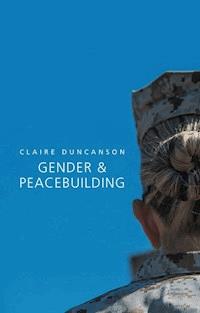
Gender and Peacebuilding offers a comprehensive and up to date analysis of how and why gender matters in contemporary peace operations. It draws on a wide range of examples from across the world to offer a nuanced account of the UN�s attempts to mainstream gender into peace operations via Security Council Resolution 1325, and assesses the successes and failures of this effort to enhance the participation and protection of women and girls in peacebuilding operations. In presenting this mixed picture of progress and ongoing challenges, the book argues for bold steps forward that will enable peacebuilding to contest the current neoliberal order, address structural inequalities, and bring about feminist visions of peace and security. It is only by focusing attention on the economic empowerment of women and its ability to temper the dangers of neo-liberalism in post-conflict contexts that feminists can hope to achieve these aims.
Timely, critical and engaged, this book provides an invaluable guide to the issues for students of peace and conflict studies, and sets the agenda for future scholarship and advocacy.
Sie lesen das E-Book in den Legimi-Apps auf:
Seitenzahl: 337
Veröffentlichungsjahr: 2016
Ähnliche




















Copyright page
Copyright © Claire Duncanson 2016
The right of Claire Duncanson to be identified as Author of this Work has been asserted in accordance with the UK Copyright, Designs and Patents Act 1988.
First published in 2016 by Polity Press
Polity Press
65 Bridge Street
Cambridge CB2 1UR, UK
Polity Press
350 Main Street
Malden, MA 02148, USA
All rights reserved. Except for the quotation of short passages for the purpose of criticism and review, no part of this publication may be reproduced, stored in a retrieval system, or transmitted, in any form or by any means, electronic, mechanical, photocopying, recording or otherwise, without the prior permission of the publisher.
ISBN-13: 978-0-7456-8251-8
ISBN-13: 978-0-7456-8252-5 (pb)
A catalogue record for this book is available from the British Library.
Library of Congress Cataloging-in-Publication Data
Names: Duncanson, Claire, 1974– author.
Title: Gender and peacebuilding / Claire Duncanson.
Description: Cambridge, UK ; Malden, MA : Polity Press, [2016] | Series: Gender and global politics | Includes bibliographical references and index.
Identifiers: LCCN 2015027163 | ISBN 9780745682518 (hardcover : alk. paper) | ISBN 0745682510 (hardcover : alk. paper) | ISBN 9780745682525 (pbk. : alk. paper) | ISBN 0745682529 (pbk. : alk. paper)
Subjects: LCSH: Women and peace. | Women and human security. | Peace-building. | Sex role and globalization. | United Nations. Security Council. Resolution 1325.
Classification: LCC JZ5578 .D86 2016 | DDC 327.1/72082–dc23 LC record available at http://lccn.loc.gov/2015027163
Typeset in 10.5 on 12pt Sabon
by Toppan Best-set Premedia Limited
Printed and bound in the UK by CPI Group (UK) Ltd, Croydon
The publisher has used its best endeavours to ensure that the URLs for external websites referred to in this book are correct and active at the time of going to press. However, the publisher has no responsibility for the websites and can make no guarantee that a site will remain live or that the content is or will remain appropriate.
Every effort has been made to trace all copyright holders, but if any have been inadvertently overlooked the publisher will be pleased to include any necessary credits in any subsequent reprint or edition.
For further information on Polity, visit our website: politybooks.com
Abbreviations
Acknowledgements
My sincere thanks go to Louise Knight, Pascal Pocheron, Nekane Tanaka Galdos and Justin Dyer at Polity Press. From the initial conversations about the idea for the book to the meticulous copy-editing, the team at Polity have been fantastic. I also have to thank the two anonymous reviewers, who provided such helpful feedback.
The University of Edinburgh provided a wonderful institutional setting in which to write this book, providing me with a semester sabbatical in 2014 to get the first draft of the manuscript together, and supportive colleagues with whom to share the pleasures and pains of a project of this kind. It is impossible to single out members of Politics and International Relations here at Edinburgh because so many provided encouragement and support.
I have presented some of the material in this book at various conferences, including the United Nations Association of Edinburgh's International Peace conference in October 2014, and the International Studies Association (ISA) Annual Convention in 2015 in New Orleans. I would like to thank the audiences at these events for their excellent questions, and, in particular, Soumita Basu, for her incisive comments on my ISA presentation. Friends and colleagues from the ISA's Feminist Theory and Gender Studies section continue to be a great source of inspiration and insight, and it has been a real pleasure showcasing their work in this book. Two in particular, Synne Lastaad Dyvik and Lauren Greenwood, deserve a huge thank you for reading the entire draft in its early stages, and providing invaluable feedback.
I am lucky to have friends who are not just wonderful but supremely talented. Some have skills that were directly helpful, and here I have to thank in particular Ailsa Bathgate and Megan Bastick, who each read a chapter and provided incredibly useful feedback. Others contributed in ways which were less obvious, but no less important – sustaining me with great food, good chat and long runs – when the writing of this book threatened to overwhelm. Alan, CJ and Martha put up with the stress and the late nights with great forbearance, and I dedicate this book to them.
Introduction
Decades of feminist scholarship have demonstrated that war is gendered in its causes and consequences. From the language and policies of state leaders to the strategies and tactics of armed groups in conflict zones, a gendered ideology is at work privileging confrontational and combative approaches to conflicts of interest. War is also experienced differently by different people depending on their gender, ethnic, sexual and class identities. At the start of 2014, humanitarian organizations appealed for aid to help 52 million people in conflict zones in urgent need of assistance and protection. By the end of the year, the number had gone up by almost 50 per cent to 76 million (UN 2015). Overwhelmingly, these people are civilians, and the majority are women and girls. Wars wrench civilians from their ‘everyday productive activities, rites and celebrations and pitch them into states of violent turmoil, confused movement, precarious existence and deep grief unrelieved by the normal symbols of mourning’ (Turshen 2015). An increasingly common feature of wars is sexual violence, both that perpetrated by armed groups as a deliberate strategy and as part of a more generalized trend in the context of a conflict-ridden society undergoing socioeconomic stress (True 2012: 126). Sexual violence is more commonly inflicted upon women and girls (Cohen and Nordås 2014: 421). Women are also affected by war in particular ways because of their designated role in nearly all societies as the main carers of the young, the old and the vulnerable – a job made particularly challenging in wartime (Sjoberg 2014: 34–8).
Lesen Sie weiter in der vollständigen Ausgabe!
Lesen Sie weiter in der vollständigen Ausgabe!
Lesen Sie weiter in der vollständigen Ausgabe!
Lesen Sie weiter in der vollständigen Ausgabe!
Lesen Sie weiter in der vollständigen Ausgabe!
Lesen Sie weiter in der vollständigen Ausgabe!
Lesen Sie weiter in der vollständigen Ausgabe!
Lesen Sie weiter in der vollständigen Ausgabe!




