


21,99 €
Mehr erfahren.
- Herausgeber: John Wiley & Sons
- Kategorie: Geisteswissenschaft
- Serie: Gender and History Special Issues
- Sprache: Englisch
Gender, Imperialism and Global Exchanges presents a collection of original readings that address gendered dimensions of empire from a wide range of geographical and temporal settings.
- Draws on original research on gender and empire in relation to labour, commodities, fashion, politics, mobility, and visuality
- Includes coverage of gender issues from countries in Africa, the Americas, Europe, and Asia between the eighteenth to twentieth centuries
- Highlights a range of transnational and transregional connections across the globe
- Features innovative gender analyses of the circulation of people, ideas, and cultural practices
Sie lesen das E-Book in den Legimi-Apps auf:
Seitenzahl: 921
Veröffentlichungsjahr: 2015
Ähnliche




















Gender and History Special Issue Book Series
Gender and History, an international, interdisciplinary journal on the history of femininity, masculinity, and gender relations, publishes annual special issues which are now available in book form. Bringing together path-breaking feminist scholarship with assessments of the field, each volume focuses on a specific subject, question or theme. These books are suitable for undergraduate and postgraduate courses in history, sociology, politics, cultural studies, and gender and women's studies.
Titles in the series include:
Gender, Imperialism and Global ExchangesEdited by Stephan F. Miescher, Michele Mitchell and Naoko Shibusawa
Sex, Gender and the Sacred: Reconfiguring Religion in Gender HistoryEdited by Joanna de Groot and Sue Morgan
Gender History Across Epistemologies Edited by Donna R. Gabaccia and Mary Jo Maynes
Gender and the City before Modernity Edited by Lin Foxhall and Gabriele Neher
Historicising Gender and Sexuality Edited by Kevin P. Murphy and Jennifer M. Spear
Homes and Homecomings: Gendered Histories of Domesticity and ReturnEdited by K. H. Adler and Carrie Hamilton
Gender and Change: Agency, Chronology and PeriodisationEdited by Alexandra Shepard and Garthine Walker
Translating Feminisms in ChinaEdited by Dorothy Ko and Wang Zheng
Visual Genders, Visual Histories: A special Issue of Gender & HistoryEdited by Patricia Hayes
Violence, Vulnerability and Embodiment: Gender and HistoryEdited by Shani D'Cruze and Anupama Rao
Dialogues of Dispersal: Gender, Sexuality and African DiasporasEdited by Sandra Gunning, Tera Hunter and Michele Mitchell
Material Strategies: Dress and Gender in Historial PerspectiveEdited by Barbara Burman and Carole Turbin
Gender, Citizenships and SubjectivitiesEdited by Kathleen Canning and Sonya Rose
Gendering the Middle Ages: A Gender and History Special IssueEdited by Pauline Stafford and Anneke B. Mulder-Bakker
Gender and History: Retrospect and ProspectEdited by Leonore Davidoff, Keith McClelland and Eleni Varikas
Feminisms and InternationalismEdited by Mrinalini Sinha, Donna Guy and Angela Woollacott
Gender and the Body in the Ancient MediterraneanEdited by Maria Wyke
Gendered Colonialisms in African HistoryEdited by Nancy Rose Hunt, Tessie P. Liu and Jean Quataert
Gender, Imperialism and Global Exchanges
EDITED BY
STEPHAN F. MIESCHER MICHELE MITCHELL AND NAOKO SHIBUSAWA
This edition first published 2015 Originally published as Volume 26, Issue 3 of Gender & History© 2015 Blackwell Publishing Ltd
Registered OfficeJohn Wiley & Sons Ltd, The Atrium, Southern Gate, Chichester, West Sussex, PO19 8SQ, United Kingdom
Editorial Offices350 Main Street, Malden, MA 02148-5020, USA 9600 Garsington Road, Oxford, OX4 2DQ, UK The Atrium, Southern Gate, Chichester, West Sussex, PO19 8SQ, UK
For details of our global editorial offices, for customer services, and for information about how to apply for permission to reuse the copyright material in this book please see our website at www.wiley.com/wiley-blackwell.
The rights of Stephan F. Miescher, Michele Mitchell and Naoko Shibusawa to be identified as the authors of the editorial material in this work has been asserted in accordance with the UK Copyright, Designs and Patents Act 1988.
All rights reserved. No part of this publication may be reproduced, stored in a retrieval system, or transmitted, in any form or by any means, electronic, mechanical, photocopying, recording or otherwise, except as permitted by the UK Copyright, Designs and Patents Act 1988, without the prior permission of the publisher.
Wiley also publishes its books in a variety of electronic formats. Some content that appears in print may not be available in electronic books.
Designations used by companies to distinguish their products are often claimed as trademarks. All brand names and product names used in this book are trade names, service marks, trademarks or registered trademarks of their respective owners. The publisher is not associated with any product or vendor mentioned in this book. This publication is designed to provide accurate and authoritative information in regard to the subject matter covered. It is sold on the understanding that the publisher is not engaged in rendering professional services. If professional advice or other expert assistance is required, the services of a competent professional should be sought.
Library of Congress Cataloging-in-Publication data is available for this book.
ISBN 9781119052203 (paperback)
A catalogue record for this book is available from the British Library.
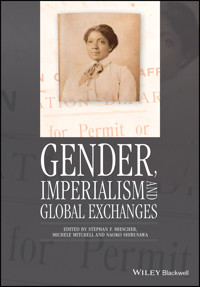
Cover image: Marie Schiffer Lafite, Cape Town, South Africa, 1914. Western Cape Archives and Record Service (KAB) PIO 1 - 147 E
CONTENTS
Notes on Contributors
Introduction: Gender, Imperialism and Global Exchanges
Labour
Commodities
Fashioning politics
Mobility and activism
Conclusion
Notes
Part I Labour
1 The Sexual Politics of Imperial Expansion: Eunuchs and Indirect Colonial Rule in Mid-Nineteenth-Century North India
The
khwajasarais
of early modern Awadh
Family, sexuality and indirect colonial rule
Eunuch labour and the sexual politics of imperial expansion
The making of a Muslim poor: the impacts of colonial modernity on
khwajasarais
Conclusion
Notes
2 Remaking Anglo-Indian Men: Agricultural Labour as Remedy in the British Empire, 1908–38
The problem
First migrations
Early experiences
Persistence of a scheme
Conclusion
Notes
3 ‘Robot Farmers’ and Cosmopolitan Workers: Technological Masculinity and Agricultural Development in the French Soudan (Mali), 1945–68
The beginnings of the Office du Niger
The turn to mechanised agriculture, 1945–68
Neither robots nor ‘
paysannat noir
’
The cosmopolitan workers’ Office du Niger
Technological men
Notes
Part II Commodities
4 Pursuing Her Profits: Women in Jamaica, Atlantic Slavery and a Globalising Market, 1700–60
Jamaica: re-configuring the gendered social hierarchy
Colonial women in a globalising market
Gender, race and slaveholding
Conclusion
Notes
5 Fashioning their Place: Dress and Global Imagination in Imperial Sudan
Historic trade routes and domestic ties
Transformation under imperial rule
Satellite dreams
A living archive
Notes
6 The Transnational Homophile Movement and the Development of Domesticity in Mexico City's Homosexual Community, 1930–70
Notes
Part III Fashioning Politics
7 Dressed for Success: Hegemonic Masculinity, Elite Men and Westernisation in Iran,
c.
1900–40
Notes
8 ‘It Gave Us Our Nationality’: US Education, the Politics of Dress and Transnational Filipino Student Networks, 1901–45
Imperial education and the politics of dress in the colonial Philippines
Gendering nationalism, nationalising gender abroad in the United States
Conclusion
Notes
9 ‘A Life of Make-Believe’: Being Boy Scouts and ‘Playing Indian’ in British Malaya (1910–42)
Setting, actors, sources
‘Making manly (mimic) men’? Colonial proscriptions of Scouting in Malaya
(Other) imperial play ethics: Malayan Scouts at ‘play’
Epilogue
Notes
10 The Tank Driver who Ran with Poodles: US Visions of Israeli Soldiers and the Cold War Liberal Consensus, 1958–79
Responsible masculinity: 1958–67
Enviable masculinity: 1967–73
Spartan masculinity: 1973–79
Conclusion
Notes
Part IV Mobility and Activism
11 Marta Vergara, Popular-Front Pan-American Feminism and the Transnational Struggle for Working Women's Rights in the 1930s
Marta Vergara's feminist evolution
Popular-Front Pan-American feminism at the Buenos Aires Peace Conferences
Notes
12 Guerrilla Ganja Gun Girls: Policing Black Revolutionaries from Notting Hill to Laventille
A national family
‘There can be no black liberation without the liberation of black women’
Ganja and global delinquency
‘Total liberation’
National mourning
Notes
13 Gender and Visuality: Identification Photographs, Respectability and Personhood in Colonial Southern Africa in the 1920s and 1930s
Introduction – visual histories of gender
Photographs as archival insertions
Fragments – South African nation building and its imperial formation
Visual articulations of gender
Framing personhood
Visualising the family as a site of colonial governance
Transgressions of whiteness – wicked women and the question of racial respectability
Conclusion
Notes
Index
EULA
List of Illustrations
Chapter 2
Figure 1
Sydney Williams, 1911. Source:
SACHM
11 (1911), p. 7, courtesy of NLS, Edinburgh.
Figure 2
Roland Spencer and Horace Brookes, 1926. Source:
SACHM
26 (1926), p. 35, courtesy of NLS, Edinburgh.
Chapter 3
Figure 1
Mechanical harvesting at the Office. Source ANOM 8Fi 417/171 Office du Niger Aménagement rurale, 1935 and 1954.
Figure 2
Unidentified engine operator and other men at the Office. Source ANOM 8Fi 417/2.33 Office du Niger Aménagement rurale 1935 and 1954.
Figure 3
Photograph of a Stahl-Lanz Machine and unidentified staff and workers. Source ANOM 8Fi 417/4.5 Office du Niger Aménagement rurale 1935 and 1954.
Chapter 5
Figure 1
‘Woman wearing a long white
tobe
’, Khartoum,
c.
1900–1920. SAD 540/1/80. Reproduced by permission of Durham University Library.
Figure 2
‘Gezira women's social welfare class’, Gezira, 1954. SAD 428/3/257. Reproduced by permission of Durham University Library.
Chapter 8
Figure 1
Filipinas wearing mestiza dress (Bureau of Insular Affairs Records, vol. 1, box 1, RG 350-P, National Archives, College Park, Maryland).
Figure 2
Girls’ Basketball Teams Playing in an Interscholastic Meet in Manila,
c.
1912 (RG 350P, NARA).
Figure 3
Salamanca, Sison, Acosta and Llamas (
Washington Post
, 16 September 1906, p. SM4).
Figure 4
Filipina Students at Columbia University (
Filipino Student Bulletin
, February 1923).
Figure 5
A ‘Filipino Nite’ in Philadelphia (
Filipino Student Bulletin
, December 1926).
Figure 6
‘Watch Your Step!’ (
Filipino Student Bulletin
, January–February 1932).
Chapter 9
Figure 1
The original caption reads: ‘A genuine Purdy Redskin complete with feathers, beads and headdress’. Source: Kevin Y. L. Tan and Wan Meng Hao,
Scouting in Singapore: 1910–2000
(Singapore: Singapore Scout Association & National Archives of Singapore, 2002). Photo courtesy of Tan and Wan (‘5
th
Mojag Collection’ and the ‘Michael Chong Collection’, circa 1941).
Figure 2
The original caption reads: ‘Black Bear [Leslie Woodford] reading out the “Legends of Purdy Camp” at a campfire’. Tan and Wan,
Scouting in Singapore
, p. 87. Photo courtesy of Tan and Wan (‘5
th
Mojag Collection’ and the ‘Michael Chong Collection’, circa 1941).
Figure 3
‘Romance of Campfire’,
Scouting in Malaya
, vol. 17, nos. 1–2, January–February 1941, p. 15. Image courtesy of the Singapore Scout Association.
Figure 4
‘Campfire-Blankets’,
Scouting in Malaya
, vol. 17, nos. 3–4, March–April, 1941, p. 40. Image courtesy of the Singapore Scout Association.
Figure 5
‘Redskin Headdress’,
Scouting in Malaya
, vol. 17, no. 7, July 1941. Note the initials ‘M. C.’ [Michael Chong] at the bottom left. Image courtesy of the Singapore Scout Association.
Figure 6
Table of participants at the 1937 Jamboree at the SITC (Tanjong Malim, Perak). The description preceding this table reads: ‘Every State in the Peninsula where there are Scouts sent their representatives’.
Scouting in Malaya
, vol. 13, no. 1, May 1937, p. 8.
Figure 7
Advertisement in
Scouting in Malaya
, vol. 15, no. 1, January 1939, unnumbered. Image courtesy of Nestlé.
Figure 8
Advertisement in
Scouting in Malaya
, vol. 1, no. 1, May 1925, p. 3. Image courtesy of the Eastman Kodak Company.
Figure 9
Possibly the first published picture of ‘Indian play’ (and one of the rare examples of female participants in ‘Indian play’) in Malaya.
Scouting in Malaya
, vol. 2, no. 5, September 1926, p. 69. Photo courtesy of the Singapore Scout Association.
Figure 10
‘The Legends of Purdy Camp’,
Scouting in Malaya
, vol. 17, nos. 1–2, January–February 1941, p. 1. Image courtesy of the Singapore Scout Association.
Figure 11
Plot summary of two ‘Scout Plays’.
Figure 12
‘Playing Sakai’,
Scouting in Malaya,
vol. 5, no. 5, September 1929. Image courtesy of the Singapore Scout Association.
Figure 13
The (original) description of this video still-image from British Pathé reads: ‘A Pack from the King George V English School in a circle doing a Red Indian dance’. ‘Negri Sembilan [FMS] State Cub Rally, Seramban, Malaya, Malaysia’, 20 March 1953. <http://www.britishpathe.com/video/negri-sembilan-cub-rally>.
Chapter 10
Figure 1
Yossi Israeli
Life Special Report – The Spirit of Israel,
May 1973. Copyright by Harry Benson (1973).
Figure 2
‘Let's grab dis one, Willie. He's packed wit’ vitamins.’ Copyright by Bill Mauldin (
Stars & Stripes Mediterranean
, 1944). Courtesy of Bill Mauldin Estate LLC.
Figure 3
‘What to do till the Peace Corps comes’. Copyright of Bill Mauldin (
St. Louis Post Dispatch
, 1961). Courtesy of Bill Mauldin Estate LLC.
Figure 4
‘It's Definitely a Citizen's Army’. Copyright by Bill Mauldin (
The New Republic
, 1967). Courtesy of Bill Mauldin Estate LLC.
Chapter 11
Figure 1
Members of the Confederación Femenina Argentina greet Marta Vergara and Doris Stevens (far right) with flowers upon their arrival in Buenos Aires in November 1936. Photograph from Doris Stevens Papers, 1884–1983; MC 546, folder PD.77f. Schlesinger Library, Radcliffe Institute, Harvard University, Cambridge, Massachusetts.
Chapter 12
Figure 1
Photograph of Beverley Jones,
Express
, 15 May 1973, p. 1. Digital image courtesy of The Alma Jordan Library, The University of the West Indies-St. Augustine (cropped by author).
Figure 2
Photograph of Randolph Burroughs,
Express
, 15 May 1973, p. 10. Digital image courtesy of The Alma Jordan Library, The University of the West Indies-St. Augustine.
Chapter 13
Figure 1
Portrait of James Dzoye, 1934, photographer unknown.
Figure 2
Portrait of Marie Schiffer Lafite, 1914, photographer unknown.
Figure 3
Genealogical arrangement of the Wing family, 1922.
Figure 4
Portrait of Augusta Dietrich, 1924, photographer unknown.
Figure 5
Portrait of Ella Dietrich, 1924, photographer unknown.
Guide
Cover
Table of Contents
Part
Pages
vii
viii
ix
1
2
3
4
5
6
7
8
9
10
11
12
13
14
15
16
17
18
19
20
21
23
25
26
27
28
29
30
31
32
33
34
35
36
37
38
39
40
41
42
43
44
45
46
47
48
49
50
51
52
53
54
55
56
57
58
59
60
61
62
63
64
65
66
67
68
69
70
71
72
73
74
75
76
77
78
79
80
81
82
83
84
85
86
87
88
89
91
92
93
94
95
96
97
98
99
100
101
102
103
104
105
106
107
108
109
110
111
112
113
114
115
116
117
118
119
120
121
122
123
124
125
126
127
128
129
130
131
132
133
134
135
136
137
138
139
140
141
142
143
144
145
146
147
148
149
150
151
152
153
154
155
156
157
159
161
162
163
164
165
166
167
168
169
170
171
172
173
174
175
176
177
178
179
180
181
182
183
184
185
186
187
188
189
190
191
192
193
194
195
196
197
198
199
200
201
202
203
204
205
206
208
209
210
211
212
213
214
215
216
217
220
221
222
223
224
225
229
230
231
232
233
234
235
236
237
238
239
240
241
242
243
244
245
246
247
248
249
250
251
252
253
254
255
256
257
259
261
262
263
264
265
266
267
268
269
270
271
272
273
274
275
276
277
278
279
280
281
282
283
284
285
286
287
288
289
290
291
292
293
294
295
296
297
298
299
300
301
302
303
304
305
306
307
308
309
310
311
312
313
314
315
316
317
318
319
320
321
322
323
324
325
326
327
329
330
331
332
333
334
335
336
337
338
339
340
341
NOTES ON CONTRIBUTORS
Sivan Balslev is a doctoral candidate at the Alliance Center for Iranian Studies and the Zvi Yavetz School of Historical Studies, Tel-Aviv University. Her dissertation focuses on images, ideals and practices of masculinity in Iran circa 1870–1940. She has published a Hebrew translation of Forough Farrokhzad's books of poems Another Birth and Let Us Believe in the Beginning of the Cold Season.
Marie Grace Brown is Assistant Professor of Middle East History at the University of Kansas. Her current book project explores the ways in which northern Sudanese women used fashion and new bodily behaviours of mobility to articulate an experience of imperialism that was both global and intimate.
Jessica Hinchy is Assistant Professor in History at Nanyang Technological University, Singapore. Her research examines gender, domesticity and colonialism in late-eighteenth- and nineteenth-century north India. Her current project analyses various groups in north India that the British colonisers classified as ‘eunuchs’. In particular, she has examined the everyday lives of hijras – who identified as feminine and had a socio-cultural role as performers at the time of births – in the context of their criminalisation by the colonial state during the nineteenth century. Her additional areas of interest in South Asian history include: slavery; historical concepts of childhood; colonial criminology and law and medical knowledge of gender and sexuality.
W. Chris Johnson is Assistant Professor of History at the University of Memphis. He is currently writing a book about gender, desire and the interwoven itineraries of migrant revolutionaries in the twentieth-century Atlantic World. His research has been supported by grants from the Marcus Garvey Foundation, the Ford Foundation, the Tinker Foundation and the MacMillan Center for International and Area Studies at Yale University.
Víctor M. Macías-González, a specialist on Porfirian Mexico (1876–1911), is Professor of Latin American History and Women's, Gender and Sexuality Studies at the University of Wisconsin, La Crosse, where he directs a minority sophomore retention program. With Anne Rubenstein (York University), he co-edited Masculinity and Sexuality in Modern Mexico (2012).
Katherine M. Marino is Assistant Professor of History and Women's, Gender and Sexuality Studies at Ohio State University. She received her PhD in History from Stanford University and her BA in History and Literature from Harvard College. She specialises in the transnational histories of women, sexuality, gender and social movements in the twentieth-century Americas. Her article on Marta Vergara is drawn from her book manuscript, ‘La Vanguardia Feminista’: Pan-American Feminism and the Rise of International Women's Rights, 1915–1946.
Jane McCabe is a teaching fellow at the University of Otago in Dunedin, New Zealand. She has published several articles from her recently completed doctoral thesis, which examined the lives and labours of 130 Anglo-Indian adolescents resettled in New Zealand between 1908 and 1938. Jane currently teaches courses on Modern India and Migration.
Stephan F. Miescher is Associate Professor of History at the University of California, Santa Barbara. He is the author of Making Men in Ghana (2005) and co-editor of Africa After Gender? (2007) and Modernization as Spectacle in Africa (2014). He is currently completing a book about the history of Volta River Project, Ghana's largest development project.
Michele Mitchell is Associate Professor of History at New York University and former North American editor of Gender & History. Mitchell is the author of Righteous Propagation: African Americans and the Politics of Racial Destiny after Reconstruction (2004), and her current book project is tentatively entitled Idle Anxieties: Youth, Race and Sexuality during the Great Depression.
Shaul Mitelpunkt is a postdoctoral fellow in the Department of History and at the Crown Center at Northwestern University. He is currently working on his first book, preliminarily titled War, Liberals, and Israel: The Cultural-Politics of US-Israeli Relations and the Rediscovery of American Empire, 1958–1985, which explores how changing American views of and policies towards Israel shaped the global mission of the United States in the Vietnam War era.
Lorena Rizzo is a postdoctoral researcher and lecturer in the History Department at the University of Bielefeld, Germany and Academic Associate in the History Department at the University of Basel, Switzerland. She has been a visiting scholar at the Department of Afroamerican and African Studies at the University of Michigan (2010–2011) and at the Centre for Humanities Research at the University of the Western Cape (2011–2013). She is currently working on a book project on photography and policing in South Africa and Namibia. Her publications include Gender & Colonialism: A History of Kaoko in North-western Namibia, 1870s to 1950s (2012); ‘Shades of Empire: Police Photography in German South West Africa’, Visual Anthropology (2013) and ‘Visual Aperture: Bureaucratic Systems of Identification, Photography and Personhood in Colonial Southern Africa’, History of Photography (2013).
Naoko Shibusawa is Associate Professor of History and American Studies at Brown University. Her first book, America's Geisha Ally: Re-Imagining the Japanese Enemy, was published by Harvard University Press in 2006. Her current book project explores the orientalism in Cold War homophobia. She has also written on anthropomorphism in Cold War ideology.
Sarah Steinbock-Pratt is Assistant Professor of History at the University of Alabama. She received her doctorate in History from the University of Texas at Austin. Her work on gender, race and US empire includes ‘“We Were All Robinson Crusoes”: American Women Teachers in the Philippines’, Women's Studies (2013). She is currently writing a book on American teachers and the building of a colonial state in the Philippines.
Laura Ann Twagira is Assistant Professor of History at Wesleyan University. She is a recipient of the Young Scholar Prize from the International Committee for the History of Technology (ICOHTEC) and is currently revising a book manuscript on gender, technology and food production at the Office du Niger in Mali.
Christine Walker is Assistant Professor of History at Texas Tech University. Her research examines how free women of European and African descent attained a new degree of economic, legal and social autonomy in the Atlantic world – largely resulting from their investment in chattel slavery. Her essay, ‘Womanly Masters: Re-thinking Gender and Slave Ownership in Colonial Jamaica’, will appear in Women in Early America: Transnational Histories, Rethinking Master Narratives, edited by Thomas Foster and forthcoming in 2015. She is the recipient of a Fulbright Research Grant and a Mellon/ACLS Dissertation Completion Fellowship from the American Council of Learned Societies.
Jialin Christina Wu is a doctoral candidate in History at the École des Hautes Études en Sciences Sociales (France) and the Université Catholique de Louvain (Belgium). Her dissertation analyses the social, cultural and political impacts of Scouting and Guiding in British Malaya from the colonial to the postcolonial era. She is the recipient of a scholarship (Aspirant) from the Fonds National de la Recherche Scientifique (FNRS, Belgium).
Introduction: Gender, Imperialism and Global Exchanges
Michele Mitchell and Naoko Shibusawa with Stephan F. Miescher
Neatly coiffed and tastefully dressed, Marie Schiffer Lafite gazes slightly to the right of the camera in a Cape Town studio photograph that accompanied her 1914 passport application.1 A long-time resident of South Africa, Schiffer Lafite sought guarantee of re‑entry privileges before leaving on an extended visit to relatives in her native Mauritius, a sugar plantation colony in the Indian Ocean east of Madagascar. Piecemeal evidence from early-twentieth-century immigration files in the Western Cape archives tells us that Schiffer Lafite lived in Port Elizabeth for a dozen years before moving westward to Cape Town in 1902, after her first marriage ended. She later married ‘Lafite’, a French hairdresser, and was working as a shop assistant at the time of her application. The archives do not reveal much more. They do not tell us when or how she emigrated, or whether she came alone, with a family or with others.
Schiffer Lafite's Mauritian origins, however, suggest that she left the plantation economy for a wider range of social opportunities in urban areas with more diversified economies. The ebb and flow of migration that deposited Schiffer Lafite on the South African coast was part of the massive global movement of fortune-seekers and labourers, free and unfree, dating back centuries. Mauritius itself was purportedly an uninhabited island prior to the advent of European colonisation in the late sixteenth century. The Dutch, then later the French and still later the British, established and operated sugar plantations with imported labour from Africa, India and elsewhere in Asia. Schiffer Lafite's ancestry reflected this movement and co-mingling of people; she was labelled ‘creole/coloured’ by the South African state. Lorena Rizzo's article in this collection underscores that such categorisations mattered to South Africa by the early twentieth century when its state officials came to see classifications as vital to accounting for and controlling the mobility of its African, Asian and European subject populations.
More so than excavating Schiffer Lafite's biography per se, Rizzo analyses such archival photographs for what they can tell us about strategies of governmentality in a modernising South African state.2 The state archives reveal how an administrative bureaucracy came to oversee and govern a range of life's activities – including monitoring crossings over borders old and new. Yet the archives also reveal how the applicants’ own self-representations (knowingly or unknowingly) resisted tidy, essentialising categorisations and placement. Even further, individuals like Schiffer Lafite used the very categories employed by the South African state to justify their subject positions. Rizzo stresses how Schiffer Lafite's file represents ‘tensions of empire’ – to borrow from Ann Stoler and Frederick Cooper – because it shows how she used colonial ideals about gendered respectability to contest categorical exclusions based on her race and citizenship.3 The visual element of the file allows us to see that the assistant shopkeeper carefully fashioned her self-image by wearing a fairly simple, yet chic, shirtwaist and by styling her hair in a manner popular among working women in Europe and the Americas during the 1910s. Schiffer Lafite's investment in a studio portrait may or may not have been especially for the application, but nonetheless underscored that she was a modern, respectable subject. Her strategy appeared to work: a Cape Town immigration officer approved her request for re-entry.
We draw upon an image and archival instance from Rizzo's article to open this special issue on gender, imperialism and global exchanges because her focus on the modernising state and border-crossings is at once compelling and illustrative. To be more specific, Rizzo's analysis of Marie Schiffer Lafite speaks in a particularly productive way to our overarching concern with how gender and sexuality have shaped embodied interactions in colonised settings. This volume contains analyses of gendered exchanges that occurred between colonial and metropolitan locations during periods of both instability and stability. Our contributors consider moments when upheaval challenged colonial regimes or even resulted in decolonisation; they explore how former colonies transitioned into becoming ‘nations’; they examine transnational dynamics between modern states. Gender, Imperialism and Global Exchanges brings together scholarship that considers the gendered dimensions of sexual, bodily, social, material, political, cultural and intellectual dynamics of empire from a wide range of geographic, as well as temporal, settings.4
Articles by Sarah Steinbock-Pratt, Sivan Balslev, Jialin Christina Wu and Shaul Mitelpunkt take up the importance of gendered performance in exhibiting national strength or liberation. Similarly, both W. Chris Johnson and Katherine M. Marino compellingly demonstrate how perceptions and performances of womanhood – not to mention feminism and femininity – could also be mobilised in political struggles connected to decolonisation, anti-imperialism and transnational solidarity. Víctor M. Macías-González, Jane McCabe and Laura Ann Twagira are among the authors here who examine ways in which individuals responded to a globalising world that either expanded or circumscribed their access to power, wealth and status. But while Marie Grace Brown's article on Sudan in this issue refers to the centuries-old networks of trade that connected northeast Africa to South Asia, and articles by Christine Walker and Jessica Hinchy examine the eighteenth and nineteenth centuries, respectively, the focus on the global has oriented the volume as a whole towards the twentieth century.
Our call for gendered histories of imperialism and global exchanges ended up, it seems, being decidedly more legible to scholars whose work grappled with a world created by capitalist modernity and hegemonic forms of western colonialism than to scholars working on earlier eras of imperialism. One possible reason for this issue's chronological tilt towards the early modern and modern, particularly the twentieth century, was our decision to think in terms of global exchanges, which arguably gestures to capitalist modernity.5 Whereas earlier empires ruled by the Han, Romans, Guptas, Mongols, Aztecs, Incas, Songhai and others were non-capitalist, modern colonialism cannot be separated from the emergence of capitalism in Western Europe. Indeed, capitalism implanted modern colonialism in enduring ways that transformed the societies of the colonised and the coloniser. As Ania Loomba has explained, ‘Modern colonialism did more than extract tribute, goods and wealth from the countries that it conquered – it restructured the economies of the latter, drawing them into a complex relationship with their own, so that there was a flow of human and natural resources between colonised and colonial countries’.6 African, Asian and indigenous labour toiled on sugar plantations in the Indian Ocean, the Pacific, the Atlantic and the Caribbean producing for the colonisers both ‘sweetness and power’, as Sidney Mintz puts it. The sugar economies channelled profits to Europe, particularly as Spain, Portugal, Britain, the Netherlands and France made extensive forays into the Americas. In addition, sugar economies also underwrote entire industries necessary for the functioning of trade and for the trafficking of free and unfree labourers, not to mention the production of items used in diverse transactions: ships, barrels, ropes, iron shackles, weapons, promissory notes, ledgers, pens and inks. Similar economies stemmed from colonial production, cultivation and extraction of commodities and raw sources such as: cotton, tropical fruits, coffee, tobacco, grains, indigo, tea, opium, spices, rubber, silver, diamonds and precious minerals. The sale of these goods proved increasingly profitable for many planters, merchants, intermediaries and seafarers who were now operating across the globe in increasingly interlinked networks.7 European colonialism thus spurred industry and allowed the primary accumulation of capital for further expansion.8 Indeed, European colonialism and capitalist modernity has indelibly shaped the world with which we must contend today.
Yet as Samir Amin stresses, ‘Capitalism was not destined to be Europe's exclusive invention’.9 Given Chinese advances in state organisation, technology and manufacturing, capitalism could have been a Chinese innovation centuries before it appeared in Europe, as Amin, Kenneth Pomeranz and Andre Gunder Frank have pointed out.10 But such alternatives were precluded once capitalism began in Europe and spread throughout the world by conquest and forceful acquiescence of other societies to reshape their economies to serve European and (later US and Japanese) profit-making goals. Capitalism has always been a worldwide system in aspiration if not in reality. Predicated on a logic of ever-expanding profits, capitalism thus continues to be a system that forever and even voraciously seeks new places and novel ways to ‘monetise’ (to use a more current term) anything and everything. According to Amin, moreover:
Historical capitalism, as it has really existed, has always been imperialist in the precise sense that the mechanisms inherent in its worldwide spread, far from progressively ‘homogenizing’ economic conditions on a planetary scale, have, on the contrary, reproduced and deepened the contrast, counterposing the dominant (imperialist) centres to the dominated peripheries.11
In other words, capitalism has created an entrenched asymmetry – a worldwide modernity of unequal exchanges – in which labour is compensated or not according to one's status and location on the globe.12 The very scale and scope, as well as the intrusiveness, of modern colonialism in directing and defining life distinguished it from earlier colonialisms.
Colonialisms that emerged during the seventeenth and eighteenth centuries were also distinct from earlier empires because of the ways in which human worth increasingly became determined by labour-value. This concept of human worth was distinct from notions about ‘wealth in persons’: if such a concept can refer to a person's or community's acquisition of ‘outsiders’ whose labour can result in wealth accumulation, ‘wealth in persons’ quite importantly refers to the practice of incorporating ostensible ‘outsiders’ to replenish populations diminished by war, disease or plunder.13 From the nineteenth century onward, however, capitalism has particularly relied upon forms of alienated labour that have even transformed workers themselves into commodities who have little – if any – control or creative input into the very goods they produce. Legally enslaved workers experienced a particularly profound alienation from their labour: the enslaved were quite literally commodified and could be ‘sold’ on the market in ways quite distinct from ‘wage slavery’.14 Crucial to the process of accumulating capital therefore was determining who would be denied full or even partial compensation for their labour power.
To be sure, like gender, concepts about ‘race’ have been decisive in determining how, whether and to what extent labourers receive compensation. Biologically based notions about human difference and variation became entrenched during the seventeenth and eighteenth centuries due to imperial expansion, colonialism and Enlightenment thought. Indeed, as Kirsten Fischer argues, not only did ‘assumptions about sexual difference also chang[e] dramatically in the eighteenth century’, but ‘assumptions of gender, race, and class difference propped each other up in the developing social hierarchy’ as well.15 ‘Race’ became a particularly significant marker of difference and unequal treatment among humans around the world who lived and toiled in modern colonial contexts with economies built upon unfree labour. Although slavery had existed earlier in various contexts, and whereas both Africans and indigenous populations in the Americas engaged in captive forms of labour both before and after their encounters with Europeans, the advent of European colonialism created a more permanent, heritable system of chattel, racialised slavery.16 Race, then, served to differentiate between humans whose worth was constructed as beyond price or ‘priceless’ and humans who became exchangeable and valuated commodities.17 Thus an individual's labour-value and human worth became pegged to varied yet overlapping racial hierarchies that have persisted long after the end of legal slavery and formal colonisation. Walter Mignolo reminds us that the ‘modern/colonial world was founded and sustained through a geopolitical [and economic] organization of the world that, in the last analysis, consisted of an ethnoracial foundation’.18
Gender – or perceptions of sexualised and embodied difference – could and did shape notions about power, human worth, economic interactions and diverse forms of work during the pre-modern period and in non-capitalist contexts.19 Feminist Marxists such as Silvia Federici insist that we must consider gender as another means of assessing how much a person was alienated from her labour.20 That acknowledged, a critical shift occurred with the advent and expansion of industrial capitalism. As Joanna de Groot underscores, the ‘growth of new forms of production…and of new forces of market relations and international interconnections’ during the nineteenth century resulted in ‘increasingly explicit and elaborated arguments for the crucial importance of gender and ethnic differences’.21 In various locations and contexts during the nineteenth century and since, capitalism and imperialism have had a profound impact – often simultaneously – on gendered forms of productive as well as reproductive labour. And, in terms of a sexual division of labour between women and men, Heidi Tinsman stresses that wage labour can be seen as ‘inherently problematic for women’ due to the long-established association of women with unpaid labour in domestic spaces.22 Gender has, then, powerfully determined labour-value and human worth since the beginnings of capitalist modernity.23 The contributors to this volume productively demonstrate how gendered, sexualised and racialised notions of human worth went beyond labour-value. They therefore contribute to vital scholarship that considers how people who were considered fully human were accorded a host of political and legal rights, a superior social standing and better access to economic, educational and cultural opportunities.
A common thread throughout the following articles is the matter of who deserved to be treated and recognised as fully human in an era of imperial exchanges and ongoing capitalist globalisation.24 Work on the subject of imperialism and global exchanges can, of course, focus squarely on the trade of manufactured products and raw resources. Given the centrality of gender, embodiment and sexuality to this volume, the articles herein more closely examine human actions, representations and aspirations. A number of contributors interrogate how, whether and why actors in particular historical contexts either adopted or subverted normative behaviours that dominant populations associated with human integrity. Moreover, the authors consider how concepts about personhood have been shaped by gendered assumptions regarding the very ability to make rational economic decisions, participate in affairs of state, question authority, attain education, travel without supervision or restriction or decide how – and whether – to work for others. Jessica Hinchy, Jane McCabe and Laura Ann Twagira explore work and workers in an extensive manner; Hinchy, Christine Walker and Lorena Rizzo discuss colonial contexts in which enslaved or racialised labour was anything but incidental.
This special issue is also designed to problematise the notion of ‘exchange’ through critical examination of labour flows and the extraction of resources. ‘Exchange’ does not refer solely to the extractive or exploitative. A number of authors, including Marie Grace Brown, Sivan Balslev, Sarah Steinbock-Pratt and Víctor Macías-González, note the pleasures and benefits that women and men derived from diverse commodities. Through gender analysis, contributors assess complex and occasionally conflicted forms of interchange – between women and men, women and women, men and men – that involved some degree of mutuality. And, authors such as Jialin Christina Wu, Lorena Rizzo, Katherine Marino, W. Chris Johnson and Shaul Mitelpunkt additionally consider how gender and sexuality shaped forms of interaction and mobility as well as collective resistance, projections of power and militarism. As a whole, this volume contributes to existing literature that reveals how thorough gender analysis of political economies provides a notably productive means of considering both global and globalising practices.
The special issue also contributes to the theoretical and historiographical effort to widen the conventional focus on how the centres dominated the peripheries. For the most part, our authors are less concerned even with how centres and peripheries mutually influenced and constituted each other.25 Instead, they largely focus on actions primarily located outside the metropoles. From wide-ranging locations, diversely situated with respect to evolving global markets, they examine the movements and exchanges of bodies, ideas and commodities. They analyse the ways in which people took advantage of, made sense of, tried to work with or fought against the conditions wrought by a world forged and indelibly shaped by western imperialism and capitalism. After all, as Cooper and Stoler have pointed out, ‘What Europeans encountered in the colonies was not open terrain for economic dominion, but people capable of circumventing and undermining the principles and practices on which extraction or capitalist development was based’.26
We have organised the articles into four major themes or rubrics: labour, commodities, fashioning politics and mobility and activism. This structure is not only intended to illuminate critical connections between the articles within each section. Given that a number of authors address more than one major theme in their respective articles, we have also juxtaposed the organising rubrics themselves in a manner that we hope creates especially revealing and meaningful dialogue across different sections of the special issue. There is, then, considerable overlap between historical dynamics and phenomena – including labour flows, consumption, sartorial practices, cultural transmissions, colonialism, nationalism, border crossings, transnationalism, activism and state interactions – that are addressed by the authors who appear in different sections. When we began this collaborative project, our approach to gender, imperialism and global exchanges was deeply informed by a shared sense that it is imperative to highlight sexualised and gendered treatments of working bodies. The special issue therefore begins with three articles that focus on the gendered politics of labour.
Labour
It could be said that we are following the example of Adam Smith in The Wealth of Nations, the ur-text of capitalist modernity, by foregrounding our work with a section on labour.27 Our ambition for this special issue is much more modest, of course, and we differ from Smith in our ultimate aim – especially given our commitment to rigorous analysis of gender and sexuality. Our focus is not so much investigating the wealth of nations, but exploring how gender and sexuality have shaped the ways in which people have functioned within a world of increasing unequal exchanges and asymmetries since the advent of European imperialism. Who, where and – as Hinchy shows – when one was situated on earth forcefully dictated one's life conditions and chances. Some humans were commodities; others were denied full recompense for the value that their labour yielded for their employers. Indeed, as Marx famously explained, under-compensating or not compensating labour enabled capitalists to accumulate profit or capital.28 The essays grouped in this section examine the expansion or contraction of access to status, power and material comfort of three very different types of workers: nineteenth-century eunuchs in North India with administrative and military roles; biracial Anglo-Indian young men in New Zealand in first decades of the twentieth century and farmers in French Soudan (Mali) during the Cold War. In addition to focusing on labour, the three articles speak to how gendered notions were central to the conceptualisation of workers.29
Increasing global and labour asymmetries notwithstanding, labourers, even slaves, sometimes held positions of power. Jessica Hinchy examines the eunuch slaves known as khwajasarais, who held high-status jobs in the state of Awadh in North India during the eighteenth and nineteenth centuries. The khwajasarais served as entertainers and musicians, as well as military commanders, negotiators, envoys and transmitters of intelligence. Yet they lost their high-status roles after the British East India Company established a system of indirect rule over Awadh in the nineteenth century. Having eunuchs in politics and administration severely challenged British understandings of proper gender order. British officials thus believed that khwajasarais were merely household slaves who had inappropriately come to dominate the public sphere and kept their rulers secluded in the feminine harem. Initial British attempts to regulate khwajasarais’ labour and curtail their political influence failed due to the resistance by both the Awadh ruler and the khwajasarais themselves. But the British won the final battle, using perceived maladministration and the khwajasarais’ continued political power as the reason for annexing Awadh in 1856. Once slave-nobles, the khwajasarais were ousted from their positions and reduced to poverty. In addition to providing a compelling window into colonial refashioning of slavery, gender and governance in British India, Hinchy shows the centrality of gender and sexuality for an understanding of imperial expansion.30
Jane McCabe tells the unlikely, but slightly happier story of adolescent, biracial Anglo-Indian men, who were sent away from their homes in Kalimpong, northeast India, to live in rural parts of New Zealand between 1908 and 1938. Seen as the problematic products of one type of imperial interaction, these biracial men were forced to participate in another exchange in the imperial system – fulfilling a need for farm labour in the settler colonies. In so doing, they could demonstrate that they were more robust than the stereotypical ‘effeminate’ Indian man, and they could find better economic opportunities and social integration than were available to them in India. This plan to kill two birds with one stone, however, did not go smoothly. The Anglo-Indian men, educated and with more refined notions of masculinity, experienced a cultural clash with the rougher, frontiersmen type of white settler masculinity in rural New Zealand. Still racially marginalised, the Anglo-Indian men found it difficult to become landowning farmers themselves. Finding work instead as wage-labourers or small businessmen, the men did achieve social integration. McCabe's study thus reveals the vision of making Anglo-Indian men into hardy, imperial citizens was limited by the ideologies of race, gender and social hierarchies dominant in New Zealand.31
Laura Ann Twagira also studies grand colonial plans to shape men into suitable workers. She distinguishes between smallholder farmers and cosmopolitan workers who were both part of the Office du Niger, the irrigation project launched by the French in the Soudan of the 1930s and continued by the Malian postcolonial government. African forced labour built the Office, which was a distinctly male space. French colonial technocrats sought to turn these men, who frequently felt like slaves, into modern farmers. The post-war era brought the abolition of forced labour and a turn to mechanisation that created the African wage-worker. The Office mechanisation was assisted by international development funds that gained prominence within the Cold War context. Twagira, drawing on oral history research, unpacks how African wage-workers, as technological agents, shaped their own engagements with modern agricultural technology, while also interacting with the international politics of development. The two forms of male work at the Office related to what it meant to be a male farmer, as well as what it meant to be a man working with technology in Mande culture. The men who operated industrial machines claimed esoteric technological knowledge that resembled the secret knowledge of the Mande blacksmith. Twagira examines the gendered African technological culture at the Office that bridged the colonial and postcolonial divide. Significantly, her discussion of heavy machinery speaks to labour and to the use of commodities by workers who perform various tasks; such gendered analysis by Twagira therefore relates to analyses of commodities.32
Commodities
The very embodiment of human labour, commodities would not exist were it not for people who manufacture, harvest, mine, extract or otherwise create them into existence as exchangeable things. As items or services that can be exchanged for something else, commodities have – by definition – a market exchange-value. Commodities also usually have a use-value as a thing or service used by someone to satisfy hunger, seek status, alleviate boredom and so on.33 Earlier studies of consumer culture focused on the exploitative nature of the market economy to labour and to women especially. As feminist scholars pointed out, advertisers and capitalist culture manipulated consumers and consigned women to a secondary role of being, in the words of Victoria de Grazia, ‘Mrs Consumer’, a disempowered mate to ‘Mr Breadwinner’.34 Women were also unfairly pinned as a source of concerns in the new market economy. Alarm about unruly, voracious female shoppers or commodified female sex workers revealed discomfort about newer social relations that capitalism wrought at different times depending on location.35 But some, more recent, studies of consumer culture – while not denying the exploitative aspects – have focused on the use-value of commodities and the agency of consumers. These studies have been interrogating the ‘politics of pleasure’ that consumerism reveals, going beyond assessments of consumer culture as being either ‘good’ or ‘bad’.36 Yet histories of consumer culture in the English language have remained overwhelmingly oriented towards Europe and the United States.37 James P. Woodward declares that we still need more studies that analyse consumer culture from the perspective of the Global South and more works that examine transnational consumer culture as an agent of historical change.38 Happily, Brown's article in this section does the former, while Macías-González does the latter. The article by Walker, on the other hand, adds an important correction to presumptions about the gendered dimension to capitalist accumulation through human commodities (i.e. slaves) before the rise of separate spheres. Overall, the three articles grouped in this section emphasise agency and fulfilment rather than victimisation in the market economy.
Christine Walker shows us that the expanding global market allowed women, as well as men, to seek profits through the trade of a variety of commodities, including humans. Focusing on eighteenth-century women who ran transatlantic import-export businesses with bases in Jamaica, the largest and wealthiest British slaveholding colony, she challenges us to rethink conventional notions as to who maintained the Atlantic slave trade. Overseeing what would be multi-million dollar businesses today, some savvy female entrepreneurs knew how to snatch huge profits during the period's imperial wars. They speculated; they borrowed and lent money; they hired privateers. Even female entrepreneurs who did not operate on such a grand scale were hardly just consumers; although some of the wealthier ones inherited their fortunes from their husbands and parents, all female entrepreneurs were both breadwinners and consumers. The extant records do not allow definitive racial identification, but most of these women were likely white, with English ancestry from both parents. Some, however, were free women of colour who had once been slaves themselves. Walker thus shows how European legal and customary regimes enforcing patriarchy or even racism were more an ideal than reality. Colonial capitalism afforded opportunities for women also to profit from chattel slavery despite English laws on coverture.39
Marie Grace Brown looks at female consumer agency on a very different scale than Walker's slave-holders. Brown examines tobes – long rectangular cloths (similar to South Asian saris) – that were the traditional outerwear of Sudanese women. For centuries, tobes or toubs came from near and far, reaching Sudan from African-Asian trade routes in earlier periods and also from the North Atlantic-Mediterranean corridor since British colonisation. Long presented as gifts from their fathers or sons to mark special occasions, tobes were often prized garments – finely textured damask or brightly patterned splashes of colour – in which Sudanese women enveloped themselves. After Sudanese independence in 1956, tobes gained added significance to women. On one hand, Sudanese women proudly wore these traditional garments as an expression of a new nationalist pride, and on the other, as they wrapped tobes intimately around their bodies, they felt a tangible connection to a larger, cosmopolitan world. Tobes were not only imported from afar, but also evocatively marketed with references to contemporary, global events. Brown thus shows how a traditional garment, sold with the latest styles and names, hooked Sudanese women into a larger network of markets and capitalist desire.40
Also investigating larger networks of markets and capitalist desire, Víctor Macías-González looks at how privileged Mexican men created homophile havens within Mexico City during the mid-twentieth century, a relatively new phenomenon that became possible with capitalist modernity. As John D'Emilio has explained, prior to wage labour, there existed little to no social space for gay identities or substantive affiliations beyond the family.41 But as a visible gay community grew in Mexico, same-sex relations and afeminado behaviour were attacked and seen as problematic, especially in the aftermath of the 1910 Revolution. In contrast to the United States, however, there was no lavender scare in Mexico; gay men were usually not persecuted if they assumed ‘proper’ bourgeois identities. Thus Mexican gay men – if they could afford to do so – sought privacy that became increasingly available in the housing stock of the fast-growing metropolis. Macías-González emphasises the transnational nature of these elite men: they brought back to Mexico fashions and cultures they acquired while living and travelling abroad, and they circulated foreign, homophile texts and imagery. Their ‘bachelor pads’ became ‘an icon of modernity’ and they vied against each other in ‘their homes’ expressions of originality, taste and elegance’.42
We grouped these three authors together because they show how people made sense of and took advantage of the larger globalising world and their place in it. Like Brown, other authors in this issue discuss clothing, but their studies differ in that they show how clothing and fashion were used with a more explicit political purpose.
Fashioning politics
Dressing one's body is an intimate way one interfaces or mediates the self with society. As Karen Tranberg Hansen and D. Soyini Madison have pointed out, examining practices of dress allows us to analyse social, political and cultural contexts – about ‘identity, status and rank, protest, power, and much more’.43 Dress is a public activity, one that is influenced by others – both in terms of emulation and avoidance – and people have lived ‘in a world where one is forced to make a visual presentation of one's self and to witness the self-presentation of others’.44 Moreover, with the advent of global market relations, the possibilities for dress widened considerably. Consumers were no longer bound to sumptuary laws or customs that restricted dress according to status or occupation, but in contrast, were encouraged to purchase more and more items to fashion themselves. Because fashion choices also signified affiliations and revealed aspirations, conflicts among citizens based on race, class and gender could often be seen in dress.45 Indeed, at the turn of the twentieth century, Thorstein Veblen and Georg Simmel observed how fashion functioned to differentiate between classes and served to exacerbate social tensions.46 Yet Joshua I. Miller as well as W. H. Sewell have countered that fashion also signified solidarity and allegiance – an explicit avowal of group membership. The articles in this section focus on nationalist group belonging and identification rather than division. While the article by Steinbock-Pratt focuses on femininity, the articles by Balslev, Wu and Mitelpunkt examine masculinity. Fashion, Miller has argued, communicates social and political matters, and thus the way one dresses can be considered a part of democratic culture.47 This particular aspect of analysing the gendered politics of representation is what brings the four articles grouped together under this rubric, ‘fashioning politics’.
Sivan Balslev examines how elite Iranian men during the first forty years of the twentieth century innovated a new model of masculinity based on their engagement with Europe. Educated in Europe or in western-style institutions in Iran – rather than in religious institutes of higher learning – these elite men embraced a set of ideas about gender, politics, dress and sexuality that contrasted the traditional with the modern.48 Focusing on dress and self-presentation, Balslev explains that Iranian men stopped using henna, dying their beards black or shaving their heads. They began taking off their hats indoors, but keeping on their shoes. And, doffing tribal dress and headgear, they began wearing western-style suits, which they believed exuded ‘respectability, rationality, seriousness and discipline’, and would help unify the new Iranian nation. The elite men, however, were not willing to accept thorough social transformation. When non-elite men began to emulate such practices, they were disdained as fokoli or manqués who were excessively westernised. Balslev thus demonstrates how fashion and cultural practices served as a social arena in which struggles over political authority were fought.49
Similarly, Sarah Steinbock-Pratt examines nationalist aspirations expressed through dress. She analyses how dress and comportment appeared to be a ‘safe’ way for colonised people like the Filipinos to express their aspirations of equality and/or independence. Often told that they were representatives of their nation, male and female Filipino students considered how their dress and bodies – both within the Philippines and the United States – would reflect on Philippine progress and civilisation (or modernity). Those studying in the United States took care to dress well in order to distance themselves from prevalent American stereotypes about dirty ‘Orientals’. That is, the relatively privileged Filipino students strove to distance themselves from Asian labourers, even though many of the students themselves had to work as cooks, dishwashers and domestics in order to support their studies. On special occasions, such as Rizal Day celebrations and independence rallies, the female students donned distinctive mestiza-style dresses to emphasise their Filipino identity. The politics of dress were charged for Filipino students, and especially for female students. How the women dressed came to personify questions regarding their proper role in society and the nascent feminist movement in their nation, as well as Philippine independence.50
Rather than challenging colonialism outright, the Malayan youth in Jialin Christina Wu's article tried to fashion themselves after the British by joining the Scouting Movement. Wu examines how the Malayans used scouting to enact an idealised version of Anglicised masculinity, how the British introduced scouting to colonial Malaya and what purpose it served the colonial rulers.51 Scouting was founded by British lieutenant general Robert Baden-Powell and intended to provide mental, physical and spiritual training, as well as imbue youth with a dose of what Baden-Powell's contemporary, Theodore Roosevelt, called the ‘barbarian virtues’.52 To counteract the perceived enervating effects of modern, industrialised society, scouting encouraged outdoor ‘survival’ skills – the sort supposedly still retained by ‘primitive’ cultures. Scouting also emphasised British martial skills and mental fortitude at a time when the British empire was beginning to wane and capitalist modernity was dealt a devastating blow by the global Great Depression. Hence, the British had multiple reasons to promote a mishmash of ‘indigenous’ Native American and African references in scouting. The mishmash notwithstanding, the Malayan scouts took the games and activities quite seriously. Appropriating other indigenous cultures enabled these boys, mostly from elite backgrounds, to play at being white, and at being frontiersmen. Colonised, but not displaced, the Malayan boys ironically played at being settler colonists.
Shaul Mitelpunkt's article on images of settler colonists takes a different approach to the politics of self-fashioning. He argues that changing US depictions of Israeli soldiers reflected not only political realities in Israel, but also the cultural and political realities of the United States. The militarism of the Israeli settler colonial state succeeded in fulfilling the desire of Zionist founders to remove old, European notions of the effeminate Jew and ‘endow the image of the Hebrew with masculine beauty’.53 Yet especially in the aftermath of their victory in the 1967 war, depictions of this masculine beauty included a softer side. Israeli soldiers were seen as being able to enjoy the gentler aspects of civil society without diminishing their martial prowess. This depiction of a youthful patriot was attractive to US mainstream outlets because it stood in such contrast to American uproar about the Vietnam War. This image, however, was not unchanging. With Israeli defeat in the 1973 war and the growing criticism of the Occupation of Palestinian Territories, the glowing assessment of Israeli soldiers faded somewhat in US public discourse. Mitelpunkt's essay, then, shows the limits of self-fashioning by considering how its reception depends on the will or perhaps the entirely separate concerns of the receiving power.
Mobility and activism
As much as there are limits to self-fashioning, individuals within various historical contexts have engaged in border crossings, migrations and collective mobilisation in order to refashion themselves, their political circumstances and their material conditions. Perceptions of people as gendered and sexualised beings have profoundly shaped – in changing yet overlapping ways – mobility across space within and across historical contexts. Feminist interactions and organising have been a notably significant form of collective mobilisation both locally and globally. Whereas some feminist politics have emerged out of colonising or racialised dynamics and while not all feminists have been anti-imperialists, there are nonetheless vital ways in which feminism has provided women and men with powerful means to resist various forms of oppression and exploitation. Moreover, close analysis of feminist politics that accounts for colonialism, imperialist impulses and asymmetrical developments between different




