


17,99 €
Mehr erfahren.
- Herausgeber: John Wiley & Sons
- Kategorie: Geisteswissenschaft
- Sprache: Englisch
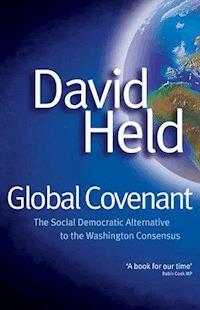
In this pathbreaking book, one of the world’s leading analysts of globalization and global governance confronts the failures of international politics in the aftermath of 9/11 and the war against Iraq. He argues that there were and are alternatives to the way the western coalitions responded to the profound challenges of mass terrorism and political violence - alternatives which can better address the roots of these challenges and deliver political and social justice.
In order to grasp this alternative, the changing structure of the global order has to be understood. To this end, the book is divided into three sections: economics, politics and law. In each section contemporary trends are analyzed, problems confronted, and a series of detailed policies set out. The aim of the book is to focus on feasible and effective policy choices which could lead to a progressive transformation of global affairs. Against the ideologues who are wholly in favour or hostile to globalization, this book shows how globalization can be better regulated to deliver human development, equitable economic change, democracy and justice.
This is an original book that will appeal to all those - students, policy makers, and the general reader - who confront questions about globalization and global governance. It is an optimistic text that holds that progressive political change is still within our grasp.
To read the transcript of an interview with the author on the Global Covenant in democratiya, please click here .
Sie lesen das E-Book in den Legimi-Apps auf:
Seitenzahl: 323
Veröffentlichungsjahr: 2013
Ähnliche


















Global Covenant
The Social Democratic Alternativeto the Washington Consensus
DAVID HELD
polity
Copyright © David Held 2004
The right of David Held to be identified as Author of this Work has been asserted in accordance with the UK Copyright, Designs and Patents Act 1988.
First published in 2004 by Polity Press Ltd.
Reprinted in 2007, 2008
Polity Press
65 Bridge Street
Cambridge CB2 1UR, UK
Polity Press
350 Main Street
Malden, MA 02148, USA
All rights reserved. Except for the quotation of short passages for the purposes of criticism and review, no part of this publication may be reproduced, stored in a retrieval system, or transmitted, in any form or by any means, electronic, mechanical, photocopying, recording or otherwise, without the prior permission of the publisher.
ISBN: 978-0-7456-3352-7
ISBN: 978-0-7456-3353-4 (pb)
A catalogue record for this book is available from the British Library and has been applied for from the Library of Congress.
The publisher has used its best endeavours to ensure that the URLs for external websites referred to in this book are correct and active at the time of going to press. However, the publisher has no responsibility for the websites and can make no guarantee that a site will remain live or that the content is or will remain appropriate.
Typeset in 11 on 13pt Sabon
by Graphicraft Limited, Hong Kong
Printed and bound in the United States by Odyssey Press Inc., Gonic, NH
For further information on Polity, visit our website: www.polity.co.uk
Contents
Figures, Boxes and Tables
Preface
Acknowledgements
Abbreviations
Introduction
The contest over globalization
Countering myths about globalization
Deep drivers and challenges
Globalization and social democracy
PART I ECONOMICS
1 Economic Globalization
Production, trade and finance
2 Globalization, Stratification and Inequality
The stratification of economic activity
Political strategies and the pattern of winners and losers
3 The Regulation of Economic Globalization: A New Policy Mix
Trade
Aid
New revenue streams
Financial governance arrangements
MNCs
PART II POLITICS
4 Political Globalization
The new context of politics
Multicentric governance
The reconfiguration of political power
5 Globalization and the Challenges to Governance
6 The Reform of Global Governance
Strengthening global governance
Social democratic multilateralism
Multilevel citizenship
PART III LAW
7 Sovereignty and the Changing Structure of International Law
Rules of warfare and weaponry
War crimes and the role of the individual
Human rights, democracy and minority groups
Environmental law
8 Liberal International Sovereignty: Achievements and Limitations
9 The Development of Global Rules
Recasting security and law enforcement
Reframing the market
PART IV THE NEW AGENDA
10 Towards a Global Covenant: Global Social Democracy
High stakes
Appendix: The Basis of a New Internationalism: Cosmopolitan Principles
References
Index
Figures, Boxes and Tables
FIGURES
1 The ‘champagne glass’ pattern of inequality between the world’s rich and poor
2 Imports and exports of goods as percentage share of world
3 Comparing incomes between the developing regions and high income OECD, 1960–1998
4 China’s and India’s real annual GDP per capita growth rate, and average weighted tariffs 1980–1998
5 Membership of selected countries in formal multilateral organizations, 1995 and 2001
6 Numbers of non-governmental organizations having members in low income, middle income and high income countries, and by region, 1991 and 2001
7 Number and geographic spread of the secretariats of international and internationally oriented non-governmental organizations
8 The organizational infrastructure of global governance: a UN-centric view
9 Global Issues Networks (GINs)
BOXES
1 A select list of human rights initiatives and agreements
2 Rights recognized by the International Bill of Human Rights
3 Status of ratification of the two principal international human rights treaties
4 The responsibility to protect: six principles for military intervention
5 Towards a new global covenant: global social democracy
TABLES
1 Twenty global issues
2 Tax levels and composition for various OECD countries, 1970, 1980 and 1997–1998
3 World distribution of income and life expectancy: inequality and poverty indices for selected years
4 UN Millennium Development Goals, 1999–2015
5 Core UN principles for the Global Compact
6 Major intergovernmental bodies
Preface
Immanuel Kant wrote over two hundred years ago that we are ‘unavoidably side by side’. A violent challenge to law and justice in one place has consequences for many other places and can be experienced everywhere. While he dwelt on these matters and their implications at length, he could not have known how profound and immediate his concerns would become.
Since Kant, our mutual interconnectedness and vulnerability have grown rapidly. We no longer live, if we ever did, in a world of discrete national communities. Instead, we live in a world of what I like to call ‘overlapping communities of fate’ where the trajectories of countries are deeply enmeshed with each other. In our world, it is not only the violent exception that links people together across borders; the very nature of everyday problems and processes joins people in multiple ways. From the movement of ideas and cultural artefacts to the fundamental issues raised by genetic engineering, from the conditions of financial stability to environmental degradation, the fate and fortunes of each of us are thoroughly intertwined.
The story of our increasingly global order – ‘globalization’ – is not a singular one. Globalization is not a one-dimensional phenomenon. For example, there has been an expansion of global markets which has altered the political terrain, increasing exit options for capital of all kinds, and putting new questions about the regulation of national economies on the agendas of polities everywhere. Yet the story of globalization is not just economic: it is also one of growing aspirations for international law and justice. From the United Nations system to the European Union, from changes to the laws of war to the entrenchment of human rights, from the emergence of international environmental regimes to the foundation of the International Criminal Court, there is also another narrative being told – a narrative which seeks to reframe human activity and entrench it in law, rights and responsibilities.
Many of these developments were framed against the background of formidable threats to humankind – above all, Nazism, fascism and the Holocaust. Those involved in them affirmed the importance of universal principles, human rights and the rule of law in the face of strong temptations to simply put up the shutters and defend the position of only some countries and nations. They rejected the view of national and moral particularists that belonging to a given community limits and determines the moral worth of individuals and the nature of their freedom, and they defended the irreducible moral status of each and every person. At the centre of such thinking is the internationalist or, better, cosmopolitan view that human well-being is not defined by geographical or cultural locations, that national or ethnic or gendered boundaries should not determine the limits of rights to or responsibilities for the satisfaction of basic human needs, and that all human beings require equal moral respect and concern. The principles of equal respect, equal concern and the priority of the vital needs of all human beings are not principles for some remote utopia; they are at the centre of significant post-Second World War legal and political developments.
If 9/11 was not a defining moment in human history, it certainly was for today’s generations. The terrorist attack on the World Trade Center and the Pentagon was an atrocity of extraordinary proportions. It was a crime against the United States and against humanity; a massive breach of many of the core codes of international law; and an attack on the fundamental principles of the sanctity of life, the importance of self-determination, and of human rights and equal liberty. After 9/11, the US and its allies could have decided that the most important things to do were to strengthen international law in the face of global terrorist threats, and to enhance the role of multilateral institutions. They could have decided it was important that no single group or power should act as judge, jury and executioner. They could have decided that global hotspots like the Middle East which feed global terrorism should be the core priority. They could have decided that the disjuncture between economic globalization and social justice needed more urgent attention, and they could have decided to be tough on terrorism and tough on the conditions which lead people to imagine that Al-Qaeda and similar groups are agents of justice in the modern world. But they have systematically failed to decide any of these things. In general, the world after 9/11 has become more polarized and international law weaker.
Enter the war against Iraq. Saddam Hussein was a tyrant who committed massive crimes against the Iraqi and Kurdish peoples, and countries close by. But Iraq was contained. It was no longer perceived as a threat by its immediate neighbours. The evidence of a link between Iraq and global terrorist networks was weak at best, and bordering on an absence highly embarrassing to both George W. Bush and Tony Blair. Prior to the war, the UN inspectors were doing their job. Disarmament was occurring. More time could have been granted – more time to save lives on all sides, to strengthen the international consensus, to nurture international law and to protect multilateral institutions.
The rush to war against Iraq in 2003 gave priority to a narrow security agenda which is at the heart of the new American security doctrine of unilateral and pre-emptive war. This agenda contradicts most of the core tenets of international politics and international agreements since 1945. It throws aside respect for open political negotiations among states (liberal multilateralism), as it does the core doctrine of deterrence and stable relations among major powers (the balance of power). We have to come to terms now not only with the reality that a single country enjoys military supremacy to an unprecedented extent in world history, but also with the fact that it can use that supremacy to respond unilaterally to perceived threats (which may be neither actual nor imminent), and that it will brook no rival. The Clausewitzean dictum that in matters of war and peace ‘the mistakes which come from kindness are among the very worst’ is actively affirmed by this doctrine.
As an agenda focused on a narrow conception of security, the new American security project displaces a much more urgent focus on a broad conception of human security, based on establishing the essential conditions for human well-being and development. The US-led coalition, in pursuing first and foremost a military response to 9/11 and a war against Iraq, chose not to prioritize the development of international rules and UN institutional arrangements; and not to emphasize the urgency of building bridges between its geoeconomic and geopolitical interests and the priorities of political and social justice, which could have helped centre attention on the full gamut of threats to humankind – physical, biological, social and environmental. Moreover, the US-led coalition chose not to address the crisis of legitimacy of international institutions. Increasingly, these institutions appear either to speak for the powerful, or to be cast aside by these very same forces if they fail to fall into line with their will. And their reputation is damaged daily by the contradiction between the huge concentration of resources and personnel seeking to restore and reshape world order after the 3,000 lives were lost on 9/11, and the failure to mobilize a sustained effort to address life’s daily carnage – the death of 30,000 children under five who die of preventable diseases. Shocking though this figure is, it would be even more appalling if we built into it the loss of life from threats such as global warming, killing people through heat waves, floods and storms (Houghton, 2003).
The strategy of war against Iraq, in the context of the Bush administration’s doctrine of pre-emptive war, compounds anxieties about a world order moving rapidly towards a breakdown of law, respect for political autonomy and human rights. We see what this situation looks like all too clearly in the daily life of the Middle East. The intense pattern of extrajudicial outlaw killings (organized, targeted murders) on both sides of the Israeli– Palestinian conflict returns those lands to Hobbes’s state of nature: the ‘warre of every one against every one’ – life as ‘solitary, poore, nasty, brutish and short’. Peace in areas like the Middle East has been singled out occasionally as a priority by some Western leaders, but there is little sign as yet that this is part of a broader rethinking of foreign and security policy in the Middle East, and of the role of the West in international affairs more generally. These are political choices and, like all choices, they carry a heavy burden of possibility and lost opportunity.
Some American commentators, notably Robert Kagan, have reflected on the US as a necessary Hobbesian sovereign, providing security and protection to a world in need of conflict management and conflict resolution (2003). Concomitantly, he interprets the EU as a Kantian haven of peace and economic exchange, albeit parasitic upon the Hobbesian protector. In fact, current US strategy is best perceived as pre-Hobbesian because it betokens a return to the state of nature. Hobbes conceived of sovereign power as justified in so far as it delivers security, safety and a ‘commodious’ life to its people. The US strategy does none of these things, endangering its citizens (especially abroad), further dividing and polarizing international affairs, and weakening the international institutions of peace and justice.
For those who, like myself, are not pacifists and recognize the obvious dangers posed by the new terrorist networks and rogue states, and who reject the position of the current American administration and the British government, it is urgent to confront the issues which inevitably arise in this context. The following questions need addressing: What are the connections between the economic, political and security realms in our increasingly global age? How should we mould public institutions to regulate and manage these connections? And under what conditions should legitimate coercive power be wielded, to what ends, and by whom?
In the destructive climate of the current global order, there seem to be only a few plausible answers to these questions. If one objects to the answers inspired by George W. Bush, then one has to look elsewhere. As things stand, the EU has no coherent position on these matters, and no credible defence and strategic capacity to offer at this time. And while the UN may sometimes proffer a sound vision, it certainly lacks institutional mechanisms to resolve public crises effectively.
So what compelling options are there? Or, to put the matter in terms I will use later, is there an alternative to the Washington consensus, understood here as both a specific, US designed neoliberal economic project and, more broadly, a political project which underwrites the current US administration’s unilateralist ambitions.
This book seeks to answer this question by setting out an agenda for addressing some of the most pressing global problems. It does so by examining how our global order is changing; how globalization is and is not reshaping our lives; how global governance can help – and hinder – political and economic development; and how a certain set of values – social democratic values – remains indispensable to a sound and feasible agenda for global change. While the volume does not shrink from addressing the question ‘What options are there?’, it seeks to do so within an understanding of the changing economic and political context of world order. Wisdom suggests that there was an alternative way to respond to 9/11 and the threat of Saddam Hussein, and it is not yet too late to learn. The alternative lies in a comprehensive yet practical programme of political, social and economic reform – a new global covenant for our global age. Such a covenant would be the basis of a rule-based and justice oriented, democratic multilateral order.
In order to grasp this alternative, the changing structure of the global order has to be understood. To this end, the book is divided into three parts: economics, politics and law. In each part contemporary trends are analysed, problems confronted, and a series of detailed policies set out. The aim of the book is to focus on feasible and effective policy choices which could lead to a progressive transformation of global affairs. Against the ideologues who are wholly in favour of or hostile to globalization, this book shows how global processes can be better regulated to help deliver human development, equitable economic change, democracy and justice.
DH
Acknowledgements
This book developed out of a paper I was asked to present to the Progressive Governance conference, London, 11–13 July 2003. I would like to thank everyone at Policy Network for the initial invitation and for the support they provided in the preparation for the conference.
Many people provided invaluable criticism of earlier drafts of the conference paper. I would like to thank, in particular, Anthony Giddens, Andrew Gamble, Mary Kaldor, Mathias Koenig-Archibugi, Matt Browne, Jonathan Perraton, Jean François Rischard, Zaki Laïdi, Phillipe Legrain, David Mepham and Stephany Griffith-Jones. Phillipe Legrain and David Mepham have been particularly helpful on trade and aid reform; Stephany Griffith-Jones provided much useful guidance on the reform of international finance institutions; and Andrew Gamble, Jonathan Perraton and Mathias Koenig-Archibugi offered valuable advice about the shape of the entire work. Ed Victor helped formulate the title, and I would like to express my appreciation to him as well.
Acknowledgements of my many intellectual debts would not be complete without special mention of Anthony McGrew. He and I have worked together on studies of globalization, global governance and global politics for over a decade. Our books such as Global Transformations, Governing Globalization and Globalization/Anti-Globalization form a core part of my intellectual makeup, and little I write about today stands wholly independently of this output. Our weekly, if not daily, exchanges on diverse topics have provided an invaluable stepping stone for this book.
In addition, I would like to thank everyone at Polity – particularly John Thompson, Gill Motley, Pam Thomas and Ann Bone – for their extraordinarily professional help at all stages of production and marketing. They continue to be a home away from home!
Finally, chapters 7–9 are based on research I am doing on politics and international law with the help of a Major Research Fellowship from the Leverhulme Trust. I would like to thank the trust for their generous support, which has made this part of the book possible.
Some sections of this book have been adapted from previously published essays. The details are as follows:
‘Law of states, law of peoples’, Legal Theory, 8 (2002). Parts of this essay were adapted to form chapter 7.
‘Cosmopolitanism: globalization tamed?’, Review of International Studies, 29 (2003). An adapted version of sections of this essay forms part of chapter 5.
‘Global social democracy’, in A. Giddens (ed.), The Progressive Manifesto (Cambridge: Polity, 2003). Sections of this essay form part of the Introduction and chapters 3 and 6.
‘Democratic accountability and political effectiveness from a cosmopolitan perspective’, Government and Opposition (forthcoming 2004). A developed version of this article forms a section of chapter 6.
The author and publishers are also grateful to the following for permission to reproduce copyright material:
American Economic Review and François Bourguignon for table 3, from François Bourguignon and Christian Morrisson, ‘Inequality among world citizens: 1820–1992’, American Economic Review 92:4 (Sept. 2002);
The Economist Newspaper Ltd for box 1, drawn from ‘A survey of human rights’, The Economist, 5 December 1998;
Elsevier UK for figure 4, from B. Milanovic, ‘Two faces of globalization: against globalization as we know it’, World Development 31:4 (2003), pp. 667–83;
The European Commission for table 2, from Making Sense of Globalization (London: Centre for Economic Policy Research, 2002);
Foreign Policy for figure 5, from Foreign Policy Online, www.foreignpolicy.com, permission via Copyright Clearance Center;
Mathias Koenig-Archibugi for figure 8, from Mathias Koenig-Archibugi, ‘Mapping global governance’, in D. Held and A. G. McGrew (eds), Governing Globalization: Power, Authority and Global Governance (Cambridge: Polity, 2002);
Oxford University Press, Inc., for figure 3, from United Nations Development Programme, Human Development Report 2001 (New York: Oxford University Press, 2001);
Perseus Books Group for table 1 and figure 9, both drawn from High Noon: Twenty Global Problems, Twenty Years to Solve Them by Jean-François Rischard (New York: Basic Books, 2002), and for box 2, from Jack Donnelly, International Human Rights, 2nd edn (Boulder: Westview Press, 1998), permissions via Copyright Clearance Center;
Union of International Associations for the use of data from Yearbook of International Organizations 2001/2002 in figures 6 and 7;
United Nations Information Centre, London, for figure 2, based on data in UNCTAD, Handbook of Statistics 2002 (Geneva: UN Conference on Trade and Development, 2002), and information in tables 4 and 5;
Professor Robert Hunter Wade for figure 1, from ‘Inequality of world incomes: what should be done?’, published by www.opendemocracy.net and also reproduced in Robert Hunter Wade, ‘The disturbing rise in poverty and inequality’, in D. Held and M. Koenig-Archibugi (eds), Taming Globalization (Cambridge: Polity, 2003).
Every effort has been made to trace copyright holders, but if any have been inadvertently overlooked, the publishers will be pleased to make the necessary arrangements at the first opportunity.
Abbreviations
AIDSAcquired Immune Deficiency SyndromeAPECAsia-Pacific Economic CooperationARFASEAN Regional ForumASEANAssociation of South East Asian NationsBISBank for International SettlementsBITbilateral investment agreementCAPCommon Agricultural PolicyCBDConvention on Biological DiversityCEPRCentre for Economic Policy ResearchLesen Sie weiter in der vollständigen Ausgabe!
Lesen Sie weiter in der vollständigen Ausgabe!
Lesen Sie weiter in der vollständigen Ausgabe!
Lesen Sie weiter in der vollständigen Ausgabe!
Lesen Sie weiter in der vollständigen Ausgabe!
Lesen Sie weiter in der vollständigen Ausgabe!
Lesen Sie weiter in der vollständigen Ausgabe!
Lesen Sie weiter in der vollständigen Ausgabe!
Lesen Sie weiter in der vollständigen Ausgabe!
Lesen Sie weiter in der vollständigen Ausgabe!
Lesen Sie weiter in der vollständigen Ausgabe!
Lesen Sie weiter in der vollständigen Ausgabe!
Lesen Sie weiter in der vollständigen Ausgabe!
Lesen Sie weiter in der vollständigen Ausgabe!
Lesen Sie weiter in der vollständigen Ausgabe!
Lesen Sie weiter in der vollständigen Ausgabe!
Lesen Sie weiter in der vollständigen Ausgabe!
Lesen Sie weiter in der vollständigen Ausgabe!
Lesen Sie weiter in der vollständigen Ausgabe!




