


6,99 €
Mehr erfahren.
- Herausgeber: Atlantic Books
- Kategorie: Geisteswissenschaft
- Sprache: Englisch
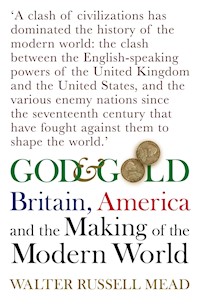
Economist Books of the Year, 2007 Financial Times Books of the Year, 2007 God and Goldis a brilliantly stimulating and provocative look at why, for over 300 years, the Anglo-Saxon powers have dominated the world economically and militarily. For four hundred years, Britain, America and their allies have dominated the world both militarily and economically. They have won the wars - the hot wars, the cold wars and the trade wars - time and again; and yet the battle for hearts and minds has proved far harder to win. In God and Gold, Walter Russell Mead examines why this has been the case and what the overwhelming ascendancy and concentration of power in the hands of 'les Anglo-Saxons' has meant for the direction of world history. In so doing, he sheds scintillating new light on the current political, economic and cultural climate, and suggests where we might be heading from here.
Das E-Book können Sie in Legimi-Apps oder einer beliebigen App lesen, die das folgende Format unterstützen:
Veröffentlichungsjahr: 2014
Ähnliche




















God and Gold
WALTER RUSSELL MEAD is a senior fellow for foreign policy at the US Council on Foreign Relations. He writes regularly for Foreign Affairs and is a contributing editor on the Los Angeles Times.
‘Mead is a scintillating writer.’ Niall Ferguson, Financial Times
‘Walter Russell Mead, among our greatest writers and experts on global affairs, brilliantly tackles one of the biggest historical questions of our age: what accounts for the ascendancy of the British and American systems during the past three centuries? He ties together religion, individualism, capitalism, and liberal democracy in a brilliant manner, and then proceeds with caution to assess what the future holds. His sweeping and compelling book will join the handful that puts in context the political and cultural trends of our era.’ Walter Isaacson
‘Clever, malevolent and with spare time on his hands, Osama bin Laden is supposed to read a lot. If the CIA wants to demoralize and to distract him, it might make sure he gets a copy of Walter Russell Mead’s new book.’ Economist
To the memory of Scott Thorne O’Brien,And to Becca, Tim, and Michael
God moves in a mysterious wayHis wonders to perform;He plants his footsteps in the seaAnd rides upon the storm.
—WILLIAM COWPER, 1779
Contents
Preface to the UK edition
Introduction
Part One The Walrus and the Carpenter
One: With God on Our Side
Two: On the Beach
Three: How They Hate Us
Part Two The Dread and Envy of Them All
Four: The Protocols of the Elders of Greenwich
Five: French Toast
Six: The World Was Their Oyster
Seven: The Sinews of Power
Eight: The Playing Fields of Eton
Nine: Goldilocks and the West
Part Three Anglo-Saxon Attitudes
Ten: The Wasps and the Bees
Eleven: The Vicar and the Dynamo
Twelve: Doxy v. Doxy
Thirteen: The White Queen
Fourteen: Called to the Bar
Fifteen: The Gyroscope and the Pyramid
Part Four What Hath God Wrought?
Sixteen: The Meaning of History
Seventeen: War on History
Eighteen: The Golden Meme
Nineteen: Whig Babylon
Part Five The Lessons of History
Twenty: The Future of Sea Power
Twenty-one: Dancing with Ghosts
Twenty-two: The Diplomacy of Civilizations
Twenty-three: The Meaning of It All
Acknowledgments
Notes
Index
Preface to the UK Edition
There are three leading points of view about the “special relationship” between the United States and Great Britain. They are all wrong.
The first view holds that maintaining the special relationship with the United States requires Britain to support the United States no matter what—and the special relationship is Britain’s best chance to influence world events and exercise more influence than a country with 1% of the world’s population and about 3% of its GDP might reasonably hope to do. From this perspective, Britain should cling as tightly as possible to America’s skirts.
A second holds that the special relationship is a bewitching illusion causing feckless British politicians to delude themselves into thinking that robotic conformity with American policy is somehow in Britain’s best interest. In reality, this second view holds, the Americans will not pay a fair price for Britain’s support and, far from enhancing Britain’s clout, the perception that London is Uncle Sam’s lap dog actually reduces Britain’s international prestige. Those who take this second view usually propose a closer relationship with Europe as Britain’s best alternative.
The third, more American view reflects a comment the former American Secretary of State Dean Acheson made about Britain in 1962. Britain, said Acheson, has lost an empire, but not yet found a role. Like many American observers, Acheson saw the UK trapped between two unsatisfactory options. Staying close to the United States brought Britain little respect or consideration from the Americans, but British efforts to place itself at the heart of EU affairs foundered on the close and exclusive relationship between Germany and France. The American aircraft carrier did not care much whether the British man o’ war came wallowing in its mighty wake; the European bicycle did not need a third wheel. From this perspective, it hardly matters what Britain does; it is fated to oscillate unhappily between an uncaring America and an unwelcoming Europe.
All these views have something to recommend them. Britain probably does enjoy more attention globally because of its close relationship with the United States. It was, however, not easy for Tony Blair to describe exactly what concessions he extracted from George W. Bush in exchange for Britain’s unflinching support for the invasion of Iraq. And looking at the twists and turns of British foreign policy for the last fifty years, it is difficult to avoid the conclusion that neither Europe nor the United States is as thrilled by the prospect of British support as British prime ministers might wish.
Where these three views go wrong is in the common, underlying assumptions they make about the special relationship between the two countries and about the sources of British power in the contemporary world.
To begin with, the special relationship is not a voluntary choice like a friendship between two people with similar tastes; it resembles more the relationship between cousins who work in a family firm. We can be as annoyed with each other as we like, and even temporarily estranged, but the family tie is still there. We may have different views about how the family company should be managed, and we are both capable of trying to extract the maximum advantage in a quiet but sometimes sharp competition with each other, but the prosperity and security of both cousins remains tied to the health of the firm. We may both have interests and relationships outside the family and firm, and we may each belong to clubs from which the other is excluded, but the commonalities in our backgrounds, our interests, and our priorities have a way of making themselves felt—and the family resemblance is so strong that even our most casual acquaintances can see that we are related.
The special relationship is less a result of policy choices made by either the British or the Americans than it is the cause of the similar choices the two countries so frequently make. America and Britain do not always see things the same way, and even when they agree on what needs to be done they often disagree quite bitterly over how to do it. Yet over time, and taking the world as a whole, the chief “Anglo-Saxon powers”, as their rivals often describe them, tend to reach similar if not identical conclusions about what needs to be done.
Over the 230 years since American independence, the special relationship has persisted through bilateral crises, withering hostility, and a mutual antagonism that at various times made war between the two English-speaking countries look more probable than not. Often, the rhetoric about the special relationship has been most lyrical when the underlying competition has been sharpest. Franklin Roosevelt was the most Anglophobic American president of the twentieth century, and despite the resistance of British negotiators he managed, as John Maynard Keynes put it, to “pick out the eyes of the British Empire” during World War II. Yet seldom has the rhetoric of Anglo-American solidarity been more loudly proclaimed and enthusiastically hailed than in the public remarks of both Churchill and Roosevelt during the war.
Tony Blair was not the first Anglo-American leader to discover that the special relationship can be a millstone around the neck rather than an anchor in stormy seas. American presidents such as James Monroe and William McKinley were embarrassed rather than pleased by the way that American initiatives like the Monroe Doctrine and the Open Door in China reflected and supplemented British policy at the time. One American president, Grover Cleveland, lost his 1888 bid for re-election after the publication of an artless letter written by a British diplomat praising Cleveland’s pro-British stance. The British prime minister at the time was the Marquess of Salisbury; his strong stance against Irish Home Rule made Irish-Americans even more Anglophobic than usual and Irish opposition cost Cleveland the election.
In those days, it was American presidents who worried about being poodles of Britain. In any case, the special relationship survived the Marquess of Salisbury; it will also survive George W. Bush.
The special relationship is based largely on the family firm, and as it happens the family business is spectacularly successful and influential. For roughly three centuries now the English-speaking peoples have been more or less continuously organizing, managing, expanding, and defending a global system of power, finance, culture, and trade. The British branch of the family held the majority of shares and furnished the firm’s leadership up through World War II; since then, the American branch has taken the lead, but the firm, though periodically updating and revising its methods and objectives, still bears the imprint of the British leaders who built it. For better or worse, the family business is the dominant force in international life today, and looks set to remain the foundation of world order for some time to come.
The family business is not merely the basis of the special relationship between the cousins; it is also the source of Britain’s enduring and even growing power and influence in the world. Britain does not just have a special relationship with the United States; it has a special relationship with the international capitalist order, an order largely built by Britain and now largely managed by the United States. The world system today as managed by the United States preserves most of the chief features of the British system that existed before World War II: a liberal, maritime international order that promotes the free flow of capital and goods and the development of liberal economic and political institutions and values. However much the British may object to particular American policies and priorities, the overall direction in which the Americans seek to lead the world is the direction in which most if not all Britons more or less hope it will go. Both British and American leaders can and do make mistakes about how best to develop and defend this world system, but the health of that system has been the chief concern of British foreign policy since the eighteenth century, and this is unlikely to change.
The close similarity between the British and American world orders does not just influence both Britain and the United States toward international policies that are usually broadly compatible; it also gives Britain a unique and special role in the world order. This is most clearly seen in the close and beneficial relations that exist between London and New York, the twin financial centers of the world. The financial genius of Great Britain has been one of the great driving forces that created the world we live in; Americans share that genius and, like the British, seek to make the world a safer and more profitable place in which increasingly sophisticated financial markets can operate on a progressively greater and more global scale.
When Acheson made his nasty crack about Britain’s fallen empire and missing role, it was at a time when Great Britain had, temporarily, lost sight of the sources of its own prosperity and power. The crash of the international system during the Great Depression and World War II, combined with the forced liquidation of Britain’s overseas investments during and after the War, left the world less hospitable to British enterprise—and left British investors and financiers without the means to take much advantage of the opportunities that remained. Together with the unhappy results of Britain’s flirtation with socialism and the profound depression and disorientation which many Britons felt as the Empire melted away, it seemed that these conditions doomed Britain to inexorable decline.
Today, led by a revived financial and service economy that is both connected to and dependent upon the integrated global economy, Britain is back. The City of London, at least, is once again “the dread and envy of them all.” Twenty years ago smug French and German voices read Britain stern lectures; today they seek to match its success. Britain’s voice counts for more today in Europe than at any time in the last half-century; across Africa and the Middle East, Britain for better or worse, is seen once again as a significant and even rising power. Even narcissistic America pays far more attention to British views than it once did.
The book in your hands is a book about the family and the family firm. It does not claim to present the complete family history, and it comes, of course, from an American author who has an American’s perspective on and understanding of British history. This may be a problem.
In 1963 my father received a temporary appointment as the rector of Esher on an exchange program, but before he could take up his duties he was required to be licensed under the Colonial Clergy Act. While there is not, so far as I know, a Colonial Writers Act, it still seems to me that a book by an American author that touches on British history might benefit from a few words of explanation and introduction for a British audience.
Americans are used to British writers commenting on American topics and describing our common history from a British point of view. In the nineteenth century British writers such as Fanny Trollope and Charles Dickens ignited critical firestorms with their unflattering portraits of American life; almost thirty years later, when Anthony Trollope visited the United States he found Americans still writhing under the lash of his mother’s observations. British historians such as Thomas Carlyle and Lord Macaulay were widely read and admired in the United States, and their work shaped the views that educated Americans held about our common past.
Britons were not shy about advising Americans on what to do with their growing power. Rudyard Kipling’s “The White Man’s Burden” was written to encourage Americans to join Britain in the thankless but noble task of ruling and uplifting the various “lesser breeds without the law” with which Providence had unaccountably stocked so much of the world. Winston Churchill’s History of the English-Speaking Peoples sold far more copies in the United States than in Britain and remained influential for many decades. More recently, historians and writers such as Paul Kennedy, Niall Ferguson, and Andrew Roberts have found large American audiences for work that analyzes American power and American prospects from viewpoints based in British history.
This has, on the whole, been a good thing. To read a foreigner’s reflections on one’s own national history can be an unsettling experience. In such a work, many if not all of the characters and situations are recognizable, but the angles and perspectives seem a little distorted. In some places the author explains too much, belaboring the obvious; in others he seems to assume vast amounts of knowledge that only specialists would have. At times the writer seems to exercise a delicate and unnecessary political caution; at others he or she disregards the most obvious and sensible conventions and taboos. Sometimes bafflingly opaque, sometimes irritatingly banal, foreigners seldom get things exactly right; but the unusual angle from which they view our familiar terrain often gives foreigners the ability to see things that natives miss.
British readers will have to deal with all that in this book; they will also have to work with the strangely anachronistic view that Americans bring to British history. Normally, remote ages seem most distant, and history becomes more familiar, more relevant, and more comprehensible as one approaches the story of one’s own time. The opposite is true for most Americans when it comes to British history.
As most Americans learn their history, the seventeenth century and the Glorious Revolution are more important than any subsequent events in the British Isles. In the seventeenth century the peoples of England, Scotland, Ireland and Wales established and settled the American colonies, and the beliefs, controversies, and habits of that age are more intimately and immediately present in American historical experience than are those of subsequent eras.
Eighteenth-century Britain is more foreign to Americans and less understood; the two societies were drifting apart, and found themselves estranged by century’s end. For Americans, British history in the eighteenth century consisted of a long and dismal wrong turn. Walpole, Pelham, Pitt, North, Pitt again: with a partial exception for the elder Pitt, warmly if faintly remembered for driving French power out of North America in the Seven Years War, the American colonists gazed appalled on the spectacle, as they saw it, of a corrupt court and Parliament making a mockery of the principles of the Glorious Revolution.
In American history, Oliver Cromwell is a more important figure than Sir Robert Walpole and the Pitts. The New England colonies were founded and largely settled by Puritans who shared most of Cromwell’s theological and political ideas. Four American states (Massachusetts, Virginia, Pennsylvania and Kentucky) are, officially, commonwealths. Even as the original Calvinist fervor of the New England Yankees faded away, Cromwell, or at least Thomas Carlyle’s vision of him, continued to loom large in nineteenth-century America. Both North and South saw the American Civil War as an echo of the seventeenth-century British civil wars, with the South cast as the Cavaliers and the North as the Roundheads. The Roundheads won, and despite some well-merited revisionism by Irish-Americans, America’s intellectual climate and culture continue to be far more heavily influenced by the religious and political legacy of Cromwell’s Commonwealth than by the ideas and the values of Hanoverian Britain.
The Britain of Adam Smith, George III, Lord North and Samuel Johnson is farther from America’s historical experience than the England of Oliver Cromwell, John Milton and John Locke; the Britain of Sir Robert Peel and John Bright is even more distant. The names of Disraeli and Gladstone resonate only faintly in the New World; very few Americans could say anything at all about what these two men did. The Duke of Wellington may, dimly, be remembered as a military figure, but the subsequent political history in which he played such an important role is as obscure to most Americans as the Wars of the Roses.
From a British point of view, this approach to modern history seems almost willfully perverse. For Americans, however, it is a natural consequence of American independence. Once we were part of the British Empire; then we were not, and since 1776 the Americans and the British have gone in different directions. It mattered a great deal to us whether Oliver Cromwell or Charles I ruled England; we did not much care whether Gladstone or Disraeli won a particular general election.
I believe that Americans would benefit from closer attention to British history on the grounds that we need to understand the whole history of the family firm to manage it properly. Furthermore, I believe that both Britons and Americans tend to underestimate the importance of the traits we share, not only for our own histories but for the history of the world. But I also think that an American’s-eye view of Britain may be useful for the British themselves, suggesting new and fruitful perspectives on Britain’s engagement with the world.
Finally, I would not want this book to appear before a British audience without acknowledging the vision and kindness of Dr. Ilsley Ingram and his wife Pat. It was the Ingrams who persuaded their friends and neighbors in Esher to invite my father to bring his family and spend a year in Surrey as their rector; it is thanks to them that some of the most intense and memorable experiences of my childhood took place in the UK. It is no exaggeration to say that the seeds of this book were planted in that year, and I could not be more grateful to those who made it possible.
New York, July 2007
Introduction
In colonial Virginia a wealthy and well-connected planter’s son once asked his Anglican rector if it was possible to find salvation outside the Church of England.
The rector struggled with his conscience; he could hardly claim that only Anglicans get to Heaven—but he didn’t want to encourage this well-born young parishioner to associate with the dissenting riffraff and wandering evangelists of the region.
After a few minutes of thought he was able to give the young man an answer. “Sir,” said the divine, “the possibility about which you enquire exists. But no gentleman would avail himself of it.”
Many Americans feel a little bit like that rector when confronted by discussions of American power. We know it’s there and we know it’s important—but the subject makes us uncomfortable. No gentleman—or, for that matter, no lady—would bring it up.
This is a book about the meaning of American power for world history, and I apologize. Most Americans probably do think that their country has a unique world mission and that our success in domestic and foreign policy has enormous implications for the rest of the world—but it still seems unpardonably triumphalist to talk seriously about what this idea might mean.
Americans tend to think both too much and too little about their country’s rise to world power. They concentrate on what might be called the statistics of power, following indices that show the American lead in military power, economic production, or various high-tech and scientific enterprises. They congratulate themselves on the global spread of democratic ideals, collecting statistics and rating countries based on their adoption of various elements of democratic culture. They cheer the indicators—like the number of American-trained Nobel Prize–winning scientists—that show the United States pulling ahead, and worry about statistics like the rising net national debt or the declining achievement of eighth-grade students on math tests that show American prospects in a less favorable light. Americans admire the prowess of their military forces and celebrate the popularity of their culture worldwide.
But while Americans spend a lot of time thinking about the dimensions of American power in the contemporary world, less thought is given to the meaning of that power. The United States has achieved an unprecedented leadership in an international community that faces unprecedented challenges. As the heir to centuries of Anglo-Saxon politics the United States supports, however inconsistently, a political and social philosophy based on free choice and private property, tolerance among religions founded in Protestant Christian values, and the idea that individuals—including women—have inalienable and equal rights which states must observe and protect. The United States is both a conservative power, defending the international status quo against those who would change it through violence, and a revolutionary power seeking to replace age-old power structures with market economics and democratic ideals. The political revolution that the United States supports involves radical change in countries as important as China, but even the political revolution pales before the economic revolution that the United States wishes to spread through the world. The United States seeks to make the world an ever more dynamic place—a place where an accelerating pace of technological change leads the world ever faster through the power of ever more flexible and dynamic private markets into ever accelerating “progress” toward an end we do not see.
This is an extraordinary ambition for the most powerful country in the history of the world—yet neither Americans nor anybody else has a very clear idea about the kind of revolution that American society seeks to bring about or about the consequences of this great revolutionary effort for the future of mankind.
Generally speaking, we have not thought deeply about the sources, foundations, consequences, or durability of American power; we do not, as a society, have a rich sense of the chief duties, risks, limits, privileges, and costs of the peculiar world position we have.
We can choose not to think about our power and its meaning for ourselves or for others, but we cannot make that power disappear and we cannot prevent decisions taken in the United States from rippling out beyond our borders and shaping the world that others live in and the choices that they make. Nor can we prevent the way that others see and react to our power from shaping the world we live in and affecting the safety and security of Americans at home.
Strong and Wrong
I start my analysis of American power with two observations: first, that the American international system and American power are in many ways continuations of a tradition of English-speaking power that goes back to the late seventeenth century. Since the Glorious Revolution of 1688 that established parliamentary and Protestant rule in Britain, the Anglo-Americans have been on the winning side in every major international conflict. The War of the League of Augsburg, the War of the Spanish Succession, the War of the Austrian Succession, the Seven Years’ War, the American Revolution (Britain lost, but America won), the French revolutionary and Napoleonic wars, World War I, World War II, and the Cold War: these are the wars that made the modern world, and either the British or the Americans or both of them together have won every one of them. More than three hundred years of unbroken victory in major wars with great powers: it begins to look almost like a pattern.
Yet the second observation about Anglo-American power is also striking: that as their power has grown, the Anglo-Americans have more and more often been dead wrong about what their growing power and their military victories mean for the world.
That is, ever since Britain, having beaten back Napoleon’s attempts at world empire, built what it hoped would be a lasting system of liberal prosperity and free trade in the late nineteenth century, Anglo-American writers and opinion leaders have seen, over and over, a stable and progressive world just ahead.
Writers captured this image as early as the eighteenth century. Bishop George Berkeley prophesied the rise and long duration of our English-speaking hegemony based in North America in his poem “On the Prospect of Planting Arts and Learning in America,” published in 1752:
Westward the course of empire takes its wayThe four first acts already past,A fifth shall close the drama with the day:Time’s noblest offspring is the last.
The young poet Alfred Tennyson captured the vision in “Locksley Hall,” a poem he published in 1842. Developing technology and commerce, fused with democratic liberty, would lead to universal peace.
For I dipt into the future, far as human eye could see,Saw the Vision of the world, and all the wonder that would be;
Saw the heavens fill with commerce, argosies of magic sails,Pilots of the purple twilight, dropping down with costly bales . . .
Till the war-drum throbb’d no longer, and the battle-flags were furl’dIn the Parliament of man, the Federation of the world.
There the common sense of most shall hold a fretful realm in awe,And the kindly earth shall slumber, lapt in universal law.
Writing in The Wall Street Journal in 1993, Arthur M. Schlesinger quoted this poem to urge readers to support President Clinton’s intervention in the Bosnian war. Tennyson’s “noble dream” could be realized only if Americans were ready to use force, he argued—and reminded readers that Winston Churchill called this passage “the most wonderful of modern prophecies” and that Harry Truman kept a copy of the poem in his wallet.1
In 2006 Yale professor Paul Kennedy took the title and much of the spirit of his new book from the Tennyson poem: The Parliament of Man is a history of the United Nations that aims to show how the United Nations can grow closer to fulfilling Tennyson’s hopes.2
By 1851, it had begun to look as if Tennyson’s future had arrived. Thirty-six years had elapsed since the end of the Napoleonic Wars; major, all-out war between the great powers was beginning to look unthinkable. “It is of Thee, O Lord, that nations do not lift up the sword against each other nor learn war any more; it is of Thee that peace is within our walls and plenteousness within our palaces,” the Archbishop of Canterbury prayed before the assembled dignitaries and throngs gathered in the Crystal Palace for the first day of the Great Exhibition. The Peaceable Kingdom had arrived; British power, progress, prosperity, and liberty were ushering in the universal rule of peace.
In mid-nineteenth-century Britain, Richard Cobden and John Bright articulated a more detailed vision than Tennyson’s of just how the argosies of magic sail would usher in a millennial age of peace. Free trade, they argued, was one part of the answer; growing ties between what today we would call the civil societies of different countries would provide the rest. Free trade would promote peace between nations based on common interests and increasing prosperity. People-to-people contact, facilitated by international human rights and religious organizations, would remove the misunderstandings that led to war and create bonds of friendship as well. Following Jean Baptiste Say, who wrote that “the theory of markets will necessarily scatter the seeds of concord and peace,” Cobden believed that the spread of market principles and free trade would create a peaceful order of free countries in Europe.
The older Tennyson was sadder and perhaps wiser; “Locksley Hall Sixty Years After,” published in his old age, has a distinctly less positive tone. As Norman Angell wrote in The Great Illusion, published in 1910, while we are “quite prepared to give the soldier his due place in poetry and legend and romance,” we are now beginning to wonder “whether the time has not come to place him, or a good portion of him, gently on the poetic shelf.” The traditional activities of the soldier, according to Angell, “have in their present form little place in the world.” Angell, like Tennyson, saw a link between the “magic sails” of commerce and the establishment of world peace. Economic integration and interdependence, he argued, meant that war would be ruinous for everyone involved. Because people are rational, wars would be increasingly rare and might already have died out. War, wrote Angell, “belongs to a stage of development out of which we have passed.” Military power “is socially and economically futile.”
The Great Illusion sold millions of copies and may be the best-selling book on international relations ever published; sales dropped off after August 1914, but new editions appeared in 1933 and 1938. Angell was championed by prominent British political leaders; the Garton Foundation was established to promote his ideas, and a series of workshops, lectures, and summer institutes were funded to expose scholars and thinkers to these promising concepts. The non-Anglo-Saxon world remained distinctly unimpressed: in France and Germany he gained few followers. In the United States, however, Angell became tremendously popular. Having moved to the United States when the First World War broke out, he is said to have influenced Woodrow Wilson’s thinking and was a strong supporter of the League of Nations, receiving the Nobel Peace Prize in the year Hitler took power in Germany.
The catastrophe of World War I did not dent this optimism; it affirmed it. American tycoons like Andrew Carnegie and Henry Ford were more sanguine than ever. Just a year into the war, in November 1915, Carnegie declared, “The world grows better, and we are soon to see blessed peace restored and a world court established.”3 A month later, Henry Ford chartered a “peace ship” and, along with several pacifists, sailed to Europe “to crush militarism and get the boys out of the trenches. Our object is to stop war for all times.”4
The war’s grim end did nothing to sap America’s cheerfulness. It is inconceivable, the New York Times editorialized on December 23, 1918, “that men of right mind and good conscience are going to oppose a League of Nations.” Indeed, the horror of the past war made the establishment of permanent peace more likely, not less.
Where five years ago there were a few seekers after righteousness, a few groups of men of foresight and forethought, lovers of their fellow-men, who dreamed and prophesied, there are now millions, literally hundreds of millions, who in the black shadow and blight and sorrow of this great war deeply feel and are resolved that this agony shall not be gone through again.
This was also Woodrow Wilson’s view. The victory of the Allies in the war to make the world safe for democracy guaranteed the creation of a permanently peaceful and democratic world. For Wilson, this wasn’t just pie-in-the-sky idealism. It was practical. It was necessary.
What men once considered theoretical and idealistic turns out to be practical and necessary. We stand at the opening of a new age in which a new statesmanship will, I am confident, lift mankind to new levels of endeavor and achievement.
Subsequent presidential administrations would repeat the argument that the nation’s values and interests had merged, making the idealistic course the only practical one. The Truman administration laid out the backbone of American Cold War strategy in NSC-68, a document particularly notable for its invocation of American ideals because it was highly classified: “In a shrinking world, which now faces the threat of atomic warfare, it is not an adequate objective merely to seek to check the Kremlin design, for the absence of order among nations is becoming less and less tolerable. This fact imposes on us, in our own interests, the responsibility of world leadership. It demands that we make the attempt, and accept the risks inherent in it, to bring about order and justice by means consistent with the principles of freedom and democracy.” This theme reappeared in President Bush’s second inaugural address: “America’s vital interests and deep beliefs are now one. . . . Advancing these ideals is the mission that created our nation. It is the honorable achievement of our fathers. Now it is the urgent requirement of our nation’s security, and the calling of our time.”
Historical necessity was the wind in the sails of the new age of peace. After describing the past war as a contest between a system of oppression and one of freedom, Wilson told an audience in Paris:
The triumph of freedom in this war means that spirits of that sort now dominate the world. There is a great wind of moral force moving through the world, and every man who opposes himself to that wind will go down in disgrace.
Wilson’s success after World War I was no greater than that of Norman Angell and the Garton Foundation before it; Tennyson’s “Parliament of man” obstinately refused to descend from the heavens. World War I was succeeded, not by a universal reign of peace, but by a rash of wars, murders, and ethnic cleansings. As the Bolsheviks crushed their opponents and proclaimed the Soviet Union, a bloody and cruel civil war across the old Russian Empire plunged millions into starvation and misery. The division of the German, Austro-Hungarian, and Ottoman empires across central and eastern Europe touched off more waves of fighting and refugees. A brutal war between Turks struggling to create a new nation from the Ottoman ruins and Greeks hoping to annex parts of what is now Turkey with large Greek populations led to hundreds of thousands of refugees and vicious fighting. “Free companies” formed out of the remnants of the disintegrating imperial German forces fought Communists, socialists, and non-German ethnic groups in the chaotic former eastern territories of the empire. Communist uprisings in Germany, Hungary, and elsewhere led to bloodshed, both from the Communists seizing power and from the forces that repressed them. In Italy, Mussolini’s Fascist movement came to power; hopeful democratic experiments in much of eastern Europe fell to dictatorships of one kind or another. The United States Senate rejected the League of Nations; France engaged in a sordid politics of revenge against Germany; Germany’s nascent democracy tottered as its economy collapsed.
Yet just a few years later, optimism revived and the “end of history” once more seemed to be at hand. As the 1920s rolled on, Tennyson’s vision once again began to hover. The League might not be working as hoped, but the world was looking brighter. The 1920s were a relatively liberal era in Japan. In the Soviet Union, the rigors of war communism gave way to both a political and economic thaw under the New Economic Policy. Were the Soviets having a Thermidor? After the Dawes and Young plans restabilized European financial markets, prosperity returned to much of the war-torn continent. Support for the pro-democracy parties in Weimar Germany rose; Hitler looked increasingly like yesterday’s man. From an outsider’s perspective, it appeared that voting rights expanded and the middle class grew in Latin America.5
It was into this atmosphere that a group of prominent Americans made a revolutionary proposal that the nations of the earth agree to declare that war was illegal. The leading intellectual John Dewey and leading Protestant clergymen like John Haynes Holmes and Christian Century editor Charles Clayton Morrison supported the efforts of the American Committee for the Outlawry of War. These culminated in the famous Kellogg-Briand Pact declaring war illegal. Including India, eight of the original eleven to sign the treaty were English-speaking countries; the notoriously treaty-shy United States Senate ratified the treaty by a vote of 85 to 1.
Ultimately more than sixty-two nations solemnly signed it; the treaty is still in force. Technically speaking, war has been illegal for almost eighty years. This is, of course, a tremendous relief to all concerned.
Yet even this magnificent accomplishment failed to usher in the vision of Locksley Hall. Hitler took power in Germany; Japan turned from its brief experiment with liberalism to invade China; Mussolini defied the League of Nations to invade Ethiopia; the Soviet Thermidor of the New Economic Program mutated into the mass starvation and terror purges of the Stalinist era. A sadder but wiser Norman Angell wasn’t fooled this time. He called, vainly, for the League of Nations to resist fascist aggression, and was one of a group of English dignitaries who welcomed exiled Ethiopian emperor Haile Selassie to London when the weak-kneed British government refused. As war clouds deepened, Angell sided with Winston Churchill in the Chamberlain years. War was no longer obsolete or fruitless; it was more terrible than ever, but also more necessary.
The end of history vanished during World War II, but as the Allied victory approached, the usual optimism began to reappear. Surely this time humanity had learned its lesson. Surely, now, we had learned that war was ruinous, costly, and unconscionably destructive. Surely Tennyson’s “Parliament of man” would now be set up, and his “Federation of the world” would at last be established.
This time the planners of the Parliament of man went to San Francisco, where they wrote the charter of the United Nations. The American establishment, Republican and Democratic, sang hosannas to the promise of the institution that would guide the world into the long-awaited bright new age. President Truman mounted the podium at the opening session of the San Francisco conference and declared, “The world has experienced a revival of the old faith in the everlasting moral force of justice.” California governor Earl Warren welcomed the council’s delegates, assuring them, “You are meeting in a state where the people have unshakable faith in the great purposes that have inspired your gathering. We look upon your presence as a great and necessary step toward world peace. It is our daily prayer that the bonds of understanding forged here will serve to benefit all humanity for generations to come.” The Layman’s Movement called for national days of prayer as the charter was completed: “the largest mass outpouring in the history of the soul of man in search of God’s help,” as the Christian activist Wallace C. Steers called it. Joining the prayer movement were the American Legion, the Congress of Industrial Organizations, the National Association of Manufacturers, and the Mutual Broadcasting Company.
The chairman of the Senate Foreign Relations Committee, Tom Connally of Texas, called the charter “the greatest document of its kind that has ever been formulated.” The senior Republican on the House Foreign Affairs Committee, Sol Bloom, called it “the most hopeful and important document in the history of world statesmanship.” He went on: it was “the greatest and most hopeful public event in history.” “The inexorable tides of destiny,” he continued, were taking the world “towards a golden age of freedom, justice, peace, and social well-being.” Future U.S. vice president Alben Barkley compared the U.N. charter to the Magna Carta, the Declaration of Independence, the Constitution, the Gettysburg Address, and Lincoln’s Second Inaugural Address.
These hopes were disappointed when instead of a golden age of peace and prosperity, the world entered the Cold War under the shadow of nuclear annihilation. But when the Cold War ended, the same old notes were heard once again.
Francis Fukuyama, wiser than most, asked whether history was over, but carefully hedged the possibility that it might still have some nasty tricks up its sleeve. Others were much quicker to embrace the idea that with the collapse of the last Evil Empire, a golden age could finally begin. Democrats and Republicans talked about the “peace dividend,” the money taxpayers would save as the U.S. was able to shrink the huge defense establishment constructed during the Cold War.
There was more. Now that socialism had failed, the whole world would grasp that free markets led to prosperity and that democracy made free markets work best. During the administrations of the first George Bush and Bill Clinton, U.S. officials went around the world preaching the gospel of free markets, free trade, and free society. The secret was known; the Communist enemies of peace were defeated; all that we now needed to do was apply a few simple lessons and all would be well.
History has a nasty sense of humor. On September 11, 1990, eleven years to the day before the attack on the World Trade Center, President George Herbert Walker Bush addressed a joint session of Congress. As soon as Kuwait was liberated from the grip of Saddam Hussein, the new world could begin. The new era would be one in which
[t]he nations of the world, East and West, North and South, can prosper and live in harmony. A hundred generations have searched for this elusive path to peace, while a thousand wars raged across the span of human endeavor. Today that new world is struggling to be born, a world quite different from the one we’ve known. A world where the rule of law supplants the rule of the jungle. A world in which nations recognize the shared responsibility for freedom and justice . . .
No doubt when and if the last fanatic terrorist in the Middle East lays down the last bomb, we shall hear once again that war is a thing of the past, and that the parliament of man is about to assemble and inaugurate the Federation of the world.
But pending that happy time, it is worth looking at one hundred fifty years of peaceable kingdoms that never quite seem to arrive. We win, we think we see the end of history, we’re wrong. This, too, begins to look a little like a pattern.
And so this book addresses six key questions about the world we live in.
What is the distinctive political and cultural agenda that the Anglo-Americans bring to world politics?
Why did the Anglo-Americans prevail in the military, economic, and political contests to shape the emerging world order?
How were the Anglo-Americans able to put together the economic and military resources that enabled them to defeat their enemies and build a global order?
Why have the Anglo-Americans so frequently believed that history is ending—that their power is bringing about a peaceful world?
Why have they been wrong every time?
Finally, what does Anglo-American power mean for the world? How long is it likely to last, and what does three hundred years of Anglo-American power mean for the larger sweep of world history?
The Walrus and the Carpenter
The book begins with the first question and a look at the clash of civilizations that dominates the history of the modern world: the clash between the English-speaking powers of the United Kingdom and the United States and the various enemy nations since the seventeenth century who have fought against them to shape the world. The study of British history and culture has almost vanished from American schools today; as a result, many Americans are unaware of just how deep the similarities between the two countries go. Foreigners have a clearer idea about this, and often lump us together as the “Anglo-Saxon powers.” This isn’t about ethnicity; the term “Anglo-Saxon” today is used to describe a cultural heritage that continues to influence Britain and the United States. For more than three hundred years, the English and then the Americans have seen their wars against countries like France, Germany, Japan, and Russia as battles between good and evil, between freedom and slavery. During that same time, the enemies of the Anglo-Saxon powers have seen the Anglo-Saxons as cold, cruel, greedy, and hypocritical. The Anglo-Saxon powers fight under the banner of liberal capitalism; their enemies oppose it. The first section of the book reviews three hundred years of clashing civilizations, explores the common Anglo-Saxon culture of the United States and Britain, and examines the rise of an “anti-Anglophone” ideology among the various forces that have opposed the English-speaking powers from the time of Louis XIV to that of Osama bin Laden.
The Dread and Envy of Them All
It is unpardonably vulgar to say so, but in three hundred years of warfare, the English-speaking powers keep winning. To put this another way, either the British or the Americans or both have been on the winning side of every major war in which they have participated since the late seventeenth century. That history of victory shapes the world we live in; the second section of the book looks at the military, diplomatic, and economic strategies that led first Britain and then the United States to world power. It also outlines ways that Anglo-American civilization has shaped the world we live in. The Anglo-Saxon powers did not just win wars. They changed the way the world lives, thinks, and organizes itself as much as any of the great civilizations of the past, and the second section of this book describes some of the key features of the world of the Wasps.
Anglo-Saxon Attitudes
The third section moves to the third of the six questions: how were the Anglo-Americans able to put together the economic and military resources that enabled them to defeat their enemies and build a global order?
The decisive factor in the success of the English-speaking world, I argue, is that both the British and the Americans came from a culture that was uniquely well positioned to develop and harness the titanic forces of capitalism as these emerged on the world scene. This does not just mean that the British and the Americans were more willing and able to tolerate the stress, uncertainty, and inequality associated with relatively free-market forms of capitalism than were other countries in Europe and around the world—although that is true. It also means that the Anglo-Americans have been consistently among the best performers at creating a favorable institutional and social climate in which capitalism can grow rapidly. Because Anglo-American society has been so favorable to the development of capitalist enterprise and technology, the great English-speaking countries have consistently been at the forefront of global technological development. They have had the deep and flexible financial markets that provide greater prosperity in peace and allow government to tap the wealth of the community for greater effectiveness in war; the great business enterprises that take shape in these dynamic and cutting-edge economies enjoy tremendous advantages when they venture out into global markets to compete against often less technologically advanced, well-financed, and managerially sophisticated rivals based in other countries.
The book finds the roots of this aptitude for capitalism in the way that the British Reformation created a pluralistic society that was at once unusually tolerant, unusually open to new ideas, and unusually pious. In most of the world the traditional values of religion are seen as deeply opposed to the utilitarian goals of capitalism. The English-speaking world—contrary to the intentions of almost all of the leading actors of the period—reached a new kind of religious equilibrium in which capitalism and social change came to be accepted as good things. In much of the world even today, people believe that they remain most true to their religious and cultural roots by rejecting change. Since the seventeenth century, the English-speaking world or at least significant chunks of it have believed that embracing and even furthering and accelerating change—economic change, social change, cultural change, political change—fulfills their religious destiny.
What Hath God Wrought?
Building on these ideas, the fourth section looks at how the Anglo-American world synthesized its religious beliefs with its historical experience to build an ideology that has shaped what is still the dominant paradigm in the English-speaking world, the deeply rooted vision of the way the world works that lies behind the physics of Sir Isaac Newton, the political economy of Adam Smith, the constitutional theories of Thomas Jefferson and James Madison, and the biological theories of Charles Darwin. While many of these thinkers were not particularly or conventionally religious, their belief that order arises spontaneously, “as if by the workings of an invisible hand,” from the free play of natural forces is a way of restating some of the most powerful spiritual convictions of the English-speaking world. The idea that the world is built (or guided by God) in such a way that unrestricted free play creates an ordered and higher form of society is found in virtually all fields and at virtually all levels of the Anglo-Saxon world. It makes people both individualistic and optimistic, and it climaxes in what many have called the “whig narrative”—a theory of history that sees the slow and gradual march of progress in a free society as the dominant force not only in Anglo-American history but in the wider world as well.
The fourth section of the book explores the implications of the golden meme for Anglo-American history and politics, and shows how the whig narrative creates the expectation of progress and the imminent sense of a triumphant end of history that is always, somehow, just around the corner.
The Lessons of History
The fifth and final section of the book addresses the final two questions: why Anglo-Saxon optimism has so often been wrong, and what three centuries of Anglo-Saxon success means for world history.
The section focuses first on the difference between the way that Americans think about their system and the way that system actually works in the world. That is, Americans think of liberal capitalist democracy as a way to promote social peace and stability. It does these things, but it also produces a great and still proceeding acceleration in the pace of social, economic, and technological change—not only for Americans, but for everyone in the world.
The acceleration of human technology and the increasing pace of historical and social change point to a much livelier future than the peaceful and prosperous stability that the whig narrative predicts. For one thing, the dynamism and change that Anglo-American and other advancing societies produce get quickly exported to other societies that do not welcome change and perhaps cannot cope with it. For another, the rise in American power—which Americans tend to think is self-evidently good not only for Americans but for everyone in the world—doesn’t always look so good to those whose interests and ambitions are obstructed by it.
The section looks at the lessons that the “long view” of Anglo-American history may hold for American policy makers today. For the foreseeable future the United States is unlikely to lose its unique position in the global political system, but it is also unlikely to remain what some analysts have called a “unipolar” power. The section also looks at the challenge posed by radical Middle Eastern terrorists and compares that challenge with similar movements in the last two hundred years.
After reviewing some of the lessons that three hundred years of Anglo-American history hold for us today, the book ends by arguing that the world may indeed be heading toward an “end of history”—but the end we are approaching looks a lot more dramatic than the peaceful and restful paradise that the whig narrative has traditionally envisioned. Anglo-American civilization isn’t leading humanity out of turbulence and chaos. Instead, powered by the belief that the way forward is the path of transcendence, America is leading the world in an accelerating rush toward a world very different from anything we have known or, perhaps, can imagine.
Conclusion
God and Gold, like my book Special Providence: American Foreign Policy and How It Changed the World, is a book about history, but it is not a history book. It is a book that reflects on history and tries to find meaningful patterns in the flow of events, but it does not try to present an authoritative and complete account of the historical events with which it deals. It is a book that touches on many subjects and doesn’t pretend to offer the last word on any of them. A writer like myself who tries to write about subjects that involve many different disciplines suffers under the necessity of offending those to whom he is indebted. Without the work of specialists and scholars who do groundbreaking, in-depth research in many different subjects, a book like this would be impossible. Yet many of those specialists and scholars will feel that a general work like this one does not do full justice to the subtlety and sophistication of their work. They are right, and I apologize. From time to time when I feel particularly guilty about the way God and Gold skips over a rich and complex historical subject, I suggest other books that treat the subject in more depth, but the truth is that no single book can ever do full justice to the vast and rich scholarly literature in all the fields that need to be considered for a book of this kind.
Yet as I researched the background for this book, I was a little frustrated. There are a great many excellent books that take on various aspects of the Anglo-American ascendancy, but I have not found any recent books that address the whole subject in a serious way. There are books on the British empire; there are books on American foreign policy, but the topic of the common history of the two peoples in world affairs has not received the attention it deserves. In some ways, the best book on the subject remains Winston Churchill’s A History of the English Speaking Peoples, published in 1956, but for all its many virtues that book is too old, too Anglo-centric, and too much influenced by the author’s political agenda to meet the needs of a twenty-first-century public. Perhaps the next great history of the English-speaking peoples will be written by an Indian or a South African; it is work that needs to be done.
Part OneThe Walrus and the Carpenter
One • With God on Our Side
On September 17, 1656, Oliver Cromwell, the Lord Protector, addressed the English Parliament to lay out his foreign policy, and he began by asking the most basic political questions: Who are our enemies, and why do they hate us?
There was, he then asserted, an axis of evil abroad in the world. England’s enemies, he said, “are all the wicked men of the world, whether abroad or at home . . .”1
And, in the language of the seventeenth century, he said that they hate us because they hate God and all that is good. They hate us “from that very enmity that is in them against whatsoever should serve the glory of God and the interest of his people; which they see to be more eminently, yea most eminently patronized and professed in this nation—we will speak it not with vanity—above all the nations in the world.”2
Cromwell went on to spell out for the Roundheads, as the partisans of Parliament had been known in the English Civil War, that the axis of evil had a leader: a great power which had put itself in the service of evil.
“Truly,” said Cromwell, “your great enemy is the Spaniard . . . through that enmity that is in him against all that is of God that is in you.” That enmity came from the origin of the Catholic religion in the primordial revolt against God, embodied by the serpent in the Garden of Eden. “I will put an enmity between thy seed and her seed,” Cromwell said, citing God’s curse on the serpent and the enmity He would fix between the Children of Darkness and the Children of Light.3
Cromwell’s approach to world politics would resonate more than three hundred years later and three thousand miles away, when on March 8, 1983, U.S. president Ronald Reagan addressed the annual convention of the National Association of Evangelicals in Orlando, Florida. The Soviet Union, he said, is “the focus of evil in the modern world.” And America was engaged in a test of faith against an adversary that had set itself against God. Citing Whittaker Chambers, the Communist-turned-informer, Reagan asserted that Marxism-Leninism is “the second oldest religious faith,” first proclaimed by the serpent in the Garden of Eden when he tempted Adam and Eve to disobey God. And like Cromwell, Reagan saw history as a struggle between spiritual forces. “I’ve always maintained,” the president told the preachers, “that the struggle now going on for the world will never be decided by bombs or rockets, by armies or military might.”
Lesen Sie weiter in der vollständigen Ausgabe!
Lesen Sie weiter in der vollständigen Ausgabe!
Lesen Sie weiter in der vollständigen Ausgabe!
Lesen Sie weiter in der vollständigen Ausgabe!
Lesen Sie weiter in der vollständigen Ausgabe!
Lesen Sie weiter in der vollständigen Ausgabe!
Lesen Sie weiter in der vollständigen Ausgabe!
Lesen Sie weiter in der vollständigen Ausgabe!
Lesen Sie weiter in der vollständigen Ausgabe!
Lesen Sie weiter in der vollständigen Ausgabe!
Lesen Sie weiter in der vollständigen Ausgabe!
Lesen Sie weiter in der vollständigen Ausgabe!
Lesen Sie weiter in der vollständigen Ausgabe!
Lesen Sie weiter in der vollständigen Ausgabe!
Lesen Sie weiter in der vollständigen Ausgabe!
Lesen Sie weiter in der vollständigen Ausgabe!
Lesen Sie weiter in der vollständigen Ausgabe!
Lesen Sie weiter in der vollständigen Ausgabe!
Lesen Sie weiter in der vollständigen Ausgabe!
Lesen Sie weiter in der vollständigen Ausgabe!
Lesen Sie weiter in der vollständigen Ausgabe!
Lesen Sie weiter in der vollständigen Ausgabe!
Lesen Sie weiter in der vollständigen Ausgabe!
Lesen Sie weiter in der vollständigen Ausgabe!
Lesen Sie weiter in der vollständigen Ausgabe!
Lesen Sie weiter in der vollständigen Ausgabe!
Lesen Sie weiter in der vollständigen Ausgabe!
Lesen Sie weiter in der vollständigen Ausgabe!
Lesen Sie weiter in der vollständigen Ausgabe!
Lesen Sie weiter in der vollständigen Ausgabe!
Lesen Sie weiter in der vollständigen Ausgabe!




