


4,99 €
Mehr erfahren.
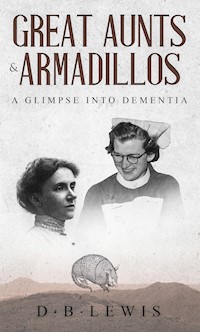
This is a book of hope and inspiration for all who may be called to look after someone suffering with dementia. It is the story of one family's eight year experience of looking after a much loved relative, and all that went with it. In these pages, the journey of a former 'old-school' nursing sister; one of the 'armadillos' of the title, is recounted from the time she was first observed to be acting 'a little oddly', to the time of her slow, but dignified, death in a North Yorkshire residential home. Rather than being a story of tragedy and despair, it is a family history containing many glimpses of hope and humour with numerous practical tips about how to approach caring for someone with this debilitating condition. It has been written by Scarborough based author, D.B. Lewis, the nephew of the story's main character, Sister Pat Botley SRN, as a testimonial to a most interesting and eccentric individual and as a way of acknowledging all those in the profession of care who so tirelessly devote their working lives to looking after other people's loved ones.
Das E-Book können Sie in Legimi-Apps oder einer beliebigen App lesen, die das folgende Format unterstützen:
Seitenzahl: 223
Veröffentlichungsjahr: 2019
Ähnliche



















Copyright © 2019 D. B. LEWIS
Publisher: tredition, Hamburg, Germany
ISBN
Paperback:
978-3-7482-2997-1
Hardcover:
978-3-7482-2998-8
eBook: 978-3-7482-2999-5
Printed on demand in many countries
All rights reserved. No part of this publication may be reproduced, distributed, or transmitted in any form or by any means, including photocopying, recording, or other electronic or mechanical methods, without the prior written permission of the publisher, except in the case of brief quotations embodied in critical reviews and certain other noncommercial uses permitted by copyright law. For permission requests, write to the publisher.
Great Aunts and Armadillos
A Glimpse into Dementia
D. B. LEWIS
For the friends and family of Pat Botley
SRN BTA Cert H.E.
(1931-2017)
and
for all those who face the care of relatives sufferingwith dementia
‘And midst the fluttering legion
Of all that ever died
I follow, and before us
Goes the delightful guide…’
(A.E.Houseman ‘A Shropshire Lad’)
The image of the armadillo used in this book is byScarborough based artist and writer, Jo Reed Turner, towhom sincere thanks are given.
Fifty percent of the royalties from this work are beinggiven to help further research into dementia by theAlzheimer’s Research UK.
Alzheimer's Research UK is a registered charity,numbers 1077089 and SC 042474. 3, Riverside, GrantaPark, Great Abington. CB21 6AD
Also by D.B.Lewis
A Little Bit of Trouble in London
Plotting Shed (Ed.)
Return to Premantura
A Wedding in Hvar
One Day in December
Contents
Preface and Acknowledgements
Preamble: The Last Letter
I. Dementia’s Turn: The Last Great Challenge
II. ‘Veins Old and New’: The Family Web
III. ‘Trying to be Glad’ (With just a Little Mirth)
IV. ‘The Blue Remembered Hills’
V. The Last Journey
Postscript: Reflections on Dementia
Preface and Acknowledgements
This is essentially the story of one person’s journey through dementia as well as a tribute to a much loved relative; who, with her own great aunt, are wonderful examples of that fine breed of seemingly armadillo-skinned aunts of the title. It has been written to provide the family and friends of Pat Botley SRN, formerly an ‘old school’ nursing sister of formidable repute, with a first-hand insight into her last years together with some of the issues involved in caring for someone with this debilitating condition. It also poses the question as to whether there is any link between ‘eccentricity’ in younger age and later dementia.
The story, which spans the years 2009 – 2017, may also be of interest to anyone who is faced with the care of relatives or friends with dementia; either now or in the future. The title was chosen because Pat Botley was a much loved ‘favourite aunt’ in the great British tradition; tough on the outside in a determination to overcome all travails, but warm hearted and soft-centred underneath her hard armadillo-like exterior. Dementia is a shared journey for most families. It is not just the sufferer who is affected but all those who have a concern for that person’s life and welfare. This story, with all its comedy as well as its tragedy, has been written with the same love and care that Pat showed to the world in her own idiosyncratic way and is dedicated to her memory and to her example. She was a very remarkable woman so this personal reminiscence of her life through the stories she told whilst she was ill is offered as a testimony to her life and work.
It would be remiss not to acknowledge Pat’s own painstaking work in collating the ‘Botley Family History’ she produced in 1993, together with its 1995 amendments, and in particular to acknowledge the many wonderful details supplied by the research undertaken with, and through, members of Pat’s extended family. A big thank you to everyone who has contributed, either knowingly or unknowingly, in the hope they will forgive any shameless usage of their own research in this book. I must give enormous thanks to Sonia, my wife, who was a large part of this shared journey of looking after my aunt. She also was a great help in bringing the book into being and thanks are due to her, and to our eldest daughter, Kate, who both helped with correcting the errors.
The Photographs
The majority of the photographs have been taken from either Pat’s or our own family albums. Where this is otherwise, the credits are shown accordingly. The photograph at the front of the book was taken at the Gala Opening Night of Scarborough’s newly re-built Open-Air Theatre in 2010 featuring Dame Kiri Te Kanawa, an event Pat was then still able to thoroughly enjoy.
Notes on‘A Shropshire Lad’
‘A Shropshire Lad’ is the best-known work of poet and scholar Alfred Edward (A.E.) Houseman (1859 - 1936), and probably amongst the most oft-quoted works from that time. It was written whilst Houseman worked in London and was first published in 1896. It has remained continuously in print ever since. The book consists of 63 separate poems, all beautifully and atmospherically linked to the Shropshire areas Houseman later came to know well, although he was actually born at Bromsgrove in Worcestershire. The extracts are taken from a 1920 reprint of the 1908 illustrated edition; the first copy to be so illuminated. Sonia gave me this copy as a memorial present shortly after Pat died so it seemed appropriate to place the very fitting extracts into a work about the life and times of a true ‘Shropshire Lass’. The archaic spellings of certain words are as they appear in the original and have been left as such. The Roman numeration is as it appears in the original text.
A Note about Factual Accuracy
In the nature of Pat’s, as in anyone’s dementia, well remembered stories became distorted as the disease progressed. The stories recorded herein are as they appeared in our conversations with Pat over the eight years of her illness. Where possible I have recorded the stories as she constantly repeated them early on in her dementia, and I have used her own words written in the Family History on occasion as the clearest version of the tale available. There is, therefore, a need to accept that the stories may over time have acquired inaccuracies both in fact and in effect. Perhaps it is a little ironic that Pat opens her Family History of 1993 with these words;
‘The human memory is very complex. Sometimes we see things through “rose-coloured spectacles”. At other times, it’s easy to exaggerate or over-dramatise events, but in either case, we are really sure, in our own minds, that it was so in reality at that time. I promise I will try to keep to facts to the best of my ability!’
(Family History. Page 10)
In testimony to Pat’s lifelong quest for factual accuracy and the absolute truth of any matter as she saw it, I have tried to do likewise and record, as faithfully as I can, the experiences Pat endured during the years of her dementia between 2009 and 2017. I have recorded extracts from Pat’s 1993 history as ‘FH’, followed by the page number where appropriate.
Preamble: The Last Letter. March 2009
‘Dear Mr Smith,1
What on earth made me do such a stupid thing by signing and ticking that form as I did? Not at all what I wanted – this job needs doing – and soon if possible. I think I must have had some sort of “panic” – not like me at all. I really do feel awful – and very worried about how careless I was.
The “ Rep.” and I had a pleasant chat and cup of tea. He looked at his watch and realised, I think, he was running late for another appointment. While he was out of the room to spend a penny, I saw to the form – far too quickly. I just cannot understand what made me do it as I did. I did not think to ask him to check it.
Would it be possible to start again please? I’m not usually careless. Since then I have nearly gone mad with worry and sleepless nights. The old blood pressure has also been a bit naughty, but that has settled down thank goodness.
The good news is (I hope) I have been to the bank and can manage to pay by cheque if this is at all possible? Or? A loan? All I can say again is how very sorry – and awful – I feel to have caused this problem for all of us – especially my nephew who has recently been very ill. Re the work already done so far. The back brick of the house – 2 men working on it. Can you please check exactly how far over they have got to in this area? I’m not sure if they did the area below the window where my swinging seat is. This had obviously not been moved and there was not room behind it to work. Thank you.
My nephew David Lewis will be in touch with you after his holiday. I do hope sincerely we can resolve this problem. I certainly do not want this sort of thing to cope with?? Never have been in serious trouble. So hope my message will be acceptable.
Again, sincere apologies for all the trouble caused – to you and me; and David.
P.M. Botley.’
1 Not his real name.
I
Dementia’s Turn: The Last Great Challenge
Before this fire of sense decay,
This smoke of thought blown clean away,
And leave with ancient night alone
The stedfast and enduring bone.‘
(‘A Shropshire Lad‘ XLIII)
I had not seen my aunt for more than four months, the longest period without such contact for many years. I had been in China leading a youth programme for the British Council whilst ‘on loan’ from the Metropolitan Police Service where I was a Community Police Inspector based at Charing Cross. During my trip I had picked up a serious bile duct infection that saw me crawl home to spend several months of hospitalisation, operation and recovery. There was no indication anything was seriously amiss with my dear mother’s younger sister. I had still spoken to her every week by ‘phone. She was, as ever, lucid, a little pedantic, exact, no nonsense. Very black and white; very Pat Botley. Very much the old eccentric Aunt I knew and loved. When we had last seen her, she had her business and family papers spread about the house which was unusual, but she seemed in good spirits claiming that, at long last, she ‘was having a good sort out’. It just did not register with us that this approach to the ‘sort-out’ was in fact, out of character. We were misled maybe by Pat’s regular ‘clear out’ sessions which could reach unbelievable levels of obsessive thoroughness. Sadly, it was a sign missed. But when she rang in great distress one Sunday morning four months later saying she couldn’t see, we knew something was obviously wrong.
Although I hadn’t completely recovered from my operation and was still being employed on ‘light duties’ with the police, my wife and I set off immediately for Croydon from our then home in Essex. It was September 2009. We entered the familiar terraced house Pat had lived in for nearly fifty years to find a battleground littered with papers on every conceivable surface. Upstairs and downstairs was a confused mass of jumbled correspondence. My aunt sat amongst it all, confused, distraught; her right eye heavily bloodshot, the hand written copy of a letter she had intended sending to the director of the cladding company, which appears above, tightly gripped in her hands. This was to be the last intelligible letter she ever wrote.
Pat was the most organised, detailed and punctilious person I had ever met. Before or since. She was as precise as the hospital corners on the beds she had ruthlessly required the junior nurses under her charge to maintain in her early career as a nursing sister. She paid all her bills on the nail. She had lists of every major purchase she had ever made. Every book she had ever read was listed; every film she had ever seen, every place she had ever visited. Every letter she had ever sent or received was meticulously recorded; every visitor logged in her fascinating ‘Visitors Book’, often with poetic notes from those who had the good fortune to come to stay. Since her first, at the Wolverhampton Civic Hall in 1948, she had listed every single concert of classical music she had ever attended; thousands of them; sometimes three or four a week, for sixty years - all logged down and often annotated. All these things and many more such as her holiday diaries, were detailed in exercise books ruled up for the purpose and appeared with additional notes in Pat’s almost totally illegible handwriting. This was the subject of much of our shared mirth for Pat smiled to think we would need to decipher it all once she was gone. In her house nothing was ever out of place. No single item was ever allowed to gather dust; if any household utensil remained unused for three years exactly, it was discarded. If it had no immediate practical use to her then that article had no place in Pat’s life.
On closer examination that day in East Croydon, it seemed Pat had not paid a very large bill for some exterior cladding work to the house that was almost certainly unnecessary in the first place. To incur a debt or not pay a bill was tantamount to high treason in the life of Cedar Road. Clearly, things were awry.
The immediate issue was to have her eye seen to. We took her straight to ‘Mayday’, the old hospital of her nursing sister days in Croydon. There we found a long waiting time was predicted. We had arrived at the ‘A and E’ in the early afternoon and we were still waiting at the hospital at 11 p.m. that same night. After what seemed like an eternity, we were referred on to the specialist eye clinic at Denmark Hill Hospital in nearby Dulwich where it was arranged for Pat to see a specialist the following morning. It was decision time. We arranged that Sonia would return home to Essex to sort things out there and I would stay with Pat and try and establish what on earth was going on.
Sadly, it was dementia that was going on. And quickly. The eye specialist found that Pat’s blood pressure had built up behind the eye severing the optic nerve, causing almost complete loss of vision in her right eye. Back at Cedar Road, I found Pat’s unconsumed blood pressure pills; she had been forgetting to take her tablets. The facts were beginning to fall into place. Clearly she could not be left alone just then and it was going to be necessary to look after her until we could stabilise the situation. I rang David, my Shropshire cousin, and explained what had happened. He spoke with the other nephews and nieces and before long we had a schedule of family care worked out for the immediate future.
The following morning, I heard the doorbell ring. I answered it and my 30 years of policing experience sent every warning bell in my brain ringing full blast. There, standing on the pavement beyond Pat’s gate and front wall, in ‘getawayquick’ mode, was as disreputable looking a character as you could ever not want to meet. His only words, ‘Come for me money’, were more than enough to confirm the instinct. His dishevelled, tarmac-marked clothing, his battered knuckles, his paunch and the vicious line across his face that passed for a mouth, gave every clue to his background.
He was indeed so disreputable that he was able to make the instant reverse conclusion about myself. It was a mutual recognition formed by long exposure, each to the other, that he was a villain and I was a copper. He was away on his toes. I was in a dilemma. I suspected he might well be a member of what we called a ‘distraction burglary’ team, and whilst I dealt with him at the front, a fellow ‘ne’er-do-well’ might be round the back removing the ‘swag’. I rushed back in, made sure the back door was locked, told Pat not to move one muscle, locked the front door and I was off after the man. By this time, he was two streets away and gaining. I dialled ‘999’ as I went. This slowed me and the man made good his escape by the main Addiscombe Road roundabout; the one known locally as the ‘Wedding Cake’. I returned and spoke to the attending officers. We drove around the area in the patrol car. There was little to go on and, as they pointed out, up to that moment no crime appeared to have been uncovered. I spoke to Pat. “‘Why had this man, ‘come for his money?’”, I asked. Pat mumbled something about ‘gutter work’. I put two and two together and for once made four. I looked into her bank statements. Every day for weeks past, Pat had attended her bank and withdrawn cash. Usually £100, sometime larger withdrawals. Over £4,000 in total. I questioned Pat closely and, I hope, sensitively. She said the man had to be paid for cleaning out the gutter. Each day he had called she had forgotten she had already paid him the day before. I went straight to the bank, taking Pat with me. I asked to see the manager. They checked. ‘Yes, we thought it was odd but didn’t like to say anything’. I asked them to check the CCTV. Sheepishly, the manager eventually returned to say it seemed a heavy, unkempt, middle-aged male had brought Pat to the bank each day where he waited outside until she handed over the cash. The description tallied. I was furious. Even the slightest duty of care, properly exercised, would have prevented much of this loss and distress. The bank were full of apologies and perhaps I should have followed it up with a negligence claim. But Pat’s condition was pressing hard and I had to be content with filing a crime report for the loss.
Some weeks later I was relieved to take a call from Croydon CID, who told me the man had been caught at a similar deception in an adjoining street and had asked for several other offences to be ‘taken into consideration’, including Pat’s. When he came up for trial, my account would be used as a ‘victim impact statement’. He eventually had a two-year prison sentence for his misdeeds; but there was no compensation. People with dementia are easy victims for ruthless criminals devoid of any empathy and this crime added to the urgency of care need for Pat.
Pat was to live on with much care, and at her own great personal and financial expense, for another eight years. In that time she deteriorated mentally from an exciting, if ‘edgy’, full-of-life individual of complete and unwavering independence, to a totally dependent shell of human suffering with moments of shockingly aware lucidity. The decline was excruciatingly painful to watch. How much more painful must it have been for her to experience? It is hard to tell. Amidst all this suffering there were brief, but great, moments of fun; the old humour never deserted her to the end - the twinkle in her only sighted eye remained to the very last breath. Before she lost the ability to even know who I was, or who anyone was, she asked me to write the story of her final years for her family and friends. This is it.
Fig 1: Pat Botley, aged 7
Dementia: A Brief Description
There isn’t much about dementia that is funny. There really isn’t. It is a cruel, wasting, debilitating condition that varies greatly from person to person. Pat’s condition brought many challenges; some of them very demanding indeed, but she never became excessively violent or abusive, as some do, she had no serious falls causing significant injury although there were many that caused minor cuts and bruises, and she retained her speaking ability until the last. For these things at least, we were grateful.
The National Health Service, rather matter of factly, describes dementia as;
'…a syndrome (a group of related syndromes) associated with an ongoing decline of brain functioning. This may include problems with memory loss, thinking speed, mental sharpness and quickness, language, understanding, judgement, mood, movement and difficulties carrying out everyday activities.
There are many different causes of dementia. People often get confused about the difference between Alzheimer’s disease and dementia. Alzheimer’s disease is a type of dementia (that Pat’s illness was initially diagnosed as) and together with vascular dementia (which Pat was later thought to have as a result of high blood pressure and a reduction of blood flow to the brain) makes up the vast majority of cases. There is currently no cure for dementia.’
(NHS Choices 2017)
Pat suffered from most of these symptoms of dementia, with the exception of her language skills, which remained unaffected. The mental health team who first diagnosed her and advised us, hinted that, despite the suddenness of the onset and its severity, Pat could live on for another 8 to 10 years, possibly more, although with constantly decreasing capabilities. They also suggested her death would probably come about from another associated cause and not dementia itself.
In the end she lived with dementia for just about the predicted 8 years, from its first signs in 2009, and died, possibly from cancer, judging by her final symptoms her doctor thought, in May 2017. Under the circumstances there seemed little point in requesting an autopsy to establish the exact cause of death. The attending doctor succinctly recorded the cause on the death certificate as ‘dementia’.
Pat, who always had a smile and a positive approach to everyone and everything, had a great ability to see the funny side of any adversity and she had many in her lifetime, of which dementia was the greatest and last. That she was still able to maintain her sense of fun even in this situation at the end of her life, is a true testimony to her greatness.
The Origins of Eccentricity
Is eccentricity a matter of nature or nurture? Like most things, probably a little of both. As far as I can tell, Pat never saw herself as ‘eccentric’. ‘Quaint Auntie Meg’ in Paignton was ‘eccentric’. We both accepted that. I loved visiting Auntie Meg. She was a strange old fusty smelling relative who lived with her companion, known as ‘Auntie B’, who my mother and I would dutifully visit on holiday trips to Devon whilst I was a young boy. She was an absolute delight with her long black Victorian skirts, pinned hats and round prescription glasses perched on the end of her nose through which she never seemed to look.
‘Auntie Meg’ was Pat’s mother’s sister, the eldest of six siblings, whose favourite trick was to put her hat on whenever anyone came to the door. Asked why by my mother one day, she explained that, if she didn’t like the look of the caller, she could then say she was ‘just going out dear’ or if she liked the possibilities, she would say ‘So glad I haven’t missed you dear, I’ve just come in.’ Quaint Auntie Meg was a ‘Primitive Methodist’. Alcohol was a forbidden subject, no swearing was allowed, anything remotely hinting of gambling, such as a tombola or a whist drive, would bring on a short, cutting statement such as ‘I don’t think we can really approve of that can we, dear?’ Even an ‘Oh bother’ would merit a stern rebuke. Lending and borrowing were the ‘root of all evil’. On her reasons for not having a television set, Auntie Meg would say, ‘Nothing but sex and boxing’, as Pat recalled in the family history.
I loved Pat’s memory of these two ‘old dears’, who, at bed time, refused to undress in the room containing the radio, believing the newsreader could see them in their shifts.
Figure 2: 'Quaint' Auntie Meg as a young woman c 1890s - Margaret (‘Meg’) Stowe was Pat’s mother’s sister; the fifth of six siblings. Much of her working life was spent as a personal assistant to a Methodist minister in Paignton, Devon but she was widely admired.
Pat would frequently recount this following story about Auntie Meg, which probably gives an insight into her aunt’s eccentric nature;
‘I remember a holiday in Cornwall and we were sorry that we could not see Meg at the same time. But that would not put Meg off trying to see us. She checked on our train’s route on the way home and discovered that it had to stop at Newton Abbott. So she got herself there and we were hanging out of the window and could see her looking out for us. We could not have been there for more than a few minutes but time enough for her to hand us over some fruit and sandwiches.‘ (FH Page 60)
Figure 3: 'Quaint' Auntie Meg, then aged 76, with 'Auntie B' at Paignton in 1961. Meg was born on April 10th 1885 in Shrewsbury and died on December 5th 1973 at Paignton, aged 88. ‘Auntie B’ lived on for a further 18 months. Pat recalled Meg in the Family History as a ‘wonderful person…and what a lot of pleasure she gave to so many different people. What a character – they certainly don’t make them like that anymore.’
Auntie Meg lived with a friend, always referred to by her, even in conversations that included this quiet unassuming companion, as ‘Miss Bassett’, but who we all called ‘Auntie B’, although she was no blood relative at all. ‘Auntie B’ had been evacuated from London to Paignton in the First World War and was a real sweetie; kindly, long suffering, a foil to my great aunt’s unbending presence. As if her friend wasn’t there, Auntie Meg would explain in a sort of stage whisper behind a shielded hand, that ‘Miss Bassett lost her fiancé in the war dear; not been quite the same since.’ These visits were in the 1960s, more than forty years after the Great War had ended, yet to Auntie Meg it seemed it was only months since the Armistice. She was stuck in a late Victorian mind-set and nothing was going to make her move on. The modern world was a very sinful place to Auntie Meg. Pat was very fond of her and in some ways perhaps hers was a model on which Pat was to cast her own idiosyncratic mould. ‘No swearing’, however, wasn’t one of the rules that passed from aunt to niece; the range of Pat’s profane vocabulary would cause us much angst, as well as amusement, when dementia loosened the shackles, and with it any restraint to her tongue.




