


Erhalten Sie Zugang zu diesem und mehr als 300000 Büchern ab EUR 5,99 monatlich.
- Herausgeber: Pocket Essentials
- Kategorie: Geisteswissenschaft
- Sprache: Englisch
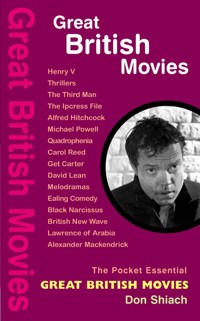
Which British movies are the best that this country has produced? In this volume Don Shiach encapsulates the peaks of the British film achievement from the beginning of the sound era to the first decade of the 21st century. The giant figures of the 1930s, Alfred Hitchcock and Alexander Korda, set a standard for the domestic film industry in its attempt to challenge the domination of the Hollywood film. Many saw the 1940s as the Golden Age of British cinema with directors such as Carol Reed and Michael Powell leading the way in establishing British cinema as worthy of serious consideration. From then on there were as many troughs as there were triumphs, but the industry continues to produce the odd masterpiece to extend the great tradition. Covering The Third Man, Black Narcissus, Lawrence of Arabia, Carol Reed, Alfred Hitchcock, Ealing Comedy, Michael Powell, Emeric Pressburger, British New Wave and much more, Great British Movies is a useful reference book, a celebration, and a starting point for the argument about what really does represent the best of British - a must for all fans of British cinema.
Sie lesen das E-Book in den Legimi-Apps auf:
Seitenzahl: 192
Veröffentlichungsjahr: 2015
Das E-Book (TTS) können Sie hören im Abo „Legimi Premium” in Legimi-Apps auf:
Ähnliche



















GREAT BRITISH MOVIES
Which British movies are the best that this country has produced? In this volume Don Shiach encapsulates the peaks of the British film achievement from the beginning of the sound era to the first decade of the 21st century.
The giant figures of the 1930s, Alfred Hitchcock and Alexander Korda, set a standard for the domestic film industry in its attempt to challenge the domination of the Hollywood film. Many saw the 1940s as the Golden Age of British cinema with directors such as Carol Reed and Michael Powell leading the way in establishing British cinema as worthy of serious consideration. From then on there were as many troughs as there were triumphs, but the industry continues to produce the odd masterpiece to extend the great tradition.
Covering The Third Man, Black Narcissus, Lawrence of Arabia, Carol Reed, Alfred Hitchcock, Ealing Comedy, Michael Powell, Emeric Pressburger, British New Wave and much more, Great British Movies is a useful reference book, a celebration, and a starting point for the argument about what really does represent the best of British - a must for all fans of British cinema.
DON SHIACH
Great British Movies
Don Shiach
POCKET ESSENTIALS
Contents
Introduction
Finding Its Feet: 1926–39
The Golden Age of British Cinema: 1940–49
Fighting for a Mass Audience: 1950–59
The 1960s: The British New Wave
Surviving American Domination: 1960–1989
Selling Britishness: 1990–2005
Best of British
References
Introduction
François Truffaut, the French director and critic, famously once said that the cinema and the British were inimical to one another, implying that as a nation we had neither a real cinematic tradition nor an innate feel for cinema, a summation that was clearly partial and superficial. In tandem with other French directors and critics of the ‘nouvelle vague’ era, Truffaut was a Hollywood enthusiast, often elevating routine material to the level of art and discovering hitherto hidden directorial ‘geniuses’ such as Howard Hawks, Samuel Fuller and even Jerry Lewis as justification of the ‘auteur theory’, which established the director as the author of a film. However, it is true that throughout its history British cinema has had to contend with the increasingly dominating influence of the Hollywood industry. At times it has struggled to survive, not only in an artistic sense but also as a separate economic entity, raising the question of whether or not there has existed an indigenous film industry at all.
With this Hollywood dominance of the marketplace has come an economic stranglehold, easily imposed by the major American film companies. More and more, the problem has been how a truly British film industry could make British films that reflected British society, and avoid merely producing genre product for a worldwide market in which 95% of the films shown were made by American companies or financed by American money. What is, after all, a ‘British film’? For example, three of the most successful ‘British’ films of all time – The Bridge on the River Kwai, Lawrence of Arabia and The English Patient – were all financed by Hollywood money, but they are largely British in content and have British directors, writers and stars. For the purposes of this book, the selection of films I have made to represent the best of British cinema is defined by how British the subject-matter is and the national identity of the major artistic influences.
Seventy-odd movies have been chosen for individual treatment, and obviously any such selection depends on personal taste and predilection. James Bond fans may be outraged that no single Bond film makes the list, as will ‘Carry On’ devotees. Whilst there is no doubt that both these series are significant in the history of the British film industry, my ultimate criteria have been significance and artistic merit. When the total oeuvre of the British film industry is considered, it is possible to see how Truffaut’s statement about the British and cinema can be dismissed as critically insubstantial.
Finding its Feet: 1926–39
The silent era in cinema produced few memorable British movies, one exception being The Lodger, directed by a young Alfred Hitchcock, who made his mark with this film as a director of imagination and individuality. However, with the success of The Jazz Singer, and Hollywood’s subsequent wholesale investment in sound stages and movies, the indigenous industry faced the same problems then that it would for the rest of the twentieth century and into the new millennium: how to compete with the Hollywood monster.
Two individuals dominate this period of British film history, Hitchcock and Alexander Korda, a native Hungarian, who nevertheless became wholly identified with the attempt to create a homegrown industry that could rival Hollywood and at the same time make worthwhile films of some artistic merit. In addition to this strand of commercial filmmaking, there emerged a strong documentary tradition under the aegis of John Grierson at the GPO Film Unit and Edgar Anstey at British Transport. As well as making memorable single documentary films such as Drifters and Night Mail, these pioneers had a lasting influence on British ‘realist’ movies in later decades.
British stars such as Ronald Colman, Charles Laughton, Laurence Olivier and Vivien Leigh were snapped up by Hollywood and became international box-office attractions. However, in Britain there was still the prevalent view that the cinema was an inferior art to the theatre and many British ‘names’ perceived work in the films as ‘slumming it’. Too many British films of this era looked to the theatre for its material, stars and inspiration, so the history of the British cinema in the 1930s is littered with forgettable farces, dire musicals, drawing-room comedies à la Noel Coward and damp squib thrillers. Top box-office stars of this period included Jessie Matthews, George Formby and Will Hay. Nevertheless, the movies discussed in this section pay tribute to the fact that some innovators were thinking outside those particular boxes and in so doing, made movies of some lasting merit.
Blackmail(1929)
Crew:directed by Alfred Hitchcock; produced by John Maxwell; screenplay by Alfred Hitchcock, Benn W Levy and Charles Bennett, based on the play by Charles Bennett; cinematography by Jack Cox; music by John Hubert Bath, Henry Stafford and John Reynders; edited by Emil De Ruelle. B&W. 75 mins.
Cast:Anny Ondra (Alice White); John Longden (Frank Webber); Donald Calthrop (Tracy); Cyril Ritchard (The Artist); Sara Allgood (Mrs White); Charles Paton (Mr White).
Blackmailis not only interesting as one of Hitchcock’s earliest successes, it stands as an important milestone in the history of British cinema. It was originally shot as a silent movie, but the arrival of sound technology and the subsequent banishment to history of silent cinema demanded that the film be transformed into a ‘talkie’. Hitchcock shot new scenes with sound and dubbed the existing footage. Thus, the film was seen in Britain as a silent movie in many cinemas and as the first all-talkie British movie in some newly equipped theatres.
The story is about a young woman whose boyfriend is a Scotland Yard detective. She becomes involved with an artist who has designs on her and tries to force her to pose nude for him, whereupon she stabs him to death.To add to her problems, her boyfriend leads the investigation into the crime and she becomes the object of blackmail. Hitchcock initially wanted the film to end with the young woman locked up in jail, but was persuaded to substitute a conventionally happy conclusion.
This rather trite melodramatic plot allows Hitchcock to explore recurring themes: woman as the object of voyeuristic lust, sexual guilt and the transference of guilt, and redemption. Clearly influenced in his early days by German expressionism and directors such as Fritz Lang, FW Murnau and GW Pabst, Blackmail is a cut above other British films of this period: layers of meaning are brought to relatively conventional material and pure cinematic devices enhance and give depth to the narrative.The added dialogue is not of great importance; it is the use of composition within the frame, point-of-view camera techniques and camera angles in general, the lighting, close-ups and the sound effects used, that mark this movie as the work of a cinematic genius in the making. Eighty years on, the movie inevitably seems creaky at times, especially considering that the soundtrack was added after the silent version was shot and the lead actress’s lines had to be dubbed (Anny Ondra was Polish and English actress Joan Barry read her lines for her).
The Lodger(1926), starring Ivor Novello, had already announced Alfred Hitchcock as a major talent of the burgeoning British film industry. Blackmail reinforced his reputation as an innovative director who was willing to handle darker themes than mass audience cinema usually allowed. He adapted expressionistic techniques from art movies to this commercial product, that presaged how later in his Hollywood career he would bestride the worlds of the commercial and the art house movie, resulting in his reputation, not only among general cinemagoers, but also those interested in ‘serious’ cinema. Blackmail remains a landmark in British cinema history and is still well worth viewing to the present day.
The Private Life of Henry VIII(1933)
Crew:directed by Alexander Korda; produced by Alexander Korda and Ludovico Toeplitz; screenplay by Lajos Biro and Arthur Wimperis; cinematography by Georges Perinal; music by Kurt Schroeder; edited by Harold Young and Stephen Harrison; art direction by Vincent Korda. B&W. 97 mins.
Cast:Charles Laughton (Henry VIII); Robert Donat (Robert Culpepper); Binnie Barnes (Katherine Howard); Elsa Lanchester (Anne of Cleves); Merle Oberon (Anne Boleyn); Wendy Barrie (Jane Seymour); Everley Gregg (Catherine Parr); Franklin Dyall (Thomas Cromwell).
Alexander Korda was a Hungarian who had worked prolifically in the Hungarian, French and German cinemas before settling in Britain and attempting to make movies in English that would break into the lucrative American market and help to establish the British film industry as a rival to Hollywood. He formed a production company called London Films, which made The Private Life of Henry VIII and would play a central role in creating an important native film industry, independent of Hollywood.
Korda’s commercial instinct told him that the best way to attract American audiences and exhibitors was to delve into British history and serve up a racy version of royal bedroom antics for their titillation.There were two English monarchs that would have been heard of, even in Idaho or South Dakota: Henry VIII and Elizabeth I. With Charles Laughton under contract at the time, it presumably made sense to choose the former, and he dispensed with any serious historical representation, concentrating instead on the dissolute tyrant’s shenanigans with his six wives (actually five in the movie itself because a prologue dismisses Henry’s first wife as being too respectable to be included in this romp). For the time, it seemed quite steamy, although very tame indeed by today’s standards. For example, Laughton as Henry, when approaching his nuptials to the supposedly ugly Anne of Cleves (played by Laughton’s wife, Elsa Lanchester) intones, ‘The things I do for England!’ Lines like these make the film teeter on the edge of being a 1930s version of Carry On Henry.
However, what makes the movie of lasting interest are the performances of the leading players (especially Laughton and Lanchester) and the art direction of Korda’s brother,Vincent. Shot for a paltry £60,000, both Kordas (as director and art director) managed to make the movie look much more sumptuous. As a screen actor Laughton divides opinion: some see him as a scenery-chewing, megalomaniac old ham, out to dominate any scene he appeared in. Others see him as an actor of genius with extravagant and larger-than-life gifts. He was only 33 when he took on this role and his performance is undoubtedly hammy, but once you reconcile yourself to this style and the overall rumbustious, dig-in-the-ribs tone of the piece, his performance and the movie as a whole become more than merely acceptable entertainment. As history it is bunk. As a movie it is significant in terms of the development of the British film industry and Alexander Korda’s role within it.
The 39 Steps(1935)
Crew:directed by Alfred Hitchcock; produced by Michael Balcon and Ivor Montagu; screenplay by Charles Bennett, Alma Reville and Ian Hay (based on the novel by John Buchan); cinematography by Bernard Knowles; music by Louis Levy; edited by Jack Twist. B&W. 85 mins.
Cast:Robert Donat (Richard Hannay); Madeleine Carroll (Pamela); Lucie Mannheim (Miss Smith/Anabella); Godfrey Tearle (Professor Jordan); Peggy Ashcroft (Margaret); John Laurie (John); Helen Haye (Mrs Jordan); Wylie Watson (Mr Memory).
This is probably the best Hitchcock film of his British period. It lacks the depth or darkness of his best Hollywood movies (Vertigo, Notorious), but is an expertly-produced spy and chase movie that has much more substance than most in the genre.The film from Hitchcock’s Hollywood output that it most resembles is North by Northwest. Both movies have the male protagonist wrongly accused of murder, forced to flee across country in an attempt to track down the mystery at the centre of the plot. Both encounter rather cool blondes whose motivations are ambiguous. In both, the comfortable, perhaps complacent, world of the hero is overturned and he is forced to behave like a fugitive criminal in order to prove his innocence and restore the normality of his life. The 39 Steps and North by Northwest are outstanding examples of the paranoid thriller that Hitchcock was such a master at directing.
The story (which differs hugely from the original novel by John Buchan) concerns Richard Hannay, who meets a mysterious woman who tells him about a spy ring that is planning some kind of mayhem. She mentions something about ‘the 39 steps’ and circles a town on a map of Scotland. When she is murdered, Hannay becomes a wanted man and flees to Scotland to try to track down the leader of the spy ring and amass evidence that will clear him. On the way, he meets Pamela, whom he handcuffs to his person and forces to accompany him. Eventually, he encounters the villainous spies whose aim is to steal a formula to make silent aircraft engines. There is a rousing climax involving a stage memory man with much effective cutting to increase tension.
Hitchcock has a great deal of fun with his hero and heroine handcuffed together, and the overtones of sexual perversity are prominent. Part of Hitchcockian mythology is the story that the director deliberately arranged to have the handcuff keys mislaid on the first day so that his stars were manacled together all day. Robert Donat and Madeleine Carroll play off each other well, although Donat is too ethereal a figure to bring out the full potential of the sexual frisson between the two. Darker overtones are added in a strange scene in a Scottish croft with a young Peggy Ashcroft playing an oppressed wife to John Laurie’s puritanical and paranoid husband. Set pieces involve the hero hanging onto to a speeding train crossing the Firth of Forth railway bridge, a prolonged chase across the Scottish moors and the final climax in the theatre. The editing of the film makes effective use of sound, for example, when a screaming woman changes into the sound of a screeching train whistle.
The 39 Stepswas adapted from a Boys’ Own yarn and given a certain depth and darkness by Hitchcock, so that it works on both the adventure/spy genre movie level and as an adult entertainment. Once again, as in Blackmail, Hitchcock pushes back the boundaries of popular entertainment, inviting audiences to enjoy his film on more than one level, proving himself both as the so-called ‘master of suspense’ and as the director of films that treat the audience as adults.The movie made international stars of Donat and Carroll. Hitchcock appeared in almost all of his movies: in this one, he can be glimpsed throwing some litter as Donat and Carroll run from the music hall.
Things to Come(1936)
Crew:directed by William Cameron Menzies; produced by Alexander Korda; screenplay by H.G. Wells and Lajos Biro adapted from The Shape of Things to Come by H.G. Wells; cinematography by Georges Perinal; edited by Charles Crichton and Francis Lyon; music by Arthur Bliss; production design by Vincent Korda. B&W. 113 mins.
Cast:Raymond Massey (John Cabal/Oswald Cabal); Edward Chapman (Pippa Passworthy/Raymond Pass-worthy); Ralph Richardson (The Boss); Margaretta Scott (Roxana/Rowena); Cedric Hardwicke (Theotocopulos); Derrick De Marney (Richard Gordon); Ann Todd (Mary Gordon).
Despite its flaws, Things to Come is a testament to the ambition of producer Alexander Korda to make Britain a filmmaking country of the first rank. He assembled an impressive array of talents to adapt H.G. Wells’ 1933 book to the screen: director William Cameron Menzies was a distinguished art director who had worked in Hollywood on the silent versions of Robin Hood and The Thief of Baghdad; the music was in the hands of Arthur Bliss whose film score was one of the first to be recorded commercially; Wells himself co-wrote the screenplay with Lajos Biro; George Perinal was in charge of photography and Korda’s brother designed the entire epic production. Wells later admitted he knew little about writing for the cinema and this is reflected in the film, with its static scenes, its speechifying and verbosity and its lack of emotional involvement, but the result is impressive to look at and, at the very least, attempts to deal with important themes of science and progress, technology versus art, war and peace.
The story spans a period of almost a hundred years, beginning in 1940.The fear of impending European war at the time of the production is reflected in Wells’ story about Everytown, a metropolis that is almost destroyed by enemy bombers.Years pass and disease has gripped the population, wiping out half of the people of the world. A kind of warlord, The Boss rules Everytown until his brutal authority is challenged by an emissary of ‘Wings Over the World’, an organisation devoted to rebuilding the world through technology. Faced with the opposition of the present powers-that-be, the organisation that the emissary represents disempowers the citizens of Everytown with the ‘gas of peace’.The reconstruction takes place with the city built underground and the use of artificial sunlight. Fast-forward to 2036 and the rulers have decided to colonise the moon, but against the opposition of those who believe that technology has destroyed human values. The wreckers attack the giant space cannon that has been constructed, but the spacecraft is successfully launched.
At times the film resembles a pageant or an illustrated lecture as Wells hammers home his message. Yet Korda’s impressive designs are worth seeing, and Raymond Massey and Cedric Harwicke manage creditable performances amongst all the empty rhetoric.The cost of the movie ($1.5 million, a very large sum for that time) does show on screen. This is large-scale movie spectacle for a mass audience with a moralising, Wellesian message thrown in for their betterment.
Things to Comeis an oddity of British film history. Korda undoubtedly took a risk in producing it and initially it seemed the film would be a box-office flop, but it gradually acquired a cult reputation. It remains one of the most interesting British movies of the decade and evidence that the industry was taking itself seriously.
The Lady Vanishes(1938)
Crew:directed by Alfred Hitchcock; produced by Edward Black; screenplay by Sidney Gilliat and Frank Launder, adapted from the novel The Wheel Spins by Ethel Lina White; cinematography by Jack Cox; edited by Alfred Roome; music by Louis Levy. B&W. 97 mins.
Cast:Margaret Lockwood (Iris Henderson); Michael Redgrave (Gilbert Redman); Paul Lukas (Dr Hartz); Dame May Whitty (Miss Froy); Cecil Parker (Eric Todhunter); Linden Travers (Margaret Todhunter); Mary Clare (Baroness); Naunton Wayne (Caldicott); Basil Radford (Charters).
This movie is a highpoint for those Hitchcock admirers who prefer his early British phase to his later Hollywood output. In fact, Hitchcock was only a last-minute substitute as director, but once aboard, he licked the script into Hitchcockian shape with the help of his wife,Alma Reville, and Launder and Gilliat who would later become stalwarts of the British movie scene as co-writers of movies such as Kipps, Night Train to Munich, The Happiest Days of Your Life and the St Trinians series. The Lady Vanishes sits firmly in the tradition of the genteel English detective story à la Agatha Christie and Dorothy L Sayers. Hollywood, by contrast, would allow him to explore the underbelly of the human condition in shockers such as Psycho and Vertigo.
The story mainly takes place aboard a train travelling towards England through Central Europe. A rather dotty old woman disappears on board and a young woman (Lockwood) who has befriended her sets out to discover what has happened, aided by a bow-tied music scholar (Redgrave). The villains are very villainous and clearly intended to represent malevolent German Nazis the film was made a year before the start of the Second World War). Caldicott and Charters, two very upper-class Englishmen who are obsessed with the latest score in the Test Match, are also on the train.The old woman turns out to be a courageous spy of sorts, in possession of vital information that must be passed onto the British authorities. After much suspense and danger, the decent British defeat the baddies and she is restored to life.
Never taking itself too seriously, The Lady Vanishes still incorporates some genuinely sinister aspects. A criticism that could be levelled at it is a tendency towards xenophobia: the British are portrayed as relentlessly eccentric but decent, while most foreigners are either downright nasty or stupid. In that rather reprehensible light, the movie enters into the ‘little Englander’ world of Agatha Christie and other writers of English detective fiction. However, it touched on an immediate pre-war paranoia about Germans in particular and Europe in general, and a sub-text of the movie certainly seems to be that it is rather dangerous to leave British shores and mix with Johnny Foreigner. This attitude is personified in the characters played by Basil Radford and Naunton Wayne, the obsessive cricket fans: depending on your point of view, an endearing national characteristic or a complacent, class-based irritation.
The Lady Vanisheswas a huge success on both sides of the Atlantic and is viewed by Hitchcockian devotees as one of his major works. It is an interesting period piece from a director who would go on to produce far finer work in Hollywood. Hitchcock can be seen in the scene set at Victoria Station near the end of the movie.
The Four Feathers(1939)
Crew:directed by Zoltan Korda; produced by Alexander Korda; screenplay by RC Sherriff, Lajos Biro and Arthur Wimperis, adapted from the novel by AEW Mason; cinematography by Georges Perinal, Osmond Borrodaille and Jack Cardiff; music by Miklos Rozsa; edited by William Hornbeck and Henry Cornelius; production design by Vincent Korda. Colour. 130 mins.
Cast:John Clements (Harry Faversham); Ralph Richardson (Captain John Durrance); C Aubrey Smith (General Burroughs); June Duprez (Ethne Burroughs); Allan Jeayes (General Faversham); Jack Allen (Lieutenant Willoughby); Donald Gray (Peter Burroughs).




