


Erhalten Sie Zugang zu diesem und mehr als 300000 Büchern ab EUR 5,99 monatlich.
- Herausgeber: The History Press
- Kategorie: Geisteswissenschaft
- Sprache: Englisch
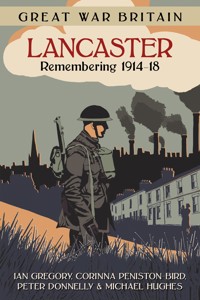
The First World War claimed over 995,000 British lives, including the deaths of over a thousand 'Men of Lancaster', and its legacy continues to be remembered today. This book looks at the impact that the loss of so many men had on the community and offers an intimate portrayal of Lancaster and its people living in the shadow of the 'war to end all wars'. Drawing on detailed research conducted by the authors and their community partners, it describes the local reaction to the outbreak of war, the experience of individuals who enlisted, the changing face of industry, the women who defied convention to play a vital role on the home front, and how Lancaster coped with the transition to life in peacetime once more. The Great War story of Lancaster draws on all of these experiences to present a unique account of the local reality of a global conflict.
Sie lesen das E-Book in den Legimi-Apps auf:
Seitenzahl: 197
Veröffentlichungsjahr: 2017
Das E-Book (TTS) können Sie hören im Abo „Legimi Premium” in Legimi-Apps auf:
Ähnliche




















This book is dedicated to the late Brigadier James (Jim) Dennis. His committed work researching the war memorials of Lancaster, Morecambe, Carnforth and the surrounding villages, and the people behind the names on those memorials, did much to inspire the book and inform its content. His work was motivated by the desire to record as much detail as possible about the 2,700 people named on local war memorials ‘so that their lives can be remembered in a fuller and more significant way for all time’. We hope that this book on Lancaster’s experience of the First World War contributes to his aim.
First published in 2017
The History Press
The Mill, Brimscombe Port
Stroud, Gloucestershire, GL5 2QG
www.thehistorypress.co.uk
This ebook edition first published in 2017
All rights reserved
© Ian Gregory, Corinna Peniston-Bird,
Peter Donnelly, Michael Hughes, 2017
The right of Ian Gregory, Corinna Peniston-Bird, Peter Donnelly, Michael Hughes to be identified as the Authors of this work has been asserted in accordance with the Copyright, Designs and Patents Act 1988.
This ebook is copyright material and must not be copied, reproduced, transferred, distributed, leased, licensed or publicly performed or used in any way except as specifically permitted in writing by the publishers, as allowed under the terms and conditions under which it was purchased or as strictly permitted by applicable copyright law. Any unauthorised distribution or use of this text may be a direct infringement of the author’s and publisher’s rights, and those responsible may be liable in law accordingly.
EPUB ISBN 978 0 7509 8492 8
Original typesetting by The History Press
eBook converted by Geethik Technologies
CONTENTS
Timeline
Acknowledgements
Introduction
1 Outbreak of War: The King’s Own Mobilises
2 Attitudes to the War
3 The War at Home
4 From the Front: The King’s Own Experience
5 From the Front: Lancaster’s Casualties
6 The Men Who Did Not Fight
7 Lancaster’s Lost: The Impact of the Deaths at Home
8 The End of War and Remembrance
Further Reading
About the Authors
TIMELINE
ACKNOWLEDGEMENTS
We would like to thank the following: Lancaster Military Heritage Group (LMHG) for making the Reveille material available to us, and the King’s Own Royal Regiment Museum, Lancaster for providing the record cards on Lancaster’s war memorial to that project. The Documenting Dissent Project, run by Global Link (www.globallink.org.uk), with particular thanks to Caroline Morrison, Janet Nelson and Alison Lloyd Williams. Janet Nelson was also very generous in sharing further research, as was Pauline Churchill of the Lancaster & District Family History Group. Heather Dowler at Lancaster City Museum for her kind assistance with photographs. Mandy Stretch and Martin Purdy for their expertise on Westfield War Memorial Village. James Hayes for permission to draw upon his Lancaster University dissertation The Enemy Within: Picturing, Confronting and Confining the ‘Alien’ in Lancaster and Morecambe during the First World War. Bowerham Primary and Nursery School, Ripley St Thomas Church of England Academy, Lancaster Royal Grammar School and Lancaster Girls’ Grammar School for access to school archives and memorials.
Ian Gregory acknowledges funding from the European Research Council (ERC) under the European Union’s Seventh Framework Programme (FP7/2007-2013) / ERC grant “Spatial Humanities: texts, GIS, places” (agreement number 283850).
Ian Gregory and Corinna Peniston-Bird acknowledge funding from the Heritage Lottery Fund (HLF) for the LMHG’s project ‘Streets of Mourning and Community Memory in Lancaster’ (FW-14-03372), that fostered our interest in the impact of the war on the communities of Lancaster.
Unless otherwise stated, all images are courtesy of Lancaster City Museum (LCM) or the King’s Own Royal Regiment Museum (KOM).
Other image credits are to: Ian Gregory (ING), Michael Hughes (MJH), Corinna Peniston-Bird (CPB) and Lancaster Girls’ Grammar School (LGGS).
INTRODUCTION
When census enumerators went round the town on 2 April 1911, they recorded that Lancaster Municipal Borough had a population of 41,410 people. In some ways the town and people they surveyed were typical of industrial Lancashire when the county, and indeed the country, was at the peak of its industrial might. The town’s employment was strongly concentrated in manufacturing, particularly the production of oilcloth and linoleum. This industry was dominated by two family firms: James Williamson and Son (James Williamson II became Lord Ashton in 1895), and Storey Brothers. Waring and Gillow, furniture makers, were based on St Leonard’s Gate and provided another source of manufacturing employment. Not everything was well with the town’s industry, however. The Lancaster Carriage and Wagon Works on Caton Road had been the second largest employer in town after Williamson’s until it closed in 1908 with a major loss of jobs.
Lancaster was not an entirely typical northern industrial town. As the county town it had a judicial role with the court and the prison, and it had well-established mental health facilities at the Moor Hospital off Quernmore Road and the Royal Albert for children with learning disabilities on Ashton Road. Significantly for what was to follow, Lancaster was also a garrison town: Bowerham Barracks (now the University of Cumbria campus) was the headquarters for the King’s Own Royal Lancaster Regiment whose 5th Battalion, a Territorial Force unit (similar to the modern Territorial Army), was headquartered on Phoenix Street. A Royal Field Artillery battery was also based on Dallas Road.
Little could the people answering the enumerators’ questions have known about what was to follow. From 1914 many of the younger men would be recruited, usually into the army, many into the King’s Own. As many as 20 per cent of men in some age groups would be killed, many more would be injured or mentally scarred by what they experienced. For much of the rest of the population, life would carry on but would be far from normal. The town’s industry and society were transformed as firms were moved to war production and women moved into jobs previously occupied by men. As you walk or drive around the town today, you pass many buildings that were part of this story: Bowerham Barracks and the other military sites were obviously centres of military activity; the Wagon Works was used as a prisoner of war camp; many of the mills and factories, now council offices, student accommodation, or disappearing under new housing, were used for the production of munitions or other products required for the war effort; many men enlisted at the Old Town Hall; and, along the streets of terraced housing and in the courts of the city centre, many houses lost men whose widows, parents, siblings and children had to carry on with their lives.
This book tells the story of Lancaster in the First World War. In doing so we draw together the military side, particularly the experience of the King’s Own, and the civilian side with the impact of mass casualties, the town’s civilian war effort, and attitudes to the war being key themes. In writing the book we are lucky to draw on two rich sources: the first is the records of the King’s Own Royal Regiment Museum, and the second is Reveille, created by Lancaster Military Heritage Group and informed by the collections held by the King’s Own, which provides a record of each Lancastrian killed in the war. The intention is to use these and other sources such as the local press to give the reader, a century later, an impression of how the global conflict affected the town and the people who lived and worked on the streets and buildings that modern inhabitants walk past every day.
1
OUTBREAK OF WAR: THE KING’S OWN MOBILISES
After years of escalating tensions, the immediate crisis that led to the First World War was triggered by the assassination of Archduke Franz Ferdinand in Sarajevo on 28 June 1914. Throughout July, tensions between Austria-Hungary, Russia, Germany, France and Britain rose and the complex system of alliances, combined with inflexible military planning, meant that the Austro-Hungarian declaration of war on Serbia pulled all of Europe’s major powers, and many of its smaller ones, into war. On 4 August, Britain declared war on Germany in support of France and Russia, and in defence of Belgian neutrality.
The most immediate effect of this period on Lancaster was on its army units, particularly those in the King’s Own Royal Lancaster Regiment which had been headquartered in the purpose-built barracks in Bowerham since 1880. Regiments consisted of a number of battalions which would typically comprise around 1,000 men and would operate independently of each other. At the outbreak of the war, the King’s Own consisted of two regular battalions, two Territorial Force battalions and a Special Reserve battalion. The two regular battalions, the 1st and 2nd were based in Dover and India respectively. The Territorial Force battalions were the 4th and 5th Battalions. The 5th was based on Phoenix Street, Lancaster and recruited heavily from the local area, while the 4th was based in Ulverston. The Special Reserve 3rd Battalion also consisted of reservists and was based in Bowerham Barracks.
COLOUR SERGEANT GEORGE HENRY BRAZIER
Not everyone at Bowerham Barracks was suited for war service, either at home or abroad. The tragic tale of Colour Sergeant George Henry Brazier was no doubt not uncommon across the army in the First World War. Brazier had completed twenty-one years’ service with the regiment, much of which was overseas in India, China and Burma. He left with a pension in 1911, but rejoined in September 1914, aged 42, to assist in training the men of the new battalions. He had been employed at White Cross Mill, and had also been at Bay Horse as a coal agent’s manager: he was thus quite well known. With a strapped wrist following an accident to his right arm some years previously, unable to march, and with a possible drinking problem, Brazier was informed in December that he would be discharged as no longer fit for military service. On Tuesday 15 December his room mates at the barracks were awakened by hearing him yell, and they found that he had cut his own throat with a penknife which fell into the blood pool on the floor. He was admitted to the infirmary having demanded ‘Why didn’t you let me cut my head off?’ and died shortly afterwards. The coroner found insufficient evidence to prove the man was of unsound mind, and suggested a verdict of ‘Killed himself by cutting his throat’, which was agreed. Brazier was buried in Lancaster Cemetery.
Group of reservists of the King’s Own at Bowerham Barracks, 8 August 1914, about to head off for training near Plymouth. (KOM)
The records of the King’s Own allow us a unique insight into the escalation of the opening days, weeks and months of the war. The weekend of 1 and 2 August was supposed to be the start of the annual West Lancashire Division Territorial Force camp which was to be held at Kirkby Lonsdale. In the lead up to the weekend it became increasingly uncertain whether the camp would go ahead as war loomed. The uncertainty increased when all oil sheets, which the men depended upon to protect themselves from damp when sleeping, and all blankets above war scale had to be returned on the Friday in preparation for the mobilisation of the Regular Army. In the event, the 4th and 5th battalions did travel from their bases on Sunday 2 August and arrived by train in Kirkby Lonsdale in heavy rain. At two o’clock on Monday morning, the news arrived that the camp had been cancelled and most men rapidly returned home. As a consequence, on the day before war was declared, a bank holiday, the streets of Lancaster were already full of men in uniform.
Ceremony and tragedy
The visible presence of the military in the centre of the town continued in the pending days. A battalion’s Colours, or flags, are emblazoned with its Battle Honours and must always be handled with due respect and reverence. Colours had not been carried on Active Service since 1881 and it had become the tradition that Colours would be safely deposited in a public building for the duration of the hostilities. In the case of the 5th Battalion this was done with a very public parade through Lancaster, with the Colours being laid up in the Regimental Chapel at Lancaster’s Priory Church on 5 August 1914. This was in preparation for the battalion being deployed, not to France, but to Barrow-in-Furness to protect the port.
The Colours of the 3rd (Special Reserve) Battalion of the King’s Own were laid up in the Town Hall. The brief ceremony saw the Colours, carried by Lieutenants Watkins and Jameson, received by the Mayor, Councillor William Briggs. After receiving the Colours, the Mayor spoke to the officers and men of the 3rd Battalion:
The Colours of the 5th Battalion, King’s Own, are ‘laid up’ in the Regimental Chapel for the duration of the war on 5 August 1914. (KOM)
In accepting the custody of your colours, I do so with the fullest sense of importance of the occasion, and all that it means. But I should like you to know that Lancaster is proud of its regiment, and wishes it every success, knowing that it will do its duty wherever it may be called to serve and do its best to live up to its great traditions with which its name is associated. My sincere wishes are that God may be with you all, and that you may safely return to receive your Colours back again.
The emphasis on men doing their ‘duty’ was reiterated in a more tragic context. One of the 5th Battalion’s members who received notification of the plans for mobilisation was Private James Hall, aged 19, of Pilling. At around 10 a.m. on 6 August, his father, Richard, was working on his farm while his son cleaned his rifle. Richard heard a single shot and found his son lying over a cow trough, dead, with the stock of his rifle under his right elbow. As James was a ‘keen religionist’, it was surmised that he feared the possibility of having to kill his fellow men. Lancaster’s coroner, Neville Holden, held the official inquest in Simpson’s Tea Rooms the next day and told the jury that it was a serious case. A soldier’s duty was to serve his King and country and it was an act of cowardice to take his own life. The jury was instructed to record a verdict of suicide. James Hall may thus have been the first British casualty of the war.
Little is recorded of the 5th Battalion’s time in Barrow, however, a foolscap piece of paper survives with instructions on how to deal with captured spies and how to search them for secret intelligence.
Whilst most of the men of the 5th Battalion were based in Lancaster, Morecambe, Carnforth and as far south as Garstang and Fleetwood, the men who were being mobilised at Bowerham Barracks were travelling from further afield. The staff at Bowerham Barracks had been working hard day and night for more than a week when the mobilisation order was actually received. Shortly afterwards the Proclamation was placarded on the walls of the barracks, at the Town Hall, police stations and other public places. The response was immediate and on 6 August large numbers of men arrived at the barracks, many from all over north-west England, some from even further afield. Here they were issued with their kit and quickly sent away by special trains to various destinations: some were sent to Plymouth, where the 3rd (Special Reserve) Battalion established its training base, and others were despatched to Dover where the 1st Battalion was based.
A small contingent of the people arriving in the town on 6 August included an escort from the 1st Battalion who travelled from Dover to Lancaster with their Regimental Colours, which were to be placed in the Regimental Chapel. Their arrival was not generally known and only a few people witnessed the handing over. Before receiving the Colours from Lieutenants Irving and Statter, the Vicar of Lancaster, Reverend J.U.N. Bardsley, said that he had received a letter from Lieutenant Colonel Dykes, the Commanding Officer of the 1st Battalion, stating that the battalion had been ordered to mobilise for active service, and he was sending the Colours to the Depot, in order to be placed in the Chapel. Lieutenant Colonel Dykes wrote:
I know that you will gladly accept this responsibility until we can return to claim them, and I also know that we shall have the prayers of yourself and your congregation that the Regiment may maintain its proud traditions and new honours to its Colours in the performance of whatever duty it may be called upon to undertake.
The vicar received the Colours and placed them on opposite sides of the altar, along with the Colours of the 5th Battalion which had been deposited the previous day. Shaking hands with the colour-bearers, the vicar said: ‘I wish you God’s blessing, and that you may return safe and sound.’ Today, the Memorial Chapel displays one of the most complete collections of Regimental Colours in the country.
The vicar’s wish was not granted. As described in Chapter 4, the 1st Battalion was quickly moved to France where it immediately became caught up in desperate fighting as the British Expeditionary Force retreated from Mons. Less than a month after carrying the Colours, Charles Irving was severely wounded and captured on 26 August at Haucort, near Le Cateau – he spent the rest of the war in captivity. William Statter was wounded a few days later at Courrois on 8 September – he recovered, was transferred to the Royal Flying Corps in January 1916, and survived the war. Lieutenant Colonel Dykes was less fortunate – a veteran of the South African War of 1899–1902, he was killed in the same action that led to Irving’s capture.
The 5th Battalion
Like all Territorial Force battalions, the 5th Battalion was designated for a Home Defence role and the men could not be ordered overseas. They could, however, volunteer for Imperial Service which they did, reportedly every single man. With this in mind, the battalion was released of its duties in Barrow-in-Furness and returned to Lancaster on 12 August 1914. They urgently needed a suitable place for accommodation so temporary barracks were established in the old Lancaster Railway Carriage and Wagon Works on Caton Road, which had been empty since the works closed in 1908. After two days there, the 5th Battalion received their orders to move to Didcot, Oxfordshire where they would guard lines of communication, particularly the Great Western Railway. The battalion departed the Wagon Works and marched along Caton Road to Lancaster Castle Station (now Lancaster station) for their transport to the south. The first train load left at 1.05 p.m. amidst cheers from the spectators, with the second departing thirty-five minutes later. Large numbers of people gathered on the line side south of Lancaster Castle Station, and cheered the departing officers and men. On 15 August the 5th Battalion arrived in Didcot which was to be their main base and detachments were sent along the Great Western Railway line in order to guard bridges and other important points.
Interior view of 5th Battalion soldiers billeted at the former Wagon Works, Caton Road, Lancaster, 12/13/14 August 1914. (KOM)
Soldiers of the 5th Battalion, King’s Own, march down Caton Road from the temporary barracks at the former wagon works to Lancaster Castle Railway Station, 14 August 1914. (KOM)
The military’s thirst for men was evident from the outset. Before the battalion departed, extensive efforts had been made to recruit more men to it and other units. On 7 August as many as 200 men were sworn in and equipped as members of the Territorial Battalion. Even so, when the battalion arrived at Didcot, an assessment took place of the 938 men who had volunteered for overseas service and it was discovered that between 200 and 300 of them were either unfit, too young, or simply changed their mind about overseas active service. As a result, in early September an appeal was sent to Lancaster for recruits to come forward to join the 5th Battalion. Recruiting meetings were held in both Lancaster and Morecambe with Major Bates, the battalion’s second-in-command, and Captain Seward addressing those present. They were frequently supported by others: for example, at a meeting at Waring and Gillows’ works they were joined on the platform by Mr S.J. Waring, one of the company directors.
The Commanding Officer of the 5th Battalion, Lord Richard Cavendish, spoke at a meeting in the Central School at Morecambe in early September 1914. He told the audience that Britain was fighting ‘to fulfil a solemn obligation to protect the weak’ (a reference to the fact that the country had gone to war in response to the German invasion of Belgium). He went on to ask the audience whether any man ‘capable of bearing arms … could calmly acknowledge that he was doing nothing to meet his country’s need’. His wife, Lady Cavendish, also addressed the meeting, calling on the women of Morecambe and Lancaster to encourage their sons and brothers to enlist.
Group of 5th Battalion, King’s Own, soldiers with some local people at Goring-on-Thames, when guarding the Great Western Railway mainline between Didcot and Reading against enemy attacks, 8 September 1914. (KOM)
Sergeant George Snowden and other members of the 5th Battalion, King’s Own, at Green Lane Bridge, when guarding the Great Western Railway, c. September 1914. (KOM)
Lord Cavendish further explained that the War Office had sent down instructions that further battalions could be raised for home defence as the 5th Battalion would be sent to serve overseas. In the early days of September hundreds of men came forward to join what became known as the Lancaster Pals and Morecambe Pals. From the volunteers, 200 men were selected to leave Lancaster on Sunday 6 September to journey to Didcot to begin their military training. This group of men were christened the ‘Gallant 200’ by the local press. They had had no previous military training. They were put through their paces with a regular programme which included all forms of military drill but also domestic duties such as the daily potato-peeling duty.
The motor lorry acquired by the 5th Battalion, King’s Own, from Barrow Corporation in August 1914, was taken with the battalion to Didcot and used by the battalion to obtain supplies. Regimental Quartermaster Sergeant Woodcock is sitting in the cab: he was a long-time member of the 5th Battalion and Volunteers and had seen active service in the South African War 1899–1902. (KOM)
The recruiting drive continued throughout September 1914, with mixed results. At one meeting in Lancaster, Herbert Lushington Storey expressed disappointment that the hall was not more crowded. He told the audience that he feared there was too much popular ignorance of ‘the object and meaning of the war’, and described how in one recent visit to a factory in Manchester he discovered that only 200 out of the 5,000 workers had enlisted. He was confident that the people of Lancaster ‘knew better, because they were always more or less in touch with the military’. He ended his speech by telling the audience that ‘if he were a young man he would not be long in coming forward’. Lord Cavendish addressed the same meeting, using similar language, describing it as the ‘solemn and bounden duty’ of every man who could bear arms to come forward. He also appealed to local patriotism, describing the enthusiastic response of the men of Morecambe and Fleetwood to the call to join up. The Mayor followed by calling on men in the audience to volunteer. The local press reports suggest that the response was less impressive than the speakers hoped. Just a few men came forward and only ‘after some delay’.
1st




