


Erhalten Sie Zugang zu diesem und mehr als 300000 Büchern ab EUR 5,99 monatlich.
- Herausgeber: The History Press
- Kategorie: Geisteswissenschaft
- Sprache: Englisch
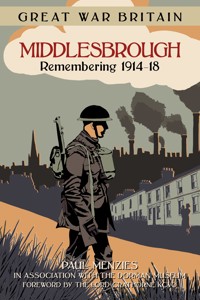
The First World War claimed over 995,000 British lives, and its legacy continues to be remembered today. Great War Britain: Middlesbrough offers an intimate portrayal of the city and its people living in the shadow of the 'war to end all wars'. A beautifully illustrated and highly accessible volume, it describes local reaction to the outbreak of war; charts the experience of individuals who enlisted; the changing face of industry and related unrest; the work of the many hospitals in the area; the effect of the conflict on local children; and concludes with a chapter dedicated to how the city and its people coped with the transition to life in peacetime once more. The Great War story of Middlesbrough is told through the voices of those who were there and is vividly illustrated through evocative images.
Sie lesen das E-Book in den Legimi-Apps auf:
Seitenzahl: 258
Veröffentlichungsjahr: 2014
Das E-Book (TTS) können Sie hören im Abo „Legimi Premium” in Legimi-Apps auf:
Ähnliche




















I would like to dedicate this book to my late father, who sadly died during the writing of this book, and to all those from Middlesbrough who experienced the Great War a century ago.
And to my wife, Jackie.
CONTENTS
Title
Dedication
Timeline
Preface by Phil Philo
Foreword by The Lord Crathorne KCVO
Introduction and Acknowledgements
Middlesbrough, 1914
1 A Summer Storm
2 ‘We Don’t Want to Lose You’
3 Safe in Your Bed
4 Keep the Home Fires Burning
5 ‘Tea or Munitions, We’re here to Help!’
6 ‘Dear Mother’: News from the Front
Postscript: Peace at Last
Bibliography and Sources
About the Author
Copyright
TIMELINE
PREFACE
For more than 100 years the Dorman Museum has been central to Middlesbrough’s commemoration of those people from, or associated with, the town who made the ultimate sacrifice in the terrible wars of the twentieth and twenty-first centuries.
The museum was officially opened on 1 July 1904, by the colonel-in-chief of the Yorkshire Regiment, as the ‘Dorman Memorial Museum’. It was presented to the town by Sir Arthur Dorman as a memorial to his son, George Lockwood Dorman, and others of the Yorkshire Regiment who lost their lives during the South African or Boer Wars of 1899–1902. It is one of Middlesbrough’s landmarks, and stands alongside the cenotaph, and the associated wall that was originally erected in 1922 as the Middlesbrough war memorial to those who fought and died in the First World War. It was rededicated to include those from the Second World War and later conflicts.
Housed inside are collections that include material representative of the townspeople’s experiences of war, both on the home front and the front line; from photographs and letters, military equipment and munitions, medals and commemorative items, to souvenirs and mementos. These artefacts, along with Middlesbrough Council’s collections held by its library service and the joint service, Teesside Archives, which it manages on behalf of its Tees Valley partners, and material that the local community have shared and made available, are central to our study and understanding of the past.
Now part of Middlesbrough Council’s Cultural Services Section, the Dorman Museum has enjoyed supporting author Paul Menzies in his research and writing of this important new publication about Middlesbrough’s Great War effort, and is grateful to the publishers, the History Press, to be selected as the official launch venue for the book. Great War Britain: Middlesbrough contains a wealth of material and stories, much of it told for the first time, and is a fitting tribute to the courage and resilience of the town’s people, in this important centenary anniversary of the start of the ‘War to end all wars’.
Phil Philo
Senior Curator, the Dorman Museum, 2014
www.dormanmuseum.co.uk
FOREWORD
The author has done great service in writing this account of life in Middlesbrough during the First World War. This book takes its place alongside the other excellent local history publications by Paul Menzies. His detailed research into the First World War gives us a fascinating glimpse into wartime life in the ‘Boro’. Many of the stories are appearing here in print for the first time.
We learn that, along with the grit and determination, went the hardship and suffering, alleviated in part by the numerous voluntary relief organisations.
Crathorne Hall, south of Middlesbrough, operated as a British Red Cross hospital from 13 November 1914 to 9 July 1917. A total of 423 men were patients there, under the command of Mrs J.L. Dugdale, most men being sent from the military hospital in Newcastle. The Dugdale family met all of the expenses incurred in running the hospital. (Courtesy of The Lord Crathorne)
After conscription started in January 1916 the role of women became even more crucial, particularly in the munitions factories. Their heroic efforts transformed women’s lives for ever.
There was a fighting spirit in the town, encouraged and promoted by the mayor and countless others. Schoolchildren helped the war effort by making sandbags; women knitted stockings for ‘our boys at the Front’; there were numerous fundraising efforts of all kinds.
As mentioned in the book, Crathorne, where I live, played its part with regular voluntary donations from the workers on the estate to ‘The Prince of Wales National Relief Fund’ and there was a VAD (Voluntary Aid Detachment) hospital run by my grandmother, Violet Dugdale. Her son Thomas (my father) went to the Front as a young officer in 1917, and she wrote to him there every day. Along with every other mother writing to a son at the Front, she did not know whether her next letter would be the last he ever received.
Over 3,000 men from Middlesbrough died in the conflict, and as we read through the following pages we remember them and their families, and the ultimate sacrifice they made during the Great War.
The Lord Crathorne KCVO
2014
INTRODUCTION AND ACKNOWLEDGEMENTS
No man has greater love or self-control
Than he who gives his life for that of friend
This he has done and captain of his soul
Played gamely – to the end
An extract from a dedication written for the burial of George Hutton Bowes-Wilson, 1/4th Battalion Alexandra, Princess of Wales’ Own Yorkshire Regiment
The personal journey I have taken when writing this book has stretched from a childhood listening to the Great War experiences of older relatives, to my journey to the Western Front last year. Whilst this was for the purpose of research, I also wanted to be able to hold my hands up and say that I had followed in the footsteps of the soldiers 100 years ago. I knew I would have felt uncomfortable writing a book on the Great War, and Middlesbrough, had I not done so.
The most remarkable discovery in my research has been the sheer enormity of the subject in every way. The thousands of graves and names on memorials like the Menin Gate in Ypres, and standing at the grave of the young Middlesbrough footballer, Harry Cook, were both very moving. The beautiful windswept landscape of the Somme seemed so far away from the world he knew as a teacher in North Ormesby, yet as I placed a wooden cross next to his white gravestone, I was the link for a few moments across time and space, between 1917 when he died and today.
Enormity is a word that describes the Great War in every way. Over 3,000 names are on the memorial tablets at Albert Park and, as I discovered, there is an increasing amount of material about the war. When writing a book of this genre there are some key decisions to make before you put pen to paper. For me, it was the choice of approach; I wanted to bring some insight into the lives of those who were here in Middlesbrough, so this is not a military history of the war, and there is not a great deal about battles. Instead this is a detailed history of what it may have felt like for people living in the town at that time. I have tried to cover as many topics as possible, focusing on some that would not normally draw much attention from local historians.
I must apologise to any of the numerous people that I have met in the course of the last three years if I have not included the name of their family member. Space has been very tight in this book, and I have had to restrict named people to those who furthered the story at that point. I have been shown extraordinary kindness by the many people who have helped me out during my research, and it has been a pleasure to have worked with them. I thank them all.
In particular I want to thank Phil Philo and his staff (Louise Harrison, Gill Moore and Jenny Philips) at The Dorman and Captain Cook Birthplace Museums for their constant encouragement and help. Paul Delplanque of the Evening Gazette, until his recent retirement, has been incredibly patient with me as I kept on asking for more and more material. The staff at Teesside Archives – Kimberley Starkie and Corrie Dales in particular have been outstanding in their support, under the guiding hand of Ruth Hobbins. Jenny Parker, at Middlesbrough Reference Library, has been a huge help, and allowed me to access material, often at short notice. Middlesbrough Football Club, too, have been superb – I must mention Jo-Ann Swinnerton who made it all possible, and Diane O’Connell and Graham Bell for giving their time.
I also thank those who shared information on their family, particularly those who came to the library event in November 2013 – it was so good to talk to you. Even if I have not used your material directly, it proved useful in building up a picture of the world as it was then. I would like to thank Joe Pearson, the descendants of J. Briggs, and finally, Jean Brighton. Also Georgina Hustler, Alice Barrigan, Pauline Weatherly and Sandra Morgan – all of whom gave me a lot of time. I also wish to thank Alan McKinnell for all his support.
Thanks to Jonathan Swingler, Mike Hill, Alastair Brownlie and Mike Parr at BBC Tees – all have taken a great interest in the book, and I have been fortunate enough to make some recordings for the BBC World War One website about life in Middlesbrough at that time. In particular I would like to thank John Foster of BBC Tees who worked tirelessly with me on my radio series on Middlesbrough 1914, broadcast in July and August 2014. His energy and support was wonderful. The History Press too has been excellent, and very patient – thank you, Matilda Richards and Rachel Jewitt.
Finally, I want to thank people in my other working roles, for their support and interest, particularly colleagues at Yarm School including David Dunn, Janice Nickson and Norma Brown. Also Carol, who with a coffee and a smile has kept me going on some tough days. My heartfelt thanks must also go to my wife Jackie, who, like the people left behind in 1914, has shouldered a huge burden but been of great support.
I have tried to check all facts in this book and take full responsibility for any errors. If you would like to email me at [email protected] I will try my best to correct it. Similarly I have tried to acknowledge all material in the bibliography, but my apologies if I have missed anyone.
Paul Menzies
May 2014
MIDDLESBROUGH, 1914
There were those still alive, in 1914, with memories of Middlesbrough from almost a century before, a time preceding the building of the Victorian town, when Middlesbrough Farm stood alone on raised land close to the River Tees.
A purpose-built town, Middlesbrough was a shipping port for the export of coal from the Durham coalfields, and by 1914 it was renowned for its iron and steel and ship building industries.
There was a predominantly male population in 1914, totalling 126,452, most of whom were employed in heavy industry. With few opportunities for women outside the retail trade or domestic service, many found themselves confined to the home.
Most working people lived in terraced streets stretching southwards from the river, a pattern that marked the town’s growth from tiny hamlet to county borough. In the immediate pre-war years new suburban areas were established and were favoured by those with greater financial means.
Many Middlesbrough men spent their days toiling away in heavy industry in scenes like this one from the local ironworks. (Author’s collection)
1
A SUMMER STORM
The New Bowling Green
For almost fifty years Albert Park had been the pride and joy of the citizens of Middlesbrough. Now, on a hot day in July 1914 it was to have a new bowling green, created under the watchful eye of Councillor George Bowes-Wilson, chairman of the Park Committee. This was an important day, the climax of two years’ work. With a darkening sky and ominous rumblings of distant thunder he prayed for the storm to pass by.
His prayers were answered and, minutes later, he was smiling at his 2-year-old son, Maurice, presenting the mayor’s wife, Mary Bruce, with a ‘handsome bouquet of pink carnations’. With barely any time to spare, special guest Mrs H.F.W. Bolckow performed the opening ceremony, before the fierce storm scattered the crowd. The dignitaries retired to the shelter of a large marquee, where Bowes-Wilson and his wife entertained them to tea; outside the crowds rushed to find shelter in the cafés and public houses on Linthorpe Road.
George Bowes-Wilson 1878–1915, a Middlesbrough solicitor and a member of Middlesbrough Borough Council (Exchange Ward). (Courtesy of Middlesbrough Council)
Like many summer storms, this one was short lived, but in hindsight it was a portent of what was to come. The opening of the bowling green was one of the last municipal ceremonies in the town before the war. Within a year, Bowes-Wilson and his son would be dead; little Maurice died suddenly on 16 March 1915, and only three months later his father George died too, on a battlefield near Ypres in Belgium. When Bowes-Wilson’s young wife thanked the town council for their condolences, she wrote: ‘all seems very black and hopeless to me now … [but I] hope the bowling green, my husband’s final undertaking for the council before enlisting, will be a lasting memorial of his work.’
Three weeks later, the contents of their home were auctioned off at J.S. Storry’s Salerooms in Newport Road – a home and a family ruined. Many local families would suffer a similar experience, with feelings of bleak despair in the coming years of war.
Middlesbrough mayor, W.J. Bruce, who was in office at the start of the war, is remembered for his war work. Among many other duties he led the town’s remarkable recruitment drive. (Courtesy of the Dorman Museum)
Archduke Who?
The assassination of Archduke Franz Ferdinand and his wife, Sophie, in Sarajevo the previous Sunday, 28 June, raised no more than passing interest in the town. Even those who knew where the Balkans were generally agreed they were too far away to be of any real concern. The North-Eastern Daily Gazette’s editorial summed it up: managing ‘Foreign Affairs’ could be a problem but the recent agreement with Germany over Mesopotamia was surely ‘a step towards a better understanding in Europe’. Besides, the situation over home rule in Ireland had recently become more threatening, with the Teesside United Irish League now calling for the formation of a local corps of Irish National Volunteers.
With the ending of the school year came the formalities of Speech Day. On Wednesday, 22 July 1914, Lady Sadler, watched by the mayor, presented the prizes at Kirby School, where the increasing breadth of the curriculum was particularly praised. Two days later, Middlesbrough High School’s 44th Annual Speech Day, chaired by Sir Hugh Bell Bt, took place in front of a large crowd at the Town Hall. The headmaster of the Boys’ School since 1901, William Edwards, and headmistress at the Girls’ School since 1893, Gertrude M. Bedford, both praised the excellent results achieved by their pupils.
Graham’s Yard, one of the many areas of slum housing and poverty in pre-1914 Middlesbrough. (Courtesy of Middlesbrough Reference Library)
Life was tough for many families in these filthy decrepit living conditions, many of which had been condemned several years before 1914. (Courtesy of Middlesbrough Reference Library)
The situation in Ireland unfortunately kept the guest of honour, the Right Honourable Joseph A. Pease MP, President of the Board of Education, in London. His under-secretary, C.P. Trevelyan, was a popular replacement, promoting in his speech the ideology of education, and advising parents to send their children to school as ‘early as you can [and] above all, keep them there as long as you can’.
This speech day, the final school event before the war, would later be sadly recalled. Some of the boys in the audience that day would soon be going to fight for king and country. It would fall to William Edwards, a few years later, to lead the school in very different circumstances, a poignant gathering to honour more than 700 High School old boys who had joined up – of whom 111 never returned.
Trevelyan’s speech made no reference to events in Europe yet, less than two weeks later, Britain would be at war. On Thursday, 23 July 1914, the home rule crisis in Ireland continued to overshadow developments in Europe, with the North-Eastern Daily Gazette devoting only four paragraphs to the ultimatum issued by Austria–Hungary to Serbia, or was it ‘Servia’? (The newspapers still couldn’t seem to decide which spelling to use.)
On Saturday, 25 July 1914, Middlesbrough thrilled to the news that their swimming hero, Jack Hatfield, had retained the national long distance swimming championship, over a 5 mile course on the Thames from the Anglian Boathouse at Kew to Putney Pier. Local summer shows attracted good crowds. Meanwhile, elsewhere, Serbia accepted all but one of the conditions of Austria–Hungary’s ultimatum, and Austria–Hungary rejected this response by closing its embassy in Serbia. It was a curious juxtaposition – two different worlds, the normality of local day-to-day life continuing alongside events which were changing history.
Middlesbrough High School was one of the town’s leading schools; 111 former pupils were to lose their lives in the war, a fact commemorated in a memorial plaque, which still exists today. (Courtesy of Teesside Archives)
Civil war appeared even closer, after a disturbance in Dublin on Sunday, 26 July 1914, ended in terrible bloodshed, with three people killed and sixty injured. Yet with Austria–Hungary seemingly intent on going to war with Serbia, the European crisis was causing concern too. A cabinet meeting, on the morning of Monday, 27 July 1914, focused for the first time on Europe. With Serbia certain to seek (and receive) support from Russia, both France and Germany would almost certainly be dragged into the affray, an escalation with serious implications for Britain.
High on the government’s agenda was safeguarding national security. Over the next few days several instructions from the government’s ‘War Book’, a range of ‘precautionary measures’, were carried out. This lengthy document, put together by the Committee of Imperial Defence in 1907, contained precise details of the steps to be taken by each department in a time of grave emergency. With secrecy an important factor, the press were asked not to report any further facts about either ship or troop movements.
The press, with their political allegiances, was an influential power. Middlesbrough’s daily newspaper, the North-Eastern Daily Gazette, had a circulation of over 70,000 copies. Aware of the potential economic effects of war on local businesses due to reliance on foreign orders, the newspaper was a staunch supporter of the Liberal government’s desire to avoid conflict. Nevertheless, events in Europe were increasingly impossible to ignore. When Sir Maurice William Ernest de Bunsen, the British Ambassador to Austria, telegraphed Edward Grey from Vienna on Tuesday, 28 July that Austria-Hungary had invaded Serbia, the North-Eastern Daily Gazette was forced to run the headline ‘Austrians March on Belgrade’ – announcing special arrangements had been made ‘for receiving the latest telegrams of the hostilities now taking place between AUSTRIA AND SERVIA (sic)’. Although there was no particular support in Middlesbrough for Austria-Hungary, or for Serbia, there was a feeling of moral injustice over this confrontation and the Gazette was determined to keep readers informed.
The Garden Fete
Against this backdrop, Sir A.J. Dorman hosted a ‘Grand Bazaar and Garden Fete’ at his home, Grey Towers, on Wednesday, 29 July 1914, to help raise funds for the new church at Nunthorpe. Imperial Tramways ran a special timetable, with a special fare of only 6d (2p) and buses leaving the town every hour during the afternoon. Opened by the Marchioness of Zetland, the fete was a great success with large crowds, and Sir Arthur, who had already donated a site for the new church, was so delighted that he gave a further £1,000. The darkening shadow of national affairs, however, meant the town’s Liberal MP, Penry Williams, was unable to get back to Middlesbrough to open the Grove Hill Allotment Show, having to remain in London while his wife took his place.
Wednesday’s eye-catching headline, ‘War: All Europe Arming’, alerted readers to a seemingly deteriorating situation. With a presentation style that would become increasingly familiar over the next four years, the North-Eastern Daily Gazette offered in-depth information on the situation, aided by a detailed map.
By Thursday, 30 July 1914, the situation in Ireland was no longer making the main headlines; those fighting for home rule agreed that priority must be given to the national interest, removing, for the time being at least, any imminent threat of civil war. After Great Britain’s declaration to Germany that it might not remain neutral if the situation escalated, the question now being asked was ‘Shall England have to fight?’
The Middlesbrough public were becoming more informed. The regular newspaper boys on the corner of Marton Road taunted each other by yelling, with increasing noise, ‘War declared between Austria and Serbia!’ When the situation came to blows, scattering placards and newspapers everywhere, one customer remarked, ‘just like Austria and Serbia – fighting over nothing!’
On Friday, 31 July 1914, as rumours of war became more persistent, an already ‘jittery’ London Stock Exchange failed to open. The Bank of England, anticipating financial panic, increased the bank rate from 4 to 8 per cent, the highest rate since November 1873 (it would be 10 per cent the following day). Middlesbrough stockbrokers, Todd and Crone, issued a statement that the ‘London and provincial stock exchanges had closed until further orders owing to the war scare’. The Tees shipping trade was ‘absolutely paralysed by the prevailing suspense’ – many vessels were docked at Middlesbrough, uncertain as to their future movements. There was concern among local shipping firms about vessels at sea carrying cargoes that might be impounded in the case of war.
The effects of the ‘scare’ were felt in ordinary life too: housewives shopping in Linthorpe Road complained about the increase in food prices, despite local food retailers like Hinton’s protesting that they were absorbing the rise.
August Bank Holiday, 1914
The fortnight’s Territorial training coincided with the August bank holiday. On a day when many people traditionally took a trip to the countryside or to the seaside on one of the cheap North-Eastern Railway Company (NER) excursion trains, despite the crisis most events were advertised as still going ahead.
Saturday, 1 August
With the barometer rising, the forecast was favourable; the band of low pressure, which had brought the latest spell of poor weather, was moving across to Germany. The early trains leaving Middlesbrough were full of chattering day trippers, mothers laden with sandwiches, and children clutching their buckets and spades, all determined to make the most of the day. Bathers crowded onto the beaches on the Cleveland coast, the bathing machines in constant demand as people enjoyed the simple pleasure of the bracing sea air. The North Sea sparkled as the sun blazed down; men and women were paddling in the cold surf as they tried to avoid being splashed by their children. Occasionally a rumour would spread that a German battleship had been seen, and people giggled nervously at the thought that the Kaiser’s navy could be somewhere just over the horizon.
In Redcar, they laughed and sang along with Sam Paul’s Pierrots, dressed in their comical pantaloons costumes – Basil Hallam’s ‘Gilbert the Filbert’ was a particular favourite with the audiences that summer. Elsewhere, crowds gathered on the esplanade where the melodious sounds of a brass band could be heard. At the Pier Pavilion, the ‘Valentines’ topped the bill. Two miles down the coast at Saltburn, Bert Grapho’s Pierrots, now in their fifteenth summer at the resort, were entertaining a slightly less boisterous crowd. The Victorian Cliff Lift was busy all day, carrying people down to the beach, as it had done for thirty years. The Zetland Hotel, determined to make a special effort that weekend, was busy too, serving a ‘superior luncheon’ for its guests as they enjoyed glorious views of the fine golden sands and the sea beyond.
In Europe, the German government ordered a general mobilisation and declared war on Russia. With France mobilising too, many senior politicians thought that war was inevitable. In Britain, the Royal Navy was mobilised. Telegrams were sent out, and the police informed to deliver call-up papers. Wherever a crowd gathered to discuss the latest news, the question of hostilities was debated. As rumours multiplied it was becoming difficult to separate fact from hysteria. Political events took up a whole page in Saturday’s Sports Gazette, much to the displeasure of local cricket fans, who wanted news of the North Yorkshire & South Durham cricket league.
A view down Albert Road of the Town Hall, the centre of civic life since it was opened in 1889. (Author’s collection)
In the Town Hall at Middlesbrough, the Watch Committee assembled at 8 p.m. on Saturday evening. Town Council meetings on a Saturday evening were very unusual, a reflection of how serious the situation had become. Alderman Amos Hinton, in the chair, solemnly addressed colleagues to inform them that they must discuss the question of making suitable arrangements for efficiently ‘policing the Borough’ if a National Emergency arose in the next few days. The chief constable, Henry Riches, responded calmly, outlining arrangements already in place if such a contingency arose. Reassured, the council gave the chief constable plenary powers to meet any emergency that might arise, including extra policing if it was required. Although there were no troops on guard in Middlesbrough at this stage, it was reported in the local press that ‘after a certain hour, constabulary are on duty at the Transporter Bridge’.
Sunday, 2 August
After Saturday’s fine day there was heavy overnight rain, flooding some of the tents at the West Riding Territorials Training Camp in Marske and testing the usual good humour of the soldiers. The growing crisis forced NER to cancel all excursions. With all eyes on Europe, church services prayed for peace; although the Rev. Howard Hall, senior brigade chaplain at Marske, warned that despite the misery of war, there was one thing worse and that was a ‘bastard peace, a peace at any price.’ The sermons in most churches in Middlesbrough that Sunday morning also made reference to the possibility of war, voicing strong support for Great Britain to remain outside any conflict. There were two cabinet meetings that day, resulting in a policy decision to guarantee naval protection of French coasts against German aggression. When the cabinet was informed, during their second meeting, that the Germans had invaded Luxembourg, a sense of uneasiness was felt among those seated around the table.
Monday, 3 August
The weather on bank holiday Monday, 3 August 1914, turned out fine after a cloudy start. Despite the cancellation of all excursion trains it was estimated that over 10,000 people arrived in Redcar by train that day. Saltburn also welcomed large crowds.
Following a decision made by the cabinet on Sunday afternoon to cancel Territorial training, the departure of over 3,000 Territorials for home, along with the call-up of navy reservists, placed a great strain on the resources of the railway companies. There wasn’t enough rolling stock at Saltburn to take the troops back to the West Riding, so special trains were sent from Darlington and given precedence over all other traffic. Large crowds watched the arrival of the soldiers at Saltburn Station, cheering the trains as they departed and all along the route. Local retailers were not too pleased, as they had brought enough stock to supply the camp for a fortnight, and they were now left with lots of perishable unused stock. This forced them to head for the day trippers at the coast to salvage some lost sales.
Worried by the thoughts of a possible war many people remained at home, heading for Albert Park which, by the afternoon, was crowded with many young people having fun, oblivious to the grave situation and the worried looks on the faces of parents.
Although many of Middlesbrough’s business leaders were away over the holiday weekend, those left behind were genuinely concerned about the prospect of war. One said he had over £20,000 worth of cargoes at sea which could be captured at any time. Another, echoing the views of Walter Cunliffe, Governor of the Bank of England, said a war involving England would be a major economic blunder.
On bank holiday Monday afternoon, Middlesbrough Station was very busy as reservists of one kind or another answered their call-up. Trains to Stockton overflowed with men from the Fleet Reserve and the Royal Naval Reserve travelling to catch a special train to Chatham. Amidst the enthusiastic send-off from relatives, one young naval reservist, having lost both legs in an accident, was wheeled onto the platform in a bath chair. Having received his papers like the others, he joined his companions in a rendition of their favourite songs. When he was wheeled up to a compartment door to shake hands with a fellow reservist boarding the train, he was heard to plead ‘couldn’t they just take me as a Marconi operator or something?’ Adding to the noise and chaos of departing trains at Middlesbrough and Stockton there were many arrivals too, as the Territorials from Yorkshire and Durham returned from their training camps in Deganwy and Conway, North Wales.
Whilst these busy scenes were being repeated across the country, Edward Grey, looking ‘pale, haggard and worn’, addressed a full House of Commons at 3 p.m., updating them on the government’s course of action and the motives behind it. The House applauded the decision not to commit the country to armed intervention as a response to the position in Serbia. Approval was given to the conditional promise of help from the navy regarding France, and the decision to help maintain the neutrality of Belgium. Following an adjournment, Grey again spoke to the House at 7 p.m., informing them that the German government had written to the Belgian government requesting free right of passage across Belgium for its troops if ‘the necessity arose’. With Belgium’s perpetual neutrality guaranteed by the European powers, including Germany, under the terms of the Treaty of London, signed in 1839, the Belgian King Albert I and his government declared their resolve to remain neutral and ‘repel aggression by all possible means’.
Weary day trippers travelling home on Monday evening read in the North-Eastern Daily Gazette that with German troops having crossed the French frontier, the two countries were now at war. In London, as the lamps were being lit, Sir Edward Grey said ‘the lamps are going out all over Europe; we shall not see them lit again in our lifetime’. Ominously, two or three war vessels, presumed to be British, were sighted off the Tees Bay later that same evening.




