


4,57 €
Mehr erfahren.
- Herausgeber: Sadhguru Jaggi Vasudev
- Kategorie: Ratgeber
- Sprache: Englisch
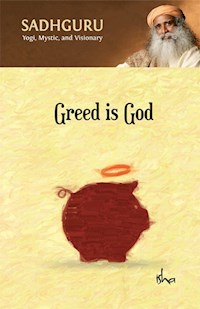
"If you become absolutely greedy, then you become spiritual." – Sadhguru. In a never before seen or read context, Greed is God presents an immortal relationship between the material and spiritual aspects of life. Through gripping Q&A sessions with Sadhguru, this vivid connection becomes evident, rooted in the fundamentals of life itself. We find that our quest for "more" – be it more wealth, joy or peace – is driven by an inherent longing in each of us. Sadhguru is a yogi and profound mystic of our times. An absolute clarity of perception places him in a unique space in not only matters spiritual but in business, environmental and international affairs, and opens a new door on all that he touches.
Das E-Book können Sie in Legimi-Apps oder einer beliebigen App lesen, die das folgende Format unterstützen:
Seitenzahl: 127
Veröffentlichungsjahr: 2019
Ähnliche




















Greed Is God
Sadhguru Jaggi Vasudev
Published by Sadhguru, 2019.
While every precaution has been taken in the preparation of this book, the publisher assumes no responsibility for errors or omissions, or for damages resulting from the use of the information contained herein.
GREED IS GOD
First edition. May 26, 2019.
Copyright © 2019 Sadhguru Jaggi Vasudev.
ISBN: 978-1099126420
Written by Sadhguru Jaggi Vasudev.
10 9 8 7 6 5 4 3 2 1
Sadhguru Jaggi Vasudev
Contents
Introduction
Longing for the Ultimate
Desire for Everything
Isha Kriya
Preparation
The Meditation
Introduction
It may seem like a bold statement, but gone are the days of political and religious ideology. This is the era of market economy, where success in the world is determined predominantly by the size of one’s pocket. In so many ways, greed rules and shapes human societies. We are greedy for money, power, recognition
– you name it. But there is one problem. Though we seek to gain control and influence in the name of ambition, it also gains control of us in many ways. Greed is essentially looking to gain more and more for our wellbeing, but in its pursuit we can end up in frustration and ill-health. Many times we try to free ourselves from greed, but we can’t help it!
Sadhguru sheds some light on this human dilemma. The root of greed and desire lies in a fundamental longing which exists in every human being. Each individual longs to be something more than what they are right now. There is a longing to expand which finds expression in different ways. In other words, we are innately greedy and there is nothing we can do about it. Desire is life.
Then what to do with our greed?
To understand this, one must first understand how desire is playing out in our lives. In this book, Sadhguru takes us step-by- step as he delves into the nature of desire, and by association, life as we know it. Desire can be both a joyful process, as well as a painful one. As long as our desires are being fulfilled, desire is a wonderful experience. However, if desires go unfulfilled they can lead to much pain and misery.
Sadhguru relates a story of a man who was worth around 500 million dollars. After a mishap in his ventures with the stock market, he lost much of his wealth and was worth only 50 million dollars. Then his friends brought him to see Sadhguru because he had become depressed and wanted to kill himself – all because he had only 50 million dollars! So despite everything that is going well in your life, even if one desire goes unfulfilled, you can become miserable.
It looks like we are doomed to misery. The only way to alleviate our suffering seems to be by curtailing greed and desire. But Sadhguru declares, “The problem in this world is not of greed; the problem is that people are stingy!” Instead of suffocating ourselves, if we allow our greed to find ultimate expression, it becomes all-inclusive and not a process of manufacturing misery.
What does greed have to do with God? Shunned by spiritualists and religious leaders alike, greed has always been seen as part of the temporal world, not something that mingles with spiritual life. Yet, Sadhguru shirks off this commonly held belief, saying that meditation or spirituality is an all-encompassing, limitless desire. Divorcing from greed is divorcing from life itself.
A daring assertion like “Greed is God” is characteristic of Sadhguru, who is not known to mince words. He covers a range of questions on the topic in depth – from the economic situation of India and greed in the corporate sector, to the guilt associated with desire and the bliss of unbridled greed. In the following pages, his refreshingly direct, honest and insightful discourses peel off layers of misconception and deliver one to a realm of clarity.
Greed is the Goal
“A feeble life cannot meditate, a feeble life cannot love, and a feeble life will never blossom because it is a half-life, not a full life. If this has to be a roaring piece of life, its desire should be limitless.”
Many people have been brought up on the idea or ideology that contentment is the greatest virtue. If you are content with whatever you have, it simply means you are not even aware of the larger possibility of life. The possibility of a human being steering his own evolution and blossoming into a state of fragrance and beauty has been completely discounted; that is the only reason why people are content.
Once, it happened that a newly married woman went back to her mother’s place and said, “My husband is such a wonderful man. He gives me whatever I ask for.”
The worldly-wise mother looked at her and said, “Obviously, you are not asking for enough.”
Obviously, you are not asking enough from life, that is why you are content. “If I am greedy would it be better?” Yes, you must be greedy. Right now you are stingy about your greediness. The problem in this world is not of greed; the problem is that people are stingy. That is why they do not aspire for the biggest possibility – they want to save themselves for the next world. If you were greedy, you would want everything from life. Would you just be satisfied with a little more money, power, or pleasure? If you were truly greedy you would aspire for the highest.
The word “enough” must be removed from our vocabulary because it is relevant only to the physicality of life. If you are being served food, at some point you have to say “enough.” “Enough” has become valuable in people’s minds only because they have not explored dimensions beyond the physical.
The physical is a limited quantity by itself. If you get greedy with the physical, there will not be enough for somebody else. If you take all the food, someone else cannot eat. If someone takes all the land, no one else will have anything. Mahatma Gandhi said, “The world has enough for everyone’s need, but not enough for everyone’s greed.” That is true of the physicality.
If the realm of your experience is limited to the physical nature of existence, contentment seems like a good idea. But if your life is beginning to explore dimensions beyond the physical, if something beyond the physical is becoming a living reality in your life, contentment is a very bad idea. You will destroy the very possibility of becoming a limitless, boundless nature. The moment you say, “I will be content,” it is a boundary. When you say, “This much is enough” you are drawing that much of a boundary.
Contentment is just containment. You are trying to draw a boundary with some semblance of sanity for yourself. But that boundary satisfies you and gives you sanity only for a short period of time. Then it has to be expanded, otherwise it will not work. People are trying to achieve contentment at various levels, at different stages of life. At the age of twenty, whatever you thought would be your contentment, did it remain the same when you turned thirty? Similarly, whatever your ideas of contentment at thirty, do they remain the same at forty? Your idea of contentment subsides only when you are going down the tube or your life is a total failure. But when you are on an upswing, your ideas of contentment continue to expand; that is, if you have an opportunity, you will expand.
If you take away the selective or discriminatory nature of your desire, then it has no limits; it does not choose. Now contentment will be a very silly idea, because it will stunt you as a human being and make you into a limited entity. Maybe you will become a good cog in society that fits into some mechanism that needs to work, but you will not blossom into a new dimension of existence.
“Success” has become another name for contentment. When you say, “I am successful,” it means you have reached a place where you can rest, where you think it is enough. Enough and contentment is not a good idea, and your limited ideas of success are no good either. However much you acquire or achieve, it is not success. Until you have broken all barriers and become boundless, you cannot call it success. Until your being allows itself to blossom to a boundless state, you should not be content; you must burn with discontent. This seems to be against all traditional teaching that you received; you have always been told that you must be content. In a way, contentment has been taught to people by political establishments, because if you were discontent you could start a revolution.
Contentment need not enter our lives as an ideology. If your aspiration or desire is not selective, naturally you would not limit yourself to the physicality of existence. Then, desire becomes a powerful energy to expand and burst open this being who is containing himself with contentment.
The very nature of a human being is to constantly desire to be something more than what he is right now. You are always longing to have a little larger slice of life than what is there now. The means that are employed to achieve that may vary from person to person. One person may believe with more money, knowledge or power it will happen; someone else may believe it will happen only by seeking God – but one way or the other, every human being is longing to be something more than what he is right now. You cannot stop this. If you carefully look at your desiring process, you will find that it is not about money, power or wealth; in some form you want to expand, that is all. How much expansion will settle you for good? If I make you the king or queen of this planet would it settle you? No, because then you would look at the stars. Is this not the nature of the human being? If I gave you the whole planet, won’t you look at the stars? If no amount of expansion is going to settle you, what is it that you are seeking? You are looking for unlimited expansion – and that is spirituality.
Contentment is just a cautious way of attending to boundlessness. You want to go towards boundlessness in installments. If you seek it in installments, you are a lost case because nobody has ever reached what we refer to as the infinite by counting 1, 2, 3, 4, 5... If you choose installments as a way towards boundlessness, you will become endless counting. Start counting today, and keep counting at your own pace. Don’t stop. See how far you can go without tiring yourself. I don’t mean physical exhaustion; you will get tired of counting simply because you know it does not get you anywhere. Endless counting will tire you someday.
Once, an accountant went to bed, but he could not sleep. He had heard the old advice that if you count sheep you can fall asleep. So he started counting sheep in his mind, and he lost one of them. Then he spent the rest of the night trying to find it.
After all, the whole thing is your invention. The only real number which exists is zero. 1, 2, 3, 4, 5 are all human invention. Because they could not invent more numbers than their fingers, they added a zero and said 11, 12, 13. If you simply start counting, you will realize that you are on an endless process, a sheer waste of life. If you lose a number in between, you will not sleep because you would have to go back and find that number which does not exist.
Desiring is a limitless process, but you are limiting it by being selective. If you take away the discriminatory nature of your desire and sit here right now not desiring for anything in particular, you will see the energy that you call as desire becomes a powerful force to become meditative.
Meditation and devotion are just a powerful desire without a goal. If your energy becomes full force, if you desire for everything, this is meditation. Right now, you have become a feeble life, not a roaring life because they have taught you, “Enough, enough, I am content with what I have.”
A feeble life cannot meditate. A feeble life cannot love. A feeble life will never blossom because it is a half-life, not a full life. If it has to become a roaring piece of life, its desire should be limitless. If you create a desire like this, “Until I can grasp everything that there is in this existence, I will not rest,” you may not sleep tonight, but you will be a roaring piece of life. This is not about depriving yourself of sleep; when you are exhausted, the body will anyway flop. The process of sleep is a must because the body needs rest. At the same time, it should only go to sleep at the very last moment when it cannot take it anymore, and wake up the very first moment when the possibility of life arises within it. It should sleep like a stone. If it is tossing and turning that means it is going to bed too early or using something to blanket itself from life. The first moment it can wake up, it should be up and ready to do what it has to do.
If you are on a spiritual path, there is no such thing as contentment. Greed is the rule. A human being should seek nothing less than everything. When he seeks everything, small things will not keep his attention. He will not be thinking of food, currency, or pieces of property – he will be thinking of the largest possibility. If you are desiring for everything, would ten crore rupees be a big thing on your mind? It would be nothing for you. The planet Earth would also not be a very big object in your mind. It is a tiny piece of nothing in this vast galaxy.
If you become absolutely greedy, then you become spiritual. If you are stingy in your greediness, you just become materially greedy. It is stinginess which is the problem, not greed. You are so stingy that you will not smile fully, laugh fully, cry fully, dance fully, sing fully, or do anything fully. This is stinginess, not greed. If you are greedy, you would aspire that not just you, but everything in the existence should be well.
Let us say you were thinking only about your personal wellbeing, then you fell in love with one more person – now you start thinking of one more person’s wellbeing. If you produce two children, you are thinking of two more people’s wellbeing. If there is a little more love, you start thinking your whole community should be well. A little more and you become a deshbhakta or a patriot; you are thinking the whole country should be well. If you become a little more borderless, you are thinking the whole world should be well.
All that you are doing is expanding your areas of greed. If you desire for everything, wouldn’t you naturally also desire for everything and everyone’s wellbeing? It would be very natural for you to seek the wellbeing of everyone and everything because that is the nature of the existence itself.




