


33,99 €
Mehr erfahren.
- Herausgeber: John Wiley & Sons
- Kategorie: Geisteswissenschaft
- Serie: Ancient World
- Sprache: Englisch
"Greek Religion . . . already has the standing of a classic, and the publication of an English version, which incorporates new material and is in effect a second edition, demands a toast . . . Anyone who pretends to survey Greek religion must be phenomenally learned. Burkert is. His book is a marvel of professional scholarship."
London Review of Books
"This book has established itself as a masterpiece, packed with learning but also rich in ideas and connections of every sort. Its appearance in a good English translation is an event not only for Hellenists but for all those interested in the study of religion . . . nobody else could have produced an account of the subject of comparable range and power. This will be the best history of Greek religion for this generation."
New York Review of Books
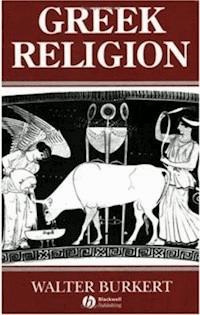
Cover illustration: detail from an Attic vase, 450 B.C., showing a victory sacrifice (The Mansell Collection).
Sie lesen das E-Book in den Legimi-Apps auf:
Seitenzahl: 1258
Veröffentlichungsjahr: 2013
Ähnliche




















Contents
Preface to the English Edition
Introduction
1 A Survey of Scholarship
2 The Sources
3 The Scope of the Study
I Prehistory and the Minoan–Mycenaean Age
1 The Neolithic and Early Bronze Age
2 Indo-European
3 The Minoan–Mycenaean Religion
4 The ‘Dark Age’ and the Problem of Continuity
II Ritual and Sanctuary
1 ‘Working Sacred Things’: Animal Sacrifice
2 Gift Offerings and Libation
3 Prayer
4 Purification
5 The Sanctuary
6 Priests
7 The Festival
8 Ecstasy and Divination
III The Gods
1 The Spell of Homer
2 Individual Gods
3 The Remainder of the Pantheon
4 The Special Character of Greek Anthropomorphism
IV The Dead, Heroes, and Chthonic Gods
1 Burial and the Cult of the Dead
2 Afterlife Mythology
3 Olympian and Chthonic
4 The Heroes
5 Figures who cross the Chthonic-Olympian Boundary
V Polis and Polytheism
1 Thought Patterns in Greek Polytheism
2 The Rhythm of the Festivals
3 Social Functions of Cult
4 Piety in the Mirror of Greek Language
VI Mysteries and Asceticism
1 Mystery Sanctuaries
2 Bacchica and Orphica
3 Bios
VII Philosophical Religion
1 The New Foundation: Being and the Divine
2 The Crisis: Sophists and Atheists
3 The Deliverance: Cosmic Religion and Metaphysics
4 Philosophical Religion and Polis Religion: Plato’s Laws
Notes
Bibliography
Index of Greek Words
Index
UXORI
English translation © 1985 by Blackwell Publishing Ltd and Harvard University Press
Originally published in German as Gricchifichc Religion der archaischcn und klassischett Epoche, in the series Die Religionen der Menschheit, vol. 15.© 1977 by Verlag W. Kohlhammer, Stuttgart
BLACKWELL PUBLISHING
350 Main Street, Maiden, MA 02148-5020, USA
9600 Garsington Road, Oxford OX4 2DQ, UK
550 Swanston Street, Carlton, Victoria 3053, Australia
All rights reserved. No part of this publication may be reproduced, stored in a retrieval system, or transmitted, in any form or by any means, electronic, mechanical, photocopying, recording or otherwise, except as permitted by the UK Copyright, Designs, and Patents Act 1988, without the prior permission of the publisher.
English translation first published 1985
First published in paperback 1987
12 2012
British Library Cataloguing in Publication Data
Burkert, Walter
Greek religion: archaic and classical
1. Greece—Religion
I. Title II. Griechische Religion der archaischen und klassischen Epoche. English
292′.08 BL782
ISBN 978-0-631-15624-6
The publisher’s policy is to use permanent paper from mills that operate a sustainable forestry policy, and which has been manufactured from pulp processed using acid-free and elementary chlorine-free practices. Furthermore, the publisher ensures that the text paper and cover board used have met acceptable environmental accreditation standards.
For further information on Blackwell Publishing, visit our website:www.blackwellpublishing.com
Preface to the English Edition
The German edition of this book was published in 1977; the transformation into an English book of 1985 can hardly be complete. The author has used the chance to add references to important new publications that came to his knowledge in the intervening years, especially to newly discovered evidence and to new standard works. Most progress and change is going on in the field of Minoan and Mycenaean religion, so that the short account contained in the first chapter of this book must be taken as a source of clues rather than final results.
W.B.
Introduction
1 A SURVEY OF SCHOLARSHIP
Greek religion1 has to some extent always remained familiar, but is far from easy to know and understand. Seemingly natural and yet atavistically estranged, refined and barbaric at the same time, it has been taken as a guide again and again in the search for the origin of all religion. But as a historical phenomenon it is unique and unrepeatable, and is itself the product of an involved prehistory.
In Western tradition an awareness of Greek religion was kept alive in three ways:2 through its presence in ancient literature and in all literature formed on that model, through the polemics of the Church Fathers, and through its assimilation in symbolic guise to Neoplatonic philosophy. The allegorical method of exposition, which taught that the names of the gods should be understood on the one hand as natural and on the other hand as metaphysical entities, had at the same time also been taken over in literature and philosophy alike. This offered possibilities for attempting a reconciliation with the Christian religion. Friedrich Creuzer’s Symbolik3 is the last largescale and thoroughly unavailing endeavour of this kind. There was, however, another path which could be taken, namely, to construct a self-consciously pagan counter-position to Christianity. The fascination which this idea exercised can be traced from the time of the Renaissance to Schiller’s poem Die Gotter Griechenlands (1788) and Goethe’s Braut von Korinth (1797) and is evident again in the work of Friedrich Nietzsche and Walter F. Otto.
The historical criticism of the nineteenth century abandoned such efforts to fill ancient religion with direct meaning and relevance and devoted itself instead to the critical collection and chronological ordering of the source material. Foremost in this line is Christian August Lobeck’s Aglaophamus,4 which reduced the speculations about Mysteries and Orphism to tangible but undeniably banal realities. A more exciting approach was inspired by the Romantic movement: myths were seen as witnesses to a specific Volksgeist, and accordingly the Greek ‘sagas’ were traced back to the individual Greek tribes and their history. Here it was Karl Otfried Mullers5 who led the way, and the same path was still followed by Wilamowitz, the master of historical philology, right up to the work of his old age Der Glaube der Hellenen.6 It was, as it were, an extension of the same project when, hand in hand with the rise of Sanskrit studies, the dominant concern for a time became the reconstruction of an Indo-European religion and mythology. With further progress in historical linguistics, however, this enterprise, which had remained deeply indebted to the nature allegorizing of antiquity, 7 was for the most part abandoned.
The picture of Greek religion had long been defined by myths transmitted in literary form and by the ideas or beliefs drawn from them, but the study of folk-lore and ethnology brought about a decisive change in perspective. Using new methods of field-work, Wilhelm Mannhardt was able to set European peasant customs alongside their ancient counterparts8 with the result that the customs of antiquity, the rituals, were brought into focus beside the myths. Customs ancient and modern consequently appeared as the expression of original religious ideas centring on the growth and fruitfulness of plant, animal and man in the course of the year: the Vegetation Spirit which dies to rise anew became the guiding idea. In Germany, Mannhardt’s synthesis of peasant customs and sophisticated nature allegorizing was continued first by Hermann Usener9 and then by Albrecht Dieterich.10 With the founding of the series Religionswissenschaftliche Versuche und Vorarbeiten (1903) and the reorganization of the Archiv for Religionswissenschaft (1904), Dieterich established the history of religion as an independent discipline based on the study of the religions of antiquity. Martin P. Nilsson, author of the most important and still indispensable standard works on Greek religion,11 placed himself unequivocally in this tradition.
Developments took a parallel course in England where reports of savage peoples and especially of their religions were flowing in from all parts of the colonial empire; the interest in religion was not entirely surprising since the ethnologists were almost all missionaries. Whatever was alien was understood as primitive, as the ‘not-yet’ of a beginning which contrasted with the Englishman’s own self-conscious progressiveness. The synthesis of this view of Primitive Culture was furnished by E.B. Tylor;12 he introduced into the history of religion the concept of animism – a belief in souls or spirits which precedes the belief in gods or a god. The stimulus which this gave to the study of the religions of antiquity was made apparent in the Cambridge School. In 1889-90 three books were published almost simultaneously: The Religion of the Semites by W. Robertson Smith,13Mythology and Monuments of Ancient Athens by Jane E. Harrison,14 and the first edition of The Golden Bough by James George Frazer.15 Common to all these works is that here, too, the investigation of tual becomes the central concern. Jane Harrison, who as an archaeologist based her studies on the vase paintings and monuments, sought to illuminate a pre-Homeric, pre-Olympian religion: the ‘Year Daimon’, following Mannhardt’s example, became a key concept. Frazer united Mannhardtian ideas with the fascinating theme of the ritual killing of the king and in his collections of material, which grew from edition to edition to monumental proportions, he also drew on the newer theories of Totemism16 and Preanimism. Preanimism17 was then believed to be the most primitive form of religion: belief in an impersonal mana. This view was also taken over by Nilsson.18
The Cambridge School gained wide influence, especially with its tracing of myths to rituals: ‘Myth and Ritual’19 has remained a rallying cry down to the present day. Jane Harrison’s pupils and colleagues, Gilbert Murray and Francis Macdonald Cornford, advanced, respectively, the theory of the ritual origin of tragedy20 and the theory that cosmogonic ritual lay behind the Ionian philosophy of nature,21 and these ideas were to have a profound and stimulating effect not only on the study of antiquity but on literary and philosophical culture in general. Frazer’s mythological motif of the dying god, Adonis–Attis–Osiris, combined with the idea of sacral kingship, offered a key which seemed to open many doors. It is only within the last decades that the influence and reputation of ‘Golden Bough anthropology’ has fallen sharply; a more rigorous methodological awareness has come to prevail in ethnology and in the specialist philologies and archaeologies, and increasing specialization has brought with it a mistrust of generalizations; but at least in Anglo-American literature and literary criticism the Frazer–Harrison tradition is still alive.
In the meantime, however, two new schools of thought had emerged about the turn of the century which were to transform intellectual life and its selfawareness: Emile Durkheim developed a radically sociological viewpoint and Sigmund Freud founded psychoanalysis. In their theses concerning the history of religion both writers closely followed Robertson Smith’s account of the sacrificial ritual.22 In both schools the alleged absolute and independent status of the mind is compromised, conditioned on the one hand by supraindividual social forces and on the other by unconscious psychic forces. When confined to an economic base, this is also the thesis of Marxism, but Marxist contributions to the history of religion have often been vitiated by a politically enforced orthodoxy bound to the state of the science at the time of Friedrich Engels.23
The immediate consequence of this revolution for the study of religion is that the investigation of representations, ideas, and beliefs can be at best only a preliminary goal: only when these are incorporated within a more comprehensive functional context can they become meaningful. The sociological challenge found a swift response in Jane Harrison’s book Themis, and then in the works of Louis Gernet24 and the subsequent Paris School of Jean-Pierre Vernant. Karl Meuli’s original and fundamental contributions to the understanding of Greek religion arose from Freudian insights combined with the study of folk-lore;25 E.R. Dodds was also able to adduce psychoanalytic perspectives to shed light on Greek intellectual history.26 From a historical point of view the psychological and sociological aspects can be reconciled, at least in principle, by the hypothesis that the development of social forms, including religious rituals, and the development of psychic functions have proceeded in constant interaction, so that in terms of the tradition the one is always attuned to the other.27 At present, however, attention tends to focus on an ahistorical structuralism concerned with formal models and confined to presenting in their full complexity the immanent, reciprocal relationships within the individual myths and rituals.28
The work of Walter F. Otto29 and Karl Kerenyi is in a category of its own. Die Gotter Griechenlands (1929) is a challenging attempt to take the Homeric gods seriously as gods, in defiance of 2,500 years of criticism: the gods enjoy an absolute actuality as Urphiinomene in Goethe’s sense of the term. This path, which ends in a sublime private religion, is not one which can be taken by everyone, but the work still radiates a powerful force of attraction. Karl Kerényi30 explicitly aligned himself with Walter F. Otto: gods and rituals appear with profound significance but without rational explanation; the synthesis with C.G. Jung’s theory of archetypes was established only fleetingly. In the harsh climate of the present it is questionable whether the autonomy of images can maintain its spell and power.
2 THE SOURCES
The mediation of religion and the transmission of information about religion always proceed through language, though not through language alone. The most important evidence for Greek religion remains the literary evidence, especially as the Greeks founded such an eminently literary culture. Nevertheless, religious texts in the narrow sense of sacred texts are scarcely to be found: there is no holy scripture and barely even fixed prayer formulae and liturgies; individual sects later possess their special books such as those of Orpheus,1 but even these are in no way comparable with the Veda or Avesta, let alone the Torah. New hymns are composed for each festival of the gods by poets: almost all archaic choral lyric is cult lyric, and the rhapsodes introduce their festal recitations with Homeric Hymns. Interweaving tales of the gods with heroic narratives, epic poetry, pre-eminently the Homeric Iliad, set its seal on the way the gods were imagined.2 By the beginning of the seventh century Hesiod had brought the myths of the gods together within a theogonic system to which the arbitrarily extensible Catalogues of hero myths were appended.3 Classical tragedy then portrays the suffering and destruction of the individual caught in the mystery of the divine. Thus practically the whole of ancient poetry is our principal evidence for Greek religion: even comedy provides important additions to our knowledge from the point of view of the ordinary man or through burlesque parody.4 Yet only a small part of the literature has survived; the content of what has been lost is preserved in part in mythographical compendia, by far the most substantial of which is the Library which circulated under the name of Apollodorus.5
From the fifth century onwards, historia, the investigation and collection of traditions, became a distinct literary genre. Customs, the dromena or rituals, are here described in conjunction with the mythical narratives. The historical writings of Herodotus represent the oldest surviving and most important example of this genre. In the fourth century, local historians in many places begin to devote themselves to cultivating their own traditions – none with greater zeal than the ‘Atthidographers’ of Athens.6 Hellenistic poetry was later to make great play with their erudition.7 Detailed descriptions of prevalent customs were incorporated into the geographical writings of Strabo8 and also into Pausanias’ travel guide through Greece.9 Finally, we find scattered among Plutarch’s wide-ranging writings a number of particularly important details of rituals of which he had first-hand knowledge. From all these sources there emerges a differentiated and often detailed picture of Greek rituals, always perceived, of course, through the medium of literary form, never as the act of the participant, but only in an external aspect mediated through a real or fictitious observer.
The sacred laws which have survived in large numbers on inscriptions provide direct documentation of religious practice,10 but they, too, present only an outward face of the cult. For the most part they are public qecrees or decrees of religious associations, in particular statutes and calendars of sacrifices, and they deal predominantly with organizational and financial questions. Nevertheless, they yield first-hand information about priesthoods, cult terminology, names and epithets of gods, and occasionally specific rituals. Even accounts and inventories can be very revealing in matters of detail.
The monuments of Greek art, the temples, statues, and vase paintings, bear spectacular witness to Greek religion.11 A number of temples in places such as Athens, Agrigentum and Paestum have survived through the ages; Roman copies of Greek images of the gods have for centuries communicated the most lively impression of ancient religion, and for more than a hundred years now scientific archaeology has been uncovering an unpresaged and quite overwhelming wealth of evidence. The early period of Greek history in particular has emerged in extraordinary intensity. The Acropolis and Olympia, Delphi and Delos, the major sanctuaries and innumerable minor sanctuaries have been excavated, and in each case the history can be determined with precision: pottery provides a firm foundation for the chronology and the slightest architectural remains make overall reconstructions possible.12 Valuable indications of the rituals performed in these places are furnished by cult monuments, altars, and ritual vessels. Deposits of votive gifts are especially instructive:13 these gifts often bear votive inscriptions which have yielded a vast corpus of divine names and epithets, providing precise information on the diffusion of individual cults. Where written sources are lacking, however, the function and meaning of installations and artefacts often remain obscure.
The visual arts have nevertheless come to occupy a place of almost equal importance alongside the written sources. Although the cult statues themselves have effectively disappeared, vase paintings, votive statues, and late replicas make it possible to trace the development of the representation of the gods step by step from the Early Archaic period onwards.14 The vase paintings of mythological scenes, which appear from about 700, are often very much earlier than the surviving written sources.15 Paintings of ritual scenes which offer an insight into the reality of the cult are comparatively rare but especially important.16
Religious disposition may be gauged indirectly from the use of theophoric names, proper names which assign a person to a specific god and often designate him as the gift of the god: Apollodotos and Apollodoros, Herodotos and Herodoros, Apollonios, Athenaios, Hekataios, Dion, Heron, Apelles and many others.17 Theophoric names are also widespread throughout the Ancient Near East, but seem to be non-existent in the Mycenaean world and appear only marginally in Homer.18 The theophoric names reflect the diffusion and popularity of the individual god, subject, of course, to certain qualifications: family tradition may retain a name once it has been introduced, without giving any thought to its significance.
The disparity in date between the mythological paintings and the texts is in itself a clear indication of the impossibility of producing an account of archaic and classical Greek religion based solely on contemporaneous sources. Often it can be clearly shown, and in most cases it is probable, that the writings of the late mythographers and the individual notes in the commentaries on classical texts are based on literature of the Classical and Early Hellenistic ages; the Library of Apollodorus to a large extent repeats the Hesiodic Catalogues; accounts of rituals are often drawn from the local historians of the fourth century. At the same time, however, a stubborn local tradition must have persisted outside literature: the myth of Demeter of Phigaleia,19 which is recorded by Pausanias alone, must somehow go back to the Bronze Age, and all the more, many of the rituals which Plutarch and Pausanias observed must be of high antiquity. For this reason, such late sources will often be adduced in the following pages: the date of these sources provides merely a terminus ante quem for the practice which they record.
If religion is quintessentially tradition, then an account of Greek religion can little afford to lose sight of the still earlier pre-Homeric and pre-Greek world. Since the spectacular successes of Heinrich Schliemann and Sir Arthur Evans in bringing to light the Cretan–Mycenaean age,20 knowledge of the prehistory and early history of the areas surrounding Greece has been extended and deepened enormously: connections have emerged linking Greece with the Bronze Age Near East and, even further back, with the European and Anatolian Neolithic.21 Of quite fundamental importance is the recognition that the Greek Homeric religion does not exist in unique and splendid isolation, but is to be regarded primarily as a representative of a more general type, as belonging within a Bronze Age kainé. It is consequently ever more difficult even to survey and record these multiple interrelationships, let alone to work them into a synthesis. The material to be considered grows apace; the problems increase.
3 THE SCOPE OF THE STUDY
An adequate account of Greek religion is nowadays an impossibility in more ways than one: the evidence is beyond the command of anyone individual, methodology is hotly contested, and the subject itself is far from well defined. It is therefore easier to say what the present book cannot be, and is not intended to be, than to say what it is: it is not a comprehensive handbook of the kind produced by Martin P. Nilsson some forty years ago, it is not a prophetic evocation of the kind ventured by Walter F. Otto, and it is not a book of pictures of the kind which give the works of archaeologists their fascination. What this book seeks to do is to indicate the manifold variety of the evidence and the problems of its interpretation, always with an awareness of the provisional nature of the undertaking. No claim is made to completeness, either in respect of the sources or in respect of the scholarly literature. Space does not permit a detailed discussion of all that is enigmatic and disputed. In particular, the reader may regret the absence of a satisfactory account of the religion of the tragedians, but this question is too subtle to be treated within the space of a few pages. Religion appears here more as a supra-personal system of communication. At the same time, the book strives to present as many primary sources as possible and to give prominence in the selection to those things which fit into meaningful contexts.
Like Greek civilization itself, Greek religion is delimited in time and place by the reach of Greek language and literature. Only with the triumph of Christianity and the devastations of the barbarian migrations does Greek religion truly come to an end; the Olympic Games and the Eleusinian Mysteries continued until the proscription of all pagan cults by the Emperor Theodosius in AD 393. The beginnings lie in the darkness of prehistory. But with the destructions and migrations about and after 1200 BC a similarly momentous caesura occurred;1 the term Greek will be used only for the civilization which commences on this side of that boundary, in contrast to the earlier Mycenaean civilization. But as a background to the Greek religion, an outline of the Minoan–Mycenaean religion is indispensable. It is only in the ninth/eighth century, however, that Greek religion emerges with truly recognizable contours; literature and vase paintings go back little before 700. These limits would still define a period of some 1100 years, a time filled with military, social, economic and spiritual convulsions. The present volume, however, takes the revolution marked by the conquests of Alexander as its lower boundary. These conquests extended the horizons of the Greeks to an unprecedented degree, established new centres of Greek culture and at the same time brought new contact with the high civilizations of the East; they were truly epoch-making. The proper subject of our study may therefore be defined as the religion of a group of cities and tribes united by bonds of language and culture in Greece, on the Aegean islands and along the coast of Asia Minor, together with their colonies from the Black Sea to Sicily, southern Italy, Marseilles, and Spain during the Late Geometric, Archaic and Classical periods – approximately between 800 and 300 BC. The form of life in which this epoch is cast is the Greek polis.
How far we are justified in speaking simply of Greek religion is, of course, a question which arises even within the limits of the period defined: each tribe, each locality and each city has its own tenaciously defended tradition, general religious movements are then recorded, and finally religion itself enters a crisis with the rise of philosophy. Would it not be more correct to speak in the plural of Greek religions?2 Against this must be set the bond of common language and, from the eighth century onwards, the common Homeric literary culture; at this time also, a number of sanctuaries gained Panhellenic importance, most notably Delphi and Olympia, and, local idiosyncrasies notwithstanding, there emerged the typically Greek style of visual art which was later to dominate the entire Mediterranean. Moreover, in spite of all emphasis on local or sectarian peculiarities, the Greeks themselves regarded the various manifestations of their religious life as essentially compatible, as a diversity of practice in devotion to the same gods, within the framework of a single world. That this world included the Greek gods was not questioned even by Greek philosophy.
Ritual and myth are the two forms in which Greek religion presents itself to the historian of religion. There are no founding figures and no documents of revelation,3 no organizations of priests and no monastic orders. The religion finds legitimation as tradition by proving itself a formative force of continuity from generation to generation. Ritual, in its outward aspect, is a programme of demonstrative acts to be performed in set sequence and often at a set place and time – sacred insofar as every omission or deviation arouses deep anxiety and calls forth sanctions. As communication and social imprinting, ritual establishes and secures the solidarity of the closed group; in this function it has doubtless accompanied the forms of human community since the earliest of times.4 Sacred ritual involves the invocation of invisible powers which are addressed as a personal opposite: they are called gods, theoi, as soon as we have texts. Myth, a complex of traditional taies,5 has more to say of these gods, but among the Greeks these tales are always taken with a pinch of salt: the truth of a myth is never guaranteed and does not have to be believed. But quite apart from the fact that mythology is at first the sole explicit form of intellectual activity and the sole mode of coming to terms with reality, the importance of the myths of the gods lies in their connection with the sacred rituals for which they frequently provide a reason, an aetiology, which is often playfully elaborated. The art of poetry then gave individual myths a fixed and memorable form, and the recitation of this poetry became in turn an essential part of every festival. Greek myth, complex in essence and actuality, therefore eludes all one-dimensional classifications and analyses.
I
Prehistory and the Minoan–Mycenaean Age
1 THE NEOLITHIC AND EARLY BRONZE AGE
Ancient religion is tradition, as old, perhaps, as mankind; but its tracks are lost in prehistory as time scales expand. The measurement of epochs from the eighth century BC onwards is made in centuries or even decades, but before this lie four ‘dark centuries’ and then some eight centuries of Bronze Age high civilization. The Early Bronze Age stretches back over a further thousand years and the Neolithic extends over more than three millennia. The Upper Palaeolithic, which then spans more than 25,000 years, still leaves the beginnings of human history almost as remote as ever; there are indications of religious continuity stretching from the Lower Palaeolithic.1
For all periods of prehistory the evidence of language to interpret the manifold and often confusing finds is lost forever. Moreover, what survives is always only a very one-sided assortment of remains decided by the accidents of physics and chemistry. More can be known of burials than of life itself. Pottery sherds can be identified and classified most accurately, and so, for the period following the discovery of ceramics, it has been this which has determined the demarcation and chronology of the individual cultures. The modes of behaviour, to say nothing of the ideas, of early man can generally be comprehended only indirectly; and as the material to be considered grows and as methods progress, there is increasing wariness of over-hasty interpretation: it is no longer acceptable to call everything that is not understood religious or ritual and to explain it by means of some tenuously drawn analogy. But like all minimalism, the critical demand for positive proof of religious meaning in each and every case is in danger of ignoring precisely what is most important. Many of the elements of religion such as processions and dances, garlands and masks, sacraments and rituals, may leave behind not the slightest remaining trace. Occasionally early pictorial art may help, but this brings its own problems of interpretation.
Another path which leads into prehistory is language itself. Greek belongs to the group of Indo-European languages, and the scholarly reconstruction of ‘Proto–Indo-European’ postulates the existence of an Indo-European people in the fourth or third millennium. But the problem which this presents of establishing an unequivocal relationship between the results of linguistic research and the findings of archaeology seems quite insoluble: neither the Indo-European homeland, nor the migration of the Indo-European Greeks into Greece, nor even the very much later historically attested Dorian migration can be identified conclusively on the basis of excavation finds, ceramics or burial forms.2
Greece was already inhabited in the Palaeolithic.3 Continuous settlements commence with the Early Neolithic4 in the seventh millennium; at the beginning of this period pottery was still unknown. These settlements mark the decisive transition from a hunting and gathering society to an agrarian and livestock-raising society. The centres were consequently the fertile plains, primarily the plains of Thessaly: here the first and most important site to be investigated was at Sesklo,5 which was to give its name to the stages of Neolithic Greek culture. The Neolithic culture spread northwards to Macedonia and southwards to Boeotia, Argolis, and Messenia; before the end of the seventh millennium its influence had extended as far as Crete.
This agrarian culture, the earliest in Europe, came from the East. Neither the grains, barley and wheat, nor the most important domestic animals, the goat and the sheep, were native to Greece. The origins of Neolithic culture lie in the fertile crescent between Iran and Jericho and its diffusion proceeded via Asia Minor: the recent excavations at Çatal Hüyük and at Hacilar6 have revealed a centre in southern Anatolia with features which clearly point towards Sesklo. Painted pottery also arrived in Greece from the East, as did metallurgy in the third millennium and later still the stimulus to high civilization and the art of writing: such is the meaning of the phrase East–West culture drift.7 From the sixth millennium onwards, however, peasant cultures were also developing to the north in the fertile Danube valley beyond the Balkan mountains, and these repeatedly irrupted into Greece: features of the fort and pottery found at Dimini in Thessaly are explained by an incursion of this kind in the fourth millennium.
As a whole the Greek Neolithic seems to span some three thousand years without any radical breaks and without any far-reaching differentiation. Throughout this entire period evidence for religion is sparse,8 and as the period progresses, it becomes, if anything, even more so. The most important complex of finds with a supposed religious significance are the figurines which are also found accompanying the Neolithic Ages in Asia, Africa and Europe: they are small terracotta or occasionally stone figures which mostly represent naked women, often with an exaggerated emphasis on the belly, buttocks, and sexual organs. They have forebears as early as the Palaeolithic and persist in various forms into the high civilizations – in Greece at least into the Archaic Age. From beginning to end they are accompanied by the problem of interpretation: an earlier, widely accepted interpretation saw them as representations of a Mother Goddess, the embodiment of fertility in man, animal, and earth. It is then tempting to proceed to draw numerous connections with the predominance of female deities in the historical Greek cult and with the Mycenaean Mistress. This goes far beyond the evidence: groups of these figures are often found together, and there is no evidence for any special connection with sanctuaries. Consequently the Mother Goddess interpretation has come to be regarded with increasing scepticism.9
The most intriguing, most impressive and most unambiguous discoveries are those from Çatal Hüyük. The Early Neolithic town here contains a series of sanctuaries, specially equipped chambers in the many-roomed houses: their distinctive features are secondary burials of the dead, cattle horns set into benches, figurative wall paintings and, most strikingly, wall reliefs of a Great Goddess with uplifted arms and straddled legs – clearly the birth-giving mother of the animals and of life itself. A female statuette is found accompanied by a boyish consort, another fulsome female figure enthroned between leopards is giving birth to a child, and a wall painting shows men masked as leopards hunting a bull: the association with the Asia Minor Great Mother of historical times, with her leopards or lions, her paredros, and with the society of men and bull sacrifice is irresistible. Here we have overwhelmingly clear proof of religious continuity over more than five millennia.
It is nevertheless questionable whether on the basis of East–West culture drift this evidence can be used to shed light on Neolithic religion as such, and in particular on the religion of Neolithic Greece. From Adonis Attis Osiris J.G. Frazer distilled the primitive idea of the Great Goddess with her dying consort who symbolizes the annual decay and return of vegetation, and Sir Arthur Evans rediscovered her in the iconography of the Minoan world;10 but here, too, the great synthesis has long since been challenged: specialist research lays emphasis on the peculiarities of each individual area, and the minimal opportunities for communication in the Stone Age would lead one to expect fragmentation rather than spiritual unity. And indeed, among the Sesklo statuettes there are a number of male figures shown seated on a throne,11 whereas the female figures stand or cower: this would seem to indicate a patriarchal order or perhaps a male god or even a divine couple; there are also figures of the so-called Kourotrophos type showing a seated woman holding a child.12 The ithyphallic male statuettes13 and simple phalloi14 may signify fertility, but they might equally serve for the apotropaic demarcation of territory; in no way can this be decided.
A building in Nea Nikomedeia in Macedonia has been described as a temple: it is free-standing and relatively large and lies at the centre of the settlement; it contained distinctive vessels and five figurines.15 It dates from the sixth millennium – further removed in time from Homer than Homer is from the present day. Elsewhere some not undisputed evidence for sacrificial sites and altars has been found.16 Offering pits containing layers of ash, animal bones, potsherds and figurines – especially at the Otzaki–Magula site in Thessaly17 – are attributed to north Balkan influence. A number of caves which later became sanctuaries seem still to have served as dwelling-places during the Neolithic.18
The inertial force of peasant culture and peasant custom must always have maintained a certain continuity of religion on Greek soil. The customary sacrificial animals of the Greeks are the sheep and the ox, the goat and the pig, whereas the ass and the horse are commonly excluded. They were introduced into Greece only in the third and second millennium respectively; the ritual must therefore have settled on the Neolithic domestic animals before this time. At Achillion in Thessaly a small clay mask was found that hung on a pillar-like stand.19 The similarity to the column bedecked with the Dionysos mask as it appears on Greek vase paintings is inescapable, and yet the Neolithic model is dated as early as 6000. A sherd attributed to the Dimini ceramics portrays a human figure with hands raised in the epiphany gesture20 as it appears in Minoan–Mycenaean art and also very much earlier in Çata1 Hüyük.
Of the Greek agrarian festivals, the Thesmophoria give an impression of extraordinary antiquity; they have been proclaimed a Stone Age festival.21 Pig sacrifices are a special feature of these festivals, and terracotta votive pigs are frequently found in Demeter shrines. An impressive clay pig figure, once again dating from the Early Neolithic, has been uncovered at Nea Makri near Marathon;22 the clay pigs studded with grains of corn, which have been found in the Balkans, make their connection with agriculture immediately apparent.23 In Hermione secret sacrifices for Demeter take place within a circle of large unhewn stones; it is difficult to ascribe this to anything other than the Stone Age.24 Various ancient and indigenous features of Greek religion may possibly be seen in such a perspective, even though the evidence is widely scattered and serious lacunae can only be bridged by conjecture; it is possible that new finds may eventually close the gaps.
The Bronze Age arose in the third millennium through renewed stimulus from the East. As the first high civilizations were unfolding in Mesopotamia and the Nile valley, the cultural progress which accompanied the techniques of metal working reached Greece via Asia Minor. Troy25 at this time achieves a first period of prosperity to which the Treasure of Priam bears witness. Greece attains no such heights, but, as a result of increasing division of labour and concentration of wealth and power, town-like walled settlements with large central buildings emerge even there. Lerna in the Argolid has been studied most closely; its name may be connected with the Proto–Hattic language of Anatolia:26 mighty springs give the place its character. A kind of palace was erected here which is known as the House of the Tiles on account of its distinctive ruins; it was violently destroyed about 2100.27
The rhythm of history accelerates; even topographically a more marked differentiation may be perceived. The culture of the mainland, now called Early Helladic, is distinguished from the Cycladic culture of the Aegean islands, and from the Early Minoan culture of Crete, now progressing without a break towards Minoan high civilization.
The evidence for Early Helladic religion seems to be even more meagre than for the Neolithic. Figurines become quite rare, indicating, perhaps, a decline in private or house cults. There is, however, clear evidence of a sacrificial cult. The building in Lerna which preceded the House of the Tiles has yielded a large, flat, rectangular and richly decorated clay basin with a cavity in the shape of a double axe at its centre; it bore traces of burning and must accordingly have served as a ceremonial hearth.28 Conspicuous layers of ash, no doubt left by sacrifices, have been found in round buildings at Orchomenos.29 The most important finds have come from the settlement at Eutresis on Euboea: 30 in one of the houses here, a forecourt and a living room led into a third larger room having, in addition to the usual hearth by the wall, a central stone-built bench and a circular, decorated platform which showed signs of burning and contained fragments of animal bones. An offering pit held ashes, animal bones, and scorched pottery; beside the platform lay a vessel in the shape of a bull, the earliest animal rhyton. Animal sacrifices accompanied with libations must have taken place here, and even though no representation of a god is to be found, this may justly be termed a sanctuary. An offering pit from an earlier level at Eutresis contained a small stone pillar, a baitylos. In the building which preceded the sanctuary the mysterious chasm was discovered – a circular, funnel-shaped pit six metres in diameter, more than three metres deep, and surrounded by a circular wall. Is this to be associated with later round buildings enclosing offering pits? The sanctuary was replaced by yet another remarkable building with a large chamber which contained a central column but no further indications of cultic functions.
When the House of the Tiles was destroyed, obviously by a warlike invasion, a large round tumulus was heaped over the ruins which was to remain undisturbed for centuries,31 a symbol of a lost world and perhaps a cultic centre dedicated to some chthonic power. Those who saw and respected this doubtless already included Greek-speaking Greeks.
The seas around the Cyclades were plied from Early Neolithic times by ships carrying the much-prized obsidian from the island of Melos. The Cycladic culture of the Bronze Age32 was founded on agriculture and craftsmanship combined with maritime trade; in contact with both East and West, small flourishing communities developed a style of their own. Notable are the installations of large graves, some roofed with false corbelling, for multiple burials. It is the graves which have yielded up the greater part of those marble idols of sometimes monumental size which more than anything else have made Cycladic art so well known, indeed almost fashionable. The principal type represents a naked woman, upright though unable to stand on her downward pointing feet, her rigid arms clasped beneath her breast, and her face, barely outlined, pointing upwards. Figures of musicians with a lyre or a flute are also found. The figures were not made exclusively as grave gifts – one large statue was broken in order to fit into the grave. The abstract yet harmoniously finished form is fascinating to the modern eye; interpretation in terms of the history of religion remains no more than speculation. Are they representations of a Great Goddess, the mother of life and death, or are they goddesses, or nymphs, or gifts to the dead man intended to serve him in another world?33 Punched on a silver leaf is the still more enigmatic figure of a Bird Goddess standing upright but apparently provided with a beak and wings.34 Once again all attempts at interpretation must remain conjecture. Yet here, too, we find continuity with later Greek cult in the shape of the characteristic cultic vessel known as the kernos,35 an earthen dish surrounded with small cupules or pots.
Of Helladic religion Nilsson wrote quite simply, “We know nothing.”36 Even now after the excavations of Lerna and Eutresis there is little to be added. Sufficient is now known, however, to establish that the Indo-European/Greek immigrants discovered and took over fully developed cults. In order to demonstrate the Mycenaean origin of Greek mythology, Nilsson37 drew attention to the fact that the centres of the great myth cycles coincide with the Mycenaean centres; yet whether in Thessaly, Boeotia, Aetolia, Attica, Argolis, the Eurotas plain, or in Messenia, in every case the Mycenaean towns stand in the areas which were settled in the Neolithic and Early Bronze Age, in the domain of the early agrarian civilization. Perhaps it is not that Nilsson’s thesis goes too far, but that it does not go far enough. It is worthy of note that a number of sanctuaries which are far removed from the later Greek towns occupy the site of a Helladic settlement. This holds for the Heraion at Argos38 and perhaps also for the one on Samos39 and even at Olympia. A chalcolithic idol has been found close to the Aphrodite sanctuary at Paphos.40 Lerna, the place of the springs, is later the site of Dionysiac mysteries;41 the two-handled drinking cup of Dionysos, the kantharos, is a characteristic vase form of the Middle Bronze Age in Lerna. A number of features which seem either absent from Minoan–Mycenaean religion or present only in the background link Greek religion with Neolithic and Early Helladic religion: animal sacrifice with fire, ithyphallic representations, and masks. Although the many broken lines of tradition and the innumerable catastrophes of early times cannot be lightly overlooked, forces of continuity have always reasserted themselves, and probably nowhere as much as in the sphere of religion.
2 INDO-EUROPEAN
It has long been known that the Greek language is so closely related to a group of other languages from Europe and Asia that it is possible to reconstruct a common proto-language, Indo-European or Indo-Germanic, down to the details of phonetics, inflection, and word-formation.1 The common features are most apparent in the two languages which for a long time were the earliest known: Homeric Greek and Vedic Sanskrit. The discovery of Hittite and the related Anatolian languages, which now lead back into the first half of the second millennium, has complicated the issues but in essence confirmed the reconstruction. It is a compelling conclusion that the reconstructed language was once spoken by a people, a group or groups of Indo-Europeans. This people split into groups which penetrated into India, Asia Minor, and Greece as well as Italy and western and northern Europe. In the course of these migrations the individual languages as they are known developed from the common proto-language. The appearance of the Hittites sets a lower date to this process of differentiation. At the other end of the scale, the time when a common language was spoken cannot be pushed further and further back into prehistory; the inevitable linguistic change in an age in which writing was unknown would have meant that Vedic and Greek, for example, would have diverged to the point where their common origin became unrecognizable. The date cannot be placed much earlier than the first half of the third millennium.
There is no agreement on what these postulates mean in concrete historical terms, that is, in terms of an Indo-European homeland, which would mean attributing an archaeologically identifiable stratum of Neolithic culture to the Indo-European people.2 Theories range from the Altai mountains to northern Germany; there is no hope of a conclusive answer.
Greece, at all events, like Italy, Anatolia, and India, only came under Indo-European influence during the migrations of the Bronze Age. Nevertheless, the arrival of the Greeks in Greece, or, more precisely, the immigration of a people bearing a language derived from Indo-European and known to us as the language of the Hellenes, as Greek, is a question scarcely less controversial, even if somewhat more defined.3 The Greek language is first encountered in the fourteenth century in the Linear B texts. That the same language was spoken even earlier by the lords of Mycenae, at least from the Shaft Grave period, is not doubted. The constraints on the dating of Indo-European make it highly improbable that Greek was spoken in the Early Helladic period, for example in Eutresis and Lerna. Hypotheses are therefore concentrated on two periods where there is archaeological evidence of radical change in the form of destructions and new beginnings: before and after the period known as Early Helladic III. About 2200, after the destruction of Troy II, Eutresis and then the House of the Tiles in Lerna were also destroyed. About 1900 there appears a striking type of pottery distinguished by a matt grey burnish, Minyan Ware, which once again has connections with Troy.4 Neither upheaval affects Crete where the Minoan, non-Greek culture is preparing to make the transition to high civilization. The choice here is complicated by the fact that the migration of other non-Greek, but nonetheless Indo-European groups must also be taken into account: some think that Luvians from Asia Minor, a people related to the Hittites, were among these groups of Pre-Greeks.5 Nor can the possibility be excluded that the Greeks gradually filtered into Greece at some earlier or later date without any dramatic conquest or destructions. A conclusive result to the discussion is not to be expected here either; there is neither an Indo-European nor a proto-Greek pottery.
The vocabulary of Indo-European enshrines a spiritual world in which value structures, social divisions, and also religious ideas may be discerned. Evident is the patriarchal organization, the central position of the father within the extended family; agriculture is known, but pasturage, cattle and horses are much more important. This leads one to imagine warlike nomads or semi-nomads living on the periphery of the unfolding high civilizations in which they could then assert themselves as masters. In matters of detail, of course, specific problems arise from case to case: there are shifts in meaning in the individual words, separate developments, parallel developments and borrowings; the vocabulary common to all Indo-European languages is minimal. In the case of the religious vocabulary there is the added complication that the same word will not infrequently appear in one language in an unequivocally sacred sense and in another language in a profane and everyday sense: the religious usage need not necessarily be the earlier.
There remains nevertheless some quite secure evidence for a developed Indo-European religion6 with gods, a cult of the gods and poetry telling of the gods. First of all there is the Sky Father, the highest of the gods among Greeks and Romans, Zeus pater, Diespiter-Juppiter.7 A word for the light heavenly gods is formed from the same root, Old Indic devah, Latin deus; in Greek, however, this word is displaced by the word theos.8 No other name from the circle of the Olympian gods can be traced with certainty to an Indo-European god, although some, such as Hera, Poseidon, and Ares, are formed from Indo-European roots.9 On the other hand, Helios, the sun god, and Eos-Aurora, the goddess of dawn, are of impeccable Indo-European lineage both in etymology and in their status as gods; but among the Greeks they stand in the shadow of the Olympians. The Greeks could no longer hear that Plataia, where the Earth Goddess was worshipped, contained the Indo-European name for the Earth Goddess, literally, the broad one.10 The association of the Dioskouroi with the aśvins of Vedic mythology is inescapable: both are youthful twins, masters of horses, and rescuers from danger; but no common name has been preserved, and the Dioskouroi also merge with non-Greek Great Gods.11
There is no doubt that there was Indo-European poetry,12 an art form in measured lines with fixed poetic flourishes, some of which appear in identical form in Vedic and Greek. The formula undying fame, kleos aphthiton, points to a poetry which sings of heroes, and the description of the gods as givers of the good, dotor, doteres eaon, points to a poetry which sings of the gods. A polytheistic mythology is also implied in which Helios and Eos would play a role. There were weighty speculations about the negation of death, about life-force and immortality: ambrotos, ambrosia.13
Outlines of the cult can also be discerned, veneration of the sacred with sacrifice and prayer. The root of the Greek words hazesthai, to stand in awe of, to venerate, hagnos, pure, and hagios, sacred, is a basic term of cultic worship in the Iranian, Avestan religion,14 but in Greek the words from this root stand at the periphery of the religious sphere, having been displaced by hieros and sebesthai. A similar situation is found in the case of the root which designates libation offerings, especially in the cult of the dead and of the subterranean powers, choai: in Indic and Iranian this root is used to form the title of the sacrificial priest himself, hotar, zaotar, but in Greek the verb may also refer to any profane outpouring, and spendein, sponde entering from Anatolian tradition came to be used for the purely cultic act.15 The most detailed description of choai, which is found in Sophocles’ Oedipus at Colonus,16 connects a strewing of branches with the outpouring, which corresponds strikingly with the Indo-Iranian baresman/barhis: Indo-European ritual tradition has clearly been preserved here beyond the testimony of language.
That animal sacrifice was also an Indo-European institution may be deduced from the word hecatomb: the curious fact that this certainly need not involve a sacrifice of 100 oxen can be explained by reference to the rules of Indo-European word-formation which show that this is to be understood rather as an act which brings in 100 oxen.17 This view of sacrifice as an act of quasi-magical multiplication is found in Greece only very marginally if at all, in contrast, for instance, to ancient India. Finally, it is to be noted that the word for a cry of prayer and a vow appears in an ultimately identical form in Greek and Avestan,18 indicating a common Indo-European origin for this form of invocation of the god.
Fascinating reconstructions which seek to find mythical-religious structures as analogues of social organization go even further. In his often repeated and expanded studies, George Dumézil19 revealed the ‘tripartition of functions’ of priests, warriors and farmers as a fundamental structure which is to be found again and again in the pantheon, in ritual, in myth and in other tales and speculation. Andreas Alföldi20 was able to sketch lines for a different structure of a society of herdsmen warriors with a mythology of animal ancestors and a dual kingship leading from the horsemen of Eurasia to the earliest Roman state. But of course the further the framework is stretched the more the uncertainties multiply. What is most noticeable, however, is that for Dumézil as well as for Alföldi the specifically Greek material is particularly unproductive: here Greek culture seems more indebted to Neolithic-Anatolian urban culture than to Indo-European nomads.
Historians have long sought to understand Greece and Greek religion as a synthesis of an indigenous substratum and Indo-European superimposition.21 How far this idea holds good and can be verified in detail is another question. Global dualisms which exaggerate the distinction between Indo-European and non-Indo-European assert themselves all too easily: male and female, patriarchy and matriarchy,22 heaven and earth, Olympian and chthonic, and intellect and instinct. The interaction of the two poles is then supposedly reflected in Greek religion as the new gods overthrow the Titans, or as the Indo-European Sky Father takes the mediterranean Mistress as his bride.23
Closer inspection shows how greatly such schematization does violence to the evidence. The myth of the generations of the gods comes from the ancient Near East, as does the idea of the opposition between the sky gods and the earth gods.24 It is the chthonic choai which are related to Indo-European, whereas the Olympian sacrifice has connections with Semitic tradition.25 As a weather god invincible by force of his thunderbolt, the Sky Father, who as a father can never have lacked a wife, stands suspiciously close to the Anatolian weather god.26
It has long been noticed that a large part of the Greek vocabulary and in particular most Greek place-names are not Indo-European. The suffixes -nth(os) and -ss(os) have attracted most attention; corresponding suffixes are found in Anatolia, as knowledge of Hittite has confirmed.27 Besides place-names such as Corinth and Tiryns, Knossos and Parnassus, there are also plant names such as erebinthos, pea, and kissos, ivy, and the hyacinth and narcissus. These are without doubt indigenous pre-Indo-European words. But whether the underlying language is to be called Early Bronze Age or even Neolithic, whether it has any special relation to Minoan Crete, and even whether it is a single language or a diverse and heterogeneous conglomerate, are all questions which remain unanswered.
In Greek myth, Hyakinthos, god and flower alike, is a youth loved by Apollo and killed by Apollo’s discus; in Amyklai, the pre-Dorian royal seat, he is honoured as a chthonian, but at the same time he is said to have entered into heaven. It is commonly asserted that he is a pre-Greek dying vegetation god, and that the myth recounts his displacement by the Dorian Apollo.28 And yet the festival which is named after Hyakinthos, not Apollo, is common throughout the Dorian area, as shown by the diffusion of the month name Hyakinthios,29 while Amyklai has special connections with the Semitic East.30 Quite clearly our access is only to an amalgam of the migration period which it is not easy to analyse either linguistically or mythologically; in particular, the precarious near-identity of god and victim is not something which can be separated into historical strata. And here as elsewhere, relations with the Ancient Near Eastern, Anatolian, and Semitic traditions demonstrate that the polarity of Indo-European and Mediterranean unduly curtails the historical diversity. Greek religion certainly bears the stamp of its prehistory, but of a prehistory which is an infinitely involved network of interrelations. One negative insight at least should emerge: there is no single origin of Greek religion.
3 THE MINOAN–MYCENAEAN RELIGION
3.1 A Historical Survey
The Bronze Age civilization of Crete which permeated and shaped almost all of what was later to become Greece1 has been uncovered in three stages. From 1871, Heinrich Schliemann, through his excavations at Mycenae, brought to light for the first time the splendour of the Greek Bronze Age which he believed to be Homeric.2 From 1900, Arthur Evans opened up the Great Palace at Knossos on Crete and discovered there the Minoan civilization which lay behind the Mycenaean.3 In 1953, after a host of further excavations had made the picture of these civilizations ever richer and more differentiated, Michael Ventris published his decipherment of the Linear B tablets from Knossos, Mycenae, and Pylos.4 Henceforth, at least the final phase of the Minoan–Mycenaean world began to speak in its own language. The language is Greek.
The Cretan Hieroglyphic and Linear A scripts and the Cypro-Minoan scripts still await decipherment. Until then the greater part of this epoch must remain in mute prehistory. Nevertheless, it is possible to draw from the archaeological findings a very detailed picture of the economic and cultural history, which can be reproduced here only in rough outline. The economic base for the advance in the third millennium was the intensified cultivation of the olive and the vine, which moved the centre of gravity from the fertile plains of northern Greece to the mountain slopes of southern Greece and the islands;5 at the same time, the art of metal-working arrived from the East. Both innovations demanded and strengthened a central organization of exchange and supply. The civilization which was built up, not without contact with Egypt and the Near East, about 2000 (Middle Minoan I/I I) accordingly has as its hallmark the great royal palace, the centre of economic and political administration. The most important of these palaces is Knossos, but Phaistos6 and Ayia Triada, Mallia7 and Kato Zakro8 are also imposing constructions. A hieroglyphic script appears. Towns, almost cities, grow up around the palaces – Knossos is reckoned to have had more than 80,000 inhabitants.9 The things which have made the civilization of Crete famous belong to the Palace Period: the virtuoso wall frescoes painted in brilliant colours; the painted vessels whose rhythmically flowing ornaments seem to mirror the breaking of the sea waves; the elegantly clothed women in sweeping, open-breasted, bell-shaped dresses; the girl acrobats somersaulting over the horns of the bull; the architectural refinement of the great palace complexes; the wealth of decoration; and always an unmistakably accomplished sense of form which seems to conceal an alert and agile, almost modern attitude to the world. The dangers of war seem distant: neither towns nor palaces are fortified.
The first palaces were destroyed by an earthquake about 1730, but the work of rebuilding proceeded swiftly; the period of the New Palaces (Middle Minoan III/Late Minoan I) is the true zenith of Minoan civilization. A syllabic script, Linear A, is now in general use. The civilization of Crete pervades the Aegean – the magnificent town on Thera10 is the most recent spectacular discovery of Minoan archaeology – and begins to shape the Greek mainland. A second natural disaster, the unprecedented eruption of the volcano on Thera,11 then brought not the end but the turning-point in Minoan history. The palaces of Mallia and Kato Zakro sank forever in the debris, areas of cultivated land were devastated. Hegemony moved to the Greek mainland.
On the mainland, an astonishing and seemingly precipitate rise of princely power is intimated as early as the sixteenth century by the shaft graves of Mycenae12 with their fabulous gold treasures. Here the warrior element is much more prominent than on Crete: forts with Cyclopean walls take the place of palaces, and war chariots appear as symbols of royal power in Hurrian–Hittite style. The rectangular megaron house with the large central hearth and columned vestibule is also unknown on Crete. The rulers here are Greeks, though their rule betrays nothing of pure Indo-European tradition, but is cast in a markedly Near Eastern and Cretan mould.




