


38,99 €
Mehr erfahren.
- Herausgeber: John Wiley & Sons
- Kategorie: Fachliteratur
- Sprache: Englisch
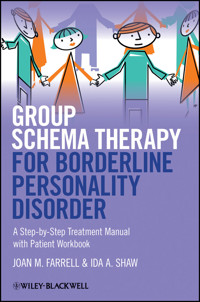
Group Schema Therapy for Borderline Personality Disorder represents the first treatment manual for group schema therapy and is based on the only group ST model validated by published empirical evidence.
- Presents an original adaptation of schema therapy for use in a group setting
- Provides a detailed manual and patient materials in a user-friendly format
- Represents a cost-effective ST alternative with the potential to assist in the public health problem of making evidence-based BPD treatment widely available
- Includes 'guest' chapters from international ST experts Jeff Young, Arnoud Arntz, Hannie van Genderen, George Lockwood, Poul Perris, Neele Reiss, Heather Fretwell and Michiel van Vreeswijk
Sie lesen das E-Book in den Legimi-Apps auf:
Seitenzahl: 531
Veröffentlichungsjahr: 2012
Ähnliche


















Contents
Cover
Title Page
Copyright
Foreword
About the Authors
Acknowledgments
Chapter 1: Introduction
The Challenge of Producing a Manual that Represents the Flexibility of Schema Therapy
The Manual Chapters
Chapter 2: The Conceptual Model of Group Schema Therapy
Goals of Group Schema Therapy
The Therapy Relationship in Schema Therapy
Structural Model of Group Schema Therapy
Chapter 3: Using the Therapeutic Factors of Groups to Catalyze and Augment Schema Therapy Interventions
The Group Modality may Augment and even Catalyze Schema Therapy
Group Therapeutic Factors can Amplify Schema Therapy Interventions
Expanded Opportunities for Experiential, Cognitive, and Behavioral Pattern-Breaking Work
Chapter 4: The Therapist Role: Limited Reparenting Broadened to a Family
General Therapist Behaviors
Limited Reparenting for Individual and Group Schema Therapy
How Many Therapists Does it Take to Parent a BPD Group?
Therapist Behaviors to Foster Connection
Therapist Behaviors to Build the Group Family
Therapist Behaviors to Establish and Maintain Safety
Therapist Behaviors when a Mode Threatens the Group
Therapist Behaviors to Respond to Conflicting Modes and Needs
Shape Self-Disclosure and Group Involvement
Group Therapists must be Jugglers
Management Issues
Therapist Tasks Related to Being Healthy Adult Role Models
Chapter 5: Some Basics of Group Schema Therapy
THE BASICS
The Stages of Group Schema Therapy
Integration of the Awareness-Focused, Cognitive, Experiential, Behavioral, and Interpersonal Components of Group Therapy
Chapter 6: The Course of Group Schema Therapy Stage One: Bonding and Emotional Regulation
Bonding and Cohesiveness
Chapter 7: The Course of Group Schema Therapy Stage Two: Schema Mode Change
Maladaptive Coping Modes
Integrating Awareness, Experiential, Cognitive, and Behavioral Aspects of ST Work
The Vulnerable Child Mode
Dysfunctional Parent Modes
The Healthy Adult mode
Chapter 8: The Course of Group Schema Therapy Stage Three: Autonomy
Healthy Adult Mode Work: Summary of Mode Change Work, Behavioral Pattern-Breaking, Stabilization of Identity
Adolescence
The Therapy Group Provides Corrective Learning Opportunities for Identity
Support Groups for Patients with BPD
Chapter 9: The Patient Workbook Materials and How to Use Them
Chapter 10: Combining Individual and Group Schema Therapy
Treatment Protocols
Therapists
Training
Individual Sessions
Ways to Use Combined Group–Individual ST
Potential Coordination Problems
Joint Supervision and Peer Supervision
Chapter 11: Meeting Core Emotional Needs in Group Schema Therapy Through Limited Reparenting
Social Belonging
Stable Attachment
Emotional Fulfillment
Basic Trust
Success
Self-Acceptance/Lovability
Healthy Boundaries/Developed Self
Self-Reliance/Competence
Assertiveness and Self-Expression
Empathic Consideration/Respect for Others
Healthy Self-Control/Self-Discipline
Optimism/Hopefulness
Realistic Standards and Expectations
Healthy Self-Interest/Self-Care
General Considerations
Chapter 12: A Systematic Review of Schema Therapy For BPD
Outpatient ST
Inpatient ST
Conclusion
Chapter 13: Conclusions and Future Directions for Group Schema Therapy
Using GST to Treat Other Personality Disorders
GST shares the applicability of ST for all PDs
The Role of the Healthy Adult
Intensive GST for severe BPD
Conclusion
Bibliography
Index
This edition first published 2012 © 2012 John Wiley & Sons Ltd
Wiley-Blackwell is an imprint of John Wiley & Sons, formed by the merger of Wiley's global Scientific, Technical and Medical business with Blackwell Publishing.
Registered office: John Wiley & Sons, Ltd, The Atrium, Southern Gate, Chichester, West Sussex, PO19 8SQ, UK
Editorial offices: 350 Main Street, Malden, MA 02148-5020, USA 9600 Garsington Road, Oxford, OX4 2DQ, UK The Atrium, Southern Gate, Chichester, West Sussex, PO19 8SQ, UK
For details of our global editorial offices, for customer services, and for information about how to apply for permission to reuse the copyright material in this book please see our website at www.wiley.com/wiley-blackwell.
The right of Joan M. Farrell, Ida A. Shaw, Arnoud Arntz, Heather Fretwell, George Lockwood, Poul Perris, Neele Reiss, Hannie van Genderen, Michiel van Vreeswijk and Jeffrey Young to be identified as the authors of this work has been asserted in accordance with the UK Copyright, Designs and Patents Act 1988.
All rights reserved. No part of this publication may be reproduced, stored in a retrieval system, or transmitted, in any form or by any means, electronic, mechanical, photocopying, recording or otherwise, except as permitted by the UK Copyright, Designs and Patents Act 1988, without the prior permission of the publisher.
Wiley also publishes its books in a variety of electronic formats. Some content that appears in print may not be available in electronic books.
Designations used by companies to distinguish their products are often claimed as trademarks. All brand names and product names used in this book are trade names, service marks, trademarks or registered trademarks of their respective owners. The publisher is not associated with any product or vendor mentioned in this book. This publication is designed to provide accurate and authoritative information in regard to the subject matter covered. It is sold on the understanding that the publisher is not engaged in rendering professional services. If professional advice or other expert assistance is required, the services of a competent professional should be sought.
Library of Congress Cataloging-in-Publication Data applied for.
A catalogue record for this book is available from the British Library.
Wiley also publishes its books in a variety of electronic formats. Some content that appears in print may not be available in electronic books.
1 2012
Foreword
I am very pleased to have been invited to write the foreword for this groundbreaking treatment manual on Group Schema Therapy (GST).
Since I first heard about the extremely positive results of the authors’ randomized controlled trial of GST for patients with Borderline Personality Disorder (BPD) in 2008, I have been very excited about the potential of the group model to make schema therapy (ST) more available and affordable for patients. Given the worsening climate for mental health reimbursement in this era of managed care in the United States and elsewhere in the world, GST has the potential to deliver the powerful treatment strategies of the schema approach in a more cost effective manner than has been possible with individual ST – with equivalent or perhaps superior results.
When I met Joan and Ida for the first time at the International Society for Schema Therapy Congress, I was surprised to learn that they had been developing their GST approach for 25 years, and was struck by how many of the core components in my own work they had independently developed for their group approach. GST feels entirely consistent with my own individual model, in terms of the conceptual model, therapeutic alliance, and treatment interventions.
In the past, I had always been skeptical about the possibility of extending the intense therapy relationship I call “Limited Reparenting” – which is so central to the effectiveness of ST – to a group approach. I had always viewed group therapy as a “watered down” version of individual treatment, especially for patients with personality disorders. I was delighted to find that my preconceptions were entirely wrong. The GST approach Joan and Ida have developed is truly unique, exciting, and promising.
GST encourages group members to become like a healthy family in which they can “reparent” each other, under the watchful guidance of two highly skilled therapist-parents. The sense of belonging and acceptance provided by this group analogue to a loving family seems to catalyze both the limited reparenting and emotion-focused components of ST.
Furthermore, by using two co-therapists for each group, GST has found a way to free up one therapist to move fluidly around the group, often working with one or two members at a time, creating novel experiential exercises to bring about change. At the same time, the second therapist serves as the “stable base” for the rest of the group, maintains an ongoing emotional connection with each member, monitors the reactions of all members, explains what is happening to educate them about what is taking place, and intervenes to shift the direction of the group to focus on the needs of other group members.
I am also impressed that GST goes well beyond traditional Cognitive Behavior Therapy/ Dialectical Behavior Therapy (CBT/DBT) group format, in which members are taught skills in a seminar-like setting; and non-CBT groups, in which the therapist does individual work with one member while the rest of the group primarily watches. In GST, the techniques used in individual ST, such as imagery change work and mode role-plays, have been adapted to engage all of the members in unique exercises that make use of the power of group interaction and support. These group therapeutic factors, combined with the broad range of integrative techniques that are already part of ST, may account for the large treatment effects in the controlled outcome study I mentioned earlier, as well as in preliminary data from other ongoing studies of GST.
This book is the first published treatment manual for GST, and succeeds in providing the most essential information clinicians will need to practice it. The authors describe a systematic approach to treating BPD patients in a group format, while retaining the flexibility that I have always valued so highly in developing individual ST. The treatment suggestions are specific and well-organized, with plenty of examples, while avoiding the temptation to write a therapeutic “cookbook” for therapists to follow in a rote manner.
To be more specific, the authors have preserved the core elements of ST by developing “limited reparenting” intervention strategies for each mode that arises in the group, seizing “experiential moments” to do emotion-focused work that brings about change at a deep level. Like individual ST, their group model blends experiential, cognitive, Interpersonal, and behavioral work.
This manual presents a step-by-step guide for GST with patients who have BPD. It includes a large selection of patient handouts, group exercises, and homework assignments – all presented in downloadable form on the Wiley website for use with patients. The workbook material is arranged both by mode and by type of intervention, allowing therapists to choose the exercises and homework assignments that best match individual group members, and the therapist's own personal style. The user-friendly format of the book also provides sample therapist scripts, and numerous patient examples throughout.
The experience that the two authors have gained over 30 years of training therapists throughout the world, and leading GST groups with a broad range of clinical populations, is evident throughout the volume. The book is written at a level that should appeal to a very broad range of mental health professionals, including psychologists, social workers, psychiatrists, counselors, psychiatric nurses, as well as interns and residents.
On a more personal level, I had the opportunity to experience GST first hand as a participant at an advanced training workshop that I invited Joan and Ida to teach for the senior schema therapists at our New York institute. I am even more excited about the potential of ST in a group after this experience, and would love to conduct a ST group like this myself once I have learned the necessary skills.
Joan Farrell is an outstanding schema therapist who serves as the “stable base”, emotional center, and “educator” for the group as a whole – a role I can imagine myself learning to fill, given enough time and experience. What truly amazed me – perhaps because her style is so different from mine and Joan's – was the remarkable group work of Ida Shaw. It is hard to convey the level of originality, creativity, and spontaneity she brings to the group experience. She is able to blend elements of gestalt, psychodrama, role-playing, and her own infectious style of play into an approach that perfectly fits the intensive demands of schema mode work, cajoling patients to change in profound ways. The group exercises in this manual will allow schema therapists to try out some of her unique work.
I see GST as one of the three most important advances since I began developing ST. It has served as a major impetus for international collaboration to further the development and dissemination of ST, including pilot studies in the Netherlands and Germany, as well as an intensive version for inpatient or day hospital use.
I am especially excited about the large-scale clinical trial that is underway at 14 sites in 5 different countries. Arnoud Arntz and Joan Farrell serve as the co-principal investigators of the study, testing the efficacy and cost-effectiveness of the GST model for BPD patients. This book includes the full treatment manual and patient materials used in the study.
Although this manual focuses on the treatment of patients with BPD, I believe that it also has great potential to be adapted for other patient populations, diagnoses, and treatment settings. Like individual ST, I expect the GST model (based on the principles outlined in this manual) to be effective for patients with other personality disorders (PDs), many Axis I disorders, and other chronic problems that have not responded to existing treatments. GST is already being explored as a potential treatment for patients with eating disorders, Avoidant PD, Dependent PD, Narcissistic PD, and Antisocial PD.
I want to personally thank the many members of the international ST community who have helped Joan and Ida in the refinement of the GST model and handbook. These include: Arnoud Arntz, Hannie van Genderen, and Michiel van Vreeswijk from Holland; Poul Perris in Sweden; Heather Fretwell and George Lockwood in the US; and Neele Reiss from Germany. These individuals have contributed chapters to this book that cover practical issues, such as combining individual and group ST; and more theoretical aspects, such as the chapter on needs and adaptive reparenting. The book also includes a meta-analysis of the studies that have been conducted to evaluate the efficacy of ST for patients with BPD; along with a chapter on the future of the group model, which I co-authored.
I highly recommend this outstanding manual to all mental health professionals working with more complex, chronic, and hard-to-treat patient populations – especially those who are looking for an evidence-based, cost effective alternative to existing therapies. This book is essential reading for professionals interested in ST, BPD and other personality disorders, group therapy, and in new approaches to expanding CBT. I commend Joan and Ida for their willingness to take risks in developing a truly creative and inspiring new approach to ST.
Jeffrey Young, PhDSchema Therapy Institute of New York,Columbia University,Department of Psychiatry
About the Authors
Joan Farrell, PhD, and Ida Shaw, MA, are the developers of the original Group Schema Therapy (GST) model and have specialized in the treatment of Borderline Personality Disorder (BPD) for 25 years. GST demonstrated its effectiveness in a randomized trial supported by a NIMH grant and was awarded the Governor's Showcase Award in Mental Health, Indiana. They developed an intensive inpatient program on a specialized hospital unit, which has promising pilot results. Currently they are the primary trainers and supervisors for a fourteen-site, five-country trial of GST and Dr. Farrell is co-PI with Professor Arnoud Arntz. Dr. Farrell is the Research and Training Director of the Center for BPD Treatment & Research (CBPDT&R), Indiana University School of Medicine-Midtown Community Mental Health Center, adjunct professor of Psychology, Indiana University-Purdue University Indianapolis. She was a clinical professor in Psychiatry Indiana University School of Medicine for 25 years where she received the Outstanding Faculty Contribution Award from the clinical psychology internship program and was honored by psychiatry residency classes for her teaching and supervision in BPD treatment.Ida Shaw, MA, is an Advanced Level Schema Therapist/Trainer and program consultant for CBPDT&R. She contributes expertise in experiential therapy and developmental psychology to GST. Together they direct the Schema Therapy Institute Midwest, Indianapolis and have been giving training in Schema Therapy (ST) and BPD treatment internationally for 20 years. They have published journal articles, a DVD series demonstrating GST and book chapters on BPD and GST and so far they have provided training to over 350 therapists from 12 countries in GST. They receive outstanding evaluations for their teaching and supervision, including the response that their enthusiasm and demonstrations inspire therapists to begin GST.
Arnoud Arntz, PhD, is a full professor of Clinical Psychology and Experimental Psychopathology at Maastricht University in the Netherlands. He is Scientific Director of the University's Research Institute of Experimental Psychopathology and Director of the Postgraduate Clinical Psychology Program in the south Netherlands. He is associated as a psychotherapist with the Maastricht Community Mental Health Center. He was project leader of the Dutch multi-center trial of individual ST for BPD and is a principal investigator of the current multi-site international trial of GST. He is the honorary scientific and researcher adviser for the International Society of Schema Therapy. He has published numerous articles on cognitive therapy (CT), ST and translational studies related to the mechanism of action of psychotherapy and two books on ST.
Heather Fretwell, MD, is a board-certified psychiatrist. She directs the outpatient BASE (Borderline patients Awareness, Skills, and Empowerment) program Midtown Community Mental Health Center and is Clinical Director of the Center for BPD Treatment and Research of Indiana University School of Medicine, where she is also a faculty member in the department of Psychiatry and lectures to psychiatric residents on personality disorders and psychotherapy. She has trained in Individual and Group ST since 2004 with J. Farrell and I. Shaw, and has presented at international conferences. She is a co-investigator on the international multi-site study on GST for patients with BPD and a principal investigator on the US grant proposals. She conducts ongoing research on the pharmacological and ST treatment of BPD patients. She is a past president of the Indiana Psychiatric Society.
George Lockwood, PhD, clinical psychologist is the Director of the Schema Therapy Institute Midwest and a Founding Fellow of the Academy of Cognitive Therapy. He completed a post doctoral fellowship in CT under the supervision of Aaron T. Beck, MD in 1982, has training in psychoanalytic psychotherapy and object–relations approaches, and has Advanced International Certification in ST. Dr. Lockwood has lectured on CT and ST for 20 years and regularly receives excellent evaluations. He has written a number of articles on both CT and ST, has participated in the development of ST, contributed to “Schema Therapy: A Practitioners Guide”, currently is serving on the board of the International Society of Schema Therapy, and has maintained a private practice for the past 25 years.
Poul Perris, MDis the director of the Swedish Institute for CBT & Schema Therapy and a licensed Psychotherapist with an Advanced international Certification in Schema Therapy, trained and supervised by Dr. Jeffrey Young. He is the Founding President of the International Society for Schema Therapy and the current President of the Swedish Association for Cognitive & Behavioral Therapies. He is trained in GST by J. Farrell and I. Shaw and is a member of the treatment protocol board in the international multi-site study on schema group therapy for patients with BPD. He offers ST workshops and supervision internationally. He is part of a research group that focuses on the concepts of core emotional needs and limited reparenting.
Neele Reiss, MSc, PhD(psychotherapist/clinical psychologist), is program director for the inpatient ST ward for patients with BPD at the University Medical Center Mainz, Germany. She holds Advanced international Certification in Schema Therapy, trained and supervised in ST and GST by Jeffrey Young, Joan Farrell, Ida Shaw, Arnoud Arntz and Gitta Jacob. She is a trainer in ST in Germany, Switzerland and the US. She is doing research on intensive ST for patients with BPD, a setting in which individual and group ST are combined. She is the author of journal articles and book chapters in English and German.
Hannie van Genderen, M. Phil.(psychotherapist/clinical psychologist), is employed at the Mental Health Center in Maastricht. She has trained in ST by Dr. Jeffrey Young since 1996. She closely collaborates with Professor A. Arntz of the Maastricht University, with whom she has written the book “Schema Therapy for Borderline Personality Disorder” (Wiley, 2009). She has trained in GST for BPD by J. Farrell and I. Shaw since 2009. She has been a trainer and supervisor in ST in the Netherlands since 2000. She is a member of the board of the International Society of Schema Therapy (coordinator for Training and Certification) and the board of the Dutch Schema Therapy Association.
Michiel van Vreeswijk, PhD, is a clinical psychologist, psychotherapist, cognitive behavioral therapist, supervisor in ST, and co-director at G-kracht private practice, the Netherlands. He is affiliated as a trainer in ST and CBT at several post-doctoral institutes in the Netherlands. He is also affiliated as a trainer with the RINO Group. He regularly gives ST workshops in the UK, Germany and at ISST conferences. He is doing research on GST and is a co-investigator on the international multi-site study on GST for patients with BPD. He is the author of many journal articles in English and Dutch.
Jeffrey Young, PhD, is a clinical psychologist and psychotherapist who is the founder of ST. He directs the Schema Therapy and Cognitive Therapy Institutes of New York. He serves on the faculty in the Department of Psychiatry at Columbia University, is a Founding Fellow of the Academy of Cognitive Therapy, and is co-founder and Honorary President of the International Society for Schema Therapy. Dr. Young has led workshops for over 20 years, training thousands of mental health professionals throughout the world, including the US, Canada, the UK, Europe, Australia, China, South Korea, Japan, New Zealand, Singapore, and South America. He consistently receives outstanding evaluations internationally for his teaching skills, including the prestigious NEEI Mental Health Educator of the Year award. Dr. Young has co-authored two best-selling books with Janet Klosko, PhD: “Schema Therapy: A Practitioner's Guide” for mental health professionals, and “Reinventing Your Life,” a self-help book for clients and the general public. Both have been translated into many languages.
Acknowledgments
We first want to acknowledge the Schema Therapy community and ISST who welcomed us with open arms after our presentation at the Coimbra ISST conference in 2008. We formed friendships and collaborations after that meeting, which have significantly affected our careers and lives and led to this book. We thank Arnoud Arntz for his research mentorship, personal support and friendship and Jeff Young for his thought provoking discussions, support and encouragement. Our dear friend and colleague Heather Fretwell bravely dove into the 20 year mass of patient material we had accumulated and began the organization that resulted in the patient workbook of this manual. Neele Reiss, valued collaborator and friend read numerous drafts of this manuscript and worked diligently with Joan on early writing. Poul Perris contributed important experiential exercises and his friendship through the writing process. There are a lot of other people to thank for support and collaboration: Marco Nill, Friederike Vogel, Hannie van Genderen, Gerhard Zarbock (whose cheerleading helped us to finish the book), Wendy Behary, Christoph Fuhrhans, Vartouhi Ohanian, and Klaus Lieb. Gitta Jacob and Eckhard Roediger invited a chapter on GST for their Handbook of Schema Therapy in 2009 that began the writing that led to this book. In addition, we acknowledge our other contributing chapter author Michiel van Vreeswijk and our Wiley editors, Darren Reed and Karen Shields. We heartily thank George Lockwood, who encouraged us to attend the Coimbra meeting, welcomed us into the ST community and invited us to be part of the ST Institute Midwest, which he founded. George has been a support in many ways – reading numerous drafts, being a theoretical sounding board for Joan, offering creative collaboration with Ida and with Julianna offering friendship and hugs.
We offer special thanks to Gerhard Zarbock, and IVAH who produced and funded the DVD set that demonstrates the interventions of this manual. We thank Vivian Rahn and Nana Novosad who directed and edited the DVDs and the schema therapist “actors”, those already mentioned above and Christine Zens, Eva Fassbinder, Niclas Wedemeyer and Brigitte Haaf who played BPD patients (very well). We also acknowledge the grant support we have received in the course of developing and evaluating GST: National Institute of Mental Health, Association for the Advancement of Mental Health Research of Drs. Joyce and Iver Small, the Clarian Values Grant. We thank the early supporters of our work who were willing to take on the paradigm shifts and opposition encountered in implementing a new way to work with BPD patients: Diana Haugh, John Mitchell, Jeffrey Kellams, Alan Schmetzer and Vicki Silver.
The therapists who trained with us have made important contributions to this treatment manual as teaching forced us to make explicit and clear the way we practice group schema therapy. They have also shared their creative ideas and feedback that led to improvements in our training model. Most of all we thank our patients, who taught us what we needed to understand about their needs and struggles and what worked to help them – the creative, intense, talented and at times challenging group of people with Borderline Personality Disorder. They stuck with us through the “group from Hell” when we were first testing our treatment ideas and continued to trust us through the 27 years of our developing the approach presented in this book. This treatment manual is dedicated to them.
Joan Farrell & Ida Shaw
1
Introduction
J. M. Farrell and I. A. Shaw
This manual presents a step-by-step guide for Group Schema Therapy (GST) with patients who have Borderline Personality Disorder (BPD) along with a collection of handouts, group exercises, and homework to use with patients. It is the result of 25 years of work by Farrell and Shaw to develop an effective and comprehensive psychotherapeutic treatment for this group of severely disabled patients whose potential is tragically not realized in the quality of their lives. The authors’ collaboration combined the training of Farrell in cognitive, personal construct, social learning, and psychodynamic treatment approaches with Shaw's training in developmental psychology and experiential approaches such as Gestalt therapy and bioenergetics into an integrative model for group therapy of BPD. Their initial approach was based upon their observation that BPD patients did not easily fit into traditional psychotherapy. For example, the patients they were working with were too distressed to stay in an office attending to the session for 50 minutes – they either dissociated or fled. In an effort to address this therapy-interfering behavior, Farrell and Shaw set distress reduction as the first goal. Patients were able to reduce distress enough to stay in sessions, but they did not use these techniques outside of sessions. This was understood as an inability to recognize pre-crisis distress levels – the point at which it is possible to use distress reduction most effectively. At the same time, Lane and Schwartz (1987) published an article presenting their theory of “levels of emotional awareness”, which they postulated as being parallel to Piagetian levels of cognitive development. This theory fit with the clinical observation of BPD patients, who presented at early levels of emotional awareness – at best the global level where emotion is experienced as global extremes of good and bad. This construct parallels the dichotomous thinking observed in BPD. So, Farrell and Shaw's second treatment goal became increasing the level of emotional awareness patients had so that they could recognize pre-crisis distress. Accomplishing this required the use of experiential techniques including some at the level of kinesthetic awareness. Awareness work is consistent with Schema Therapy (ST) and remains part of the treatment described in this manual. Unfortunately, Farrell and Shaw found that even after their patients were able to notice pre-crisis distress, outside of therapy they still did not use the distress management or coping strategies they had been taught. Using a practical and collaborative approach, they asked the patients “Why?.” The answer gave them the third goal of their initial program – schema change. Patient's answers were some form of “I am bad and deserve punishment, so it would be wrong to do good things for myself” or “I am helpless and life is hopeless, so why try?.”
Lesen Sie weiter in der vollständigen Ausgabe!
Lesen Sie weiter in der vollständigen Ausgabe!
Lesen Sie weiter in der vollständigen Ausgabe!
Lesen Sie weiter in der vollständigen Ausgabe!
Lesen Sie weiter in der vollständigen Ausgabe!
Lesen Sie weiter in der vollständigen Ausgabe!
Lesen Sie weiter in der vollständigen Ausgabe!
Lesen Sie weiter in der vollständigen Ausgabe!
Lesen Sie weiter in der vollständigen Ausgabe!
Lesen Sie weiter in der vollständigen Ausgabe!
Lesen Sie weiter in der vollständigen Ausgabe!
Lesen Sie weiter in der vollständigen Ausgabe!
Lesen Sie weiter in der vollständigen Ausgabe!
Lesen Sie weiter in der vollständigen Ausgabe!




