


43,99 €
Mehr erfahren.
- Herausgeber: John Wiley & Sons
- Kategorie: Fachliteratur
- Sprache: Englisch
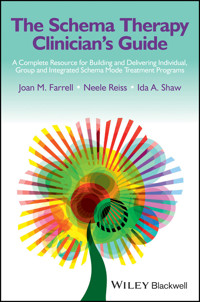
The Schema Therapy Clinician’s Guide is a complete clinical resource for psychotherapists implementing schema therapy, group schema therapy or a combination of both in a structured, cost-effective way. The authors provide ready-made individual and group sessions with patient hand-outs.
- A unique resource providing ready-made individual and group schema therapy sessions, linked across schema modes, allowing clinicians to pick and choose what they need or adopt a full integrated individual and group program which can be delivered over a range of treatment lengths from a six week intensive program to a one year outpatient treatment
- Approaches treatment by targeting maladaptive Schema Modes rather than specific disorders, thus increasing clinical flexibility and ensuring shelf life through changes in diagnostic classification
- Provides step-by-step instructions and tips for therapists, along with a wealth of unique clinical resources including sample scripts, handouts, session exercises, assignment forms and patient materials
- Meets the current need for effective clinical treatments that can provide tangible effects on time and on budget
Sie lesen das E-Book in den Legimi-Apps auf:
Seitenzahl: 477
Veröffentlichungsjahr: 2014
Ähnliche


















CONTENTS
Cover
Title page
Copyright page
List of Figures and Tables
About the Authors
Foreword
Acknowledgments
1 Introduction
1.1 Background
1.2 The Chapters
2 The Basics of Schema Therapy
2.1 The Theoretical Model
2.2 Goals and Stages of Schema Therapy
2.3 Limited Reparenting
2.4 The Components of Schema Therapy
3 The Integrated Schema Therapy Treatment Program
3.1 The Patients: Who Are Good Candidates?
3.2 The Group Schema Therapy Sessions
3.3 The Individual Schema Therapy (IST) Sessions
3.4 Options for the Delivery of the Treatment Program
3.5 Structural Aspects of the Group Sessions
3.6 Assessment and Orientation
3.7 The Milieu of the Treatment Program
4 The Group Schema Therapy Sessions
4.1 General Therapist Tips for Group Schema Therapy
4.2 The Welcome Group Session
4.3 Five Schema Therapy Education (STE) Sessions
4.4 The 12 Mode Awareness Sessions
4.5 The 12 Mode Management Sessions
4.6 The 12 Experiential Mode Work Sessions
5 The Individual Schema Therapy Sessions
5.1 The Schema TherapyConceptualization and Goals
5.2 The Maladaptive Coping Modes (MCM)
5.3 Dysfunctional Parent Modes (DyPMs)
5.4 The Vulnerable Child Mode
5.5 The Angry or Impulsive Child Mode (ACM, ICM)
5.6 The Happy Child Mode
5.7 The Healthy Adult Mode (HAM)
6 Training, Supervision, Research, and Concluding Remarks
6.1 Training
6.2 Supervision
6.3 Research on Schema Therapy
6.4 Concluding Remarks
References
Index
Access the Companion Web Site
Eula
List of Tables
Chapter 02
Table 2.1 Schemas organized by content area
Table 2.2 Basic schema modes
Table 2.3 Suggested therapist interventions in relationship to patient modes and needs
Table 2.4 Models of group therapy
Chapter 03
Table 3.1 Integrated Schema Therapy Program by session: group and individual
Table 3.2 Treatment components, goals and focus, patient materials list
Table 3.3 Formats and lengths for the Integrated Schema Therapy treatment program
Table 3.4 Schema therapist tool kit
Chapter 04
Table 4.1 List of group handouts, exercises, and assignments by session, mode, and location
Chapter 05
Table 5.1 Patient materials for Individual Schema Therapy sessions
List of Illustrations
Chapter 02
Figure 2.1 Schema Therapy: Etiology of psychological disorders.
Chapter 04
Figure 4.1 Mode role-play of schema modes in action. Scene 1: This is how modes develop and how they function now
Figure 4.2 Mode role-play of schema modes in action. Scene 2: This is what begins to change during Schema Therapy
Figure 4.3 Mode role-play of schema modes in action. Scene 3: The results of Schema Therapy
Guide
Cover
Table of Contents
Begin Reading
Pages
iii
iv
ix
xi
xiii
xiv
xv
xvi
xvii
xviii
1
2
3
4
6
7
8
9
10
11
12
13
14
15
16
17
18
19
20
21
22
23
24
25
26
27
28
29
30
31
32
33
34
35
36
37
38
39
40
41
42
43
44
45
46
47
48
49
50
51
52
53
54
55
56
57
58
59
60
61
62
63
64
65
66
67
68
69
70
71
72
73
74
75
76
77
78
79
80
81
82
83
84
85
86
87
88
89
90
91
92
93
94
95
96
97
98
99
100
101
102
103
104
105
106
107
108
109
110
111
112
113
114
115
116
117
118
119
120
121
122
123
124
125
126
127
128
129
130
131
132
133
134
135
136
137
138
139
140
141
142
143
144
145
146
147
148
149
150
151
152
153
154
155
156
157
158
159
160
161
162
163
164
165
166
167
168
169
170
171
172
173
174
175
176
177
178
179
180
181
182
183
184
185
186
187
188
189
190
191
192
193
194
195
196
197
198
199
200
201
202
203
204
205
206
207
208
209
210
211
212
213
214
215
216
217
218
219
220
221
222
223
224
225
226
227
228
229
230
231
232
233
234
235
236
237
238
239
240
241
242
243
244
245
246
247
248
249
250
251
252
253
254
255
256
257
258
259
260
261
262
263
264
265
266
267
268
269
270
271
272
273
274
275
276
277
278
279
280
281
282
283
284
285
286
287
288
289
290
291
292
293
294
295
296
297
298
299
300
301
302
303
304
305
306
307
308
309
310
311
312
313
314
315
316
317
318
319
320
321
322
323
324
325
326
327
328
329
xix
The Schema Therapy Clinician’s Guide
A Complete Resource for Building and Delivering Individual, Group and Integrated Schema Mode Treatment Programs
Joan M. Farrell, Neele Reiss, and Ida A. Shaw
Illustrations by Britta Finkelmeier
This edition first published 2014© 2014 John Wiley & Sons, LtdExcept for illustrations © 2014 Britta Finkelmeier.
Registered OfficeJohn Wiley & Sons, Ltd, The Atrium, Southern Gate, Chichester, West Sussex, PO19 8SQ, UK
Editorial Offices350 Main Street, Malden, MA 02148-5020, USA9600 Garsington Road, Oxford, OX4 2DQ, UKThe Atrium, Southern Gate, Chichester, West Sussex, PO19 8SQ, UK
For details of our global editorial offices, for customer services, and for information about how to apply for permission to reuse the copyright material in this book please see our website at www.wiley.com/wiley-blackwell.
The right of Joan M. Farrell, Neele Reiss, and Ida A. Shaw to be identified as the authors of this work has been asserted in accordance with the UK Copyright, Designs and Patents Act 1988.
All rights reserved. No part of this publication may be reproduced, stored in a retrieval system, or transmitted, in any form or by any means, electronic, mechanical, photocopying, recording or otherwise, except as permitted by the UK Copyright, Designs and Patents Act 1988, without the prior permission of the publisher.
Wiley also publishes its books in a variety of electronic formats. Some content that appears in print may not be available in electronic books.
Designations used by companies to distinguish their products are often claimed as trademarks. All brand names and product names used in this book are trade names, service marks, trademarks or registered trademarks of their respective owners. The publisher is not associated with any product or vendor mentioned in this book.
Limit of Liability/Disclaimer of Warranty: While the publisher and author(s) have used their best efforts in preparing this book, they make no representations or warranties with respect to the accuracy or completeness of the contents of this book and specifically disclaim any implied warranties of merchantability or fitness for a particular purpose. It is sold on the understanding that the publisher is not engaged in rendering professional services and neither the publisher nor the author shall be liable for damages arising herefrom. If professional advice or other expert assistance is required, the services of a competent professional should be sought.
Library of Congress Cataloging-in-Publication Data
Farrell, Joan M.,author. The schema therapy clinician’s guide : a complete resource for building and delivering individual, group and integrated schema mode treatment programs / Joan M. Farrell, Neele Reiss, and Ida A. Shaw. p. ; cm. Includes bibliographical references and index.
ISBN 978-1-118-50917-3 (pbk.) – ISBN 978-1-118-50918-0 (cloth) I. Reiss, Neele, author. II. Shaw, Ida A., author. III. Title. [DNLM: 1. Psychotherapy–methods–Handbooks. 2. Personality Disorders–therapy–Handbooks. 3. Psychotherapy, Group–methods–Handbooks. WM 34] RC480.5 616.89′14dc232014002676
A catalogue record for this book is available from the British Library.
Cover image: Alamy, ID C84W3FCover design by Design Deluxe
List of Figures and Tables
Figures
2.1
Schema Therapy: Etiology of psychological disorders
4.1
Mode role-play of schema modes in action. Scene 1
4.2
Mode role-play of schema modes in action. Scene 2
4.3
Mode role-play of schema modes in action. Scene 3
Tables
2.1
Schemas organized by content area
2.2
Basic schema modes
2.3
Suggested therapist interventions in relationship to patient modes and needs
2.4
Models of group therapy
3.1
Integrated Schema Therapy Program by session: group and individual
3.2
Treatment components, goals and focus, patient materials list
3.3
Formats and lengths for the Integrated Schema Therapy treatment program
3.4
Schema therapist tool kit
4.1
List of group handouts, exercises, and assignmentsby session, mode, and location
5.1
Patient materials for Individual Schema Therapy sessions
About the Authors
Joan M. Farrell, Ph.D. is a Clinical Psychologist, Research and Training Director of the Center for Borderline Personality disorder Treatment and Research, Indiana University School of Medicine, USA, and Adjunct Professor in the Department of Psychology, Indiana University-Purdue University Indianapolis (IUPUI). She is an International Society for Schema Therapy (ISST) Certified Schema Therapy Trainer and Supervisor, the Coordinator for Training & Certification of the ISST, and an Executive Board member.
Neele Reiss is a Researcher, Clinical Psychologist, and Schema Therapist in the Department of Differential Psychology and Psychological Diagnostics, Goethe-University Frankfurt, Germany, and a Director of the Institute for Psychotherapy in Mainz, Germany. She is an International Society for Schema Therapy (ISST) Certified Schema Therapy Trainer and Supervisor in Adult and Group.
Ida A. Shaw, M.A. is the Director of the Schema Therapy Institute Midwest, Indianapolis, USA, and Senior Clinical Supervisor at the Center for BPD Treatment and Research, Indiana University School of Medicine. She is an ISST Certified Schema Therapy Trainer and Supervisor in Adult, Child–Adolescent and Group.
Foreword
I am very pleased to have been invited to write the foreword for this groundbreaking resource, which will allow clinicians to integrate Individual and Group Schema Therapy (GST) sessions into complete treatment programs that can be delivered over a range of patient populations, treatment lengths, and levels of care.
Since I first heard about the extremely positive results of the authors’ randomized controlled trial of GST for patients with borderline personality disorder (BPD) in 2008, I have been very excited about the potential of the group model to make Schema Therapy more available and affordable for patients. Given the worsening climate for mental health reimbursement in this era of managed care in the United States and elsewhere in the world, Group Schema Therapy has the potential to deliver the powerful treatment strategies of the schema approach in a more cost-effective manner than has been possible with individual schema therapy – with equivalent or perhaps superior results. I am especially excited about the large-scale clinical trial that is under way at 14 sites in six different countries. Arnoud Arntz and Joan Farrell serve as the co-principal investigators of the study, testing the efficacy and cost-effectiveness of the Group Schema Therapy model for BPD patients combined with two different numbers of individual sessions.
This book, with the collaboration of Neele Reiss, the psychologist and schema therapist who pioneered GST in Germany, extends the integrated Individual and Group Schema Therapy program for use with a wide range of patient groups – personality disorder, complex trauma, chronic difficulties, those who have failed in other treatments, and those who need a higher level of care. It includes the novel concept of giving patients a “bank account” of individual ST sessions to draw on, as they need to; this concept was developed for the BPD multisite trial. Since the publication of the first book on GST (Farrell & Shaw, 2012), there have been many initiatives internationally to apply the GST model to other diagnostic groups of patients. Like individual ST, GST is trans-diagnostic – in the sense that the focus of interventions is the mode profile of the patient rather than specific symptoms. Thus, GST, like ST, should be effective for disorders other than BPD. Of course, any application needs empirical validation and I am happy to say that preliminary findings are promising. This integrated program has been tested in inpatient and day hospital settings for BPD (Reiss et al., 2013a) and mixed Cluster B and C disorders (Muste, 2012; Fuhrhans, 2012). Its use in forensic settings is being evaluated in the UK. A randomized controlled trial comparing ST to cognitive–behavioral therapy (CBT) for avoidant PD and social phobia and an experimental case series for dissociative disorders are under way in the Netherlands.
The integration of Group and Individual Schema Therapy presented here feels entirely consistent with my own individual model, in terms of the conceptual model, therapeutic alliance, and treatment interventions. The GST model encourages group members to become like a healthy family in which they can “re-family” each other, under the watchful guidance of two highly skilled therapist-parents. The sense of belonging and acceptance provided by this group analogue of a loving family seems to catalyze both the limited reparenting and emotion-focused components of ST. Furthermore, by utilizing two co-therapists for each group, GST has found a way to free up one therapist to move fluidly around the group, often working with one or two members at a time, creating novel experiential exercises to bring about change. At the same time, the second therapist serves as the “stable base” for the rest of the group, maintains an ongoing emotional connection with each member, monitors the reactions of all members, explains what is happening to educate them about what is taking place, and intervenes to shift the direction of the group to focus on the needs of other group members. I am also impressed that GST goes well beyond the traditional CBT/DBT (dialectical behavioral therapy) group format, in which members are taught skills in a seminar-like setting; and beyond non-CBT groups, in which the therapist does individual work with one member while the rest of the group primarily watches. In GST, the techniques used in Individual Schema Therapy, like imagery change work and mode role-plays, have been adapted to engage all of the members in unique exercises that make use of the power of group interaction and support. These group therapeutic factors, combined with the broad range of integrative techniques that are already part of ST, may account for the large treatment effects in the controlled outcome study I mentioned earlier, as well as in preliminary data from other ongoing studies of GST.
The authors describe a systematic approach to ST treatment, while retaining the flexibility that I have always valued so highly in developing Individual Schema Therapy. The treatment suggestions are specific and well organized, while avoiding the temptation to write a therapeutic “cookbook” for therapists to follow in a rote manner. The authors have preserved the core elements of ST by developing “limited reparenting” intervention strategies for each mode that arises, seizing “experiential moments” to do emotion-focused work that brings about change at a deep level. Like individual ST, their group model blends experiential, cognitive, interpersonal, and behavioral work. The program presented here divides ST interventions into four main components: Schema Therapy Education, Mode Awareness, Mode Management, and Experiential Mode Work. There are sessions of each component that target the main schema modes one at a time. The individual and group sessions are coordinated by mode. The individual ST sessions give therapists the option of a cognitive, experiential, or behavioral pattern-breaking intervention. The authors provide specific therapist script examples that allow access for the beginner using ST, yet have the essential flexibility of ST so that they can be adapted to meet an individual patient’s mode and need. The combination of structure and flexibility in this manual make it accessible to practitioners at all levels of experience with ST. The book is written at a level that should appeal to a very broad range of mental health professionals, including psychologists, social workers, psychiatrists, counselors, and psychiatric nurses, as well as interns and residents.
The experience that the authors have gained over 30 years of training therapists throughout the world, and of leading GST groups with a broad range of clinical populations, is evident throughout the volume. This book is the first published treatment manual for integrating Individual and Group Schema Therapy, and succeeds in providing the most essential information that clinicians will need in order to develop and implement such programs. The program sessions can be delivered in intensive form for higher levels of care, such as inpatient and day therapy, or spread over a year of outpatient treatment. The program could begin with more sessions per week, then taper in intensity and be moved to outpatient care. The user-friendly format of the book includes patient examples, descriptions of group and individual sessions, and examples of therapist scripts to explain core ST concepts in language easily understood by patients, along with patient handouts, exercises, and assignments. This material is presented in the manual itself as well as being available in downloadable form on the Wiley website for use with patients.
On a more personal level, I had the opportunity to experience GST first hand as a participant at an advanced training workshop that I invited Joan and Ida with Neele to teach for the senior schema therapists at our New York institute. I am even more excited about the potential of ST in a group after this experience, and would love to conduct an ST group like this myself once I have learned the necessary skills. Joan Farrell is an outstanding schema therapist who serves as the “stable base,” emotional center, and “educator” for the group as a whole – a role I can imagine myself learning to fill, given enough time and experience. What truly amazed me – perhaps because her style is so different from mine and Joan’s – was the remarkable group work of Ida Shaw. It is hard to convey the level of originality, creativity, and spontaneity she brings to the group experience. She is able to blend elements of gestalt, psychodrama, role-playing, and her own infectious style of play into an approach that perfectly fits the intensive demands of schema mode work, cajoling patients to change in profound ways. The group exercises in this manual will allow schema therapists to try out some of her unique work. Neele Reiss adds the perspective of the “next generation” of schema therapists who are intent upon practicing and empirically validating ST. She collaborated on inpatient studies of the integrated model for BPD patients (Reiss et al., 2013a) and her current work applies ST interventions to problems like test phobia and eating disorders.
I highly recommend this outstanding manual to all mental health professionals working with more complex, chronic, and hard-to-treat patient populations – especially those who are looking for an evidence-based, cost-effective alternative to existing therapies. This book is essential reading for professionals interested in schema therapy, BPD and other personality disorders, group therapy, and new approaches to expanding CBT.
Jeffrey Young, PhDSchema Therapy Institute of New YorkColumbia University, Dept. of PsychiatryMarch 2014
Acknowledgments
This book is the culmination of our collaboration with Neele Reiss that began in 2008 when we discovered at the International Society of Schema Therapy Conference in Portugal that someone else in the world was doing Schema Therapy in groups. We have had hours of discussion, fun, and ice cream since then and the development of an important friendship which we treasure. We thank Arnoud Arntz for his mentorship, personal support, and friendship; Jeff Young for his thought-provoking discussions, support, and encouragement and Wendy Behary for commiserating about the arduous task of writing and for humor at needed moments.
The therapists who trained with us made important contributions to this treatment manual as teaching them forced us to make explicit and clear the way we practice Group Schema Therapy. Most of all we thank our patients, who taught us what we needed to understand about their needs and struggles and what worked to help them.
Special thanks from Joan to Elke and Siegbert Reiss for their warm hospitality, lovely meals, and fine wine during a heavy writing period as well as German history lessons and sightseeing during much needed breaks.
Joan Farrell and Ida Shaw
Writing this book with my close friends Joan and Ida has been a wonderful journey with many new discoveries. I want to thank you for the collaboration and the warm friendship over the past years.
I would also like to thank Friederike Vogel, who has been a very supportive colleague ever since we started working together and has become a dear friend to me. Furthermore I would like to thank all my patients – without them I would never have learned to practice Schema Therapy and Group Schema Therapy.
Last but not least, I would like to thank my family, especially my father Siegbert and my mother Elke, and my best friend Steffi – for your patience, your advice, for grounding me whenever needed, and for your unconditional support at all times. I know I can count on you.
Neele Reiss
Lesen Sie weiter in der vollständigen Ausgabe!
Lesen Sie weiter in der vollständigen Ausgabe!
Lesen Sie weiter in der vollständigen Ausgabe!
Lesen Sie weiter in der vollständigen Ausgabe!
Lesen Sie weiter in der vollständigen Ausgabe!
Lesen Sie weiter in der vollständigen Ausgabe!
Lesen Sie weiter in der vollständigen Ausgabe!
Lesen Sie weiter in der vollständigen Ausgabe!
Lesen Sie weiter in der vollständigen Ausgabe!
Lesen Sie weiter in der vollständigen Ausgabe!
Lesen Sie weiter in der vollständigen Ausgabe!
Lesen Sie weiter in der vollständigen Ausgabe!




