


Erhalten Sie Zugang zu diesem und mehr als 300000 Büchern ab EUR 5,99 monatlich.
- Herausgeber: Books on Demand
- Kategorie: Geisteswissenschaft
- Sprache: Englisch
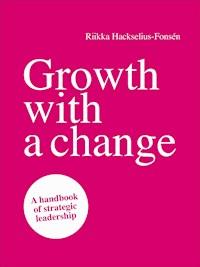
There is a lot of pressure piled on the corporate management of today. Organisations are becoming increasingly diverse and the discussion taking place around management makes it look complicated and challenging. It should not be. Good leadership makes operations clear and simple - and this book aims to guide you towards that. Growth with a change discusses the human contexts and principles related to the environment surrounding strategic leadership. In doing that it creates an idea of the structures that should be considered in good management.
Sie lesen das E-Book in den Legimi-Apps auf:
Seitenzahl: 103
Veröffentlichungsjahr: 2018
Das E-Book (TTS) können Sie hören im Abo „Legimi Premium” in Legimi-Apps auf:
Ähnliche



















Growth with a change
The journey up to this moment has taken hundreds of bold clients and openings made with them, plenty of my own mistakes, and analytical growth as a leader. Time has not changed people’s behaviour as individuals or groups even though the ways and channels of sharing information have changed. This book travels along individuals as leaders and as people who are led, and attempts to build an understanding of why our goals differ from each other or combine in ways that sometimes even surprise us. In November 2017 Riikka Hackselius-Fonsén
Introduction: A change in market thinking
Leading change means changing awareness. Charting the background of different issues and creating new connections are among the most important tools used to shape people’s thinking. Each experience changes the thoughts of a recipient. A person’s ideas may not be based on facts, but rather on the experience of reliable information or the generality of a given subject. This is what I explored in my previous book, Sokaisevat trendit (”Blinding Trends”, 2012).
Managing the way people think is based on building a logic which enables small things to find their natural place as a part of a larger entity. Breaking down large structures must be accompanied by another, even more logical one, which can poimt out a weakness in the earlier way of thinking. This is the foundation on which our western society has largely been built and preserved, from the time of Napoleon to this day.
In this book, we will focus on change management which aims to challenge status quo within the direction of the organization, or to change the structures of the market. We will approach the subject from the perspective of the management of group thinking. Sokaisevat trendit discussed current illusions, while my first book, Visio2025 – Me teemme sen (”Vision2025 – Let’s Do It”, 2010) charted the way new generations’ values and logic challenges the markets. This book, on the other hand, aims to shed light on the mechanisms with which we are able to follow and develop the thinking in our operational environment. In my own work in the field of brand management, I emphasise the clarity of a joint vision. In the core of the company’s activity is the common understanding of the strategy shared across the management, personnel, and clients. The visualization of this culture is often called a brand. Unique operations should be based on the company vision and culture. In this process, communication that reaches the target groups plays an important role. The content of this book runs through the stages and rhythm of change management, introduces the reader to a process of the acceptance of change, and the steps to successful growth during the strategy execution.
The Future is expected
Leadership means painting a picture of future possibilities to stakeholders, and enabling the realisation of this vision. The more people commit to the leader’s idea of the future, the more significant the change will turn out to be. When people commit to a given set of goals, it creates the power that enables to build new logic and change people’s thinking.
What makes change management important?
Our operational environment is in a constant state of flux. If change does not occur in an organised manner and through the leading actors in the field, it happens as a result of the target groups’ thinking development and constant desire for change. Managing the way of thinking is not a negative thing when it remains within the limits set by ethical scrutiny. Most people are willing to be led. It creates a sense of safety.
Without a shared direction created by the community, individuals may build expectations typical to each of them. This may lead to some very conflicting situations, where the internal social hierarchy of the group rises above the goal which ties the community together. The communal sense of togetherness disappears as the pack disperses into smaller groups. Simultaneously, the expectations we have set for the activity are lowered, and scrutiny turns into the mere assessment of technically observable details.
Many of us have certainly observed markets in which product development has not significantly advanced. Functional new products have not entered the market and, instead, the actors in the field have concentrated on perfecting the existing properties of the products. In the meantime, the field has pushed the value of the market into a downward trajectory, and subjected development to price competition. A price competition initiated by one company takes the others down with it. In the end, change is even more difficult when the resources available for product development have disappeared as a result of diminishing margins.
This type of development is a part of the natural lifespan of different industries. It also entails the goals met by anchor companies operating in the field and the maturing of markets. Typically, at this stage, satiating the hunger of the companies that led and built the field provides an excellent opportunity for new challengers. This shows how important it is that an organisation’s hunger and desire to move forward remain among its most important values.
A battle between companies is waged within the organisation in a situation where the shared direction is not clear or ambitious enough. As the activities grow, individuals find it difficult to understand the bigger picture, while responsibilities are concentrated to increasingly small areas.
As the common goal disappears, social consciousness forms at random led by individual ambitions rather than following the common direction. Management has the important task of ensuring that both the clients and personnel constantly recognise their goals and the perpetually challenging need for change without having to spend time collecting new information and possible solutions in order to understand the goals. In this way, they can use all their energy to solve the challenges related to their tasks and to achieve better operations than their competitors.
Building a plan for change
A company’s strategy is its view of the means by which it believes it can achieve the greatest success in the chosen market. It is also always a plan for change, even if it aims to maintain the company’s activities as similar as possible. While the strategy addresses issues that have to be re solved, and also determines the issues on which there is no longer need to spend time or energy.
If you decide to stick with the old, you must be able to justify to yourself and your environment why it is important for the company to resign from the change occurring in the market. In this case, change is based on the strong traditions of the company, while the strategy aims to promote them. However, it is more common that through its strategy the company aims to learn about the change in market’s mechanisms and ways to utilise them ensuring its own operational success.
Adapting takes time
Strategy always addresses change. The starting point for a successful strategy is the view of the timeframe within which the change can occur, and its results become visible. The strategical plans are usually too short-sighted, which results in change being ostensible and the desired benefits not materialised.
Operatively, people can quickly adapt to new situations. For example, the organisational period of 100 days used in change projects and common in most management practices, enables the company to establish new structures, roles and report models during the change process.
However, after 100 days, few people feel like they can rely on the resources of the newly built organisation, or that it will provide additional support to their work. It takes a great deal more time to adapt and to collect experiences of the operational model.
Usually, it takes up to two years of experience to be able to predict the market outcomes, to operate flexibly within the organisation, and to utilise the model offered by the network. This refers to the same schedule, by which the market learns to trust new actors and procedures.
Increasing the amount of knowledge does not change the situation. If you enforce co-operation between the different parties and engage in empirical, activity-based learning, you can affect the internal process required to adapt and commit. Therefore, it is important to train the stakeholders to accept a long-term goal instead of serving several short-term goals. The latter approach allows the market and the organization to exist in a perpetual state of adaptation. It is difficult for the organization to execute a strategy when possible changes are expected within just a few years. In such a case, trust and commitment to the strategy are weak and the direction shown by the management is not fully accepted.
A good long-term strategy that supports the rhythm of the market and the vision attached to it extends to ten, and preferably even fifteen, years into the future. This means that the market can be developed together with personnel and clients without the need for constant re-organisation. Concequently, the desired change projects are planned with an eye on future needs, and their results seem logical to the clients and the personnel. A long-term vision provides an opportunity to lead larger entities, and to navigate on the terms of the changing market.
So why a large portion of companies develops their activities in the timespan of a few years and even considers it beneficial to completely resign from strategic thinking and throw themselves to the mercy of the whims of the market? Discussions with the management of different companies indicate that the top management does not trust its ability to assess the development in the industry any further than a few years ahead. They want to observe how the markets develop and then attempt to react and adapt to them.
Short-term reactions may be easy in a lunch restaurant where a small team makes decisions about the ingredients on a daily basis. They do not have to consider changes in the supply and consequent investments or changes in the production line. But if the company’s activities are even slightly broader, changes always require dozens if not hundreds of decisions across different areas of the operation. It is also probable that the lunch restaurant would find it more profitable in the long-term to specialise and become known for unique and high quality solutions rather than constantly changing its flavours. Quality increases only through practice, so it is clear that an ever-changing model will inevitably lead to inconsistent quality.
Executing change within an organisation requires years of work. After the drafting stage by the management, organising the resulting strategy into operational models shared by the organisation is only the first step towards creating a client experience.The market usually takes two years to accept new ideas. During this time, clients find out about opportunities made available to them by the company’s services, and arrive at a decision.
The role of the leader
Strategic leadership requires the ability to assess the activities of the organisation, create operating methods, make choices and believe in the decisions reached through the process. This is the way to lead by sharing long-term goals, the perspectives behind them, the reasons for using different solutions, as well as engaging environment with organisation’s ideas.
The leader’s inexperience at strategy work can make reaching decisions difficult. Even an experienced CEO is only able to outline, create and implement a few large-scale transformational strategies during their career. This makes it difficult to assess the quality and effectiveness of the process. In the worst-case scenario, the process itself becomes the goal, instead of the content that supports competitiveness or a business plan that can be implemented.
The help can come by using experienced professionals to collect the base material for the strategy work and to implement the process. This allows the management to concentrate their energy on brainstorming critical content, instead of facilitating the process itself. In the meantime, the team receives coaching and an opportunity for blue-sky thinking that can help to crystallise their future strategy.




