


7,19 €
Mehr erfahren.
- Herausgeber: Uniform
- Kategorie: Geisteswissenschaft
- Sprache: Englisch
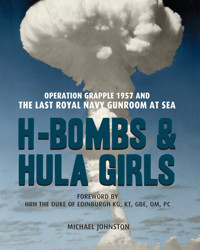
Published to coincide with the 60th anniversay of Britain's first successful thermonuclear bomb testing in the Pacific, H-Bombs and Hula Girls tells the tale of ten young men brought together through National Service in the Royal Navy and taking part in Britain's top secret tests near Christmas Island. They experience at extremely close quarters what the world is told were three megaton H-bomb explosions, going on to show their country's flag in Hawaii, then around the South Pacific, and finally round all of South America. Theirs is the only British warship ever to sail directly from Port Stanley to Puerto Belgrano, mooring next to the Argentine flagship General Belgrano. H-Bombs & Hula Girls evokes the Cold War atmosphere of Britain in the 1950s and the race to secure the nation's place among the thermonuclear powers, but also paints the picture of a heterogeneous group of young men enjoying life-shaping experiences together: learning to be sailors, exploring island paradises, participating in three vast explosions, being their nation's goodwill ambassadors as they encounter completely different cultures, and here and there experiencing life-threatening moments and even having their hearts broken. This fascinating memoir of the last Royal Navy Gunroom at sea, crafted from journals, letters, and contemporary records, plus the wonders of hindsight, culminates in the surprising realisation that Operation Grapple may not have been quite what it seemed.
Das E-Book können Sie in Legimi-Apps oder einer beliebigen App lesen, die das folgende Format unterstützen:
Veröffentlichungsjahr: 2017
Ähnliche




















H-BOMBS & HULA GIRLS
Operation Grapple 1957 and the Last Royal Navy Gunroom at Sea
Written and compiled by Michael Johnston
CONTENTS
Albatross following Warrior through the Magellan Straits (John Hutchinson)
15 MAY 1957
‘Bomb gone!’
In the cloudless sky nine miles above Malden Island, around 300 miles south of the equator, the bomb started its fifty-two second parabolic descent. No ordinary bomb. This was a live hydrogen bomb. The RAF Valiant bomber went into a tight turn to port, the bomb aimer placed the light-tight cover over his sights. The telemetry sender switch was pressed on HMS Narvik and the recording instruments on the island responded.
Within less than a minute, history would be written, and a memory of the moment would be permanently etched in the mind’s eye of all those present – not least the ten young men who made up the National Service members of the Gunroom in HMS Warrior twenty-six miles from Ground Zero. Warrior, a Colossus Class light fleet aircraft carrier, was the lead ship of the Royal Navy squadron forming part of Operation Grapple, Britain’s first ever nuclear fusion test programme. At that same moment a bond would be fused between the ten that has not been broken in nearly sixty years.
On Warrior’s flight deck, and at their watch stations in the several ships of the Grapple Squadron, the crews were already turning their backs on the coming explosion, pulling the white hoods on their anti-flash overalls up and their dark goggles down, closing their eyes, and finally covering the goggles with their gloved hands. From the starboard wing of Warrior’s compass platform, standing beside the Commodore and the Commander, Midshipman Cooper relayed the countdown over the ship’s Tannoy.
‘Thirty seconds … twenty seconds … ten seconds … five seconds, four, three, two, one.’
In every listening radio in the central Pacific came a loud click, caused by the electro-magnetic radiation from the nuclear reaction, and the bomb’s trace on HMS Narvik’s telemetry receiver vanished, leaving only the straight base line. The weapon exploded at 8,000 feet. On the backs of all spectators on Warrior, Narvik, Messina and the other ships of the squadron, came a sudden flash of heat, as though the fire door of a great furnace had momentarily been opened behind them; and despite tightly shut eyes and hands over them, there was a sensation of brilliant light. There are many, indeed, in telling of it afterwards, who can recall seeing an image of the bones in their fingers.
Ten seconds later, permission was given to turn round and gaze with awe at what man had wrought. At this stage, there was still a large orange and red fireball, churning in the sky to the south and steadily rising. A thin pancake of cloud formed above the rapidly greying fireball. Steam and water vapour from ground zero were drawn upwards in a slender cone towards the underside of the vast cloud, creating the iconic mushroom image that twelve years of nuclear fission and fusion explosions had made so very recognisable.
Recognisable or not, surely none of those spectators had actually witnessed such an awesome sight before. Some say they didn’t hear anything, but Sub-Lieutenant Johnston on the flight deck remembers instinctively ducking as the sound wave from the explosion, travelling much slower than the flash of light, caught him unawares. From the compass platform, Cooper, an experienced sailor, saw the air pressure wave radiating out across the surface of the Pacific. Midshipman Riches on the flight deck felt the wind, saw the sea ruffling and heard the sound wave – like prolonged but distant gunfire.
On board Messina, when the ban on private camera use was lifted after two minutes, Midshipman Anson began to shoot what is thought to be the only private ciné film made of the explosion. On all the ships, crews were passing each other their cameras to be photographed standing in front of the cloud pillar and dome. In Warrior’s Ops Room, where the tension during the drop had been palpable, Midshipmen Reed and Hume joined the rush outside to stare and take photographs. Hume recalls the looks of amazement on the faces of everyone. Midshipman Hutchinson, on watch on the compass platform in protective clothing, turned to gaze at the fireball when the all clear was given and felt a deep sense of awe.
Within thirty minutes, a helicopter took off from Warrior, flew to Narvik to pick up the Health Physics team, and made the first, post-nuclear approach to Malden Island, checking the levels of radiation as it approached and descended. Fires were burning on the island and a low dark cloud stretched out some two or three miles down wind. But there was no radiation detected: the instruments had all survived and made their vital measurements.
Britain was now a megaton thermonuclear power and here was the evidence to prove it – or was there?
1956
It would be no exaggeration to say that 1956 was a busy year at any and every level. One year before, in February 1955, the British Government had announced its decision to build the country’s own hydrogen bomb, immensely more powerful than the atom bombs that had ended World War II. At the end of that year, the Pope, in his Christmas broadcast, had spoken of the need to suspend nuclear tests. If Britain had ambitions to possess a fully operational H-bomb, the Government would need to move swiftly so that this could be achieved before world opinion, in the form of a test ban treaty, brought testing, especially atmospheric testing, to an end.
At a geopolitical level, April 1956 saw the much anticipated visit to the UK of the Soviet leaders Bulganin and Khrushchev on board the Soviet’s latest warship, the Ordzhonikidze, which docked at Portsmouth, the Royal Navy’s most important base. At that same moment, several of the future ‘Warriors’ were RNVR Ordinary Seamen doing their fortnight’s training and finding time to exchange their RN cigarettes, known as ‘blue liners’ for the blue line down each cigarette, with their Russian opposite numbers who gladly traded their strange cardboard-and-black-tobacco Russian ones. While on the surface the diplomats, politicians and sailors were all smiles, beneath the surface, literally, less diplomatic events were taking place. A botched CIA/MI6 undersea operation, aiming to explore the then state-of-the-art Ordzhonikidze, ended in the disappearance of MI6 diver Commander Lionel ‘Buster’ Crabb. The body of Crabb, one of several MI6 agents involved in the operation, was never recovered. In 2007, Eduard Koltsov, a retired Russian military diver, said he killed a man he thinks was Crabb, as he was ‘trying to place a mine’ on the Soviet ship.
1956 was also the year of Suez and Hungary, often bracketed together since the British/French/Israeli actions in Egypt were then, and are still now, perceived as a very convenient public relations excuse for the Soviet invasion of Hungary. In Cold War terms, the USA was already a thermonuclear power and had carried out an aerial H-bomb test at Bikini Atoll on 21 May; with the aircraft missing the target site by around four miles, resulting in the loss of all the scientific data that instruments at the target site were set up to collect. In the UK, the DIDO heavy-water enriched uranium nuclear reactor began operation at the British Atomic Weapon Research Establishment (AWRE) at Aldermaston. In October, the Queen opened the world’s first commercial nuclear power station at Calder Hall, a by-product of which was weapons grade plutonium, while the Campaign for Nuclear Disarmament (CND) was in the process of formation, being launched the following year.
Meanwhile, at a national level, Tesco opened its first self-service stores in St Albans and Maldon, while double yellow lines were painted on the road to forbid parking in certain parts of Slough. The Queen Mother’s racehorse Devon Loch was within sight of the winning post in the Grand National, ridden by the so far unpublished author Dick Francis, when it collapsed inexplicably, only fifty yards from the finish. Chancellor of the Exchequer Harold Macmillan introduced Premium Bonds in his Budget speech in April, with the winners to be chosen by ERNIE (the electronic random number indicator equipment). The Minister of Health, R H Turton, rejected a call for a government-led anti-smoking campaign, stating that no ill-effects had yet been proven. Espresso bars were beginning to be opened, mainly in the London area, but the availability at that time of ‘frothy coffee’ at least as far north as the Scottish Borders has been verified. John Osborne’s play opened on 8 May at the Royal Court Theatre to a combination of bafflement, disapproval and critical acclaim. Dodie Smith’s book was published and Third Class railway travel was abolished by the simple expedient of rebranding it as Second Class. Manchester United won the Football League First Division title in April and then went on to win the FA Cup in May.
Lesen Sie weiter in der vollständigen Ausgabe!
Lesen Sie weiter in der vollständigen Ausgabe!
Lesen Sie weiter in der vollständigen Ausgabe!
Lesen Sie weiter in der vollständigen Ausgabe!
Lesen Sie weiter in der vollständigen Ausgabe!
Lesen Sie weiter in der vollständigen Ausgabe!
Lesen Sie weiter in der vollständigen Ausgabe!
Lesen Sie weiter in der vollständigen Ausgabe!
Lesen Sie weiter in der vollständigen Ausgabe!
Lesen Sie weiter in der vollständigen Ausgabe!
Lesen Sie weiter in der vollständigen Ausgabe!
Lesen Sie weiter in der vollständigen Ausgabe!
Lesen Sie weiter in der vollständigen Ausgabe!
Lesen Sie weiter in der vollständigen Ausgabe!
Lesen Sie weiter in der vollständigen Ausgabe!
Lesen Sie weiter in der vollständigen Ausgabe!




