


8,32 €
Mehr erfahren.
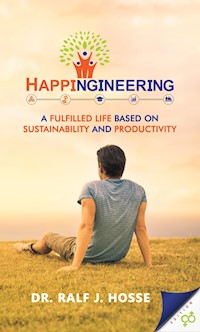
HAPPINGINEERING will draw your attention to what really matters in life. It will remind you of simple things we shouldn't lose sight of. It will be your companion helping you to see a clearer picture of your life, to understand life as a whole, to define where you are and where you want to go. HAPPINGINEERING will raise your awareness of the variety life has to offer and invites you to be a part of it. Life is never perfect. In fact, it's perfectly normal that some things in your life go well and others don't. Likewise, there's no guarantee for happiness. The truth is, however, that there's a lot you can do that chances are pretty good that you will lead a happy, fulfilled, and sustainable life.
Das E-Book können Sie in Legimi-Apps oder einer beliebigen App lesen, die das folgende Format unterstützen:
Seitenzahl: 208
Veröffentlichungsjahr: 2020
Ähnliche



















DR. RALF J. HOSSE
A Fulfilled Life Based On Sustainability And Productivity
Copyright © 2020 Dr. Ralf J. Hosse
www.happingineering.com
Publisher: tredition GmbH, Halenreie 40-44, 22359 Hamburg, Germany
Photography: Cover image used under license from Shutterstock.com Kieferpix Photography / Shutterstock.com
ISBN
Paperback: 978-3-347-01002-4
Hardcover: 978-3-347-01003-1
eBook: 978-3-347-01004-8
Printed on demand in many countries.
All rights reserved. No part of this publication may be reproduced, distributed, or transmitted in any form or by any means, including photocopying, recording, or other electronic or mechanical methods, without the prior written permission of the publisher, except in the case of brief quotations embodied in critical reviews and certain other noncommercial uses permitted by copyright law. For permission requests, write to the publisher.
Trade marks
The trademark HAPPINGINEERING © is a registered trademark belonging to the author; he does not give any permission for the use of this trademark and such use may constitute an infringement of his rights. The third party registered and unregistered trademarks and service marks that feature in this book are the property of their respective owners and, unless stated otherwise in this disclaimer, we do not endorse and are not affiliated with any of the holders of any such rights and as such we cannot grant any licence to exercise such rights.
No advice
The book contains information about 1. social relationships, 2. health and well-being, 3. education, personal, and professional development, 4. finances, and 5. hobbies & leisure. The information, suggestions, or tips of any kind whatsoever contained or expressed in this book are non-personal from the author to you and are not relating to any kind of personal or specific situation you are in; in no case shall these be construed or understood as professional advice. You must not rely on the information in the book as an alternative to medical (including psychological), financial, educational or legal advice from an appropriately qualified professional. If you have any specific questions about any such matter, you shall consult an appropriately qualified professional. You should never delay seeking any of the above advice from a competent professional, disregard such advice, or commence or discontinue any related action because of any information or suggestion in this book.
Limited warranties
Whilst the author endeavours to ensure that the information in this book is correct, he does not warrant or represent its completeness or accuracy. The information contained in this book are - to the best of the author’s knowledge - up to date as of the year of the 1. edition 2020. Where reference is made to third party apps, software, external links to third party websites, or services of any kind, the author does not assume any liability for the content or the use of the same. The author does not warrant or represent that the use of this book will lead to any particular outcome or result. To the maximum extent permitted by applicable law, the author excludes and limits his liability relating to the information provided in this book and the use of this book.
FOR MY BELOVED CHILDREN,LEONARDO & VALENTINA.
ACKNOWLEDGMENTS
Alexandra, Anne, Claudia, Davide, François, Kai, Martina, Michele, Nadine, Nathalie, Sabine, Sandra, Susagna — your valuable feedback and encouragement mean a lot to me!
THANKS HEAPS!
PREFACE
Part 1: GETTING PREPARED
Introduction
#1 A Journey of a Thousand Miles
#2 Be Honest with Yourself: No Excuses!
#3 A Personal Heat-Map: Color-Coded Self-Reflection
#4 A Mission Statement: All Goals at a Glance
#5 Write a Letter to Your Future Self
#6 Optimism: The Key Factor for Success
#7 Build your Success on Solid Ground
#8 Sustainability
#9 The “You” Business
#10 Carpe Diem: Give Your Best Every Single Day
#11 Your Attitude Toward Change
#12 Dealing with Envy
#13 Become Your Best Self as You Age
Part 2A: SOCIAL RELATIONSHIPS
Introduction
#14 Connect Beyond Your Virtual Network
#15 Be Honest and Reliable
#16 Saying Sorry: It’s Never Too Late to Fix Regrets
#17 Find Peace of Mind by Getting Rid of Grudges
#18 Avoid Toxic Relationships
#19 Finish the Day Peacefully
#20 Be a Role Model
#21 Make a Difference for the Better
#22 Use the Power of Modesty
#23 Actively Show Gratitude
#24 Aim for Win-Win Situations
#25 Unplug for Quality Time with Your Family
#26 Manage your Family Appointments Electronically
#27 Leave a Legacy for Once You’re Gone
#28 Understand the Power of Love
#29 What If Today Was My Last?
Part 2B: HEALTH AND WELL-BEING
Introduction
#30 Give Up Victimhood
#31 Rely on Yourself and Your Self-Esteem
#32 Learn How to Say No
#33 Reduce the Complexity in Your Life
#34 Clean Out All the Clutter
#35 Make Yourself Comfortable at Home and at Work
#36 Systematically Eliminate Time and Energy Wasters
#37 Stop Feeling Rushed: Ditch Your Wristwatch
#38 Mindfulness Comes in Many Different Flavors
#39 Use Solitude to Maximize Your Consciousness
#40 The Importance of Having Rituals
#41 Set Nutritional Ground Rules
#42 Make Time for Regular Physical Activity
#43 Use the Stairs, Not the Elevator
#44 Exchange Your Desk Chair for a Gymnastic Ball
#45 Recharge your Batteries
#46 Reward Yourself
#47 Motivation: Have Something to Look Forward to
#48 Enjoy When Everything is on Track
#49 Escape Technology and Go Offline
#50 Escape the City and Immerse in Nature
#51 Accept What Cannot Be Changed
Part 2C: EDUCATION AND DEVELOPMENT
Introduction
#52 Find Your Professional Niche
#53 Maintain Your Work-Life Balance
#54 The Importance of Lifelong Learning
#55 Stay Efficiently Informed
#56 Read It Later: Offline Reading
#57 The Importance of Focused Reading
#58 Write Your Own Summaries
#59 Make the Best of Meetings
#60 Practice Active Listening
#61 Feedback: Request It Today
#62 Strive for International Experience
#63 Beware of Perfectionism
#64 Your Personal Elevator Pitch
#65 See Opportunities in Failures and Setbacks
Part 2D: FINANCIAL SITUATION
Introduction
#66 Spend Less Than You Earn
#67 Save Immediately When You Get Your Paycheck
#68 Manage your Debts
#69 Create a Financial Asset Inventory
#70 Regularly Review Your Financial Commitments
#71 Remember That Less Is More
#72 Plan Ahead to Get Good Value Deals
#73 Make Smart Investments
#74 Wait for the Right Opportunity to Invest
#75 Earn Passive Income
Part 2E: HOBBIES AND LEISURE
Introduction
#76 Let Your Hobbies Balance Your Life
#77 What Did You Enjoy When You Were Young?
#78 Creativity: Discover Your Hidden Talents
#79 Start Learning a Foreign Language Today
#80 Choose to Travel Off the Beaten Track
Part 3: PRODUCTIVITY
Introduction
#81 Be an Early Bird
#82 The To-Do List: Your Constant Companion
#83 Align your Decisions with Your Priorities
#84 No Multitasking: One Task at a Time
#85 Always Know What’s Next
#86 Get It Done Step by Step
#87 Achieve Your Goals by Habits
#88 Continuity and Endurance
#89 Synergy: Combine Your Skills
#90 Innovation and Optimization
#91 Working Smarter, not Harder
#92 Batch Recurring Tasks
#93 Do Yourself a Favor by Outsourcing
#94 Delegate Efficiently
#95 The Purposeful Use of Your Idle Time
#96 Make the Best of Your Commute Time
#97 Dictation: The Goodness of Voice-to-Text
#98 Avoid the Peaks
#99 Allocate Time to Every Task
#100 Develop a Sense of Urgency
CONCLUDING REMARKS
ABOUT THE AUTHOR
PREFACE
Happiness. Happiness means different things to different people. What is it that makes you happy? Have you ever been truly happy? If so what would it take to make you happy (again)? And, now that you’re about to start reading HAPPINGINEERING, are you happy right now? As often our own mind is the worst obstacle between us and happiness, know this: happiness is a choice.
The concept behind this book is pretty simple and much of its content is based on common sense. Nevertheless, even if you will only put a few of the tips in this book into practice — particularly in the areas of your life where there is most room for improvement — you will experience a dramatic increase in the quality of life. Used with an adequate level of commitment and endurance, this book will be your powerful and transformative companion.
Think of life as resting on five pillars: 1. your social relationships, 2. your health and well-being, 3. your education, personal and professional development, 4. your financial situation, and 5. your hobbies & leisure. Life will only be happy, fulfilled, and sustainable, if none of these pillars is being neglected, if all of them are being maintained adequately.
To build and maintain these five pillars, not only do you have to do the right things, you also have to be productive and efficient; otherwise, your time at disposition will hardly ever be enough.
This book contains 100 “handpicked” tips grouped and listed in the order you will need them along the way toward happiness: for getting prepared, i.e., to define where you are right now, where you want to go and to establish the respective attitude (Part 1); for building, improving or maintaining the five pillars of your life (Part 2); and for applying selected productivity tips so you can make it all happen (Part 3).
First, familiarize yourself with the concepts of Part 1 (there’s some homework involved here) and dedicate some undisturbed time to getting a clear picture of yourself and your life. Next, pick a few tips that matter most to you from Part 2, i.e., the ones that may have the most profound positive impact on your life. Start small to eventually turn them into integral habits that feel natural and align with your goals and overall direction in life. Finally, increase your productivity to sustainably maintain your multifaceted lifestyle.
You will be equipped with the mind-set and tools to engineer a happy and fulfilled life based on sustainability and productivity — you will be taught HAPPINGINEERING. It’s an invitation to reflect more on what you do, how you do it, and, to actually DO IT.
PART 1: GETTING PREPARED
Introduction
To establish a basis for a life that is happy, fulfilled, and sustainable, there are five pillars that have to be built and maintained: 1. your social relationships, 2. your health and well-being (physical and mental), 3. your education and personal and professional development, 4. your financial situation, and 5. your hobbies and leisure time.
Before you start building these pillars, you should quietly and honestly look at yourself. You should self-reflect: set aside undisturbed time to assess your thoughts and feelings. Look into the mirror and describe what you see.
Life is always trying to keep you in a “comfortable” routine and keeping you busy with things that in the long run may lead you nowhere. It’s only when you reflect that you are able to review your internal qualities and improve on them. An hour or two of silent assessment can go a long way in giving you that much-needed kick-start to shape the life you want.
Remember that true self-reflection is based on the awareness of your personality, your strengths and weaknesses, your beliefs and thoughts, your motivations and dreams, and, importantly, your emotions. It’s about YOU, so try to avoid assumptions about others. Be aware that situations may actually be different from how they appear to you — they may only be the result of how you perceive them in your current emotional state.
Are you ready for a deep dive into your life, into what you like about it and what you would like to change before you resurface to see a brighter horizon? You are? Great! Then find some time for yourself in a pleasant atmosphere and read on.
#1 A Journey of a Thousand Miles
Chinese philosopher Lao Tzu said, “A journey of a thousand miles begins with a single step.” It is so extremely important to take this first step. Once this is done, of course, it takes discipline, commitment, and endurance to continue this journey. Nevertheless, you have to acknowledge the importance of this very first step and keep the momentum of it: every goal requires that first foot forward.
May reading this book be the first step toward many more first steps that you will take in the five different areas of your life. These steps will be the start to slowly but steadily solidify the five pillars your life rests upon.
From decluttering your apartment to making a call about that job opening to learning a new language, the first step matters. The “right” moment may never come. The “right” mood or circumstance may never appear. Don’t just wait for things to happen.
Most times, self-doubt is the real enemy. Confidence and motivation are solidified by actions. A step in the right direction comes with both. It’s quite alluring to remain in a daydream. But success is for dreamers who act, not for dreamers who fantasize.
We live in a world filled with endless possibilities. But it’s also a world of difficulties and rejections. As adults, we fear failure more than we would like to admit. We dread the thought of exploring strange grounds, of venturing into new businesses, of starting a new relationship, of trying out something new. Because everything seems so daunting, you tend to procrastinate. “It’s impossible,” your subconscious tells you, “and it’s just beyond your control.” Is it really?
Remember that a journey of a thousand miles begins with a single step.
And the truth is that the mind-sets of a doer and that of a day-dreamer are different from each other. Every man and woman on the face of the earth is a bundle of ideas and talents. However, only a small percentage actually act on those ideas and talents. Self-doubt always manages to creep in to dissolve every spark of inspiration.
Know that successful people aren’t necessarily superhuman. They start small and move on to bigger things. Where others see obstacles, they see a learning opportunity.
Want to get fit? Start with few stretches and walks. Want to write that book? Jot down 100 words a day. Just start small and with something simple but keep on going and enjoy the progress you make. A first step here, another first step there, and you will soon own this journey called life.
#2 Be Honest with Yourself: No Excuses!
To get the most out of this book, you have to be honest with yourself and drop all excuses.
It may happen that we lie to others for some reason or the other. Possibly, a lie just seems like the best choice in a sea of bad options.
But to lie to yourself? That’s even worse. It can happen more often than you care to acknowledge. You convince yourself that you are doing the right thing, that you made a wise financial choice, or that everything is fine. When reality proves otherwise, you stick to your guns and refuse to back down.
As human beings, we tend to want to be in the right. We want our actions, beliefs, and attitude to line up together. A rift in these things would make us feel uncomfortable, so we are very quick to justify our actions, right or wrong. But there’s a price to pay for always wanting to be right: you lose plenty of opportunities for personal growth, plenty of opportunities to improve on your outlook of life.
Another reason why we lie to ourselves is that we fear getting hurt. We don’t want to rock the boat, so we make excuses. We turn a blind eye to obvious wrongdoings and say it can’t be as bad as it looks.
We also lie to ourselves because we dread change. We are scared of leaving our current space, no matter how toxic it gets, because we are held down by the power of denial. We keep holding on to false beliefs that clog up space for new opportunities, ideas, or people.
Stuck in a bad relationship or a terrible job? We choose to wallow in denial or make excuses. The excuse that things will get better on their own. The excuse that you can never do better than this. The excuse that you have already invested too much time and energy to just suddenly get up and leave it all behind. The fact remains that the excuses you tell yourself and you make yourself believe can be damaging to your well-being, your life, and other people, in particular the ones close to you to whom you mean a lot.
It’s time to start listening to yourself. Before you justify your behavior, actions, or thoughts, look in deep and know the reason why. Are you being truthful to yourself, or are you covering up the unsavory facts?
Wounds can only be healed by honesty. And honesty requires emotional strength. Find that strength to open up yourself to new possibilities. Stop sugar-coating your problems and burying your head in the sand.
#3 A Personal Heat-Map: Color-Coded Self-Reflection
The concept of a personal heat-map is simple. Assess what matters in your life and assign a color code of three different colors to these categories: green means all is good, yellow means room for improvement, and red means far from being ideal and that you should really do something about it.
A personal heat-map lets you see the bigger picture with more objectivity. It’s basically a status report of you and your life. A visual tool you can use to break down those seemingly complicated aspects of your life into a color-coded assessment showing not only your strengths and weaknesses but also providing a call-to-action. It will facilitate coming up with actionable plans to achieve your goals, improving the neglected areas of your life, and pursuing things that bring fulfillment.
A very suitable format of a personal heat-map is a pie chart with equally sized slices, one for every area of your life, with three segments each from the inside to the outside: the inner segment for red, the middle segment for yellow, and the outer segment for green. As an alternative format, you could also use a simple radar chart in Microsoft Excel and replace the colors by numbers ranging from 1 to 3 or higher if you want more granularity.
All around the outer line of the slices, you can place the various aspects of your life that matter, possibly grouped together according to the 5 pillars mentioned above plus additional ones that come to your mind.
Start by compiling a list of these aspects, then group and arrange them around your pie chart. And while you are keeping everything listed and making room for more, you have to keep it honest and thorough. Consider your relationships (with your partner, friends, and family), health, body, mind, character, fitness, sleep, mindfulness, spiritual life, peace of mind, living conditions, skills, education, career, finances, hobbies, creativity, spontaneity, and productivity. Think about yourself, your major life goals, how you spend your time, and how much fulfillment you’re getting.
The next step will be grading these areas by applying the respective colors to the segments in the slices. If you cannot be totally truthful with your evaluation, ask a trusted family member or friend to help you. Very soon, you will have a pretty complete picture of how things are going in the various areas of your life — all at a glance!
The whole point of a personal heat-map is self-reflection and the assessment of what goes well and what does not. Which parts of your life are flourishing and which have been neglected or need some extra care? To achieve personal growth, you have to step back and assess where you are in life, taking stock of every single aspect of your life, with the focus on who you want to be and where you want to go.
For instance, if the personal heat-map shows that you are overweight (your weight status will carry a red color), start making weight loss plans. Alter your current diet and start eating healthy, get a treadmill or do a 30-minute walk every sunrise. Drink more water. Get a gym membership. Consult a fitness professional. This action plan can be well supported by additional tools and tips in this book, i.e., the mission statement (#4), the to-do list (#82), and achieving goals by habits (#87).
And as you’re carrying out your action plan, keep the personal heat-map updated along the way. As you do this, you will be able to monitor your progress, make necessary adjustments, and keep up your motivation.
Finally, while you’re focusing on improving the “reds” and “yellows” of your personal heat-map, keep an eye on your “greens” — just because they are green (congratulations on that, by the way) does not mean that they do not require maintenance anymore!
#4 A Mission Statement: All Goals at a Glance
Your mission statement serves as a roadmap to where you are going and how you are going to get there. It is a concise list of your goals (whether short- or long-term) and priorities as well as your personal set of core values that guide your day-to-day decision-making.
Your mission statement is also a steady reminder that keeps you in check. A guiding light to your destination. It keeps you in the right frame of mind, as you will be allocating your resources in a way that is consistent with your goals. Although the process might be challenging, developing one is satisfying and illuminating.
A suitable format is a one-pager, as it helps having your mission at a glance and not split up across several pages; for example it can be prepared in Microsoft PowerPoint or with a mind-mapping software. Your goals should be grouped according to which pillar of life they belong to and can be ordered short- to long-term.
It’s necessary to always refresh your mission statement, for example, on a 3-month basis, to keep the progress flowing. With one, you can better manage your time, update your short-term goals and priorities, say no to distractions, and keep your long-term goals in sight.
Building a solid mission statement, at least for the first time, may take a while. You need to commit this time to examining your goals, values, passions, regrets, and limitations. To create one, you need to be introspective, you need to reflect, review, revise, and try to capture your true essence in a concise manner.
Moreover, you need to imagine. Envision your life in two, five, or even ten years from now. For instance, visualize the end of your current career. What achievements, contributions do you wish to have in your field? Do you want to start a sideline that you want to shape and grow over the years?
The key thing about a personal mission statement is that it is personal. It must be unique to you alone, not tailored to a second party’s demands. Your language in writing has to be specific, decisive, and concrete, not watered-down. Use your “I will” and “I want” effectively. Take your action verbs seriously and also personalize your declarations. You can start each statement with “I” to take ownership of its content.
Ultimately, you will come up with a cohesive written piece exemplifying your innermost goals that represent your mission statement.
#5 Write a Letter to Your Future Self
Have you ever considered writing a letter to your future self — a personal note of your resolutions that will be forwarded to you on a future date? This letter will serve as a reminder of your commitments as well as a benchmark you can use to review your progress and adjust your focus.
The perfect time to write this letter is once you have completed your mission statement. Sum up in a letter what currently matters most, put it into an envelope, seal it, address it to yourself, and ask a trusted person to post it three or six months later. There are really no limits on how far you should project your letter. It could go from three months to a few years.
Remember that your letter must state the kind of person you want to be and the goals you want to achieve. And as you’re writing this letter, think about the actions you should take to materialize them in your projected time frame.
Afterward, when you receive your letter down the track, you can evaluate your reality against the resolutions in your letter, then contemplate why that is the case. Apart from being reminded of the commitments you made a while ago, it will also allow you to review your progress and adjust your focus.
Due to changes in priorities and unforeseen circumstances, it’s not unusual for goals to change along the way. Reading your letter shows you how your life trajectory has changed since you wrote it. You are able to pause and reflect on your goals. You are able to take a step back to appreciate your progress or find answers to some of your shortcomings.
There is also the angle of increased self-awareness in the act of opening and reading a self-written letter from the past addressed to yourself. You understand yourself better because you can see how much or how little you have changed.
When you’re stuck in a hard place or you feel like your best days are behind, write a letter to your future self. This exercise alone assists you in getting your mind out of your current state and focuses on a future that is more hopeful. Make the effort to write a letter that is thoughtful and sincere.




